MSCI's acquisition of Burgiss: deal terms, numbers and what came next
 By Jan Suski. I go deep on every review, checking every number against its source and digging up details other coverage misses, a habit from six years of SEO and link building for tech companies. Bylines at Surfer, Brand24, and Senuto. How the scoring works.
· Prefer this source on Google
The numbers MSCI-Burgiss deal, checked 27 August 2026
MSCI paid roughly 12 times Burgiss's revenue for the deal, a full price by Morningstar's own math.
The segment Burgiss now anchors is still a small share of MSCI's total revenue three years later. It grows in the single digits while MSCI's Index segment grows in the double digits.
The deal was never only about Burgiss. It was the second of six private-markets and index acquisitions MSCI has closed since 2020. Four more landed in a single twelve-month stretch through August 2026.
Data vendors, investors and advisers track deals in their market. Send the deal and I'll source a version you own.
MSCI spent $913 million over three years to own one company: Burgiss, the Hoboken, New Jersey data firm that has tracked private-fund cash flows since 1978. The final check, $697 million in cash for the 66% MSCI didn't already hold, closed on October 2, 2023.
That deal turned MSCI from a public-markets index provider with a side interest in private assets into a different kind of company. It now reports "All Other – Private Assets" as its own line on every quarterly earnings release, alongside Index, Analytics, and Sustainability and Climate.
This report works through the MSCI acquisition itself: what MSCI signed on August 14, 2023, what the Burgiss Group dataset covers, and what MSCI's own SEC filings say about the risk attached to it. It also covers what the private assets segment has produced in revenue since, and the five deals MSCI has closed in private markets and index data since Burgiss. None of them happened on its own; MSCI's own earnings calls now name the pattern outright.
Anyone pricing a market-intelligence platform, benchmarking a private equity fund, or trying to work out how much of MSCI's growth now comes from data it didn't build in-house needs the figures below. They're sourced to MSCI's own press releases, its SEC filings and a Morningstar valuation note published the day the deal was announced.
The number that matters most sits in the paragraph above: $697 million for 66% of a company earning $90 million a year at the time. If that price held up is what the rest of this page answers, using three years of segment results as the evidence.
The acquisition of Burgiss: deal terms and timeline
MSCI announced a definitive agreement to acquire the remaining 66% of The Burgiss Group, LLC on August 14, 2023, for $697 million in cash. MSCI had held a minority stake since January 2020; the new payment brought its aggregate spend on Burgiss to $913 million for 100% of the company.
MSCI said it would fund the purchase from existing liquidity, without new debt or equity issuance.
The deal carried the standard conditions for a transaction this size: regulatory approvals and customary closing conditions, with a target close in the fourth quarter of 2023.
MSCI hit that window with room to spare, completing the acquisition on October 2, 2023, seven weeks after signing. Davis Polk & Wardwell LLP acted as MSCI's legal adviser, with partner William J. Chudd and associate Joshua B. Pittell on the corporate team, Michael Mollerus, Liang Zhang and Michelle Zhao on tax, and Travis Triano on executive compensation.
Burgiss's results now sit inside MSCI's "All Other – Private Assets" reportable segment. That's the line MSCI created to hold the businesses that don't fit its Index, Analytics, Sustainability and Climate segments. At signing, MSCI projected Burgiss would generate over $90 million in 2023 revenue, with an EBITDA margin and operating income margin in the mid-teens.
What Burgiss Group brought MSCI
Burgiss is a provider of data, analytics and technology solutions for private-asset investors. It carries more than 35 years of alternative-investment history, with research-quality performance records dating back to 1978. The Burgiss dataset covers over 13,000 private-asset funds worldwide, representing $15 trillion in cumulative investments.
That coverage spans private equity, private real estate, private debt, infrastructure and natural resources, spread across 195 countries. Around 1,000 clients, split between limited partners, general partners and financial intermediaries, use the data across 40 countries, and the firm employed 650-plus people across the U.S., Europe, Asia Pacific and South Africa at the time of the deal.
The acquisition also brought MSCI the Burgiss Caissa Platform, a multi-asset technology tool built for institutional investors. It gives a single view of performance and risk drivers across public and private portfolios together. That's the piece MSCI leans on hardest today. Three of its four current Private Capital Solutions products, Total Plan Manager, Private Capital Transparency Data and Private Capital Intel, trace back to the Caissa infrastructure.
Burgiss's private-asset reach paired with a private real estate business MSCI already owned. MSCI had acquired Real Capital Analytics (RCA) in September 2021. By the time the Burgiss deal was announced, RCA gave MSCI private real estate data covering over one million properties and more than $45 trillion in transactions and portfolio assets across 170-plus countries. That's the same real estate business now ranked fourth in our real estate data providers ranking.
Burgiss filled in the private equity, private debt and infrastructure classes RCA didn't cover. MSCI now had, in two companies bought two years apart, data across every major private-asset class.
Why MSCI wanted private capital and private credit leadership
MSCI's own explanation for the deal, in the words of Chairman and CEO Henry Fernandez, was blunt about the ambition:
"The acquisition of Burgiss marks a transformational milestone for MSCI and reinforces our commitment to driving innovation and transparency across the global private asset investment landscape. By combining Burgiss' comprehensive private asset data and analytics with MSCI's expertise in research, analytics, data and technology for investments across public asset classes, we are aiming to redefine total portfolio investing and build solutions that can help investors manage their complex portfolios and make better informed decisions."
Burgiss founder and CEO Jim Kocis framed the deal from the other side. He called it an exit that kept the business intact, without folding it into a larger platform and stripping it for parts:
"The combination with MSCI marks a significant landmark event in Burgiss' journey. In this next phase, our combined capabilities are poised to create even more powerful solutions that can help better navigate and drive innovation across private assets."
Behind both quotes sits the plain business case MSCI has made for every private-asset deal since. The 2023 announcement put it this way:
"The acquisition of Burgiss will provide MSCI with comprehensive data and deep expertise in all private assets, enabling investors to evaluate fundamental information, measure and compare performance, understand exposures, manage risk, and conduct robust analytics."
MSCI's standing description of itself, unchanged across the Burgiss, First Street, Vantager and Compass releases, makes the same case in one sentence:
"MSCI is a leading provider of critical decision support tools and services for the global investment community. With over 50 years of expertise in research, data, and technology, we power better investment decisions by enabling clients to understand and analyze key drivers of risk and return and confidently build more effective portfolios."
That's the sentence every acquisition on this page maps back to. Private equity, private credit and private real estate are the asset classes where MSCI had the least first-party data before 2020. Buying Burgiss, RCA and the smaller deals that followed closed that gap one asset class at a time.
Alongside the equity index and ESG ratings businesses MSCI already ran, that gap-closing explains where MSCI stands today. It ranks in our own financial data providers ranking against peers like FactSet, Bloomberg and LSEG.
"Total portfolio investing," the phrase Fernandez used at signing, names the specific product idea behind the deal. Before Burgiss, an investor holding both public equities and a private-equity fund had to pull risk and performance data from two vendors that didn't talk to each other. Reconciling the two meant doing it by hand.
Caissa, the platform Burgiss brought with it, was built to sit under both holdings at once. That's the reason MSCI's Total Plan Manager product exists in its current form.
Was $697 million a full price? Morningstar's read
Morningstar equity analyst Rajiv Bhatia published a note the day the deal was announced, and it didn't hedge on the price:
"Burgiss is expected to generate $90 million of revenue in 2023 and with midteens adjusted EBITDA margin, which suggests a valuation of about 12 times revenue and over 70 times adjusted EBITDA. While we acknowledge these multiples are high, Burgiss is a fast grower and the firm's midteens adjusted EBITDA margins have significant room to grow, in our view."
The arithmetic behind that read: $697 million for 66% implies a total enterprise value close to $1.06 billion. Against Burgiss's projected $90 million in 2023 revenue, that's just under 12 times revenue, matching Morningstar's figure exactly.
On a midteens EBITDA margin, that same $90 million in revenue produces adjusted EBITDA somewhere between roughly $13.5 million and $15.3 million. That puts the EBITDA multiple in the high-60s to low-80s range, the figure Morningstar rounded to "over 70 times."
Bhatia kept Morningstar's wide-moat rating and $440 fair value estimate on MSCI stock unchanged after the announcement. It didn't change his read of the company, even at that price.
His note pointed to two reasons the multiple made sense anyway. Burgiss's management had guided to accelerating growth toward 20%, partly from cross-selling into MSCI's existing index, analytics and ESG client base. Burgiss's client roster also overlapped with MSCI's own.
He also flagged the one real mismatch in the deal: Burgiss's business ran heavily U.S.-centric against a MSCI client base that's global. The growth case depended on MSCI selling Burgiss data into markets Burgiss itself hadn't reached before the deal closed.
What MSCI's SEC filings disclose about the deal
Every MSCI press release tied to the Burgiss acquisition carries the same forward-looking-statements paragraph, required under the Private Securities Litigation Reform Act of 1995. So does every release MSCI has issued for a deal since. It's boilerplate, not a Burgiss-specific warning, but it's worth reading once because it's the language MSCI attaches to every claim it makes about a deal's prospects:
"These forward-looking statements relate to future events or to future financial performance and involve known and unknown risks, uncertainties and other factors that may cause our actual results, levels of activity, performance or achievements to be materially different from any future results, levels of activity, performance or achievements expressed or implied by these statements. In some cases, you can identify forward-looking statements by the use of words such as 'may,' 'could,' 'expect,' 'intend,' 'plan,' 'seek,' 'anticipate,' 'believe,' 'estimate,' 'predict,' 'potential' or 'continue,' or the negative of these terms or other comparable terminology. You should not place undue reliance on forward-looking statements ... Other factors that could materially affect actual results, levels of activity, performance or achievements can be found in MSCI's Annual Report on Form 10-K for the fiscal year ended December 31, 2022 filed with the Securities and Exchange Commission ("SEC") on February 10, 2023 and in quarterly reports on Form 10-Q and current reports on Form 8-K filed or furnished with the SEC. If any of these risks or uncertainties materialize, or if MSCI's underlying assumptions prove to be incorrect, actual results may vary significantly from what MSCI projected. ... [This statement] is subject to these and other risks, uncertainties and assumptions relating to MSCI's operations, results of operations, growth strategy and liquidity. MSCI assumes no obligation to publicly update or revise these forward-looking statements for any reason."
MSCI's later deal announcements trimmed that paragraph down. The First Street release in 2026 compressed the same warning to one line. It reads: forward-looking statements "involve risks that may cause actual results or performance to differ materially, and you should not place undue reliance on them." Shorter disclosure, same legal purpose.
MSCI's SEC disclosures also define how Burgiss's own numbers get measured. Because Burgiss's financial results were unaudited and non-GAAP at the point of announcement, MSCI specified the exact formula behind the EBITDA margin figure it quoted.
That formula: net income before (1) provision for income taxes and (2) other expense (income), net. Then add back (3) depreciation and amortization of property, equipment and leasehold improvements, and (4) amortization of intangible assets. It's the standard MSCI applies across its deal announcements. It isn't a one-off adjustment built to flatter Burgiss.
MSCI's own quarterly filing with the SEC carries the segment detail behind it. SEC EDGAR is a free source our guide to market intelligence data covers alongside the paid ones.
Reading the filing correctly matters more than reading it at all. The SEC-filed language is the same paragraph MSCI runs under every deal it announces, priced high or low.
What's worth checking against risk is in MSCI's next few quarters of segment revenue, covered below.
How the private assets segment has performed since
MSCI's quarterly results give a running scorecard for the Burgiss bet, and by the first half of 2026 the pattern was consistent. All Other – Private Assets operating revenue reached $72.6 million in the first quarter of 2026, up 7.9% year over year with 5.3% organic growth.
Revenue for the segment then hit $74.7 million in the second quarter, up 4.9% with 4.4% organic growth. Six-month revenue landed at $147.3 million, up 6.4% against the first half of 2025.
The forward-looking number is the Run Rate, MSCI's measure of annualized subscription revenue already locked in under contract. It stood at $302.6 million as of June 30, 2026, up 8.0% year over year.
MSCI credited the $22.3 million increase mainly to Private Capital Solutions, the Burgiss-descended product line built around Total Plan Manager, Private Capital Transparency Data and Private Capital Intel. Growth there spread across regions and concentrated in the asset owner client segment.
Set against MSCI's total company results, the segment's growth reads as steady. MSCI's total operating revenue hit $867.0 million in the second quarter of 2026, up 12.2%, and $1,717.8 million for the first half, up 13.1%.
The Index segment alone grew 17.5% in the quarter on the back of higher asset-based fees. Private Assets, at $74.7 million, made up around 8.6% of quarterly revenue and grew at roughly a third of the Index segment's pace.
Burgiss settled into MSCI's business as a steady, durable performer. Growth was never the story here. It's a segment with an 8% run-rate growth rate three years after the deal closed, built on subscription products that didn't exist inside Burgiss before MSCI owned it.
MSCI's private-markets and index acquisitions since Burgiss
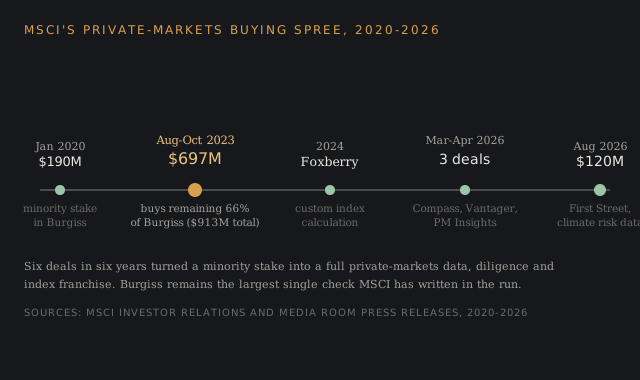
Burgiss is the largest single deal in a run that MSCI has kept up on both sides of the private-markets business. MSCI has bought data and platforms for the pre-investment and index sides of the data business it built around Burgiss and RCA. Our Adobe-Semrush acquisition report tracks the same kind of deal in a different category.
Copy these lines into an email, fill them in and send. I reply with scope and a price within 2 to 3 business days.
Open the email| Deal | Date | What it does | Segment |
|---|---|---|---|
| Real Capital Analytics (RCA) | Sep 2021 | Private real estate data: 1M+ properties, $45T+ in transactions | Private Assets (precursor) |
| Burgiss (remaining 66%) | Oct 2023, $697M | Private-asset data, analytics and the Caissa multi-asset platform | All Other – Private Assets |
| Foxberry | 2024 | Custom index calculation, precursor to Compass | Index |
| Compass Financial Technologies | Mar 2026 | Multi-asset and alternative index calculation, incl. commodities and crypto | Index |
| Vantager | Mar 2026 | AI-native pre-investment diligence for GP data rooms | All Other – Private Assets |
| PM Insights (ApeVue) | Apr 2026 | Secondary-market pricing for private companies, $5.5T+ equity value covered | Index |
| First Street | Aug 2026, $120M | Physical climate-risk data across 2.4B+ structures | Sustainability and Climate |
Only Burgiss and First Street carry public price tags. MSCI said the financial impact of PM Insights, Vantager and Compass wasn't expected to be material to its results. That's corporate shorthand for a deal small enough not to move the segment.
Foxberry, the smallest and least-documented deal in the table, matters mainly as setup. MSCI's own Compass announcement in March 2026 described Compass as complementing "MSCI's acquisition of Foxberry in 2024." Together, the two deals gave MSCI the ability to calculate complex, customized cross-asset indexes spanning equities, fixed income, commodities, digital assets, currencies and derivatives in one governance framework.
MSCI's Head of Index, Jana Haines, framed the Compass deal as continuity. "Compass has been a trusted partner for MSCI," she said, and the acquisition "secures the long-term continuity of MSCI indexes calculated by Compass."
Compass CEO Guillaume Le Fur put the eight years the two firms worked together before the deal in similar terms. He described an "innovation-driven index calculation platform" moving inside MSCI's own governance and operations.
Vantager feeds directly back into the Burgiss-descended product line. MSCI's Head of Private Assets, Luke Flemmer, described due diligence as "one of the most time consuming and fragmented stages of private markets investing." Vantager co-founder and CEO Mason Lender said the company was founded "to help LPs bring speed, structure, and scale to private markets diligence."
Vantager's AI-based document extraction is now MSCI's answer for that pre-investment stage, ahead of Total Plan Manager taking over post-investment. PM Insights plays a similar connective role on pricing. CEO Nick Fusco said joining MSCI gave the firm a chance "to shape a more transparent ecosystem built on robust, market-driven data."
Flemmer described the PM Insights deal as filling a specific gap too. He said: "we are bringing objective secondary market pricing, liquidity and reference data to our clients to support more robust portfolio construction and the development of indexes and analytics solutions."
PM Insights aggregates proprietary data from a network of institutional broker-dealers and bank secondary desks. It covers secondary-market activity for private companies representing an estimated $5.5 trillion in equity market value as of April 2026. That's the kind of coverage our alternative data providers ranking tracks across the category. Its results sit inside MSCI's Index segment, alongside Compass and Foxberry, separate from Private Assets.
The First Street deal took MSCI outside private markets entirely and into physical climate-risk data, covering over 2.4 billion structures worldwide. MSCI announced the acquisition on June 24, 2026, and completed it on August 3, 2026. That's a six-week turnaround, close to the seven weeks Burgiss took in 2023.
Richard Mattison is MSCI's Head of Sustainability and Climate. He said the acquisition was about "strengthening our physical climate risk capabilities to enable clients to better understand how their risk exposures are evolving."
What MSCI's private asset business covers today
Three years after the deal closed, MSCI's Private Asset Solutions business, as described on its own product page, spans $17.3 trillion in private investments as of January 2026 and 29,500 funds and funds of funds as of April 2026. It also covers 616,000 underlying investments and $59.24 trillion in capital markets transactions.
MSCI's Private Asset Solutions business now spans $17.3 trillion in private investments and 29,500 funds and funds of funds.
Private investments covered by MSCI Private Asset Solutions, January 2026
Source: MSCIe.g. what your rival bought and what it now covers
Source: linked, checked, datedThe product line built on top of that data now includes Private i, the platform MSCI markets as its core private-markets tool. It also includes Total Plan Manager, for integrated public and private portfolio analytics.
Alongside those sit GP Solutions for fund managers reporting to their own investors, Private Credit Solutions, Private Capital Transparency, and an AI for Private Markets toolkit. There's also a Diligence Platform built on the Vantager acquisition, and PACS, MSCI's classification standard for comparing private assets against the same rigor public-market indexes already apply.
That list didn't exist under the Burgiss name before the acquisition. Burgiss brought the underlying dataset and the Caissa platform. The rest is MSCI product development layered on top over three years, plus the Vantager and PM Insights data folded in during 2026.
MSCI markets the business to asset owners, general partners, banks, real estate owners, asset managers and wealth managers alike. It groups what it sells around six capabilities on the same product page: asset allocation, manager monitoring, benchmarking, climate assessment, AI-powered due diligence, and total portfolio integration. The last of those connects public and private data for one combined view of risk and construction.
Four of those six barely existed as MSCI products before Burgiss. The dataset gave MSCI something to allocate, monitor and benchmark against, and Vantager gave it the diligence layer in 2026.
The gap between what Burgiss was in October 2023 and what MSCI's private-asset business is now is the clearest evidence of change. The deal reshaped both MSCI's product roadmap and its revenue line.
What the academic record shows about the Burgiss dataset
Since 2010, MSCI data, tracing back to the pre-acquisition Burgiss dataset, has supported more than 95 academic papers written by over 140 researchers across 60 universities. Those universities include the University of Chicago, Oxford, Duke, Stanford and the National Bureau of Economic Research, according to MSCI Institute's own review of the research.
That review, published in October 2025, credits the dataset's construction for the research it enabled. The data comes from limited partners directly. General partners don't self-report it. That gives researchers a record of fund cash flows and valuations without the survivorship bias that self-reported data carries.
The findings researchers have pulled from it give a picture of where private markets deliver for investors, and where the returns are thinner than the marketing suggests. The same review put the private-markets total at more than $12 trillion in assets as of 2024.
A 2024 study used data on more than 5,000 American funds from 1987 to 2022. It found buyouts delivered a statistically significant annual alpha of around 2.5%, with venture capital showing higher potential returns and more volatility. Real estate funds produced alpha too small to call meaningful, once illiquidity and concentration risk are priced in.
Private credit research from the same window tells a related story. A separate 2024 paper analyzed more than 500 funds raised between 1992 and 2015. It found that private credit investors were compensated fairly for the risk they took on. That holds even as private credit has become the fastest-growing segment of private capital.
The Small Business Investment Company program gets its own paper. SBIC funds delivered an average net internal rate of return of 16.9%, outperforming comparable non-SBIC peers even after adjusting for risk. That's evidence public policy capital in private markets can pay for itself.
Manager skill is the fourth thread. A 2023 study of nearly 2,400 funds across three decades found that persistence in returns, meaning top managers staying on top, remains strong in venture capital. It has weakened in buyouts since 2000, when investors started relying on interim performance data at fundraising, before final results were available.
A related paper on the same theme found that even well-timed commitment strategies deliver limited benefit, once real institutional-investing constraints are factored in. That leaves diversification and manager selection as more reliable levers than trying to time entries and exits.
Innovation and credit risk get a fifth paper. It combines MSCI's venture data with corporate bond and patent datasets. The paper finds that industries with high venture investment and IPO activity tend to see elevated corporate default rates in the years that follow. That's a sign disruption benefits founders and venture investors, while raising risk for the incumbents and creditors on the other side of it.
One more study applied natural language processing to millions of news articles to build a private-equity tracking index. It correlates with actual fund benchmarks at close to 90%, a liquid proxy for an asset class that otherwise offers none.
Delivered for your site and your byline. Hosting here is optional.
Frequently asked questions
What is Burgiss?
Burgiss, formally The Burgiss Group, LLC, is a Hoboken, New Jersey-based provider of data, analytics and software for investors in private assets, with research-quality performance data dating back to 1978. MSCI acquired the company in two stages: a minority stake in January 2020, and the remaining 66% for $697 million in October 2023.
Is Burgiss owned by MSCI?
Yes. MSCI completed its acquisition of the remaining 66% of The Burgiss Group, LLC on October 2, 2023, giving it full ownership. Burgiss's results are now reported inside MSCI's All Other – Private Assets segment.
What is Burgiss' benchmark for private equity?
Burgiss data underpins performance benchmarks used across the private-equity industry to compare fund returns against peers, delivered today through MSCI's Private i and Private Capital Intel products. Academic researchers, including the Private Equity Research Consortium, have used the same underlying dataset, sourced directly from limited partners, to study private-market performance since 2010.
Who owns MSCI?
MSCI Inc. is a publicly traded company on the NYSE under the ticker MSCI. Morgan Stanley took MSCI public in a 2007 IPO and held a majority economic interest at the time, but sold down its stake in stages over the following years and holds no MSCI shares today. MSCI's largest shareholders now include BlackRock, The Capital Group Companies and State Street Corporation.
Is MSCI still owned by Morgan Stanley?
No. Morgan Stanley spun MSCI out through an IPO in November 2007 and reduced its stake in stages, including a secondary offering in 2008 that took its holding down to around 53%. Morgan Stanley has since exited its MSCI position entirely, and MSCI operates as an independent public company.
When did MSCI acquire RCA?
MSCI acquired Real Capital Analytics, its private real estate data business, in September 2021, two years before the Burgiss deal closed. RCA gave MSCI private real estate coverage across more than one million properties and $45 trillion-plus in transactions before Burgiss added private equity, private debt and infrastructure data on top.
What does MSCI stand for?
MSCI began as Morgan Stanley Capital International, the index business Morgan Stanley built before spinning it out as an independent public company in 2007. MSCI has operated under the initialism alone since the spinoff, without using the full original name in its own branding.
Bottom line
By Morningstar's math on announcement day, MSCI paid roughly 12 times Burgiss's revenue, a full price. Three years of segment results confirm that read.
The All Other – Private Assets segment isn't MSCI's fastest-growing line; Index still outpaces it by a wide margin. By 2026, it's a business generating close to $300 million in annualized run-rate revenue on products that didn't exist under the Burgiss name before MSCI owned it. That revenue sits on a dataset with more than a decade of academic use behind it.
The Burgiss deal also set a pattern MSCI hasn't broken since. Buy the data and platform businesses that close a gap in one asset class, fold the results into the segment that already fits, and keep going. Six deals in six years, from a $190 million minority stake to a $120 million climate-risk acquisition in August 2026, add up to the fuller answer. That's what this MSCI acquisition turned out to be.
Burgiss was the biggest single purchase in that run. It wasn't the last one, and on MSCI's own record, it won't be.
Data vendors, investors and M&A advisers use reports like this one in board packs and client notes.
A report on your topic for a blog page, gated content or a lead magnet.
Written for your client and published under their brand, with my name left off.
Your report on marketintelligencetools.com, with 2 to 3 CTAs carrying your sponsored links.
Default terms: the report is yours to publish, and I keep the right to republish it on this site behind a gate, outside Google's index.
Sources, and what MSCI hasn't disclosed
Deal terms, dates and quotes are MSCI's own. They come from its August 2023 and October 2023 Burgiss press releases, its June and August 2026 First Street releases, and its March and April 2026 Compass, Vantager and PM Insights releases, all on ir.msci.com and msci.com/discover-msci/media-room.
The SEC filing referenced is MSCI's Form 10-Q for the quarter ended March 31, 2024, filed with the Securities and Exchange Commission and read on sec.gov. Segment revenue figures are from MSCI's Q1 and Q2 2026 earnings releases.
The valuation read is Morningstar equity analyst Rajiv Bhatia's note published 14 August 2023. Burgiss's dataset scale and academic use are from MSCI's own Private Asset Solutions product page and MSCI Institute's October 2025 research review. Davis Polk & Wardwell's deal team is from its own experience page. All URLs accessed 27 August 2026.
MSCI has not disclosed purchase prices for Foxberry, Compass, Vantager or PM Insights. It also hasn't broken out how much of the All Other – Private Assets segment's growth comes from Burgiss specifically, versus the products layered on top of it since.