Black Friday statistics show $11.8 billion spent online in 2025 and 202.9 million shoppers
 By Jan Suski. I go deep on every review, checking every number against its source and digging up details other coverage misses, a habit from six years of SEO and link building for tech companies. Bylines at Surfer, Brand24, and Senuto. How the scoring works.
The numbers US and global Black Friday sales, checked 4 October 2026
Black Friday online sales grew 9.1% against 7.1% for Cyber Monday, the second year running that Black Friday grew faster.
Mastercard SpendingPulse measured ecommerce sales up 10.4% on Black Friday 2025 and in-store sales up 1.7%.
NRF counted 80.3 million in-store and 85.7 million online Black Friday shoppers, slightly below 2024, while Saturday and Sunday drew more people.
US shoppers spent $11.8 billion online on Black Friday 2025, up 9.1% on 2024, Adobe Analytics reported on December 2. Cyber Monday stayed the biggest online day at $14.25 billion, and a record 202.9 million people shopped over the Thanksgiving holiday weekend, per the National Retail Federation and Prosper Insights & Analytics.
Adobe's 2026 forecast, released September 28, puts Black Friday on November 27 at $12.9 billion online, up 9.2%, and Cyber Monday on November 30 at $15.1 billion.
These Black Friday statistics cover the 2025 holiday shopping season, the 2026 outlook from six forecasters, discounts, mobile, AI tools, the Black Friday trends behind them and the reasons the houses publish different numbers for the same weekend.
The report is written for retail analysts, ecommerce managers, marketers and small-business owners setting budgets and planning Black Friday deals for November 27, 2026. The numbers matter because the five days from Thanksgiving carried $44.2 billion of US online spend in 2025, 17% of the season's $257.8 billion.
Black Friday 2025 sales: $11.8 billion online, up 9.1%
Adobe builds its count from direct transactions across more than 1 trillion visits to US retail sites, 100 million SKUs and 18 product categories, and the majority of the top 100 US online retailers run its analytics. That count put Black Friday sales at $11.8 billion on November 28, 2025.
| Day | Date | US online spend | Change vs 2024 |
|---|---|---|---|
| Thanksgiving Day | Nov 27, 2025 | $6.4B | +5.3% |
| Black Friday | Nov 28, 2025 | $11.8B | +9.1% |
| Saturday and Sunday | Nov 29 to 30, 2025 | $11.8B | +8.7% |
| Cyber Monday | Dec 1, 2025 | $14.25B | +7.1% |
| Cyber Week total | Nov 27 to Dec 1, 2025 | $44.2B | +7.7% |
Source: Adobe Analytics recap, December 2, 2025.
Growth on Black Friday and Cyber Monday split the same way for the second holiday season in a row, with Black Friday ahead. In 2024 Black Friday rose 10.2% against 7.3% for the Monday, per Adobe's 2024 recap, and Adobe credits shoppers acting on early deals.
Cyber Monday sales still set the one-day record. Shoppers spent $16 million a minute between 8 p.m. and 10 p.m., and the $14.25 billion total beat Adobe's own $14.2 billion projection. Salesforce calls Cyber Week the year's most important purchasing window, and in Adobe's data that biggest shopping event took 17% of the season.
Across the full holiday season from November 1 to December 31, US consumers spent $257.8 billion on online shopping, up 6.8%, per Adobe's January 7 season recap. Twenty-five days topped $4 billion each, against 18 days in 2024. The retail industry statistics report puts those figures in the context of the full retail year.
Black Friday statistics by year: online spending up 31% since 2020
Black Friday spending online rose from $9.0 billion in 2020 to $11.8 billion in 2025, a 31% gain. The one dip came in 2021, when shoppers spent $8.9 billion, down 1.3%, per Adobe's 2021 holiday report. Adobe tied that year to October deals and supply chain worries that spread spending across October and November.
| Year | Black Friday | Cyber Monday | Cyber Week |
|---|---|---|---|
| 2020 | $9.0B | $10.8B | n/a |
| 2021 | $8.9B | $10.7B | $33.9B |
| 2022 | $9.12B | $11.3B | $35.3B |
| 2023 | $9.8B | $12.4B | $38.0B |
| 2024 | $10.8B | $13.3B | $41.1B |
| 2025 | $11.8B | $14.25B | $44.2B |
| 2026 forecast | $12.9B | $15.1B | $47.5B |
US online spend. Sources: Adobe Analytics releases for 2022, 2023, 2024, 2025 and the 2026 forecast.
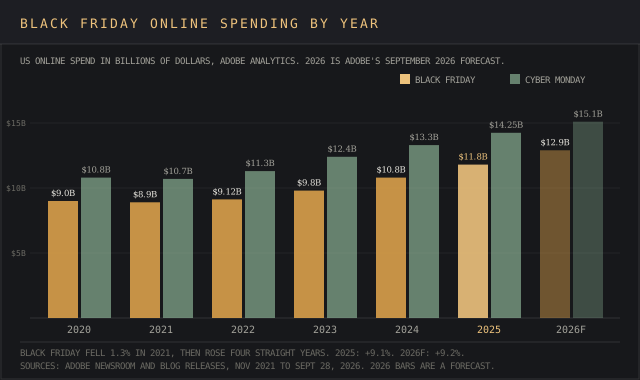
Cyber Week grew from $35.3 billion in 2022 to $44.2 billion in 2025. Black Friday sales have risen every year since 2021.
Black Friday shoppers: 202.9 million over Thanksgiving weekend
NRF's Black Friday statistics come from a survey of 3,099 adults, run November 26 to 30, which counted 202.9 million people shopping over the five days from Thanksgiving Day, 2025. That beat 197 million in 2024 and the previous record of 200.4 million from 2023, and NRF had expected 186.9 million. The margin of error is plus or minus 1.8 percentage points.
- Black Friday shopping drew 80.3 million people to stores and 85.7 million online, against 81.7 million and 87.3 million in 2024.
- Saturday: 62.7 million store shoppers and 63 million online, up from 53.9 million online a year earlier.
- Sunday: a record 32.6 million in-store shoppers, up 27% from 25.6 million, and 38.7 million online.
- Cyber Monday: 75.9 million online shoppers, up from 64.4 million, with 46.9 million of them using mobile devices to shop online.
Across the five days, 129.5 million people chose in-store shopping (+3%) and 134.9 million chose to shop online (+9%). Supermarkets (47%) and online (45%) were the top destinations, followed by department stores (40%), clothing stores (37%) and discount stores (30%).
Average spending per shopper over the weekend reached $337.86 on holiday items, up from $315.56 and the highest figure since $361.90 in 2019. Gifts took about 67%, or $225.74. The early bird catches the worm in this data, as 84% of consumers had started their holiday shopping by Thanksgiving weekend and still had 53% of it left.
Why the published Black Friday figures diverge
Six houses published Black Friday sales numbers for 2025, and their headline figures run from $11.8 billion to $79 billion. The devil's in the details, since each one counts a different geography, channel, time window and data panel.
| Publisher | What it measures | Data behind it | Black Friday 2025 figure |
|---|---|---|---|
| Adobe Analytics | US online spending | Direct transactions, 1 trillion+ visits to US retail sites | $11.8B, +9.1% |
| Salesforce | Global and US sales, extrapolated to the industry | Activity of 1.5 billion+ shoppers in 89+ countries | $79B global (+6%), $18B US (+3%) |
| Shopify | Its merchants' gross merchandise volume, online and offline, Friday to Monday | Shopify merchants worldwide | $14.6B for the four days, +27% |
| Mastercard SpendingPulse | US sales at retailers excluding autos, all payment types, not inflation adjusted | Aggregated, anonymized Mastercard data | +4.1% (online +10.4%, stores +1.7%) |
| NRF and Prosper | People who shopped over the five-day Thanksgiving weekend | Survey of 3,099 adults | 80.3M at stores, 85.7M online |
| Bank of America Institute | Card spending per household | Bank of America credit and debit cards | November spending +1.3% |
- Channel: Adobe counts online spend only, and Salesforce's Black Friday sales figure includes stores, where Black Friday took 31% of Cyber Week's in-store sales.
- Geography: Salesforce and Shopify report worldwide totals, while Adobe, Mastercard and NRF report the US.
- Window: Shopify's $14.6 billion covers four days of sales, Adobe's Cyber Week five, and NRF counts people across five days.
- Panel: Salesforce extrapolates its platforms' data to the industry, Shopify reports only its own merchants, and NRF's people counts come from a survey.
- Prices: Mastercard says its figures aren't adjusted for inflation, and Adobe's aren't either.
Read between the lines and the two houses that split channels agree, with Mastercard measuring online sales up 10.4% against 1.7% in stores and NRF counting people shopping online up 9% against 3% in stores. At Cyber Monday scale the gap between houses is small, with Adobe at $14.25 billion of US online spend and Salesforce at $13.6 billion, up 6%.
Bank of America's December 2025 Consumer Checkpoint found holiday spending strong in October and November, then slower around Black Friday and Cyber Monday, a sign some shoppers started early. The ecommerce analytics tools and retail analytics tools rankings cover the software retailers use to measure their own weekend.
Black Friday mobile shopping: 56.4% of online holiday sales in 2025
Mobile devices drove 56.4% of online spending in the 2025 holiday season, up from 54.5% in 2024, per Adobe. On Cyber Monday, 57.5% of sales came through mobile phones, worth $8.2 billion, against 41.4% in 2020.
Salesforce's Black Friday mobile picture runs higher, and it counts orders where Adobe counts dollars. Mobile devices drove 70% of online orders worldwide and in the US over Cyber Week, and mobile wallets paid for 27% of global orders and 29% of US orders.
Buy Now Pay Later carried $20 billion of online holiday spend in 2025, up 9.8%, and mobile phones handled 82.2% of it. Cyber Monday BNPL crossed $1 billion for the first time at $1.03 billion.
- Adobe expects mobile shopping to take 57.4% of 2026 holiday spending and a record 63% on Thanksgiving.
- BNPL is forecast at $21.3 billion for November and December 2026, up 6.6%.
- Black Friday purchases paid with BNPL are forecast at $807 million, and Cyber Monday at $1.09 billion.
Black Friday deals: discounts peaked at 30.9% off in 2025
Electronics discounts peaked at 30.9% off listed price in the 2025 holiday season, the deepest of the eight categories Adobe tracks, followed by toys at 29.6% and apparel at 25.1%. Black Friday discounts deepened in seven of the eight against 2024, and only furniture slipped.
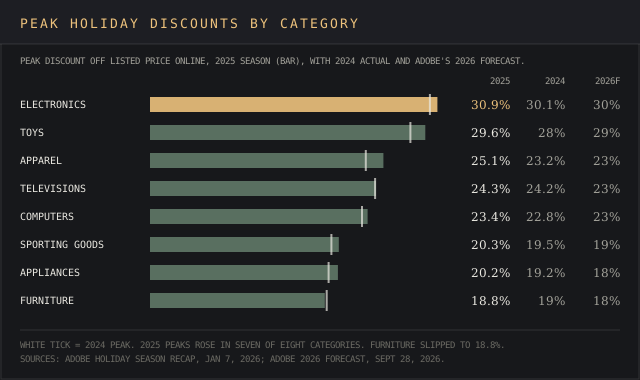
Deeper cuts pushed shoppers to trade up. The share of units sold for the most expensive goods rose 20% in the 2025 season against the rest of the year, and 56% in electronics, Adobe said.
Adobe's 2026 forecast spreads the best deals across the calendar:
- Up to 14% off in early November, 21% just before Thanksgiving and 30% during Cyber Week.
- Black Friday deals are forecast to carry the best prices for TVs, toys, apparel, appliances and furniture.
- Cyber Monday is forecast to carry the deepest cuts on electronics and computers, and Thanksgiving on sporting goods.
- December discounts settle at 10% to 15%, par for the course after the Thanksgiving week peak.
Retailers that track rival prices through the weekend use the tools in the pricing intelligence ranking. PwC's 2026 survey found 79% of consumers say deals and discounts influence when they shop.
Top Black Friday categories: electronics drove $59.8 billion online
Electronics, apparel and furniture took the lion's share of the $257.8 billion spent online in the 2025 holiday season, together 54%, and electronics alone took 23%. Adobe's 2026 forecast keeps the same order.
| Category | 2025 online spend | Change | 2026 forecast | Change |
|---|---|---|---|---|
| Electronics | $59.8B | +8.2% | $63.3B | +5.9% |
| Apparel | $49.0B | +7.4% | $51.3B | +4.7% |
| Furniture | $31.1B | +6.6% | $33.4B | +7.3% |
| Groceries | $23.7B | +10.2% | $26.1B | +10.3% |
| Toys | $8.8B | +7.8% | $9.6B | +9.6% |
| Cosmetics | $8.4B | +9.3% | $9.2B | +9.5% |
US online spend, November 1 to December 31. Sources: Adobe season recap, January 7, 2026, and Adobe forecast, September 28, 2026.
Black Friday shopping data from card payments tells the same apparel story. Mastercard SpendingPulse found apparel up 5.7% on Black Friday 2025 (online +6.1%, stores +5.4%), jewelry up 2.75% and restaurants up 4.5%. On Cyber Monday, more than half of online spend (57%) went to electronics, apparel and furniture, per Adobe.
NRF's weekend survey found 51% of gift buyers chose clothing and accessories, 32% toys, 28% books and other media (up from 22%) and 26% gift cards. Shopify merchants sold the most cosmetics, clothing tops and pants, activewear, and fitness and nutrition products.
Health and beauty drew holiday shoppers too. Cosmetics took $8.4 billion of online spend, up 9.3%, the share of top-priced personal care units sold rose 34%, per Adobe, and beauty products made PwC's top five gifts for adult family and friends.
Online sales of video games rose 415% in the 2025 season against October levels, and hand tools 395%, per Adobe. Top consoles included Xbox Series X/S, PlayStation 5 and Nintendo Switch 2, which the video game industry statistics report tracks year round.
For 2026, Adobe expects shoppers to stock up on essentials. It forecasts Cyber Week sales of personal hygiene products up 150% against September levels, clothing basics up 210%, baby products up 113%, pet products up 93% and household cleaning items up 49%.
AI shopping: traffic from generative AI tools up 693.4% in 2025
Traffic to US retail sites from generative AI tools rose 693.4% across the 2025 holiday shopping season and 670% on Cyber Monday, Adobe measured. Adobe counts a shopper clicking a link to a retail site, and it describes the user base behind this AI-driven discovery as modest. Video games, toys, appliances, electronics and personal care drew the most use.
Salesforce measured AI by sales. AI and agents influenced $67 billion of Cyber Week sales and 20% of global orders through product recommendations and customer service, and its full-season report puts AI-influenced holiday sales at $262 billion. Shoppers referred from AI search channels such as ChatGPT and Perplexity converted nine times more often than social media referrals.
- Retailers running their own AI shopper agents grew 2025 holiday sales 6.2%, against 3.9% for those without, per Salesforce.
- Agentic customer service conversations grew 55% on the prior week, and Pandora's customer service agent has deflected 60% of service cases since January 2025, per Salesforce.
- Adobe expects AI traffic to US retail sites to rise 130% in the 2026 season, including 159% on Thanksgiving, 95% on Black Friday and 88% on Cyber Monday.
- In Adobe's survey of 5,000 consumers, 77% of AI shoppers felt more confident in a purchase and 69% said they were less likely to return it.
Salesforce's 2026 holiday predictions expect AI agents to originate 20% of holiday ecommerce traffic. PwC found 29% of consumers plan to use AI in their holiday shopping, up from 22%. Three-quarters of those AI users research products with it, and 55% use it for comparing prices.
Mastercard's economists found shoppers with paid AI subscriptions were ahead of the curve in 2025, spending a larger share of their holiday budget before Thanksgiving, especially on travel, clothing and jewelry. The AI traffic report and AI statistics cover the referral data behind these numbers.
Marketing channels: social media drove 4.6% of holiday online revenue
Social media took 4.6% of online revenue in the 2025 holiday season, up 40.3% from a 3.3% share in 2024, per Adobe. Affiliates and partners, which include influencers, took 20.4% of online revenue, up 15.9%. Adobe says paid search and email remain reliable drivers of traffic and sales.
Salesforce found social media drove 15% of global digital traffic to retailers over Cyber Week and 16% in the US. TikTok produced 9% of global social traffic, up 55%, and Salesforce's marketing platform sent 56.3 billion marketing messages that week.
For 2026, Adobe expects revenue share to rise 12% for affiliates and 17% for social media, against 4% for paid search. Cashback and rewards partners lead affiliate traffic at 36%, followed by influencers and creators at 22%. Brands with native social shops already get 7% to 9% of orders there, a real sales channel by Salesforce's count.
The social media statistics, advertising industry statistics and search engine marketing statistics reports track the ad budgets behind these channels.
Black Friday 2026 forecast: $12.9 billion online on November 27
Hot off the press on September 28, Adobe's forecast expects US consumers to spend $275.1 billion online over the 2026 holiday shopping season, November 1 to December 31, up 6.7%. Cyber Week is forecast at $47.5 billion (+7.4%), Cyber Monday at $15.1 billion (+6.2%), Black Friday at $12.9 billion (+9.2%) and Thanksgiving at $6.9 billion (+8.5%).
October now carries its own peak of online shopping. Adobe expects $95.8 billion of October online spend, up 8%, including $9.9 billion during the Prime Day event on October 6 and 7.
| Publisher | Released | What it forecasts | 2026 forecast |
|---|---|---|---|
| Adobe Analytics | Sept 28, 2026 | US online spend, Nov 1 to Dec 31 | $275.1B, +6.7% |
| Deloitte | Sept 10, 2026 | Holiday sales, Nov 2026 to Jan 2027 | $1.70T to $1.71T, +4.0% to +4.8% |
| Deloitte | Sept 10, 2026 | Holiday ecommerce sales, Nov 2026 to Jan 2027 | $316.1B to $318.9B, +7.5% to +8.4% |
| Mastercard Economics Institute | Sept 23, 2026 | US sales excluding autos and gas, Nov 1 to Dec 24 | +5.5% (online +11%, stores +3.6%) |
| PwC | Sept 8, 2026 | Average gift budget per consumer | $708, -2% |
| NRF | Mar 18, 2026 | Full-year 2026 retail sales | $5.6T, +4.4% |
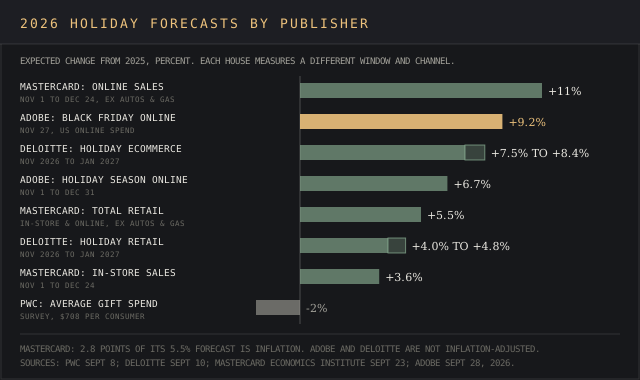
Mastercard says 2.8 points of its 5.5% consumer spending forecast reflect inflation. Thanksgiving falls late again, which compresses the window to Christmas, and Cyber Monday lands in November this year, pulling a block of online sales into the month.
Deloitte's baseline is Census data, which shows sales from November 2025 to January 2026, excluding autos and gas, grew 4.1% to $1.63 trillion. Holiday ecommerce grew 7.5% to an estimated $294 billion over the same months.
PwC's survey of 4,093 consumers, fielded June 15 to 26, shows US consumers plan to spend $708 each on gifts, down 2%. Eight in ten, so most consumers, plan to adopt a budgeting strategy. Consumer confidence on the University of Michigan index fell 18.5%, from 60.7 in June 2025 to 49.5 in June 2026.
Shopper demographics: 33% of Gen Z plan early-morning Black Friday trips
Salesforce's 2026 predictions found 33% of Gen Z, 27% of millennials and 24% of both Gen X and baby boomers plan to shop Black Friday events in person early in the morning. Physical stores lead holiday channel preferences at 77%, ahead of online marketplaces at 69%, brand websites at 36% and retailer websites at 30%.
Shoppers prefer stores for immediate gratification and the chance to touch the merchandise, Salesforce found, and 79% are on their phones in the aisles, with 24% checking competitor prices. In PwC's survey, 60% of consumers expect to shop in-store for gifts and 38% to buy online at brand or retailer websites. Salesforce found 42% of people who shop in-store come to buy something they researched online.
- 28% of Gen Z shoppers plan to shop online through social apps, against 22% of millennials, 12% of Gen X and 3% of baby boomers, per Salesforce.
- 78% of Gen Z shoppers prioritize screen-free gifts, and 71% say they enjoy browsing in person, per PwC.
- Millennial shoppers plan to cut gift budgets 10% and travel budgets 37%, while Gen Z plans a 9% cut in gift spending.
- Baby boomers have more room for discretionary purchases as mortgage and dependent costs recede, PwC says.
Income splits the season. Bank of America's November 2025 card data showed higher-income households lifting spending 2.6% and lower-income households 0.6%, for 1.3% overall. Salesforce counts 35% of holiday shoppers trading down to cheaper goods, 49% of low-income consumers buying less, and 32% of higher-income shoppers buying more.
Budget-conscious consumers lean on free shipping, which Salesforce found ranked first in choosing a retailer at every income level.
Scams shadow Black Friday deal hunting. Mastercard's research found 72% of consumers shop on unfamiliar websites, nearly 1 in 5 shoppers have had items that never arrived, and 16% have received counterfeit goods in past seasons. Prices that look too good to be true were the top red flag, named by 52%.
The season also runs down to the wire. Mastercard found more than 35% of in-store spending on jewelry, handbags, department stores and cosmetics between November 22 and December 25, 2025 landed in the final week. Its economists say these patterns support tailoring promotional strategies and timing, the case for targeted promotions by shopper group.
Global Black Friday sales: $336.6 billion over Cyber Week
Salesforce put worldwide sales across Black Friday and Cyber Week, November 25 to December 1, 2025, at $336.6 billion, up 7%, with $79.6 billion in the US (+5%). Black Friday sales worldwide reached $79 billion, and Cyber Monday drove $53 billion in global online sales, up 7%.
Shoppers bit the bullet and kept buying while paying higher prices. Average selling prices rose 6% over Cyber Week and order volumes 2% globally and 1% in the US. Salesforce's commerce platform handled nearly 61 million orders on online stores that week.
Over the full season, Salesforce counted $1.29 trillion in global online sales, $294 billion of it in the US. Returns reached $181 billion, 14% of purchases, and nearly one in five orders used buy online, pick up in store, rising to 35% on December 22 as late shoppers collected gifts in the nick of time.
Shopify merchants sold $14.6 billion over Black Friday and Cyber Monday 2025, up 27% (24% at constant currency), to 81 million-plus customers. Sales from Black Friday shoppers peaked at $5.1 million a minute at 12:01 p.m. EST that Friday, and cross-border orders were 16% of the total.
- Black Friday success reached small sellers too, as 94,900-plus Shopify merchants had their highest-selling day ever, and 15,800-plus made a first sale.
- Average cart price, Shopify's measure of average order value, rose to $114.70 from $108.56 in 2024.
The UK retail market report covers the second-largest Shopify market, and the small business statistics report covers the independent sellers behind those online stores.
Where each Black Friday figure was published, and the gaps in the record
2025 season results, checked 4 October 2026: news.adobe.com (Cyber Monday recap, 2 December 2025, season recap, 7 January 2026, and the 2022, 2023 and 2024 recaps), blog.adobe.com (2021 holiday report) and nrf.com (Thanksgiving weekend survey, 2 December 2025).
Platform and card data: salesforce.com (Cyber Week release, 5 December 2025, and the full-season report), shopify.com (BFCM recaps, 2 December 2024 and 2 December 2025), businesswire.com (Mastercard SpendingPulse, 29 November 2025) and institute.bankofamerica.com (Consumer Checkpoint, December 2025).
2026 outlook: news.adobe.com (forecast, 28 September 2026), deloitte.com (10 September 2026), mastercard.com (Mastercard Economics Institute, 23 September 2026), pwc.com (Holiday Outlook, 8 September 2026), salesforce.com (2026 holiday predictions) and nrf.com (annual forecast, 18 March 2026). Background: census.gov (August 2026 advance retail sales) and britannica.com.
Black Friday 2026 results arrive with the recaps in late November and early December 2026, so every 2026 figure on this page is a forecast. The 2020 Cyber Week cell reads n/a because the Adobe 2021 report gives the 2021 total and a percentage change, and the 2020 total is missing from it.
Frequently asked questions
Is Black Friday a dying trend?
Black Friday statistics from 2025 show records. US shoppers spent $11.8 billion online that day, and NRF said Black Friday remains the top shopping day for both in-store and online shoppers, with 202.9 million people shopping across Thanksgiving weekend.
What are the most purchased items on Black Friday?
Clothing and accessories, bought by 51% of weekend gift shoppers, followed by toys at 32%, per NRF. By online dollars, electronics led the 2025 season at $59.8 billion, per Adobe.
How much did ecommerce make on Cyber Monday?
Ecommerce sales reached $14.25 billion in the US on that day in 2025, up 7.1%, per Adobe. Salesforce measured Cyber Monday sales of $13.6 billion in the US and $53 billion worldwide.
How many percent does Black Friday take off?
Black Friday discounts sit inside Adobe's season peaks, which reached 30.9% off listed price for electronics, 29.6% for toys and 25.1% for apparel in 2025. For 2026, Adobe expects the best deals, up to 30% off, during Cyber Week.
Are retail sales expected to decrease in 2026?
NRF forecasts 4.4% growth for 2026 to $5.6 trillion. The Census Bureau's advance estimate put August 2026 retail and food services sales at $773.9 billion, up 6.0% on August 2025.
What is the origin of the Black Friday sale?
Philadelphia police began using the phrase in the early 1960s for the crowds and traffic of the day after Thanksgiving, per Britannica. Merchants spread the story of stores turning a profit that day nationally in the late 1980s.
What was the worst Black Friday ever?
In Adobe's online series, 2021 is the only decline since 2020. Black Friday spending fell 1.3% to $8.9 billion and Cyber Monday 1.4% to $10.7 billion.
What are the top 5 busiest shopping days of the year?
By US online dollars in 2025, Cyber Monday ($14.25 billion) and Black Friday ($11.8 billion) led, followed by Thanksgiving Day ($6.4 billion), per Adobe. By in-store visitors, NRF ranked Black Friday shopping (80.3 million) ahead of the Saturday (62.7 million) and Sunday (32.6 million) after Thanksgiving.
Bottom line
Black Friday 2025 set records, with $11.8 billion in US online spend and 202.9 million shoppers over the weekend, and growth on Black Friday and Cyber Monday favored Black Friday for a second year. Online sales grew faster than store sales in Mastercard's and NRF's data, and the holiday season now starts in October.
These Black Friday statistics come from houses that measure different things, so quote each of these Black Friday stats with its publisher, channel and window. For 2026, keep an eye on Adobe's $12.9 billion Black Friday forecast for November 27, Mastercard's 5.5% season forecast and Deloitte's $1.70 trillion, and the jury's still out on how much of that growth is price.