Search engine marketing statistics 2026: paid clicks up 13%, zero-click searches at 68%
 By Jan Suski. I go deep on every review, checking every number against its source and digging up details other coverage misses, a habit from six years of SEO and link building for tech companies. Bylines at Surfer, Brand24, and Senuto. How the scoring works.
The numbers US and global search, January to September 2026, checked 30 September 2026
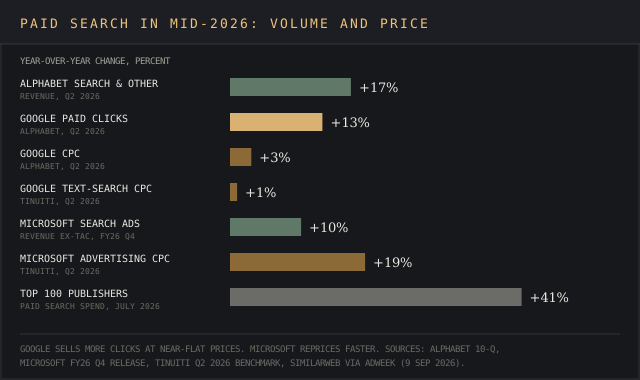
Google's ad business grows on volume, with paid clicks up 13% and the price of each click up 3%.
Position-one CTR runs 58% lower on keywords where Google shows an AI Overview, in Ahrefs' data.
Publishers that lost organic search traffic now buy it back, with paid search spend up 41% in a year.
Google sold 13% more paid clicks in Q2 2026 than a year earlier, and each click cost 3% more, per Alphabet's 10-Q as summarized by Steady Compounding. Over January to April, 68.01% of US Google searches ended with no click at all, according to SparkToro's June 2026 study of Similarweb panel data. The 100 largest publishers then spent $113 million on paid search in July alone.
Search engine marketing (SEM) here means ads bought against people typing specific queries into search engines such as Google, Bing and now ChatGPT, paired with search engine optimization data where both share the search results. The page collects SEO and digital marketing statistics published from January to September 2026.
It's written for search teams, agency leads and marketing leaders setting 2027 budgets. Each figure carries its publisher & date, and pre-2026 figures sit in one labelled section.
Paid search spend: US search ads reached $114.2 billion in 2025
US advertising on search engines brought in $114.2 billion in 2025, AI search ads included, per IAB and PwC. Growth slowed to 11% from 15.9% in 2024, and search made up 38.8% of the $294.6 billion US digital ad total. The 2023 edition put search at $88.8 billion, up 5.2%, per Search Engine Land. IAB & PwC count ad revenue, so fees for SEO services and the wider global SEO services market sit outside that number.
Alphabet's quarterly figures come straight from the horse's mouth. Google Search & other revenue reached $63.27 billion in Q2 2026, up 17% after 19% in Q1, per Search Engine Journal's read of the release. Google Network revenue fell about 0.7% to $7.3 billion, the only ad line that shrank.
| Measure, quarter to 30 June 2026 | Alphabet | Microsoft |
|---|---|---|
| Search revenue growth | Search & other $63.27B, +17% | Search ads ex-TAC +10% (+9% constant currency) |
| Prior quarter | +19% | +12% |
| Cost per click | +3% (Alphabet), +1% (Tinuiti) | +19% on 7% more spend (Tinuiti) |
| Automated campaigns | Performance Max: 4 million advertisers | Bing: 1 billion monthly users |
Cost per click: Google Ads averages $5.42 and Microsoft prices rose 19%
WordStream by LocaliQ puts the median Google Ads cost per click at $5.42 across 13,474 US search campaigns (April 2025 to March 2026), with:
- 6.64% average click-through rate on search ads
- 8.18% conversion rate and $66.69 cost per lead
- $9.87 top CPC (attorneys & legal services) against $1.63 at the bottom (arts & entertainment)
The advertising industry statistics report sets that 6.64% CTR against two other Google Ads panels, ranks channels by ROAS and covers Meta, retail media and video.
Click prices rose at a different speed on each platform. Tinuiti's Q2 2026 benchmark logged Google text-search CPCs up 1% on roughly 14% more spend, and Microsoft Advertising CPCs up 19%. Skai's Q2 2026 trends show paid search spend up 17% with clicks "relatively flat" and CPCs rising.
Cost per lead fell for the first time in five years in WordStream's data, and conversion rate rose in 87% of industries. To check a competitor's bids on relevant keywords, the SpyFu review covers PPC history and the ad intelligence software ranking covers ad-copy tracking.
Why the published search statistics diverge
Three headline numbers in these SEO statistics have a rival figure from a second tracker, and the devil's in the details of device mix, click definition and sample.
| Measure | Figure A | Figure B | What each counts |
|---|---|---|---|
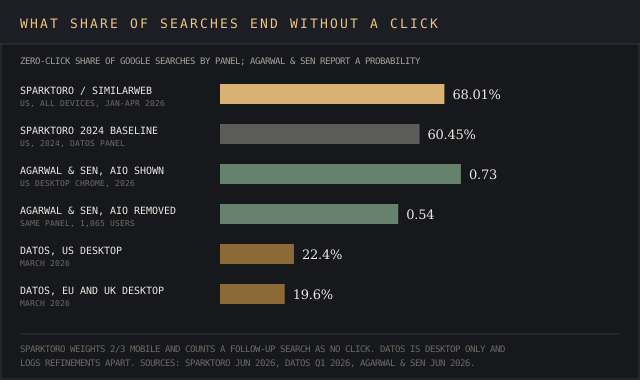
| Zero-click rate, US | 68.01%, SparkToro on Similarweb, Jan to Apr 2026 | 22.4%, Datos, March 2026 | All devices, two-thirds mobile (SparkToro), against desktop only with refinements apart (Datos) |
| Google share, US | 86.1%, StatCounter, August 2026 | 94.3%, Datos, March 2026 | Referred page views (StatCounter), against desktop search events (Datos) |
| CPC movement | $5.42 median, WordStream by LocaliQ | +3% Alphabet, +1% Tinuiti, Q2 2026 | SMB accounts (WordStream), all of Google (Alphabet), managed spend (Tinuiti) |
SparkToro counts a search as zero-click when it ends with no click anywhere, a follow-up search included, weights mobile searches at two-thirds and leaves out the Google app.
Datos' Q1 2026 State of Search is desktop-only, logs refinement searches (15% to 16% of the US total) as a separate bucket, and reads 19.6% for EU and UK desktop. SparkToro's 2024 baseline of 60.45% came from Datos, so its 2024-to-2026 trend mixes two panels.
SparkToro's Rand Fishkin said of the desktop-only Datos panel, "We're missing the two-thirds of searches that happen on mobile." StatCounter counts referrals from search engines to more than 1 million websites, per its 7 May 2026 notes, so a search that ends on Google's search results never reaches its count. The clickstream data providers ranking sets out how each panel behind these search engine statistics is built.
Key SEO statistics: Google AI Overviews cut position-one clicks by 58%
Ahrefs measured a 58% lower click-through rate for the top organic search result on keywords with an AI Overview, across 300,000 keywords. Position-one CTR fell from 0.073 to 0.016 between December 2023 and December 2025.
Ryan Law, Ahrefs' Director of Content Marketing, wrote that AI Overviews "siphon away the majority of the clicks once available to top-ranking pages," a bitter pill to swallow for anyone reporting organic traffic from pages ranking first.
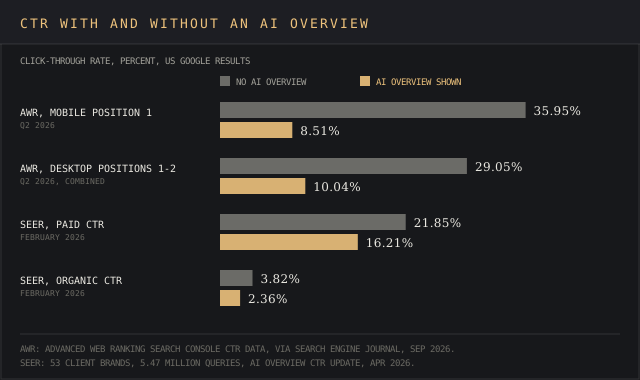
Advanced Web Ranking's Search Console data, published by Search Engine Journal in September 2026, splits Q2 2026 Google search results by device for top-ranking pages:
- Mobile, position one: 35.95% CTR without an AI Overview, 8.51% with one
- Desktop, positions one and two combined: 29.05% without, 10.04% with
A Google Search Console logging error misreported impressions from 13 May 2025 to 27 April 2026, with clicks unaffected, per the same report. Technical SEO teams should flag any SEO statistics on CTR that span April 2026.
A randomized experiment by Saharsh Agarwal and Ananya Sen, revised 17 June 2026, followed 1,065 US desktop Chrome users. Showing Google AI Overviews cut outbound organic clicks by 39.8%. The overviews triggered on about 41% of their search queries, and removing them cut the zero-click probability from 0.73 to 0.54.
"If all you were going to do was go to the webpage, see the fact, and immediately click back, you're going to spend like a half a second on the page."
Liz Reid, VP and Head of Search, Google, Bloomberg Odd Lots, 23 April 2026, transcribed by PPC Land
Agarwal and Sen measured the quality of the lost clicks and call the result "at odds with the view that AIOs primarily eliminate low-engagement website visits," per Search Engine Journal.
Paid listings lose less. Seer Interactive's April 2026 update, built on 53 client brands and 5.47 million queries, measured:
- Paid CTR of 16.21% on AI Overview queries in February 2026, against 21.85% without one
- Organic search CTR of 2.36% with an AI Overview, up from 1.31% in December 2025, against 3.82% without
- 120% more organic clicks per impression for brands cited inside the overview, still 38% below queries without one
Titles and meta descriptions now sit below an answer box on those queries, and the cited listing collects Seer's 120% uplift whatever its meta descriptions say.
Featured snippets and People Also Ask: 97% of answers AI-generated
AlsoAsked tracked about 19.2 million English queries and found AI-generated content in 86% of People Also Ask answers in August 2026 and 97% by early September, per PPC Land. Fourteen months earlier it was about 12%.
Mark Williams-Cook, AlsoAsked's founder, said "we are on track for 100% shortly." Older CTR-by-snippet studies of featured snippets describe search results that now carry AI-generated content in nearly every PAA box.
Search engine market share: Google holds 91.1% of referrals worldwide
Google took 91.1% of worldwide referrals from search engines in August 2026 on StatCounter's count, the lion's share of the global search engine market. In the US the August split ran:
- Google 86.1%
- Bing 8.92%
- Yahoo 2.74%
- DuckDuckGo 1.7%
StatCounter also publishes a separate global mobile search market series, and this report quotes its all-platforms figure. Datos puts Google at 94.3% of US desktop search in March 2026, after a 92.1% low in December 2025. Bing peaked at 5.33% that December and fell back to between 3.2% and 3.8%.
Bing passed 1 billion monthly active users for the first time, disclosed on Microsoft's FY26 Q3 call, per Search Engine Journal in April 2026.
Tools that measure market share and website traffic across search engines, including referral website traffic from Google, are compared in the website traffic analysis tools ranking.
Search behavior and content marketing: 64.55% of Google searches are informational
Informational intent reached 64.55% of Google searches in Q1 2026, up from 55.52% a year earlier, in Datos' US desktop panel. Navigational intent fell on all the search engines it tracks. Google searchers ran 102.5 searches each in March 2026, up from 95.3 in December.
Six-word queries made up 6.3% of US desktop search queries in Q1 2026, and seven-word queries 4.4%.
Ahrefs' long-tail keyword guide, updated 27 May 2026, says "Keywords with fewer than 10 searches per month account for almost 93% of our U.S. keyword database."
The most searched keyword on US Google is "youtube" at 85,890,000 monthly searches, ahead of "amazon" at 85,830,000 and "chatgpt" at 68,580,000, in Ahrefs' top Google searches list updated 1 September 2026 from a database of 28.7 billion keywords.
Google users click organic search results on 44.9% of US desktop searches (March 2026, up from 42.0%), and paid clicks held at 2.1% to 2.3%. Mobile searches sit outside that panel. SparkToro's model gives mobile search traffic two-thirds of US Google searches, double desktop's share.
Seer's April 2026 data shows AI Overviews in the search results of 95.4% of comparison queries, 36% of informational, 8% of commercial and 5% of transactional queries.
AI Overviews answer question-shaped searches, which puts informational content marketing in the path of the biggest click loss. Kevin Indig revised his own forecast in Growth Memo's AI Halftime Report in July 2026, writing, "I predicted up to 70% of 2024 organic traffic could be gone by 2026, but that was overeager."
Video takes a share of the same content budgets. Wyzowl's Video Marketing Statistics 2026, from 266 marketers and consumers surveyed in late 2025, found 91% of businesses use video as a marketing tool, and 82% of video marketers say video has helped them increase web traffic.
The SEO visibility score report explains how CTR curves feed rank-based scores, and keyword tools still report monthly search volumes with no adjustment for AI answers (see the Semrush pricing breakdown).
Local SEO statistics: 45% of consumers use AI for local recommendations
BrightLocal's Local Consumer Review Survey, published 11 February 2026 from 1,002 US adults, holds the largest set of local SEO statistics dated this year. ChatGPT and other AI tools grew under the radar as a local recommendation source, from 6% to 45%, now third.
| Local search measure | 2025 | 2026 |
|---|---|---|
| Google as a source of local reviews | 83% | 71% |
| "Always" read reviews for local businesses | 29% | 41% |
97% of consumers read reviews for local businesses, and 42% trust AI platform recommendations as much as written reviews. For local search queries, Seer found 76.9% of informational "near me" queries showed an AI Overview in their search results.
The most quoted figure on local mobile searches comes from Google's May 2016 Purchased Digital Diary study of smartphone users, which found "76% of people who search on their smartphones for something nearby visit a business within a day," with 28% ending in a purchase, per a Think with Google report.
AI search traffic: AI Mode passes 1 billion users and ChatGPT links out on 6.8% of answers
Sundar Pichai said in Alphabet's Q2 2026 remarks of 22 July, "Since expanding AI Mode globally last October, we've surpassed 1 billion monthly active users." SparkToro's panel saw 0.34% of US searches go to AI Mode from January to April 2026, a drop in the bucket next to the classic results page.
ChatGPT reached 1.2 billion weekly users, a figure hot off the press in the OpenAI DevDay 2026 recap of 29 September. Similarweb, a marketing tool that measures global web traffic, sized the overlap among internet users worldwide in its 2026 Generative AI report, covered by Search Engine Journal:
- Search sites: 3.3 billion average monthly unique visitors, March to May 2026
- AI chatbots: 655 million monthly unique visitors
- 461 million of ChatGPT's 494 million users also used Google
- 9.5 billion average monthly visits to gen AI platforms, up 70%, June 2025 to May 2026
Chatbot answers send little global website traffic. Similarweb found 6.8% of US ChatGPT answers carried an external link in May 2026, up from about 1.6%. AI tools took 1.65% of US desktop events in Q1 2026, per Datos. In StatCounter's April 2026 chatbot referral shares, ChatGPT fell to 76.85% from 84.21%, ahead of Gemini at 9%, Perplexity 7.73%, Copilot 3.76% and Claude 2.66%.
StatCounter CEO Aodhan Cullen said "optimising for a single AI chatbot is no longer sufficient." The AI traffic report tracks where that web traffic lands, the Reddit AI visibility study tests which sources chatbots cite, and the competitive intelligence SEO tools ranking covers citation tracking.
AI assistants, tracked in the AI statistics report, also became a paid channel inside a year. OpenAI said on 31 August 2026 that ChatGPT Ads reached a $1 billion annualized run rate in under 200 days, sold in 40+ countries to tens of thousands of advertisers.
Publishers bought back traffic: $113 million on paid search in July 2026
The 100 largest media publishers spent $113 million on paid search in July 2026, per Similarweb data reported by Adweek on 9 September and covered by PPC Land. That's up 41% year over year and 274% over three years, for 23.7 million paid visits (up 39%).
Forbes alone spent $72.2 million in July while its organic search traffic fell 26.7%. Publishers who bite the bullet pay the same auction prices as every other advertiser. The publishing industry statistics report covers the revenue side.
SEO statistics from before 2026 that still circulate
Roundups of top SEO statistics and SEO industry statistics repeat figures on search engines from 2014 to 2025 that SEO professionals still cite, and they're a dime a dozen. This report takes SEO statistics for 2026 only, each with a named publisher. The table dates the most repeated older SEO stats at their original source.
| Original source | Figure that circulates | Age of the data in 2026 |
|---|---|---|
| Google Mobile Voice Study, October 2014 | 55% of US teens use voice search daily | 12 years |
| Sundar Pichai, Google I/O keynote, May 2016 | 20% of queries on Google's mobile app and Android are voice searches | 10 years |
| Google/Purchased Digital Diary, May 2016 | 76% of nearby smartphone searches lead to a visit within a day | 10 years |
| Backlinko, 11.8 million Google results, first published January 2016, updated April 2025 | The #1 result has 3.8x more backlinks than positions 2 to 10 | 10 years since first publication |
| Backlinko, same study | The average word count of a Google top 10 result is 1,447 words | 10 years since first publication |
| Semrush AI Overviews study, 10M+ keywords, updated December 2025 | AI Overviews on 6.49% of keywords (January 2025), 24.61% (July 2025) and 15.69% (November 2025) | 10 to 20 months |
| First Page Sage SEO ROI statistics, September 2025, updated December 2025 | 748% ROI and a 9-month break-even for thought-leadership SEO campaigns, and 1,389% ROI with 10 months for real estate | 9 to 12 months |
| GoGulf via Social Media Today, 2019, as credited by HubSpot's local SEO statistics | 46% of all Google searches look for local information | 7 years |
| SEO Tribunal, as credited by HubSpot | 78% of location-based mobile searches end in an offline purchase | Undated at source |
| Pew Research Center, July 2025, 900 US adults | 1% of visits click a link inside an AI summary | 18 months (March 2025 data) |
Voice search statistics
Voice search figures are the oldest search engine optimization statistics in circulation, from 2014 and 2016. Voice search optimization advice built on them assumes voice search results and voice search answers come from a featured snippet for conversational or local questions. In Seer's 2026 data, an AI Overview sits at the top of 36% of informational queries.
Link building and backlink statistics
Backlinko's study says the top result has 3.8x more backlinks and 3x more referring domains than positions 2 to 10, counted on pages ranking before Google's AI answers existed. Link building still pays in Backlinko's data, where top-ranking pages carry more backlinks, and Ahrefs puts the click loss for a position-one page at 58% once an AI Overview appears.
Search engine marketing KPIs and marketing strategy by goal
These SEO statistics map onto a short KPI set. Keep an eye on impression share, which Google Ads Help defines as "the percentage of impressions that your ads receive compared to the total number of impressions that your ads could get," plus the goal metrics below, which mix financial (CPC, cost per lead), behavioral (CTR) and visibility (citation rate) measures.
The Semrush vs Similarweb comparison covers which tool tracks them for your domain.
| Goal | Metrics to track | 2026 reference figure |
|---|---|---|
| Brand awareness | AI citation rate, chatbot referral share, branded search, organic social media reach among social media users | ChatGPT 76.85% of chatbot referrals (StatCounter) |
| Direct response | CPC, cost per lead, paid CTR on AI Overview queries | $5.42 CPC, $66.69 CPL (WordStream by LocaliQ) |
| Local store visits | Review count and recency, Google Maps actions, chatbot mentions | 45% use AI for local picks (BrightLocal) |
On AI Overview queries, Seer measured 16.21% paid CTR against 2.36% organic search CTR in February 2026, a gap that favors PPC over SEO on the same query.
For an SEO strategy on informational terms, Seer's data makes citation share inside AI Overviews the metric to chase, on top of technical SEO basics. SEO professionals can price the organic side in the SEO ROI calculator with the Q2 2026 Advanced Web Ranking CTRs. Seer's report calls paid search "your most predictable lever in search right now." Use AI for research and content creation drafts, with a human editor checking every number.
Core updates and Core Web Vitals in 2026
Google's Search Status Dashboard logs two core updates in 2026 so far, starting 27 March and 21 May and taking 12 and 11 days to roll out, plus four spam updates, the latest from 24 September.
Google's helpful content guidance, last updated 10 December 2025, groups experience, expertise, authoritativeness and trustworthiness as E-E-A-T and states, "Of these aspects, trust is most important."
The Core Web Vitals documentation sets the pass marks at 2.5 seconds for Largest Contentful Paint, 200 milliseconds for Interaction to Next Paint and 0.1 for Cumulative Layout Shift. HTTP Archive's 2025 Web Almanac counts 48% of mobile websites with good Core Web Vitals in 2025, up from 44% in 2024, and 56% of desktop websites, up from 55%.
Sources and data notes
Datos, Seer Interactive and Advanced Web Ranking publish 2026 reports on late-2025 and early-2026 data. Wyzowl's 2026 video survey ran in late 2025, and the 2025 Web Almanac reads 2025 Chrome UX Report data.
Every source behind these search figures, and the gaps no 2026 publisher fills
Spend and earnings: IAB and PwC (16 April 2026), Steady Compounding on Alphabet's 10-Q, Search Engine Journal, Microsoft FY26 Q4, AdExchanger, Search Engine Land.
CPC and benchmarks: WordStream by LocaliQ (19 May 2026), Tinuiti via Digital Applied, Skai, Google Ads Help.
Clicks, CTR and zero-click: SparkToro (June 2026), Datos via PPC Land (27 April 2026), Ahrefs (4 February 2026), Advanced Web Ranking via Search Engine Journal, Agarwal and Sen via PPC Land, Search Engine Journal on lost-click quality, Seer Interactive (April 2026), PPC Land on Liz Reid.
Share, queries and content: StatCounter via searchengines.net, StatCounter press notes (7 May 2026), Search Engine Journal on Bing, Ahrefs long-tail keywords (27 May 2026), Ahrefs top Google searches (1 September 2026), Growth Memo, Wyzowl.
Local and AI search: BrightLocal (11 February 2026), Google (22 July 2026), OpenAI DevDay (29 September 2026), OpenAI on ChatGPT Ads (31 August 2026), Similarweb via Search Engine Journal, Similarweb gen AI statistics, PPC Land on publisher spend and AlsoAsked.
Technical SEO: Google Search Status Dashboard, Google helpful content guidance and Core Web Vitals documentation (both updated 10 December 2025), HTTP Archive Web Almanac 2025. Figures checked 30 September 2026.
Google publishes no 2026 figure for daily or monthly search volume, and no primary source sizes the global SEO services market or the voice share of mobile queries for 2026, so none of the three appears here.
Frequently asked questions
Is SEO still relevant in 2026?
44.9% of US desktop searches ended with Google searchers clicking organic search results in March 2026, per Datos, the largest click source on the page. SEO efforts now include getting cited inside Google's AI answers.
What percentage of Google searches end without a click?
68.01% of US Google searches, more than half, ended without a click from January to April 2026 in SparkToro's study of Similarweb data, which weights mobile searches at two-thirds. Desktop-only data from Datos puts the narrower rate at 22.4% for March 2026.
What are the statistics for search engine use?
3.3 billion internet users visited search sites each month from March to May 2026 (Similarweb), and Google took 91.1% of worldwide referrals in August (StatCounter). Among SEO statistics for 2026, informational intent reached 64.55% (Datos).
What are some SEO KPIs?
Organic CTR by position, which titles and meta descriptions drive, AI answer citation rate, impression share, organic traffic and conversions, each read against an average click-through rate for the position. Seer measured organic CTR at 2.36% on AI Overview queries against 3.82% without in February 2026, a baseline for these SEO stats.
Bottom line
The search click got dearer on two fronts in 2026. Google sells more paid clicks at slowly rising prices, Microsoft reprices faster, and ChatGPT now sells ads alongside the search engines. AI Overviews take the top of the search engine results pages on informational queries, and zero-click runs from 22.4% to 68.01% by panel.
Read SEO statistics for their definitions first. A desktop-only panel and a mobile-weighted one measure different searches, and a 2014 voice survey describes phones from before Google's AI answers. Paid search stays the most predictable line, and the publishers who paid $113 million for it in July show what that predictability costs.