Clickstream data providers: rankings and buying guide (2026)
 By Jan Suski. I go deep on every review, checking every number against its source and digging up details other coverage misses, a habit from six years of SEO and link building for tech companies. Bylines at Surfer, Brand24, and Senuto. How the scoring works.
· Prefer this source on Google
Quick comparison: clickstream data providers
Four providers with the coverage figure each one publishes, what it costs to start, and the buyer it fits best. Coverage figures are vendor-reported; the Comscore price marked with an asterisk is Vendr's anonymized buyer data.
| # | Provider | Coverage figure | Entry price | Best fit |
|---|---|---|---|---|
| 1 | Similarweb | 10B+ digital signals collected daily across 100M+ websites and 4M+ apps | $125/month, self-serve | Competitor traffic estimates without a data contract |
| 2 | Semrush | Traffic & Market Intelligence runs on the panel acquired with Datos | $117.33/month, SEO plan, billed annually | SEO teams wanting clickstream estimates in an existing toolkit |
| 3 | Datos | 20Bn+ URLs processed monthly across 185 countries | Quote-only | Teams licensing raw clickstream feeds to build on top of |
| 4 | Comscore | No panel size published; positions itself as a measurement currency | $105,791/year median* | Media planners needing a syndicated cross-platform currency |
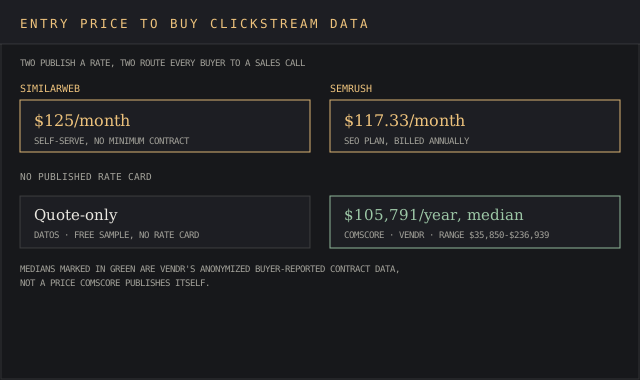
The median marked * is Vendr's anonymized buyer-reported annual contract value for Comscore. Everything else is the price or figure the vendor publishes itself.
Where these figures come from
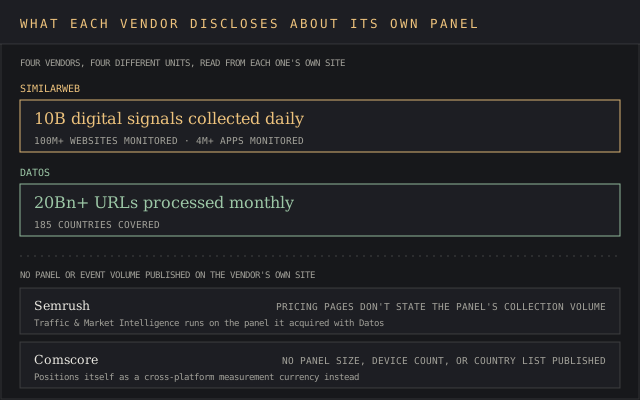
Coverage figures are each vendor's own published claim, read from its product and pricing pages in August 2026. The Comscore price marked * comes from Vendr's marketplace listing, anonymized buyer-reported contract data. Neither Semrush nor Comscore publishes its panel's collection volume, and Datos and Comscore both route every price through a sales call; neither publishes a public rate card.
Clickstream data records every click, page view, timestamp, and exit point a person leaves behind while browsing a website or app. A retailer buys it to see where shoppers drop out of checkout. A marketing team buys it to check a competitor's traffic directly, without waiting for a press release to confirm it. An SEO team buys it to see which pages on a rival's site pull the most visits.
This guide ranks four vendors that sell clickstream data as a product. Each one publishes at least one verifiable figure about its data collection.
Pricing varies just as much: one sells self-serve seats, one bundles clickstream estimates into an SEO platform, one licenses raw data by contract, and one prices a syndicated measurement product that most buyers negotiate through procurement.
The page covers what clickstream data contains, how vendors collect it, four testable criteria for judging a provider, the ranked list itself, and where the pricing traps sit across the category. It's written for analysts, growth teams, and procurement staff evaluating a clickstream data provider for the first time.
Similarweb and Semrush both also appear on our marketing intelligence tools ranking, which judges the same two vendors against a wider field of marketing platforms. Read that page for the broader marketing-stack comparison. Read this one if the raw data itself is the purchase.
Evaluation criteria for clickstream data providers
Finding the right clickstream data provider depends on evaluating a small set of core features. Four criteria decide the shortlist, and the ranking below applies them in this order.
Disclosed panel or event volume
A provider either publishes a real number for the events, URLs, or devices behind its clickstream data, or it doesn't. Similarweb states 10 billion digital signals collected daily; Datos states 20 billion-plus URLs processed monthly across 185 countries. A vendor that publishes nothing forces the buyer to take data quality on faith.
Digital signals Similarweb says it collects every day, the most specific daily collection figure any vendor in this ranking discloses on its own site.
Data delivery format
Clickstream data collected for a dashboard serves a different purpose than clickstream data collected for a data warehouse. Some providers expose only processed metrics inside a UI; others ship raw event-level feeds through an API or a scheduled export a data engineering team can load directly.
Published entry price
A provider either lists a real price on its own site, a self-serve monthly rate or a per-record cost, or it routes every buyer to a sales call. A published price lets a buyer size a deal before committing time to a contract negotiation.
Country and platform coverage
Coverage in one country doesn't transfer to another; a clickstream data provider covering the US and UK is a different purchase than one covering 185 countries and both mobile app and desktop web platforms. App data vendors price geography the same way, and our Sensor Tower pricing report shows U.S.-only coverage costing less than global access.
The ranked list
Ranked on disclosed panel or event volume, data delivery format, published entry price, and country and platform coverage, applied in that order.
Similarweb
Best fit
Teams that need competitor traffic and app-usage estimates fast, without a procurement cycle.
Similarweb is a web intelligence platform built around clickstream data. The company says it collects 10 billion digital signals a day and monitors more than 100 million websites and 4 million apps, drawing on a contributor network it describes as "millions of devices, worldwide," on top of public data and partnerships.
Key features
- Website traffic estimates covering 100M+ monitored domains.
- App intelligence covering 4M+ mobile apps across iOS and Android.
- 10 years of historical traffic data for trend analysis.
- API access for pulling clickstream-derived metrics into a data warehouse.
- Keyword and referral traffic breakdowns for competitor benchmarking.
Pricing
Self-serve Web Intelligence plans start at $125 per month; larger data volumes and API access move to a custom enterprise package priced through a sales conversation.
Pros
- Publishes real, numbered collection figures on its own site.
- Self-serve entry price with no minimum contract at the base tier.
- Covers both web and app clickstream data in one product.
Cons
- G2 reviewers flag lower confidence in estimates for smaller or niche sites.
- Advanced tiers and API access get expensive fast for a small team.
- Historical data resets its baseline whenever Similarweb changes its estimation model.
"The estimates tend to be more dependable for established domains with meaningful traffic than for smaller, newer, or highly specialized sites." Valeria B., Deputy Head of Marketing, Mid-Market, G2 review, July 29, 2026
Why it's ranked #1. Similarweb is the only provider here that discloses a specific daily collection figure, 10 billion signals, tied to a self-serve price a buyer can act on the same day. Semrush's clickstream panel sits one tier down in transparency because it publishes plan prices but not the panel's own collection volume.
Semrush
Best fit
SEO and marketing teams that already run keyword tracking and want clickstream-based traffic estimates in the same subscription.
Semrush built its Traffic & Market Intelligence surface on the clickstream panel it gained by acquiring Datos, folding raw browsing data into a platform most buyers already use for keyword rankings and site audits. The company's own G2 listing shows how quickly its per-toolkit pricing stacks: Local SEO, AI Visibility, Content, and Advertising each add on top of the base plan.
Key features
- Traffic Analytics for benchmarking a rival's visits and engagement, up to 100 sites at once.
- Keyword and rank tracking bundled into the same subscription as traffic estimates.
- Domain-level competitor comparisons pulling from the same clickstream backend as Datos.
- AI Visibility tracking across Google Search, ChatGPT, Perplexity, and Gemini.
- API access on the Advanced plan for exporting data programmatically.
Pricing
Plans run $117.33 to $455.67 per month billed annually across four tiers (SEO, Starter, Pro+, Advanced), before the per-toolkit add-ons the company sells separately.
Pros
- One subscription covers clickstream traffic data, keyword tracking, and site auditing.
- Published, tiered pricing with no sales call required to start.
- Traffic Analytics covers up to 100 competitor sites per report.
Cons
- Add-on toolkits push the real monthly cost well past the list price.
- The underlying clickstream panel volume isn't published on Semrush's own pricing pages.
- Historical traffic data goes back to January 2017, shorter than some dedicated panels.
"The real cost of SEMrush is never the sticker price. Local SEO, AI Visibility, Content, and Advertising toolkits each add $30 to $220/month on top of already steep plans." Verified reviewer, Manufacturing, Mid-Market, G2 review, February 10, 2026
Why it's ranked #2. Semrush publishes tiered pricing that beats Datos on the published-entry-price criterion outright, since Datos won't quote a number without a sales call. It ranks behind Similarweb because its own pricing pages never state the clickstream panel's collection volume, only Datos does that, one company removed.
See the full Semrush vs Similarweb comparison for how the two handle publishing a collection figure against publishing a price.
Datos
Best fit
Product and data teams that want to license raw clickstream feeds and build their own analytics on top.
Datos, a Semrush company, sells clickstream data directly. It tracks "users' journeys across the web at the URL level," every page view, click, and interaction, across a panel it describes as millions of opt-in panelists, and processes more than 20 billion URLs a month across 185 countries.
Key features
- URL-level clickstream feeds covering desktop and mobile browsing.
- Domain traffic, keyword, and search-event data products sold separately.
- In-app consumer behavior data through partnerships, beyond browser-based tracking.
- Free data sample available before a purchase commitment.
- 185-country coverage, among the widest of any provider on this list.
Pricing
Not published. Datos directs buyers to request a free sample or a custom quote through datos.live.
Pros
- 185-country coverage is wider than any other provider ranked here.
- Sells raw data, letting buyers build their own analytics on top.
- Free sample available before signing a contract.
Cons
- No published pricing anywhere on the vendor's own site.
- No self-serve signup; every deal starts with a sales conversation.
- Smaller company profile than Similarweb or Comscore, with less public documentation of methodology.
"Large data volume: With over 100 trillion anonymous clickstream events, DATOS has one of the most significant data volumes on the market." Adil K., Senior IT Recruiter, G2 review, June 23, 2023
Why it's ranked #3. Datos beats Comscore on the panel-and-coverage criterion by publishing hard numbers, 20 billion-plus URLs monthly across 185 countries, that Comscore's own site never states. It loses to Semrush because Semrush lists an actual monthly price and Datos won't quote one without a call.
Comscore
Best fit
Media planners and agencies that need a syndicated, industry-standard measurement currency for cross-platform ad buying, and have budget for an enterprise contract.
Comscore positions itself as "a trusted currency for planning, transacting, and evaluating media across platforms," a measurement standard used across the advertising industry. It doesn't publish panel size, device counts, or country coverage on its own site, unlike every other provider in this ranking.
Key features
- Cross-platform measurement spanning TV, digital, and mobile in one currency.
- Industry-standard audience measurement used in media buying negotiations.
- Custom reporting built around advertiser and publisher deal terms.
- No self-serve free trial; every account starts through sales.
Pricing
Comscore does not publish standard list pricing. Vendr's anonymized transaction data puts the median annual contract at $105,791, with deals ranging from $35,850 to $236,939.
Pros
- Recognized as an industry-standard measurement currency in ad buying.
- Cross-platform coverage spanning digital and traditional media in one contract.
- Vendr's transaction data gives buyers a real budget benchmark before a sales call.
Cons
- Discloses no panel size or country coverage on its own site.
- No free trial; a small business reviewer on G2 called that out directly.
- Highest entry cost of any provider in this ranking, by Vendr's own median.
"comScore don't provide the free trial, you have to pay before using it.." Verified User, Marketing and Advertising, Small-Business, G2 review, July 16, 2020
Why it's ranked #4. Comscore's $105,791 median contract, by Vendr's own tracked deals, is the highest entry cost of the four, and it's the only provider here that discloses neither a panel figure nor a published price on its own site. Datos beats it by publishing both a collection volume and a free sample path.
What clickstream data collection captures
Clickstream data collection captures a sequence of events: a page view, a click, a scroll, a form submission, a search query, and the timestamp attached to each one. A single session might include an entry point, several pages visited, a set of clicks on specific pages, and an exit point.
All of that gets sequenced so a data analyst can reconstruct the click path a person took across a web page and any mobile applications they touched along the way.
Vendors collect this behavioral data through a few methods. Some run JavaScript tags on partner sites and apps that a visitor's browser executes, so that user interaction data streams back in real time. Some route data through server-side platforms that log every request.
Others recruit a panel of people who install browser extensions or mobile SDKs and opt in to having their web navigation data collected in exchange for a reward, which is how third-party providers estimate traffic to sites that never installed their own tracking.
Server response issues, page load time, and scroll depth all show up in a clean clickstream dataset alongside URLs visited and mobile app screens opened. Repeat visitors and human visitors get flagged separately from bots, since bot traffic pollutes any analysis that doesn't filter for it first.
That raw event stream is temporal data before it's anything else. Unstructured data processing turns it into rows a data warehouse can query, with each user's interaction timestamped and joined back to the customer data a business already holds. A typical feed carries fields including:
- Page URL and device type.
- Referrer and session ID.
- Time on page.
Aggregated across thousands of sessions, those fields let a data analyst read trends across the whole customer base. A single visitor's session alone doesn't show that pattern.
Collecting clickstream data, and buying it from a third party, both sit inside privacy law. GDPR and CCPA compliance shapes what a provider can capture and how long it can keep it, and buying the data from a vendor doesn't move that obligation off a buyer's own books. Confirm the panel behind the data was collected under proper consent before putting it to work.
What clickstream data analysis reveals
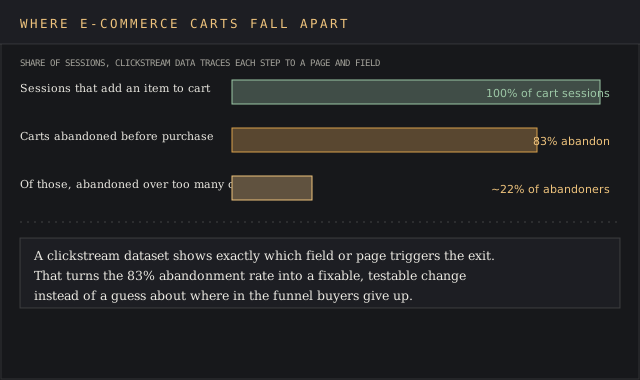
Clickstream data analysis turns raw events into a complete view of customer behavior. In e-commerce, analyzing clickstream data starts at cart abandonment: 83% of e-commerce customers abandon their shopping cart before completing a purchase, and roughly 22% of that drop-off traces to a checkout that asks for too many steps.
A clickstream dataset shows exactly which field or page triggers the exit, and it turns that pain point into a fixable, testable change. The alternative is a guess.
The same data collection method maps a customer journey end to end, from initial awareness through the pages visited during research to the final conversion event. Marketing teams use it to see which touchpoints move people toward a purchase, checking if campaigns and ad platforms drove real engagement or just impressions.
When two campaigns claim the same conversion, only the underlying user interactions in the clickstream data settle which one gets credit.
At the site level, clickstream analytics surfaces drop-off points, pages with high bounce rates, and the specific click path visitors follow between a landing page and a product page.
Cutting the number of clicks between a landing page and the page a visitor wants reduces bounce rates, and clickstream data is what tells a team which navigation change to make, replacing the change that merely feels right with the one the data supports.
Reducing friction on those pages is one of the few web analytics interventions with a measurable, testable outcome: a lower bounce rate, higher conversion rates, and a shorter path to conversion.
Clickstream data also feeds personalization: a returning visitor's past click path lets a site show a relevant product or offer in place of a generic homepage. Doing it across devices requires identity resolution, matching a phone session and a laptop session back to the same person, since a customer journey stitched from only one device is an incomplete one.
Real-time ingestion matters here too. A personalization engine acting on a session that ended ten minutes ago has already missed the moment, and the strongest clickstream feeds capture user behavior down to the millisecond so a triggered offer can still land while the visitor is on the page.
Outside e-commerce, the same clickstream data acts as a proxy for competitor traffic, letting a team benchmark ad spend against a rival's site without direct access to that rival's Google Analytics account. Worldwide ad spending is set to reach $1.17 trillion in 2026, with digital channels driving most of that growth, according to eMarketer.
Clickstream-based traffic and audience data is what a media buyer uses to decide where inside that spend to put a dollar, turning behavior on someone else's platform into a decision on the buyer's own.
Clickstream data pricing across the category
Pricing splits into two models. Similarweb and Semrush sell subscription seats with a published monthly rate, so a buyer can size the cost before talking to anyone. Datos and Comscore sell contracts instead.
The only way to benchmark either contract-sold vendor without a sales call is a third-party source like Vendr's anonymized deal data, which is why Comscore's true cost only shows up once a buyer looks outside the vendor's own pages.
The hidden cost sits in add-ons. Semrush's base plan looks competitive against Similarweb's $125 entry price, but toolkits for Local SEO, AI Visibility, Content, and Advertising each add $30 to $220 a month on top, according to reviewers. A buyer comparing list prices alone will underestimate the real Semrush bill.
Common buying mistakes
Buyers most often mistake a provider's raw event count for accuracy on one specific target site, which is the most common error in this category. A large aggregate collection figure, if it's Similarweb's 10 billion daily signals or Datos's 20 billion monthly URLs, says nothing about how well that panel represents a single small or niche domain, which is exactly where reviewers report the weakest estimates.
The second mistake is buying dashboard access when the actual need is a data feed, or the reverse. A marketing team that just wants competitor benchmarks doesn't need Datos's raw URL-level export; a data engineering team building its own product on top of clickstream data doesn't need Similarweb's dashboard, it needs the API.
How teams put clickstream data analytics to work
Most buyers don't collect data themselves; they buy clickstream data from one of the four providers above and route it into an existing marketing workflow. A growth team pulls traffic and conversion data into a spreadsheet, checks how visitors interact with a rival's pricing page against their own, and adjusts strategy for the next quarter based on what moved trends.
Clickstream data analytics only pays off when someone reads the behavioral patterns it surfaces and acts on them. Using it well means starting with a question, how do users navigate from a search results page to a purchase, and then tracing that path through the conversion funnels clickstream data recorded. Running analysis for its own sake doesn't answer that question.
The clickstream datasets that matter most are the ones tied to specific pain points: a checkout step that loses buyers, a landing page nobody scrolls past, or search queries that never turn into a sale. Visit counts alone are a vanity number; the valuable insight is what those visits did next.
Frequently asked questions
What is clickstream data?
Clickstream data is the recorded sequence of a person's actions on a website or app: page views, clicks, scrolls, form submissions, and the timestamps attached to each event, captured in the order they happened.
What does clickstream mean?
The term describes the "stream" of clicks and page requests a browser generates as someone moves through a site, the same way a river's course is a stream of connected points.
Who are the biggest clickstream data providers?
Similarweb, Semrush (through its Datos subsidiary), Datos, and Comscore are among the largest providers selling third-party clickstream or panel-based traffic data as a standalone product.
How does Semrush get its clickstream data?
Semrush's Traffic & Market Intelligence surface runs on the panel it gained when it acquired Datos, layering keyword and rank data from its own crawlers on top.
Bottom line
Similarweb wins for most buyers who need competitor or app-traffic estimates without a procurement cycle: it publishes real collection figures and starts at $125 a month with no contract. Semrush is the right call for a team that already lives in its SEO toolkit and wants clickstream-based traffic numbers folded into the same login, as long as the buyer prices the toolkit add-ons before signing.
Datos and Comscore serve narrower, contract-driven needs. Datos fits a product or data team that wants raw, URL-level clickstream feeds to build on top of, and Comscore fits a media-buying team that needs an industry-standard currency and has the budget, north of $100,000 a year by Vendr's median, to pay for it.