Audience segmentation tools: 10 platforms ranked for 2026
 By Jan Suski. I go deep on every review, checking every number against its source and digging up details other coverage misses, a habit from six years of SEO and link building for tech companies. Bylines at Surfer, Brand24, and Senuto. How the scoring works.
· Prefer this source on Google
Quick comparison of audience segmentation tools
Coverage and price come from each vendor's own site or a dated G2 listing, as cited in the entries below; rank reflects the five criteria in the next section.
| # | Provider | Coverage figure | Entry price | Best fit |
|---|---|---|---|---|
| 1 | Insider | 9 native channels, G2 4.8/1,415 reviews | Custom, $225,000 median* | Teams that want segmentation and cross-channel send together |
| 2 | Tealium | 1,300+ integrations | From $1,000/mo (Data Cloud Activation) | Enterprises needing HIPAA/ISO-grade identity stitching |
| 3 | mParticle (by Rokt) | 300+ integrations | Custom, $96,361 median* | App-first brands syncing audiences to ad and CRM partners |
| 4 | Adobe Real-Time CDP | 100+ activation destinations | Custom, quote-only | Adobe Experience Cloud shops with a long implementation runway |
| 5 | Salesforce Marketing Cloud | 200+ Data Cloud connectors | From $1,500/org/mo (Next Growth) | Salesforce-native enterprises unifying CRM and ad audiences |
| 6 | HubSpot Marketing Hub | 3 native ad-sync platforms | Free, Starter from $7/mo/seat | SMB teams that want segmentation inside a CRM they run |
| 7 | Viant Technology | 125M households (Household ID) | Custom subscription, flat-fee model | CTV and programmatic media buyers building household segments |
| 8 | LiveRamp | 600+ advertiser network | Custom, $323,535 median* | Enterprises building an identity layer under several ad platforms |
| 9 | GWI | 3B+ people represented, 53 markets | Free, Plus from $150/mo | Brand and media strategy teams researching audiences pre-campaign |
| 10 | Solsten | 275+ psychological traits modeled | Custom, no public pricing | Gaming and entertainment studios profiling players pre-launch |
Medians marked * are anonymized buyer-reported contract values published by Vendr. Everything else is the price the vendor publishes itself, or "Custom" where none is published.
Where these figures come from
Coverage figures, G2 ratings and review counts are each vendor's own published page or its G2 listing, read this session; mParticle's negative review is sourced to TrustRadius, its only public listing at the time. Medians marked * in the table are Vendr's anonymized buyer-reported contract values, used where a vendor publishes no rate card of its own: Insider, mParticle and LiveRamp.
Six of the ten platforms carry a Vendr-tracked contract value overall, detailed in the pricing section below; the rest publish their own rate or route every quote through a sales call. Solsten carries no G2, Capterra, TrustRadius, Reddit or Hacker News presence, so its entry cites the vendor's own site alone.
Audience segmentation tools split a mass market into groups a brand can target directly: a lookalike built off a checkout list, a household reached across CTV and mobile through one identifier. Customer segmentation tracks people already inside a company's data, such as logins and repeat purchases; audience segmentation builds and activates those groups before any relationship with the brand exists.
This page ranks ten audience segmentation tools marketing, media-buying and research teams use in 2026, scored against five testable criteria. Each entry states what a buyer would pay, how many channels it reaches, and a sourced complaint or compliment from a user.
The roster leans toward identity, activation and audience research, skipping the CRM-bound lifecycle tools in MarketIntelligenceTools' marketing segmentation software ranking. A behavioral-cohort platform like Amplitude or a data pipeline like Segment can feed an audience segmentation tool by tracking behavior, but neither builds the identity graph or media-buying audience these ten platforms specialize in.
Third-party review data separates this roster more than price does. Insider carries a 4.8-star G2 rating across 1,415 reviews, the highest here; Solsten carries none. That review gap is where the risk sits for a buyer.
Two vendors here also show up on the sibling marketing segmentation software ranking: Insider and HubSpot both build and activate segments, so they get scored twice, once as identity and activation platforms here, once as CRM-bound customer segmentation tools there. Buy from whichever framing matches the actual job.
Evaluation criteria for audience segmentation tools
Five criteria decide the shortlist, in this order: native activation channel breadth, AI-assisted segment building, third-party review validation, Vendr contract cost, and published pricing transparency.
Native activation channel breadth
A segment is only useful once it reaches somewhere. This criterion counts the channels, destinations or connectors a vendor names on its site; a tool handing a segment to a second system scores lower than one sending directly.
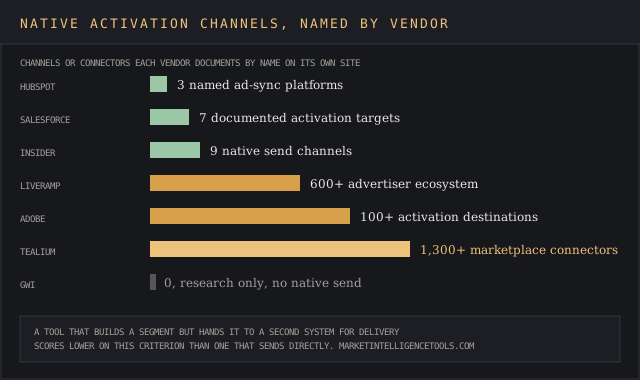
GWI scores lowest here by design. It's a research panel built for insight.
AI-assisted or natural-language segment building
The bar is a named, documented feature: Salesforce's Agentforce, HubSpot's Breeze Assistant, Adobe's Audience Agent and Insider's predictive segments all count. A vendor page calling itself an AI powered segmentation tool, or one of many AI powered segmentation tools with only a chatbot, has to name the model or rule engine behind that AI driven segmentation claim to pass.
Ask a vendor to name the model or rule engine behind an "AI-powered" segmentation claim before taking it as a criterion pass. A chatbot bolted onto a filter builder doesn't clear the same bar as Salesforce's Agentforce or Insider's predictive segments, both named, documented features.
Third-party review validation
A buyer can check this directly via G2 (or Capterra, where G2 has no listing) rating and review count.
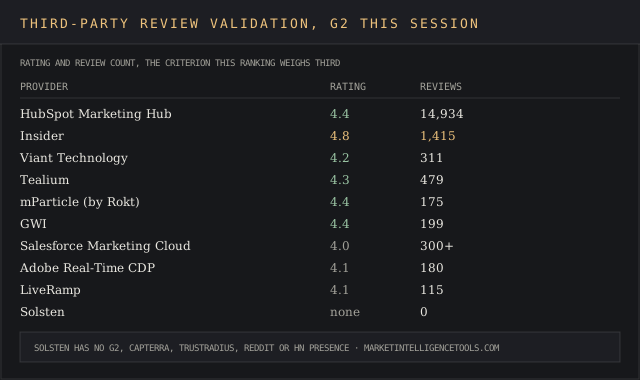
Rating alone hides sample size. HubSpot's 14,934 reviews and Viant's 311 aren't the same kind of evidence.
Vendr contract cost
Where Vendr tracks a vendor, its median contract, purchase count and range give a buyer a number to negotiate against before the first sales call.
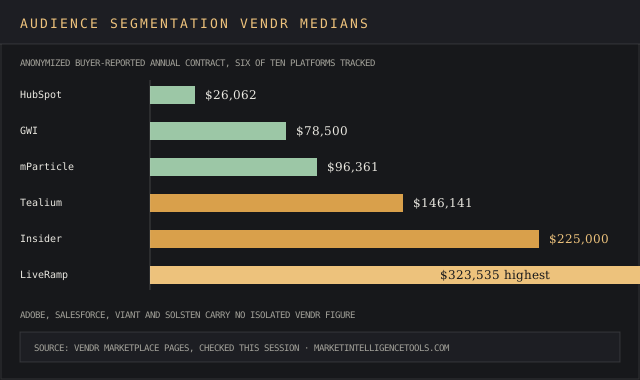
The spread between HubSpot's $26,062 Vendr median and LiveRamp's $323,535, the widest tracked gap between any two platforms in this ranking.
A twelvefold spread between the cheapest and most expensive tracked contract in this ranking.
Published pricing transparency
Four platforms here put a number on their pricing page; the other six route every quote through a conversation, priced to the account.
The 10 best audience segmentation tools, ranked
Ranked on native activation channel breadth, AI-assisted segment building, third-party review validation, Vendr contract cost and published pricing transparency, in that order.
Insider
Best fit
Teams that want one platform to build and send a segment across web, app, email, SMS/RCS and WhatsApp.
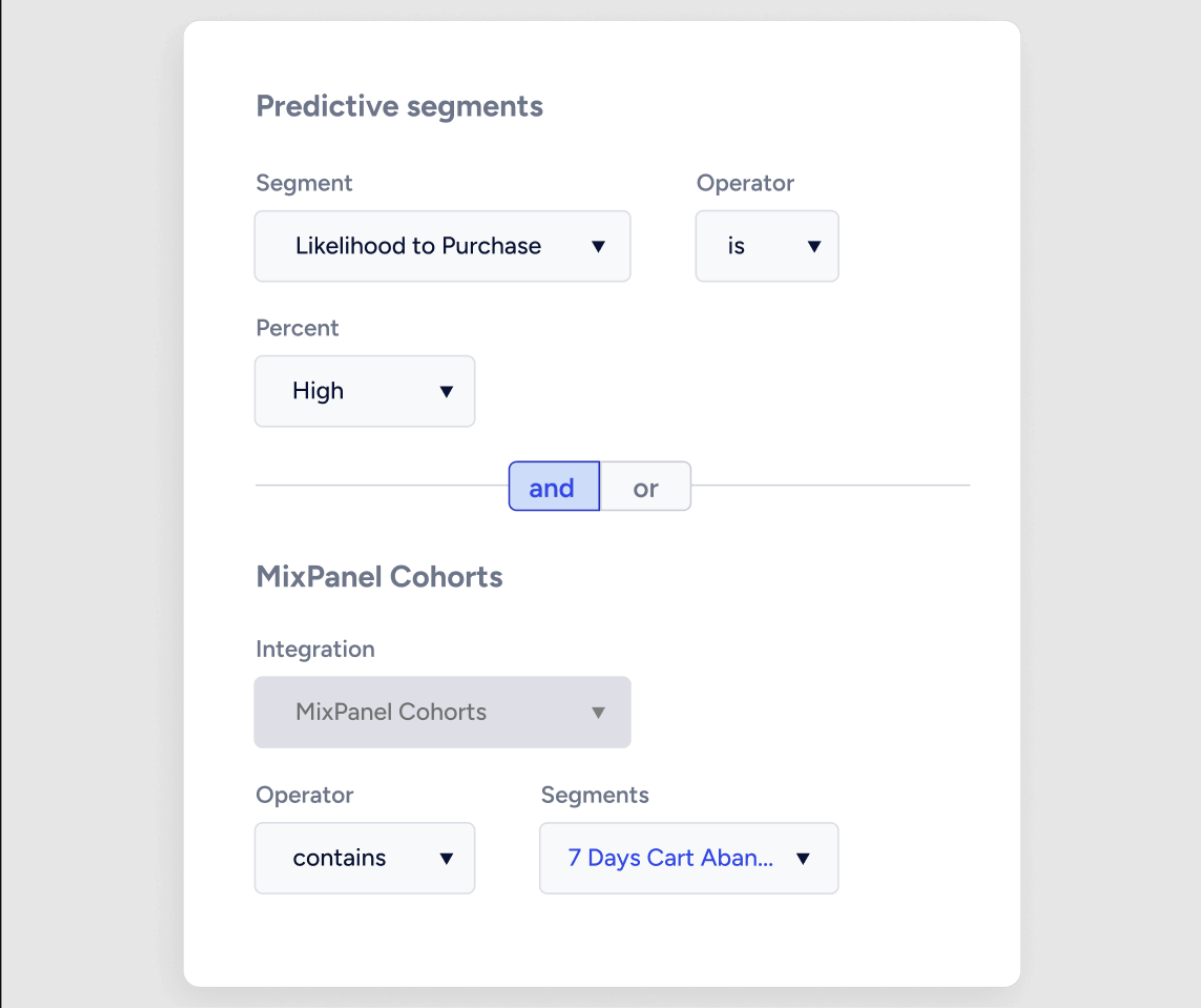
Insider is a growth platform for AI-driven audience segmentation across nine native channels: web, email, site search, conversational CX, WhatsApp, web push, InStory, app and SMS/RCS.
Key features
- Real-Time Segmentation and Predictive Segments built from 120+ rules and attributes
- Nine native send channels from one segment, no third-party relay
- 100+ integrations through an Integration Hub
- SOC 2 Type 2 examined (April 2023 to March 2024) and ISO/IEC 27001 certified
Pricing
Insider prices against Monthly Active Users. Vendr puts the median annual contract at $225,000, ranging from $150,000 to $360,000.
Pros
- Highest G2 rating here: 4.8 across 1,415 reviews
- Nine channels send natively, the most of any platform ranked here
- Predictive segments run alongside manual rules
Cons
- No published pricing; every deal starts with a sales call
- Implementation runs heavy, per reviewers
- 120+ rules can make segments hard to audit
"Initial implementation is notoriously heavy. Getting Insider One up and running can take months."Gabriel A., CRM Analyst, mid-market company, G2 review, June 2026
Why it's ranked #1. Insider's 4.8-star G2 rating across 1,415 reviews beats every platform here on review validation, and its nine channels edge out Tealium's connector-heavy setup below it.
Tealium
Best fit
Regulated enterprises that need HIPAA, ISO 27001 and SOC 2 compliance built into the identity layer.
Tealium's AudienceStream, now part of Customer Data Hub, builds real-time profiles through patented visitor-stitching technology.
Key features
- Visitor Stitching for cross-device identity resolution
- Tealium Predict ML for behavior and value forecasting
- 1,300+ marketplace connectors, 300+ included at the entry tier
- HIPAA, ISO 27001, ISO 27018 and SOC 2 Type I & II certified
Pricing
The Data Cloud Activation tier is published at $1,000 a month, billed annually, with unlimited users. The Data Collection and CDP tiers above it are quote-only. Vendr puts the median annual contract at $146,141, ranging from $20,980 to $456,878.
Pros
- One of four platforms here with a published entry price
- Compliance stack (HIPAA, ISO 27001/27018, SOC 2) is the widest here
- 1,300+ connectors give segments an activation surface
Cons
- Connector count drops to 300 at the priced tier
- Implementation ran close to 18 months for one reviewer
- Real activation and CDP tiers still require a sales call
"Tealium has become our source of truth for customer data. It gives us a single, reliable view of our customers that we use to power segmentation."Mark H., enterprise company (1,000+ employees), G2 review, April 28, 2026
Why it's ranked #2. Tealium's 1,300-plus connectors and $1,000-a-month entry tier beat Insider on pricing transparency, but its 4.3 G2 rating across 479 reviews trails Insider's 4.8 across 1,415.
mParticle (by Rokt)
Best fit
App-first brands syncing behavioral segments to ad and lifecycle-messaging partners.
mParticle, now mParticle by Rokt, builds audiences through Audience Builder and Composable Audiences, resolved by IDSync, and documents 300+ integrations including Salesforce, Snowflake, LiveRamp, Braze and The Trade Desk.
Key features
- IDSync identity resolution feeding Audience Builder and Real-Time Audiences
- Match Boost, claimed to lift audience match rates up to 2x
- 300+ integrations spanning ad platforms, warehouses and lifecycle tools
- SOC 2 Type II and ISO 27001 certified, with GDPR/CCPA/LGPD support
Pricing
mParticle runs a credit-based pricing model. Vendr puts the median annual contract at $96,361, ranging from $96,000 to $116,835.
Pros
- Second-highest G2 rating here: 4.4 across 175 reviews
- 300+ integrations cover ad activation and internal data warehouses
- Real-time audience updates forward to partners with no manual export
Cons
- A TrustRadius reviewer reported lag: "There is no way to do real-time targeting"
- No published pricing tier
- Review volume (175 on G2) is thin next to HubSpot's or Salesforce's
"The lag is really bad. There is no way to do real-time targeting."Senior data analyst, AKQA (201 to 500 employees), TrustRadius review, January 24, 2023
Why it's ranked #3. mParticle's 4.4 G2 rating and Vendr median of $96,361 give a buyer more to check than Adobe's unpublished figures below it, but its 175 reviews are a fraction of the volume above.
Adobe Real-Time CDP
Best fit
Adobe Experience Cloud enterprises that can absorb a multi-month rollout.
Adobe's Real-Time CDP unifies first, zero and cookieless third-party data into AI-scored profiles, supporting batch, streaming and edge segmentation.
Key features
- Audience Agent, a natural-language interface for building segments
- Batch, streaming and edge segmentation types in one builder
- 100+ pre-built destinations across advertising, analytics and email partners
- Profile-volume pricing metered per 1,000 profiles, with per-pack add-ons
Pricing
Pricing is set by profile volume across B2C, B2B and B2P editions. No isolated Vendr figure exists; Vendr's portfolio-wide Adobe page reports a $63,842 average contract across 894 deals, spanning Adobe's product line.
Pros
- 100+ activation destinations, the widest count here
- Audience Agent turns a written brief into segment logic
- Edge segmentation adds a speed tier batch-only competitors don't offer
Cons
- 4.1 G2 rating across 180 reviews trails every platform above it
- Implementation runs three to eight months, per reviewers
- No isolated pricing benchmark exists, vendor or Vendr
"Implementation takes a long time, usually about three to eight months."Nooruddin S., web developer, cosmetics industry, mid-market company, G2 review, July 24, 2026
Why it's ranked #4. Adobe's 100-plus destinations beat mParticle's 300 integrations on activation breadth, but its 4.1 G2 rating across 180 reviews, the second-lowest here, is why it trails mParticle.
Salesforce Marketing Cloud
Best fit
Salesforce-native enterprises building segments on the same Data Cloud records sales and service teams already update.
Salesforce Marketing Cloud's segmentation runs on a canvas inside Data Cloud: up to 50 include and 50 exclude rules per segment, restricted by logic like "at least five orders."
Key features
- Agentforce turns a written audience brief into segment attributes with no SQL
- Rapid Publish refreshes segments on a 1- or 4-hour cycle
- 200+ Data Cloud connectors, plus zero-copy Snowflake and Databricks links
- Seven activation targets, from Loyalty Cloud to external ad platforms
Pricing
Marketing Cloud Next's Growth Edition starts at $1,500 per org per month, billed annually; Advanced Edition runs $3,250. Engagement runs Pro+ at $2,000/month up to Enterprise+ at $30,000/month. No isolated Vendr figure exists; Vendr's whole-Salesforce median of $75,866 across 1,786 deals spans every Salesforce product.
Pros
- Published starting prices across the Next and Engagement lines
- Segments draw on records sales and service teams already use
- Seven native activation targets without a third-party relay
Cons
- 4.0 G2 rating, the lowest among platforms with more than 300 reviews here
- A reviewer called the data-extension learning curve "SHARP" without SQL knowledge
- Full capability requires stacking editions and add-ons
"The learning curve is SHARP. It takes awhile to truly understand how data extensions can be used, and if you don't know SQL, you're in real trouble."Verified user, insurance industry, mid-market company, G2 review, June 6, 2026
Why it's ranked #5. Salesforce publishes starting prices where Adobe doesn't, and its 200-plus connectors and seven activation targets beat HubSpot's three ad platforms below it, but its 4.0 G2 rating pulls it under Adobe's 4.1.
HubSpot Marketing Hub
Best fit
Small and mid-market teams that want segmentation bundled into the CRM they run.
HubSpot's Audience Segments builds lists from contact and company properties, website behavior and deal data, syncing directly to three ad platforms: Meta, Google Ads and LinkedIn Ads.
Key features
- Breeze Assistant generates segment filters from a plain-language description
- Active segments update membership automatically; static segments freeze at save
- Direct sync to three ad platforms without a third-party connector
- Up to 250 filters per segment, including 60 associated-object filters on Enterprise
Pricing
Marketing Hub's free plan covers up to two seats; Starter runs $7 a month per seat with 1,000 marketing contacts. Professional runs $800 a month plus a $3,000 onboarding fee; Enterprise runs $3,600 a month plus a $7,000 onboarding fee. Vendr puts the median annual contract at $26,062, the lowest here, ranging from $2,877 to $74,755.
Pros
- Largest review base here: 14,934 G2 reviews, rated 4.4
- Lowest published entry price and lowest Vendr median here
- Breeze Assistant works from a written description
Cons
- Native ad sync stops at three platforms, fewer than Insider's nine channels
- 250-filter ceiling is a cap enterprise tools don't carry
- List management gets disorganized at scale, per one small-business reviewer
"List management becomes a real headache at scale. There's no folder system or tagging to organise lists, so finding the right one means scrolling through a pile of outdated ones."Adeel M., virtual assistant, IT services company, small business, G2 review, April 28, 2026
Why it's ranked #6. HubSpot's $26,062 Vendr median is the lowest here and its 14,934 G2 reviews are the largest sample, but three native ad-sync platforms against Salesforce's seven activation targets is why it trails.
Viant Technology
Best fit
CTV and programmatic buyers who want household-level audiences built into the DSP they bid through.
Viant's Adelphic DSP builds audiences through Household ID, a cookieless identity system Viant says is "present in over 80% of bid opportunities today," resolved against more than 1.8 billion IP addresses to reach 125 million households.
Key features
- Household ID for cross-device, cookieless household identity resolution
- People-based lookalike segments matched against an advertiser's CRM lists
- 70+ data partners, including Experian, Data Axle and TransUnion
- Bid filtering that Viant says eliminates more than half of unqualified bids
Pricing
Adelphic runs a flat subscription fee; Viant's release claims customers cut DSP fees "by as much as 80 percent" versus percent-of-spend pricing. No dollar figures are published, and Viant has no Vendr listing.
Pros
- 4.2 G2 rating across 311 reviews, ahead of Adobe, LiveRamp and Salesforce
- Flat-fee pricing is a documented alternative to percent-of-spend DSPs
- Household ID reaches 125 million households without third-party cookies
Cons
- A reviewer called the interface "clunky and feels very outdated"
- No dollar figure exists anywhere, vendor or Vendr, for subscription cost
- Segmentation serves media buying, not cross-channel activation
"UI is clunky and feels very outdated, reporting section makes almost no sense."Ryan W., senior media optimization analyst, mid-market company, G2 review, May 21, 2025
Why it's ranked #7. Viant's 4.2 G2 rating beats HubSpot's per-review, but HubSpot's $7-to-$3,600 tier ladder and Vendr-tracked median give a buyer a number to plan against, which Viant's flat-fee subscription doesn't.
LiveRamp
Best fit
Enterprises building an identity layer that feeds several ad platforms and clean rooms at once.
LiveRamp's Data Collaboration Platform organizes around four portfolios: identity resolution, cross-channel connectivity, a data marketplace and clean-room measurement, and its RampID identifier is claimed to deliver "up to 50% better match rates than other identifiers."
Key features
- RampID cross-platform identity resolution across browser, app and CTV
- LiveRamp Clean Room for audience overlap, incrementality and attribution
- 600+ advertiser and brand network for data monetization and matching
- Publisher integrations including Roku, Samsung Ads, LG Ads and Snapchat
Pricing
LiveRamp's pricing page states cost scales with "the volume of data utilized and the specific actions performed with it." Vendr puts the median annual contract at $323,535, the highest here, ranging from $118,000 to $560,157.
Pros
- Deepest identity-resolution and clean-room stack here
- 600+ advertiser network for cross-platform audience matching
- Integrations with premium CTV and streaming publishers
Cons
- Highest Vendr median here at $323,535 a year
- 4.1 G2 rating across just 115 reviews, the smallest sample here
- A reviewer named an alternative: "there are more emerging tech in the space like TTD UID"
"Very expensive, and there are more emerging tech in the space like TTD UID."Enterprise marketing and advertising respondent, G2 review, January 17, 2023
Why it's ranked #8. LiveRamp's 600-plus advertiser network beats GWI's research-only reach on activation breadth, but its $323,535 Vendr median, the highest here, is why it sits below Viant's cheaper-feeling subscription.
GWI
Best fit
Brand and media strategy teams that need to research and define an audience before a campaign exists.
GWI (formerly GlobalWebIndex) is a survey-panel research platform. Its Core dataset represents more than 3 billion internet users across 53 markets, from roughly 940,000 people surveyed annually, with segments drawn from more than 50,000 profiling points per person.
Key features
- Audiences builder combining 250,000+ data points across 50+ markets
- Agent Spark, an AI assistant answering audience questions from a prompt
- GWI USA, a 240-million-person US dataset refreshed quarterly
- Specialty datasets (Sports, Automotive, Consumer Tech) on separate refresh cycles
Pricing
GWI publishes self-serve pricing: a free tier with 10 Agent Spark prompts a month, and a Plus tier at $150 a user per month, or $1,500 a year. Teams and Pro tiers are quote-only. Vendr puts the median annual contract at $78,500, ranging from $58,130 to $142,500.
Pros
- Only platform here with a self-serve free tier
- 4.4 G2 rating across 199 reviews, tied with mParticle for second-highest here
- 3 billion internet users is the broadest research panel here
Cons
- Zero native activation channels; a segment here still needs another tool to send
- A reviewer flagged thin sample sizes in secondary datasets like Auto and Luxury
- Attitudinal segmentation refreshes quarterly, not real time
"A significant problem is the too small sample sizes in the secondary datasets. For example, when we use GWI Luxury or Auto, we do not get sufficiently robust sample sizes."Laçin Serra A., marketing intern, enterprise company, G2 review, June 9, 2026
Why it's ranked #9. GWI's free tier and $150-a-month Plus plan make it the most price-transparent platform here, but zero native activation channels is why it trails.
Solsten
Best fit
Gaming and entertainment studios that need a psychological read on a player base before a launch.
Solsten builds what it calls audience intelligence for gaming, media and entertainment brands, modeling more than 275 psychological traits across 12 categories on one vendor page, and 175-plus on its Navigator footer.
Key features
- Traits, a real-time psychometric assessment shown in-product
- Navigator, a public audience-discovery tool with sample-size-backed trait data
- Elaris, an AI persona-chat tool drawing on data from 1.5 million people
- Named client results including a 60% cut in playtest acquisition cost for Playable Worlds
Pricing
Solsten's core platform is quote-only. A sub-product, Elaris Pro, published a $2,400-a-year list price on Solsten's blog before moving to a waitlist. Solsten has a Vendr marketplace listing, but the page carries no median, purchase count or range.
Pros
- Deepest psychographic specialization here, purpose-built for gaming
- Named, quantified client case studies in place of generic testimonials
- Navigator gives a buyer a public preview before any sales conversation
Cons
- No G2, Capterra, TrustRadius, Reddit or Hacker News presence found
- No pricing figure exists, including on Vendr's listing
- Trait count is stated inconsistently across the vendor's pages (275 versus 175+)
Why it's ranked #10. Every other platform here clears at least one third-party review threshold; Solsten clears none, and its Vendr listing carries no pricing data, which is why it lands last despite the deepest niche.
How audience segmentation differs from customer and market segmentation
Behavioral, demographic, psychographic and predictive segmentation are the same four core types on both sides; the data source differs. Segment or Amplitude build segments from a company's event stream (purchases, logins, support tickets); the ten platforms above build segments before that relationship exists, through an identity network like LiveRamp's, a DSP like Viant's, or a survey panel like GWI's.
This matters for buying: a team messaging existing customers from first-party data needs a customer segmentation tool; a team reaching people who've never interacted with the brand, or needing a psychological read on a market first, needs one of the platforms above.
Pricing across audience segmentation platforms
Six of the ten platforms here have a Vendr-tracked median, spreading from HubSpot's $26,062 to LiveRamp's $323,535, a twelvefold difference. The gap tracks proximity to enterprise identity infrastructure: HubSpot and GWI sell self-serve software at a real price; LiveRamp and Insider sell infrastructure and activation priced to the account.
Four platforms publish a number before a sales call: HubSpot's tier ladder, Tealium's $1,000-a-month entry, Salesforce's per-org editions, and GWI's free-to-$150 tiers. The rest route every quote through a conversation, priced to the account.
Common buying mistakes in this category
Buyers often shop audience and customer segmentation as one category, ending up with two tools for one job: Segment and Amplitude answer "who are my existing customers," while LiveRamp, Viant and Insider answer "who should I reach that isn't a customer yet." Confirming which applies avoids paying for infrastructure a CDP covers.
A second mistake weighs a G2 star rating alone: Viant's 4.2 stars across 311 reviews and LiveRamp's 4.1 across 115 look similar, but the sample sizes don't, and a rating built on a few hundred reviews moves more than one built on thousands.
GWI names zero native activation channels, by design: it's a research panel. Pair it with a separate activation platform to close the loop on a segment.
A third mistake skips the workflow question. Most audience segmentation tools build a segment on geographic, demographic or behavioral data, then hand the result to a separate system for email, social and paid delivery.
Teams running campaigns on a tight headcount should confirm, before signing, if a platform's segments plug into the ad or CRM tools already in the stack. Personalization only works when the identity layer underneath it does.
Audience segmentation tools FAQ
What is audience segmentation?
Audience segmentation is dividing a broad market into groups sharing a trait: a household reached through one identifier, a psychographic cluster, or a behavioral pattern from a survey panel. A media or growth team uses those groups to target a campaign in place of buying broad reach.
What are the four main types of audience segmentation?
Demographic segmentation groups people by age, income or location; behavioral segmentation, by actions like clicks or purchases; psychographic segmentation, by personality and values, Solsten's specialty. Predictive segmentation forecasts behavior with machine learning.
What tools are used for segmentation?
Identity platforms like LiveRamp unify audience data across ad networks; DSPs like Viant build household-level segments for media buying; growth platforms like Insider build and activate segments across channels; research platforms like GWI define audiences from survey data pre-campaign.
Why is audience segmentation important?
A Matomo-cited survey put the share of internet users who expect a personalized experience at 81%; machine learning drives that personalization, forecasting behavior in place of describing the past. Segmentation tools control acquisition cost by targeting a defined group over a broad audience.
How is audience segmentation different from customer segmentation?
Customer segmentation splits people already inside a company's data; audience segmentation can start before that relationship exists, built from an identity network, a media-buying platform or a survey panel.
What should a buyer look for before choosing an audience segmentation tool?
A buyer should confirm four things before signing: how the platform prices against actual usage, which channels it sends to natively, how it handles the first party data the company already owns, and how fast a segment updates once customer behavior changes. Reviewers on G2 and Capterra flag customer lifetime value modeling and predictive segmentation as the features that separate a platform worth the contract from one that only reports data points after a campaign ends.
How do audience segmentation tools differ for small and enterprise teams?
Pricing and support scale differently for mid market brands than for enterprise accounts. HubSpot and GWI publish paid plans a small team can self-serve. Insider, LiveRamp and Tealium sell priority support and phone support mostly on enterprise contracts, and every vendor here handles a particular segment definition differently depending on contract size.
Bottom line
These ten platforms split by what they're built to do first: Insider, Tealium and mParticle build and activate a segment inside one product, Insider's 4.8-star G2 rating and Tealium's 1,300-plus connectors putting both ahead of the rest on review validation and channel reach.
Adobe and Salesforce bring segmentation as one module in a larger suite; HubSpot wins on price and review volume but caps at three ad channels and 250 filters, a ceiling for teams that outgrow list-based segmentation.
Viant, LiveRamp and GWI serve three different jobs: media buying, identity infrastructure and pre-campaign research. Solsten's psychographic depth is real, but zero third-party review validation is a risk none of the other nine platforms here ask for.