Data buying companies in 2026: 10 vendors ranked for buying data in bulk
 By Jan Suski. I go deep on every review, checking every number against its source and digging up details other coverage misses, a habit from six years of SEO and link building for tech companies. Bylines at Brand24 and Senuto. How the scoring works.
Quick comparison of data buying companies
The table below holds one row per ranked vendor, in rank order, with the published coverage figure, the entry price, and the buyer this one fits best. Figures come from each vendor's own domain or from Vendr's anonymized buyer data where the vendor itself publishes no number; medians marked with an asterisk are Vendr's, everything else is the vendor's own published figure.
| # | Provider | Published coverage | Entry price | Best fit |
|---|---|---|---|---|
| 1 | Dun & Bradstreet Data Cloud | 400M+ business records | $41,400/yr median* | Enterprise buyers needing one authoritative global company ID |
| 2 | AWS Data Exchange | 300+ providers, 3,500+ datasets | 1,000+ datasets free | Engineering teams wanting many vendors under one AWS bill |
| 3 | Snowflake Marketplace | 820+ providers, 3,400+ listings | Free to browse and list | Teams on Snowflake wanting live, zero-copy data shares |
| 4 | Coresignal | 907M+ employee profiles, 70M+ companies | $49/mo API | Engineering teams building their own GTM or AI product on fresh web data |
| 5 | People Data Labs | 20 credits per multi-source record | $98/mo, 350 credits | Startups needing a self-serve identity data API |
| 6 | Bright Data | 14 dataset categories, daily refresh option | $2.50 per 1,000 records | Teams needing custom public web datasets across many verticals |
| 7 | Oxylabs | 1,000+ datasets, 21B+ records in marketplace | $250 minimum order | Budget-conscious teams needing one-off bulk datasets |
| 8 | Enigma | Every US business resolved to one identity graph | Quote only | Fintech and KYB teams needing verified small-business identity data |
| 9 | LiveRamp Data Marketplace | 200+ data sellers, 650+ partners | $323,535/yr median* | Marketers activating consumer audience data into ad platforms |
| 10 | NielsenIQ | Retail panel and point-of-sale data, enterprise scale | Quote only | CPG and retail teams needing syndicated market-share data |
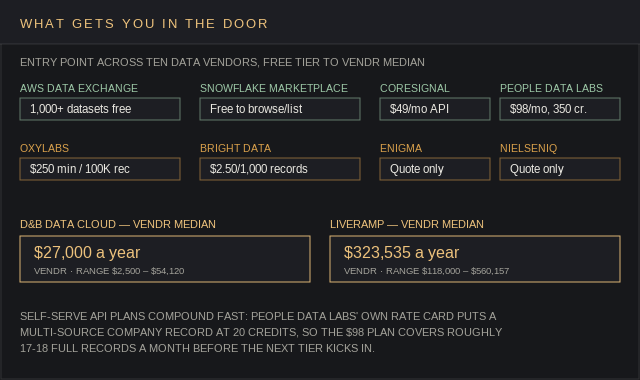
Medians marked * are anonymized buyer-reported contract values published by Vendr. Everything else is the price the vendor publishes itself.
Where these figures come from
Coverage counts are each vendor's own published figure, read on 13 October 2026. Medians marked * are Vendr's anonymized buyer-reported contract values for Dun & Bradstreet and LiveRamp. Neither Enigma nor NielsenIQ publishes a price or has a Vendr header median on record, so neither row claims one.
This page sits in our data providers guide, one of the categories that split the market by what the record describes. If the actual need is contact-level enrichment for an SDR team, our B2B data providers ranking judges a different, overlapping set of vendors against that workflow instead.
Every team that outgrows manual research eventually asks the same question: where do you buy data outright, avoiding the work of standing up scrapers or hiring analysts to copy it out of filings by hand? The answer is a small set of data vendors that sell records outright. They ship a dataset, a bulk file, or an API key, and the contract covers the data itself, no dashboard attached.
This guide ranks ten of them: generalist data vendors and marketplaces built to sell structured records at volume, no sales-contact platforms built to run outbound campaigns here. The ten span business records, public web data, consumer data, and syndicated retail panels, because data buying is a purchasing motion that cuts across data types.
A company buying 400 million business records from Dun & Bradstreet and a brand buying retail panel data from NielsenIQ are both buying data in the sense this page cares about; they sit on the same page because the evaluation questions are the same: what does the record cost, how is it delivered, and can you verify the number before you sign.
We cover entry price, delivery format, data coverage and compliance documentation for each entry, with at least one sourced figure and one buyer or customer quote per vendor, and we flag every vendor whose pricing requires a sales call before you can compare it against a published number.
None of this replaces a data collection process you already run. External data from a vendor on this list sits beside internal data, your own CRM, your own analytics, your own contact database, and leaves it in place; the right-data-provider question comes down to which gap in your own data collection a given vendor closes.
Evaluation criteria for choosing a data vendor
Five criteria decide the shortlist, and the ranking below applies them in this order. None of the five rest on a vendor's own market analysis of its category; each one is checkable against a public page or a sample pull.
Delivery format and refresh cadence
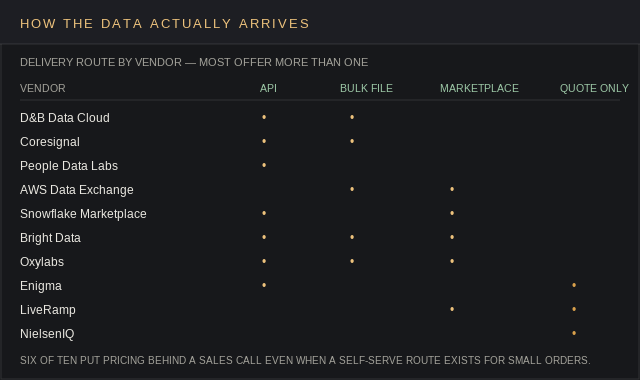
A buyer should be able to name, in one sentence, which of three routes the data arrives by (an API call, a bulk file drop, or a live marketplace share) and how often it refreshes. Coresignal states daily, weekly or monthly refresh depending on dataset; Bright Data offers a refresh subscription that cuts the per-record rate on repeat pulls. A vendor that won't commit to a refresh cadence in writing fails this test regardless of record count.
Discount Bright Data offers on a repeat pull through its refresh subscription against the one-time rate.
Price on record versus quote only
Four of the ten publish a number you can act on without a sales call: Coresignal's API tiers, People Data Labs' credit pricing, Bright Data and Oxylabs' per-record and minimum-order figures. The other six, including Enigma, LiveRamp and NielsenIQ, require a quote, and we use the Vendr median where Vendr has anonymized buyer data for that vendor.
Coverage breadth against a stated baseline
A record count only means something against a named baseline: 400 million business records, 907 million employee profiles, 21 billion marketplace records. We require the vendor to publish that number on its own domain; inferring it from a listicle doesn't count. Where no number exists, the ranking says so and leaves it at that, without a made-up estimate.
Never buy on the first data sample the vendor picks. Give them your own 50 known accounts and score fill rate and accuracy against ground truth your team can check.
Compliance documentation on the data itself
GDPR and CCPA documentation has to describe the dataset being sold itself, no vendor website cookie policy standing in for it. Bright Data publishes compliance notes per dataset; several of the enterprise-quote vendors here bury this inside a master services agreement a buyer only sees after signing intent to purchase.
Privacy law also varies by jurisdiction: California's Delete Act requires every data broker operating in the state to register with the CPPA, and a vendor missing from that public registry while claiming to sell into California is a documentation gap worth flagging before the contract is signed.
Independent review validation
Several of these data providers barely exist on G2, Capterra or TrustRadius, because their buyers are developers and procurement teams, with few end users filling out review surveys. A thin review footprint isn't disqualifying on its own, but it means the only verification available is a verified-buyer quote on a data marketplace listing, no star rating attached, and we treat that distinction as real, a difference in kind more than degree.
A criterion only counts if a reader could run the test and get a yes, a no or a number. Ask for the refresh cadence in writing and the compliance documentation for the specific dataset; the vendor's general privacy policy doesn't count as that.
Top 10 data buying companies, ranked
Dun & Bradstreet Data Cloud
Best fit
Enterprise buyers who need one authoritative business identifier covering nearly every company on earth.
D&B's Data Cloud passed 400 million business records in 2026, up from 355 million earlier the same year, a 33% increase over two years built mostly from small and emerging businesses in China, India and Brazil. The foundation is public filings pulled from tens of thousands of sources and tens of millions of websites, resolved under the D-U-N-S Number system D&B has run since 1963.
Contact data coverage inside the Data Cloud tripled over the same two-year window, and the company now maps millions of B2B relationships, including corporate family trees that show which subsidiary belongs to which parent. That resolution layer is the actual product: raw records are commodity, and knowing that a vendor's billing entity and its operating entity are the same company isn't.
Key features
- D-U-N-S Number identity resolution across 400M+ business records worldwide.
- Corporate family tree and B2B relationship mapping between parent and subsidiary entities.
- Delivered via API, bulk file, and inside AWS Data Exchange and Snowflake Marketplace as a managed listing.
- Risk, credit and compliance scoring layered on top of the core firmographic record.
- Historical data back decades for established businesses, useful for trend and funding-data research.
Pricing
Vendr's anonymized buyer data, based on 109 purchases, puts the median D&B contract at $41,400 a year, with a range from $6,922 to $147,552 depending on record volume and which modules are attached. D&B itself quotes by dataset and delivery method, no published rate card.
Pros
- Broadest global database here by a wide margin, with the fastest growth in regions rivals under-cover.
- Entity resolution and family-tree mapping no competitor on this list matches.
- Distributed through AWS Data Exchange and Snowflake Marketplace, so existing cloud billing covers it.
Cons
- Coverage still thins out for the smallest companies, the exact segment D&B says it is expanding fastest.
- No published rate card; every contract starts with a sales conversation.
- Historical reputation issues around credit-report accuracy for small businesses persist in buyer conversations.
"It seems to miss the smaller companies."
Sakshi, Information Technology & Services, Capterra review of D&B Hoovers, 14 January 2026
Why it's ranked #1. 400 million records and a B2B relationship graph nothing else here offers put it ahead of AWS Data Exchange on authority, even though AWS Data Exchange beats it on sheer provider count.
AWS Data Exchange
Best fit
Engineering teams who want many data providers under one AWS billing relationship, no ten separate contracts to manage.
Not a data vendor in its own right, AWS Data Exchange is a marketplace layer: it lists over 300 data providers and more than 3,500 third-party datasets, including over 1,000 free datasets, inside the AWS console. D&B, and several other data providers on this list, distribute through it as a secondary channel.
The appeal is procurement over coverage. A team already buying AWS compute can subscribe to a dataset the same way it provisions an S3 bucket, with usage flowing through the same invoice. That consolidation matters more at scale than it sounds: a data team running five data providers through one AWS contract avoids five separate security reviews and five separate renewal cycles.
Key features
- 300+ data providers and 3,500+ third-party datasets in one catalog, with 1,000+ available free.
- Subscriptions provision like any other AWS resource, billed through the existing AWS account.
- Data lands directly in S3, Redshift or an API Gateway endpoint without a separate delivery pipeline.
- Providers set custom pricing per dataset, including usage-based pricing for API-delivered data.
- Works as a resale channel for data providers that don't want to build their own billing and delivery infrastructure.
Pricing
AWS sets no price itself; pricing is set per provider per dataset, and the free datasets cost nothing beyond standard AWS storage and compute, while paid listings range from a few hundred dollars to enterprise-scale contracts billed the same way as any other AWS service.
Pros
- More than 1,000 free datasets make it the cheapest real entry point on this list.
- Consolidated billing and security review across many data providers at once.
- Data delivery is native to AWS infrastructure, so no separate pipeline work is required.
Cons
- A seller-side reviewer called the console "confusing, buggy and misleading," with weak account verification on subscription requests.
- Delivering a dataset to a buyer without an AWS account is awkward and sometimes requires workarounds.
- AWS itself does no quality control on any individual listing; that due diligence is still the buyer's job.
"Confusing, buggy and misleading UX. Little verification of accounts requesting subscriptions."
Ike Bennion, General Manager of Product-Led Growth, Visier Inc., TrustRadius review, 3 December 2022
Why it's ranked #2. 300+ providers and 3,500+ datasets beat every other marketplace here on raw provider count, but a documented account-verification gap keeps it below D&B's single-vendor authority.
Snowflake Marketplace
Best fit
Teams already running Snowflake who want live, zero-copy data shares, no batch file to re-import.
Snowflake Marketplace connects buyers to more than 820 data providers and over 3,400 listings, described by Snowflake as live, AI-ready data, agents and integrated SaaS tools, no static exports among them. The distinction from AWS Data Exchange is architectural: a Snowflake share updates in place inside the buyer's own account, with no file transfer step and no stale copy sitting in a bucket.
That live-share model is why several of the business and consumer data vendors elsewhere in this ranking, D&B included, list a Snowflake-native product alongside their own API. For a data team that has already centralized its warehouse on Snowflake, pulling a new dataset in is closer to granting a permission than running an ETL job.
Key features
- 820+ data providers and 3,400+ live listings inside the Snowflake Data Cloud.
- Zero-copy data sharing: the buyer queries the provider's data in place, with no import pipeline.
- Listings include AI-ready structured data, autonomous agents and packaged analytics apps, well beyond raw tables.
- Providers set custom pricing and usage terms per listing, including free-to-browse tiers.
- Native governance and access controls carry over from the buyer's existing Snowflake account.
Pricing
Browsing and listing on Snowflake Marketplace costs nothing; buyers pay the per-listing price each provider sets, which on data-heavy listings is usually usage-based pricing against Snowflake compute credits, no flat subscription.
Pros
- Largest provider count of any marketplace on this list at 820+.
- Live data shares eliminate the stale-copy problem that comes with batch files.
- One reviewer called the marketplace "well thought out," with an easy-to-implement data connector fabric.
Cons
- Only useful if the buying team already runs its warehouse on Snowflake; there's no standalone delivery route.
- Snowflake gives no published figure for how many of the 3,400+ listings are live data versus packaged apps.
- Usage-based pricing against compute credits makes cost harder to forecast than a flat per-record rate.
"Snowflake Marketplace is well thought out and the data connector fabric is easy to understand and implement."
Verified Reviewer, Security Sr. Manager, Architecture & Planning, Capterra review, 10 September 2021
Why it's ranked #3. 820+ providers is the largest count on this list, but the live-share model only pays off for buyers already on Snowflake, which is why it sits behind AWS Data Exchange's broader standalone reach.
Coresignal
Best fit
Engineering teams building their own GTM tool, AI product or research pipeline on fresh public web data, no finished SaaS platform required.
Coresignal sells structured datasets scraped from the public web: 70 million-plus company records and more than 907 million employee profiles, built from 15-plus web sources and updated daily, weekly or monthly depending on the dataset. Job postings add another 482 million records. It's the clearest example on this list of buying raw structured data over a finished sales tool, the distinction this whole ranking turns on.
Delivery splits two ways: full bulk datasets starting at $1,000 for a negotiated contract, or a metered Database API priced from $49 a month for 2,500 credits, where a multi-source company or employee record costs 20 credits and a job posting costs one. That tiering means a small team can start on the API and move to a bulk license once volume justifies it, without switching vendors.
Key features
- 907M+ employee profiles and 70M+ company records, sourced from 15+ public web sources.
- 482M+ job postings, refreshed daily, weekly or monthly by dataset.
- Database API with per-record credit pricing, separate from the bulk dataset product.
- JSON and CSV delivery, with historical data snapshots available on request.
- Company, Employee, Jobs and an Agentic Search API sold as discrete data products.
Pricing
API plans run from $49 a month for a Mini tier (2,500 credits) up to $5,000 a month for 10 million credits on the Elite tier, with a 10% discount on annual terms. Full bulk datasets start from $1,000, with the final price set by record count and contract length.
Pros
- Clear, published credit pricing from a $49 entry point, rare among data providers this size.
- Employee-profile volume at 907M+ is the largest single figure in this ranking.
- A verified buyer called the data a match for "all our data quality and data volume requirements."
Cons
- One verified buyer flagged that some profiles marked deleted aren't deleted at all, a data hygiene gap worth testing before a large purchase.
- Raw datasets need real pre-processing to normalize before they're usable downstream.
- Almost no footprint on G2, Capterra or TrustRadius; verification runs through marketplace reviews more than mainstream review sites.
"Coresignal meets all our data quality and data volume requirements."
Verified Buyer, Datarade profile review
"We see some deleted profiles which are actually not deleted but are marked deleted by Coresignal."
Verified Buyer, Datarade profile review
Why it's ranked #4. 907 million employee profiles at a published $49 entry price beats every other API-first vendor here on volume per dollar, but it loses to the three marketplaces above it on total provider breadth.
People Data Labs
Best fit
Startups and small data teams who want a self-serve identity data API without a sales call for the first contract.
People Data Labs sells person and company data through a developer-first API, with a free tier capped at 100 credits a month and contact fields obfuscated, and a self-serve Pro plan starting at $98 a month for as few as 350 credits. Volume discounts trigger automatically as usage grows, and annual commitments get 20% off with the full year of data accessible upfront.
The positioning is explicitly technical: PDL markets itself on API design and Elasticsearch-style querying over a polished sales UI, which is why its own pricing page measures usage in records retrieved per month, no stated total dataset size given. That's a deliberate trade: buyers get granular, queryable access to identity data, no dashboard showing database size.
Key features
- Person and company data API with Elasticsearch-style query syntax.
- Self-serve Pro tier from $98/month, enterprise tier on custom pricing.
- Free tier with up to 100 credits a month, no commitment, with contact fields withheld.
- Volume-based pricing that discounts automatically as monthly usage grows.
- Bulk access available on annual terms, with the year's data accessible upfront.
Pricing
Pro starts at $98 a month for 350 credits; Enterprise is custom pricing. Annual commitments save 20% against the monthly rate. PDL does not publish a single price-per-record figure, since credit cost varies by record type and match confidence.
Pros
- Lowest genuinely self-serve entry price among the API-first data providers on this list.
- Reviewers single out fast, responsive customer service alongside the data itself.
- Free tier lets a team test match quality before committing a card.
Cons
- Free tier withholds contact fields, so real evaluation requires paying first.
- No published total dataset size, unlike Coresignal's stated 907M profile figure.
- Entry-level credit volume is thin; a few hundred lookups a month exhausts the $98 tier quickly.
"People Data Labs is a great source for business owners and sales teams to get quality data."
Bhargav P., G2 review via SaaSworthy, 1 November 2023
"Great and fast customer service and very valuable data."
Anonymous user, G2 review via SaaSworthy, 3 February 2022
Why it's ranked #5. A $98 self-serve floor undercuts Coresignal's bulk product on commitment size, but Coresignal's published 907M-profile figure and lower per-credit API floor keep it one place ahead.
Bright Data
Best fit
Teams that need a custom public web dataset across a specific vertical, priced by the record, no seat pricing involved.
Bright Data's Datasets product sells structured data scraped from public websites across business, ecommerce, social media, real estate, travel and several other categories, starting at $0.0025 a record with a $250 minimum order, which works out to $2.50 per 1,000 records. Subscription volumes run from 100,000 up to 20 million records, with a 3TB Complete option for the largest buyers.
Our real estate data providers ranking covers Bright Data's property-listing dataset specifically; here the relevant point is that the same pricing and delivery model extends across every category Bright Data lists, which is the generalist case for including it in a data-buying roundup, no single-vertical case needed.
Key features
- 14 dataset categories including business, ecommerce, social media, real estate and travel data.
- Per-record pricing from $0.0025, with a $250 minimum order for smaller pulls.
- Subscription volume tiers from 100K to 20M records, plus a 3TB bulk option.
- Refresh subscriptions cut the per-record rate by up to 80% on repeat pulls.
- JSON, CSV or Parquet delivery, with GDPR and CCPA compliance documentation per dataset.
Pricing
$2.50 per 1,000 records at the base rate, with a $250 minimum order. A refresh subscription on the same dataset cuts the effective rate by as much as 80%. Vendr's anonymized buyer data separately puts Bright Data's broader contract median at $27,000 a year across its full product line, beyond the Datasets product alone.
Pros
- Cheapest published per-record rate among the dataset-specific data providers here.
- Refresh subscriptions make repeat purchases materially cheaper over time.
- One reviewer cited "a much lower error rate compared to other solutions available."
Cons
- 14 broad categories mean depth within any single one trails a specialist vendor built around it.
- Normalizing scraped data into a usable schema is still the buyer's job.
- Compliance documentation is per dataset, so a buyer running several categories tracks several policies, no single one covering all of them.
"I really like that Bright Data has a much lower error rate compared to other solutions available."
Pasha, Internet industry, Capterra review, 25 February 2026
Why it's ranked #6. A $2.50-per-1,000-record rate beats Oxylabs' comparable entry price, and the refresh-subscription discount is a real figure Oxylabs doesn't publish, which is why it ranks one place above it.

Price your own dataset pull
Sign up for Bright Data
Datasets start at $2.50 per 1,000 records with a $250 minimum order, and a refresh subscription cuts that rate by up to 80% on repeat pulls.
 Visit Bright Data →
May earn a commission if you sign up through this link, at no extra cost to you. Full affiliate disclosure.
Oxylabs
Best fit
Budget-conscious teams who need one bulk dataset now and don't need a recurring refresh contract.
Oxylabs runs a datasets marketplace listing 1,000-plus datasets and more than 21 billion total records across business, ecommerce, real estate, travel, job listings, financial, news and several other categories. Standard datasets start from $400 a month on fixed delivery schedules, and custom datasets start from $800 a month with daily, weekly, monthly or quarterly delivery built to spec.
The pitch is outcome-based pricing: Oxylabs says buyers pay for the specific data points they need, no flat per-GB rate charged, though the exact unit economics still require a sales conversation. For a one-time pull, no ongoing feed, that custom-quote model is less convenient than Bright Data's published per-record rate, but the 21-billion-record marketplace gives it more raw inventory to draw from.
Key features
- 1,000+ datasets and 21B+ total records across the marketplace.
- Standard datasets from $400/month, custom datasets from $800/month.
- JSON, CSV, Parquet or XML delivery via SFTP, S3, Google Cloud, Azure or Cloudflare.
- Outcome-based pricing model: pay for the data points required, no flat volume rate.
- Coverage spans business, ecommerce, social media, real estate, travel, financial, news, government, scientific and local business data.
Pricing
Standard datasets start at $400 a month; custom datasets start at $800 a month. Oxylabs doesn't publish a flat per-record rate the way Bright Data does, so exact unit cost depends on the dataset negotiated with sales.
Pros
- 21B+ records across the marketplace is the largest total-record figure in this ranking.
- Broadest category list of any single vendor here, at 14-plus data types.
- A reviewer praised support as "truly great, always available to chat and answer my questions."
Cons
- A reviewer flagged "premium pricing, which might be a barrier for smaller businesses or individual users."
- No published flat per-record rate, unlike Bright Data's $2.50 per 1,000.
- Outcome-based pricing is hard to budget against before the first quote lands.
"The only downside is their premium pricing, which might be a barrier for smaller businesses or individual users."
Mangane A., CFO, Building Materials, Capterra review, 24 November 2024
Why it's ranked #7. 21 billion records is the largest total on this list, but the lack of a published per-record rate puts it a notch below Bright Data's clearer $2.50-per-1,000 pricing.
Enigma
Best fit
Fintech, payments and KYB teams that need verified small-business identity data, no firmographic volume play.
Enigma's core product is an Identity Graph built to resolve every US business, including the smallest ones most other data providers on this list under-cover, to one current profile. The inputs are Secretary of State filings, IRS records, web crawling, legal filings, card revenue signals, industry and activity data, associated people, and watchlist screening, aimed squarely at onboarding, KYB and payment-risk use cases, no general sales prospecting.
That specialization is the trade-off: Enigma doesn't compete with D&B or Coresignal on raw record count, because it isn't trying to. It competes on resolving identity for exactly the segment, small and newly formed US businesses, that broader data providers say they're still catching up on.
Key features
- Identity Graph resolving US businesses to a single, current profile.
- Inputs include Secretary of State filings, IRS records, legal filings and card revenue signals.
- Watchlist and associated-people screening built for KYB and onboarding workflows.
- GraphQL API with a console for exploring the data before integration.
- Government and Gov Archive data products alongside the core business data product.
Pricing
Enigma publishes a pricing page, a rate card and segment pricing, but none of the three states a number without a sales conversation; buyers get custom pricing after describing their use case.
Pros
- Strongest small-business identity resolution of any vendor in this ranking.
- Purpose-built for KYB and onboarding, where generalist firmographic data falls short.
- A console lets buyers explore the data before committing to API integration.
Cons
- No published pricing anywhere on the site, three different pricing pages deep.
- Narrow focus means it's the wrong buy for anyone needing broad international coverage.
- Thin independent review footprint outside vendor-published case studies.
"The best thing about it is the center of public data where companies can benefit from a lot of resources."
Verified user, Financial Services, Mid-Market, G2 review, 18 January 2023
Why it's ranked #8. Oxylabs and Bright Data both publish a price before Enigma will even state one, and that gap, more than coverage quality, is what keeps a specialist identity vendor behind two generalist dataset sellers.
LiveRamp Data Marketplace
Best fit
Marketers who need third-party consumer audience data activated straight into ad platforms, no raw records to warehouse.
LiveRamp's Data Marketplace connects buyers to more than 200 trusted data sellers and 650-plus partners, activating segments into over 500 destinations, the ad platforms, DSPs and martech tools where a marketing team spends its media budget.
Experian's ConsumerView data was one of the earliest third-party datasets offered this way, a pattern most consumer data vendors on LiveRamp still follow: license the underlying data, let LiveRamp handle identity resolution and activation.
That activation layer is the point of paying LiveRamp's price. A marketer doesn't need the raw consumer records; they need a segment that resolves against their own first-party data and then pushes into a buy, and LiveRamp's pricing, and buyer base, reflects a platform fee for that pipeline, no per-record data cost.
Key features
- 200+ vetted data sellers inside the Data Marketplace.
- 650+ partners and over 500 activation destinations across ad platforms and martech tools.
- Identity resolution that matches third-party segments against a buyer's own first-party data.
- Established consumer data partners, Experian's ConsumerView among the earliest, distributed through the same pipeline.
- Clean-room style data collaboration for buyers who need to combine data without handing over raw records.
Pricing
Vendr's anonymized buyer data puts the median LiveRamp contract at $323,535 a year, with a range from $118,000 to $560,157, the highest price band in this ranking by a wide margin. LiveRamp itself doesn't publish a rate card.
Pros
- Broadest consumer-data activation network on this list, at 500+ destinations.
- A long-tenured corporate customer described it as a way to identify third-party data segments cleanly against first-party data.
- Established partner roster reduces the data-sourcing risk of a newer consumer data vendor.
Cons
- Highest entry price in this ranking, a six-figure median contract.
- Built for activation into ad platforms, no fit for a team that just wants raw consumer records to analyze.
- Consumer data brokerage has drawn regulatory and privacy-class-action scrutiny industry-wide, LiveRamp included.
"We leverage LiveRamp's data store to identify third-party data segments."
Co-founder and Managing Director, Corporate, PrograMetrix, TrustRadius review, 8 July 2021
Why it's ranked #9. A $323,535 median contract, roughly twelve times D&B's median, only makes sense for the specific activation workflow it's built for, which is why a far cheaper, narrower KYB specialist in Enigma still ranks ahead of it.
NielsenIQ
Best fit
CPG and retail teams that need syndicated market-share and point-of-sale data no self-serve vendor on this list replicates.
NielsenIQ sells retail panel and point-of-sale data built from decades of category tracking, the syndicated benchmark most CPG brands still measure market share against.
The 2026 expansion of its Homescan panel added categories available for monthly analysis in markets including Singapore and Hong Kong, and its Full View measurement product added the largest US club retailer to its coverage in 2025, both signs that the underlying panel keeps growing, no standing still on a legacy dataset.
What sets NielsenIQ apart from everything else on this list is that its data describes consumer purchase behavior at the point of sale, no companies, people or web content involved.
That's a different subject entirely from the business and identity data the other nine vendors sell. It's the reason NielsenIQ belongs at the bottom of a generalist data-buying ranking, no disqualification from it: a brand buying retail panel data is still buying data, just a different kind than a startup engineering team is shopping for.
Key features
- Retail point-of-sale and panel data covering CPG category sales at scale.
- Homescan consumer panel, expanded into new categories across multiple Asian markets in 2026.
- Full View measurement, extended to include major US club retailers.
- A century of category-tracking history underpinning current market-share benchmarks.
- Connect partner network for integrating NIQ data into a brand's existing analytics stack.
Pricing
NielsenIQ does not publish pricing; every engagement runs through a sales conversation, and Vendr's price-check tool shows no anonymized buyer data for NielsenIQ specifically, unlike the figures available for D&B, LiveRamp and Bright Data.
Pros
- Syndicated retail panel data no self-serve API vendor on this list offers.
- A long operating history gives its market-share benchmarks real staying power with CPG buyers.
- Panel coverage is actively expanding into new markets and categories, no stagnation.
Cons
- No self-serve entry point and no published price at any tier.
- Data describes consumer purchase behavior, no businesses or people covered, so it doesn't substitute for anything else on this list.
- Enterprise sales cycle makes it the slowest vendor here to get live.
"They have the most accurate data in the world."
Verified reviewer, Capterra review of Nielsen's data tools, 9 May 2018
Why it's ranked #10. It answers a different question than the other nine, consumer purchase behavior, no business or identity data covered, and with zero price transparency against nine data providers that each publish at least a Vendr median or a rate card, it sits last.
Why companies buy data over collecting it themselves
Scraping data in-house requires real upfront engineering investment: proxy infrastructure, parsing logic that breaks every time a target site redesigns, and a data quality team to catch what the scraper missed. Buying data from an established data vendor trades that build cost for a subscription, and for most teams the trade favors buying the moment internal tooling would need more than one dedicated engineer to maintain.
The cost of getting this wrong is measurable: poor data quality costs organizations $12.9 million a year on average, and 28% of B2B email addresses go stale annually, numbers that explain why a refresh cadence matters more than the initial record count.
Estimated annual cost of poor data quality to an organization, per Coresignal's buying-data research.
Buying also closes a compliance gap self-collection often leaves open, the same reason a procurement team comparing several data providers side by side usually asks for compliance documentation before it asks about price.
A vendor selling structured data at scale, Bright Data and Coresignal both publish GDPR and CCPA documentation per dataset, has usually already built the compliance review a buyer's own legal team would otherwise have to run from scratch on a freshly scraped dataset.
The trade-off runs the other way too: buying means depending on someone else's refresh cadence and someone else's definition of a clean record. A team with a genuinely unusual need, a niche vertical no vendor here covers, for instance, may still be better off building. For the other 90% of buyers, the vendor relationship is faster and, past a certain volume, cheaper than the in-house alternative.
Types of data sold by these vendors
The ten vendors above sell at least six distinct categories of data, and knowing which one a buyer needs narrows the shortlist fast. None of them package their catalog the way a seat-priced B2B data vendor does; the pricing model here is per record or per contract, no per-login seat, which is also why none of the ten should be confused with the B2B data providers selling access to a CRM-style platform.
Contact data
Names, emails and phone numbers tied to a person at a company. None of the ten vendors above lead with contact data the way our B2B data providers ranking covers; People Data Labs and Coresignal both sell it as one field set among several, no whole-product play. If the actual need is seat-based B2B data providers selling contact-level enrichment for an SDR team, that sibling ranking is the better starting point than this page.
Firmographic data
Industry, size, revenue and location describing a company as a legal entity. D&B, Enigma and Coresignal all sell this, with D&B's family-tree resolution the deepest version of it here.
Technographic data
What a company runs: its CRM, cloud provider, analytics stack. Several of these vendors fold technographic signals into a broader company record, no standalone sale; our technographic data providers ranking covers the specialists. Buying technographic data in bulk from a generalist on this page usually means a wider but shallower field set than a dedicated technographic vendor provides.
Intent data and intent signals
Behavioral signals showing which accounts are actively researching a category. LiveRamp's activation network carries third-party intent and buyer intent data from publisher co-ops into ad platforms. None of the ten vendors above sell intent data as a standalone product, so a buyer shopping specifically for intent data should start with our dedicated intent data providers ranking, which covers the specialists in depth.
Consumer and retail data
LiveRamp and NielsenIQ both sell data about people as consumers, no company-as-entity framing, licensed audience segments on one side and retail panel and point-of-sale data on the other. For US small-business and household mailing lists, our Data Axle review covers Salesgenie, list accuracy and contract terms.
Structured public web data
Bright Data, Oxylabs and Coresignal all sell structured data collected from the public web at scale, the category that barely existed as a line item a decade ago and now anchors three of the ten entries on this list.
Delivery format varies by vendor: JSON and JSONL are the formats most of them use for structured records, CSV remains common for straightforward data exchange and storage, and raw HTML delivery shows up for buyers who want to parse page structure themselves.
Signals increasingly bundled alongside the core record
A decade ago, a data vendor sold one table: a contact database, or a company list, full stop. The ten vendors here increasingly bundle adjacent signals into the same contract, and knowing what's included versus what needs a separate line item changes the real price.
Hiring trends and funding data show up inside several firmographic feeds now, no separate product required: D&B and Coresignal both layer hiring-trends and funding-data fields on top of the base company record, because a revenue team reading employee count against hiring trends gets an earlier signal than either number alone.
Technology usage and account-based marketing data, what a company runs and its fit against an ABM target list, sit in the same bucket; our ABM platforms ranking covers the activation side of that data once it's bought.
Predictive analytics and investment analysis are the two use cases furthest from the raw record: an investor running investment analysis on private company data wants the same Enigma or D&B feed a sales team uses for prospecting, just scored differently.
Market research and business intelligence teams pull from the same vendors too, usually through a data warehouse, no CRM involved, which is part of why AWS Data Exchange and Snowflake Marketplace exist as a bridge between a data vendor and a company's own internal tools.
Verified contact data, verified email addresses and phone numbers remain the hardest fields to keep fresh at scale, which is why several vendors here price them separately from the firmographic base: a sales-navigator-style contact layer is usually the add-on, no core-SKU status.
Website visitor tracking and anonymous website traffic resolution, naming the company behind an anonymous visit, is a newer bundle entirely, closer to intent signals than to a static company record, and it's worth asking explicitly which of the two a vendor's visitor-tracking claim resolves to, a company or a named person.
Social media platforms and company websites are now standard crawl inputs behind the scenes for the web-data vendors here, no separate product a buyer selects. What does vary by vendor is integration support: how much engineering time it takes to connect the feed to your own systems and gain access to it inside a CRM or warehouse, a cost every buying mistake in the next section traces back to in some form.
A short checklist before the contract is signed
A sales team or revenue team evaluating any of the ten should walk through the same list, regardless of which data type is on the table:
- Does the vendor's market analysis of its own category match independent market research, or only its own marketing? A vendor's internal view of where it leads is worth less than a buyer's own test against a sample.
- Is the contact data, intent data and intent signals on offer fresh data, or a static export sitting behind a glossy pricing page?
- Does data freshness hold up field by field, and does the vendor publish a number for data accuracy, no slogan about broad coverage?
- Is buyer intent measured at the account level or the visitor level, and does the technology usage and account-based marketing layer, if any, tie back to target accounts your revenue team already tracks?
- Does external data enrichment plug into your existing business intelligence stack, or does it need a sales-navigator-style side tool to be useful at all? External data that can't reach your existing systems without custom engineering is worth less than the record count implies.
- Is data compliance documentation dataset-specific, and does engagement data on usage show up anywhere a buyer can audit it before renewal?
Newer entrants on this list tend to answer more of these in writing than the incumbents do, since a published answer is how a newer data vendor earns the first contract with a skeptical data collection team.
Buying mistakes that cost the most
The single most expensive mistake is buying static datasets when the use case needs a live feed. A one-time bulk purchase looks cheaper on the invoice, but stale data degrades fast: company data changes constantly, and a dataset bought once and never refreshed starts producing inaccurate data within months, well before most contracts come up for renewal.
The second mistake is buying for coverage breadth when the real requirement is accuracy on a narrow segment. A generalist vendor's 400-million-record database sounds larger than a specialist's narrower identity graph, but if the buyer need is verified small-business data for underwriting, Enigma's narrower, resolution-first approach beats a broader database with a thinner small-business tail.
Test a data sample before signing. Every vendor here that publishes self-serve pricing, Coresignal, People Data Labs, Bright Data, Oxylabs, lets a buyer check match rates and fill rates against a known list before the contract.
The third mistake is skipping that sample entirely. That test should happen before the sales call that sets the final price, never after.
Data accuracy claims move with market trends too: a vendor that scored well on a 2024 accuracy audit may be working from a flatter pipeline today, so re-test it; don't cite an old number as current.
Big data vendors selling bulk data at the scale this ranking covers all lean on some form of real-time data enrichment behind the scenes, even when the delivery to the buyer is a static file, no live feed involved; that's what keeps a bulk data drop from going stale on day one.
A data vendor that lets a buyer self-serve a sample, confirm up-to-date information against a known list, and only then sign protects the buyer far better than one whose sales engagement tools get involved before any data changes hands. Contact database depth and API access are the two fields worth re-verifying on that sample, since they're the two most likely to be oversold.
Testing data quality before you sign
Run every vendor's data sample against the same 50 known accounts internal data already covers, and score fill rate and accuracy against ground truth your team can verify independently. A vendor that performs well on a generic demo list and poorly on your own internal tools' records is telling you something real about coverage gaps in your specific industry or geography.
Check data freshness on the fields that move fastest: employee count, funding data and technology adoption change inside a quarter, while incorporation date and legal name barely change at all. A vendor whose refresh cadence only covers the slow-moving fields will look fresh on paper and stale on the fields a revenue team checks week to week.
Price the full cost of integration; the subscription line alone understates it. A dataset delivered as a flat file needs ETL work before it's usable in a CRM or data warehouse; an API needs engineering time to build and maintain the integration. Oxylabs and Bright Data both quote the raw data price separately from that integration cost, and skipping that step is how a $2.50-per-1,000-record dataset turns into a far more expensive project than the invoice suggested.
Pricing across these data vendors
Entry price spans from free, AWS Data Exchange lists over 1,000 free datasets and Snowflake Marketplace charges nothing to browse or list, to a $323,535 median annual contract at LiveRamp. Between those extremes sit the self-serve API vendors, Coresignal from $49 a month, People Data Labs from $98, and the bulk dataset sellers, Oxylabs from $400 a month and Bright Data at $2.50 per 1,000 records with an 80% discount available on refresh subscriptions.
Six of the ten vendors here, D&B, Enigma, LiveRamp and NielsenIQ among them, put real pricing behind a sales call even where a self-serve route exists for smaller orders. That's not automatically a red flag: enterprise data contracts genuinely vary by volume and use case in ways a flat rate card can't capture. But it does mean a buyer comparing this list on price alone is comparing four published numbers against six quotes, no ten apples-to-apples figures in hand.
The wider market research context
Market research firms track this category too, beyond the vendors selling into it. Market trends coverage from research houses puts the broader data providers market at tens of billions of dollars, and most of that spend sits with data providers a sales team or revenue team never evaluates directly, because it flows through market research subscriptions, no direct data collection contract involved.
External data enrichment and buyer intent, specifically, show up as two of the fastest-growing line items inside that wider market research picture, alongside contact data and intent data demand from sales team buyers and intent signals demand from marketing teams running account-based plays.
Where the data comes from and how collection differs
Business data vendors collect from three broad sources: public filings and registries (D&B, Enigma), public web crawling (Coresignal, Bright Data, Oxylabs), and licensed partner data (LiveRamp, NielsenIQ's panel network).
A buyer evaluating two vendors with similar record counts should ask which bucket each one draws from, because the failure modes differ: filing-based data lags real-world change by however long registries take to update, while web-crawled data is fresher but inherits whatever errors sit on the source page.
AI is increasingly part of that collection pipeline on the processing side now, beyond the sourcing side alone. Several vendors in this category now describe using machine learning models to identify patterns across large-scale data and flag likely duplicates or stale records before a human reviews them, and natural-language search over a dataset is becoming a standard feature, no premium add-on, Coresignal's Agentic Search API among the examples.
Building a sales pipeline from purchased data
The order of operations matters more than which vendor wins on paper. Internal data, whatever a revenue team already has in its CRM, should define the ICP before any external dataset gets purchased, never after. Buying first and fitting the ICP to whatever the data covers afterward is how teams end up with large-scale data that doesn't match target accounts.
Once the ICP is set, test coverage on a sample before committing contract-length volume, then build the enrichment or waterfall step that merges the new feed with your existing systems without replacing them outright.
A revenue team that swaps its CRM's existing contact database wholesale for a single new vendor's feed, skipping the step of layering the new source in and reconciling conflicts, usually ends up with worse data quality than before the purchase, never better.
Data buying companies FAQ
What counts as a data buying company?
In the sense this page uses the phrase, it's a vendor you buy data from: a dataset, a bulk file or a metered API, no seat-based software subscription. The ten vendors ranked above sell business records, public web data, or consumer and retail data this way.
What are the top data vendors by published coverage?
Among the data providers with the broadest published coverage figures in this category, Dun & Bradstreet, AWS Data Exchange, Snowflake Marketplace, Coresignal and Oxylabs lead on record count or provider breadth, though which one is right depends heavily on which data type a buyer needs.
Who are the big data center companies, and are they data vendors?
Data center operators, AWS, Microsoft Azure, Google Cloud, Equinix and Digital Realty among the largest, are infrastructure providers, no data-vendor role among them. AWS appears on this page only because AWS Data Exchange is a marketplace for third-party data; AWS itself doesn't sell business or consumer records.
What are the top consumer data brokers?
LiveRamp, Acxiom and Experian are commonly named as the largest consumer data brokers by revenue and partner network size; LiveRamp's Data Marketplace, ranked above, is the one built specifically for buying and activating that data.
How much do companies pay for access to consumer data?
Figures vary by data type and buyer, and none of the vendors in this ranking publish a per-consumer payout; LiveRamp's published contract figures describe what a buyer pays for access to licensed segments, never what any individual data subject receives.
How do I evaluate one of these vendors before signing?
Request a data sample and test it against 50 known accounts your own systems already cover, confirm the refresh cadence in writing, get the compliance documentation for the specific dataset, no generic vendor privacy policy standing in, and price the integration cost on its own, separately from the subscription line.
Can I use more than one of these data providers at once?
Most data teams do, often layering a broad firmographic vendor like D&B with a narrower specialist like Enigma for KYB, or a marketplace like Snowflake for distribution alongside a direct API contract for the primary feed. The buying-mistakes section above covers the integration cost of running more than one source at once.
Bottom line
Dun & Bradstreet wins this ranking on the strength of its 400-million-record Data Cloud and a B2B relationship graph nothing else here replicates, and it's the right default for any buyer whose first question is: does this vendor have the company I'm looking for.
AWS Data Exchange and Snowflake Marketplace are the right starting point for an engineering team that wants to shop many data providers at once under one contract, with the caveat that neither marketplace does quality control on your behalf.
For teams buying structured web data specifically, Coresignal's published $49 API floor and 907-million-profile employee dataset make it the strongest self-serve option, with People Data Labs the cheaper entry point for a smaller team and Bright Data and Oxylabs the two to compare on a one-time bulk pull priced by the record.
Enigma, LiveRamp and NielsenIQ round out the list as specialists worth a direct comparison only when the use case is narrow enough to need them: verified small-business identity, consumer audience activation, or syndicated retail panel data, each a different purchase than a general-purpose data buy.