Marketing segmentation software: 10 platforms ranked (2026)
 By Jan Suski. I go deep on every review, checking every number against its source and digging up details other coverage misses, a habit from six years of SEO and link building for tech companies. Bylines at Surfer, Brand24, and Senuto. How the scoring works.
· Prefer this source on Google
Quick comparison of marketing segmentation platforms
Ten platforms with the coverage figure each one leads on, what it costs to start, and the buyer it fits. Six publish no rate card; those entry prices are Vendr's anonymized median contract value instead.
| # | Provider | Coverage figure | Entry price | Best fit |
|---|---|---|---|---|
| 1 | Klaviyo | 205,000+ paying customers | $45/mo at 1,500 profiles | High-volume ecommerce brands wanting self-serve, real-time segmentation |
| 2 | HubSpot | 250 filters per segment, 60 associated-object | $800/mo (Professional) | Teams that want segmentation built into a full CRM suite |
| 3 | Segment (Twilio) | 700+ pipeline destinations | $55,600 median* | Teams building a first-party data pipeline before picking a channel tool |
| 4 | ActiveCampaign | 1,000+ app integrations | $15/mo | Budget-conscious SMBs that want published, self-serve pricing |
| 5 | Amplitude | Predictive Cohorts score a user's last 128 events | Free, 2M events/mo | Product-led teams segmenting on behavior, not demographics |
| 6 | Braze | Warehouse segments update "in seconds" at billions of rows | $91,251 median* | Enterprises segmenting live off a cloud data warehouse |
| 7 | Insider | 120+ rules across 9 channels | $225,000 median* | Enterprise retailers wanting one platform across every channel |
| 8 | Bloomreach Engagement | 175+ integrations, 1,400+ brands | $160,700 median* | Retail and ecommerce brands wanting a CDP with built-in AI recommendations |
| 9 | Iterable | Nova cited a 72% lift in Redfin's agent meetings | $85,775 median* | Cross-channel campaign teams wanting AI-orchestrated sends |
| 10 | Optimove | Claims an 88% campaign-efficiency gain from micro-segmentation | $116,952 median* | Retention marketing teams running lifecycle-stage campaigns |
Medians marked * are anonymized buyer-reported contract values published by Vendr. Everything else is the price the vendor publishes itself.
Where these figures come from
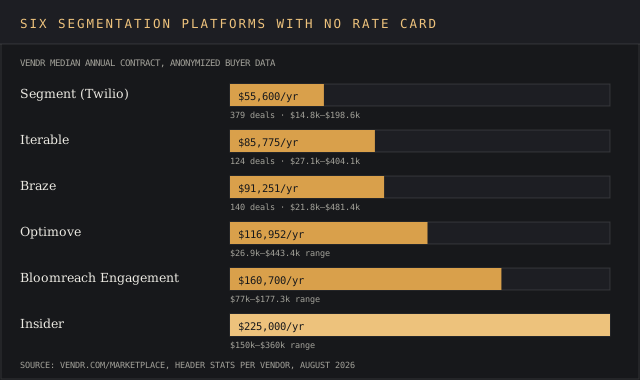
Coverage figures and prices are each vendor's own published figure, read in August 2026. Medians marked * are Vendr's anonymized buyer-reported contract values for Segment, Braze, Insider, Bloomreach Engagement, Iterable and Optimove, none of which publish a rate card.
Insider's own Vendr pages disagree on the median contract by close to 5x; the marketplace header figure used here is the more recently maintained of the two. Klaviyo, HubSpot, ActiveCampaign and Amplitude publish exact tier pricing directly, so no Vendr marker applies to those four rows.
Marketing segmentation software takes a customer base and splits it into groups worth treating differently: a shopper who abandoned a cart last night, a subscriber who opens every email but never clicks, an account whose usage just spiked.
The category spans customer data platforms that unify records, engagement platforms that send the campaign, and analytics tools that build the cohort in the first place. Most vendors below do at least two of those three jobs at once.
This page ranks ten of them: Klaviyo, HubSpot, Segment, ActiveCampaign, Amplitude, Braze, Insider, Bloomreach Engagement, Iterable and Optimove. Each entry names a real figure from the vendor's own site or from Vendr's anonymized buyer data.
It's built for a marketing ops lead, a lifecycle marketer or a growth team lead who already knows they need customer segmentation tools and wants to know which one fits a specific budget and data stack. Every ranked tool gets the same shape: what it is, what it costs, what its key features are, its pros and cons, and why it sits where it does.
Why now: five of the ten platforms below shipped a named AI segmentation feature (Klaviyo's Composer, HubSpot's AI segment recommendations, Amplitude's transformer-based Predictive Cohorts, Insider's Predictive Segments, Optimove's AI Offer Decisioning Agents) in the twelve months to August 2026, and pricing for the category split further into two camps: platforms that publish a rate card and platforms that don't, which is itself the first criterion below.
Evaluation criteria for marketing segmentation software
Five criteria decide the shortlist, and the ranking below applies them in this order. Each is admissible only because a buyer can run the test and get a yes, a no, or a number, not a vague sense of "how good the segmentation feels."
Published pricing
Does the vendor post a rate card a buyer can act on without a sales call? Klaviyo, HubSpot, ActiveCampaign and Amplitude all publish exact tier prices. Segment, Braze, Insider, Bloomreach Engagement, Iterable and Optimove are quote-only, so their entry in this article uses Vendr's anonymized median contract value instead.
Segmentation filter or rule depth
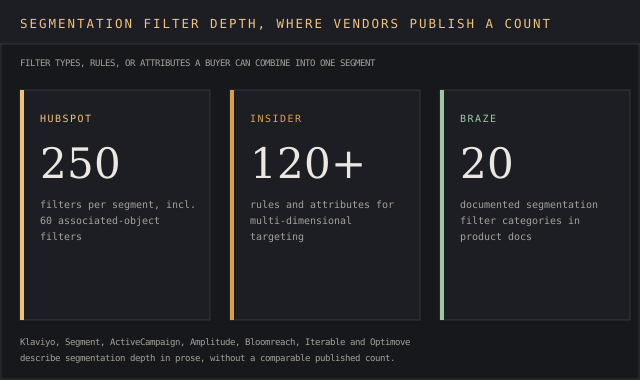
How many filter types, rules or attributes can one segment combine, by the vendor's own count? HubSpot documents 250 filters per segment, Insider documents 120+ rules and attributes, Braze documents 20 segmentation filter categories in its product docs. A platform that only says "powerful segmentation" without a number scores lower on this axis.
Integration or connector catalog
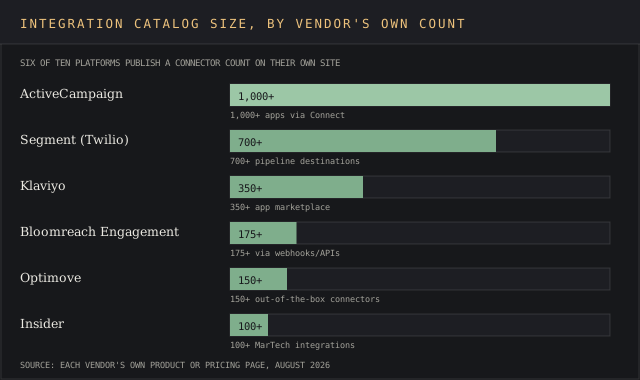
A documented count of native integrations, sourced from the vendor's own product or pricing page: ActiveCampaign's 1,000+, Segment's 700+ pipeline destinations, Klaviyo's 350+ app marketplace, Bloomreach's 175+, Optimove's 150+, Insider's 100+.
Named predictive or AI segmentation method
Marketing copy says "AI-powered" on every vendor's homepage. This criterion asks for a named mechanism: Amplitude's transformer-based Predictive Cohorts model evaluates a user's most recent 128 events; Optimove's AI Offer Decisioning Agents run a softmax function against a minimum data threshold; Insider's Predictive Segments forecast future behavior. A platform that can't name its own method doesn't clear this bar.
Real-time update speed
How fast does segment membership reflect new data, by the vendor's own documentation? Braze's Cloud Data Ingestion segments update "in seconds" against a warehouse holding billions of data points. Amplitude offers minute, hourly or daily cohort sync. Optimove continuously recalculates every customer's micro-segment.
A platform documenting only a nightly batch job loses ground here against one documenting real-time sync. Maestra, a segmentation platform outside this ranking's ten, states on its own site that it processes segment updates in under 300 milliseconds, a useful benchmark for how fast "real-time" can mean in this category. Source: maestra.io.
Six of these platforms also show up on our broader digital marketing intelligence ranking. That ranking judges them as measurement and tracking tools; the segmentation lens here produces a different order, so pick one lens and buy against it.
Top marketing segmentation platforms, ranked
Ranked on published pricing, filter or rule depth, integration catalog size, a named predictive method, and real-time update speed.
Klaviyo
Best fit
High-volume ecommerce brands that want real-time segmentation baked into a self-serve, published-pricing product.
Klaviyo is a B2C CRM and marketing platform that unifies email, SMS and other channels with customer data so brands can personalize and automate marketing at scale. Its data infrastructure stores more than 9 billion consumer profiles and processes a quarter-trillion data points a quarter, serving 205,000+ paying customers as of its August 5, 2026 Agency acquisition announcement.
Its segmentation runs on unified, lifetime customer profiles inside the Advanced Klaviyo Data Platform, and it plugs directly into commerce stacks: Shopify, Salesforce, WooCommerce, Magento, BigCommerce and Wix integrations sit inside a 350+ app marketplace.
Key features
- Real-time customer segmentation across unified, lifetime profiles in the Advanced Klaviyo Data Platform
- Composer, an AI agent that generates campaigns, flows and segments from a prompt
- Customer Agent, an AI customer-service agent supporting 100+ languages
- Multi-channel messaging across email, SMS, RCS, WhatsApp, push and Instagram
- Data warehouse integrations with Snowflake, BigQuery and Databricks
- 350+ app marketplace, including Shopify, Salesforce, WooCommerce, Magento, BigCommerce and Wix
Pricing
The free plan covers up to 250 profiles, 500 email sends a month and $5 of mobile messaging, with 10,000 Composer AI credits included. The paid Email plan starts at $45 a month for 1,500 active profiles, including 15,000 emails a month; price scales with a profile-count slider.
The Marketing Analytics add-on runs $100 a month at 1,500 profiles, and the Advanced Klaviyo Data Platform (its CDP tier) runs $500 a month at 100,000 total profiles. SMS is pay-as-you-go, around $0.01 plus carrier fees per send. Source: klaviyo.com/pricing.
Pros
- Published, self-serve pricing at every tier, no sales call required to see an exact number
- Deep native ecommerce integrations, led by Shopify
- Real-time segmentation available from the first paid tier, not gated behind an enterprise plan
Cons
- Cost scales quickly with list size, and the CDP tier alone adds $500/mo at 100,000 profiles
- SMS pricing is metered per send, which complicates budgeting compared with a flat monthly fee
- Advanced flow logic and event triggers carry a real learning curve for teams new to marketing automation
"The integration with our Shopify store makes it easy to build automated flows based on real customer behavior... What I appreciate most is the level of segmentation and data. We can see which customers are purchasing certain brands or product categories and tailor messaging accordingly."Wil L., Founder & Owner, Small-Business, G2, March 11, 2026
"Pricing can scale quickly as your subscriber list grows. For smaller brands or businesses just starting out, the cost may feel high compared to simpler email tools... there is definitely a learning curve."Wil L., Founder & Owner, Small-Business, G2, March 11, 2026
Why it's ranked #1. Klaviyo is the only platform in the field with published pricing at every tier and real-time segmentation included from the $45/mo entry point, versus HubSpot's $800/mo floor for its deepest filter logic. That published-pricing gap, criterion one, is what separates the top two.
HubSpot
Best fit
Marketing teams that want customer segmentation tools built into a full CRM.
HubSpot's segmentation tool, renamed from "Lists" to Segments, groups CRM records (contacts, companies, deals) into active, auto-updating groups or static, point-in-time groups, based on property values, behavioral events, workflow membership and associated-object data, then activates those groups across email, ads and other channels. HubSpot states it serves 306,000+ customers in over 135 countries.
A single segment can carry up to 250 filters, including up to 60 associated-object filters that let a marketer filter contacts by their associated deals or campaigns, per HubSpot's own documentation. That is the deepest documented filter count of any platform on this list.
Key features
- Up to 250 filters per segment, including up to 60 associated-object filters
- Active segments that auto-update membership; static segments that stay fixed for one-time use
- Four filter types: properties, events, workflow memberships and associated objects
- AI-powered segment recommendations and AI-generated filter descriptions
- Anonymous web-visitor segmentation, ahead of a visitor converting into a known contact
- Multi-channel activation library pushing segments to email, ads, social and landing pages
Pricing
Starter begins at $7/mo per seat (annual billing), with 1,000 marketing contacts and 500 HubSpot Credits. Professional starts at $800/mo, with 2,000 marketing contacts, 3,000 credits and 3 core seats (additional seats $45/mo), plus a one-time $3,000 onboarding fee. Enterprise starts at $3,600/mo, with 10,000 contacts, 5,000 credits and 5 core seats (additional seats $75/mo), plus a one-time $7,000 onboarding fee. Source: hubspot.com/pricing/marketing.
Pros
- The deepest documented filter logic in the category, at 250 filters including 60 associated-object filters
- Segmentation sits inside the same record set as sales and service data, so a segment can factor in deal stage
- AI-generated filter descriptions lower the bar for a non-technical marketer building a first segment
Cons
- Full segmentation depth requires Professional at $800/mo, plus a $3,000 onboarding fee
- Contact-tier pricing means the bill grows independently of segmentation usage
- Enterprise-only features add a further $3,600/mo floor before advanced permissioning is available
"It's easy to use HubSpot's list importing, filtering, and syncing with third-party systems, e.g. using a HubSpot list for LinkedIn Marketing Solutions ads."Joe Kevens, Director of Demand Generation, PartnerStack, TrustRadius, January 21, 2022
Why it's ranked #2. HubSpot's 250-filter segment logic, 60 of them associated-object filters, beats every other platform on documented filter depth, but that depth only unlocks at the $800/mo Professional tier, well above Segment's quote-only floor. That gap is why it sits below Klaviyo in this ranking.
Segment (Twilio)
Best fit
Teams building a first-party data pipeline before they've picked which channel tool receives it.
Segment, Twilio's customer data platform, collects, unifies and enriches first-party customer data across apps and devices, then activates it through a pipeline, identity resolution and journey orchestration to hundreds of downstream marketing, analytics and warehouse tools. Source: twilio.com/segment.
Its Connections product routes real-time event data to 700+ destinations, more native pipeline endpoints than any other platform ranked here, while Unify handles identity resolution and Engage builds journeys with generative and predictive AI audiences.
Key features
- Connections: a real-time event pipeline to 700+ destinations
- Unify: identity resolution stitching disparate signals into one customer profile
- Engage: real-time journey orchestration, including generative and predictive AI audiences
- Reverse ETL and a Profile API for pulling warehouse data back into the CDP
- Protocols, an optional add-on for data governance across the pipeline
- 550+ activation destinations inside a 750+ total integration catalog
Pricing
Segment publishes no fixed rate card. Both the Customer Data Pipeline (Connections-only) and full Customer Data Platform (Connections, Unify and Engage) require a custom quote, billed on monthly tracked users with unlimited seats and a 14-day free trial on the pipeline product. Source: twilio.com/pricing/customer-data.
Vendr's anonymized buyer data puts the median contract at $55,600 a year, based on 379 deals, with a range of $14,810 to $198,600 and average savings around 17%. Source: vendr.com/marketplace/twilio-segment.
Pros
- 700+ pipeline destinations, the widest documented integration catalog in the field
- Identity resolution and reverse ETL cover the plumbing most engagement platforms assume already exists
- Vendr's median contract, $55,600/yr, undercuts every other quote-only platform on this list
Cons
- No published rate card, so an exact price requires a sales conversation
- Segment ships the data; it has no native send channel of its own for email, SMS or push
- One G2 reviewer put a real-world contract at roughly $400,000 for a large deployment
"The $400k price tag doesn't help. I can't recommend this product and won't be taking it to my next employer."Verified User, Enterprise, Computer & Network Security industry, G2, November 12, 2024
Why it's ranked #3. Segment's 700+ pipeline destinations beat every other platform's integration count, and its $55,600/yr Vendr median is the cheapest of the six quote-only vendors, but it activates nothing on its own. That gap in criterion five, real-time send versus real-time collection, is what keeps it below the two platforms that publish a price and ship a campaign.
ActiveCampaign
Best fit
Budget-conscious SMBs that want published, self-serve pricing and a large integration catalog on day one.
ActiveCampaign is a marketing automation and CRM platform running email, SMS and WhatsApp campaigns, marketed as an "autonomous marketing platform" with its Active Intelligence AI layer sitting on top of segmentation and automation. Source: activecampaign.com/platform/segmentation.
Segmentation criteria span website visits, industry, job title, quiz results, location data, purchase history, email opens and clicks, and date subscribed, among "hundreds more," and the platform ships with a library the vendor describes as over 900 customer journey maps.
Key features
- Automation Recipes library with over 900 customer journey maps
- 1,000+ app integrations through Connect Integrations
- Segmentation depth tiered by plan, from Limited on Starter to Premium on Enterprise
- AI-Suggested Segments that auto-identify candidate segments
- Custom Objects for unifying diverse business data into one contact model
- Segmentation on website visits, purchase history, quiz results and location data, among hundreds of other criteria
Pricing
At the 1,000-contact tier, billed annually: Starter from $15/mo, Plus from $49/mo, Pro from $79/mo, Enterprise from $145/mo. Starter caps automations at 5 actions each; Plus, Pro and Enterprise offer unlimited automation actions. No setup fee, 30-day money-back guarantee stated on the page. Source: activecampaign.com/pricing.
Pros
- Cheapest published entry price in the category, at $15/mo
- 1,000+ integrations, the second-widest documented catalog after Segment
- AI-Suggested Segments surface groupings a marketer might not think to build manually
Cons
- Starter's "Limited" segmentation tier and 5-action automation cap push serious users toward Plus or Pro quickly
- Premium segmentation depth and AI-Suggested Segments are gated to higher tiers
- One long-tenured customer reported an account shutdown with no warning, later called a vendor-side mistake
"I was an ActiveCampaign user for 8 years, from 2017-2025. It was fantastic, the functionality was very robust. So why am I giving it a 1-star review? Because in late 2025, my account was shut down for no reason, and without warning."Igor K., CEO, Small-Business, G2, March 30, 2026
Why it's ranked #4. ActiveCampaign's $15/mo entry price is the cheapest published rate in the field, and its 1,000+ integrations trail only Segment, but Starter's segmentation is capped at "Limited," pushing anyone who needs real depth up to Pro's $79/mo, still cheaper than Amplitude's free tier ceiling once behavioral data volume climbs.
Amplitude
Best fit
Product-led teams that need to segment on behavioral data and want to see the pricing before talking to sales.
Amplitude's Behavioral Cohorts group users by the actions they take inside a product within a specific time window, for example users who watched three consecutive episodes after signup, and cohorts auto-recompute whenever they're used in a chart. Source: amplitude.com/docs/analytics/behavioral-cohorts.
Its newer Predictive Cohorts use a transformer-based model to group users by the likelihood of a future action instead. Source: amplitude.com/docs/data/audiences/predictions.
The Predictive Cohorts model evaluates each user's most recent 128 events and the time intervals between them, across four variable types: events, event properties, user properties and activity sequences. Amplitude states a well-designed prediction can drive a 5% to 20% lift relative to a plain behavioral cohort.
Key features
- Behavioral Cohorts, included from the Plus tier, with a Behavioral Cohorts API supporting cohorts up to 2 million users
- Predictive Cohorts, a transformer-based model scoring a user's last 128 events across four variable types
- Cohort sync at minute, hourly or daily frequency, to destinations including Kinesis, Braze, webhooks and the Profile API
- Group-level (account-based) cohorts via the Accounts add-on, for B2B segmentation
- Documented 5% to 20% lift from prediction-based targeting versus a plain behavioral cohort
- Free plan covers 2 million events a month, forever, with no credit card required
Pricing
Free: $0, 2 million events a month. Plus: starts at $0 and scales with usage up to 70 million events, and the current pricing page lists 20 behavioral cohorts on this tier. Amplitude's own help-center FAQ separately states a five-cohort limit for Plus, an unresolved discrepancy between two of the vendor's own pages; the pricing page is the more recently maintained of the two, so this article uses its figure.
Growth and Enterprise: custom, event-based pricing, adding advanced behavioral exploration and unlimited projects respectively. Source: amplitude.com/pricing.
Pros
- The only platform on this list that names its predictive mechanism: a transformer model scored against 128 recent events
- Published, usage-based pricing with a genuinely free tier at 2 million events a month
- Cohort sync frequency is configurable down to the minute for downstream activation
Cons
- Amplitude's own pricing page and help-center FAQ disagree on how many behavioral cohorts Plus includes
- No native send channel; cohorts sync out to Braze, webhooks or an API, and campaign delivery happens on a separate platform
- Account-level cohorts require the separate Accounts add-on
"Amplitude Analytics scores better in terms of conversion drives and cohort analysis."Shreyans Dhingra, Product Manager, LXME, TrustRadius, July 19, 2022, comparing Amplitude against Mixpanel
Why it's ranked #5. Amplitude is the only platform here that names its predictive segmentation mechanism, a transformer model over 128 recent events, criterion four, but like Segment it has no native send channel, and its free-tier ceiling at 2 million events a month runs out well before ActiveCampaign's $15/mo tier hits a comparable wall.
Braze
Best fit
Enterprises that want to segment live off a cloud data warehouse, skipping the step of copying data into the platform first.
Braze is a customer engagement platform unifying customer data, AI-powered orchestration through its Canvas builder, and multi-channel messaging (push, email, SMS, in-app and more) so marketers can build real-time, personalized campaigns. Source: braze.com/product/overview.
Braze's Cloud Data Ingestion (CDI) segments query a data warehouse like Snowflake directly, without copying data into Braze first, and the vendor states audiences update "in seconds," even at billions of data points. Its docs list 20 distinct segmentation filter categories, spanning custom attributes, purchase behavior, ecommerce, demographic, location, cohort membership and predictive filters. Source: braze.com/docs/user_guide/audience/segments/segmentation_filters.
Key features
- Cloud Data Ingestion segments that query a warehouse like Snowflake directly, updating in seconds at billions of data points
- 20 documented segmentation filter categories, including predictive and cohort-membership filters
- Real-time dynamic segmentation that adds and removes members as criteria are met or exited
- Segment Extensions for fixed, point-in-time historical segmentation snapshots
- Canvas Flow, with four branching components: Audience Paths, Decision Split, Action Paths and Experiment Paths
- Three Canvas entry types: scheduled delivery, action-based entry and API-triggered delivery
Pricing
Braze publishes no public rate card. Vendr's anonymized buyer data shows a median annual contract of $91,251, drawn from 140 deals, with a range of $21,811 to $481,409. Source: vendr.com/marketplace/braze. Per its Fiscal Q3 2026 earnings, Braze reported 2,528 total customers and 303 large customers with $500K+ ARR. Source: investors.braze.com.
Pros
- Warehouse-native segmentation avoids duplicating customer data into a second system
- 20 documented filter categories give a marketer real range without leaving Braze's own UI
- Named a Leader in Gartner's Magic Quadrant for Multichannel Marketing Hubs for a third consecutive year
Cons
- No public rate card; the Vendr median of $91,251/yr sits well above every published-pricing platform ranked
- Deal range runs from $21,811 to $481,409, a spread that makes budgeting hard without a quote in hand
- Canvas Flow's four branching components carry setup complexity beyond a simple filter-and-send
"Our previous manual process for building emails was taking up to 20 hours a week, but now with catalogs, we can do it in just 2 hours, achieving a 90% reduction in time spent."Amy E., Mid-Market, G2, April 23, 2026
Why it's ranked #6. Braze's "in seconds" warehouse-native segmentation is the fastest documented real-time claim in the field, criterion five, but its Vendr median of $91,251/yr sits above ActiveCampaign's published $79/mo Pro tier by two orders of magnitude, and it loses ground to HubSpot's 250-filter depth on criterion two.
Insider
Best fit
Enterprise retailers that want one platform orchestrating segmentation across every channel, from web to WhatsApp.
Insider, rebranded Insider One, is an AI-powered customer engagement platform unifying customer data, AI-driven personalization and segmentation, and cross-channel journey orchestration, serving 2,000+ enterprise customers. Source: insiderone.com/ai-personalization.
Its Real-Time Segmentation reacts instantly to behavior changes, and its Predictive Segments use algorithms to forecast future customer behavior, with 120+ rules and attributes available for multi-dimensional audience targeting across nine channels: web, email, site search, conversational CX, WhatsApp, web push, InStory, app, and SMS and RCS.
Key features
- 120+ rules and attributes for multi-dimensional audience targeting
- Predictive Segments forecasting future customer behavior, alongside Real-Time Segmentation
- Cross-channel orchestration across nine channels, from web push to WhatsApp
- Insider One AI, blending predictive and generative AI, including automatic A/B test winner selection
- 20+ product recommendation strategies, such as bought-together and most-valued-products
- 100+ pre-built campaign templates and 100+ MarTech integrations
Pricing
Insider publishes no public rate card. Vendr's marketplace header stats put the median buyer contract at $225,000 a year, with a range of $150,000 to $360,000. Source: vendr.com/marketplace/insider. That figure is the current marketplace header data; a separate, older Vendr buyer-guide page for Insider shows a lower average of roughly $48,210 based on four completed deals, a gap between two of Vendr's own pages worth noting since the two disagree substantially.
Pros
- Nine-channel orchestration is the widest documented channel spread of any platform ranked
- 120+ segmentation rules and attributes support genuinely multi-dimensional targeting
- One G2 reviewer credited Insider's journeys and recommendations with lifting click-through rate to 11% and generating 10,000+ leads
Cons
- The most expensive platform ranked, at a $225,000/yr Vendr median
- A G2 reviewer described initial implementation as "notoriously heavy" when source data is messy, taking months to launch
- Two of Vendr's own pages for Insider disagree on pricing by nearly 5x, which complicates budgeting from that source alone
"Insider's journeys and recommendations lifted our CTR to 11% and helped us generate 10,000+ leads."Jamal eddine Z., Enterprise, G2, August 5, 2026
"The initial implementation is notoriously heavy. If your company's internal data is messy or if you don't have clean APIs, getting Insider One up and running can take months."Gabriel A., CRM Analyst, Mid-Market, G2, June 26, 2026
Why it's ranked #7. Insider's nine-channel spread and 120+ rules outdo Braze's channel range, but a $225,000/yr Vendr median makes it the single most expensive platform ranked, and a documented "months"-long implementation when source data is messy pushes it below the six cheaper, faster-to-launch options above it.
Bloomreach Engagement
Best fit
Retail and ecommerce brands that want a CDP with built-in AI product recommendations.
Bloomreach Engagement is a customer data platform and marketing automation product letting marketers build real-time customer segments from demographic and behavioral event data, then deploy them across email, SMS, web personalization, mobile and ad channels. Source: bloomreach.com/en/products/segments-and-audience-builder.
Its Loomi AI powers audience creation by identifying patterns and predicting customer behavior, and the platform ships pre-built RFM (recency, frequency, monetary) segmentation alongside lookalike-audience generation based on customer lifetime value or purchase intent.
Key features
- "Virtually unlimited" segmentation combinations across demographic attributes and behavioral event data
- Loomi AI-powered audience creation, identifying patterns and predicting future behavior
- Lookalike audience generation based on customer lifetime value or purchase intent
- Pre-built segmentation use cases, including RFM segmentation and behavioral analysis
- Native integrations across email, SMS, web personalization, mobile apps and ad platforms
- 175+ external tool integrations via webhooks, APIs and tag managers
Pricing
Bloomreach publishes no public rate card. Vendr's anonymized buyer data puts the median annual contract at $160,700, with a range of $77,000 to $177,315. Source: vendr.com/marketplace/bloomreach. Per its own newsroom, Bloomreach surpassed $260 million in annual recurring revenue in February 2026, serving 1,400+ global brands. Source: bloomreach.com/en/news/2026.
Pros
- 175+ integrations via webhooks, APIs and tag managers, without custom engineering per connection
- Loomi AI ties segmentation directly to product recommendations, useful for retail merchandising teams
- 1,400+ global brands and $260M+ ARR signal a mature, retail-tested customer base
Cons
- No public rate card; the Vendr range, $77,000 to $177,315, is the tightest spread of any quote-only platform ranked, leaving little room to start small
- Purchase-count data was not available on Vendr's current page, unlike Segment or Braze
- Depth is weighted toward retail and ecommerce use cases, less toward B2B account-based segmentation
"We switched from Airship because Bloomreach is more powerful and flexible for marketing comms."Daniel E., Enterprise, G2, March 17, 2026
Why it's ranked #8. Bloomreach's named switch-from-Airship story and 175+ integrations show real retail pull, but its Vendr contract range, $77,000 to $177,315, is the narrowest of any quote-only vendor here, and it trails Insider's nine-channel orchestration on criterion three.
Iterable
Best fit
Cross-channel campaign teams that want AI-orchestrated sends without hand-tuning every campaign's timing.
Iterable is an AI-powered customer engagement platform that unifies real-time customer data and uses its Nova Intelligence to orchestrate personalized marketing across email, SMS, push and in-app messaging. Source: iterable.com/product.
Segmentation is available from four separate places in the product: the Segmentation page, Predictive Goals, Journeys and the Dynamic Content Builder, and inside a Journey a marketer can segment via Yes/No Split tiles, entry rules or exit rules, saving the result as a static, dynamic or scheduled list. Source: support.iterable.com.
Key features
- Segmentation query builder usable from four places: Segmentation page, Predictive Goals, Journeys and Dynamic Content Builder
- Journey Agent, a visual builder orchestrating four channels without SQL or code
- Nova Decisioning, optimizing send timing, content and channel per user in real time
- Nova Agent, automating campaign build work including copy generation and journey logic
- Nova Predictive Audiences with a "Glassbox AI" explainability layer for churn and high-value-opportunity identification
- Cited customer results: Redfin +72% lift in agent meetings, Therabody +45% conversion increase, RealSelf +44% conversion increase
Pricing
Iterable publishes no public rate card. Vendr's anonymized buyer data puts the median annual contract at $85,775, with a range of $27,051 to $404,147. Source: vendr.com/marketplace/iterable.
Pros
- Nova's cited case studies include a 72% lift in agent meetings for Redfin, the largest single documented result in this ranking
- Journey Agent's no-code visual builder lowers the technical bar for cross-channel orchestration
- Vendr's $85,775/yr median undercuts Braze, Bloomreach, Insider and Optimove
Cons
- No public rate card, and four separate places to build a segment adds more surface area to learn than a single filter list
- Vendr's page shows two different purchase-count figures for Iterable, 124 and 235 deals, in different sections
- Cited AI lift figures (72%, 45%, 44%) come from named customer case studies, not an audited industry-wide average
"We have grown the revenue of our CRM channel exponentially... increased CTR by +34% YoY since 2020."María Fernanda Carbajal, CRM Manager, Stayforlong, TrustRadius, June 28, 2026
Why it's ranked #9. Iterable's Nova case studies, up to a 72% lift for Redfin, and its $85,775/yr Vendr median, cheaper than Insider or Bloomreach, argue for a higher spot, but four separate segment-building surfaces inside one product cost it ground against Braze's single, 20-category filter list on criterion two.
Optimove
Best fit
Retention marketing teams running lifecycle-stage campaigns who need segmentation to move with the customer.
Optimove is an AI-powered customer engagement and retention marketing platform with an embedded CDP, letting marketers orchestrate personalized multichannel campaigns (email, SMS, push, web, ad networks, WhatsApp) driven by customer segmentation and AI decisioning. Source: optimove.com/platform.
Its dynamic micro-segmentation continuously recalculates every customer's group and tracks how customers move between micro-segments over time, layered on top of lifecycle-stage grouping. Optimove states marketers using this approach can boost campaign efficiency by 88%. Source: optimove.com/resources/learning-center.
Key features
- Dynamic micro-segmentation, continuously recalculated, tracking movement across lifecycle stages
- Predictive marketing-action optimization, forecasting which action works best per micro-segment
- AI Offer Decisioning Agents, testing 2 to 4 competing actions against a control group per campaign
- Embedded CDP with 150+ out-of-the-box connectors unifying customer data into one profile
- AI Decisioning Studio, coordinating four AI agents: Journey, Offer, Content and Send Time Optimization
- Documented 88% campaign-efficiency gain attributed to the micro-segmentation approach
Pricing
Optimove publishes no public rate card. Vendr's anonymized buyer data puts the median annual contract at $116,952, with a range of $26,915 to $443,395. Source: vendr.com/marketplace/optimove.
Pros
- The boldest documented efficiency number in the field, an 88% campaign-efficiency gain from micro-segmentation
- AI Offer Decisioning Agents apply statistical minimums (50 targeted/15 responders in test, 30/5 in control) before optimizing, a documented guardrail against acting on thin data
- 150+ out-of-the-box CDP connectors reduce the integration lift for retention teams
Cons
- Built specifically for lifecycle retention marketing, narrower than the general-purpose segmentation job most of this list handles
- No public rate card, with a $116,952/yr Vendr median sitting between Braze and Bloomreach
- One G2 reviewer flagged that "the last year of development has prioritized AI-bloatware over needed usability features"
"Compared to the previous product, Ongage, Optimove's abilities are way superior."Guy S., Small-Business, G2, January 22, 2026
Why it's ranked #10. Optimove's 88% campaign-efficiency claim is the boldest number in this ranking, but it's also the narrowest specialist, built for lifecycle retention marketing. That focus is why it closes this list.
What marketing segmentation software does
Every platform above performs some mix of three jobs: collecting customer data into unified profiles, building the actual segments or cohorts from that data, and activating those segments as a campaign.
- Segment and Amplitude lean toward collection and cohort-building without a native send channel.
- Klaviyo, ActiveCampaign, Braze, Insider, Bloomreach, Iterable and Optimove combine segmentation with delivery, so the segment and the campaign live in one product.
- HubSpot sits in between, building segments from CRM records it already owns and activating them through its own marketing tools.
A segment itself, in every one of these products, is a rule set applied to customer data: a demographic attribute, a behavioral event, a purchase history entry, or a predicted future action, combined with AND/OR logic into a group a marketer can target. What differs by vendor is how many of those rule types a segment can combine at once, criterion two above, and how fast a segment's membership reflects a new data point, criterion five.
Types of customer segmentation these tools apply
Every segmentation tool on this list, whatever it calls itself, applies some combination of four classic segmentation types to a customer base.
- Demographic segmentation groups customers by age, income, company size or job title, the fields HubSpot's 250-filter engine and Optimove's lifecycle stages both draw on first.
- Geographic segmentation divides a customer base by region, city or shipping zone, a criterion most CDPs pull straight from an order's delivery address.
- Psychographic segmentation groups customers by values, interests or lifestyle, usually sourced from customer surveys or a quiz answer. Transaction records don't factor into it.
- Behavioral segmentation, the type every platform in this ranking leans on hardest, groups customers by purchasing behaviors, product usage or engagement pattern, the exact data Amplitude's behavioral cohorts and Braze's real-time filters are built to query.
A segmentation tool worth buying does four things with that data.
- Collect data cleanly: web and app event tracking, a CRM sync, a customer relationship management import, or a direct feed from Google Analytics or Google Ads for acquisition-channel context.
- Identify patterns across it, using simple rule-based filters or the machine learning algorithms Amplitude and Optimove document by name.
- Turn those patterns into actionable segments a marketing team can target. A report read once and shelved doesn't do that job.
- Keep those segments current as customer behavior changes, which is exactly what criterion five, real-time update speed, is testing for.
Data quality and data accuracy determine if any of that holds up. A platform can offer flawless segmentation logic and still ship bad marketing campaigns if the underlying customer data is duplicated, stale or missing key fields.
Every platform above that documents a data-warehouse connection, Segment, Braze, Amplitude, is, among other things, addressing that data-quality gap by querying a single source of truth, skipping the copying and re-copying of customer records into its own database.
Data privacy sits alongside data quality as a gating requirement. Segment's Privacy Portal, built into the same product covered in the ranking above, automates GDPR and CCPA data subject requests with deletion and suppression across Segment and every connected downstream tool.
The Privacy Portal also enforces consent categories against any connected consent-management platform and auto-classifies personally identifiable and protected health information into a live data inventory. One customer case Twilio cites reported an 85% cut in time spent on manual data collection after turning it on. Source: twilio.com/en-us/products/privacy-portal.
Klaviyo handles the same obligation differently: help-center guidance walks marketers through handling GDPR and CCPA data requests inside the platform, with no dedicated product wrapping the workflow. Source: help.klaviyo.com.
The best customer segmentation tools turn that combination, clean data collection, pattern identification, actionable segments and real-time updates, into a small number of high-value segments a team can act on. Hundreds of micro-segments, the kind no one has the headcount to build a campaign for, don't make that cut.
Optimove's lifecycle-stage model and Braze's 20 filter categories both push toward that same discipline: a handful of distinct, well-defined groups sharing characteristics that matter to the business.
What good segmentation buys a marketing team is fewer wasted sends and a clearer read on where the real pain points sit. A customer segmentation strategy that surfaces the group at risk of churn, the group with rising customer lifetime value, or the group whose customer satisfaction scores just dropped, gives a marketing team something to act on this week.
That's the throughline across every one of the ten platforms ranked above: the tools differ in price, channel count and how they name their AI, but every one of them exists to turn a single customer base into a set of distinct, actionable, and current groups.
Two features separate the more capable platforms in this ranking from the more basic ones once a team moves past its first few segments: support for custom segments built on nested logic, beyond one rule at a time, and the ability to automatically group customers into new segments as fresh data arrives, skipping the manual rebuild every time market research turns up a new pattern.
Enterprise platforms built for larger customer bases, Braze, Insider, Bloomreach and Optimove among them, tend to gate that dynamic behavior, along with account-based and mobile apps segmentation, behind their higher enterprise tiers.
Types of marketing segmentation software
Three subtypes cover the category.
- Customer data platforms (Segment and, to a lesser extent, Bloomreach Engagement) focus on unifying and enriching customer records before any campaign logic runs.
- Engagement platforms (Klaviyo, Braze, Insider and Iterable) build segments and deliver the campaign inside the same product, favoring marketers who want one tool for both jobs.
- Analytics-first platforms (Amplitude) favor product and growth teams segmenting on in-app behavior over marketing channel history.
HubSpot and ActiveCampaign don't fit neatly into any one bucket; both bundle segmentation into a broader CRM or automation suite; neither sells it as a standalone capability.
Optimove sits closest to a fourth, narrower subtype: retention-focused platforms that treat the customer's lifecycle stage as the primary segmentation axis. It recalculates which micro-segment a customer belongs to continuously as behavior changes; segmenting once and campaigning against a static list isn't part of the model.
None of these four subtypes is objectively the best customer segmentation approach; the right customer segmentation software depends on where a team's data already lives and how many channels a single campaign needs to reach.
A team already running a data warehouse and a separate send tool is usually better served by a customer data platform than by an all-in-one customer engagement platform. A team with no existing infrastructure is usually better served by an all-in-one option, since standing up separate customer segmentation tools for collection, analysis and delivery is real engineering work most marketing teams can't take on alone.
Market segmentation, in the broader sense that predates any of these ten products, still frames how most of this software gets built. Classic market segmentation theory splits a market into demographic, geographic, psychographic and behavioral groups before a product or message ever reaches a single customer.
Every platform ranked above is, in effect, a piece of market segmentation software narrowed down to a company's own paying customer base. The total addressable market sits outside that scope entirely. Best customer segmentation tools earn that label by making the classic market segmentation categories fast and repeatable to apply against live customer data.
Where the segmentation data comes from
Every platform ranked above draws on some combination of four data sources: first-party event data (a page view, an email open, a purchase), CRM or transactional records (deal stage, order history), survey or explicit preference data (a quiz answer, a stated interest), and third-party enrichment (firmographic or demographic append data).
Segment and Braze both document direct data-warehouse connections, letting a segmentation query run against a system like Snowflake without first copying the data into the platform. Klaviyo's Advanced Data Platform tier and Bloomreach's CDP both build a unified profile from multiple source systems before segmentation runs against it.
Amplitude's behavioral and predictive cohorts run exclusively on event data captured directly inside the product being analyzed.
What pricing looks like across the category
Four of the ten platforms ranked here publish an exact price a buyer can act on without a sales call: Klaviyo, HubSpot, ActiveCampaign and Amplitude. The other six, Segment, Braze, Insider, Bloomreach Engagement, Iterable and Optimove, require a custom quote, and this article uses Vendr's anonymized buyer-contract data as the entry figure for each.
Among those six, the Vendr medians run from Segment's $55,600 a year up to Insider's $225,000 a year, a four-times spread across platforms that all describe themselves as AI-powered segmentation and engagement tools.
Counting ActiveCampaign's published $180-a-year entry tier against Insider's $225,000 Vendr median widens that spread to well over a thousand times across the full ranking, a sharper picture than the roughly 40-times range some general coverage of this category cites without naming a specific vendor on either end.
That range matters for a buyer's shortlist as much as any feature. A team evaluating Braze at a $91,251 median and Insider at a $225,000 median is not comparing two similarly priced options with different feature sets; it's comparing a mid-market contract against one that runs roughly 2.5 times larger before either vendor has quoted a specific deployment.
Common buying mistakes
The most repeated mistake in this category is treating "AI-powered" as a feature, without checking for a named mechanism first. Only Amplitude, Optimove and Insider name a specific predictive method in their own documentation; the rest describe AI in marketing language without a documented model, an evaluated lift figure, or a data-volume threshold, which is exactly what criterion four above is built to catch.
A second mistake is comparing a published entry price against a competitor's Vendr median as if they represented the same buying motion. Klaviyo's $45/mo tier and Braze's $91,251/yr Vendr median describe entirely different customer sizes and negotiation processes; the comparison only holds once both quotes reflect a similar data volume and contract length.
A third mistake is skipping the integration audit before signing. A platform's headline integration count, ActiveCampaign's 1,000+ or Segment's 700+, doesn't confirm that the specific systems a buyer already runs, a warehouse, an ad platform, a support desk, sit on that list; that's a five-minute check against the vendor's own integration directory before any contract gets signed.
Ask what happens to segment membership and connector uptime at renewal. Contract-length discounts, seat reduction rights and a cap on annual increases are all negotiable at signature and almost never negotiable afterward.
How to run a segmentation software evaluation
Start with the data source test: pull the exact fields a first segment needs (a purchase date, an email open, a deal stage) and confirm the platform under evaluation can ingest or query that field without a custom integration project.
Then build one real segment using the platform's own filter builder, skipping the demo segment, and measure how long it takes for a new customer event to show up as a change in that segment's membership; this directly tests criterion five, real-time update speed, against the vendor's own documented claim.
Next, price the actual data volume expected in year one. The demo tier's number won't match it, since every quote-only vendor above sets its number against usage or contract size that a trial account rarely reflects.
Finally, pull one or two independent user quotes from G2, TrustRadius or Capterra for the specific feature under evaluation. Skip the vendor's own case study page; several vendors above have public reviews naming a specific pro or con (Klaviyo's pricing scaling with list size, Insider's implementation timeline against messy data) worth weighing against the sales pitch.
Klaviyo vs HubSpot vs Segment
These three sit at the top of this ranking for different reasons, and buyers often shortlist two of the three together. Klaviyo and HubSpot both publish pricing and both activate a segment directly into a campaign.
Klaviyo's segmentation lives inside a commerce-first product built around Shopify and similar platforms, while HubSpot's segmentation lives inside a CRM built around deal stages and sales activity. The choice usually comes down to direct-to-consumer sales versus a longer B2B sales cycle.
Segment competes with neither directly. It has no native send channel, so a team choosing Segment is choosing to build (or already own) a separate email, SMS or ad platform and feed it clean, unified data from Segment's pipeline. A team that already runs Klaviyo or HubSpot for campaigns sometimes adds Segment underneath both, using its 700+ destinations to keep customer data consistent across tools, with neither platform getting replaced.
The free and cheap options, and what they can't do
Two platforms in this ranking offer a genuinely free tier: Klaviyo (up to 250 profiles, 500 email sends a month) and Amplitude (2 million events a month, no credit card required). ActiveCampaign's $15/mo Starter tier is the cheapest paid entry point, though its segmentation depth is explicitly labeled "Limited" at that tier by the vendor's own pricing page.
What the free and cheap tiers can't do, across all three, is the thing that separates a top-half platform from a bottom-half one in this ranking.
- Klaviyo's free tier has no access to the Advanced Data Platform's unified, lifetime profiles.
- Amplitude's free tier caps out at 2 million events, a volume a mid-size ecommerce site clears within days.
- ActiveCampaign's Starter tier caps automations at 5 actions each and withholds AI-Suggested Segments entirely.
Each of the six enterprise, quote-only platforms above (Segment through Optimove) offers no free tier at all.
Customer segmentation tools vs market segmentation tools
The ten platforms ranked on this page are customer segmentation tools: they work on data a business already owns about its own paying customers, an order, an email open, a support ticket, and turn that customer base into targetable groups.
Market segmentation tools are a broader category, covering the market the business hasn't converted yet. Google Analytics and Google Ads audience insights are the two market segmentation tools most marketing teams already run, since both segment site visitors and ad audiences by geographic, demographic and behavioral data before those visitors ever become a customer record inside Klaviyo, HubSpot or any other platform on this list.
For the identity and activation platforms built specifically for that pre-conversion job, see MarketIntelligenceTools' audience segmentation tools ranking.
That distinction matters when a team is choosing between customer segmentation software and market segmentation tools; assuming one replaces the other is the mistake worth avoiding. A market segmentation tool like Google Analytics tells a team which pain points show up before purchase, where a visitor drops off, which channel drove the click, which geographic region converts best.
A customer segmentation tool then takes over once that visitor becomes a customer, applying the same demographic segmentation, behavioral segmentation and psychographic segmentation logic to a known, named record, no longer an anonymous session.
Several platforms above bridge the two directly: HubSpot's anonymous web-visitor segmentation and Segment's identity resolution both exist specifically to hand a visitor off from market segmentation tools into a customer segmentation tools pipeline the moment enough data exists to identify them.
Most teams evaluating customer segmentation tools already run Google Analytics or Google Ads for the market-segmentation side and are shopping this list to cover the customer-segmentation side; treating the two categories as one shopping decision is a common source of the buying mistakes covered above, since a market segmentation tool and a customer segmentation tool are answering different questions with different data.
Market context
The category consolidated meaningfully in the twelve months to August 2026.
- Klaviyo acquired Agency, an AI-native customer-success company, on August 5, 2026, adding Elias Torres as Chief Product Officer to lead its agent product line.
- Insider acquired Bluecore, a retail martech platform serving 400+ enterprise brands including Sephora and J.Crew, on May 13, 2026, adding an identity graph processing 10+ billion daily shopper events.
- Amplitude acquired InfiniGrow, an AI-powered marketing measurement platform, on January 14, 2026, extending its footprint from product analytics into marketing and revenue analytics.
- Optimove acquired Adact, a no-code gamification vendor, in March 2025.
Each of these deals points the same direction: platforms built for one job, collecting data, analyzing behavior, or running campaigns, are acquiring their way into the other two, which is part of why criteria like published pricing and a named predictive method matter more now than a feature list that could describe any vendor in the category.
Key features to look for in customer segmentation tools
Buyers comparing customer segmentation software tend to check the same handful of things, whichever of the ten tools above they're evaluating. A short checklist, built from the criteria and entries above, covers most of it.
- The ability to create segments based on more than one data type. A tool that can only filter on a single field, an email domain, a purchase date, isn't enough; look for a segmentation tool that lets a marketer combine demographic, behavioral and transactional fields into one rule set, the way HubSpot's 250-filter engine or Insider's 120+ rules do.
- Unified customer profiles, merged from every channel a customer touches. A platform that can't merge a customer's web session, purchase history and support ticket into one profile will produce segments built on partial data; Klaviyo's Advanced Data Platform and Segment's Unify product both exist to solve exactly this.
- Segmentation features that update automatically. Static, manually rebuilt lists fall out of date the moment a customer's behavior changes; dynamic and custom segments that recompute on new data, criterion five above, are what separate a modern segmentation tool from a spreadsheet export.
- A way to analyze customer interactions across every channel. As customers interact with a brand over web, mobile apps, SMS and support, a segmentation strategy built on email opens alone misses most of what a customer does across the rest; Insider's nine-channel spread and Braze's Canvas Flow both target this gap directly.
- Enough segmentation strategies to reach both broad and narrow groups. Look for a platform that supports both large, high value segments for broad campaigns and small, precisely defined segments for one-to-one personalization, the way Optimove's lifecycle-stage model and Bloomreach's lookalike audiences both do at opposite ends of that spectrum.
- Enough evidence to identify segments worth building in the first place. Data analysis, customer surveys and market research all feed the initial hypothesis about which segments matter; a platform that only lets a team define segments after the fact, with no reporting layer to identify segments worth testing, adds real work back onto a marketing team's plate.
A customer engagement platform built around these features turns a generic customer base into a set of distinct groups a marketing team can act on this week: the segment showing early churn signals, the segment worth a loyalty offer, the segment whose pain points a support team keeps hearing about.
That's the throughline across every marketing strategy this ranking's ten tools are built to support: a win-back email, a paid retargeting push, or a customer success outreach to a newly high-value account.
Marketing segmentation software FAQ
What is a segmentation tool?
A segmentation tool takes a customer base and groups it by shared characteristics, demographic, behavioral, transactional or predicted, so a marketer can target each group differently. One message sent to everyone stops being the default. Every platform ranked above is a segmentation tool in this sense, though most also handle campaign delivery beyond that basic grouping job.
What are the best customer segmentation tools?
Based on the criteria above, published pricing, filter depth, integration count, named AI method and real-time update speed, Klaviyo, HubSpot and Segment lead this ranking, with Amplitude standing out specifically for behavioral and predictive segmentation.
What are the four types of market segmentation?
Demographic (age, income, company size), geographic (location, region), psychographic (values, interests, lifestyle) and behavioral (purchase history, product usage, engagement pattern) are the four classic types; most platforms above segment on some combination of the last two, since behavioral and psychographic signals are what first-party event data captures most directly.
What tools are used for segmentation?
The ten platforms ranked on this page cover the category's main approaches: customer data platforms (Segment), engagement platforms that combine segmentation with delivery (Klaviyo, Braze, Insider, Iterable, Bloomreach Engagement, Optimove), a CRM-embedded option (HubSpot), a budget automation platform (ActiveCampaign), and a behavioral analytics platform (Amplitude).
Is there free customer segmentation software?
Klaviyo and Amplitude both offer genuinely free tiers, covering up to 250 profiles or 2 million monthly events respectively, though both cap out well before the volume most mid-size marketing teams need within a year.
What tools might you use to segment the market?
Market segmentation tools like Google Analytics and Google Ads audience insights segment visitors and ad audiences before they become a customer. Once a visitor converts, the ten customer segmentation tools ranked above take over, using the same demographic, geographic, psychographic and behavioral data to segment customers who are already in the CRM.
How does defining segments improve marketing strategies?
Defining segments around a specific target audience is what turns raw data into actionable insights a marketing team can build a campaign against; one message sent to an entire customer base doesn't do that job. Advanced segmentation, layering behavioral and predictive data on top of basic demographics, is specifically what separates the platforms ranked highest above from a plain email list export.
It's also what a customer success team draws on to catch churn signals in how customers interact with a product before a renewal date, based on user behavior, with no fixed schedule driving it.
How this ranking was built
This ranking leans specifically on customer segmentation tools and market segmentation tools that publish or disclose a real figure. Every vendor claim about behavioral segmentation, geographic segmentation or advanced segmentation had to trace to a product page, a docs page, or Vendr's anonymized buyer data before it made the entry above.
A platform that talks about segmentation specifically without naming a filter count, a channel count or a contract figure scored lower on criteria two through five.
Customer interactions, purchasing history and the shared characteristics that a segment is built from came from each vendor's own documentation of what customer segments and segment customers logic those platforms support, cross-checked against a genuine G2, TrustRadius or Capterra review for every entry.
Data collection and data analysis claims got the same treatment: an ability to create precise segments or create segments based on live behavior only counted if the vendor's own docs described the mechanism, the way Amplitude names its transformer model or Optimove names its softmax-based decisioning.
Where a platform's segmentation features or segmentation focuses read as generic, marketing language dressed in adjectives with no testable claim behind it, this article either cut the claim or flagged it explicitly as unverified, without repeating it as fact.
That's also why customer satisfaction and pain points appear in this piece only where a cited review names them directly. A marketing strategy built on invented pain points is worse than one built on none, and market research that can't be traced back to its source doesn't belong in a ranking a buyer is using to spend real budget.
Revenue lift from segmentation is a case in point: this article skips any category-wide multiple with no named study behind it and leans on Iterable's own cited case studies, Redfin, Therabody and RealSelf, each a named customer with a specific, attributed figure.
Bottom line
Klaviyo wins this ranking for the same reason most buyers should start there: published pricing at every tier, real-time segmentation from the first paid plan, and a 205,000-plus customer base big enough to have already found most of the product's edge cases.
HubSpot is the right call for a team that wants segmentation to live inside the same CRM as its sales and service data, and Segment is the right call for a team that has already picked its campaign tool and needs the data pipeline underneath it.
Below the top three, the choice is about depth of specialization. Amplitude is the pick for behavioral and predictive segmentation with a named model behind it.
Braze and Insider are built for enterprises that need warehouse-native speed or nine-channel reach and can absorb a six-figure contract. Optimove is worth the narrower fit only for teams running true lifecycle retention marketing, where its continuously recalculated micro-segments do a job none of the other nine tools are built to do.
Whichever platform a team picks, the same test applies before signing: can it segment customers on more than one data type, does its behavioral segmentation update in something close to real time, and can a marketer see the resulting customer segments without waiting on an engineer.
The best customer segmentation tools, the ones near the top of this ranking, pass all three. Market segmentation tools like Google Analytics can point a marketing strategy at the right audience before the sale, but customer segmentation still has to run inside one of the ten platforms above, or a close competitor to them, once that audience becomes a paying account.
Advanced segmentation features and ambitious marketing campaigns both start from that same customer segmentation foundation. The marketing strategies built on top of it only work if the platform underneath can segment customers as fast as the data changes, no matter if that data came from a customer segmentation tool or from one of the market segmentation tools feeding it.
Marketing strategies built on stale customer segments and outdated market segmentation tools data cost more in wasted sends than any of the ten platforms above cost in monthly fees.