Customer data platform pricing in 2026: what 15 vendors charge, from $0 to $2.75 million
 By Jan Suski. I go deep on every review, checking every number against its source and digging up details other coverage misses, a habit from six years of SEO and link building for tech companies. Bylines at Surfer, Brand24, and Senuto. How the scoring works.
The numbers Customer data platform pricing, checked 6 October 2026
Nine of the 15 vendors put a paid price on a public page, and they bill on six different units: tracked users, events, profiles, seats, Amps and flat platform fees.
Packaged suites start where the published plans stop: Bloomreach's floor of $60,000 a year sits above Segment's $55,600 median contract.
Warehouse-native tools carry the lowest tracked medians, $15,000 for Hightouch and $25,836 for Census, and the customer pays separately for the warehouse those tools read.
A customer data platform costs anything from $0 to $916,667 a year at list, and the billing unit decides where a buyer lands. Twilio Segment bills per monthly tracked user from $120 a month, Salesforce bills $240 per 1,000 profiles a year, and Amperity's own AWS Marketplace listing prices a full licence at $2,750,000 over 36 months.
This report checks 15 CDP vendors against their own pricing pages as of October 2026 and adds Vendr's anonymised contract medians for 8 of them, including the ones that hide the number behind a sales call. It covers packaged suites, composable tools that sit on an existing data warehouse, and the CDP add-ons now sold inside an email platform or CRM.
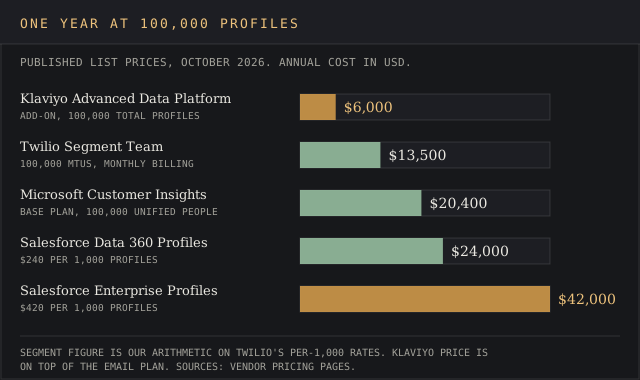
It's written for marketing teams and data leads building a business case. The figures matter because the same 100,000 customer profiles cost $6,000 a year on one vendor's add-on and $42,000 on another's enterprise tier, and that gap shows up before anyone prices implementation or warehouse compute.
What a customer data platform does for the price
Most companies buy a CDP to fix fragmented customer data and turn first-party data into one customer record. Customer information sits in a CRM, an email platform, a support desk, an e-commerce store and the ad accounts, and none of those operational systems shares a customer ID. Marketing teams pay a CDP vendor to unify customer data from those data sources into one record per person.
The price covers five jobs, and vendors charge for them separately or in one bundle:
- Collection. A data layer on the website & app captures customer behavior as events, and connectors pull CRM data and engagement data from other tools in the existing tech stack.
- Data transformation and governance. Raw data gets cleaned and mapped to one schema, with data governance rules on consent and access.
- Identity resolution. Matching rules merge each email, device ID and customer ID into an identity graph, the step that turns fragmented data into unified customer profiles.
- Segmentation and data analytics. Customer segments, lifetime value scores and churn flags get built on the unified customer view, often with the behavioral segmentation rules a team already uses.
- Activation. Segments sync to advertising platforms, email tools and the website for real-time activation and personalized customer experiences.
A CDP sits beside master data management, which governs product and supplier records as well as customer records, and in front of the warehouse a data team already runs. Data unification gives marketing teams the complete picture of existing customers, and the marketing ROI comes from the targeted campaigns built on it.
Every job a vendor leaves out means someone has to pick up the slack in other tools, at an additional cost, from an ETL licence to warehouse compute to the AI models a team trains on its own customer data.
Ease of use moves the services bill too. A user-friendly segment builder and a native integration with the email platform let marketing teams ship audiences without a ticket to data engineering, and a data-driven team with SQL skills can skip both and query the warehouse direct. The customer intelligence guide covers what those unified profiles feed downstream.
How CDP pricing works: profiles, tracked users, events and rows
Every vendor here meters customer data, and each meter sits at a different point in the data flow from source to activation. The unit sets the bill, so the first job in a business case is to count the unit the shortlisted vendor uses. A retail company with 2 million customer records and 400,000 monthly website visitors gets a different number from each meter below.
- Monthly tracked users (MTUs). Twilio Segment's pricing FAQ says both of its plans are priced on MTUs, the users it collects data on each month. Anonymous visitors count, so traffic drives the bill.
- Stored profiles. Salesforce Data 360 charges per 1,000 profiles a year. Klaviyo prices its Advanced Klaviyo Data Platform on the total number of profiles stored in the account.
- Unified people. Customer Insights, Microsoft's CDP, counts unified people and sells extra capacity in packs of 100,000.
- Events. RudderStack sells event volume: 250,000 events a month free, then $265 a month for 1 million events on Growth.
- Synced rows. Fivetran, which now owns Census, bills its Activations product on monthly active rows (MAR).
- Consumption credits. Amperity sells Amps, a standard unit for processing customer records, building segments and running campaigns. Salesforce sells Flex Credits at $500 per 100,000.
- Profiles plus behaviours. Treasure AI prices its CDP on a "P+B unit" measured daily from the parent table of the production instance.
mParticle adds a twist on ingested data. Its event-tier documentation splits events into Connect, Preserve and Personalize tiers, and says the cheaper configurations "may provide cost savings for value-based pricing customers." Personalize is the default for every event, so a team that never sets tiers leaves those savings unclaimed, even on raw data it only forwards.
Usage-based contracts, flat subscriptions and enterprise custom deals all show up in the same category. The devil's in the details: Tealium's Data Cloud Activation is a flat $1,000 a month, while Segment's Team bill adds $10 to $12 for every extra 1,000 tracked users as traffic grows.
Customer data platform cost by vendor
The table lists every vendor's billing unit, its cheapest published price and the Vendr median where one exists. Prices come straight from the horse's mouth, read on each vendor's own site in October 2026. Vendr figures come from the header of each marketplace page.
| Vendor | Billing unit | Lowest published paid price | Vendr median a year | Vendr purchases |
|---|---|---|---|---|
| Twilio Segment | Monthly tracked users | $120 a month (Team) | $55,600* | 616 |
| RudderStack | Events a month | $265 a month (Growth) | $50,958* | 61 |
| Hightouch | Usage, rows synced | Quote (free tier: 2 syncs) | $15,000* | 178 |
| Census (Fivetran) | Monthly active rows | Quote (14-day trial) | $25,836* | 51 |
| Tealium | Modules, compute | $1,000 a month (Data Cloud Activation) | $146,141* | Not stated |
| mParticle | Credits, event tiers | Quote | $96,361* | Not stated |
| Salesforce Data 360 | Profiles or Flex Credits | $240 per 1,000 profiles a year | None for Data 360 | 0 |
| Microsoft Customer Insights | Unified people | $1,700 a month | None | 0 |
| Adobe Real-Time CDP | Per 1,000 profiles | Quote | None for the CDP | 0 |
| Klaviyo | Total profiles | $500 a month at 100,000 profiles | None | 0 |
| HubSpot Data Hub | Seats plus credits | $20 a seat a month (Starter) | None for Data Hub | 0 |
| Bloomreach | Platform fee plus usage | $60,000+ a year | $160,700* | Not stated |
| Treasure AI | Profiles plus behaviours | Quote | None | 0 |
| Amperity | Amps | $2,750,000 for 36 months | None | 0 |
| Insider | Custom | Quote | $225,000* | Not stated |
Figures marked * are Vendr median annual contract values from anonymised buyer data. Every other price is the vendor's own published list price, read on 6 October 2026.
Bloomreach's Vendr median covers six Bloomreach products, so read it as a whole-account figure. The cheapest entry prices sit with tools that leave storage and identity resolution to the customer's own stack, a pattern the CRM software cost report also tracks across per-seat, flat-rate and metered CRM pricing.
Packaged CDPs: Salesforce, Microsoft, Adobe, Tealium and Treasure AI
Packaged CDPs store the unified profiles inside the vendor's own platform and bundle identity resolution, segmentation & activation channels in one contract. That bundle costs an arm and a leg next to a pipeline tool: Tealium's Vendr median is $146,141 against Hightouch's $15,000. Salesforce, Microsoft and Tealium publish a meter, and Adobe and Treasure AI quote every deal.
Salesforce Data 360: $240 or $420 per 1,000 profiles
Salesforce Data 360 lists three meters on its pricing page. Profiles costs $240 per 1,000 profiles a year with 25 calculated insights, 25 transforms and 100 segments. Enterprise Profiles costs $420 per 1,000 with 100 calculated insights, 100 transforms and 500 segments. Flex Credits run $500 per 100,000, and Salesforce says one credit "can be applied towards any Data 360 action."
Ingestion is free on every plan. A company with 1 million customer profiles pays $240,000 a year on Profiles or $420,000 on Enterprise Profiles, before Flex Credits.
Microsoft Dynamics 365 Customer Insights: $1,700 a month
Microsoft's Customer Insights pricing starts at $1,700 per tenant a month, paid yearly, with unlimited users, 100,000 unified people and 10,000 interacted people. The attach price drops to $1,000 a month for a tenant that already runs a qualifying Dynamics 365 app.
- 100,000 to 500,000 unified people: $2,000 a month per pack of 100,000
- 500,000 to 2 million: $1,500 a month per pack
- Over 2 million: $1,000 a month per pack
- Interacted people: $250 to $500 a month per pack, in packs of 5,000 to 50,000
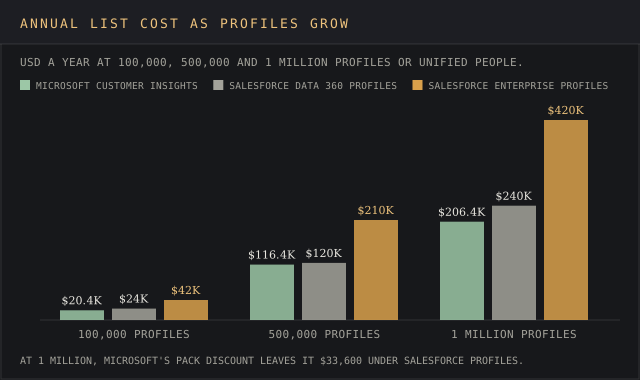
The total quantity of packs is what moves the invoice. At 1 million unified people the arithmetic comes to $206,400 a year, $33,600 under Salesforce's Profiles meter for the same count.
Adobe Real-Time CDP: licensed per 1,000 profiles, priced by quote
Adobe publishes the licence terms and keeps the dollar figure for the sales call. Its product description for the B2B edition licenses Prime and Ultimate packages "per 1,000 Businessperson Profiles," caps average profile richness at 100 kilobytes and includes up to 5 sandboxes.
The meter is the Businessperson Profile, a person record, so six buyers tracked at one target account count as six profiles. Prime allows data export of 500 kilobytes per profile a year. Ultimate raises that to 700 kilobytes and adds 8 Profile API calls per profile a year. Overage fees start after 7 consecutive days above the contracted profile count.
Tealium: $1,000 a month to start, quotes above it
Tealium's pricing page lists Data Cloud Activation at $1,000 a month, billed annually, with reverse ETL, unlimited users & 300+ connectors. Data Collection and the full CDP tier, which adds real-time profiles, real-time identity and personalization for web and mobile, both go to a quote.
Vendr's tracked Tealium customers paid a median of $146,141 a year, from $20,980 to $456,878. That high end is 3.1 times the median, a red flag for anyone budgeting off the entry tier.
Treasure AI, formerly Treasure Data
Treasure Data now trades as Treasure AI, and treasuredata.com redirects to treasure.ai. Its pricing page sells an annual Intelligent CDP subscription in tiers "based on profiles and behaviors," then charges a fixed annual licence per AI Suite plus consumption credits for real-time features. Treasure Data's pitch is predictability: it says it prices by profiles or behavioural events and leaves query volume out of the bill.
Treasure Data keeps dollar figures for the sales call. It runs a two-week proof of concept free for standard use cases and charges a fixed-bid fee for custom ones.
Enterprise suites priced only by quote: Amperity, Bloomreach, Insider, ActionIQ
Four vendors keep a full rate card off the website, and three of them leave a public number anyway.
Amperity's pricing page describes Standard and Enterprise editions with full platform access and usage billed in Amps. Up to 10% of unused Amps roll into the next contract term. Its AWS Marketplace listing is where the number shows: $2,750,000 for a 36-month full licence, or $916,667 a year, with the note "All fees are non-cancellable and non-refundable except as required by law."
Bloomreach publishes the floor. Its pricing page reads "Starting at $60K+ a year for most brands," made up of a platform fee plus usage tied to audience size, catalog size, messages sent and searches served. Annual billing is required, and AI agents are sold as add-ons.
Insider, which now trades as Insider One, publishes no pricing page, and its old pricing URL returns a 404. Vendr tracks a $225,000 median, from $150,000 to $360,000. ActionIQ belongs to Uniphore, which announced the deal on 5 December 2024, and Uniphore publishes no ActionIQ price.
Read between the lines and packaged CDPs land in six figures a year: Tealium's $146,141 median, Insider's $225,000 and Amperity's listing all clear $100,000. The customer data intelligence rankings score these suites on identity resolution and published pricing side by side.
Composable CDP pricing on an existing data warehouse
A composable CDP splits the jobs a packaged suite bundles, so collection, storage, data modeling and activation can each sit in one of multiple tools. The pitch is one copy of first-party data in the customer's own warehouse, with no proprietary store to duplicate it. The bill splits the same way: a smaller CDP invoice plus warehouse compute the CDP vendor never sees.
Twilio Segment: per-1,000 overage on the Team plan
Segment's Connections pricing is the most detailed rate card in the category:
- Free: $0 a month, 1,000 visitors, 2 sources, one daily warehouse sync
- Team: from $120 a month for 10,000 visitors, then $12 per 1,000 up to 25,000, $11 per 1,000 up to 100,000 and $10 per 1,000 above that
- Business: custom volume, unlimited warehouses, HIPAA eligibility and advanced roles
At 100,000 tracked users the Team arithmetic is $1,125 a month, or $13,500 a year before the annual discount of up to 20%. The full Customer Data Platform plan, with Unify for identity resolution and Engage for audiences, is sold only through sales.
RudderStack, Hightouch and Census
RudderStack's free tier stops processing data after the second consecutive month over 250,000 events. Its Growth plan charges overage as the gap to the next volume tier, and HIPAA plus Profiles sit on Enterprise only.
Hightouch's pricing page offers a free tier with 2 active syncs and says the paid plans carry "No MTU (Monthly Tracked Users) limits." Hightouch's identity resolution and Customer Studio are priced as separate products a customer mixes in.
Census was acquired by Fivetran, which announced the deal on 1 May 2025. The old Census pricing URL now redirects to Fivetran's pricing, where one worked example syncs 12,007 MAR from Snowflake to Salesforce for $202.25.
Klaviyo and HubSpot: CDP features inside an email platform or CRM
Klaviyo's pricing page lists the Advanced Klaviyo Data Platform at $500 a month for 100,000 total profiles, on top of the email plan. It includes unified lifetime profiles, real-time segmentation, predictive analytics and data export to other systems, with catalog insights that drive cross-sell emails off purchase history. Open and click benchmarks for those sends are in the email marketing statistics report.
HubSpot sells the same idea as Data Hub: free for 2 users, $20 a seat a month on Starter, from $720 a month on Professional and from $2,000 a month on Enterprise. Each paid tier adds HubSpot Credits for AI agents.
Warehouse compute and infrastructure costs
Warehouse-native pricing moves part of the bill to the cloud data warehouse. Snowflake's warehouse documentation rates an X-Small warehouse at 1 credit an hour and an X-Large at 16, billed per second with a 60-second minimum each time it starts. Every audience refresh a composable tool runs against the warehouse burns those credits, so the data flow schedule sets the compute bill.
Scott Zakrajsek put rough numbers on the do-it-yourself route in a LinkedIn post on 27 March 2025:
"Tools like Fivetran or Funnel let you authenticate with just your admin credentials. They'll pull your data into a warehouse YOU own for $1-2K monthly."
Scott Zakrajsek, LinkedIn, 27 March 2025
The same post puts Google Cloud or Snowflake at "under $1k/mo for most mid-market brands." A composable stack's infrastructure costs therefore add a line to the business case that a packaged CDP folds into its own fee.
Data engineering time is the other line, and owning the warehouse is easier said than done without it. A Product Manager reviewing Segment on G2 in July 2025 named the trap:
"Initial implementation and event taxonomy design are hard to get right, and mistakes are expensive long-term."
Lorenzo B., Product Manager, mid-market company, G2, 30 July 2025
What 100,000 and 1 million profiles cost at list price
The table prices a brand with 100,000 customer profiles, then 1 million, on the five published rate cards that price it, three of which also cover 1 million. Segment counts tracked users, which includes anonymous visitors who never become customers, so its figure assumes 100,000 MTUs.
| Vendor and plan | 100,000 profiles a year | 500,000 profiles a year | 1 million profiles a year |
|---|---|---|---|
| Klaviyo Advanced Data Platform | $6,000 | Slider quote | Slider quote |
| Twilio Segment Team, monthly billing | $13,500 | Business quote | Business quote |
| Microsoft Customer Insights | $20,400 | $116,400 | $206,400 |
| Salesforce Data 360 Profiles | $24,000 | $120,000 | $240,000 |
| Salesforce Data 360 Enterprise Profiles | $42,000 | $210,000 | $420,000 |
Every figure is a list price worked out from the vendor's own published rate card, before any negotiated discount.
Customer Insights and Data 360 sit within $3,600 of each other at 100,000 customer profiles. The falling Customer Insights pack price opens a $33,600 gap at 1 million, and Salesforce's Enterprise tier costs 1.75 times its own Profiles meter at every volume.
What buyers pay in practice: Vendr medians against list
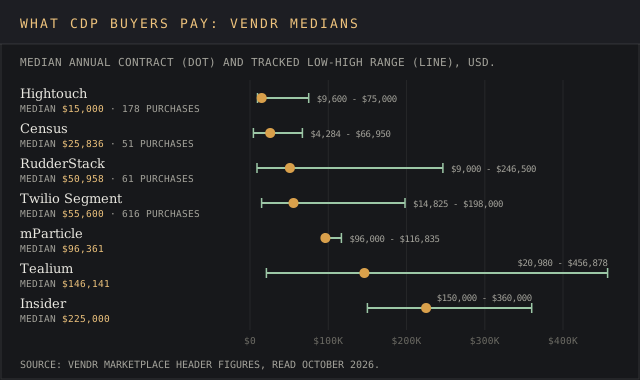
Vendr's marketplace pages give the closest thing to a real invoice for the quote-only vendors. The header figures, read in October 2026:
- Hightouch: $15,000 median, $9,600 to $75,000, 178 purchases, 26% average savings
- Census: $25,836 median, $4,284 to $66,950, 51 purchases, 21.13% average savings
- RudderStack: $50,958 median, $9,000 to $246,500, 61 purchases
- Twilio Segment: $55,600 median, $14,825 to $198,000, 616 purchases, 17.35% average savings
- mParticle: $96,361 median, $96,000 to $116,835
- Tealium: $146,141 median, $20,980 to $456,878
- Insider: $225,000 median, $150,000 to $360,000
Segment's median is 4.1 times its $13,500 Team arithmetic at 100,000 users, and its top contract is 13.4 times its bottom one. One enterprise customer in computer and network security put a number on it in a one-star G2 review on 12 November 2024:
"From implementation woes to awful support, Segment has failed us at every bend. The $400k price tag doesn't help."
Verified user, enterprise computer and network security company, G2, 12 November 2024
Contract terms move as much as list prices. A small-business COO wrote about Hightouch on G2 on 21 November 2025:
"After having used Hightouch for more than 2 years, they decided to completely change the conditions of us making it unaffordable, all within 2 months."
Mael T., COO, small business, G2, 21 November 2025
A stitch in time saves nine here. Ask for the renewal cap and the overage rate in the order form before signature, because the Hightouch reviewer above got two months between the new terms and a locked account.
Hidden costs: overage, implementation, support and AI add-ons
The platform fee is the lion's share of year one, and four other lines sit outside it.
Overage and data volume
Data ingestion volume is the line that surprises customers at renewal, and it lands on marketing teams that add one more tracking source mid-contract. Segment's Team plan charges $10 to $12 per extra 1,000 tracked users, RudderStack stops the free tier after two months over its cap, and Adobe's overage fees start after 7 days above the licensed profile count.
An enterprise education customer of Segment wrote on G2 on 21 April 2026 that "Cost is one factor that can increase quickly if the consumer sends too many events."
Implementation time and services
Vendors quote short timelines. Bloomreach says customers go live "in about two months," and Treasure AI's FAQ says a typical implementation "can take between 8 to 12 weeks." Zakrajsek's LinkedIn post sets the DIY route, up in weeks, against "lengthy 6/12/18mo CDP timelines."
A PeerSpot reviewer of Amperity, syndicated on its AWS listing on 29 September 2026, described "onboarding taking several months" and a platform "requiring proof of concept." The number of data sources drives services hours, and Bloomreach includes onboarding and 175+ integrations in its fee.
Support and compliance tiers
Support and compliance requirements push customers up a tier. RudderStack keeps HIPAA, SSO & dedicated support off its Growth plan, Segment puts HIPAA eligibility on Business, and Amperity's Enterprise edition adds 24/7 support coverage against Standard's 6am to 6pm Pacific window on weekdays.
AI and predictive models as add-ons
Advanced capabilities carry their own meters. Treasure AI sells each AI Suite on a fixed annual licence plus credits, Salesforce charges Flex Credits for AI actions, HubSpot meters agents in HubSpot Credits, and Bloomreach lists AI agents as add-ons.
Predictive models for customer lifetime value sit inside Klaviyo's CDP add-on, and mParticle lists churn reduction and win-back as named use cases for its platform. Retention benchmarks to size that case sit in the customer retention statistics report.
Who each pricing model fits
Price follows company size closely. Mordor Intelligence puts large enterprises at 63.41% of 2025 CDP revenue, and the quote-only suites are priced for them. Smaller customers say so in reviews:
- Tim C., CTO at a small business, on Segment, G2, 23 April 2026: "Can get expensive and a little bit overkill for small projects."
- Miguel L., Marketing Automation Project Manager, on Tealium, G2, 28 April 2026: "The cost can also be a concern for smaller organizations, particularly when compared to lighter-weight alternatives."
- Nate H., Customer Success Rep, on Hightouch, G2, 10 December 2024: "I'd love to see a lower priced starter plan, to know I have a cap but also room to work with."
Three customer types map onto the three pricing models:
- Marketing teams at an e-commerce brand already sending email through Klaviyo get unified profiles for $500 a month at 100,000 profiles.
- A B2B company running HubSpot gets CRM data, engagement data and support interactions in one customer database on Data Hub, and the account-based marketing pricing report covers the ad and platform fees layered on top.
- A customer with a modeled warehouse and data engineers fits the composable route on its own warehouse data.
The audience segmentation tools ranking covers the segment builders on top of each, and the marketing segmentation software ranking covers the ones sold without a CDP attached.
Buyers who put all their eggs in one basket with a packaged suite pay for identity resolution, the identity graph and activation channels as one fee. A team that only needs audience syncs to Google Ads pays for all three anyway.
CDP alternatives: ETL, a warehouse and batch syncs
The cheapest of the CDP alternatives skips the CDP. Zakrajsek's post lays out the quick and dirty version: pick one foundation system, pull data from multiple sources into a warehouse and sync on a schedule.
"Daily batch syncs of core customer data will solve 80% of your problems. Setup simple pipelines or (eek) scheduled queries to bring data together. Most companies overcomplicate this."
Scott Zakrajsek, LinkedIn, 27 March 2025
The trade-off is identity resolution. Andrew Seipp, replying under the same post on 30 March 2025, wrote that "One of the biggest issues that CDP vendors don't like to talk about is the lack of flexibility in identity resolution as well," and described a guest checkout that attached orders to the first profile tied to an email address.
Seipp's alternative was warehouse logic on customer data, such as fuzzy matching on company name. Firmographic fields for that kind of match come from the vendors in the data enrichment tools ranking.
Visitor-priced activation tools sit between the two. Untitled's pricing page lists $500 a month for up to 25,000 unique monthly visitors and $1,000 a month for 50,000, billed annually.
Untitled argues on its own blog that legacy CDPs "were built for marketers but ended up owned by IT," and calls the composable CDP movement "the market's correction." Untitled sells the alternative, so read that as a sales argument.
Customer data platform market size, and why two estimates differ by $5.82 billion
Two research houses publish 2026 figures for the market these prices add up to, and they sit $5.82 billion apart:
- Mordor Intelligence: $4.58 billion in 2026, rising to $13.14 billion by 2031 at a 23.47% CAGR
- Grand View Research: $8.2 billion in 2025 and $10.4 billion in 2026, rising to $58.4 billion by 2033 at a 27.8% CAGR
Grand View's 2026 figure is 2.3 times Mordor's, and the jury's still out on which definition of a CDP is right. Mordor's segment data puts cloud deployment at 88.43% of the market, retail and e-commerce at 35.67% and North America at 47.32%, so a reader can check what each house counted as a CDP before trusting either headline.
How to budget for a customer data platform
- Count the meter your shortlist uses: MTUs, stored profiles, unified people, events or rows. Pull 12 months of website behavior and customer records first, and list every one of your data sources.
- Price the 100,000 and 1 million profile cases on every published rate card, as in the table above.
- Add warehouse compute for any composable option, at 1 credit an hour for each X-Small Snowflake warehouse running.
- Get the overage rate, the renewal cap and the support tier in writing.
- Ask for a proof of concept: Treasure AI runs one free for 2 weeks.
Bite the bullet on the services estimate early, before the contract is signed. The business intelligence cost report and the intent data pricing report price the BI and intent-data tools a team may connect to the same profiles.
Frequently asked questions
How much does a CDP cost?
Published prices run from $0 on Segment's and RudderStack's free tiers to $2,750,000 for a 36-month Amperity licence. Vendr medians for quote-only tools run from $15,000 a year for Hightouch to $225,000 for Insider.
Is a CDP worth the investment?
For marketing teams, it pays off when the unified data feeds customer revenue work: targeted campaigns, revenue attribution & personalized experiences across different channels. Bloomreach's pricing page cites a 2024 Forrester study putting three-year ROI at 251% for its own customers. Marketing teams can test the case on Klaviyo's $500-a-month add-on at 100,000 profiles before signing a six-figure suite.
What is the best customer data platform?
The best fit depends on where customer data lives today and how many customer records it holds. Salesforce Data 360 suits Salesforce CRM shops at $240 per 1,000 profiles, Hightouch suits warehouse-first teams at a $15,000 Vendr median, and Klaviyo suits e-commerce brands already on its email platform. The customer intelligence platforms ranking scores ten systems on the same customer data jobs.
What is a CDP vs. a CRM?
A CRM stores sales records and the interactions reps log, priced per seat. A CDP ingests website behavior, app events, CRM data and support tickets to create unified profiles for each customer, priced per profile, user or event. The CRM cost breakdown prices the seat side.
How does a customer data platform work?
It collects real-time data from data sources such as a website tag, mobile SDK, CRM and email platform, then runs identity resolution to unify customer data, merging each device ID, email and customer ID into one profile. Segments built on those profiles sync to ad platforms such as Google Ads, email tools and other systems.
Bottom line
The billing unit decides a customer data budget. MTU pricing grows with traffic, profile pricing grows with list size, and row pricing hands part of the bill to the warehouse.
At 100,000 profiles the published options cost $6,000 to $42,000 a year. Quote-only suites land between Tealium's $146,141 median and Amperity's $916,667 a year, and the Vendr ranges show how far one customer's deal can drift from the next.
Marketing teams that count their customer data on the vendor's own meter before the first sales call walk in with a number to defend.
Where each CDP price was read, and the numbers no vendor prints
List prices and plan terms come from the vendors' own pages: twilio.com for Segment, salesforce.com, microsoft.com, helpx.adobe.com for Adobe's product description, tealium.com, treasure.ai, amperity.com, bloomreach.com, rudderstack.com, docs.mparticle.com, hightouch.com, fivetran.com for Census, klaviyo.com, hubspot.com, docs.snowflake.com and getuntitled.ai. Amperity's licence price is its listing on aws.amazon.com/marketplace.
Contract medians, ranges, purchase counts and savings are the header stat blocks on vendr.com/marketplace for Segment, RudderStack, Hightouch, Census, Tealium, mParticle, Bloomreach and Insider. Market sizes come from Mordor Intelligence's customer data platform report on mordorintelligence.com, last updated 15 May 2026, and Grand View Research's report on grandviewresearch.com, last updated June 2026.
Acquisitions come from Uniphore's press release of 5 December 2024 on uniphore.com and Fivetran's of 1 May 2025 on fivetran.com. Buyer quotes come from g2.com reviews dated 12 November 2024 to 28 April 2026, a PeerSpot review shown on the AWS listing on 29 September 2026, and Scott Zakrajsek's linkedin.com post of 27 March 2025 with Andrew Seipp's reply of 30 March 2025.
Every figure was checked against its origin on 6 October 2026. Adobe, Treasure AI, mParticle, Insider and Uniphore's ActionIQ print no dollar price, Hightouch and Census quote every paid plan, and Segment and Tealium sell their full CDP tiers through sales only. Vendr tracks no contracts for Salesforce Data 360, Customer Insights, Adobe's CDP, Klaviyo, HubSpot Data Hub, Treasure AI or Amperity.