Stacksync pricing in 2026: platform from $1,000 a month, agents from $200, apps from $5
 By Jan Suski. I go deep on every review, checking every number against its source and digging up details other coverage misses, a habit from six years of SEO and link building for tech companies. Bylines at Surfer, Brand24, and Senuto. How the scoring works.
The numbers Stacksync pricing, checked 22 October 2026
The cheapest way in is AI Genies. At $200 a month it's $2,400 a year, one fifth of Starter's $12,000, and Enterprise OS at $5 an app is $60 a year for each app.
Dividing the $3,000 Pro price by the 1M records it covers gives $3.00 per 1,000 records, and the same plan at 2M works out to $1.95, so the unit price falls about 35% as volume doubles.
Celigo's Vendr median of $14,787 sits between Starter's $12,000 and Pro's $36,000, so the cheaper option depends on how many app pairs and flows a team runs.
I'll write a 2,500+ word report on the vendor you name, with list prices, usage rates and the fine print sourced line by line. Yours to publish, from $200.
Stacksync pricing starts at $1,000 a month for the platform, $200 a month for AI Genies and $5 a month for each Enterprise OS app. Those are the three numbers on its pricing page, all billed annually.
This report is written for operations, RevOps and data engineering teams sizing a first sync, and for anyone asked to put a number on AI agents or internal tools that read the same data. It covers the three products, the billing units behind them, five worked platform bills from 50K to 2M records, the costs outside the plan price, and how the platform compares with Celigo and Workato.
Each price is built from the pricing page, the Service Consumption Table it points to in Stacksync's documentation, and Vendr's buyer-reported contracts for the alternatives. Most integration vendors print none of these numbers. Celigo and Workato quote every deal, so Stacksync's own pricing page is one of the few places where an integration, an agent and an internal-app bill can be read side by side.
The platform bills on records in sync, the agents bill on runs and the apps bill per app, so a buyer needs three counts before a call. The report also covers who sells Stacksync, how a sync is set up and which security features sit behind each plan, since those decide which plan a team lands on. Teams that put a warehouse or a reporting layer on top of the synced data add a fourth line, which our business intelligence cost report tracks.
Stacksync pricing compared to the alternatives
Stacksync is the only platform in this table that publishes a price list. The other two quote every deal, so the figures in their rows come from buyer-reported data and third-party trackers.
| Platform | Annual price | Low to high | Price source | Pricing model |
|---|---|---|---|---|
| Stacksync AI Genies | $2,400 | Fixed entry | Vendor pricing page | Flat plan with credits, billed on agent runs |
| Stacksync Starter | $12,000 | Fixed | Vendor pricing page | Active syncs plus records in sync |
| Stacksync Pro | $36,000 | Fixed | Vendor pricing page | Active syncs plus records in sync |
| Celigo | $14,787* | $6,514 to $35,988 | Vendr, 253 purchases | Editions priced on endpoints and flows |
| Workato | $10,000 to $45,000† | Up to $400,000+ at enterprise volume | Third-party trackers | Platform edition fee plus task usage |
Copy these lines into an email, fill them in and send. I reply with scope and a price within 2 to 3 business days.
Open the email* Vendr median contract value across 253 purchases. Stacksync rows are vendor list prices.
† Entry-level estimate from public pricing trackers. Workato prints no list price, so treat the range as an editorial band and confirm the real figure in a quote.
The three platforms meter different things. Celigo and Workato are broad automation platforms that quote on how many flows or tasks you run. Stacksync's platform is built around keeping records identical in two systems, so its meter is the record count.
A team that needs one or two flows may pay less for Celigo than for Stacksync Pro. A team that keeps adding objects between the same pair of apps will see the Stacksync price move far less than a per-task price would. Enterprise OS has no counterpart in the table, because neither vendor sells hosting for the internal apps a team builds.
Third-party listings add little. App Marketplace's Stacksync page counts 5 native integrations and lists Zadarma, Knowlarity, Voximplant and Vouch as similar products. Zadarma and Knowlarity sell business telephony and Voximplant sells real-time communication APIs, so that list compares Stacksync with phone systems.
Who sells it: a San Francisco data synchronization company
Stacksync is a San Francisco company founded in 2022. Y Combinator lists it in the Winter 2024 batch with a team of 34. Ruben Burdin is listed as Founder/CEO. Stacksync's other founder, Alexis Favre, is listed as Founder/CTO.
The YC company profile describes the product as real-time and two-way sync between CRMs and databases, with Salesforce, HubSpot and SAP on the CRM side and Postgres or Google BigQuery on the database side. It says the database becomes a read and write interface to CRM data, so an engineer can run SQL queries to update data at any scale and the change lands in the CRM.
Stacksync's two-way sync page claims 1,000+ connectors, its homepage puts the count at 1,000+ SaaS apps, and the homepage logo wall shows the customers it names, several tagged as case studies or as customers migrated from a competitor: the IA Capital Group logo, the Golden Pear Funding logo and the SEAL SQ logo sit beside IDEXX, Vimeo, Codility, Gladia and MedPro.
Software Advice lists Salesforce Sales Cloud, Salesforce Data Cloud, HubSpot CRM, PostgreSQL and Amazon RDS among its integrations.
Front's marketplace page pairs Stacksync with Snowflake, PostgreSQL and Amazon RDS for two-way sync of Front data with a warehouse. Buyers syncing customer records into a warehouse sometimes price a customer data platform for the same job.
Software Advice files it under data management, data synchronization, ETL and reporting features, and shows zero user reviews so far. The named customers publish no contract values, so the pricing page is the only price evidence a buyer gets.
How a sync is set up
The quick start in Stacksync's documentation walks users through the dashboard interface in four steps, and says a first sync takes under 5 minutes:
- Click Create a new sync from the Stacksync dashboard.
- Connect each app you want to sync, one click per app.
- Pick the tables to sync and set each one's direction to one-way or two-way sync.
- Review the field pairs that AI auto-mapping proposes, edit the wrong ones, and start the sync.
The setup is configuration-driven, and Stacksync pitches it as a way to run data streams at scale without writing scripts. The homepage describes no-code workflow automation between any enterprise systems, and Pro adds Configuration as Code for teams that want the setup version-controlled. Since you choose which tables and fields go into each sync, the setup screen is also where the record count, and the bill, gets decided.
Workflows can then fire when a record changes. That's how the platform automates the data movement operations teams would otherwise handle with manual exports between CRMs and databases, and why Stacksync pitches itself as a fix for data sitting in separate systems across departments.
Real-time two-way sync, record matching and field ownership
Stacksync markets millisecond propagation, and its homepage examples cite order-to-cash updates across your systems in under a second. The claim is that an edit in Salesforce will instantly update Postgres, and vice versa. Change data capture, which picks up row-level changes in real time, appears in its logistics example.
The company's own two-way sync page is more careful. It tells buyers to measure latency in both directions on their own objects, because delivery depends on each connector's change detection method. Run that test during the trial on the objects you plan to pay for.
Before go-live, Stacksync's integration pages ask a team to settle record matching, field ownership and conflicting-edit behaviour: which identifier links the same record across systems, which team owns each field, and which edit wins. Add how a schema change on either side gets handled. A badly matched sync creates duplicate records, and each duplicate is one more record in sync on the bill.
Failed records surface in the Issues dashboard, where each can be retried or reverted, and alerts go out by email, Slack, PagerDuty and WhatsApp.
For reliability under high traffic, the site points to a customer case study claiming a Black Friday peak ran without losing a single order, and to triggers it calls lossless and replayable end to end. Stacksync also sells event queues, which it treats as the same primitive as EDI, and the data you keep in hosted queues and databases is stored by design.
How much does Stacksync cost
Stacksync sells three things, and the pricing page opens with all of them. Each is quoted per month and billed once a year. Month-to-month billing costs more and skips the annual commitment.
| Product | Starting price | What the price covers |
|---|---|---|
| Platform | From $1,000 a month | Two-way sync, workflow automation, database hosting and EDI, with full access to every platform product |
| AI Genies | From $200 a month | Cross-system agents with credits, access control and guardrails |
| Enterprise OS | From $5 a month, per app | Hosting for the internal apps and agents a team builds |
Stacksync list prices per month, billed annually.
The platform has four plans of its own.
| Plan | Billed annually | Month-to-month | Active syncs | Records in sync included |
|---|---|---|---|---|
| Starter | $1,000 | $1,400 | 1 | 50K |
| Pro | $3,000 | $3,700 | 3 | 1M |
| Managed Pro | $4,200 | $4,900 | 3 | 1M |
| Enterprise | Quote | Quote | Unlimited | Custom |
All prices are Stacksync list prices per month from its pricing page, and the numbers above match the full plan grid there.
Starter
Starter is the only self-serve plan. It includes one active sync, 50K records in sync, workflow automation, basic connectors, three collaborators and community support. At $12,000 a year it's the cheapest way into the platform, and it fits a team with one app pair. Users on Starter get the same real-time two-way sync as Pro users, with smaller allowances and community support.
Pro
Pro adds SOC 2 Type II, ISO 27001 and HIPAA coverage, the Management API, Configuration as Code, processing regions and a dedicated Slack channel for live support. It raises the allowance to three active syncs and 1M records in sync. The jump from Starter is $2,000 a month, and Pro stays at $3,000 all the way to 1M records.
Managed Pro
Managed Pro is Pro with people attached. A dedicated engineering team runs the integrations end to end, and a dedicated integration lead, a named person on Stacksync's side, defines the system blueprint. The premium over Pro is $1,200 a month billed annually, or $14,400 a year. Weigh that number against hiring an integration engineer.
Enterprise
Enterprise has no printed price. It adds unlimited syncs, SSO and SCIM, audit logs, a support hotline, a dedicated solutions architect, custom processing regions, SLAs and volume-based discounts.
Security and compliance features by plan
Several security features start at Pro or Enterprise, so a compliance checklist can push a small team past Starter before its record count does. Stacksync's security page splits them like this:
- Every plan: GDPR and CCPA coverage, role-based access control, SSH tunneling and a no-data-retention policy on the sync path.
- Pro and above: SOC 2 Type II (report under NDA), ISO 27001, a HIPAA BAA, DPF certification for US, EU, UK and Swiss transfers, MFA, IP allowlisting and SSL certificates.
- Enterprise only: SSO and SCIM with Okta, Azure or Google, audit logs, logs kept in your own storage, a choice of cloud provider (GCP, AWS or Azure), VPC peering, private networking and on-premise deployment.
Customers on Pro and above can request the SOC 2 Type II report under NDA through Stacksync's Trust Center. Customer data moves under TLS 1.2+ and sits encrypted with AES-256 at rest. Stored credentials such as OAuth tokens, API keys and database passwords are encrypted too. The sync path keeps no copy of a record once the write completes, though Stacksync does store sync state, meaning record IDs and change fingerprints.
Support scales with the plan too: community support on Starter, a dedicated Slack channel on Pro and a 24/7 hotline on Enterprise.
Logs are kept for 1 day on Starter, 7 days on Pro and Managed Pro and 30 days on Enterprise. Processing regions widen with the plan: a basic set on Starter, an extended set on Pro and Managed Pro, and every region including custom ones on Enterprise. The page doesn't say where AI inference for Genies runs, and tells buyers to request that in writing.
How the platform bill is built
Two units set the platform price: records in sync and active syncs. Task counts play no part.
What counts as a record in sync
A record counts when it's present at the beginning of the month or when it syncs for the first time. A record synced between two apps counts once, so 100 records kept identical in Salesforce and Postgres count as 100 records in sync.
Once a record is in sync it can be updated any number of times at no extra cost. That's the reason the meter sits closer to a storage bill than to a usage bill. A record that changes 50 times a day costs the same as one that never changes.
Stacksync's page doesn't say how records synced across three or more apps, chained syncs, unchanged rows or the initial backfill are counted. Ask for that in writing before signing.
What counts as an active sync
A sync is a pair of apps. Salesforce and Postgres is one sync, and it can hold as many tables, objects and fields as you choose. A sync is active while it's turned on. A new app pair uses another active sync, so a team connecting five pairs needs five active syncs, two more than Pro includes.
Usage rates above the allowance
Records above the plan allowance are billed per 1,000 at rates that fall as volume rises.
| Records in sync | Price per 1,000 |
|---|---|
| 0 to 50K | Included |
| 50K to 150K | $8 |
| 150K to 1M | $2 |
| 1M to 10M | $0.90 |
| 10M to 100M | $0.40 |
| 100M+ | $0.10 |
Stacksync list rates per 1,000 records in sync, from its pricing page.
Sync direction leaves the price where it is. Real-time two-way sync and configurable write direction come with every plan, so a two-way sync costs the same as a sync that writes in a single direction.
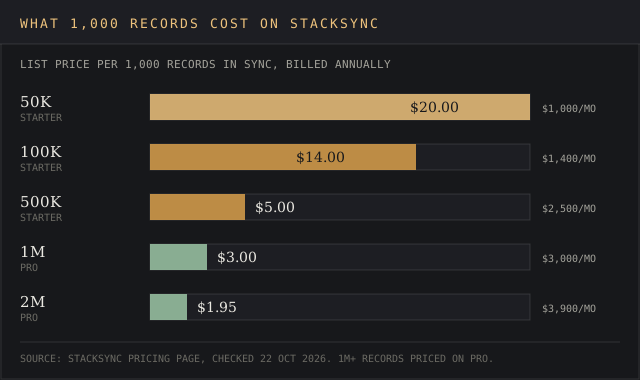
What a platform bill looks like at five volumes
Each row is the list price per month, billed annually, with the plan price plus the usage rate for any records above the allowance.
| Records in sync | Plan | Monthly price | Yearly price | Cost per 1,000 records |
|---|---|---|---|---|
| 50,000 | Starter | $1,000 | $12,000 | $20.00 |
| 100,000 | Starter | $1,400 | $16,800 | $14.00 |
| 500,000 | Starter | $2,500 | $30,000 | $5.00 |
| 1,000,000 | Pro | $3,000 | $36,000 | $3.00 |
| 2,000,000 | Pro | $3,900 | $46,800 | $1.95 |
Calculated from Stacksync's list plan prices and usage rates, billed annually.
The arithmetic is short. At 100K records Starter costs $1,000 plus 50,000 records at $8 per 1,000, which is $400. At 500K it's $1,000, plus $800 for the 100K records between 50K and 150K, plus $700 for the 350K records between 150K and 500K at $2 per 1,000, which lands at $2,500. At 2M records on Pro it's $3,000 plus 1M records at $0.90 per 1,000, or $900.
Per record, the first row is the most expensive. A record costs $20 per 1,000 at 50K and $1.95 at 2M, a drop of about 90%. The pricing rewards volume.
Want a unit-price chart like this for the platform your buyers compare you with? Send the vendor name.
Email a briefThe calculator moves a buyer from Starter to Pro at 1M records, and the reason is visible in the numbers. Starter at 1M would cost $1,000 plus $800 plus $1,700, which is $3,500. Pro covers the same volume for $3,000.
Managed Pro at 2M records is $5,100 a month, $1,200 above Pro. Past the range of the pricing calculator, Enterprise is quoted.
AI Genies pricing
The AI Genies plan is the newest line on the page and the cheapest entry. Stacksync's AI agents are cross-system agents that read the ERP, CRM, database and support tools a team connects and act across them. The plan costs $200 a month billed annually, which is $2,400 a year.
For month-to-month billing, the pricing page's search listing gives $250 a month, a figure the plan card itself leaves out, so confirm it on a call.
What the $200 includes
The plan lets a team create unlimited Genies and includes $200 in credits, unlimited concurrent runs, access from Slack, Claude, Teams and MCP, and access control and guardrails. A free trial is offered through the Start free trial button, and the page gives no trial length.
How an agent run is billed
Agent plans bill on runs. A run is one complete job an agent carries out, from the trigger to the last action it takes, and retries inside a run aren't charged again. That makes the meter easy to forecast for a fixed job such as a daily report, and harder for an open-ended one.
Genies inside a platform plan
The agents can also be added to a platform plan. Each platform plan includes a Genie allowance, and extra Genies, Genie runs and AI credits are billed at the rates in the Service Consumption Table. Stacksync prints no credit-to-run conversion on the pricing page, so a buyer who wants to know how many runs $200 buys has to ask.
A team that already owns Starter and also buys the standalone plan would list at $14,400 a year, so check the allowance before paying for the same capacity twice.
Using Stacksync from Claude and ChatGPT
The banner at the top of the pricing page links to the MCP server for Claude and ChatGPT, and it matters for cost because it changes who sets things up. Through MCP an assistant can create syncs, workflows, Genies, queues and API proxies from a chat prompt, using the same plans and allowances as the web app.
Is the MCP server priced separately
The MCP page prints no price. The pricing page lists MCP gateways among the units billed above a plan's allowance, at the rates in the Service Consumption Table, and says the order form lists every fee. Treat MCP as a line to confirm in that order form.
What the page does say
Sign-in is by OAuth, so there are no API keys to paste into a chat. Actions run with the user's workspace role, access can be read-only, and a workspace owner can set the assistant to ask before every change. The page lists a limit of 120 tool calls per minute, per user and per workspace API key. Eight AI clients are named: Claude, Claude Code, ChatGPT, Codex, Cursor, VS Code, Windsurf and Gemini CLI.
Stacksync's MCP page lists a limit of 120 tool calls per minute, per user and per workspace API key.
Stacksync MCP tool calls per minute, per user and per workspace API key
Source: Stacksync MCP pagee.g. API and MCP limits for the five tools in your category
Source: linked, checked, datedEnterprise OS pricing
The pricing page puts Enterprise OS from $5 a month for each app. That's $60 a year for one app and $600 a year for ten. Enterprise OS hosts the dashboards, portals and internal tools a team builds, gives each a live URL, and handles the database and the access rules behind it.
What an app gets
Each deployment is saved, so an earlier version can be redeployed. A database is created and connected when an app needs one. Access can be limited to specific people or groups, with separate use and manage permissions, and apps can call models from OpenAI, Anthropic and others with spending limits and usage tracking. Apps are deployed from a project folder with a command line tool, without a GitHub repository.
What the price leaves out
The $5 is a starting price, and the Enterprise OS page prints no price, quota or uptime figure. The page also says that deploying an app won't connect it to synced data on its own. A team that wants an app to read Salesforce records pays for the app, plus the records in sync that feed it.
Costs priced outside the subscription
Four costs sit around the plan price.
Additional active syncs and billed units
A sync above the plan allowance is billed at the rate in Stacksync's Service Consumption Table in its docs. So are extra workflows, queues, Genies, Genie runs, MCP gateways and AI credits. Read that table before you size the plan, because it's where a three-pair stack turns into a five-pair one.
Enterprise-only features
Private networking, VPC peering and on-premise deployment are Enterprise features. So are enterprise connectors, audit logs, storing logs in your own storage and Autonomous AI Agents for the connector development kit.
EDI
Stacksync prints no per-trading-partner price list. EDI is quoted for the whole partner network, based on the number of partners, the document types and the monthly document volume.
Proof of concept and onboarding
Starter has self-serve sign-up. Pro, Managed Pro and Enterprise start with a demo, and larger projects move on to a guided proof of concept led by integration engineers. Stacksync gives its length and price on request, and the page says nothing about crediting it toward a plan. All plans include onboarding support.
What drives a Stacksync quote
Three variables move a number from the printed list into a negotiation.
Active sync count
Enterprise is the only plan with unlimited syncs. A company with eight app pairs is already past Pro's three, and each extra pair is billed above the allowance.
Record volume
Volume past the pricing calculator's range is quoted. The per-1,000 rate keeps falling to $0.10 above 100M, so volume discounts are where the negotiation is.
Security and support
SSO and SCIM, SLAs, a solutions architect, custom processing regions and a 24/7 hotline are what move a mid-size deal into Enterprise.
Who each plan is priced for
One app pair, up to 50K records
Starter. A single CRM to database sync, where one team owns both sides, fits inside the allowance at $12,000 a year.
Three app pairs, up to 1M records
Pro. This covers a CRM, an ERP and a billing system kept consistent with one warehouse, with compliance coverage included.
Teams without an integration engineer
Managed Pro. The extra $14,400 a year pays for the engineering team and the integration lead. The record allowance stays at Pro's 1M.
Teams trying agents before committing to a platform
AI Genies. At $2,400 a year it's the smallest commitment on the page, and it avoids a record-based meter while a team learns what its agents will run.
Teams with internal tools to host
Enterprise OS. A handful of apps at $5 each costs less than one month of the smallest platform plan.
Large and regulated buyers
Enterprise. The reasons are SSO, SLAs, private networking and volumes past the calculator's range.
How to cut the bill
Sync only the tables you need
Tables and objects left out of a sync add nothing to the record count. A team that syncs 8 of 40 objects keeps the count, and the price, down.
Choose annual over monthly
The annual price saves $4,800 a year on Starter, $8,400 on Pro and $8,400 on Managed Pro against month-to-month billing. On AI Genies the same choice saves $600 a year if the $250 monthly figure holds. The trade is the commitment.
Use the agent allowance before buying a second plan
Platform plans already include a Genie allowance. Start there, watch the runs, and buy the standalone plan only when the allowance runs out.
Compare the plan with a consultant
Some teams would sooner hand their syncs to an outside firm to maintain. An integration consultant can run them as a monthly service, and Managed Pro's $4,200 a month is the number to price that against.
Is Stacksync worth the cost
The case rests on one comparison. A platform that bills per task grows with activity, and a platform that bills per record grows with the data you hold. For a stack where the same records change many times a day, the second is easier to forecast.
The case against is just as concrete. A team with one or two simple automations may find Celigo's entry editions cheaper, and a team that needs EDI, document processing and RPA in one platform is buying something Stacksync doesn't sell as a bundle. The agent and app prices are low, but they come with fewer printed limits than the platform, and that gap is where a contract needs the most detail.
What to budget
A reasonable first-year budget has five lines.
- The platform plan at the volume you have today, from the table above.
- The usage rate on the records you expect to add in the next 12 months.
- Any active syncs above the allowance, from the Service Consumption Table.
- The agent plan or the Genie allowance, plus a margin for runs beyond it.
- Enterprise OS at $5 a month for each app you plan to host.
For a team on one app pair at 100K records, two internal apps and no agents, that's $16,800 plus $120, or $16,920 a year. For three pairs at 1M records with the standalone agent plan and five apps, it's $36,000 plus $2,400 plus $300, or $38,700. Neither figure includes professional services, which Stacksync doesn't publish, or the CRM seats at the other end of the sync, which our CRM software cost report prices from $0 to $550 a seat.
Delivered for your site and your byline. Hosting here is optional.
Frequently asked questions
How much does Stacksync cost per month?
The platform starts at $1,000 a month billed annually, or $1,400 month-to-month, on Starter. Pro is $3,000 or $3,700, and Managed Pro is $4,200 or $4,900. AI Genies start at $200 a month and Enterprise OS at $5 a month for each app. Enterprise is by quote.
How much do Stacksync AI agents cost?
The AI Genies plan is $200 a month billed annually. It includes unlimited Genies, $200 in credits, unlimited concurrent runs and access control and guardrails. Runs beyond the credits are billed at the Service Consumption Table rates.
Does Stacksync have a free plan?
The pricing page lists no free plan. Starter has self-serve sign-up and the agent plan has a free trial button. Pro, Managed Pro and Enterprise start with a demo, and larger projects go to a guided proof of concept whose terms Stacksync gives on request.
What is a record in sync?
A record counts when it's present at the beginning of the month or when it syncs for the first time. A record synced between two apps counts once.
Does two-way sync cost extra over a sync that writes in one direction?
Sync direction leaves the price unchanged, and real-time two-way sync is on every plan.
Is the Stacksync MCP server free?
The MCP page lists no price. MCP gateways are one of the units billed above a plan's allowance, so confirm the rate in the order form.
Is Stacksync secure enough for regulated data?
Pro and above carry SOC 2 Type II, ISO 27001, a HIPAA BAA and DPF certification. Data is encrypted with TLS 1.2+ in transit and AES-256 at rest, and audit logs, SSO and SCIM are Enterprise features.
Where is Stacksync based?
San Francisco. Y Combinator lists the company as founded in 2022, in its Winter 2024 batch, with Ruben Burdin as Founder/CEO and Alexis Favre as Founder/CTO.
What happens when I go over my records allowance?
The extra records are billed per 1,000 at the usage rates, which fall from $8 to $0.10 as volume grows. You can move to a larger plan at any time.
Bottom line
Stacksync's list price is $12,000 a year on Starter, $36,000 on Pro and $50,400 on Managed Pro, all billed annually, with AI Genies at $2,400 and Enterprise OS at $60 per app. The bill that matters is the one at your record count. At 500K records on Starter it's $30,000, and at 2M records on Pro it's $46,800.
The cost driver is the number of records you keep in sync, then the number of app pairs. Update frequency leaves the price where it is. Agents add a second meter on runs, and the apps add a third on app count.
Before buying, count your record volume, app pairs, agent jobs and internal apps, read the Service Consumption Table, and ask for the record definition, the credit-to-run conversion and any setup terms in writing. Starter fits one app pair. Pro fits three pairs and a compliance requirement. Managed Pro fits teams that would otherwise hire an integration engineer, and Enterprise fits buyers who need SSO, SLAs or volume past the calculator's range.
Integration vendors, RevOps consultancies and data teams use reports like this one in sales calls and budget reviews.
A report on your topic for a blog page, gated content or a lead magnet.
Written for your client and published under their brand, with my name left off.
Your report on marketintelligencetools.com, with 2 to 3 CTAs carrying your sponsored links.
Default terms: the report is yours to publish, and I keep the right to republish it on this site behind a gate, outside Google's index.
Where each Stacksync figure came from, and what stays off the rate card
Plan prices, record allowances, usage rates, the AI Genies and Enterprise OS prices, and the MCP and Service Consumption Table notes were read off stacksync.com/pricing on 22 October 2026. Company facts come from Stacksync's Y Combinator profile at ycombinator.com. Product, setup and security details come from stacksync.com, its two-way sync, security, MCP and Enterprise OS pages, and the quick start on docs.stacksync.com, all checked the same day.
Celigo's median, spread and purchase count are the header figures on vendr.com/marketplace/celigo. Workato's band comes from public pricing trackers, because Workato prints no list price. Integration lists come from softwareadvice.com, front.com and compare.appmarketplace.com.
Stacksync prints no credit-to-run conversion for Genies, no per-trading-partner EDI price, no proof-of-concept price and no uptime figure for Enterprise OS, so those numbers stay off this page until it does.