Clay pricing: plans, Data Credits, and the real cost per seat
 By Jan Suski. I go deep on every review, checking every number against its source and digging up details other coverage misses, a habit from six years of SEO and link building for tech companies. Bylines at Surfer, Brand24, and Senuto. How the scoring works.
· Prefer this source on Google
Vendr's own marketplace page for Clay still describes the Starter, Explorer, and Pro plans that Clay retired on March 11, 2026. Even the tracker this report leans on for Enterprise pricing hasn't caught up to Clay's own rate card. Clay replaced that three-tier structure with Free, Launch, Growth, and Enterprise, splitting usage into two currencies: Data Credits, which meter data purchases, and Actions, which meter platform work and never top up.
Vendr's tracked data puts the median Enterprise contract at $40,500 a year across 80 purchases, ranging from $16,044 to $117,900, a figure Clay itself never publishes. This report breaks down what each of the four plans costs, how Data Credits and Actions get spent, and where the published price and the real bill diverge, drawing on Clay's own pricing page, Vendr's tracked data, and verified G2 and TrustRadius reviews.
It's for RevOps leads sizing a plan for sales teams, finance staff checking a quote against list price, and anyone who's read Vendr's page and wondered why the tier names don't match. Our LeadIQ pricing report covers a similar pooled-credit model, useful for comparing the two.
The numbers Clay pricing, checked 11 August 2026
Growth costs 2.7 times what Launch costs but only doubles the Data Credit allocation, so the jump buys CRM integration and API access more than it buys enrichment volume.
The 30% top-up markup means every Data Credit bought outside a plan costs more than upgrading the plan itself, once usage clears a threshold.
Vendr's $40,500 median sits well above the $5,940 annual list price for Launch.
Most paying customers are not buying the entry plan; they're negotiating something closer to the middle or above it.
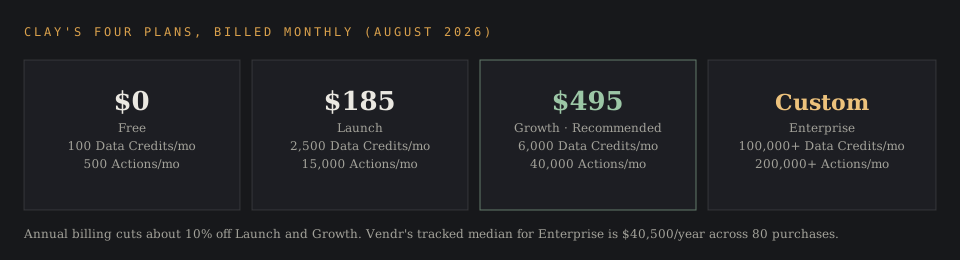
Clay pricing breakdown: the four plans
Clay runs four plans: Free, Launch, Growth, and Enterprise. Multiple pricing tiers exist inside Launch and Growth too, since each one lets you scale the Action ceiling up in steps without changing the base plan.
Every plan includes unlimited seats and unlimited tables, a deliberate break from the per-user pricing common at Apollo or ZoomInfo. What scales instead is Data Credits and Actions, the two currencies that meter data purchases and platform work.
| Plan | Price (monthly billing) | Data Credits/mo | Actions/mo | CRM integration |
|---|---|---|---|---|
| Free | $0 | 100 | 500 | No |
| Launch | $185 | 2,500 | 15,000 | No |
| Growth | $495 | 6,000 | 40,000 | Yes |
| Enterprise | Custom pricing* | 100,000+ | 200,000+ | Yes |
*Enterprise price is negotiated per contract. No public rate card lists it: Vendr's tracked median for Clay Enterprise contracts is $40,500/year, against a range of $16,044 to $117,900 across 80 purchases.
Annual billing cuts roughly 10% off Clay's subscription price on every paid plan. Launch drops to about $167/mo and Growth to about $446/mo under annual plans.
That's a smaller discount than Clay offered before the March restructure, when older marketing pages advertised savings closer to 15-25% for annual billing.
Free plan
The Free plan is a flexible entry point: no card required, unlimited users, and access to Clay's full workflow builder.
It includes 100 Data Credits and 500 Actions a month, along with multi-provider waterfalls, basic enrichment through Claygent, and the ability to bring your own API keys.
The catch is row volume. Free tables cap at 50 rows, and phone number enrichments are excluded outright.
Vendr's own research notes that most buyers exhaust the free plan's credit allocation within days of running an active workflow. That makes the Free and Starter plans, old and new, a proof-of-concept tier.
Clay offers the same workflow builder on the free plan and on Enterprise; only the credit ceiling changes. Clay's core data enrichment layer looks the same across plans too, only the ceiling and integrations move.
Launch plan
The Launch plan starts at $185/mo for 2,500 Data Credits and 15,000 Actions, sized by Clay for roughly 10,000 enriched records a year.
It replaced the old Starter plan in the March overhaul. The Starter tier ran $149/mo for a single undivided credit pool; Launch splits that into Data Credits and Actions at a higher list price but a clearer cost per credit. Customers who stay on a legacy plans agreement keep the old Starter plan rate until Clay migrates them; new signups only see Launch.
Launch adds phone number enrichments, job-change and company-news signals, email campaign integrations, and reusable functions on top of everything in Free.
Launch has no native CRM integration and no HTTP API access. Teams on this paid plan get enriched data into Clay tables, then export it manually or wire up Zapier or Make to push it into Salesforce or HubSpot.
That gap, the missing CRM integration and API access, is the single biggest reason buyers move from Launch to Growth in the first month of use.
Growth plan
Growth starts at $495/mo for 6,000 Data Credits and 40,000 Actions, the plan Clay itself flags as "Recommended" on the pricing page.
It's the first tier with native CRM integration and enrichment, HTTP API integrations, webhook-triggered signals, and web intent signals tracking.
Growth also adds unlimited ad-audience pushes, priority support, and signal tracking that extends to web intent, where Launch's signal tracking stops at job changes and company news only.
CRM integration is the feature that decides most Launch-to-Growth upgrades. One G2 reviewer running Clay for phone-number enrichment and API-driven waterfalls put it plainly:
"It can get very expensive if you don't know how to use it with API's and integrations. Creating the correct waterfall and using the correct API's can make it a game changer for your outbound."
Farzana N., CEO, G2 review, September 2024.
Enterprise plan
Enterprise plan pricing is custom, built around 100,000+ Data Credits and 200,000+ Actions a month.
It adds single sign-on, role-based access control with workbook-level credit budgets, and a custom Cloud Services Agreement and Data Processing Agreement.
Enterprise customers also get unlimited row bulk enrichment, Clay API access, data warehouse syncs, and a dedicated growth strategist, Clay's version of a customer success manager who handles onboarding, training, and roadmap planning.
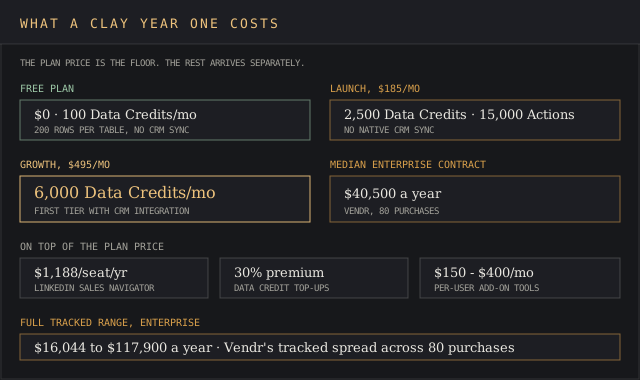
Vendr's tracked data puts the median Enterprise contract at $40,500 a year across 80 purchases, with a low of $16,044 and a high of $117,900.
That figure has moved since late 2025: an earlier Vendr snapshot, cited across several pricing blogs, showed enterprise contracts averaging $30,400 across just 19 purchases. The gap reflects Vendr's dataset growing, not a 2025-to-2026 price cut: both readings come from the same tracker, one built on 19 purchases and the current one on 80.
$40,500 across 80 recorded purchases, with $16,044 at the bottom and $117,900 at the top of Vendr's range. That spread is the clearest evidence available once a quote moves past the published Launch and Growth rates.
How Clay's credit system works
Clay's credit system runs on a dual meter, not a single credit pool: Data Credits start at $0.05 each, Actions run under $0.01. Data Credits and Actions track separately, and that split is what makes budgeting workable. Data Credits are the currency; Actions are the toll for using the platform.
| Data Credits | Actions | |
|---|---|---|
| What it pays for | Data purchased from Clay's 200+ marketplace data providers | Platform orchestration: running a table, calling AI, exporting data |
| Starting cost per credit | $0.05 each, cheaper at volume | Under $0.01 each |
| Rollover | Yes, capped at 2x monthly allocation | No, resets every billing cycle |
| Top up credits available | Yes, at a 30% premium | Not available; upgrade the plan instead |
Data Credit and Action rates are Clay's own published starting prices; neither figure is a Vendr contract number.
Data Credits buy the enrichment itself: an email address, a phone number, a firmographic record pulled from one data provider or several in a waterfall.
Actions cover the work Clay does behind the scenes to route that request, run a workflow, call an AI model, or push a record into a CRM or ad platform.
Every enrichment typically consumes one Action plus a variable number of Data Credits, so a usage-based pricing model applies twice to the same click. Data Credits pay for data pulled from Clay's marketplace partners; Actions, which start under $0.01 each, cover platform time instead.
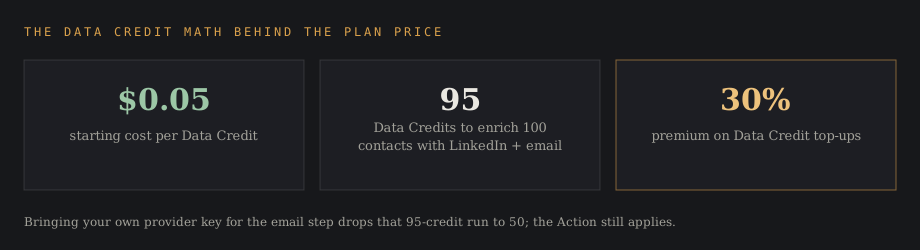
What a Data Credit buys
Clay's own documentation puts a fully enriched record at 6 to 20 Data Credits. The exact cost per record depends on the data types requested and how many waterfall providers get queried.
A worked example from Clay University: enriching 100 contacts with LinkedIn profiles and email addresses through the marketplace consumes 95 Data Credits total.
That's 50 Data Credits for LinkedIn enrichment at 0.5 credits per profile, and 45 for email finds at 0.5 credits per successful match.
Bring your existing provider keys for the email step and that same run drops to 50 Data Credits, since the platform skips the marketplace purchase and only meters the Action.
Connecting an existing ZoomInfo, Apollo, or Clearbit key eliminates Data Credit cost for that provider's calls, while the Action for the platform work still applies. Clay's data partners set the wholesale rate for each lookup, and volume discounts get passed through as Data Credit price cuts. Clearbit's standalone API now serves existing accounts only, a change our Clearbit pricing breakdown covers in full.
How many Data Credits do you need
Clay sizes monthly Data Credit allocation against usage patterns. Seat count plays no part in the math: a five-person team running light enrichment can sit comfortably on Launch's 2,500 monthly credits.
The same five people running a heavy waterfall across every data partner, purchasing phone numbers and company data on top of email, will burn that allocation in days.
Clay's credit reporting dashboard breaks consumption down by workbook, table, and integration, so a team can see which workflow drove the data costs before the next invoice arrives.
Third party data quality also plays into consumption. A workflow querying five providers to find one working phone number pays credits for every provider queried, match or no match. Teams enriching data through Claygent draw Data Credits the same way a marketplace lookup does.
Does Clay charge for failed lookups
Clay's current documentation is explicit here: "If an enrichment returns no result, you're not charged Data Credits or Actions." That's the live policy published on Clay's Actions and Data Credits documentation, confirmed on the pricing FAQ.
It contradicts a claim repeated across several third-party pricing guides, which say failed lookups still consume credits and can burn 20-30% of a monthly allocation on stale-data pipelines.
Those guides describe Clay's pre-2026 behavior. The vendor's own current documentation is the more current source, and it states the opposite.
Credit rollover, top-ups, and the March 2026 pricing overhaul
Data Credits roll over month to month, but the cap matters. On Launch and Growth, unused Data Credits accumulate up to 2x the plan's monthly allocation.
A Growth account banks a maximum of 12,000 credits against its 6,000/mo base. Enterprise customers get a smaller rollover: up to 15% of the prior year's purchased credits, provided they renew at an equal or higher commitment. Exceeding the monthly allocation in a launch month is normal; budgeting for it ahead of time is what keeps the bill predictable.
Actions don't roll over at all. They reset every billing cycle because they represent fixed platform capacity. Buying more doesn't change that: Launch resets to its 15,000-Action ceiling and Growth to its 40,000, no matter what carried over the month before.
Clay sizes each plan so 90% of customers never hit the Action ceiling. Teams that do must upgrade to a higher Clay pricing tier, since Actions can't be topped up the way Data Credits can.
Top up credits, and why the markup fell
Running out of Data Credits mid-cycle means buying top up credits at a 30% premium over the plan's per credit rate.
That's down from the 50% premium Clay charged before the March 2026 restructure. Several older pricing breakdowns still quote the 50% figure, dated before the change. Buying extra Data Credits at the 30% markup rarely beats upgrading the plan, and running out of credits mid-month is the most common billing surprise reviewers report.
Top-up Data Credits are subject to the same 2x rollover cap as regular monthly credit. Actions have no top-up option at all: hit the Action ceiling and the only path forward is a higher plan tier.
Legacy plans: what changed for existing customers
Clay's old three-tier structure ran on a single undivided credit pool. Starter cost $149/mo, Explorer cost $349/mo, and Pro cost $800/mo.
The March 2026 overhaul retired that legacy structure for new signups and split usage into Data Credits and Actions.
Vendr's marketplace page for Clay, last substantively updated in February 2026, still describes the Starter, Explorer, and Pro structure in its body text.
That's a stale snapshot from before the switch. It isn't a second live pricing tier: Clay's March 11, 2026 overhaul retired the old structure for good. Buyers reading Vendr today should treat its contract-value stat block, the median, low, high, and purchase count, as current, and its named-tier prose as legacy.
Starter plan renewals keep the old Starter tier's flat-pool pricing Clay retired for everyone else.
Hidden costs beyond the subscription
The plan price is the floor. Three hidden costs sit above it, starting with a $1,079.88-a-year Sales Navigator seat, and recur often enough in Clay reviews and buyer breakdowns to budget for upfront.
LinkedIn Sales Navigator
Several of Clay's LinkedIn enrichment workflows perform better, or only work at all, with an active Sales Navigator subscription attached.
LinkedIn prices a Sales Navigator Core seat at $1,079.88 a year billed annually, or $119.99 a month. That cost sits entirely outside Clay's own billing, and it scales per user, unlike Clay's unlimited-seat model.
CRM integration is gated to Growth
Native Salesforce and HubSpot sync doesn't exist on Launch. A team that starts on Launch and later needs CRM integration is paying the full jump to Growth, $310/mo more, largely for that one capability plus the higher credit ceiling.
Most CRM-dependent teams land on the Growth plan within weeks of starting on Launch. One G2 reviewer on a Launch-equivalent plan flagged the same gap from the other side:
"Nothing I dislike, but I wish it was easier to integrate with my CRM and LinkedIn."
Verified User, Small-Business, G2 review, January 2024.
Add-on tools most teams still need
Clay handles enrichment and a basic Sequencer, capped around four steps per campaign.
Teams running multi-step outbound, social automation, or dedicated deliverability monitoring typically layer in one to three extra tools on top of Clay. Those hidden costs run $150 to $400 a month per user depending on category, before the Clay invoice reflects the full outbound stack. Treat hidden costs like credits as a real line item in the initial budget.
What Clay costs by team size
Sizing a Clay budget means adding the plan, expected top-up credits, and the tools Clay doesn't replace. Reading the pricing page alone won't get you there.
- Solo or founder-led: Free or Launch, roughly $0 to $2,220/year on the base plan, before any Sales Navigator seat or add-on tool.
- Small teams (1-10 seats): Launch or Growth, $2,220 to $5,940/year on the base plan, commonly $10,000-$12,000/year once Sales Navigator seats and an outreach tool are added.
- Mid-market sales teams: the Growth plan with regular top-up credits, or an early Enterprise conversation once monthly Data Credit needs pass roughly 6,000-10,000.
- Enterprise sales teams: custom contract, Vendr's tracked median $40,500/year, with observed deals from $16,044 to $117,900 depending on credit volume and seat count.
Build a quarterly buffer into any of these bands. Data Credit consumption tracks campaign volume. A single heavy month can burn through Growth's 6,000-credit allocation regardless of team size.
A quiet quarter followed by a heavy launch push can double monthly usage for small teams and sales teams alike, without adding a single seat. Core features stay the same across every band; only the credit ceiling and the CRM integration gate move.
How to cut your Clay bill
Credit consumption is the lever that moves a Clay invoice most. Clay's own cost-optimization guidance lines up with what reviewers report works.
- Connect your existing provider keys for any provider you already pay for; this can cut Data Credit spend by 50-80% while still metering one Action per enrichment.
- Filter before enriching so workflows run against a narrowed list, avoiding wasted Actions and Data Credits on records you won't use.
- Test on small batches of 10-20 records before scaling a new workflow, since every test run against a full dataset spends live credits with no sandbox mode.
- Turn off Auto-Update on tables that don't need continuous refreshes, and pause AI columns that aren't producing value, since both keep consuming credits in the background.
One G2 reviewer's complaint doubles as the clearest argument for the habit above:
"I think it would be that it can in some cases be quite easy to burn a lot of credits quickly without realizing it. Especially if you're pulling in a ton of different data sources. With that in mind, it could be helpful to have 'credit estimates' or 'maximum credit usage' for a given run to help mitigate that."
Max T., Small-Business, G2 review, December 2023.
Bring your own API keys
Every plan, including Free, allows customers to bring their own API keys for outside data providers or AI models.
Doing so eliminates the Data Credit cost for that provider's calls entirely. The platform still meters one Action per enrichment, since Clay is still doing the orchestration work of routing the request and returning a result to the table.
AI runs finish faster on Clay's own keys than on a customer's own credentials, a result of the higher rate limits Clay has negotiated directly with AI vendors.
Is Clay worth paying for
The answer depends on who's asking. Clay carries a 4.6 out of 5 rating across 213 G2 reviews and a 9.3 out of 10 TrustRadius score across 147 reviews.
Those are strong marks, alongside a consistent complaint: the platform takes time to learn, and that learning happens on the clock, in credits.
"It's not the easiest tools to use, to be fair. Over the months they've evolved but at least in my memory when I started it took me weeks to understand what's what."
Leon W., Revenue Operations Specialist, G2 review, December 2023.
Small agencies feel the credit-based pricing hardest. A one-person prospecting shop, writing in a January 2026 TrustRadius review, put a number on it:
"pricing is too high for me and there credit system is somewhat messy like its unpredicatble to get how I much credit will be used for the enrichment...Clay is well suited if you need to do filtering and enrichment in volume like alteast 2k leads."
Jitendra Dhage, Founder, Prospectvista (1-10 employees), TrustRadius review, January 2026.
Clay offers the most value to a team that runs enrichment at volume, at least a few thousand records a month, with someone comfortable configuring waterfalls, APIs, and conditional logic.
It fits less well for a low-volume sender who wants predictable per-seat pricing, or small teams without a dedicated RevOps or growth engineering resource to own the workflow builder.
How to negotiate Clay pricing
Clay's list price is a starting point above the Enterprise plan tier. Vendr's tracked spread, $16,044 to $117,900 for a median of $40,500, is itself evidence of how much room exists in a negotiation.
Ask for credits before asking for a discount on the sticker price. Clay's margin sits mostly in the subscription; the per-credit rate carries less of it. Negotiating an extra 1,000 Data Credits at the same price point is often easier to secure than a percentage off.
Multi-year or annual billing commitments give Clay's sales team the clearest reason to move off list price. Locking the plan's per credit rate for future expansion protects against a mid-contract increase. Ask if a Growth plan renewal can fold in extra Data Credits as an alternative to a flat discount on Clay pricing.
For a competitive quote on custom pricing, ask what a comparable Data Credit allocation costs on Growth versus a custom Enterprise pool before committing to either.
Clay vs. alternatives on cost
Clay competes with a wide field of enrichment and outbound tools, several using a similar credit model priced differently.
| Tool | Starting price* | Credit rollover | Model |
|---|---|---|---|
| Clay | $185/mo (Launch) | 2x monthly cap | Data Credits + Actions |
| Derrick | €20/mo | Unlimited | Single credit pool |
| Enginy | Not published | No credit limits | Flat automation, lead capture and outreach |
| Warmly | Not published | N/A, output-based | Modular, priced by engagement output |
*Vendor-published prices where available; unpublished rates require a direct quote.
Derrick, a Google Sheets-native tool, undercuts Clay per-action for LinkedIn and email lookups, and allows unlimited credit rollover, unlike Clay's 2x cap, though it lacks Clay's workflow builder and multi-step orchestration.
Warmly focuses on real-time visitor identification and engagement, with pricing built around engagement output. It has no Data Credit pool at all.
Enginy positions itself against Clay's credit ceiling, automating lead capture and outreach without a stated credit limit.
None of the three replace Clay's core strength: aggregating 200+ data providers behind one credit pool with a workflow builder on top. They compete on predictability and cost per action. Breadth doesn't decide it: none comes close to Clay's 200+ data-provider footprint. Lusha runs a similar credit meter for contact reveals, and our Lusha pricing breakdown compares the two credit systems directly.
Try it yourself
Sign up for Lusha
Free plan available, credit-based pricing after that.
 Visit Lusha →
May earn a commission if you sign up through this link, at no extra cost to you. Full affiliate disclosure.
Frequently asked questions
How much does Clay cost?
Published plans run $0 (Free) to $495/mo (Growth) on monthly billing, with Enterprise plan pricing custom and tracked by Vendr at a $40,500/year median.
How much does one Clay credit cost?
Data Credits start at $0.05 each and get cheaper with volume, since Clay negotiates provider discounts and passes savings through as tier size increases. Actions cost under $0.01 each and also get cheaper with scale.
How much does Claygent cost?
Claygent, Clay's AI research agent, draws Data Credits like any other enrichment. Most native models run on fixed-price Data Credit costs per task; token-intensive models such as GPT-5.1 and Claude 4.6 Sonnet run on variable pricing tied to actual token consumption, billed at Clay's cost with no markup.
How much does a Clay subscription cost?
Clay's subscription price runs $0 to $495/mo across three self-serve tiers, custom above that on Enterprise.
How does Clay pricing work?
Every Clay plan bundles a monthly Data Credits allocation and an Action ceiling. Data Credits buy third party data; Actions meter platform orchestration. Both scale with the plan tier, and only Data Credits can be topped up separately.
Is Clay.com worth it?
For teams running enrichment at volume with a dedicated workflow owner, reviewers rate it highly: 4.6/5 on G2, 9.3/10 on TrustRadius. For low-volume senders without that resourcing, the credit system and learning curve are the most cited friction points.
How much is Clay per month?
$185/mo for Launch or $495/mo for Growth on monthly billing, roughly 10% less under annual billing.
What is Clay's new pricing model?
The March 11, 2026 overhaul replaced Starter, Explorer, and Pro with Free, Launch, Growth, and Enterprise, and split the old single credit pool into Data Credits and Actions.
Does Clay have a free version?
Yes. The Free plan includes 100 Data Credits and 500 Actions a month, unlimited users, and access to the full workflow builder, capped at 50 rows per table.
What is the valuation of Clay?
Clay raised a Series C at a $3 billion valuation in June 2025, according to TechCrunch. By January 2026, the company had reached $100 million in annual recurring revenue and let employees sell shares at a $5 billion valuation in a second tender offer within nine months, announced by Clay.
Bottom line
Clay's published price answers what the plan costs: $0 to $495/mo across three self-serve tiers, custom pricing above that.
It doesn't answer what a team will spend, which depends on credit consumption, CRM integration needs, and if a second outreach tool sits alongside it.
Budget the plan price, then add a buffer for top up credits at the 30% premium rate, and price out any add-on tool the Sequencer doesn't replace before signing.
Vendr's tracked spread, $16,044 to $117,900 a year, shows how much that buffer can vary between a lean setup and a loaded one. Total Clay cost tracks credit discipline more than plan choice.
Sources, and what Clay doesn't publish
Plan prices, Data Credit and Action allocations, rollover caps and the top-up markup are Clay's own, read off clay.com/pricing and Clay University's credit documentation, checked 11 August 2026. Enterprise contract figures, including the $40,500 median across 80 purchases and the earlier $30,400 median across 19 purchases, are Vendr's marketplace data for Clay, checked the same day.
User quotes are dated individually in the text and drawn from G2 (five reviews, September 2024 to January 2024) and TrustRadius (one review, published January 2026). The Series C valuation is TechCrunch's reporting from June 2025; the tender-offer valuation and revenue figure are the New York Times' reporting from January 2026.
Clay publishes no historical price-change archive beyond its current pricing page, so the pre-March 2026 Starter, Explorer and Pro rates here come from Clay's own documentation of the change. No archived snapshot of the earlier pricing page exists. Clay also publishes no public breakdown of what share of customers sit on each plan tier.
Disclaimer
This page includes one or more affiliate links. If you sign up for a product through one of them, this site may earn a commission at no extra cost to you.