Apollo.io pricing in 2026: four plans, credit costs and contract terms
 By Jan Suski. I go deep on every review, checking every number against its source and digging up details other coverage misses, a habit from six years of SEO and link building for tech companies. Bylines at Surfer, Brand24, and Senuto. How the scoring works.
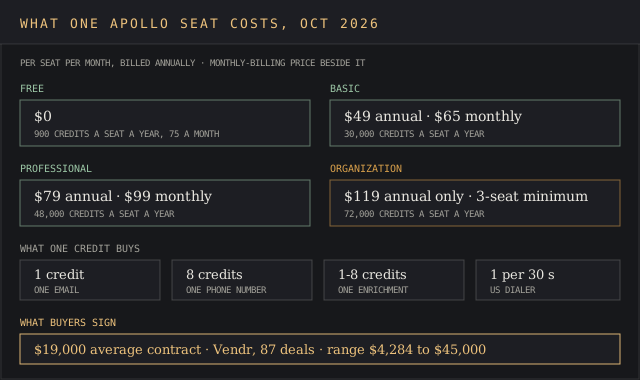
Apollo.io pricing starts at $0 and tops out at $119 per seat per month on the Organization plan, which Apollo sells on annual terms only with a three-seat floor. All four tiers sit on one public Apollo pricing page, read for this report on 4 October 2026, and every paid seat comes with a pool of credits that pays for each email, mobile number and enrichment the team pulls.
The seat price is the smaller half of the bill. A phone number costs 8 credits against an email's 1, credits expire at the end of every billing cycle, and section 4(c)(v) of Apollo's terms of service makes every subscription non-cancelable and every payment nonrefundable.
This pricing breakdown covers the plan tiers, the credit system and how it changed since January 2025, what Vendr's 87 tracked deals say buyers sign, the renewal clauses, and how Apollo sits against Lusha, Seamless.AI and ZoomInfo, three other sales intelligence vendors.
It's written for sales teams, RevOps leads and founders sizing a first Apollo purchase, and for current customers checking a renewal quote. The figures matter because a renewal locks seat count and price in for another full term, and credits bought for that term expire unused. Our Apollo.io review covers the product side.
The numbers Apollo.io list prices, credits and contracts, checked 4 October 2026
Annual billing cuts the Basic plan by 24.6% and the Professional plan by 20.2%, so the "Save 24%" label on the pricing toggle describes Basic only.
Every paid tier prices a credit at about 2 cents on annual terms. On Basic, $588 buys 30,000 credits, on Professional $948 buys 48,000 and on Organization $1,428 buys 72,000.
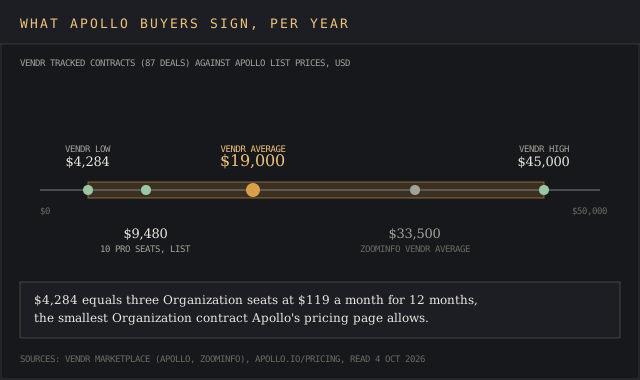
Vendr's lowest tracked Apollo contract, $4,284, equals the list price of three Organization seats for a year.
How Apollo's pricing works
Apollo sells seats, and every seat on an account sits on one plan. The pricing FAQ puts it plainly: "you can't have some users on Professional and others on Basic."
Credits are the second meter. Apollo pools them across the team and grants them "upfront at the start of each billing cycle", so an annual Basic seat lands 30,000 credits on day one and a monthly Basic seat lands 2,500 a month. The monthly credits add up to the same credits per year. Annual buyers get the year's allotment at once. The devil's in the details, because that whole allotment expires on a single date 12 months later.
Monthly billing against annual billing
Over 12 months, per seat:
- Basic plan: $65 billed monthly against $49 billed annually, so $780 against $588 a year, 24.6% off.
- Professional plan: $99 monthly against $79 billed annually, so $1,188 against $948 a year, 20.2% off.
- Organization plan: shown at $149 on the monthly toggle and marked "Annual Only", $119 billed annually, $1,428 a year.
Switching from monthly to annual plans is allowed at any time, and payments already made are prorated toward the annual plan. The reverse takes a cancellation. Per the FAQ, an annual customer has to cancel and wait for the plan "to expire at end of the current plan cycle," and "Mid-cycle downgrades on annual plans are not permitted."
Apollo IO pricing plans, tier by tier
Four tiers appear on the pricing cards: Free for light use, Basic for individual sellers, then the Professional and Organization plans for full-time reps and larger teams. The FAQ also names a Custom plan for custom volumes, SSO and dedicated support, routed through Apollo's sales team with no list price.
Free plan
Apollo's free plan costs $0 and grants 900 credits per seat per year, released at 75 a month, enough for 112 numbers a year. Against a working SDR's week of prospecting, 75 monthly credits are a drop in the bucket, and the other free-tier limits are tight too:
- 25 records per selection, 2 sequences per team and 250 email sends a day.
- Basic filters only (advanced filters start on Basic), 1 intent topic and 5,000 AI-written words a month.
- Gmail is the only sending provider. Paid plans add Microsoft and any other provider.
- 20 identified website-visitor companies a month, against 100 on the paid tiers.
- One seat after 100 days of active use, per Apollo's plan management article.
The Gmail rule matters to anyone whose corporate domain runs on Microsoft 365, because sending sequences from that mailbox needs a paid plan. Apollo Free works as a test account. Ten mobile numbers cost 80 credits, more than a month's free allowance.
Basic plan
The Basic plan costs $49 per seat per month billed annually, or $65 billed monthly, with 30,000 credits per seat per year. Over the free tier it adds the sales engagement pieces most teams pay for:
- A 1,000-record selection limit and unlimited sequences.
- Advanced filters and signals, Google Maps business search and intent data on 6 topics.
- The dialer, chat support and the Outreach and SalesLoft integration.
- Job change enrichment and 250,000 AI-written words a month.
Daily sends stay at 250 and mailboxes at one per user, the same caps as Apollo Free.
Professional plan
The Professional plan runs $79 per seat billed annually or $99 monthly, with 48,000 credits per seat per year. This is the tier for high volume outbound across multiple mailboxes. Daily sends go to unlimited and mailboxes to unlimited Google and Microsoft accounts plus 5 SMTP per user.
Record selection rises to 2,500, workflows go from 5 to 50 per team, sequences gain A/Z testing and AI writing rises to 800,000 words a month. Apollo's agents switch on here.
Organization plan
The Organization plan costs $119 per seat per month, billed annually only. Buying it means purchasing at least 3 seats at once, so the smallest Organization plan contract is $4,284 a year. Each seat carries 72,000 credits a year. Several features appear on this tier and nowhere below it:
- Single sign-on (SSO) and advanced security configurations.
- Running Apollo against your own LLM API key.
- Custom territories, custom permission profiles and Salesforce custom objects.
- 12 intent topics for intent signals, a 10,000-record selection limit, 500 workflows and 1,000,000 AI words a month.
- 15 SMTP mailboxes per user.
Enterprise teams that need SSO have to bite the bullet. The Organization plan's $1,428 per seat per year applies to every seat on the account, since plans can't be mixed.
Apollo plans compared
| Plan | Per user/month, billed annually | Billed monthly | Credits per seat a year | Record selection limit | Daily email sends | Intent topics | Workflows per team |
|---|---|---|---|---|---|---|---|
| Free | $0 | $0 | 900 | 25 | 250 | 1 | 2 |
| Basic | $49 | $65 | 30,000 | 1,000 | 250 | 6 | 5 |
| Professional | $79 | $99 | 48,000 | 2,500 | Unlimited | 6 | 50 |
| Organization | $119, 3-seat minimum | Annual only | 72,000 | 10,000 | Unlimited | 12 | 500 |
All prices are Apollo list prices, read off the Apollo pricing page on 4 October 2026, with no Vendr figures in the table.
The Professional and Organization plans share the unlimited daily send cap and differ mainly on credits, selection limits and security.
How Apollo's credit system works
Apollo calls credits "the currency to perform activities throughout the platform." The pricing page lists what it costs to reveal contact information and run other actions, in Apollo credits:
- Email: 1 credit, and never more than 1 per contact, per Apollo's credits page.
- Phone number: 8 credits, the same for mobile, direct and office numbers.
- Enrich data: 1 to 8 credits.
- AI research: 1 credit per run.
- US dialer: 1 credit per 30 seconds. International calling through the dialer varies by region.
A Basic seat's 30,000 credits buy 30,000 emails or 3,750 phone numbers. Most teams mix both channels, and phone numbers eat the lion's share of any mixed pool. At about 2 cents a credit on annual terms, one mobile number costs roughly 16 cents and a minute on the US dialer about 4 cents.
Apollo's credit usage article lists exports, waterfall enrichment, job changes, website visitors, form enrichment and the API among the features that consume credits. Credits also pay for email warmup and for domains and mailboxes, so a team can set up a secondary corporate domain for cold email inside Apollo.
Teams discover the per-user credit limits in Settings, where admins also track credit consumption by date, credit type and user, so one rep can't drain the shared pool.
Email credits come with a refund rule. Apollo's email verification article says that if you send to an Apollo-verified contact "within 30 days of requesting the details and the email bounces, Apollo refunds your email credit."
How the credit-based model changed since January 2025
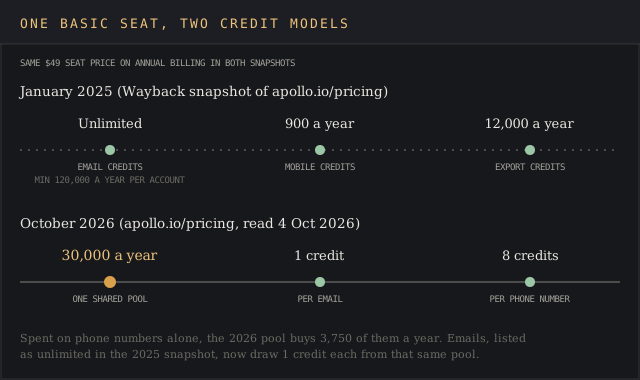
The 2025 rate card split credits three ways. The Wayback Machine's 14 January 2025 snapshot lists, for the same $49 Basic seat, unlimited email credits (minimum 120,000 a year per account), 900 mobile credits a year and 12,000 export credits a year. Professional carried 1,200 mobile credits and 24,000 export credits, and Organization 2,400 mobile credits and 48,000 export credits.
The 12,000, 24,000 and 48,000 figures still quoted in third-party pricing guides are those 2025 export-credit allowances, so readers have to read between the lines of a guide's publish date. The October 2026 page folds email, mobile credits and exports into one pool.
A Basic rep who spends the 2026 pool on phone numbers alone gets 3,750 a year, against 900 mobile credits in 2025. An email-first rep now pays 1 credit per reveal, where the 2025 card listed unlimited email credits. The free tier moved furthest. In 2025 it carried up to 10,000 email credits a month per account, 60 mobile credits and 120 export credits a year, against 75 credits a month per seat today.
Advanced features, API access and CRM integration by plan
The comparison table on the pricing page marks API enrichment and "All other APIs" on all four plans, along with CRM integrations for Salesforce, HubSpot and Pipedrive, LLM integrations through MCP, email deliverability tools, AI scores and website visitor tracking. The FAQ ties API access for advanced or custom integrations to Custom plans.
CRM sync on the free plan covers the same three CRMs as the paid tiers. The CRM sync limits that matter sit in the record selection caps, 25 records on Free and 10,000 on Organization.
Analytics is gated by plan too. Apollo's analytics overview lets users build customizable reports and dashboards from scratch or from templates, and states that "Access to analytics depends on your Apollo plan."
Hidden costs from credit overages, seat minimums and renewal
Additional credits renew automatically
Apollo handles credit overages through prepaid add-ons. When the pool runs dry, reveals stop until someone buys additional credits under Settings, Manage Subscription, Customize Credits. Apollo prices add-on credits on that in-app slider, and the public pricing page lists no per-credit rate. Three FAQ rules make top-ups stickier than they look:
- Add-on credits are "charged immediately when added."
- They're recurring, and "renew automatically each billing cycle until removed."
- They expire with the billing cycle, the same as plan credits.
Keep an eye on that slider before every renewal date, since a one-off top-up stays a standing charge until someone drags it back to zero. A Trustpilot reviewer in Belgium put a price on the frustration:
"They charge you $99 for a thousand credits a month, 1 email is 1 credit. The credits don't roll over and they are expensive as hell."
Trustpilot review, Thymen Van Volsem, Belgium, 2 October 2026
Credits expire every billing cycle
Unused credits "expire at the end of each billing cycle and do not carry over," and the FAQ applies that to "both plan-included credits and purchased add-on credits." Section 4(d)(ii) of the terms says the same. An annual Professional seat that uses 30,000 of its 48,000 credits forfeits 18,000 at renewal, worth about $356 at the list rate, and those credits are water under the bridge once the cycle closes.
Seat minimums and plan lock-in
Organization needs 3 seats, every seat shares one plan, and for sales teams that shrink mid-year, section 4(d)(i) of the terms says "The number of seats may not be decreased during a Term." Downgrades take effect immediately with no refund for unused time, per the FAQ, and the lower price starts at the next term. Moving a paid account to the free plan leaves one seat, and the rest disappear ten days later.
Renewal, cancellation and refund terms
On monthly plans and annual contracts alike, section 4(c)(i) auto-renews every subscription "for an additional period equal to the expiring Subscription Term" unless either side sends written notice at least 30 days before the term ends. The same clause reserves Apollo's right "to change the Subscription Fee upon expiration of the applicable Subscription Term." Late payments carry 1.5% a month in interest under section 4(c)(iii).
Cancellations take effect at the end of the current plan term. Leaving the 30-day notice down to the wire means another full term at whatever price Apollo sets. An Australian Trustpilot reviewer, posting in September 2026, reported "Well over 65% bounce and failed rate" and wrote that Apollo "refused refund", which section 4(c)(v) allows.
Data quality and what a credit buys
Apollo publishes two different accuracy figures for its own email data. Its knowledge base says "Apollo verified emails have an accuracy rate of 91%," while its company information page claims "98% email accuracy." The same page puts the contact database at more than 240 million contacts and 30 million companies.
Independent tests of data quality land lower. In a review published 12 June 2026, FlyPix ran a 250-lead campaign and logged these deliverability rates:
- US-based contacts: 73% deliverable.
- International contacts: 58% deliverable.
- Overall: 68%, a 32% hard bounce rate.
- Mid-market companies (50 to 200 employees) 71%, enterprise (500 plus) 64%.
- About 40% of mobile phone numbers reached the intended person.
For teams operating outside the US, the international coverage figure is a red flag for the 8 credits spent on mobile numbers. A team that wants to validate data quality before buying can spend 100 of the free plan's 900 credits on a sample of US contacts and another 100 on its own target countries, then compare bounces against the 30-day refund window. That sample measures database quality on the buyer's own market.
User complaints about data accuracy and data quality cluster on wrong numbers and credit spend, as in this US Trustpilot review:
"They have associated wrong numbers with wrong business. And when trying to contact them regarding corrections, it is confusing and can't get a hold of anyone real on the site."
Trustpilot review, Bradley, United States, 25 September 2026
A research user in staffing, two years in, listed the credit system first among the problems on Capterra:
"Unclear pricing, forced waterfall verification, slow email access, and excessive credit consumption even for email-only exports."
Capterra review, Rafay A., Research, Staffing and Recruiting (51 to 200 employees), 8 January 2026
"You have to be careful with how you spend credits, especially on premium data like mobile numbers, so it requires some planning to ensure you don't run out before the end of the month."
Capterra review, Jordan V., Sales Specialist, Computer Software, 15 May 2026
What buyers pay in practice
For Apollo cost data from signed purchases, Vendr's Apollo page tracks 87 deals with an average contract value of $19,000, a low of $4,284, a high of $45,000 and average cost savings of 30.17%. At list price, $19,000 buys about 32 Basic seats, 20 Professional seats or 13 Organization seats for a year. The $4,284 low matches three Organization seats at list, the smallest contract that tier allows.
ZoomInfo's average contract value on Vendr's ZoomInfo page is $33,500 a year across 1,012 deals, so the average Apollo contract runs 43% below it. Per seat, Apollo's Organization plan costs 96% less than ZoomInfo's average contract ($1,428 a year against $33,500). The three-seat Organization floor, $4,284, sits 87% under, a gap our Apollo vs ZoomInfo comparison prices at ten seats.
Jordan V., the Capterra reviewer who warned about mobile credits, described the switch from ZoomInfo:
"We were previously paying $15,000 a year for ZoomInfo, but with Apollo, we are paying less than $100 a month for the credits we actually need."
Capterra review, Jordan V., Sales Specialist, Computer Software, 15 May 2026
How to negotiate Apollo pricing
With the seat price public, the negotiable parts are volume, term and credits, and Vendr's 30.17% average saving gives an anchor for annual contracts quoted above list. Four moves put the ball in the buyer's court:
- Start on a monthly plan to test, then convert. The FAQ allows monthly to annual at any time, prorated.
- Size credits before seats. A rep who pulls one phone number for every four emails spends 12 credits on those five reveals, so price the mix first.
- Send the non-renewal notice 31 or more days ahead. Section 4(c)(i) lets Apollo reprice at renewal, and the notice turns renewal into a negotiation.
- Bring a competing quote from Lusha or ZoomInfo to the call.
Buyers also cite ZoomInfo's minimums when they explain why they stayed:
"ZoomInfo required a minimum contract of about $5,000. Apollo was much easier to keep renewing at $59/month."
Capterra review, Ellie A., Co-Founder, Computer Software, 16 May 2026
Who Apollo's pricing fits
Apollo's own FAQ names its ideal customers by tier: Free for "founders and early-stage teams," Basic for individual sellers, Professional for "Full-time reps needing higher credit limits," and Custom for enterprise teams that need SSO and dedicated support.
Apollo wins on cost for small and mid-market sales teams running email-led outbound from one tech stack, where its sales engagement platform (sequences, dialer, meetings) runs sales processes from one account and replaces separate tools for data and sending. It's a jack of all trades by design. The fit weakens for most teams that dial internationally, because each number costs 8 credits and international coverage in FlyPix's test came in at 58% deliverable.
The sales intelligence platform rankings and the B2B data providers ranking list the alternatives by measured coverage, and the sales engagement pricing report covers sequencing tools priced per seat.
Apollo against Lusha, Seamless.AI and ZoomInfo
Apollo and Lusha publish their credit costs, while Seamless.AI and ZoomInfo, the other two sales intelligence vendors here, route pricing through a sales conversation:
| Vendor | Pricing model | Free allowance | Email reveal | Phone reveal | Vendr average contract |
|---|---|---|---|---|---|
| Apollo | Published per-seat rates, $0 to $119 per user/month | 900 credits per seat a year | 1 credit | 8 credits | $19,000* (87 deals) |
| Lusha | Credit-based plans | Up to 40 credits a month | 1 credit | 5 credits | $15,999* (85 deals) |
| Seamless.AI | Quote through a sales form | 50 credits | Email and phone in 1 credit | Email and phone in 1 credit | Quote only |
| ZoomInfo | Quote based on features, licenses and credit usage | Free trial | Metered by credits | Metered by credits | $33,500* (1,012 deals) |
Figures marked * are Vendr average annual contract values from tracked purchases. Every other cell comes from the vendor's own pages. Sources: the Lusha pricing page and Vendr's Lusha page. seamless.ai/pricing redirected to a pricing-inquiry form on 4 October 2026, and Seamless's own pricing post says "there's no fixed pricing rate". ZoomInfo's pricing model comes from ZoomInfo's pricing page and its contract value from Vendr.
Lusha charges 5 credits for a phone number against Apollo's 8, so phone-heavy teams get more numbers per credit there. Our Lusha pricing teardown covers its seat structure.
Try it yourself
Sign up for Lusha
Free plan available, credit-based pricing after that.
 Visit Lusha →
May earn a commission if you sign up through this link, at no extra cost to you. Full affiliate disclosure.
The Seamless.AI pricing report tracks the quote-only tiers behind Seamless.AI's sales form, and the Cognism pricing report covers the phone-verified European option. For enrichment-led stacks, the Clay pricing breakdown and RocketReach pricing price the alternatives per lookup.
Try it yourself
Sign up for Seamless.AI
Free plan: 50 credits, no card required. Pro and Enterprise route through a sales call.
 Visit Seamless.AI →
May earn a commission if you sign up through this link, at no extra cost to you. Full affiliate disclosure.
What to budget
The real cost of Apollo is seats plus the credit mix plus any recurring top-up. Pricing Apollo a year ahead starts with its credit consumption model, meaning how many emails, numbers and enrichments each rep pulls a month. Three worked examples at list, billed annually:
- Solo founder: 1 Basic seat at $588 a year, 30,000 credits. Enough for 30,000 emails, or 2,000 phone numbers plus 14,000 emails.
- Five-rep team: 5 Professional seats at $4,740 a year, 240,000 pooled credits, or 30,000 mobile numbers if spent on calls alone.
- Ten seats with SSO: 10 Organization seats at $14,280 a year, 720,000 credits.
Ten Professional seats come to $9,480, half of Vendr's $19,000 average. Teams that need intent data beyond 6 topics, SSO or Salesforce custom objects should price Organization from the start. The LeadIQ pricing report and Wiza pricing cover two cheaper credit models.
Frequently asked questions
How much does Apollo.io cost?
$0 on Free, $49 on Basic, $79 on Professional and $119 on Organization, per seat per month billed annually. Monthly billing raises Basic to $65 and Professional to $99.
Is Apollo.io free?
Yes. Apollo's free plan costs $0 with 900 credits per seat per year, 2 sequences, 250 daily sends and a 25-record selection limit, and the plan has no time limit, though free accounts drop to one seat after 100 days of use.
What payment plans does Apollo.io offer?
Monthly billing, which can be cancelled any time and ends with the current month, and annual billing paid upfront at 24.6% off Basic and 20.2% off Professional. Organization is billed annually only, and the Custom plan is quoted by sales.
Is Apollo worth it?
For email-led outbound in the US at 1 to 20 seats, Apollo's pricing at $49 to $79 a seat undercuts ZoomInfo's $33,500 Vendr average by a wide margin. Phone-first teams and teams calling internationally should test a sample first, since each number costs 8 credits.
How expensive is Apollo AI?
AI research costs 1 credit per run, about 2 cents at list. AI writing is included by word allowance: 5,000 words a month on Free, 250,000 on Basic, 800,000 on Professional and 1,000,000 on Organization.
Is Apollo.io an Indian company?
Apollo is a US company, founded in 2015 and headquartered in San Francisco, California, per its company page, with Tim Zheng as founder and chairman and Matt Curl as CEO.
What does Apollo.io do?
Apollo combines a contact database for lead generation with sequencing, a dialer, enrichment and deal management in one account.
Bottom line
Apollo.io pricing is public and cheap per seat, at $49 to $119 a month on annual terms and about 2 cents a credit on every paid tier. The credit mix moves a budget further than the seat price, because a mobile number costs eight times an email and unused credits vanish at the end of each cycle.
The contract terms carry the rest of the risk: auto-renewal with 30 days' written notice, no seat reductions mid-term, nonrefundable payments and add-on credits that renew until someone removes them. Buyers on the fence should run a free-plan sample, size credits by channel, and diarise the notice date on day one.
Where each Apollo figure comes from, and what Apollo leaves off its pricing page
Plan prices, credit costs, plan limits and the billing FAQ are Apollo's own, read off apollo.io/pricing and apollo.io/pricing/about-credits. Contract clauses are quoted from Apollo's terms of service at apollo.io/terms, sections 4(c) and 4(d). Credit, verification, analytics and plan-management rules come from knowledge.apollo.io, and the accuracy and database-size claims from apollo.io/llm-info.
The January 2025 rate card is the Wayback Machine capture of apollo.io/pricing dated 14 January 2025. Contract values are Vendr's tracked figures for Apollo, ZoomInfo and Lusha at vendr.com/marketplace. Lusha's credit costs come from lusha.com/pricing, Seamless.AI's from seamless.ai and its own pricing post, and ZoomInfo's pricing model from zoominfo.com/pricing.
The deliverability test is FlyPix's Apollo review at flypix.ai, published 12 June 2026. User quotes come from Trustpilot reviews dated September and October 2026 and Capterra reviews dated 8 January to 16 May 2026. All URLs accessed 4 October 2026.
Apollo publishes no per-credit rate for add-on credits, which are priced only inside the in-app slider, and no list price for the Custom plan. Seamless.AI and ZoomInfo publish no rate card at all.