LeadIQ pricing: plans, credits and hidden costs for 2026
 By Jan Suski. I go deep on every review, checking every number against its source and digging up details other coverage misses, a habit from six years of SEO and link building for tech companies. Bylines at Surfer, Brand24, and Senuto. How the scoring works.
· Prefer this source on Google
G2's AI-generated pricing summary invents a $45-a-month "Essential" plan and an $89-a-month Pro plan for LeadIQ; TrustRadius lists a different pair, $39 for Essential and $79 for Pro. LeadIQ has no plan called Essential, and its real Pro range runs $15 to $217.69 a month. Neither third-party site matches what's live on leadiq.com.
The real pricing engine is Universal Credits, a pooled resource spanning all three tiers, where a phone number costs 10 credits against an email's 1 and Enterprise carries no published price. Vendr's marketplace tracked deals from $5,201 to $66,780, landing on a $26,400 median well above what the self-serve slider implies alone.
This report covers every LeadIQ tier, the credit math behind each unlock, the year-long re-access window buried in a help center article, and how the price compares against Apollo, ZoomInfo and Cognism. It's for a sales ops lead sizing a contract, a founder pricing alternatives, or a buyer trying to reconcile an invoice against the page, because the credit system decides the real bill more than seat count does.
The numbers LeadIQ pricing, checked 11 August 2026
LeadIQ's list price looks cheap next to ZoomInfo or Cognism, but the credit system means the real number depends on how many phone numbers a team unlocks. Seat count barely moves it.
Vendr's tracked median of $26,400 sits well above what the $15-to-$217.69 self-serve slider implies, which means most paying customers are on Enterprise quotes.
The mechanic that controls cost is a one-year re-access window on unlocked records. LeadIQ documents it only in a help center article; the pricing page never mentions it.
How much does LeadIQ cost
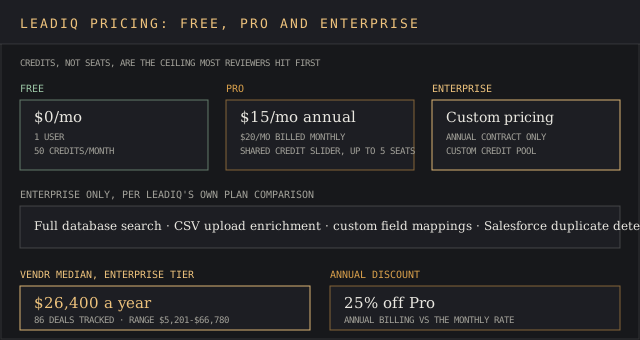
LeadIQ runs three tiers: Free, Pro and Enterprise. Free and Pro carry list prices; Enterprise doesn't. A slider on the pricing page lets a buyer pick an annual credit volume, from 2,400 up to 81,000 credits a year, and the price scales with that choice.
At the low end, 2,400 credits a year (200 a month) costs $15 a month on annual billing and includes one user. At the top of the published slider, 81,000 credits a year costs $217.69 a month, which comes to $2,612.28 for the year. Past 81,000 credits, the slider hands off to a "Contact us" Enterprise quote. LeadIQ's plan comparison table lists Pro as supporting up to 5 users, though the exact credit tier where a second seat unlocks isn't published.
A toggle above the slider switches between annual billing, marked "25% off," and monthly billing at the uncapped list rate. LeadIQ doesn't publish the monthly-billed dollar figures anywhere in the slider's static markup, only the discounted annual numbers.
Every number on that slider prices the team as a whole once it has more than one seat, since the credit pool and the user count move together; it isn't a price per user by itself. A five-user Pro team evaluating LeadIQ's list price should read the slider's dollar figure as the team total and divide by seats to compare it against a competitor's per-user quote.
At the top of the published slider, that works out to roughly $43.50 per user a month for a full five-seat team, well under ZoomInfo's or Cognism's published per-user rates.
LeadIQ's pricing plans
Free plan
The Free plan costs $0 a month for one user and 50 credits. Per LeadIQ's own feature list, it includes:
- People search for email and mobile contact details
- Contact data enrichment through company search
- Exporting
- Job-change tracking for champions
- Chrome extension prospecting
- The AI outbound message writer
- Signals (10-K filings, podcast mentions, hiring)
- CRM enrichment
- Webform enrichment and API access
LeadIQ database search is listed as "Limited Access" on Free, the same restriction Pro carries; only Enterprise gets unrestricted database search.
Fifty credits doesn't stretch far once phone numbers enter the mix: at 10 credits each, the Free plan covers 50 contact unlocks by email or five phone unlocks a month, or some mix of the two, before a team needs to purchase additional credits or move to a paid tier.
Pro plan
The Pro plan adds nothing to the Free feature list except credit volume and seats; the two plans show an identical checklist on LeadIQ's own comparison grid. What changes is scale: the Pro slider runs from 2,400 to 81,000 credits a year and from 1 to up to 5 users, and the price rises step by step with the credit volume a buyer picks.
G2's AI-generated pricing summary lists a $20-a-month Pro starting price and describes a $45-a-month Essential plan and an $89-a-month Pro plan; TrustRadius lists its own $39 Essential plan and $79 Pro plan. None of those four figures match what LeadIQ's own pricing page shows live, and LeadIQ itself doesn't publish an Essential plan under that name.
Third-party pricing pages built from scraped data are a common source of this drift; the vendor's own page is what resolves it.
Enterprise plan
The Enterprise plan has no published price. LeadIQ pitches it at "established sales teams looking to increase outbound activities and response rates without risking data hygiene," describing the tier as Pro's features plus:
- AI account prospecting
- Governance controls for prospect data
- CSV file enrichment
- Advanced admin settings for integrations
- Salesforce duplicate detection
- Team analytics dashboarding and reporting
- Custom field mappings for CRM and engagement integrations
SSO also appears gated to this tier on LeadIQ's comparison grid. Every quote runs through a "Talk to an expert" form.
How LeadIQ's credit system works
LeadIQ's help center documents its Universal Credits system, which unifies what used to be separate credit pools across its Prospecting Hub and Data Hub products into one shared balance. A credit gets spent the moment a user unlocks a contact's email or phone number, or exports a new company record.
Credits sit in that shared pool for every user on the team, and credits purchased at the Enterprise tier draw from the same pool as everything else.
| Action | Credits used |
|---|---|
| Unlock an email | 1 |
| Export a new company | 3 |
| Unlock a phone number (mobile or work) | 10 |
| Unlock an email + phone together | 11 |
Phone numbers cost 10 times what an email costs. A team running 500 phone unlocks a month burns 5,000 credits on phone numbers alone, more than double the 2,400-credit annual allocation on Pro's entry tier.
The mechanic that controls the bill is what LeadIQ calls a Record Under Management. It has nothing to do with a monthly reset. Once a contact or company is unlocked or exported, LeadIQ won't charge for that same record again for a full year, counted from the unlock date or the subscription's end date, whichever is later, and that protection applies at the team level.
A colleague who unlocks a contact someone else on the team already paid for costs the team nothing.
That's a different model from the flat "credits expire every month, no rollover" description several third-party pricing guides give LeadIQ. LeadIQ states it only in its help center; the pricing page itself never mentions it.
What LeadIQ's help center doesn't fully spell out is if unused credits in a monthly allocation carry into the next billing cycle. The Record Under Management window covers re-access to a record already unlocked; it says nothing about an unspent portion of a monthly allocation rolling forward. A team that needs more than its plan's monthly allocation can purchase additional credits, though LeadIQ doesn't publish an overage rate for doing so.
Annual billing vs monthly billing
LeadIQ's pricing page defaults to annual billing and labels it "25% off" against the monthly rate. The published dollar figures on the slider, $15 to $217.69 a month, are the annual-billed numbers; LeadIQ doesn't show the equivalent monthly-billed prices in the page's static text, only the toggle itself.
Annual billing also matters for the Record Under Management window: LeadIQ's help center specifies that the one-year re-access clock runs from the unlock date or the subscription's end date, whichever is later, so a record unlocked late in an annual term can carry its free re-access period past the term's renewal. A team switching billing cycles mid-contract should confirm with LeadIQ how that switch affects credits already sitting in the current cycle.
Hidden costs and contract terms
LeadIQ's own FAQ covers data accuracy and coverage; it says nothing about billing, so none of the hidden costs below come from LeadIQ directly. Contract terms, overage pricing and renewal clauses come from Vendr's anonymized buyer data instead, which tracked LeadIQ deals ranging from a $5,201 low to a $66,780 high around a $26,400 median.
Credit overages
Vendr's dataset flags credit overages as a common source of unplanned spend: teams that exceed a plan's included credit volume either buy additional credit packs or pay overage charges, and Vendr reports overage rates typically run higher than bundled-credit rates. Because a phone unlock costs 10 credits against an email's 1, a team that shifts even a small share of its prospecting toward mobile numbers can burn through an allocation faster than the plan anticipated.
Other contract terms
Vendr's data also names mid-term user additions, which get pro-rated at the original per-user rate, and renewal price escalation clauses running 5% to 10% a year on auto-renewal. A buyer who doesn't renegotiate before the renewal date risks accepting that increase by default. Custom integrations, dedicated onboarding and training beyond the standard setup can carry separate fees at the Enterprise tier.
None of this appears on LeadIQ's own pricing or FAQ pages; it comes exclusively from Vendr's buyer-reported contract data.
What buyers pay
Vendr's marketplace page for LeadIQ tracked deals across a range of 86 to 112 purchases (Vendr's own header and body text disagree on the exact count), landing on a $26,400 median annual contract value with average savings around 22% off the initial quote.
That median sits well above what Pro's published slider implies on its own, a signal that a meaningful share of Vendr-tracked LeadIQ customers are buying Enterprise or multi-seat Pro contracts.
| Team size | Typical tier | What Vendr's data shows |
|---|---|---|
| 1 user | Free | $0, 50 credits/month |
| 1-5 users | Pro | $15-$217.69/month depending on credit volume, annual billing |
| 5+ users or 81,000+ credits/year | Enterprise | Custom quote; Vendr median $26,400/year, range $5,201-$66,780 |
Vendr figures are anonymized buyer-reported contract values; LeadIQ doesn't publish its own prices for comparison.
How to negotiate LeadIQ pricing
Vendr's negotiation data points to a handful of levers that show up repeatedly in LeadIQ deals:
- Start 60 to 90 days before a renewal or target start date, since rushed deals tend to close at less favorable terms.
- Anchor to an internal budget figure.
- Bring a competing quote from Apollo.io, ZoomInfo, Cognism or Seamless.AI into the conversation; Vendr's data ties competitive pressure to larger discounts.
- Ask for multi-year terms if the team's usage is stable, since 2- to 3-year commitments carry incremental savings over annual terms in Vendr's dataset.
- Get the credit allocation and overage rate written into the contract before signing, given how directly phone-heavy prospecting can blow through an allocation.
- Negotiate a cap on the renewal price escalation clause up front, since Vendr's data shows 5% to 10% annual increases are standard on auto-renewal.
- Ask what the total cost looks like per user once seats and credits are both accounted for.
Chrome extension, LinkedIn and other features
LeadIQ's Chrome extension ships on every plan, including Free, and mirrors what a user is viewing on LinkedIn or Sales Navigator, capturing contact data from the page without switching tabs. Multiple G2 reviewers name it as the reason they use LeadIQ at all.
"I like how it is a chrome extension that can mirror what I am looking at in Sales Navigator. It pulls there email and can also provide you with their cell phone."Ignacio V., Computer Software, G2
Because the extension reads whatever LinkedIn page is open, most teams keep an existing LinkedIn Sales Navigator seat and run the extension alongside it. LinkedIn's own pricing page lists Sales Navigator Core at $119.99 a month, or $1,079.88 billed annually, and Advanced at $159.99 a month, or $1,799.88 annually, a cost that sits entirely outside LeadIQ's own invoice.
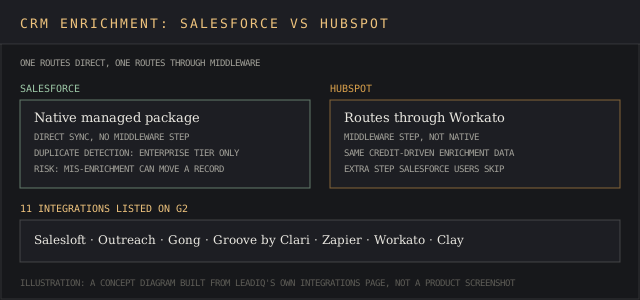
CRM enrichment and sync ship on every plan too, with named integrations to Salesforce and HubSpot; LeadIQ says it enriches more than 40 firmographic fields on write to Salesforce, alongside technographic data on what software an account already runs. That enrichment also feeds LeadIQ's champion tracking, flagging job changes and other buying signals so a rep sees a prospect's move to a new company as an outreach trigger.
MCP integration and API access at 60 requests a minute with 50 free test calls are also included on every plan, a different structure than vendors that charge separately for API access. LeadIQ also lists integrations with sales engagement platforms including Outreach and Salesloft, so captured contacts move directly into existing prospecting workflows.
Visitor identification, the kind that flags anonymous website traffic, isn't part of LeadIQ's feature set; tools like RB2B and Bombora cover that separately. What LeadIQ sells instead are event-based signals, covered below, a narrower job than either visitor identification or intent-data account scoring.
AI account prospecting and what's Enterprise-only
AI account prospecting, LeadIQ's tool for surfacing accounts and contacts algorithmically, sits behind the Enterprise tier alongside:
- Governance controls
- Prospect data file enrichment through a CSV upload
- Advanced admin settings
- Salesforce duplicate detection
- Team analytics dashboarding
Lando, LeadIQ's AI agent for the Chrome extension, is not one of them: LeadIQ's own plan-comparison grid checks it on both Pro and Enterprise, not Free, matching G2's description of the Pro plan and contradicting the impression LeadIQ's Enterprise sales copy gives by listing Lando among the tier's additions.
Custom pricing is the only option once a team's needs cross the Enterprise line: 81,000-plus credits a year, more than 5 seats, or a feature gated to the tier. There's no published rate card past that point, only the "Talk to an expert" quote form, and Vendr's $26,400 median is the closest thing to a public custom-pricing benchmark that exists.
Intent data and what LeadIQ doesn't sell
LeadIQ doesn't sell intent data or topic-level intent signals. It sells event-based signals instead: job changes, hiring activity, 10-K filings and podcast mentions, surfaced as "Signals" on every plan including Free. That's a narrower category than intent-data platforms like 6sense or ZoomInfo, which score buying-committee behavior against intent signals spanning thousands of topics.
A team that needs topic-level intent signals won't find them in LeadIQ at any tier; a team that wants a job-change alert when a champion moves companies gets that on the free plan.
LeadIQ pricing compare: how it stacks against alternatives
LeadIQ runs head-to-head comparison pages on its own site: LeadIQ vs. ZoomInfo, LeadIQ vs. Apollo, LeadIQ vs. Cognism, LeadIQ vs. Lusha and LeadIQ vs. Seamless.AI, each naming the same rivals Vendr's negotiation data points to. None of those pages publish the competitor's actual price; they argue data quality and workflow instead.
Try it yourself
Sign up for Lusha
Free plan available, credit-based pricing after that.
 Visit Lusha →
May earn a commission if you sign up through this link, at no extra cost to you. Full affiliate disclosure.
Vendr's own comparison data, built from the same anonymized transaction set as its LeadIQ figures, puts LeadIQ's published list pricing at $75 to $150-plus per user a month against ZoomInfo's $150 to $300-plus per user, Apollo.io's $49 to $149-plus per user and Cognism's $100 to $200-plus per user. That framing doesn't map cleanly onto LeadIQ's credit-based structure, so it's worth treating as Vendr's own estimate.
| Vendor | List pricing (per user/month)* | Estimated 20-user annual total |
|---|---|---|
| LeadIQ | $75-$150+ | $18,000-$31,000 |
| ZoomInfo | $150-$300+ | $36,000-$72,000 |
| Cognism | $100-$200+ | $24,000-$48,000 |
| Apollo.io | $49-$149+ | $12,000-$36,000 |
Figures marked * are Vendr's editorial estimates from anonymized buyer data. LeadIQ has not published matching list prices. Apollo.io's entry pricing runs below LeadIQ's; its higher tiers can exceed it.
The Vendr-tracked median tells a similar story: LeadIQ's $26,400 sits below ZoomInfo's tracked $33,500 median, a gap of roughly 21%. Buyers comparing the two on data breadth should weigh that ZoomInfo publishes over 500 million contact records and 4,500-plus intent topics against LeadIQ's narrower, event-based signal set.
Key features by plan
| Feature | Free | Pro | Enterprise |
|---|---|---|---|
| Users | 1 | Up to 5 | Custom |
| Credits/year | 50/month | 2,400-81,000 | Custom |
| Chrome extension | Yes | Yes | Yes |
| LeadIQ database search | Limited | Limited | Full |
| CRM enrichment & sync | Yes | Yes | Yes |
| MCP integration & API | Yes | Yes | Yes |
| AI account prospecting | No | No | Yes |
| Governance controls | No | No | Yes |
| Salesforce duplicate detection | No | No | Yes |
| SSO | No | No | Yes |
Who LeadIQ's pricing fits
The credit model rewards email-heavy prospecting over phone-heavy prospecting, so a small sales team that mostly needs verified work emails and a LinkedIn-to-CRM workflow gets more out of the Free or entry Pro tier than a team that leans on cold calling.
Omkar S., a team lead at a small business, wrote on G2 in December 2025 that LeadIQ's "pricing, which seems a bit high, especially for individual users or smaller teams," was what he liked least, and Christopher K., also at a small business, put it more bluntly on G2 in June 2026: "Credits are way too expensive."
Megan J., a business development representative on a mid-market team, told G2 in November 2025 that she wanted "more credits for a more competitive price."
Phone data quality complicates the calculus further. Monu K., a senior market researcher on a mid-market team, called poor phone number quality "the most significant and frequent complaint" among LeadIQ users in a November 2025 G2 review, noting that "the mobile and direct-dial numbers are often inaccurate, outdated, or 'garbage.'"
Brent H., a sales development rep, described the Free plan on G2 in October 2024 as "restrictive due to its insufficient mobile credits, which limit the ability to utilize the service entirely." Paying 10 credits for a number with an uncertain accuracy rate is a different value proposition than paying 1 credit for an email LeadIQ claims to verify.
Not every review reads that way.
"I was also impressed by the pricing structure and the ability for me to pick and choose my plan or customize based on the sales team numbers and team capacity."Mithil Patel, Digital Marketing, Trevelino/Keller, TrustRadius
The credit slider's flexibility is a real advantage for a team that wants to buy exactly the volume it needs. It never forces a step up to a fixed tier.
LeadIQ's own marketing describes itself as built for revenue teams, and in practice that spans small sales teams of one to five reps on the Free or entry Pro plan, mid-market sales teams of five to twenty-five running Pro's higher credit tiers, and larger accounts negotiating a custom Enterprise quote.
Sales reps chasing a short list of key contacts at target accounts fit the credit model better than reps running high-volume, phone-heavy outbound, given how much faster phone unlocks burn through a plan's allocation.
What to budget
A single user on the Free plan costs nothing and covers roughly 50 emails or 5 phone numbers a month. A small team on Pro's entry tier runs $15 a month, or $180 a year, for 2,400 credits, thin for anything beyond light, email-first prospecting. Scaling to Pro's published ceiling of 81,000 credits a year costs $2,612.28 annually and still caps at 5 users.
Past that line, Vendr's tracked median of $26,400 a year is the more realistic budget anchor for a team that needs Enterprise features, more seats, or a credit volume the self-serve slider doesn't reach, with deals in Vendr's dataset ranging as low as $5,201 and as high as $66,780 depending on scope.
Total cost also depends on what a team stacks alongside LeadIQ. Add a LinkedIn Sales Navigator seat at $1,079.88 to $1,799.88 a year per user, and the total cost of the workflow LeadIQ's own marketing assumes, extension plus Sales Navigator plus a CRM seat, runs well past LeadIQ's own invoice.
Frequently asked questions
How much does LeadIQ cost?
Free is $0 for one user and 50 credits a month. Pro runs $15 to $217.69 a month on annual billing, scaling from 2,400 to 81,000 credits a year and up to 5 users. Enterprise is quote-only; Vendr's tracked median across its LeadIQ deals is $26,400 a year.
What is the current status of LeadIQ?
LeadIQ is an active, operating B2B prospecting platform selling directly through its own pricing page, with a live free trial and self-serve checkout on Free and Pro. It publishes no funding history or public financial filings, and its Enterprise pricing runs entirely through a sales quote process.
What are the pricing options for LeadIQ's API?
API access ships on every plan, including Free, at no separate charge, capped at 60 requests a minute with 50 free test calls. There's no metered or pay-per-call tier; API usage draws Universal Credits from the same pool as every other feature.
Is LeadIQ a good tool?
G2 reviewers rate it 4.2 out of 5 across more than 1,100 reviews, with the Chrome extension and CRM integrations cited most often as strengths. Phone number accuracy is the recurring complaint, and it's the specific weakness that makes the 10-credit cost of a phone unlock a harder value case than the 1-credit cost of an email.
What are the alternatives to LeadIQ?
Apollo.io, ZoomInfo, Cognism and Seamless.AI are the four alternatives LeadIQ names in head-to-head comparison pages on its own site. Apollo.io undercuts LeadIQ on entry pricing; ZoomInfo and Cognism run higher on Vendr's tracked medians but cover intent data and international compliance LeadIQ doesn't sell.
Free tier, no card
Sign up for Seamless.AI
50 credits a month free. Pro and Enterprise are both quote-only, "Contact sales."
 Visit Seamless.AI →
May earn a commission if you sign up through this link, at no extra cost to you. Full affiliate disclosure.
Bottom line
LeadIQ pricing's headline numbers, $0 free and $15-a-month Pro, are real prices for a narrow slice of what the platform can do. The number that lands on an invoice depends on how many phone numbers a team unlocks, since those cost 10 times what an email costs, and on the point where a team's needs cross into the credit volume or feature set that pushes it to an Enterprise quote.
Most third-party pricing guides get the Record Under Management mechanic wrong and describe a monthly credit reset instead, the detail most likely to change what a team pays over a year. Buyers sizing a contract should budget against Vendr's $26,400 median and negotiate the credit allocation and overage rate into the contract before signing. Skipping that risks discovering the phone-number multiplier after the first invoice.
Sources
Plan prices, credit costs, feature gating, and the Record Under Management mechanic are LeadIQ's own published figures, read off leadiq.com/pricing and its help center, checked 11 August 2026. Median, low, and high contract figures and the negotiation levers are Vendr's, read off vendr.com/marketplace/leadiq; Vendr's own page cites both 86 and 112 tracked purchases in different sections.
Buyer quotes are verbatim from named reviewers on G2 and TrustRadius. LinkedIn Sales Navigator prices are LinkedIn's own published rates.
Disclaimer
This page includes one or more affiliate links. If you sign up for a product through one of them, this site may earn a commission at no extra cost to you.