Lusha pricing in 2026: five plans, credit costs, and hidden fees
 By Jan Suski. I go deep on every review, checking every number against its source and digging up details other coverage misses, a habit from six years of SEO and link building for tech companies. Bylines at Surfer, Brand24, and Senuto. How the scoring works.
· Prefer this source on Google
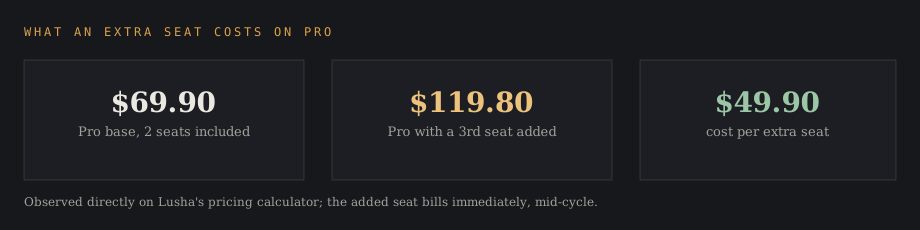
Add a person to Lusha's Pro plan past its two included seats, and the bill grows by $49.90 a month, the exact price of the entire Starter plan one tier down. A ten-person Pro team ends up paying for eight of those add-on seats at $49.90 each, on top of the advertised $69.90 base.
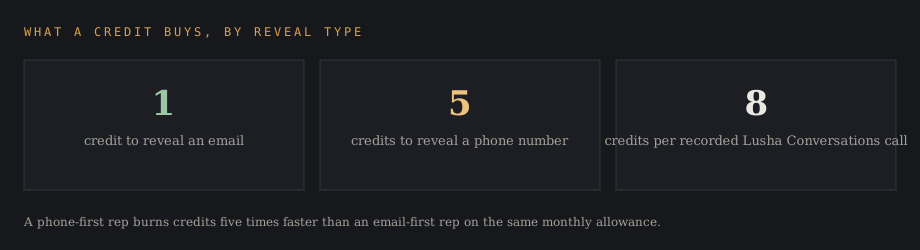
Every reveal spends credits differently: an email costs 1, a phone number costs 5, so a phone-first rep burns Lusha's monthly allowance five times faster than an email-first one on the identical plan, a mechanic close to the pooled-credit system in our LeadIQ pricing report. Vendr's dataset puts the median paid Lusha contract at $15,999 a year, ranging from $6,000 to $70,403, well above any single Pro seat's list price annualized.
This report breaks down what each Lusha tier costs, what a credit buys, and where the sticker price stops telling the story, for a sales, marketing or recruiting team sizing Lusha against a quote from ZoomInfo, Apollo or Cognism, and for anyone already paying who wants to know if the renewal price is fair.
The numbers Lusha pricing, checked 11 August 2026
The credit-per-reveal split is what makes a phone-heavy sales team pay more per month than an email-heavy one on an identical plan, since phone numbers cost five times what an email costs to reveal.
Lusha's $69.90-per-month Pro price sits well below Vendr's $15,999-per-year median contract, a gap that shows most paying teams buy more seats and credits than the entry-level tier includes.
The current 25% sale is time-bound, so a quote taken today won't match a quote taken once the promotion ends.
How Lusha's pricing plans work
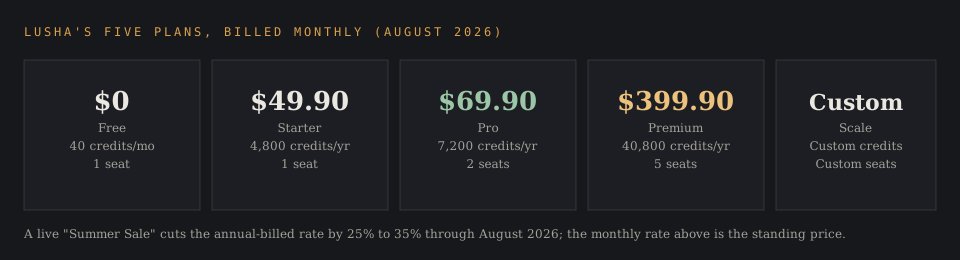
Lusha offers five pricing plans, each gated on a monthly credit allowance and a seat count: Free, Starter, Pro, Premium, and Scale. Credits are the unit a user spends per reveal; seats are the number of people who can spend them. A team picks a plan by estimating how many contact-data reveals it needs per month, then checking if the included seats match its headcount.
As a contact data tool, Lusha bundles a free plan alongside four paid tiers, and Lusha's credit system ties every one of those reveals to a spend.
Lusha's pricing model narrows, in Vendr's own tracking, to three pricing plans it benchmarks most closely, Free, Pro, and Premium, with Scale and Enterprise treated as custom overlays on top. Billed monthly, the paid tiers list at $49.90 per month for Starter, $69.90 per month for Pro, and $399.90 per month for Premium. The scale plan runs on a custom quote; Lusha publishes no flat monthly rate for it.
Monthly plans versus annual plans
Paying per month keeps a team on Lusha's standard monthly billing cycle, resetting credits on the billing anniversary. It lets a team cancel without losing a prepaid year. Annual plans provide a full year of allocated credits upfront and cut the effective per month rate, but annual plan credits don't reset mid-cycle the way monthly plan credits do.
A team tracking credits usage closely can request additional credits mid-cycle on either monthly billing or annual billing, though Scale's custom pricing usually bundles a bigger buffer in from the start.
Lusha is currently running a "Summer Sale" that stacks a limited-time discount on top of standard annual billing, dropping the effective monthly rate when billed annually:
- 25% off Starter, to $37.45
- 25% off Pro, to $52.45
- 25% off Premium, to $299.95
Those sale rates apply only under the current promotion. They narrow once the sale window closes and the billing cycle reverts to standard custom pricing on Scale or standard annual billing everywhere else. A team weighing monthly plans against annual plans should treat the sale price as temporary and budget for the standard annual rate at renewal.
Beyond the five core tiers, Lusha offers this live, time-bound discount only through the Summer Sale promotion. The rate isn't permanent.
| Plan | Billed monthly | Billed annually (sale price) | Credits | Seats included |
|---|---|---|---|---|
| Free | $0 per month | $0 per month | 40 credits per month | 1 |
| Starter | $49.90 per month | $37.45 per month | 4,800 credits per year | 1 |
| Pro | $69.90 per month | $52.45 per month | 7,200 credits per year | 2 |
| Premium | $399.90 per month | $299.95 per month | 40,800 credits per year | 5 |
| Scale | Custom | Custom | Custom, granted upfront | Custom |
Prices are Lusha's own published rates, checked 11 August 2026; the annual column reflects the live Summer Sale discount.
Free
The Lusha free plan gives one user 40 credits per month with no credit card required, alongside the browser extension and basic CRM integrations. Free is the one tier where Lusha offers access with zero payment method on file at all, and it's built for testing accurate data on a handful of real prospects before a team commits budget. A live sales pipeline needs a paid tier instead.
Try it yourself
Sign up for Lusha
Free plan available, credit-based pricing after that.
 Visit Lusha →
May earn a commission if you sign up through this link, at no extra cost to you. Full affiliate disclosure.
How Lusha's credit system works
How do Lusha credits work day to day? A user spends credits out of the Lusha database the moment they reveal an email or a phone number, and the plan's monthly or annual allocation is the ceiling on that spend. Lusha's own current figures, published on its data page, put that database at 290 million-plus verified contacts and 26 million-plus companies, checked at 98% email accuracy and 86% phone accuracy, and a single search can enrich up to 1,000 contacts at once.
Once a team adds bulk data enrichment or CSV data enrichment on top of single reveals, the same per-credit rate applies, so a batch of 100 phone numbers pulled through data enrichment still costs 5 credits each.
Lusha Conversations, the call-recording and AI-insights add-on, costs 8 credits per recorded call, a separate line item from the 1-credit email and 5-credit phone rate.
Premium and Scale plans add per-user credit allocation, letting an admin cap how many credits a given rep can spend before needing more credits approved. Buyers who exhaust their monthly pool can request more credits mid-cycle, though unused credits on that top-up don't get the same rollover treatment as the base plan's unused credits. Scale's contract even lists unlimited results API access as a named line item once a buyer's volume clears the Premium ceiling.
The browser extension pulls from the same Lusha database as the web app and the API, so a rep revealing phone numbers through the Chrome extension spends identical credits to one doing it through a bulk export.
Starter
Starter adds 400 credits per month (4,800 credits per year) for a single seat, plus contact and company lookalikes, bulk enrichment, an AI assistant, basic team management, and access to five buying-intent topics. At $49.90 per month, or roughly $37.45 per month under the current annual sale, it suits a solo rep who's outgrown the free plan's 40-credit ceiling. It doesn't need a team seat yet.
Pro
Pro is the first tier built for a small sales team: it bundles two free seats into its $69.90 per month price, plus API access, CSV enrichment, Signals, webhooks, and automated workflows for syncing CRM data into Salesforce or HubSpot.
Credits jump to 600 per month, or 7,200 credits per year, and Lusha's credit rollover lets unused credits on Pro's monthly billing carry over up to twice the monthly allowance; Free and Starter don't get that same rollover treatment. Reps revealing phone numbers on Pro pay the same 5-credit rate as Starter, so the tier mainly changes seat count and ceiling. The per-reveal price stays put.
Premium plan
The Premium plan is Lusha's most heavily promoted tier, tagged "Most Popular" on the pricing page, and it's built around volume: 3,400 credits per month, five free seats, and everything in Pro plus API Advanced, formal team management, advanced usage analysis, and per-user credit allocation. The free manager seat Lusha once bundled into Premium now gates at Scale.
At $399.90 per month before the annual discount, the Premium plan is where most mid-market teams land once Pro's two seats stop covering the desk. Reps pulling a heavy volume of phone numbers at Premium's higher seat count still spend down the 3,400 monthly credits fast if outreach leans toward calls over emails. It's also the smallest Lusha plan that covers 1,000 emails a month, a job the email finder pricing report prices at $39 on Skrapp.
Scale plan
The scale plan is Lusha's fully custom tier, quoted per organization with no published flat rate, and it doesn't market itself around unlimited contacts the way a flat-fee, seat-based competitor might. Against the lower tiers, it layers in:
- more than 50% off the effective price per credit
- single sign-on
- 25 buying-intent topics with unlimited results
- API access
- advanced compliance controls
- a dedicated customer success manager with priority support
Lusha's sales team sizes the scale plan on projected annual credit volume and seat count. A Scale contract's credit pool is granted upfront for the full contract year.
What each tier gates
The paid tiers aren't just bigger credit pools bolted onto the same product; specific features only unlock above a certain tier among Lusha's pricing plans, and mapping that gate matters as much as comparing Lusha pricing plans by sticker price alone. API access starts at Pro, so a team wanting to pull data through the Lusha API into an internal tool needs at least the $69.90-per-month tier.
Per-user credit allocation, where an admin caps how many credits each rep can burn per month, is a Premium and Scale feature only; legacy Premium subscribers who signed up before Lusha's current pricing plans launched don't get it without upgrading.
CRM integrations with Salesforce, HubSpot, and Microsoft Dynamics ship on every paid plan, including Starter, so that part of the stack doesn't drive a buyer up the tier list. What does:
- Signals and CSV enrichment start at Pro
- advanced usage analysis starts at Premium; the free manager seat now gates at Scale
- the scale plan is the only tier that removes the strict rate limits Lusha applies to API calls on Pro and Premium
Lusha users deciding if Lusha's worth upgrading to a higher tier should map required features against this gating before comparing sticker prices, since two plans close in price per month can sit a full feature tier apart.
The extra costs sitting outside the sticker price
Two costs sit outside the monthly plan fee and change the real bill for a growing team.
Extra seats
Pro includes two seats and Premium includes five; adding a person beyond that count costs $49.90 per user per month on Pro, observed directly on Lusha's own pricing calculator, matching the flat Starter plan rate. Adding that seat bills immediately, mid-cycle. A ten-person Pro team is paying for eight add-on seats at $49.90 per user per month each, on top of the advertised $69.90 base.
Credit math on phone-heavy outreach
Because revealing phone numbers costs 5 credits against an email's 1, a rep who works phone-first burns an allocated credit pool roughly five times faster than one working email-first. A Pro team with 600 credits per month gets 600 email data reveals or 120 phone-number data reveals from the same monthly credit limit, a distinction the plan's headline credit count doesn't show.
Reps chasing direct phone numbers over emails should model that credit limit before committing to a seat count.
Lusha Engage and the add-on layer
Lusha Engage sits above the core reveal product as a separate outbound layer. It requires its own dialer for phone calls, with no routing through the base plan's phone-number credits. Teams running automated workflows that pair a Lusha Engage sequence with a CRM export should budget it as an add-on; its cost sits outside Pro or Premium's headline credits per month.
What drives a Scale quote
Lusha's scale plan runs on a unified credit pool sized to the buyer. Three inputs set the number: projected annual credit volume, seat count, and which advanced features (SSO, the dedicated customer success manager, the 25-topic Signals tier) the buyer needs turned on. Vendr's transaction data puts typical Scale and Enterprise-scale annual contracts in the tens of thousands of dollars once volume passes what Premium's 40,800 credits per year covers.
Because Scale grants its full credit pool upfront for the contract year, a buyer needs a real usage estimate before signing. Vendr's guide to Lusha pricing flags credit overages specifically: exceeding an annual allocation typically triggers a per-credit overage fee above the contracted rate, so negotiating that overage number and a credit allocation buffer upfront avoids a mid-contract surprise.
Hidden costs buyers report
Four costs don't show up on the pricing page and only surface once a Lusha subscription is running.
Credits don't refund for bad data
If a revealed phone number or email is wrong, Lusha doesn't return the credit spent revealing it.
"Many phone numbers in the database are incorrect, leading to the wastage of credits. Also if a user stops the subscription, all the remaining leads go waste."Capterra review, Arpita M., Associate Director in Human Resources, more than two years using Lusha
Annual credits expire at the term's end
Unused credits on annual plans don't carry into the next contract year, unlike the monthly plans' 2x rollover cap.
Renewal pricing has moved before
Marc A., a CEO in financial services who'd used Lusha for years, described a 66% jump in per-credit pricing at renewal on Capterra:
"When it came time recently to buy more credits, the price increased by 66%, that's way to expensive and out the cost of a lead to over 50 cents, and that was the discounted price, the best price the guys could offer us."Capterra review, Marc A., CEO in financial services
The credit system itself frustrates high-volume users
Jerguz A., a Project Manager in IT services, wrote in March 2026:
"Data is outdated, extracting the list is tedious at best and the cost for the data i higher than most I have used before"Capterra review, Jerguz A., Project Manager in IT services, March 2026
Set against those complaints, other reviewers price Lusha as reasonable for what it does; Nurudeen O., a Business Outreach Analyst, wrote in April 2026:
"the subscription pricing is fairly reasonable compared to similar tools, making it accessible for teams of different sizes without breaking the budget."Capterra review, Nurudeen O., Business Outreach Analyst, April 2026
Lokesh G., a Sales Manager, was blunter in an April 2021 review:
"Pricing is on the higher side. Sometimes it feeds you with wrong contacts."Capterra review, Lokesh G., Sales Manager, April 2021
Both views trace to real accounts; the split usually comes down to how phone-heavy the buyer's outreach runs and how tightly the team tracks credit usage against its monthly credit limit.
What buyers pay in practice
Vendr's dataset puts the median Lusha contract at $15,999 per year. The tracked range runs from $6,000 at the low end to $70,403 at the high end, with an average savings of 10.93% against the initial quote. Vendr's own page cites both 85 and 144 tracked purchases in different sections, so the deal count itself should be read as a range; the pricing spread is the more reliable number.
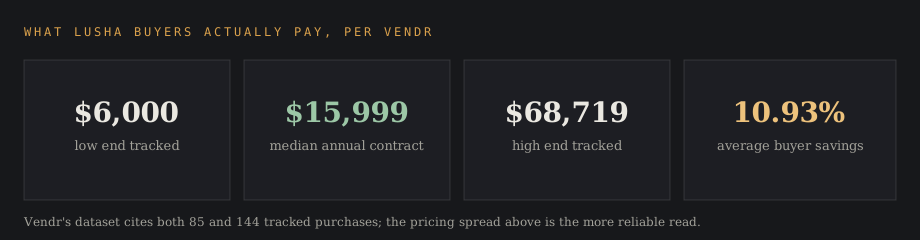
That $15,999 median sits well above a single Pro seat's $69.90 per month list price annualized ($838.80). It confirms most paying accounts buy multiple seats, a higher tier, or both. For comparison, Vendr's own benchmarking of Lusha's competitors quotes Apollo's entry pricing around $49 to $79 per user per month and ZoomInfo's contracts starting near $15,000 per year with no self-serve floor at all.
Vendr's data shows accounts with 10 or more seats, or credit pools exceeding 10,000 credits per year, seeing the most consistent volume-based discounting, while smaller Pro-tier purchases see less negotiating room; Vendr's own benchmarking treats teams revealing large volumes of phone numbers as needing Premium or Scale by default, since Pro's 600 monthly credits run out fast under a calls-first outreach motion.
How to negotiate Lusha pricing
Three levers show up across buyer reports and Vendr's negotiation data. Engaging Lusha's sales team early, before a renewal deadline forces a decision, gives a buyer more room to frame the conversation around total cost ahead of the per-user sticker. Naming a specific competitor under evaluation, ZoomInfo, Apollo, or Cognism, tends to sharpen an offer, since Lusha competes hardest on price against tools running a similar credit-based model.
Buyers who reveal mostly phone numbers should negotiate a lower per-credit phone rate directly, since Lusha's published rate card doesn't discount phone reveals independently of the plan tier. Multi-year commitments are the third lever, and they cut both ways. Nolan W., Head of Sales at a real estate company, wrote in May 2025:
"I also love that Lusha allows flexibility in the pricing and customization for Enterprise Plans, which is appreciated for smaller organizations who need to dial in usage across users."Capterra review, Nolan W., Head of Sales, real estate, May 2025
That flexibility runs through Lusha's sales team, so a buyer negotiating a Scale or Premium contract should ask directly for a credit overage rate and a renewal price cap in writing. Don't assume the first-year rate holds. Marc A.'s 66% renewal jump above is the reason to ask before signing.
Who Lusha's pricing plans fit
Is Lusha worth the price for a given team? That depends less on company size than on how the team mixes email and phone reveals against its monthly credit limit.
The Lusha free plan and Starter fit a single rep or a two-person team testing accurate data before committing budget, since neither requires a credit card upfront. Pro is priced for a small sales team of two to three people that needs Lusha API access and CRM integrations without a mid-market feature set.
The Premium plan targets a growing revenue team large enough to need five or more seats and per-user credit allocation, and the scale plan exists for a sales team or recruiting org running enough monthly volume that a custom credit pool beats any published tier.
A recruiting team or a marketing team evaluating Lusha alongside a sales use case should weigh the same credit math: contact data lookups from the Lusha database cost the same regardless of department, so the plan choice comes down to seat count and phone-versus-email mix. A buyer's job title doesn't change the credit math.
Our Lusha review scores the product's data accuracy, compliance record and support against this same pricing, and the sales intelligence rankings place it against the rest of the category.
Lusha against its alternatives
| Tool | Entry pricing | Pricing model | Best fit |
|---|---|---|---|
| Lusha | $49.90 to $399.90 per month | Credit-based, per reveal | Small to mid-market teams wanting a browser-first workflow |
| ZoomInfo | ~$15,000+ per year minimum* | Seat-based, 1 credit per export | Teams wanting deeper datasets at a higher floor price |
| Apollo | ~$49 to $79 per user per month* | Credit-based, per reveal | Teams wanting sequencing and outreach bundled with data |
| Cognism | Custom, no self-serve tier | License-based | Teams prioritizing GDPR-compliant international coverage |
| UpLead | Custom, accuracy-guaranteed | Credit-based, per reveal | Teams wanting a published accuracy guarantee |
Lusha's entry pricing is its own published rate. Figures marked * are Vendr's benchmarking of competitor entry pricing.
ZoomInfo prices differently again: it charges 1 credit per export for any record type: email, phone number, or full company profile, against Lusha's 1-credit email and 5-credit phone split; Cognism runs a transparent, license-based pricing model, which some buyers prefer because it decouples cost from how many phone numbers a rep happens to reveal in a given month.
UpLead publishes a 95% verified data accuracy guarantee tied to its own credit-based pricing, a claim aimed directly at the best Lusha alternative candidates for buyers weighing data quality against cost.
SalesIntel takes a different angle again, pairing human-verified contact data with intent signals ahead of competing purely on the per-credit rate; the Lusha vs ZoomInfo comparison runs the full feature-by-feature breakdown for that specific matchup.
None of those alternatives is a strict upgrade. ZoomInfo's seat-based model can cost less than Lusha's credits for a phone-heavy team once volume climbs, while Lusha's lower entry price and free plan give a small team room to test contact data quality before either vendor sees a signed contract.
In the wider contact-data market, plans marketed as offering unlimited contacts or unlimited contact access often carry fair-use throttling in practice once usage climbs, unlike Lusha's transparent per-credit ceiling; Vendr's own comparison notes Seamless.AI's unlimited-reveal, seat-based model runs $125 to $300 per user per month against Lusha's per-credit floor.
See how it compares
Sign up for Seamless.AI
Free tier: 50 credits a month, no card required. Pro and Enterprise are quote-only.
 Visit Seamless.AI →
May earn a commission if you sign up through this link, at no extra cost to you. Full affiliate disclosure.
A team unsure which lusha alternative fits its outreach mix should shortlist by pricing model first, seat-based versus credit-based, before comparing feature lists line by line.
What to budget
A solo user testing Lusha pricing should budget $0 to start. Expect to move to Starter's roughly $37 to $49.90 per month once the free plan's 40 credits run out inside a normal prospecting month. A two-to-three-person sales team should plan around Pro's $69.90 per month base plus $49.90 per user per month for each additional seat, and should model its phone-to-email reveal ratio before committing, since that ratio decides how far 600 credits per month stretch.
Teams sizing a Premium or Scale purchase should budget closer to Vendr's $15,999-per-year median than to any published sticker price, and should ask Lusha directly for the current per-credit overage rate and a written renewal price cap before signing, given how often that number moves at renewal.
Annual plans reset that math once a year, so budgeting Lusha pricing correctly means picking the billing cycle that matches how predictable the team's contact data needs are.
Frequently asked questions
How much does Lusha cost per month?
Lusha's paid plans list at $49.90 per month for Starter, $69.90 per month for Pro, and $399.90 per month for Premium when billed monthly, with the scale plan priced by custom quote. Billed annually under the current sale, those drop to roughly $37.45, $52.45, and $299.95 per month.
Why is Lusha so expensive?
Lusha's list price looks moderate next to ZoomInfo's five-figure minimums, but the credit system pushes real cost up per month for phone-heavy teams: a phone reveal spends 5 credits against an email's 1, and Vendr's tracked median contract of $15,999 per year sits well above any single seat's list price.
Is Lusha an Israeli company?
Lusha was founded in Tel Aviv and keeps a development center there, though the company is now headquartered in Boston, Massachusetts.
Do you have to pay for Lusha?
No. The Lusha free plan gives one user 40 credits per month with no credit card required, though a growing team will exhaust that allowance and need a paid plan for consistent outreach.
How much does Lusha cost?
Paid plans run from $49.90 to $399.90 per month depending on tier, and scale plan pricing is custom-quoted based on credit volume and seat count. Vendr's dataset puts the median annual contract at $15,999.
Is Lusha for free?
Lusha's free plan is genuinely free: it renews its 40-credit monthly allowance for as long as a user stays on it, with no credit card on file.
What are the pricing options for Lusha lead generation?
Five Lusha pricing plans cover the range: Free, Starter, Pro, Premium, and Scale, moving from a single-seat 40-credit monthly allowance up to a fully custom credit pool with per-user allocation and SSO.
What are the pros and cons of Lusha?
Buyers cite fast contact-data reveals, solid CRM integrations, and a workable free plan as pros; the recurring cons are a credit system that gets expensive per month for phone-heavy outreach, no credit refunds on bad data, and renewal pricing that has jumped as much as 66% for at least one buyer.
Is Lusha free to use?
Lusha's free tier is usable indefinitely at $0 per month with 40 credits, though the browser extension and basic CRM integrations are the extent of what's included at that level.
How to get Lusha for free?
Signing up for the free plan requires no credit card and no time limit, though the 40 monthly credits cap how many contacts a user can reveal per month before needing a paid tier.
Bottom line
Lusha's five-plan structure prices most of its real cost into the credit system: $49.90 to $399.90 per month buys a seat count and a credit pool, and what that pool is worth depends entirely on where a team's outreach leans: emails or phone numbers. Vendr's $15,999-per-year median contract, well above any single Pro seat's annualized list price, confirms most paying teams buy more than the entry tier.
The hidden costs that catch buyers off guard sit outside the plan grid:
- credits that don't refund for bad data
- annual pools that expire unspent
- renewal pricing that has moved by double digits for reviewers who didn't ask for a cap in writing
A buyer who models phone-to-email ratio against credit cost per month, and negotiates renewal terms before signing, closes the gap between Lusha's list price and what the average contract costs.
Run that same math before asking the broader Lusha worth question: credits spent per rep against pipeline generated is a cleaner test than any published tier comparison, and it's the difference between reading this report on Lusha pricing once and re-checking it at every renewal.
Sources, and what Lusha doesn't publish on its own pricing page
Plan prices, credit costs, seat counts, the Summer Sale discount and the extra-seat rate are Lusha's own published figures, read off lusha.com and its pricing calculator. The 290 million-plus contacts, 26 million-plus companies, 98% email and 86% phone accuracy figures are Lusha's own, published on its data page.
Median, low, high and average-savings contract figures are Vendr's, read off vendr.com/marketplace/lusha; Vendr's own page cites both 85 and 144 tracked purchases in different sections. Competitor entry pricing for Apollo and ZoomInfo is Vendr's benchmarking; Cognism and UpLead publish no self-serve rate card at all.
Buyer quotes are verbatim from named Capterra reviewers, dated where the review itself carries a date. All figures checked 11 August 2026. Lusha publishes no fixed overage rate for Scale credits and no standing, non-promotional annual price list; both are negotiated per contract.
Disclaimer
This page includes one or more affiliate links. If you sign up for a product through one of them, this site may earn a commission at no extra cost to you.
Changelog
9 September 2026: Lusha's own pricing page moved since this report's 30 August update, and the figures below now match what's live today.
The Summer Sale's annual discount flattened to 25% off every paid tier. Pro's sale price moved from $48.95 to $52.45 a month; Premium's moved from $259.95 to $299.95 a month. Starter's 25% rate, and its $37.45 sale price, held.
Premium's bundled free manager seat now gates at Scale instead. Premium's five free seats, 3,400 monthly credits, and every other listed feature stay as this report first recorded them.
Vendr's tracked contract high moved from $68,719 to $70,403; the median and low both held at $15,999 and $6,000.
Figures corrected against lusha.com/pricing and its live pricing calculator, checked 9 September 2026. Vendr's median, low, and average-savings figures weren't rechecked in this pass beyond the high-end update noted above.