Email finder pricing: what 1,000 found emails cost across 16 vendors in 2026
 By Jan Suski. I go deep on every review, checking every number against its source and digging up details other coverage misses, a habit from six years of SEO and link building for tech companies. Bylines at Surfer, Brand24, and Senuto. How the scoring works.
The numbers Email finder pricing across 16 vendors, checked 6 October 2026
Credit-priced email finders cluster between $19.50 and $72.50 per 1,000 found email addresses, while contact databases that bundle phones run $124.75 to $490.
Phone data reprices the plan, because a mobile number costs 8 to 10 times an email at Apollo, Prospeo and Findymail.
Expiry rules decide how much of a plan you use, and they range from 30 days at Snov.io to never at BookYourData.
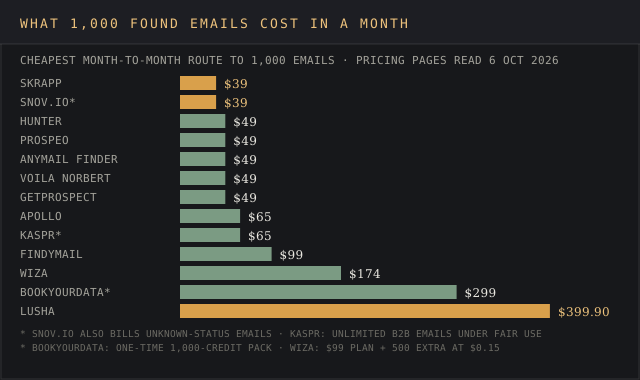
A thousand found email addresses cost $39 on Skrapp's monthly plan and $399.90 on Lusha's, a tenfold gap for the same output. I read the pricing tables of 16 email finder vendors on 6 October 2026, then priced one job across all of them. The job is to find 1,000 business emails for cold outreach in a month, on month-to-month billing, at list price.
The sticker price hides most of the bill. Every email finder sells credits, and a credit means something different at each vendor. One credit buys one verified email at Prospeo, one email marked valid or catch-all at Skrapp, and up to 10 emails in one bulk lookup at Hunter. A phone number costs 1 credit at Seamless.AI and 10 at Findymail.
This report is for founders, agencies and sales leads at small businesses who buy contact data to generate leads for cold outreach, and who want to compare paid plans before a free trial runs out. The email finder tools ranking scores the same vendors on accuracy and bounce remedies. This page sticks to what they charge and what the credit buys.
How email finder tools price a lookup
Email finder vendors bill on four units, and the unit decides what a failed search costs. Most email finder tools sell a monthly pool of credits that users draw on for every search. A few charge per valid email, per export, or per contact pack, and a handful still quote every seat through sales.
- Credits: Hunter, Snov.io, Prospeo, Findymail, Anymail Finder, Skrapp, Apollo and Lusha sell a pool that every search draws on.
- Valid emails: Wiza and GetProspect count only prospects whose email passes verification, and Voila Norbert counts "only successful email founds," per its pricing table.
- Exports: RocketReach lists unlimited verified emails and caps exports at 1,200 a year on Essentials, per RocketReach.
- Contact packs: BookYourData sells one-time packs where 1 credit equals 1 contact.
- Seats: Apollo, Prospeo, Kaspr and Wiza price per user on top of the credit pool.
Seat-based pricing multiplies fast as users join. Apollo's Basic plan costs $49 per seat a month on annual billing and $65 month to month, with 2,500 credits per seat per month, per Apollo's pricing. A five-person sales team pays $325 a month before anyone exports leads or sends outreach. Wiza's top plan starts at 3 users with unlimited valid emails at a custom price, so seats matter most for companies with several SDRs.
What one credit buys at each email finder
The devil's in the details, and the word "credit" covers at least six different data transactions. Read the definition before the price, because it decides if 2,000 credits buy 2,000 email addresses or 1,400.
| Vendor | One credit buys | No result found | Unknown or catch-all result | Phone number |
|---|---|---|---|---|
| Hunter | 1 email found, or up to 10 on Bulk Domain Search | 0 credits | Verification at 0.5 credit | Not listed |
| Snov.io | 1 valid or unknown email, or 1 domain search | 0 credits | 1 credit | Not listed |
| Prospeo | 1 verified business email | 0 credits | 0 credits for catch-all | 10 credits |
| Findymail | 1 verified email | 0 credits | Verified only | 10 credits |
| Anymail Finder | 1 person email, or up to 20 company emails | 0 credits | Verified only | Not listed |
| Skrapp | 1 email marked valid or catch-all | 0 credits | 1 credit for catch-all | Not listed |
| Apollo | 1 verified or catch-all email | 0 credits | 1 credit for catch-all | 8 credits |
Sources for each row: Hunter, Snov.io's credit guide, Prospeo, Findymail, Anymail Finder, Skrapp and Apollo's email status guide.
Snov.io bills the widest set of events. Its credit guide says "Each domain search costs 1 credit," and "Each email address with a green (valid) or yellow (unknown) status costs 1 credit." A list of prospects heavy with unknown statuses burns credits on email addresses you'll still have to verify. Buyers have to read between the lines of every "1 credit = 1 email" promise.
Apollo charges the same credit for a catch-all address as a verified one, per its email status overview, and charges nothing for an Unavailable result. Skrapp does the same with catch-alls. Prospeo says users "never pay for catch-all or emails you already found," per its Email Finder. Pay-per-valid email finder vendors push that risk back onto themselves, and Findymail's headline reads "Only pay for verified results."
A database executive at a marketing agency put the credit problem plainly on Capterra in July 2026:
"Some contact information is outdated and credit can runs out quickly with heavy usage that need to be improve."
Database executive at a marketing agency, Apollo user, Capterra, July 2026
What 1,000 found emails cost on each plan
Two numbers matter for each email finder tool. The plan rate is the monthly price divided by the email addresses it includes. It assumes every credit becomes one of your leads, which holds at the pay-per-valid vendors. The real cost of 1,000 emails is the cheapest plan that covers them, since nobody sells 1,000 credits at the plan rate of a 5,000-credit tier.
Self-serve credit plans
| Vendor | Entry plan, monthly billing | Emails included | Cost per 1,000 at plan rate | Annual-billing price |
|---|---|---|---|---|
| Skrapp | $39 Professional | 2,000 | $19.50 | $29 a month |
| Findymail | $99 Starter | 5,000 | $19.80 | 2 months free |
| Hunter | $49 Starter | 2,000 | $24.50 | $34 a month |
| Prospeo | $49 Starter | 2,000 | $24.50 | $37 a month |
| Apollo | $65 Basic, per seat | 2,500 | $26.00 | $49 a month |
| Snov.io | $39 Starter | 1,000 | $39.00 | $29.25 a month |
| Voila Norbert | $49 Valet | 1,000 leads | $49.00 | $39 a month |
| Anymail Finder | $29 Starter | 400 | $72.50 | Not offered |
Vendor list prices on monthly billing, read on each vendor’s pricing page on 6 October 2026. Cost per 1,000 divides the entry plan’s price by the emails it includes.
Rates fall steeply as the volume of leads grows. Anymail Finder's Ultimate plan sells 100,000 credits for $799, or $0.008 each, and Hunter's Scale plan sells 25,000 for $299 a month. Skrapp's Enterprise plan carries 50,000 credits for $349 a month, $262 on annual billing, and covers 15 users against 2 on Professional.
Findymail's rate looks like a bargain until the entry ticket shows up. The $99 Starter is its only self-serve plan, with 5,000 finder credits plus 5,000 verifier credits, per Findymail. A founder whose outreach needs 300 email addresses a month pays 33 cents each. Datacare, its CRM enrichment product, starts at $500 a month billed annually.
A penny saved is a penny earned, and annual billing saves the most pennies. Hunter drops from $49 to $34, Prospeo from $49 to $37, Kaspr from $65 to $49, and Apollo's annual seat hands over 30,000 credits upfront, per Apollo. That upfront grant makes year one a sunk cost if the outreach program stalls in month three. Hunter's Starter plan costs $34 a month on yearly billing for 2,000 credits a month, and the 50-credit allowance belongs to its free plan.
Contact databases and LinkedIn tools
| Vendor | Entry plan | What it includes | Cost per 1,000 emails at plan rate | Phone numbers |
|---|---|---|---|---|
| GetProspect | $49 a month | 1,000 valid emails | $49 | Not listed |
| lemlist data add-on | $20 a month on a $69 plan | 2,000 credits, 400 emails | $50 plus plan | 100 for 2,000 credits |
| Lusha | $49.90 Starter | 400 credits | $124.75 | 5 credits each |
| RocketReach | $229 a year, Essentials | 1,200 exports a year | $190.83 | From Pro, $619 a year |
| BookYourData | $99 one-time pack | 250 contacts | $396 | Same credit |
| Wiza | $49 Starter | 100 valid emails, 100 phones | $490 | $0.35 each past 100 |
| Kaspr | $65 Starter | Unlimited B2B emails, 100 phone credits | Fair use | 100 a month |
Vendor list prices, read on 6 October 2026. RocketReach bills Essentials once a year and BookYourData sells one-time packs, so their cost per 1,000 uses the annual or pack price.
Sources: GetProspect, lemlist, Lusha, RocketReach, BookYourData, Wiza and Kaspr. For email-only prospecting, per-contact pricing costs an arm and a leg next to a $39 credit plan.
Wiza's Starter plan costs $49 a month for 100 valid emails and 100 phone numbers, with extra emails at $0.15 and phones at $0.35. A buyer chasing 1,000 email addresses for outreach does better on the $99 Email plan, which includes 500 valid emails. Adding 500 extras at $0.15 brings the month to $174. The Wiza pricing report covers its annual plans, where the $83-a-month Email tier caps exports at 2,500 a month.
RocketReach sells exports by the year. Essentials costs $229 billed annually for 1,200 exports, and Pro costs $619 for 3,600 exports with access to mobile and direct phone numbers, per RocketReach. The RocketReach pricing breakdown has the seat and custom-plan detail.
BookYourData's packs shrink from $0.40 a lead on the $99 pack to $0.10 on the $999 pack of 10,000, and $299 buys exactly 1,000 with credits that never expire, per its pricing. Coverage outside mainstream industries is thin, and the complaint shows up in its own reviews. A sales manager at a farming business wrote on Capterra in March 2025:
"Niche industries like cannabis have limited contacts, hard to find long term value for these types of business sectors."
Sales manager at a farming business, BookYourData user, Capterra, March 2025
The BookYourData review counts that coverage complaint in seven of the eleven critical reviews it pulled.
Try it yourself
Sign up for BookYourData
Packs from $99 for 250 contacts to $999 for 10,000, with credits that never expire and a free 10-credit pack.
 Visit BookYourData →
May earn a commission if you sign up through this link, at no extra cost to you. Full affiliate disclosure.
Phone numbers cost 4 to 10 times an email
Phone is the second outreach channel, and it drains credit plans fastest. Lusha prices a phone reveal at 5 credits, Apollo at 8, and Prospeo and Findymail at 10, against 1 credit for an email at all four. lemlist's add-on sells 2,000 credits as 400 emails or 100 phones, so a phone costs four emails' worth. On a calling list, phones take the lion's share of the plan.
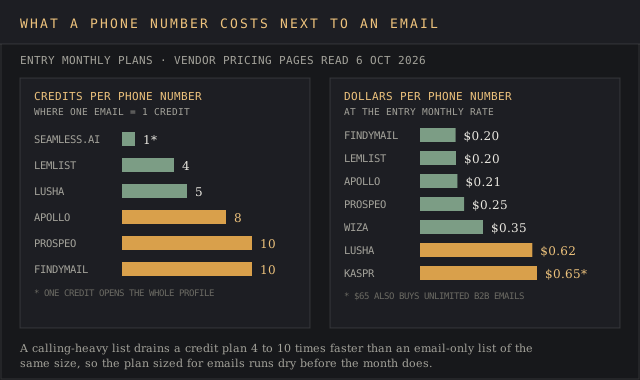
In dollars the order changes. A phone number costs about $0.20 on Findymail's Starter and on lemlist's add-on, $0.21 on Apollo's monthly Basic seat, and $0.62 on Lusha Starter, where 400 credits for $49.90 buy 80 phones. Lusha prices contact information by reveal type, 1 credit for an email and 5 for a phone. Kaspr's Starter includes 100 phone credits a month for $65, alongside unlimited B2B emails under a fair use policy, per Kaspr.
Seamless.AI runs the opposite model. Its credit article says clicking Find "uses 1 credit per contact to generate all information in the contact profile, including title(s), email(s), phone number(s)." One credit returns the full contact details, and the catch sits in the price, which Seamless doesn't publish above the free license. Its pricing page sends visitors to a sales inquiry form.
Apollo pitches its phone credits as a way to "directly connect with your prospects," per its pricing. Teams that book meetings by phone and connect with prospects on the first dial should size a calling campaign in phone credits first, once they identify how many leads need a number. A list of 400 decision makers with direct phone numbers drains 4,000 Prospeo credits, double the Starter allowance.
Credit expiry and rollover rules
An unused credit is money already spent on leads you never pulled. Five rules cover the email finder vendors here, and they run from a 30-day expiry on Snov.io's monthly plans to BookYourData packs that never expire.
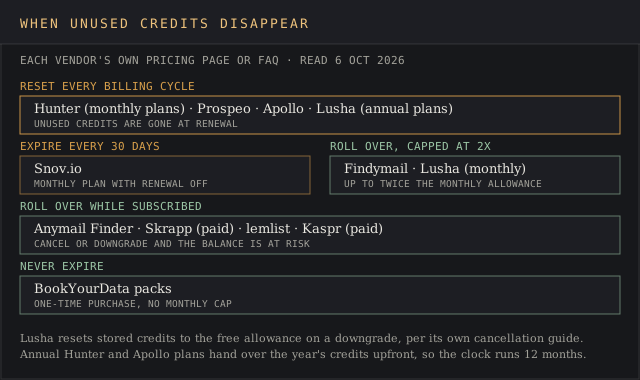
- Reset at renewal: Hunter's monthly credits "reset monthly and don't roll over." Prospeo's "unused credits expire at renewal." Apollo's credits "do not roll over if unused," and Lusha's annual credits reset at the end of the cycle.
- Expire after 30 days: Snov.io's credits expire every 30 days unless the plan is annual or renewal is on.
- Roll over to a cap: Findymail and Lusha's monthly plans carry credits forward up to twice the monthly allowance.
- Roll over while subscribed: Anymail Finder, Skrapp's paid plans, lemlist and Kaspr keep the balance growing while the subscription stays active.
- Never expire: BookYourData's packs, which suit businesses that prospect in bursts.
Rollover suits lead generation that comes in bursts, such as a quarterly campaign push to new prospects. It also has a back door, and a downgrade can send a balance back to square one. Lusha's cancellation guide says "All stored credits reset when your plan downgrades to free." A Lusha customer described what that looks like on Trustpilot on 19 August 2026:
"I had over 200 accumulated credits, but after cancelling my subscription, these were reduced to just 40 without this being made clear beforehand."
Lusha customer, Trustpilot, 19 August 2026
Failed searches, verification and bounce refunds
Every email finder in the credit table charges 0 credits for a search that finds nothing. The money moves on the results in between, such as catch-all email addresses, unknown statuses and emails that bounce after you pay for them.
Email verification is priced separately at most email finder vendors. Hunter's Email Verifier costs 0.5 credit an address, Anymail Finder's 0.2 credits, and Voila Norbert sells it pay-as-you-go at $0.003 an email up to 500,000 with a $2 minimum. Hunter also runs a free check on its own finds: "All the email addresses go through a free email verification before being returned," per its Email Finder.
Three vendors put a bounce rate in writing:
- Findymail promises a bounce rate under 5%, with credits refunded past it.
- Anymail Finder offers a "97%+ delivery guarantee" and refunds the credit for a reported bounce.
- BookYourData promises a "97% deliverability guarantee or refund the credits."
Verification protects the sender's reputation more than the budget. Prospect emails that bounce heavily on a new sender get throttled by mailbox providers, and the email campaigns behind them stall. Paying 0.5 credit to verify emails before a send costs less than warming a replacement sender. At Voila Norbert's rate, verifying 1,000 emails costs $3, a drop in the bucket.
Bulk tools change the arithmetic. Hunter's bulk lookup returns up to 10 email addresses per company for 1 credit, and Anymail Finder's company search returns up to 20 verified email addresses for 1 credit. Both suit list building, where users find emails from company names, company websites or LinkedIn exports in bulk, and both return generic inboxes along with named prospects.
AeroLeads' website markets its Bulk Email Finder as a way to "Obtain bulk email lists in a matter of seconds," per its bulk upload page, and the speed matters less than the credit each row spends.
Free plans and free trials
Most email finder tools give away enough to test accuracy on 40 to 100 leads. Monthly free allowances beat one-time grants for small businesses that need to find emails for a few outreach prospects each week.
- Prospeo: 100 credits a month on its free plan.
- Apollo: 900 credits per seat a year, granted monthly, with 2 sequences, enough for a new SDR to hit the ground running.
- Hunter: 50 credits a month.
- Skrapp: 50 credits a month.
- Snov.io offers a trial of 50 credits and 100 recipients that renews every 30 days.
- GetProspect: 50 valid emails and 100 verifications a month.
- Lusha: 40 credits a month.
- Kaspr: 15 B2B email, 5 phone and 5 direct email credits a month, used from its LinkedIn extension.
- Wiza: 20 valid emails and 5 phone numbers.
- Anymail Finder: 100 credits once. Voila Norbert: 50 once. Seamless.AI: 50 once. BookYourData: 10 once. Findymail: 10 once, with no credit card, so the test comes with no strings attached.
- RocketReach: 5 lookups when you create an account, per its FAQ.
- lemlist: a 14-day free trial with no credit card.
A free plan lets you test a vendor against your own market before paying, and Prospeo, Apollo and Hunter let you find contact information for 50 to 100 people a month at $0. The test should identify which vendor covers your market.
- Pull 50 prospects from LinkedIn whose data you already know.
- Run the same search through two email finder tools.
- Count bounces, wrong job titles and missing contact information.
- Ask the vendor's support team in writing how a catch-all result is billed.
That test takes an afternoon and beats any accuracy claim on a vendor's homepage. Judge the user friendly interface in the same week, since the credit rules take a full billing cycle to show.
How buyers use an email finder tool
Buyers use an email finder for three jobs, and each one spends credits at its own rate. LinkedIn prospecting spends a credit per LinkedIn profile. Company search spends credits across target companies. List cleanup spends verification credits on email addresses a CRM already holds.
- LinkedIn prospecting: An SDR opens a LinkedIn profile, clicks the Chrome extension and reveals contact details for the right person without leaving LinkedIn. Lusha, Kaspr, Wiza, Skrapp, Apollo and Prospeo all sell a Google Chrome extension for LinkedIn, and a reveal costs the same credit the web app charges.
- Company lists: An agency feeds company names or company websites into Hunter to find email addresses for each decision maker at 200 target companies. Hunter bills "1 credit = 1 email found via Domain Search, Email Finder, or Bulk Email Finder," per its pricing.
- List cleanup: Marketers verify emails on an old list before marketing campaigns go out, at 0.5 credit an address on Hunter or 0.2 on Anymail Finder.
Lead generation volume sets the plan size. An SDR who sends 40 personalized emails a day to new prospects needs about 800 business emails a month across 20 working days. That fits inside the 2,000-credit tier at Hunter, Prospeo or Skrapp with room for misses, which cost 0 credits at all three.
Personalized emails need job titles, company names and a reason to write along with the address. Apollo, Prospeo and Lusha return those fields with each of their leads. Hunter returns the public sources where it found an address "along with the discovery dates," per its Email Finder, so users can judge how old the data is before the message goes out. Those public sources are often company websites, which makes a stale find easy to spot.
Hunter's database holds "more than one hundred million professional email addresses," per the same source. A large database lets users easily find leads and prospects at large companies. Apollo says over 600,000 companies use it, per its pricing. Small businesses in niche sectors come back thinner, and BookYourData's own reviewers say so in writing.
Email finders bundled with outreach
Several email finder vendors sell finding, verifying and outreach inside one platform, so the finder price arrives as part of a bigger bill. Snov.io's credits pay for "prospect search, email search and email verification," so users find email addresses, check them and send from one account, and its plans add recipients for email campaigns, per Snov.io.
lemlist works the other way round. The lemlist Email plan costs $69 a month, or $55 on yearly billing, and covers 50,000 emails a month for unlimited users. Finding contacts needs the data add-on at $20 a month for 2,000 credits. The Multichannel plan costs $109 a month, $87 yearly, with no monthly cap on emails and messages. lemlist says credits are "charged only for successful results" and roll over while the subscription is active, per lemlist.
Apollo bundles the most. Its free plan allows 2 sequences, and the Basic seat lifts that to unlimited sequences, so unlimited campaigns arrive with the $49 annual seat along with CRM integrations and waterfall enrichment. The free plan also lets users identify 20 companies a month from website visitors.
Waterfall enrichment lets an email finder check several databases in sequence until one returns a result. Apollo's waterfall guide says it "checks its own data first, then moves down your lineup, source by source," and "Credits are charged when a source successfully returns data." The Apollo.io pricing report covers the contract terms, and Apollo vs ZoomInfo sets it next to ZoomInfo's quote-only contracts.
Oppora sits at the low end of the bundles. Its Pro plan costs $34 a month for 10,000 data credits and 200 phone credits, per Oppora. Bundles kill two birds with one stone for a solo founder who'd otherwise pay for an email finder and a sender. A company already running a sales engagement platform pays twice for the outreach half, and a bundle puts all your eggs in one basket when the data or the sending breaks.
LinkedIn and Chrome extension pricing
Most email finders ship a Google Chrome extension that pulls a person's email address off a LinkedIn profile or a company website, and the extension costs nothing extra. The credit it spends is the same credit the web app spends, and it lets SDRs easily find an address mid-browse. Users who find emails for prospects one profile at a time spend credits as fast as the extension allows.
Kaspr adds "Kaspr on Sales Navigator" from its Starter plan, and Business adds LinkedIn Recruiter Lite. Kaspr says it can "Export enriched leads to your favorite CRMs like HubSpot, Salesforce and more," and caps exports at 12,000 a year on Starter, enough for 1,000 prospects a month. A founder reviewing Wiza on Capterra in October 2025 singled out its LinkedIn and HubSpot integrations.
The LinkedIn seat itself is a separate bill. The LinkedIn Sales Navigator pricing report covers that cost. LinkedIn prospecting therefore carries two bills, the LinkedIn seat and the email finder credits, and companies that already pay for Sales Navigator add only the credits.
Contracts, auto-renewal and complaints
The list price is half the contract. Lusha asks groups larger than 5 users to talk to sales, and its terms renew a plan "at the then-current pricing structure" (section 16.1.2), require cancellation "at least fourteen (14) days prior to the expiration of the then-current service period" (16.2.2), and state "All payments under these Terms are non-refundable" (13.2.3), per Lusha's terms. A Trustpilot reviewer wrote on 5 August 2026:
"On July 21, 2026, my personal credit card was charged over $400 for an auto-renewal subscription. This account was tied to my former employer's company email."
Lusha user, Trustpilot, 5 August 2026
Lusha also carries live litigation, and the Lusha review traces each case.
- Hutchings v. Lusha Systems, filed 18 June 2025 in the District of Colorado, is stayed pending Lusha's motion to dismiss, with the Colorado Attorney General filing as amicus.
- Stavros v. Lusha Systems, filed 30 July 2026 in the Northern District of California, alleges Lusha uses people's names and profiles to "induce Free-plan users to become paying subscribers."
- Italy's Garante pulled its decision no. 542 of 14 July 2026 against Lusha from its website after a Rome court's interim order of 8 September 2026.
The Lusha pricing report covers the plan detail, including the 25% gap between monthly and annual billing.
Try it yourself
Sign up for Lusha
Free plan with 40 credits a month. Starter costs $49.90 a month for 400 credits, and a phone number takes 5 of them.
 Visit Lusha →
May earn a commission if you sign up through this link, at no extra cost to you. Full affiliate disclosure.
Seamless.AI draws the same kind of complaint. Its Trustpilot profile showed 1.2 stars across 309 reviews on 6 October 2026, and Trustpilot's own summary says many reviewers described annual subscriptions renewing without warning. One reviewer posted in October 2026:
"Only way to cancel is by scheduling a sales call with one of their associates. Earliest appointment is for one day after they bill me for another months service."
Seamless.AI customer, Trustpilot, October 2026
A cancellation path that runs through a sales call is a red flag. The Seamless.AI pricing report lays out the quote-only tiers, and the Seamless.AI review covers the 60-day notice complaints. Get the cancellation window in writing before you sign any outreach data contract.
Credit burn is the third complaint family. A managing director who trialled Prospeo wrote on Capterra on 13 July 2026:
"The credit-burn rate can feel incredibly steep, especially since complex tasks like bulk domain searches or deep verifications consume multiple credits per lead, causing entry-tier plans to vanish quickly."
Managing director who trialled Prospeo, Capterra, 13 July 2026
A founder who switched to Wiza from RocketReach wrote on Capterra in October 2025 that "At $83 per month it is a little pricey unless you are using consistently." The Wiza review weighs that against its export caps.
Quote-only vendors and enrichment suites
Seamless.AI publishes no dollar figure above its free license. Its own credit documentation names a Basic license with 250 universal credits a month and a Pro license with 10,000, and the prices circulating on third-party pricing blogs don't come from Seamless.
Try it yourself
Sign up for Seamless.AI
Free license with 50 credits, granted once. Basic (250 credits a month) and Pro (10,000) are priced on a sales call.
 Visit Seamless.AI →
May earn a commission if you sign up through this link, at no extra cost to you. Full affiliate disclosure.
Clearbit stopped selling its enrichment and email finder data on its own. Its help center says "We're no longer offering new standalone Clearbit subscriptions," and points buyers to HubSpot's Breeze Intelligence for the same data on the HubSpot platform. HubSpot says "Data enrichment does not consume HubSpot Credits," so companies already on a paid HubSpot hub get enrichment without spending credits, per its knowledge base.
The Clearbit pricing report has the HubSpot seat math.
ZoomInfo and Cognism sell annual contracts to companies with a procurement process, with no self-serve email finder plan. The ZoomInfo pricing report and the Cognism pricing report cover what buyers pay, and Lusha vs ZoomInfo sets a credit plan beside an annual contract.
What to budget for an email finder
Budget from the number of leads your outreach needs each month, then add phones. These are the cheapest month-to-month routes on published pricing plans, read on 6 October 2026.
| Monthly need | Cheapest published route | Next options |
|---|---|---|
| Under 100 emails | $0 on Prospeo's 100 free credits | Apollo free, Hunter free at 50 |
| 1,000 emails | $39 on Skrapp or Snov.io | $49 on Hunter, Prospeo, Anymail Finder, Voila Norbert or GetProspect |
| 2,000 emails | $39 on Skrapp | $49 on Hunter or Prospeo |
| 5,000 emails | $99 on Findymail or Prospeo Growth | $99 on Snov.io Pro S or Voila Norbert Butler |
| 10,000 emails, such as an agency that has to generate leads for three client companies | $149 on Hunter Growth | $189 on Snov.io Pro M, $199 on Anymail Finder Scale |
| 400 phone numbers | $99 on Findymail, 4,000 of 5,000 credits | Kaspr Starter, whose 100 phone credits cover a quarter |
Vendor list prices on month-to-month billing, read on 6 October 2026.
Higher plans buy lower rates and the same rules. Hunter Growth costs $149 for 10,000 credits and still resets them monthly.
- Prospeo Growth lets users connect HubSpot and Salesforce, with the same reset at renewal.
- Prospeo's search filters grow from 28 on Free to 32 on Starter and 38 on Growth, so users can narrow leads before spending a credit.
- Apollo's free plan includes API access, Kaspr's Starter gets limited API access and Business full access, and RocketReach includes MCP and API access from Essentials.
Advanced features such as CRM sync and intent topics sit on the middle tiers, so the plan you need for the workflow can outrun the plan you need for the volume.
Run the math on found email addresses. Take a sample of 200 prospects, count how many results come back verified, and divide the plan price by that number.
Frequently asked questions
How much does it cost to send 1000 emails?
Sending outreach is cheap next to finding the list for most businesses. lemlist's Email plan covers 50,000 emails a month for $69, and Snov.io's trial includes 100 campaign recipients. Finding the 1,000 email addresses first costs $39 to $399.90 a month on the plans above.
What is the cheapest email marketing platform for small businesses?
For cold outreach to prospects at small businesses, Snov.io's Starter at $39 a month lets you search, verify and send from one account. To find emails alone, Prospeo's free plan gives 100 credits a month at $0.
Which tool is best for email marketing?
Email finders build the list for outreach, and a sending tool runs the marketing campaigns. Apollo and lemlist generate leads and send to them on one platform, and Apollo Basic includes unlimited campaigns. Hunter, Skrapp and Findymail work as pure email finder tools that find an address from a name and a company website. The ranking of email finders scores the finding half.
How much does it cost to purchase an email list?
BookYourData sells contact packs from $99 for 250 leads to $999 for 10,000, with credits that never expire, and each credit reveals one lead's contact details. Businesses buying a list of companies and contacts skip the step where they find email addresses themselves. Its pricing also lists one-time custom builds from $499 for 1,000 records.
Bottom line
An email finder costs between $19.50 and $490 per 1,000 found email addresses at plan rate, and the credit definition moves the real cost of leads more than the sticker does for lead generation. Check what a catch-all costs at each email finder, what a phone number costs, and when unused credits vanish before comparing monthly prices.
For buyers who only need to find emails for outreach to prospects on LinkedIn or company websites, Skrapp, Hunter, Prospeo and Snov.io sit at $39 to $49 for 1,000 emails. For phone-heavy calling that has to book meetings, Findymail and Apollo price a number near $0.20.
Lusha and Seamless.AI need the closest reading of the contract, because auto-renewal and cancellation terms decide what leaving costs. A user friendly interface wins the trial week, and the credit definition wins the year.
Where each email finder price came from, and which vendors keep theirs off the page
Every price, credit rule and quote on this page links to its origin on first use, and all of them were read on 6 October 2026.
Plan prices and credit definitions come from the vendors’ own pricing pages and help documents at skrapp.io, hunter.io, snov.io, prospeo.io, findymail.com, anymailfinder.com, apollo.io, lusha.com, wiza.co, rocketreach.co, bookyourdata.com, getprospect.com, voilanorbert.com, kaspr.io, lemlist.com, oppora.ai, aeroleads.com and seamless.ai. Clearbit’s status is from help.clearbit.com and HubSpot’s enrichment rule from knowledge.hubspot.com.
Lusha’s contract terms are quoted from lusha.com, its two US cases from dockets.justia.com and courtlistener.com, and the Italian decision from garanteprivacy.it. Ratings and buyer quotes come from trustpilot.com and capterra.com, dated March 2025 to October 2026.
Seamless.AI prints no dollar price for its Basic, Pro or Enterprise licenses, ZoomInfo and Cognism quote only through sales, and Wiza’s Team plan carries a custom price. ContactOut’s pricing cards didn’t render on the check date, so it was left out of the 16.