RocketReach pricing: what the tiers, seats and custom plans cost
 By Jan Suski. I go deep on every review, checking every number against its source and digging up details other coverage misses, a habit from six years of SEO and link building for tech companies. Bylines at Surfer, Brand24, and Senuto. How the scoring works.
· Prefer this source on Google
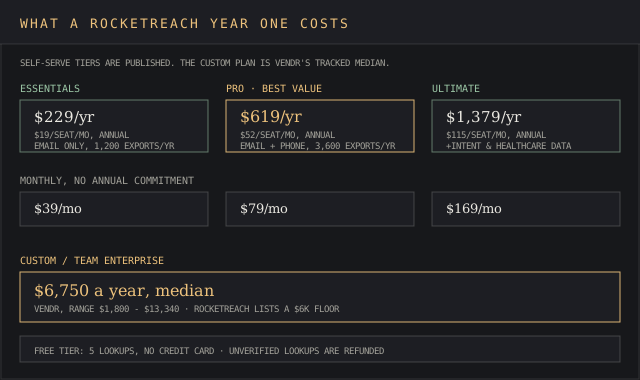
RocketReach says its custom team plans start around $6,000 a year. Vendr's tracked purchases run as low as $1,800, less than a third of that stated floor, with the same dataset topping out at $13,340 and landing on a $6,750 median.
The published side is simpler to check. Essentials runs $19 a seat monthly on annual billing, Pro $52, and Ultimate $115, adding phone lookups, intent data and full API access as the price climbs. None of that matches the $399, $899 and $2,099 figures still circulating in pricing round-ups and AI answers. Those numbers describe an older RocketReach plan structure, discontinued on the live pricing page.
The gap matters past the sticker price too. RocketReach's own marketing states 90 to 98% data accuracy, yet G2 reviewers keep flagging contacts that turn out stale, which is what one lookup credit buys once the seat is paid for.
This report checks every published tier against that $6,000 custom floor, tracks where the credit-based lookup system creates friction for buyers who run out mid-month, and sizes RocketReach against B2B data providers like ZoomInfo, Cognism, SalesIntel and LinkedIn Sales Navigator. It's built for a solo recruiter checking Essentials, a five-person sales team pricing Pro or Ultimate, and any buyer already holding a custom quote with nothing public to check it against.
The numbers RocketReach pricing, checked 13 August 2026
Vendr's tracked median for custom plans sits within a few hundred dollars of RocketReach's own stated $6,000 floor.
The self-serve annual tiers run two to eleven times cheaper than a typical custom contract.
None of the three self-serve tiers grant unlimited monthly lookups without committing to annual billing.
A buyer's first move should still be checking if Essentials or Pro's seat limits cover the team before that custom conversation even starts, since every self-serve tier caps exports and lookups by month or year regardless of billing cycle.
How much RocketReach costs today
RocketReach sells three individual plans and a matching set of team plans, each billed monthly or annually. Annual billing is the better deal on every tier: switching Essentials from monthly to annual billing drops the effective monthly rate from $39 to $19, a discount RocketReach frames as "save 50%" at checkout.
Pro drops from $79 to $52 a month, and Ultimate from $169 to $115. The trade is commitment. Annual plans lock in a year of billing up front, and month-to-month plans give up that annual pricing discount for the ability to cancel anytime.
Canceling at any point still lets a subscriber keep their plan features through the end of the paid term, a month or a year depending on the billing cycle chosen, per RocketReach's own FAQ. There's no partial refund for time left on the term after cancellation.
Essentials plan
Essentials is RocketReach's email-only tier: personal and professional emails, no phone data. On annual billing it runs $19 a seat per month, $229 a year for one seat.
On monthly billing it's $39 a month with 100 lookups and 100 exports per month, 1,200 a year. The annual plan instead grants unlimited lookups and caps exports at 1,200 a year, plus a 500-email-a-day sending limit.
It's built for individuals doing outreach on volume.
Pro plan
Pro is the plan RocketReach itself badges "Best Value," and it's the first tier with phone data: mobile direct phone numbers alongside verified email addresses. Annual billing runs $52 a seat per month, $619 a year for one seat; monthly billing is $79 a month with 250 lookups and exports monthly, 3,000 a year.
The annual version raises exports to 3,600 a year and adds technographics, company trends and org charts, ten active Autopilot jobs, and integrations with Salesforce, Outreach, HubSpot, Salesloft and Bullhorn.
Sales teams running multi channel outreach campaigns with both email and phone tend to land here.
Ultimate plan
RocketReach's Ultimate plan targets teams running heavier prospecting and automation: $115 a seat per month annual, $1,379 a year for one seat, or $169 a month with no annual commitment.
It carries everything Pro has plus 25 active Autopilot jobs, Salesforce custom field mapping, intent data, healthcare data, and 20,000 exports a year on the annual plan, or 12,000 lookups a year on monthly billing.
Full API access sits on this tier, which matters for anyone piping RocketReach data into a CRM or a custom data enrichment pipeline.
Custom and team enterprise plans
Beyond Ultimate, RocketReach routes larger buyers to a custom plan. The pricing page states plans start around $6,000 annually, with company exports, pooled credits, customizable packages, a dedicated account manager and higher API limits.
Vendr's tracked purchases put the median at $6,750 a year, with observed contracts running as low as $1,800 and as high as $13,340. One buyer told Vendr's community insights they negotiated three enterprise seats down to $6,750, a $690 saving against RocketReach's direct online list price for the same three seats.
What each tier gates, and what sits behind an add-on
The gate that matters most across every RocketReach pricing plan is data type more than seat count. Essentials never unlocks phone numbers no matter how many seats a team buys; only Pro and Ultimate include mobile direct phone numbers, and only those two tiers offer quick contact lookups directly on both channels at once.
Intent data and healthcare data are Ultimate-only, and neither shows up on Essentials or Pro at any seat count. Advanced team management, suppression lists and single sign-on are also gated to Ultimate, which pushes any team with basic account-governance needs onto the top tier regardless of lookup volume.
Integration and API gates
Integrations follow a similar pattern. The Chrome extension is available on every RocketReach plan, but HubSpot, Salesloft, Outreach, Salesforce and Bullhorn connections start on Pro; Salesforce custom field mapping is Ultimate-only.
API access itself is listed as "Select Plan" across all three tiers on RocketReach's comparison table, meaning full API access opens gradually. A buyer who needs company data and contact data flowing straight into a CRM through the API should confirm their specific plan's API limits before signing, since RocketReach doesn't publish a rate-limit table publicly.
Data quality: what "verified" means here
RocketReach markets itself on data accuracy and calls its own numbers "verified on demand and in real time," with a stated 98% accuracy figure on the pricing page and a 90-98% range across other RocketReach-owned pages.
The company positions itself as a data provider covering 700 million professionals and 35 million companies, searchable through advanced search filters covering job title, industry and location. That's a genuinely extensive database by any measure in this category.
Independent sentiment tells a more mixed story. G2 reviewers repeatedly flag verified contact information that turns out stale, and one director of business development wrote that RocketReach's information was "inaccurate more often than it's useful" despite the affordable price point.
RocketReach's refund mechanic softens the cost of that gap: a lookup only counts against a plan if it returns verified data, so a search that fails to produce accurate contact details doesn't burn a credit.
How up to date a given lookup stays depends heavily on how recently that specific contact changed roles, a limitation shared across every credit system priced on data freshness.
Hidden costs and the credit based lookup system
RocketReach prices per lookup through a capped credit system, and that credit system is where reviewers report the most friction. Stefan L., a small-business RocketReach user, wrote on G2: "I'm sometimes not clear how many lookups I get to do. I use RocketReach carefully because I don't want to reach the point where I'm looking for contact information I really need, and it tells me I'm out of credits."
A verified user in market research echoed the same complaint about the credit based system: "The credit-based pricing model can feel limiting, especially when you're doing a high volume of searches."
Fergus P., a marketing executive, put the export ceiling plainly: "It's also quite expensive and limited to 500 exports on my plan, not a lot if you're trying to put a lot of effort into outbound." Carl F., a small-business owner, made a related point about plan flexibility: "The pricing can be a bit steep for a small business like mine... It would also be helpful if they offered more flexible plan options for users who only need a limited number of lookups per month."
What happens to unused credits
Annual-plan exports and lookups are counted per year, so a team that under-uses one year doesn't carry the surplus into the next. There's no publicly listed price for buying extra lookup credit outside a plan's monthly or annual allotment.
RocketReach's pricing page routes anyone who needs more straight to a plan upgrade or a custom quote. A single lookup credit purchased outside a plan isn't an option RocketReach's own pricing page offers, which sits among the real hidden costs a team can hit if it miscalculates monthly volume.
What buyers pay against list price
List price and what buyers pay converge more tightly on RocketReach than on most B2B data platforms. Vendr's $6,750 median contract sits close to the $6,000 floor RocketReach states publicly, and the $1,800 to $13,340 range brackets the gap between a small custom deal and a larger team footprint.
That's a narrower spread than a platform like ZoomInfo shows on the same marketplace, where tracked contracts run from roughly $7,200 to over $150,000 with a median near $33,500, a scale RocketReach's entire self-serve and custom range never approaches.
Reviewer sentiment on value runs mixed. Larry N., a managing partner, called RocketReach "effective, simple to use and a good price point," and Dan B., a senior director, said "the performance is exceptional and we feel that the pricing and ROI is well worth it."
Holly M., a director of business development, captured the tension most reviewers land on: "Rocket Reach is much more affordable than competing software, which makes it a better fit for my budget," followed immediately by "we're getting what we paid for: Rocket Reach's information is inaccurate more often than it's useful."
How to negotiate a RocketReach quote
The clearest way to lower RocketReach pricing on a real contract is going through a third-party buying desk. The Vendr buyer who landed three enterprise seats at $6,750 explicitly framed it as savings against the list-price self-serve path, which was the more expensive route for that seat count.
For teams sizing at two or more seats, comparing RocketReach's own team pricing tier against a marketplace-negotiated quote before signing is worth the extra step, especially once a buyer is past Ultimate's seat pricing and into custom-plan territory where pooled credits and customizable packages are explicitly on the table.
Below custom-plan size, the main lever is billing cycle. Moving from monthly to annual billing cuts the effective rate by roughly half on every tier, so a team confident it will use RocketReach for a full year has a straightforward, published cost saving available without any negotiation at all.
Managing the account: seats, billing and switching plans
RocketReach's own FAQ confirms subscribers can upgrade, downgrade, or change their paid plan anytime from the accounts page inside the product. There's no separate contract to sign for a self-serve seat change on Essentials, Pro or Ultimate.
Account settings also control email-type preferences: a subscriber can filter to only personal or only professional emails, which trims how many lookups get spent on emails they'll never use. RocketReach accepts most bank credit and debit cards plus PayPal, which the company's support flags as the workaround when a card gets declined.
None of that changes the core structure: every RocketReach plan is a paid plan past the free tier's 5 lookups, billed on a monthly or annual cycle chosen at signup and adjustable from account settings later.
Who RocketReach's pricing fits
Essentials fits a single recruiter or founder doing personal and professional email outreach who doesn't need phone numbers, sales engagement tools, advanced team management, or the data quality guarantees priced into the higher tiers. Pro is built for sales teams running targeted outreach campaigns across email and phone together, particularly ones already using Salesforce, Outreach, Salesloft or HubSpot, since Pro is the first tier where those integrations activate.
Ultimate targets teams that need intent data, healthcare data, advanced reporting through Salesforce custom mapping, or full API access, and its per-seat annual rate still lands well under what a comparable seat costs on ZoomInfo. Custom plans exist for teams past a handful of seats where pooled credits, priority support and a dedicated account manager start to matter more than per-seat list pricing.
RocketReach's own numbers back that segmentation: the company reports 21 million-plus rocketreach users and adoption by 95% of the S&P 500, spanning everyone from a single job title lookup to enterprise-wide global coverage of prospecting data.
RocketReach pricing compared to the alternatives
| Provider | Entry price | What it's priced for |
|---|---|---|
| RocketReach | $229/yr (Essentials, 1 seat) | Self-serve individual and team plans, email and phone lookups, credit based |
| ZoomInfo | $7,200/yr low, $33,500/yr median (Vendr)* | Enterprise-first sales intelligence platform, quote-only |
| Cognism | Custom, quote-only | Phone-verified mobile numbers through its Diamond Data process |
| SalesIntel | Custom, quote-only | Human-verified contact data, 95% published accuracy, 83%+ on mobile |
| LinkedIn Sales Navigator | $1,079.88/yr (Core) | Relationship mapping and buyer intent signals layered on LinkedIn's own network |
ZoomInfo figures marked * are Vendr median annual contract values from anonymized buyer data. They aren't vendor list price.
ZoomInfo's low tracked contract on Vendr runs roughly 31 times RocketReach's cheapest annual seat, and the median-to-median gap is closer to five times. Either way, RocketReach's self-serve entry point sits well under ZoomInfo's, though not at the 38x figure some pricing summaries repeat.
Cognism differentiates on verified data for phone numbers specifically, confirming each mobile number by having a researcher call the contact, which is a different accuracy claim than RocketReach's own stated range.
SalesIntel's published 95% overall accuracy, with a separately stated 83%-plus figure for mobile numbers, sits above RocketReach's self-reported range, though neither vendor's number has been independently audited in this research.
LinkedIn Sales Navigator solves a different problem than a contact data provider does. Its Core plan runs $119.99 a month, $1,079.88 billed annually, and its Advanced plan runs $159.99 a month, $1,799.88 annually, with its own advanced search filters, real-time alerts and relationship mapping built on LinkedIn's network.
Sales Navigator doesn't export verified emails or direct phone numbers the way RocketReach, Cognism or SalesIntel do, which is why many sales teams run RocketReach or a comparable data provider alongside Sales Navigator.
A smaller Google-Sheets-native tool called Derrick markets itself as 5 to 10 times cheaper than RocketReach's team plans for similar lookup volume. That comparison comes from Derrick's own pricing page, and it bundles export caps and credit-rollover differences that widen the gap in Derrick's favor, so it's worth reading as marketing. The email finder pricing report puts Essentials at $190.83 per 1,000 exports, against $19.50 per 1,000 emails on Skrapp.
What to budget
A solo user doing email-only prospecting should budget $229 a year on Essentials annual billing, or $39 a month with no commitment. A small sales team combining email and phone should plan for $619 a seat annually on Pro, multiplied by seat count with the team-plan discount RocketReach applies per additional seat.
A team needing intent data, healthcare data or full API access should budget $1,379 a seat annually on Ultimate. Anything past that, plan around Vendr's $6,750 median, since the tracked figure reflects what buyers pay after negotiating a multi-seat enterprise contract, well below list price.
Evaluating RocketReach pricing plans against your own use case
When evaluating RocketReach pricing plans against a shortlist of alternatives, seat count and data type decide more than the sticker price does. Rocketreach plans scale from a single seat on Essentials to a custom team plan built around pooled rocketreach credits, and intent data access is typically what drives the jump from Pro to a larger, custom team footprint.
Buyers comparing rocketreach pricing against a monthly subscription elsewhere should also check export data limits, phone numbers coverage, and if verified contact information and verified email addresses hold up against their own target list before committing to a full year of annual billing.
Individual plans cover most solo use cases; individual and team plans both draw from the same rocketreach credits pool once a team account exists, and advanced reporting through Salesforce custom mapping is the one feature that pushes larger teams toward Ultimate regardless of the data accuracy claims each tier shares equally.
Frequently asked questions
How much does RocketReach cost per month?
On monthly plans with no annual commitment, RocketReach costs $39 a month for Essentials, $79 for Pro, or $169 for Ultimate, per seat. Annual billing lowers the effective monthly rate to $19, $52 and $115.
How much does RocketReach cost?
Annually, RocketReach runs $229 to $1,379 a seat depending on tier, or from $6,000 on a custom team plan, with Vendr's tracked median for those custom deals at $6,750 a year.
How many free searches do you get on RocketReach?
RocketReach's free plan includes 5 lookups with no credit card required, according to its own pricing FAQ.
Is there a free version of RocketReach?
Yes. Creating an account is free and includes 5 lookups. There's no free plan beyond that trial allotment, and every paid plan requires upgrading to monthly or annual billing.
Can I use RocketReach for free?
Only for the first 5 lookups. After that, using RocketReach requires an active monthly or annual subscription, or a custom team plan for larger seat counts.
What payment plans does RocketReach offer?
RocketReach offers monthly subscription plans and annual plans across all three tiers, plus custom team plans billed on negotiated terms. Both individual plans and team plans support monthly or annual billing, and PayPal is available where a card is declined.
How many lookups do you get on RocketReach?
Essentials grants 100 lookups a month for email only, or unlimited on annual billing, capped by 1,200 exports a year. Pro and Ultimate add phone numbers to every lookup: Pro grants 250 a month, Ultimate grants 1,000 a month. Annual plans convert the monthly cap to an unlimited-lookup, export-capped structure instead.
What's better than RocketReach?
It depends on what a buyer is optimizing for. ZoomInfo carries a larger enterprise feature set at a materially higher price. Cognism leads specifically on phone-verified mobile numbers. SalesIntel publishes a higher overall accuracy figure. None of the three undercuts RocketReach on entry price.
Do you have to pay for RocketReach?
Only past the 5 free lookups. Every lookup beyond that requires an active monthly or annual subscription on one of the three published tiers, or a custom team plan.
How is RocketReach legal?
RocketReach aggregates and verifies publicly available professional contact details, which is the same legal basis most B2B contact data providers in this category rely on.
Bottom line
RocketReach pricing today is $229 to $1,379 a year per seat across three annual tiers, with monthly plans available at roughly double the effective rate for anyone unwilling to commit for a year.
The credit based lookup and export system is the real cost driver reviewers flag ahead of the sticker price on any single tier, and the custom plan buyers land on averages $6,750 a year against a stated $6,000 floor.
Anyone pricing RocketReach against ZoomInfo, Cognism, SalesIntel or Sales Navigator should compare on data type and verification method as much as on the number itself, since none of those vendors' accuracy figures in this category have been independently audited.
What was checked, and where the numbers stop
Every figure above traces to a named source.
- RocketReach's tier prices, export and lookup caps, and free-plan terms: rocketreach.co/pricing and its pricing FAQ, checked 13 August 2026.
- Custom and team contract figures: Vendr's tracked marketplace data for RocketReach and for ZoomInfo, drawn from anonymized buyer submissions.
- Reviewer quotes: RocketReach's G2 profile, dated mostly April 2026 with one from February 2026.
- LinkedIn Sales Navigator's Core and Advanced prices: its own pricing page.
- Derrick's 5-to-10x cost claim: Derrick's own pricing-comparison page, marketing material.
RocketReach doesn't publish a per-lookup overage price outside a plan's allotment, doesn't publish an API rate-limit table, and hasn't had its accuracy claim independently audited by any third party found in this research.