ZoomInfo vs RocketReach: Database Size, Pricing, and Data Accuracy Compared
 By Jan Suski. I go deep on every review, checking every number against its source and digging up details other coverage misses, a habit from six years of SEO and link building for tech companies. Bylines at Surfer, Brand24, and Senuto. How the scoring works.
· Prefer this source on Google
| WHAT EACH ONE DOES | ROCKETREACH | ZOOMINFO |
|---|---|---|
| Core job | Contact lookup tool | Full GTM platform |
| Contact profiles | 700 million claimed | 500 million+ claimed |
| Company records | 35M or 60M, contradicts | 100M or 122M, contradicts |
| Platform features | No dialer or intent data | Engage, Chorus, Copilot |
| CRM integrations | 5 native + Zapier | Salesforce, HubSpot native |
| API access | Included, Pro/Ultimate | Credit-metered, no public cap |
| Verification method | Real-time at lookup | AI + 300 human research |
| Trust certifications | SOC 2 Type II, ISO 27001 | Not checked this session |
| Skip it if | Need dialer or intent data | Need a published price |
| WHAT YOU GET | ROCKETREACH | ZOOMINFO |
|---|---|---|
| Entry price | $19/mo, annual billing | ~$15,000/yr, quoted |
| Team/custom price | From $6,000/yr | No public floor |
| Free tier | 5 lookups, one-time | 10 reveals at signup |
| Vendr avg contract | $6,750/yr (1,800-13,340) | $33,500/yr (1,012 deals) |
| Contract term | Cancel anytime | No public minimum |
| Billing/credit model | Lookup + export credits | Monthly, bulk, AI credits |
| Ownership | Private, founded 2015 | Nasdaq: GTM, public |
| G2 reviews | 4.4/5, 1,375 reviews | 4.5/5, 9,384 reviews |
| Analyst position | No category claim found | No. 1 in 133 G2 categories |
StrongerWeakerNo edge
Thirty-five further documented limits sit behind the button below: Autopilot job caps, credit tiers, API rate limits, and both vendors’ certifications. Test scenario: a sales team evaluating a self-serve contact-lookup subscription against a quoted GTM platform contract, comparing first list prices.
Capability figures from rocketreach.co and zoominfo.com; commercial figures from Vendr's marketplace header stat blocks only; G2 figures checked directly on g2.com. All figures accessed 11 August 2026. Every figure is sourced in the section its row links to.
| RocketReach | WHAT IT DOCUMENTS |
|---|---|
| Autopilot cap, Pro | 10 active jobs |
| Autopilot cap, Ultimate | 25 active jobs |
| Lookups/exports, Essentials | 100/mo, 1,200/yr |
| Lookups/exports, Pro | 250/mo, 3,000/yr |
| Lookups/exports, Ultimate | 1,000/mo, 12,000/yr |
| Email send cap | 500/day, Essentials tier |
| Bulk lookup batch size | Up to 100 profiles/request |
| API rate limit, Essentials | 15/min person search |
| Global API cap | 10 requests/second, all plans |
| RocketVerify volume | 180M+ email checks/month |
| Founding-team patents | 13 patents in data mining |
| Certifications | SOC 2 Type II, ISO 27001 |
| Recovery targets | 12-hour RPO, 24-hour RTO |
| Status page | status.rocketreach.co, live |
| User count | 21M, 26M, and 30M* on 3 pages |
| MCP server | Queries via existing account credits |
| Trusted-by index | "S&P 500"† vs "Fortune 500" claims |
| Total-records figure | "4.5B records"* vs 700M elsewhere |
| ZoomInfo | WHAT IT DOCUMENTS |
|---|---|
| Credit types | 3: monthly, bulk, AI action |
| Export cost | 1 credit per exported record |
| Credit reset | 1st of month, midnight PST |
| Records Under Management | 365-day free re-export window |
| Engage email cap | 500/day, rest queued next day |
| Copilot dialer | US numbers only |
| Chorus transcription unit | 5-15 second utterance |
| Chorus email retention | Deleted within 30 days of contract end |
| Waterfall enrichment | 25+ vendors* vs 40+ same page |
| Intent topics | 4,500+ topics |
| Intent signal volume | 85M signals/week |
| Data processed daily | 1.5B+ data points |
| IP-to-org pairings | 210M pairings, Clickagy-built |
| Research team | 300+ human researchers |
| ZI Community size | 100M+ opted-in users |
| G2 category rankings | No. 1 in 133 categories, Summer 2025 |
| Founding | 2007, as DiscoverOrg, Henry Schuck |
*A marked figure is one the vendor states two ways on its own domain. RocketReach's About Us page cites 21 million users while its knowledge base cites 26 million and newer product pages cite 30 million; its integrations page cites "4.5B records" against 700 million contacts stated everywhere else. ZoomInfo's waterfall enrichment page cites 25-plus vendors in one section and 40-plus data providers in another, on the same page.
†RocketReach's security page claims "95% of the S&P 500" while its knowledge base claims "95% of the Fortune 500," the same statistic attributed to two different indices.
Sources, and the counts RocketReach can't settle on itself
RocketReach rows come from rocketreach.co's pricing, security, contact-database, API, MCP, integrations and verify pages, plus docs.rocketreach.co, knowledgebase.rocketreach.co and status.rocketreach.co. ZoomInfo rows come from zoominfo.com's data and product pages, help.zoominfo.com, and pipeline.zoominfo.com's RocketReach comparison page.
Neither company publishes a contract minimum, a seat minimum, an audited accuracy figure, or a post-cancellation data retention policy. RocketReach does not name its founders or disclose funding or ownership anywhere on its own site, and its status page shows live operational status only, with no historical uptime percentage.
ZoomInfo and RocketReach both sell contact data, but a ZoomInfo vs RocketReach comparison built on price alone misses the point. ZoomInfo quotes annual contracts that start near $15,000 and require a sales call. RocketReach posts its rates on a public page: $19 a month for email-only lookups, up to $169 a month for phone numbers and automated workflows.
That gap traces back to two different products built for two different budgets. The pricing pages make the split obvious before either sales team says a word.
RocketReach is a contact lookup tool a single rep can sign up for in an afternoon. ZoomInfo is a go to market platform with intent data, a dialer, conversation intelligence, and an AI copilot layered on top of the same kind of contact database. This guide works through what each company publishes: contact data and company counts, the live pricing pages, G2 review scores, and the claims ZoomInfo and RocketReach make about each other on their own comparison pages.
It's built for sales teams and marketing teams choosing between a self-serve lookup subscription and a quoted sales intelligence contract, and for anyone who has read one vendor's page about the other and wants the numbers checked before buying.
Recruiting teams researching contact-finding tools face the same choice, even where both companies market to sales teams first. Every figure below traces to a vendor's own site, a directly verified G2 page, or Vendr's tracked contract data, accessed 11 August 2026.
A short version of the ZoomInfo vs RocketReach answer: pick RocketReach for contact info and phone number lookups at a published rate, and pick ZoomInfo when the same contact data needs to feed intent signals, a dialer, and a marketing platform at once. The rest of this ZoomInfo vs RocketReach breakdown works through why.
↑ COMPARISONRocketReach and ZoomInfo solve different jobs
RocketReach does one thing: it finds a work email, a personal email, or a phone number for a named person, then lets you export the contact info. The pricing page frames this directly, describing Essentials as built for "individuals focusing on email outreach" and Pro for "professionals using multi-channel outreach with email and phone," according to rocketreach.co/pricing (accessed 11 August 2026).
Every tier includes a Chrome extension and a small set of CRM integrations, and the same browser extension ships across Essentials, Pro, and Ultimate alike. Nothing in RocketReach's own product pages describes intent data, conversation intelligence, or a dialer as native features; those stay ZoomInfo's ground to cover.
ZoomInfo sells the same category of contact data, but wraps it inside Sales, Marketing, and Talent product tracks. None of that sits behind a single self-serve toggle; the whole stack sits behind a quote, with a lead-gen form standing in for a price on every product page checked.
↑ COMPARISONKey features: Autopilot, Copilot, Chorus, and WebSights
RocketReach's automation layer is called Autopilot: a scheduled search that re-runs and re-exports contacts on a set cadence, capped at 10 active jobs on Pro and 25 on Ultimate, per rocketreach.co/pricing. It's outreach automation built for list-building on a schedule, the kind small sales teams use to keep a target list current.
RocketReach doesn't build a sequencing or sending layer of its own. Sending routes through whichever external tools its integrations connect to: Salesforce, HubSpot, Outreach, and Salesloft.
ZoomInfo's Sales track adds four tools, per zoominfo.com's product pages (accessed 11 August 2026):
- Engage: email and dialer sequencing
- Chorus: call recording and transcription
- Copilot: an AI layer that scores accounts and drafts outreach
- WebSights: identifies anonymous US website visitors
A team buying ZoomInfo for contact data alone is still paying for a platform built around all four. A team buying RocketReach gets none of them, and instead plugs its own sales tools in through the integrations RocketReach ships.
That difference decides who should be comparing these two tools at all. A recruiter or a two-person outbound team needs a phone number and an email address; a full revenue platform solves a problem that team hasn't grown into yet.
A revenue operations team running a multi-touch outbound motion across a large sales org needs the platform, and the platform is what ZoomInfo charges for, the same buyer our sales intelligence ranking covers in full. The two companies are pricing two entirely different things.
↑ COMPARISONDatabase coverage: contact and company counts
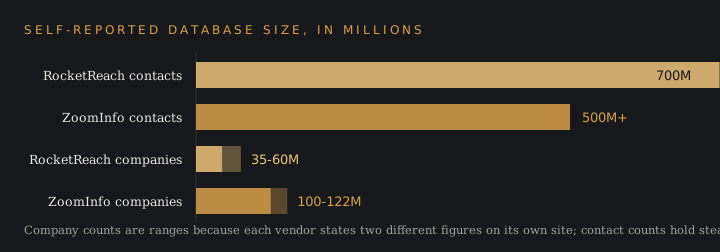
Both companies publish a headline contact count, and both companies also publish smaller counts elsewhere on the same domain that contradict the headline. That's worth knowing before either number gets used to justify a purchase.
RocketReach's pricing page states "700 million professionals & 35 million companies," per rocketreach.co/pricing (accessed 11 August 2026).
Its API and MCP product pages instead cite 60 million companies, and a separate integrations page mentions "4.5B records" without explaining what that figure counts, per rocketreach.co/resources/products/api and rocketreach.co/resources/products/integrations (both accessed 11 August 2026).
The 700 million contact figure holds steady across every RocketReach page checked, including the company websites it links to for company information. The company count does not.
That inconsistency matters to anyone running a real ZoomInfo and RocketReach evaluation side by side, because a database-size comparison built on the wrong RocketReach number understates its actual company coverage by nearly half.
| Metric | RocketReach | ZoomInfo |
|---|---|---|
| Contact profiles | 700M (rocketreach.co/pricing) | 500M+ (zoominfo.com/data) |
| Companies | 35M or 60M, contradicts across own pages | 100M or 122M, contradicts across own pages |
| Verified emails | Not broken out separately | 300M+ (zoominfo.com/data) |
| Verified phones | Not broken out separately | 135M+ (zoominfo.com/data) |
| Data points processed daily | Not published | 1.5B+ (pipeline.zoominfo.com) |
ZoomInfo's own /data page, the single page it points to as its authoritative source, states "500M+ Total Professional Profiles," 122M+ companies, and 300M+ verified emails, per zoominfo.com/data (accessed 11 August 2026).
But ZoomInfo's blog cites that same URL for a different set of numbers: 100M companies and 200M+ verified emails, on pipeline.zoominfo.com/sales/rocketreach-vs-zoominfo (updated 14 June 2026). The page ZoomInfo calls its source doesn't match how its own writers cite it.
Phone numbers, direct dials, and decision maker data
Phone number coverage is where the two companies diverge the most in what they'll say plainly. ZoomInfo states 135M+ verified phone numbers on its /data page, alongside a separate "120M direct-dial numbers" figure on its RocketReach comparison page, a distinction between any verified phone and a direct line to a named decision maker.
RocketReach's product pages describe phone number lookups as part of the Pro and Ultimate tiers only. Essentials is email-only, and neither the pricing page nor the contact-database page states a total phone-number count independent of the 700M contact figure.
Identifying decision makers by job title, company size, and funding events is a firmographic and technographic data problem past a raw contact-count problem, and both companies build their advanced filters around it.
ZoomInfo's contact records carry job title, company data, and technographic data as standard filters across its Sales track. RocketReach's advanced filters cover job title, company websites, and target companies through its "100+ filters including work, industry & location," per rocketreach.co/pricing.
Neither company publishes a market trends or funding events data source independent of its main contact database, and neither publishes a step-by-step method to identify decision makers beyond filtering by title and seniority. A buyer comparing contact details across the two still ends up filtering the same way on either platform: title first, seniority second, company data third.
Neither company publishes an independently audited figure for any of these counts. Both counts are self-reported, and both should be read as directional.
Neither vendor breaks its contact total down by international markets separately from its headline figure, so a buyer researching coverage outside the US has to test a sample of lookups. Buyers weighing database size against the wider field should check our company data providers ranking.
RocketReach markets its holdings as a vast database. ZoomInfo's product pages describe a similarly large database, then add company information layers, technographic data, and job title filters most contact-lookup tools don't carry at all.
Both companies use "database" as a single word for what is, on inspection, several linked data sets: contact records, company information, and firmographic and technographic data, updated on different schedules.
↑ COMPARISONPricing: a published rate card against a quoted contract
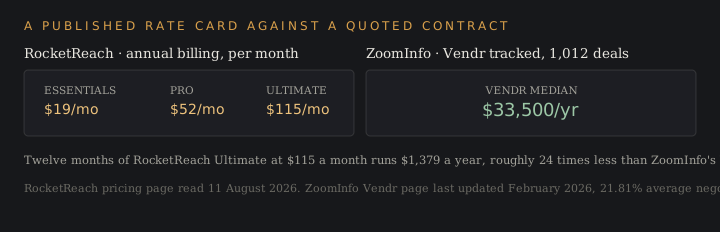
RocketReach is the rare contact database vendor that renders real numbers on its own pricing page. Most competitors put up a "request a demo" form. As of 11 August 2026, rocketreach.co/pricing shows three self-serve tiers, billed either monthly or annually. Our RocketReach pricing report covers the full tier breakdown, the custom team plans and the Vendr contract data.
| Plan | Monthly billing | Annual billing (per month) | Exports per year | Includes |
|---|---|---|---|---|
| Essentials | $39/mo | $19/mo ($229/yr) | 1,200 | Email only, 500 sends/day |
| Pro | $79/mo | $52/mo ($619/yr) | 3,600 | Email + phone, technographics, Autopilot (10 jobs), Salesforce/Outreach/HubSpot/Salesloft |
| Ultimate | $169/mo | $115/mo ($1,379/yr) | 20,000 | Email + phone, Autopilot (25 jobs), plus Bullhorn, Salesforce custom mapping |
A Custom/Team plan starts at $6,000 a year and adds pooled credits, custom exports, and a dedicated account manager, sold through a sales call, per rocketreach.co/pricing.
That's the point where RocketReach's own transparent pricing stops: Essentials, Pro, and Ultimate are fixed numbers on the page, and everything under Custom reverts to negotiated pricing, the same way ZoomInfo negotiates its contracts.
ZoomInfo publishes no dollar figure anywhere on zoominfo.com/pricing. The FAQ on that page states pricing depends on "features and functionality, number of licenses, credit usage," with no rate card attached, accessed 11 August 2026.
ZoomInfo does offer a free plan, ZoomInfo Lite, granting 10 reveal credits at signup, per the same source. RocketReach's free plan is smaller in a different way: five free lookups total with no credit card, a one-time allowance, per rocketreach.co/pricing.
Beyond Lite, the only public pricing signal for ZoomInfo comes from Vendr's marketplace listing: an average contract value of $33,500 a year, tracked across 1,012 deals, with an average negotiated discount of 21.81%, per vendr.com/marketplace/zoominfo (accessed 11 August 2026, page marked "Last updated: February 2026").
The practical math: a solo user on RocketReach Essentials pays $229 a year. A five-seat ZoomInfo deal at the Vendr median runs roughly 70 times that, before add-ons like Chorus or Copilot. That's the cost of the platform layer RocketReach doesn't build.
↑ COMPARISONData accuracy, verification, and G2 review scores
RocketReach describes its verification as happening at the moment of lookup: "Every time a user does a lookup we run email prediction + verification steps in real time," and credits are only charged when a verified email or phone comes back, refunded otherwise, per rocketreach.co/resources/products/contact-database (accessed 11 August 2026).
RocketReach's knowledge base states 98% deliverability on A-grade verified emails, with typical fill rates of 85%+ for email and 60%+ for direct phone numbers, sourced from over a dozen data feeds plus proprietary algorithms, per knowledgebase.rocketreach.co (accessed 11 August 2026).
ZoomInfo describes a mixed model: AI-driven matching backed by a 300-person human research team, plus a self-reported "ZI Community" of more than 100 million opted-in users whose CRM and email data feeds the platform through user contributions, according to pipeline.zoominfo.com (accessed 11 August 2026).
ZoomInfo states up to 95% accuracy on its first-party data; RocketReach's API page separately claims 90-98% accuracy for its own People Data API. Neither figure comes from an outside audit, and neither company publishes a methodology a buyer could reproduce.
Data quality: verification methods and known gaps
Data quality complaints on both platforms follow a similar pattern in G2's written reviews: users flag bad data and outdated contacts even where the aggregate accuracy figure is high, since a database this size can't apply real time verification to every record on every refresh cycle.
RocketReach's manual verification step runs on demand, at the point of lookup, which fixes staleness at the individual-record level but does nothing for records nobody has looked up recently. Users only see fresh data once a lookup triggers it.
ZoomInfo's static database between refresh cycles carries the same risk at a larger scale, since a platform update touching hundreds of millions of records can't run real time verification against all of them simultaneously.
Neither company publishes real time intent signals as separately verified data; both flow from the same underlying contact database, refreshed on its own schedule. Both platforms describe their intent data as built on top of the same contact records.
Verified contacts, verified email addresses, and verified data are the three claims both companies lean on hardest in marketing copy, and both attach a percentage to at least one of the three. A high data accuracy claim only means as much as the sample size and methodology behind it, and neither company publishes either one.
Accurate leads: what the review scores show
Review scores tell a closer story than either company's marketing copy. G2 lists ZoomInfo at 4.5 out of 5 across 9,384 reviews, per zoominfo.com/pricing (accessed 11 August 2026, citing G2). G2's own RocketReach reviews page lists 4.4 out of 5 across 1,375 reviews, verified directly on g2.com/products/rocketreach/reviews (accessed 11 August 2026).
RocketReach's own ZoomInfo vs RocketReach comparison page cites a G2 category score of 80% for its contact data accuracy against 78% for ZoomInfo's, then two paragraphs later restates the same ZoomInfo figure as 77% in body copy, a same-page inconsistency, per rocketreach.co/resources/comparison/rocketreach-vs-zoominfo (accessed 11 August 2026).
G2's public RocketReach page does not surface a numeric data accuracy percentage independent of that citation. The 80-vs-78 figure should be read as RocketReach's own framing of G2 data. G2's own page displays no such side-by-side number.
The two G2 profiles agree on one thing: verified contacts drive the review scores more than raw database size does. Reviewers on both platforms cite data enrichment and intent signals when they explain a high rating, and cite verified contacts going stale when they explain a low one. That pattern holds across ZoomInfo and RocketReach reviews alike, which suggests the accuracy gap between the two is smaller in practice than either comparison page's percentages suggest.
↑ COMPARISONWhere ZoomInfo and RocketReach attack each other directly
ZoomInfo and RocketReach both maintain a live, SEO-targeted page arguing against the other, which is unusual: most pairs in this category have one vendor publish and the other stay silent.
ZoomInfo's page, bylined Chief Data Officer Brandon Tucker and last updated 14 June 2026, sits at pipeline.zoominfo.com/sales/rocketreach-vs-zoominfo, titled to match this exact ZoomInfo vs RocketReach search. RocketReach's page, last modified 12 January 2026, sits at rocketreach.co/resources/comparison/rocketreach-vs-zoominfo and runs the comparison the other direction.
| Claim | ZoomInfo's page says | RocketReach's page says |
|---|---|---|
| Contact records | 500M ZoomInfo vs RocketReach 700M+ | RocketReach 700M vs ZoomInfo 260M |
| Company records | 100M ZoomInfo vs RocketReach 60M | RocketReach 60M vs ZoomInfo 100M |
| Pricing model | Self-serve RocketReach vs quoted ZoomInfo | Not framed as a table row |
| MCP / AI agent support | ZoomInfo has one; RocketReach does not | Not addressed on this page |
| G2 rating cited | RocketReach 4.5/5, 654 reviews | Not restated on this page |
The ZoomInfo-vs-RocketReach contact count in the first row is close to what each company states about itself elsewhere. The company-record row matches too.
But ZoomInfo's claim that RocketReach "has no published MCP server, no Claude marketplace listing, no agent-framework integration" doesn't hold up against RocketReach's own site: rocketreach.co/resources/products/mcp describes an MCP server that lets AI assistants query RocketReach's database using existing account credits, live and documented as of 11 August 2026.
That's a specific, checkable claim on a page updated within the past two months, and it's wrong.
ZoomInfo's page also cites RocketReach's G2 rating as "4.5/5 from 654 reviews." G2's own RocketReach page, checked directly, shows 4.4/5 from 1,375 reviews, a gap large enough that it looks like a stale pull.
ZoomInfo and RocketReach both write comparison pages to win the search result, and neither page should be the last stop for a number that matters to a purchase. Anyone running their own evaluation should treat both companies' self-comparison pages as a starting list of claims to check before trusting the numbers.
↑ COMPARISONContract terms and switching costs
RocketReach's monthly and annual plans both cancel from the account page at any time, with plan access continuing through the end of the current paid term, per rocketreach.co/pricing FAQ (accessed 11 August 2026).
Unused credits on monthly plans roll over for up to 12 months while the subscription stays active; annual-plan credits expire at the end of the paid year with no rollover, per knowledgebase.rocketreach.co (accessed 11 August 2026). Custom/Team plans route through a sales contract, and RocketReach's own site does not publish a minimum term for that tier.
ZoomInfo does not publish a contract minimum, a seat minimum, or an export cap anywhere on its public site. What is public: three separate credit types, monthly, bulk, and AI action credits, a monthly reset at midnight Pacific on the first of the month, and a "Records Under Management" policy that gives a free re-export window of 365 days on records a customer has already licensed, according to help.zoominfo.com (accessed 11 August 2026).
Exporting contacts from ZoomInfo costs one credit per record; RocketReach's export allotment is a fixed annual or monthly number baked into the plan price.
Switching between ZoomInfo and RocketReach is mostly a data-format problem. Neither contract locks a customer's exported data to the platform, so RocketReach's CRM sync covers Salesforce, HubSpot, Outreach, Salesloft, and Bullhorn natively, plus Zapier for everything else; ZoomInfo's CRM integration list is longer and includes native workflow automation inside Salesforce and HubSpot.
Neither company publishes a data retention policy covering what happens to a customer's records after cancellation. RocketReach documents what happens to unused credits; it doesn't document what happens to previously exported contact info once the subscription ends, and ZoomInfo's public help center is silent on the same question for its own customers.
A team moving off either platform keeps its own exported contact database, since both companies sell exports as owned data. What doesn't move is the automated workflows built around each platform's specific credit system: a RocketReach Autopilot job or a ZoomInfo Workflow both have to be rebuilt from scratch on the other side, since neither exports its automation rules in a format the other reads.
Who each tool fits
RocketReach fits solo users, a founder doing their own outbound, or one of the smaller sales teams that needs contact lookup without buying a platform, a comparison our UpLead vs ZoomInfo page also draws for a different self-serve challenger.
Its pricing plans scale in $19-to-$169 per-seat steps, there's no dedicated onboarding, and every tier covers phone number lookups, contact details, a browser extension, and a handful of CRM sync targets.
A single platform covering lookup, export, and a light automation layer is all this buyer needs, and it doesn't require adopting a second set of sales tools just to run outreach efforts.
ZoomInfo fits a company already running go to market motions across sales, marketing, and recruiting teams, where the same underlying contact data feeds an outbound sequence, an intent-based ad campaign, and a candidate search. Its intent signals, real time buying signals, and account scoring assume a team large enough to have someone managing credit budgets and CRM integration across departments. A single rep exporting a list doesn't touch most of that surface.
Lead generation and sales prospecting fit, by team size
Mid-market teams and smaller teams sit in between, and the pricing gap matters most for lead generation right there.
A five- or ten-person sales team choosing RocketReach's Ultimate plan for $115 to $169 a seat a month gets phone numbers, technographic data, and automated workflows through Autopilot, without the CRM-wide data enrichment or intent data that a ZoomInfo contract adds.
A team running targeted outreach purely through email and calls, without a marketing arm consuming the same data for ad targeting, rarely needs ZoomInfo's marketing teams tooling at all, and lead generation stays cheaper on RocketReach's custom pricing tier than on a ZoomInfo contract built for the same headcount.
Sales prospecting at the individual-contributor level, one rep building a list and working it manually, is RocketReach's strongest fit; the Chrome extension and per-lookup credit model match how a single rep works.
Outbound sales built around sequencing, multi-channel cadences, and shared account intelligence across a revenue team is closer to what ZoomInfo's Engage and Copilot tools run. That trade-off is what decides the choice.
Sales teams sizing this decision by headcount tend to land in one of three groups. Under five reps, RocketReach's Chrome extension and transparent pricing win on cost alone. Five to twenty-five reps is the real ZoomInfo vs RocketReach contest, where smaller teams weigh RocketReach's Ultimate plan against a ZoomInfo entry contract, and the answer turns on one question: do marketing and recruiting share the same contact data.
Past twenty-five seats, sales teams and marketing teams both drawing on one contact database make ZoomInfo's platform pricing easier to justify than running two separate tools with two Chrome extension logins and duplicate lead generation efforts.
Frequently asked questions
Is RocketReach as good as ZoomInfo?
For contact lookup specifically, RocketReach's own comparison page cites a higher G2 contact-data-accuracy score than ZoomInfo, 80% against a self-cited 77-78%, and G2's directly verified overall rating puts RocketReach at 4.4/5 against ZoomInfo's 4.5/5. RocketReach does not build the intent data, dialer, and conversation intelligence tools bundled into ZoomInfo's sales platform, so "as good" depends on the buyer needing those features at all.
Who is ZoomInfo's biggest competitor?
ZoomInfo competes across three separate categories: sales intelligence tools like RocketReach and Apollo, marketing data platforms like 6sense and Demandbase, and recruiting-focused tools. RocketReach competes only in the first category, at a fraction of ZoomInfo's typical contract size, which is why the two companies write comparison pages about each other at all, one pairing among the 18 ZoomInfo alternatives ranked by search demand on this site.
Is ZoomInfo outdated?
ZoomInfo has shipped Copilot, an MCP server for AI agents, and Chorus conversation intelligence within its current product line, according to zoominfo.com and pipeline.zoominfo.com (accessed 11 August 2026). Those are current additions, released alongside the rest of the platform.
The steeper learning curve some reviewers cite tracks the size of the platform itself, since a buyer has to learn Engage, Copilot, Chorus, and WebSights as four separate tools inside one login.
Can I get myself off RocketReach?
RocketReach's own site does not publish a self-service opt-out or data-removal process on its pricing, security, or about pages. A data-removal request would go through RocketReach's support contact, based on what's published as of 11 August 2026.
Do people know if you look them up on RocketReach?
Nothing on RocketReach's public pages describes notifying a person when their contact record is searched or exported. The lookup and verification process described on RocketReach's contact-database page runs a query against RocketReach's existing data and licensed sources; it doesn't reach out to the person being searched.
What is the lawsuit against ZoomInfo?
This page doesn't cover litigation history for either vendor. Check court records and ZoomInfo's own investor disclosures directly for current legal matters.
Verdict
Buy RocketReach if a lookup and an export are the whole job: a founder, a recruiter, or a two-to-five person outbound team that wants a published price, a cancel-anytime term, contact details, and phone number lookups without a sales call. The $19-to-$169-a-month range and the five-lookup free plan make this the lower-risk first purchase for anyone unsure how much contact data they'll use, and RocketReach's data enrichment stays useful even at that small a scale.
Buy ZoomInfo if the contact data needs to feed a platform: multi-touch sequencing, real time data on intent shared across sales and marketing, call recording and coaching through Chorus, or an AI layer scoring accounts for a team large enough to need it. The Vendr-tracked $33,500 median contract reflects that scope more than it reflects database size on its own, and it buys sales intelligence depth RocketReach was never built to sell.
A sales intelligence budget under five figures a year almost always lands on RocketReach; past that, decision makers tend to weigh ZoomInfo's data accuracy claims against its price, and ZoomInfo and RocketReach stop being direct competitors the moment a buyer's contract crosses that line.
Whichever direction the decision goes, verify the specific numbers that matter to the purchase directly on each vendor's own site. Both RocketReach and ZoomInfo have published claims about each other that don't match what a direct check of the cited source shows.
Sales teams evaluating both platforms side by side, past the two companies' own comparison pages, will get a cleaner read on intent signals, outreach, and pricing than either vendor's marketing team is going to volunteer.
Smaller sales teams researching a ZoomInfo and RocketReach purchase should start with a free RocketReach lookup and a ZoomInfo Lite export before committing a card number to either one; smaller teams rarely need to see more than that to know which side of this comparison they're on.
Sources: rocketreach.co pricing, security, contact-database, API, MCP, integrations and verify pages, plus docs.rocketreach.co, knowledgebase.rocketreach.co and status.rocketreach.co; zoominfo.com pricing and data pages, help.zoominfo.com, and pipeline.zoominfo.com's RocketReach comparison page; Vendr's marketplace header stat blocks; G2 checked directly on g2.com. Accessed 11 August 2026.