GTM tools: the 12 best go-to-market platforms ranked for 2026
 By Jan Suski. I go deep on every review, checking every number against its source and digging up details other coverage misses, a habit from six years of SEO and link building for tech companies. Bylines at Brand24 and Senuto. How the scoring works.
· Prefer this source on Google
Quick comparison of the 12 best GTM tools
The table lists all 12 GTM platforms and point tools in rank order, with the job count that decides most of that order.
| Rank | GTM tool | GTM jobs covered (of 8) | Entry price | Best fit |
|---|---|---|---|---|
| 1 | HubSpot | 7 | $0; paid seats $20 to $150/mo | Teams that want CRM, outreach and enrichment on one record |
| 2 | Apollo.io | 6 | $0; paid $49 to $119/user/mo | Outbound teams under 50 reps |
| 3 | ZoomInfo | 5 | Quote; Vendr median $33,500/yr* | Enterprise teams that need phone coverage |
| 4 | Salesloft | 4 | Quote; Vendr median $30,740/yr* | Sales orgs that forecast and sequence in one place |
| 5 | Clay | 3 | $0; paid from $54/mo | Ops teams building enrichment waterfalls |
| 6 | Outreach | 3 | Quote; Vendr median $45,600/yr* | Large SDR teams on Salesforce |
| 7 | Gong | 3 | Quote; Vendr median $55,333/yr* | Teams that coach from recorded calls |
| 8 | 6sense | 3 | Quote; Vendr median $62,220/yr* | Account-based teams scoring anonymous demand |
| 9 | Demandbase | 3 | Quote; Vendr median $68,591/yr* | ABM programs that run their own ads |
| 10 | Common Room | 2 | $2,500/mo, billed annually | Product-led companies watching community signals |
| 11 | LeanData | 1 | Quote; Vendr median $23,100/yr* | Salesforce orgs with messy inbound routing |
| 12 | HockeyStack | 1 | Quote; Vendr median $29,702/yr* | B2B marketers who need attribution insights |
Jobs counted from each vendor's product and pricing pages. Vendr figures marked * are medians of anonymised buyer contracts, checked 14 October 2026. Every other price is the one the vendor publishes itself.
Where these figures come from
Job counts come from each vendor's own product and pricing pages, read on 14 October 2026. Medians marked * are anonymised buyer-reported contract values from the Vendr marketplace, read the same day. HubSpot, Apollo.io, Clay and Common Room publish a list price, so their rows quote it directly.
Eight vendors publish no list price, so their rows carry the Vendr median alone. Gong publishes no figure for its platform fee and LeanData none for its setup fee, so neither cost appears in a row.
Two sibling rankings judge the same vendors from a narrower angle.
The lead intelligence software ranking scores Apollo.io, ZoomInfo, Clay and 6sense on lead-level signals and data. The technographic data providers ranking scores Apollo.io, ZoomInfo and Demandbase on tech-stack coverage. This page counts GTM jobs per contract, so the order differs.
GTM tools are the software revenue teams use to go to market, to find buyers, reach them and close them. The category covers contact data, intent signals, outbound sequencing, pipeline tracking, call recording, lead routing, attribution and account-based advertising. ZoomInfo renamed its Nasdaq ticker to GTM, which tells you how much money now chases the label.
This page ranks 12 GTM platforms against four measurable criteria, set out before the list so you can check the order yourself. Every price links to the vendor's own page or to Vendr's anonymised buyer data, and every entry carries at least one quote from a named user platform.
It's written for sales leaders, RevOps and marketing ops people building or trimming a GTM stack in 2026. If you're still writing the GTM strategy those GTM tools will execute, start with the go-to-market plan template and come back with the workflow on paper.
Two things changed this year. 6sense shut its free Sales Intelligence plan on 12 August 2026, and Clari and Salesloft finished merging under one CEO. The free tier shortlist got shorter, buyers who waited on 6sense's free seats missed the boat, and the sales engagement category lost a vendor.
Evaluation criteria for GTM tools and GTM platforms
Four criteria decide the order of these GTM tools, and the ranking below applies them in sequence: a tool that wins the first criterion outranks one that wins the second. Each one can be checked with a vendor page or a spreadsheet in under an hour.
GTM jobs covered under one contract
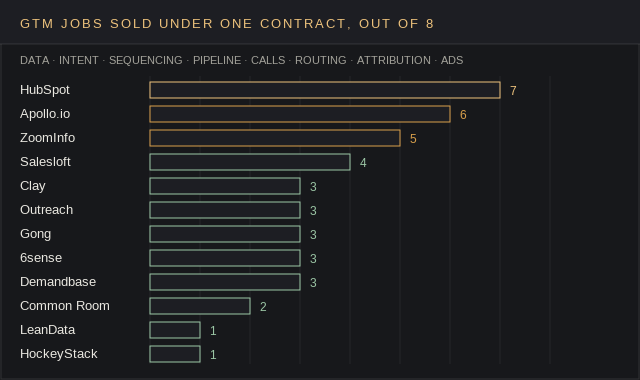
Eight jobs make up the entire GTM motion, and each gap in the GTM workflow needs another vendor: contact and company data, intent signals, outbound sequencing, pipeline and forecasting, call recording, lead routing, attribution, and account-based advertising. We count how many of the eight a vendor sells under one login, per its own product pages. A higher count means fewer point solutions to stitch together and fewer duplicate records between them.
A price published before the demo
A buyer can open the pricing page and read a dollar figure, or they can't. Four of the 12 tools publish one; the rest leave you reading between the lines of a sales deck. When two tools cover the same number of jobs, the one with a public price ranks higher, because you can model year-one cost without a sales call.
Vendr median contract per job covered
We divide Vendr's median annual contract by the job count. Gong's $55,333 median across 3 jobs works out to $18,444 per job; Salesloft's $30,740 across 4 works out to $7,685. This settles ties between quote-only tools and levels the playing field between a $23,100 router and a $68,591 ABM suite.
Salesloft's Vendr median per GTM job covered: $30,740 across 4 jobs. Gong's $55,333 across 3 jobs works out to $18,444.
Documented data volume and usage limits
Every ranked tool had to publish at least one hard number: a record count, a credit allowance, a contact cap or an API quota. A vendor that publishes none gives you no way to size the contract, so it didn't make the list. This criterion works as a gate, and it breaks the last ties.
The 12 best GTM tools, ranked
HubSpot
Best fit
Companies under roughly 200 reps that want CRM, marketing automation, sequences and enrichment on one contact record.
HubSpot is the only tool here that covers seven of the eight GTM jobs without a second vendor. The CRM is free, Sales Hub adds sequences and conversation intelligence, and Breeze Intelligence enriches contact and company records inside the same database. HubSpot's ROI calculator draws on over 306,000 customers, and the same record serves sales, marketing and customer success.
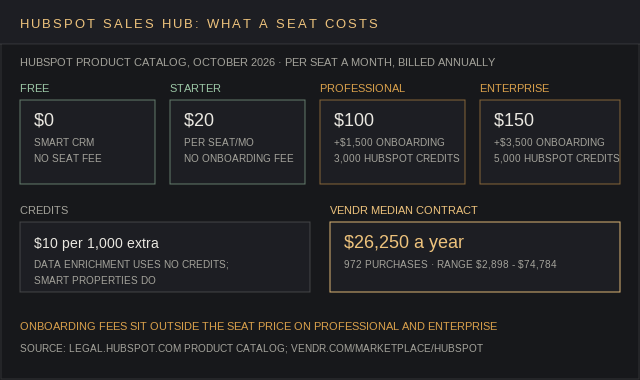
Enrichment is cheaper than it looks. HubSpot's knowledge base says data enrichment doesn't consume HubSpot Credits; smart properties do. That puts the CRM data layer at $0 on top of the seat, killing two birds with one stone for teams paying a separate enrichment vendor.
Key features
- Smart CRM with deal pipelines, deal scoring and a free tier
- Sequences, sales workflows and workflow automation on Sales Hub Professional
- Breeze Intelligence for contact and company enrichment plus buyer intent tracking on anonymous website visitors
- Conversation intelligence that records and transcribes sales calls
- Lead rotation and routing rules tied to CRM stage and owner
- Breeze AI assistant and prospecting agent across all hubs
Pricing
The HubSpot product catalog lists Sales Hub Starter at $20 a seat a month, Professional at $100 with a required $1,500 onboarding fee, and Enterprise at $150, billed annually, with a $3,500 onboarding fee. Professional includes 3,000 HubSpot Credits and Enterprise 5,000; extra capacity costs $10 per 1,000. Vendr tracks a $26,250 median annual contract across 972 purchases, ranging from $2,898 to $74,784.
Pros
- Seven of eight GTM jobs on one contact record, so CRM data never needs a sync job
- Published prices from $0 to $150 a seat
- Enrichment doesn't burn credits
- Marketing automation and sales engagement share the same buyer journey timeline
Cons
- Onboarding fees of $1,500 and $3,500 sit outside the seat price
- Marketing contact tiers raise the bill as the database grows
- No account-based advertising DSP of its own
The contact-tier con is the elephant in the room at renewal time. A C-level executive at a 1-10 person marketing agency wrote on TrustRadius in December 2024:
"Contact limits are tough to manage, we're always hitting our limit and then the cost increases."
TrustRadius review, C-Level Executive, marketing and advertising, 18 December 2024
A marketing manager at a 201-500 person company described the upside on TrustRadius the same month: "we have HubSpot Sales Hub tied to our social media ads, our live chat, google ads, forms, etc."
Why it's ranked #1. HubSpot covers 7 of 8 GTM jobs, one more than Apollo.io's 6, which wins the first criterion outright. It also publishes every seat price from $0 to $150, so nothing above it is left to beat.
Apollo.io
Best fit
Outbound teams under about 50 reps that want contact data and sequencing on one bill.
Apollo pairs a database of 240M contacts and 30M companies with email sequences, a dialer with call recording, a deals pipeline and an inbound router. Some SERP roundups still quote 275M contacts; Apollo's own pages say 240M. Our Apollo.io review tests the data, and the Apollo vs ZoomInfo comparison covers the head-to-head.
The inbound side is newer, and it puts the best of both worlds on one bill. Apollo's inbound page promises to route leads to the right rep with form enrichment that asks for an email, fills in the rest and scores the lead on 65+ data points. That's the routing job LeanData sells separately.
Key features
- 240M-contact database with 65+ filters, including buyer intent
- Multichannel sequences across email, phone and LinkedIn tasks
- Dialer with call recording on Professional
- Form enrichment, round-robin router and meeting scheduler for inbound
- Deals pipeline and two-way Salesforce and HubSpot sync
Pricing
Apollo lists Free at $0, Basic at $49 a user a month, Professional at $79 and Organization at $119 with a 3-user minimum, all on annual billing. Credits are pooled across the team and don't roll over. Vendr's anonymised data puts the median contract at $19,000 a year across 101 purchases, between $4,284 and $45,000. The Apollo.io pricing report breaks down the credit math.
Apollo pools credits across the team and they don't roll over, so size the plan to a typical month of lookups. A peak month sets the bill too high for the other eleven.
Pros
- The lowest Vendr median on this list at $19,000
- Free tier with no time limit
- Six GTM jobs, including inbound routing, under one login
Cons
- Free plans connect Gmail accounts only for email campaigns
- Unused credits expire at the end of each billing cycle
- Job-change lag on contact records
- No attribution or advertising
The data lag is where users note the cost. An executive at a 51-200 person agency wrote:
"It gives 90% data correct, but for 10% it gives an outdated profile, as the person switched, and Apollo still shows the previous company details."
TrustRadius review, Executive in Marketing, marketing and advertising, 22 July 2026
Why it's ranked #2. Apollo covers 6 GTM jobs, one fewer than HubSpot's 7, and one more than ZoomInfo's 5. Its $19,000 Vendr median is also $14,500 below ZoomInfo's.
ZoomInfo
Best fit
Enterprise sales teams calling into North America that need direct dials at volume.
ZoomInfo's data page lists 500M+ professional profiles, 135M+ direct dials and 300M+ verified business emails, and it tracks 4,500+ intent topics across 85M+ weekly signals. The 200M email figure that circulates in AI answers is stale. Our ZoomInfo review covers accuracy, and the ZoomInfo alternatives hub routes to 18 head-to-heads.
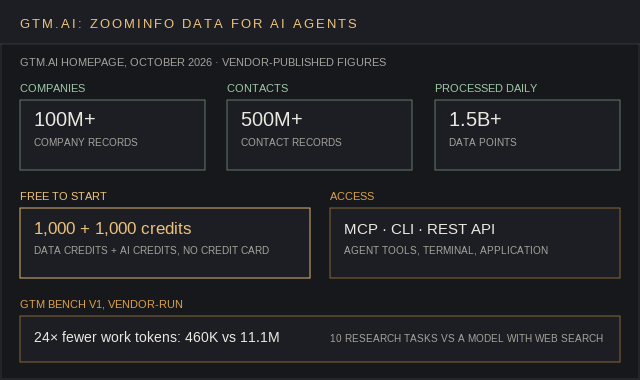
The company jumped on the AI GTM bandwagon early. Its Q2 2026 release calls it "the all-in-one AI GTM platform", with GAAP revenue of $310.4 million, up 1.2%, and net revenue retention of 89%. GTM.AI, its data layer for AI agents, gives away 1,000 data and 1,000 AI credits free over MCP, a CLI or REST.
Key features
- Contact profiles with 135M+ direct dials and 300M+ emails
- Intent data on 4,500+ topics and 15 to 20 million job-change events processed monthly
- Technographic data refreshed on a 60-day rolling cycle
- ZoomInfo Engage for sequencing and Chorus for conversation intelligence, bought for about $575 million in July 2021
- Routing and deduplication from the RingLead acquisition
Pricing
No public price. Vendr tracks a $33,500 median across 1,581 purchases, from $7,267 to $156,000. The ZoomInfo pricing report covers credits and renewal terms.
Pros
- The deepest phone coverage on the list at 135M+ direct dials
- Named a Leader in the 2026 Gartner Magic Quadrant for Account-Based Marketing Platforms on 8 October 2026
- Pushes contacts straight into the CRM
Cons
- No list price before a sales call
- A Capterra reviewer in August 2026 asked to cancel a contract signed for the wrong product
- Records go stale between refreshes
Users mention both sides in the same breath. A senior account executive in software wrote on Capterra in January 2026: "Very frequently, the information is outdated." A BDR in IT services called it "Very useful for contact data and for pushing contacts to my CRM" a month earlier.
Why it's ranked #3. ZoomInfo covers 5 jobs, one fewer than Apollo's 6 and one more than Salesloft's 4. Its 135M+ direct dials are the deepest phone data here.
Salesloft
Best fit
Sales orgs that want cadences, call recording and the forecast in one vendor.
Salesloft and Clari merged and appointed Steve Cox as CEO of the combined company, announced 3 December 2025. The merged vendor says it serves more than 4,000 organizations and processes 10 billion revenue interactions. Its site now lists logins for Clari Forecast, Conversations, Drift and Groove under one roof.
That stack covers four GTM jobs: sequencing, call recording, pipeline and forecasting through Clari, and website routing through Drift chat. That puts it in the driver's seat among the sales engagement vendors, and the revenue intelligence software ranking covers the Clari half in depth.
Key features
- Cadences with email, phone and LinkedIn steps
- Conversations for call recording and transcripts
- Clari Forecast for pipeline inspection and roll-ups
- Drift chat for routing website visitors to reps
Pricing
Quote only. Vendr's median is $30,740 across 710 purchases, with a range of $5,152 to $146,494. The sales engagement pricing report compares it with Outreach and HubSpot.
Pros
- Four jobs for a $30,740 median, or $7,685 per job
- Reps can add inbound leads to an existing cadence
- Forecasting and engagement now share a vendor
Cons
- No public price
- Post-merger product names still overlap across four logins
- Reporting draws complaints
An administrator at a 51-200 person company rated it 6 out of 10 on TrustRadius in February 2026: "Reporting is quiet hard." An SDR at a 501-1000 person firm wrote on TrustRadius: "When a new inbound lead comes in, it helps me just add it to an existing cadence."
Why it's ranked #4. Salesloft covers 4 jobs, one fewer than ZoomInfo's 5, and one more than Clay's 3. That fourth job, Clari forecasting, is what lifts it above every other engagement vendor.
Clay
Best fit
RevOps and GTM engineers who build enrichment from multiple data sources and want to pay per action.
Clay is a spreadsheet where each column calls a data provider or an AI research agent. Its pricing page lists 150+ data providers on every plan, which is what makes waterfall enrichment work: if provider one misses an email, provider two runs, then three, leaving no stone unturned on each row. Our Clay review tests fill rates, and the data enrichment tools ranking lists the providers it calls.
Key features
- Waterfall enrichment across 150+ providers
- Claygent AI agents that replace manual research on each row
- Signals for job changes and other buying signals
- Native sequencer, or push to Outreach, Salesloft or HubSpot
- Workflow automation through multi-step workflows that write back to CRM data
Pricing
The free tier includes 500 actions and 100 data credits a month. Launch starts at $54 a month on annual billing for 180,000 actions a year, and Growth at $185 a month for 480,000. Vendr's buyer data shows a $59,996 median across 96 purchases, from $16,500 to $170,000. See the Clay pricing report for credit costs per enrichment.
Pros
- Published prices and a free tier
- 150+ providers behind one table
- Unlimited seats on every plan
Cons
- Credit burn is hard to predict
- Formula chains carry a learning curve close to programming
- No call recording or attribution
Founder Jitendra Dhage of Prospectvista didn't beat around the bush on TrustRadius in January 2026: "pricing is too high for me and there credit system is somewhat messy." Justin Ashby, VP of Marketing at Glyphic, summed up the appeal on TrustRadius: "it's a spreadsheet with every column is an integration."
Why it's ranked #5. Clay covers 3 jobs, one fewer than Salesloft's 4. It beats Outreach, also at 3, on the second criterion: Clay publishes prices from $0 to $495 a month and Outreach publishes none.
Outreach
Best fit
SDR and sales teams of 50 or more reps running sequences out of Salesforce.
Outreach moved its site from outreach.io to outreach.ai and now prices on two meters: seats, plus consumption-based AI credits. Its pricing page lists 10,000 AI credits on Amplify Essentials up to 100,000 on Amplify Pro, with 250,000 to 1,000,000 API calls on the upper tiers and no platform fee.
The three jobs it covers are sequencing, call recording and deal forecasting. Outreach claims its Plus tier predicts deal outcomes with 81% accuracy; the jury's still out until it publishes a method.
Key features
- Sequences with A/B tests and Salesforce two-way sync
- Kaia call recording and conversation intelligence
- Deal management and forecasting
- AI agents metered by AI credits per tier
Pricing
Per user, on request. Vendr tracks a $45,600 median across 919 purchases, between $8,660 and $215,400.
Pros
- Published AI credit and API allowances per tier
- No platform fee on top of seats
- Salesforce contact import starts sequences without CSVs
Cons
- No seat price before a call
- Admin setup carries a learning curve and takes a dedicated owner
- $15,200 per job covered against Salesloft's $7,685
An Onit account executive wrote on TrustRadius in August 2026: "I love the integration with Salesforce where I can upload contacts into Outreach to start a sequence." A sales administrator at a 501-1000 person company was shorter that same month on TrustRadius: "Administration isn't intuitive."
Why it's ranked #6. Outreach ties Clay at 3 jobs and loses to it on the second criterion, because Clay publishes a price and Outreach doesn't. It beats Gong on cost per job: $15,200 against $18,444.
Gong
Best fit
Sales managers who coach from recorded sales calls and want the forecast built from the same data.
Gong says it has 5,000+ customers and has analyzed more than 120 million sales calls. It records calls, generates transcripts and runs AI agents for follow-ups, pipeline edits and forecast corrections. The conversation intelligence software ranking compares it with Chorus and others.
Gong Engage added sequencing and Gong Forecast added pipeline, so it now covers three jobs. The pricing model has two parts: licenses priced per user plus a platform fee based on users supported.
Key features
- Call recording, transcripts and topic tracking
- Gong Engage for sequences and Gong Forecast for pipeline
- Gong Enable, a sales enablement platform for AI-driven training built from real calls
- Gong Agents for follow-ups and CRM updates
Pricing
Quote only. Vendr's median is $55,333 across 1,157 purchases, from $11,572 to $204,802. The Gong pricing report covers the platform fee.
Pros
- 120 million analyzed calls behind the models
- Transcripts and video useful to marketing, product and customer success teams
- Free integrations with the existing tech stack
Cons
- Platform fee on top of seats
- $18,444 per job covered
- No contact data or intent
A sales team lead at a 201-500 person IT services firm explained why they bit the bullet and renewed:
"Gong was more expensive by far, and there were many more affordable options on the market, but at the time, we also considered switching costs and decided to stay with Gong."
TrustRadius review, Team Lead in Sales, information technology and services, 30 December 2024
A marketing director at an 11-50 person company valued that it "Has both the transcripts and videos of calls to allow marketing to interogate a sales call in-depth," per TrustRadius in August 2026.
Why it's ranked #7. Gong covers the same 3 jobs as Outreach, and its $55,333 median works out to $18,444 per job against Outreach's $15,200. It beats 6sense's $20,740 per job on the same test.
6sense
Best fit
Account-based marketing teams that need to spot anonymous demand before a form fill.
6sense's predictive models read historical CRM, MAP, first-party and third-party intent data to give each account an ICP fit, a buying stage and persona engagement across the buying group. Its 2025 study of 4,000+ B2B buyers found the average buyer journey lasts 10 months, six of them anonymous research. Our 6sense review tests those scores, and the 6sense vs ZoomInfo comparison covers the data overlap.
Free users went back to the drawing board when 6sense ended its Sales Intelligence free plan on 12 August 2026, and every package on the pricing page now goes through sales.
Key features
- Predictive analytics for account prioritization and buying stage
- Third-party intent in every package
- Sales intelligence tools with data credits for emails and phones
- Account based advertising on its own audiences
- AI account summaries and recommended actions
Pricing
Quote only. Vendr's median is $62,220 across 388 purchases, between $11,191 and $175,915. The 6sense pricing report covers what drives the spread.
Pros
- 6QA alerts land in the CRM where reps already work
- Buying stage per account, refreshed as behavior changes
- Intent signals, data and ads under one contract
Cons
- Free plan closed in August 2026
- Temperature scores draw accuracy complaints
- $20,740 per job covered
A marketing manager at a 10,001+ employee company wrote on TrustRadius in August 2026 that "our sales reps used 6sense qualified account (6QA) alert directly in our CRM." An account manager at a 1,001-5,000 person firm added a caution on TrustRadius: "Temperature scores could be misleading at times as well."
Why it's ranked #8. 6sense and Gong both cover 3 jobs, and 6sense's $62,220 median works out to $20,740 per job, above Gong's $18,444. It beats Demandbase, which costs $22,864 per job for the same 3 jobs.
Demandbase
Best fit
ABM programs with a buying group model and a budget for their own B2B ads.
Demandbase combines firmographic and technographic data with intent and runs account based advertising from the same platform. Its pricing page describes a platform fee plus a flat fee per user, and its Data product can be bought on its own. Read the Demandbase review and the Demandbase vs ZoomInfo comparison for the data side.
Demandbase's own content team calls it a GTM intelligence platform that coordinates ads, email, CRM data actions and sales plays in automated workflows.
Key features
- Account intelligence with firmographic and technographic data
- Intent topics researched per account
- B2B advertising tied to target accounts
- Buying group mapping and orchestration workflows
Pricing
Quote only, and it takes the lion's share of any budget here. Vendr's median is $68,591 across 187 purchases, from $24,000 to $164,037, the highest median on this list.
Pros
- Site-visit reporting tied to ad campaigns
- Data sold standalone or in the full platform
- Buying group view per account
Cons
- $68,591 median, the top of this list
- Company name variants break list building
- Ad targeting is less granular than other ad platforms, per users
A marketing strategist at a 1,001-5,000 person company wrote on TrustRadius: "It's hard to build accurate lists as there are multiple names for certain companies." The same reviewer liked that "it's great to see the accounts that are coming to our site based on our advertising efforts."
Why it's ranked #9. Demandbase covers 3 jobs like 6sense, but its $68,591 median works out to $22,864 per job against 6sense's $20,740. Its 3 jobs still beat Common Room's 2, which decides that pair on the first criterion.
Common Room
Best fit
Companies running a product-led GTM motion whose buying signals come from GitHub, Slack, LinkedIn and community channels.
Common Room collects signals from 50+ integrations and matches them to a 400M+ contact directory, so a Slack question or a GitHub star that would fly under the radar turns into a named person at a known account. It covers two jobs: intent signals and contact data.
Key features
- Signal capture from community, product and social channels
- Person360 identity resolution against a 400M+ directory
- RoomieAI agents that summarize accounts
- CRM and Slack alerts for existing accounts
Pricing
Essential costs $2,500 a month, billed annually, with 5 seats and up to 100,000 contacts. Advanced and Enterprise raise that to 15 and 30 seats and 250,000 and 750,000 contacts at custom enterprise pricing. Vendr tracks a $27,250 median across 76 purchases.
Pros
- A published entry price
- Community and dev signals no other tool here reads
- Contact caps stated per tier
Cons
- $30,000 a year minimum on Essential
- No sequencing or call recording
- Signal volume depends on an active community or open-source footprint
A marketing director at a 51-200 person IT company weighed the price:
"For the price, I think Common Room does an okay job of ABM tracking and account identification. Similar software is 2x the price."
TrustRadius review, Director in Marketing, information technology and services, 27 December 2025
Why it's ranked #10. Common Room covers 2 jobs, one fewer than Demandbase's 3 and one more than LeanData's 1. It's also one of 4 ranked tools that publishes a price, $2,500 a month.
LeanData
Best fit
Salesforce orgs where inbound leads land on the wrong rep or never get matched to accounts.
LeanData does one GTM job, routing, and it knows the ropes inside Salesforce. Over 1,000 companies use it for lead-to-account matching, round-robin and territory assignment, and BookIt scheduling from forms. Packages price on features, objects and the number of Salesforce users or queues, with setup billed separately.
Key features
- Lead-to-account matching that catches duplicate records
- Round-robin, territory and account-based routing
- BookIt for Forms, Handoff and Links
- Buying Groups Blueprint add-on
Pricing
Quote only. Vendr's median is $23,100 across 727 purchases, from $7,056 to $78,840.
Pros
- Routing on any standard or custom Salesforce object on Premium
- Matching that reps describe as the best in class
- Lowest per-job cost among single-job tools
Cons
- Setup and onboarding billed on top
- One job only
- Built around Salesforce
Ian Nate, a RevOps manager at a 201-500 person software firm, wrote on TrustRadius in September 2026: "LeanData is just simply the best at matching and routing." A deal desk lead at a 51-200 person company added on TrustRadius: "The price is higher than expected but the tool works well."
Why it's ranked #11. LeanData covers 1 job against Common Room's 2, which settles that pair on the first criterion. It beats HockeyStack, also at 1 job, on cost: a $23,100 Vendr median against $29,702.
HockeyStack
Best fit
B2B marketers who need multi-touch attribution across ads, web, CRM and the data warehouse.
HockeyStack is an attribution and revenue analytics tool that syncs both ways with the CRM, ad platforms and warehouse and lets you compare attribution models side by side. The vendor says most customers get initial attribution insights within 24 hours, and its AI agents suggest the next best action per segment.
Key features
- Multi-touch attribution with side-by-side model comparison
- Warehouse-native sync with CRM and ad platforms
- Odin prompt library for analysis
- AI agents with forward-looking recommendations
Pricing
Custom-built plans with startup pricing on request. Vendr's median is $29,702 across 33 purchases, from $24,040 to $77,500, the smallest sample here.
Pros
- Attribution tied to content and pipeline
- Warehouse sync both ways
- Attribution live within 24 hours, per the vendor
Cons
- $24,040 floor in Vendr's data
- Data connection can stall onboarding
- One job only
Onboarding is the red flag in reviews. A reviewer in IT services wrote on Software Advice in May 2026: "4 months of onboarding ended in us cancelling the contract because they could not connect our data." Levi O., a content and website director, wrote on G2: "I'm now able to track 'first-source' content opportunities more accurately."
Why it's ranked #12. HockeyStack covers 1 job, like LeanData, and loses that pair on cost: a $29,702 Vendr median against $23,100, drawn from 33 purchases. It sits last on both tests that separate single-job tools.
GTM tools vs GTM platforms: point solutions and when each fits
A GTM tool solves one specific job, like data enrichment or routing. A GTM platform connects several jobs into one system with a shared view of buyer data. LeanData and HockeyStack are point solutions; HubSpot and Apollo are platforms.
Vendors blur the line on purpose. ZoomInfo calls itself an AI GTM platform and Demandbase calls itself a GTM intelligence platform. Count the jobs: of the 12 GTM platforms and GTM software vendors ranked here, three cover five or more.
Three of the 12 vendors ranked here cover five or more of the eight GTM jobs: HubSpot with 7, Apollo.io with 6 and ZoomInfo with 5.
Point solutions fit narrow, urgent problems, where a stitch in time saves nine. If inbound leads sit unassigned for a day, a $23,100 router fixes that in a quarter without touching the rest of the GTM stack.
GTM platforms fit cross-functional pain points. When marketing, sales and customer success teams each keep their own copy of the account, every handoff creates duplicate records and a fight about whose number is right. One record removes the sync jobs between them.
The tradeoff is depth. Gong's call analysis and ZoomInfo's 135M direct dials beat what any all-in-one platform ships for those single jobs, so most revenue teams end up with one platform plus two or three point solutions. That mix is normal for gtm teams; at 15 tools the sync jobs become a job of their own.
Types of GTM software on a GTM tools list
GTM software splits into eight categories, matching the eight jobs in the criteria above. Most revenue teams need four or five.
- Sales intelligence and B2B data: contact and company records, firmographic and technographic data. ZoomInfo and Apollo lead; the sales intelligence ranking and B2B data providers ranking go deeper on sales intelligence tools.
- Data enrichment: filling blanks on existing records. Clay, Breeze Intelligence and single-purpose finders like Anymail Finder, which claims 98.9% accuracy from its own 5,000-contact benchmark and charges only for verified emails.
- Buyer intent: accounts researching your category, sold by every GTM intelligence platform on this list. The intent data providers ranking covers Bombora and the rest.
- Sales engagement: sequences that automate outbound across email, phone and LinkedIn.
- Marketing automation: campaigns and nurture flows; HubSpot is the default under 200 reps.
- Conversation intelligence: recording and analyzing sales calls.
- Routing and scheduling: LeanData and the routers inside Apollo and HubSpot.
- Attribution and ABM: HockeyStack for attribution; 6sense and Demandbase for account based marketing, covered in the ABM platforms ranking.
Content-led GTM teams add a ninth layer that sits outside this ranking: market research and keyword research. Semrush and Positive Surfer handle keyword research and content optimization for the top of the funnel the rest of the stack works.
Pricing across GTM platforms
The Vendr medians for these 12 GTM platforms run from $19,000 for Apollo to $68,591 for Demandbase. Eight of the 12 GTM software vendors publish no list price, so for most buyers the median is the only reference point before the first call.
Ranked GTM vendors that publish no list price. For those eight, the Vendr median is the only reference point before the first sales call.
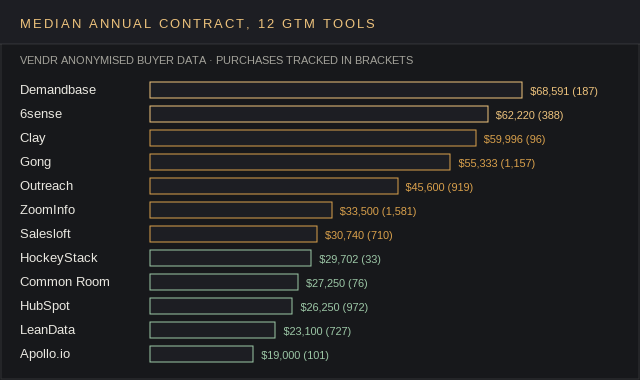
The four tools with public prices are HubSpot, Apollo, Clay and Common Room. Their entry points span $0 to $2,500 a month, and three of the four have a free tier.
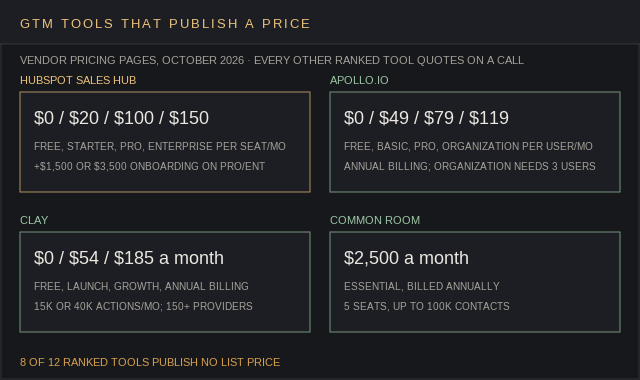
Total cost of ownership for GTM software runs higher than the seat price. HubSpot charges $1,500 or $3,500 in required onboarding, LeanData bills setup separately, and Gong adds a platform fee. Implementation and training time add a cost no invoice shows: one HockeyStack buyer above spent 4 months in onboarding before cancelling.
Three costs sit outside the seat price on this list: HubSpot's $1,500 or $3,500 onboarding fee, LeanData's separately billed setup, and Gong's platform fee. Ask for each one in writing before the order form.
Credits are the other hidden line in GTM tools pricing. Apollo's credits don't roll over, Clay meters actions and data credits separately, and Outreach meters AI credits per tier. Model a full month of real usage before you sign, or the credit bill can cost an arm and a leg. The intent data pricing report and the revenue intelligence pricing report cover two of the pricier categories.
How to evaluate GTM tools before you buy
Five checks catch most bad buys and nip the expensive mistakes in the bud. Run them in order; each takes a day or less.
- Map workflows before comparing features. Write down the GTM workflow from first signal to closed deal, and mark which step breaks today. A go to market plan with named owners per stage turns into a GTM workflow you can test each tool against. Identify the specific problem first, then shop for the tool that fixes that step.
- Check data quality and coverage. Export 50 accounts you already know well and ask each vendor to enrich them in a trial. Count correct emails, direct dials and job titles. Bad contact data weakens every downstream workflow, and AI-powered features inherit the errors.
- Test the CRM integration. Confirm two-way sync with your CRM, the objects it writes, and how it handles a CRM stage change. A GTM tool that doesn't keep CRM data consistent creates the duplicates it was bought to remove.
- Prioritize intent signals you'll act on. Pick three buying signals your reps will work this quarter, and score them at the buying group level. Teams that buy intent data and turn on every topic at once end up in analysis paralysis with a dashboard nobody reads.
- Price the total cost of ownership. Add onboarding fees, platform fees, credit overages, implementation hours and training time to the seat price. Compare that figure to the Vendr median before the renewal clause gets signed.
Evaluate how each tool fits your existing tools and tech stack before anything else. A tool that needs a data warehouse your data team doesn't run, or a CRM you don't use, is the wrong tool at any price.
AI GTM tools: what the AI capabilities do
Every vendor on this list now sells AI GTM features, and they fall into three groups. AI agents run automated workflows across multi-step workflows: Clay's Claygent does account research, Gong Agents update the CRM after calls, and HubSpot's prospecting agent drafts outreach. AI assistants answer questions inside the app. Predictive models, like 6sense's predictive analytics, score accounts and build a predictive pipeline view.
ZoomInfo's GTM.AI goes further and sells the data layer to outside AI agents over MCP. It claims a 24x token-efficiency gain on its own 10-task GTM Bench against a model using web search alone; that's a vendor benchmark, and talk is cheap, so run your own.
GTM.AI gives away 1,000 data credits and 1,000 AI credits. Spend them on 10 of your own account research tasks and count the tokens before the 24x vendor figure goes into a business case.
The ai capabilities in AI GTM tools only work on a clean data foundation. An agent that writes to CRM records from stale contact data writes stale data faster. Manual research shrinks to a review: the AI drafts, and a rep still checks the account before the call.
Speed to lead is where AI GTM tools earn their keep for revenue teams. Clay quotes ElevenLabs at under 5 minutes from form fill to response; Apollo and HubSpot route and book inbound meetings automatically. Measure your current response time before buying, because the improvement is the business case.
GTM as Google Tag Manager: the other meaning of the acronym
GTM is also the standard abbreviation for Google Tag Manager, a free tag management system unrelated to go-to-market. Google describes it as a way to control all of your tags from a web user interface, with a data layer that holds page values for tags, triggers and variables.
The working practices go by the book. Use a strict naming convention for tags, triggers and variables. Read values from the data layer in place of scraping page elements. Test every change in Preview mode before publishing, and set container permissions to one of five levels: No access, Read, Edit, Approve and Publish.
Document each version and audit tags on a schedule. Server-side tagging moves tags off the site to a server for large sites, which helps performance and data governance.
GTM tools FAQ
What is a GTM tool?
A GTM tool is GTM software that executes part of a go-to-market strategy: finding buyers, reaching them, or closing and measuring deals. Data enrichment, sales engagement and conversation intelligence are the most common types.
What are GTM platforms?
GTM platforms are vendors that sell three or more GTM jobs on one contract. On this list, nine of the 12 qualify.
What is a GTM platform?
A GTM platform covers several GTM jobs on one record. HubSpot covers 7 of 8 and Apollo 6; a GTM intelligence platform like ZoomInfo or Demandbase centers on data and intent.
Is Salesforce a GTM tool?
Yes. Salesforce is a CRM, the system of record most GTM tools sync to. Outreach, LeanData and Gong all write back to it. Sales Cloud on its own covers one of the eight jobs, pipeline, so it sits outside this ranking; the sales engagement pricing report lists its seat prices.
Is GTM a CRM?
No. GTM is the strategy; a CRM is one tool in the GTM stack. HubSpot is the only tool on this list that is both.
What is the best GTM tool?
HubSpot is the best GTM tool for most companies under 200 reps, with 7 of 8 jobs and public prices. Apollo is the best GTM tool for budget outbound at a $19,000 Vendr median.
Who owns go-to-market?
Usually the CRO or the CMO, with RevOps running the GTM stack. Sales leaders own the outcome; RevOps owns the tools and the data.
What does GTM stand for?
Go to market. In tracking contexts it also stands for Google Tag Manager.
How many GTM tools is too many?
When two tools write the same field to the CRM. Most revenue teams run one platform plus two or three point solutions; past that, other GTM tools mostly add sync jobs.
Bottom line
Of the 12 GTM platforms ranked, HubSpot wins for companies that want one record and a public price: 7 of 8 jobs from $0 a seat. Apollo wins for outbound sales teams on a budget at a $19,000 median. ZoomInfo is the pick when phone coverage decides deals.
Salesloft, Outreach and Gong compete for the sales engagement and call-recording budget; Salesloft's Clari merger gives it the widest coverage of the three. 6sense and Demandbase serve account-based teams with a $60,000-plus budget. Clay is the builder's choice for enrichment, a jack of all trades for ops teams who can write formulas.
Common Room, LeanData and HockeyStack are the narrowest GTM tools here, and each fixes one job well. Buy them when that job is the one breaking, and plan the rest of the go to market stack around it with the GTM plan template.