Predictive sales analytics software: 10 tools ranked for 2026
 By Jan Suski. I go deep on every review, checking every number against its source and digging up details other coverage misses, a habit from six years of SEO and link building for tech companies. Bylines at Surfer, Brand24, and Senuto. How the scoring works.
· Prefer this source on Google
Quick comparison of predictive sales analytics tools
Ten predictive sales analytics tools in ranked order, with the prediction types each ships, its published training minimum, the entry price and the buyer each fits. Prediction types counted: lead or account score, deal win probability, revenue forecast, churn or propensity.
| # | Provider | Predictions shipped (of 4) | Published training minimum | Entry price | Best fit |
|---|---|---|---|---|---|
| 1 | Microsoft Dynamics 365 Sales | 3: lead, opportunity, forecast | 40 won + 40 lost | $105/user/mo (Enterprise) | Microsoft shops with three months of closed deals |
| 2 | Salesforce Sales Cloud (Einstein) | 3: lead, opportunity, forecast | 200 won + 200 lost in 24 months | $195/user/mo (Core) | Salesforce orgs with two years of history |
| 3 | Zoho CRM (Zia) | 3: lead, deal, churn | 200 records, 75 per outcome | $23/user/mo (Professional) | Teams under 50 sellers |
| 4 | HubSpot Sales Hub | 2: lead, deal | 50 contacts, 25 per outcome | $90/seat/mo + $1,500 onboarding | HubSpot teams wanting reasons on deal scores |
| 5 | Aviso | 2: deal, forecast | Unpublished | $73,662 median* | Forecast-led enterprise teams |
| 6 | Gong | 2: deal, forecast | Unpublished | $55,346 median* | Teams already recording calls in Gong |
| 7 | Clari (Salesloft) | 2: forecast, deal risk | Unpublished | $76,000 median* | Enterprise forecast roll-ups |
| 8 | Pecan AI | 2: lead, churn and propensity | Unpublished | Quote, annual billing | Churn and lifetime value models |
| 9 | 6sense | 1: account score | Set with 6sense consultants | $62,440 median* | ABM teams scoring accounts |
| 10 | Forecastio | 1: forecast | Unpublished | $249/mo for 2 seats | HubSpot teams under 20 sellers |
Medians marked * are anonymized buyer-reported contract values published by Vendr. Everything else is the list price the vendor publishes itself, billed annually; all figures checked 4 October 2026.
Where these figures come from
Training minimums are each vendor's own documented floor: Microsoft Learn for Dynamics 365, Salesforce Help for Einstein, Zoho's help center for Zia and HubSpot's knowledge base for AI lead scores. Prediction types count only what the product documentation describes. Medians marked * are Vendr's anonymized buyer data. Aviso, Gong, Clari, Pecan and Forecastio publish no training minimum, 6sense sets its threshold on a consultant call, and Pecan publishes no price.
Gong ranks #1, Clari #2 and Aviso #6 on our revenue intelligence software ranking, which scores call recording and coaching alongside the forecast. Gong and 6sense rank #2 and #4 on the sales intelligence ranking, built around contact and account data. Inventory forecasts sit on the demand forecasting software ranking. This page scores the sales predictions alone.
Predictive sales analytics reads the historical data in a CRM and turns it into four outputs: a lead score, a win probability on each open deal, a revenue forecast and a churn or upsell flag on current accounts. The engines are machine learning classifiers and time-series models trained on your own closed deals. Microsoft's documentation shows how small that training set can be: 40 won and 40 lost opportunities.
This page ranks ten predictive sales analytics tools on five tests a buyer can run before booking a demo. Four are CRMs with scoring built in (Dynamics 365, Salesforce, Zoho, HubSpot), three are forecasting platforms (Aviso, Gong, Clari) and three are specialists for churn models, account scores and HubSpot forecasts.
It's written for sales leaders, sales operations and RevOps managers deciding where their first predictive models should live. Call recording and coaching bundles get their own treatment on our revenue intelligence software ranking. Here, only the predictions count.
The timing argument is a forecasting one. Gong's blog cites a Harvard Business Review Analytic Services survey in which less than one quarter of executives think their forecasting methods predict sales accurately. Every CRM on this list now ships a scoring model inside a published tier, so the open question is which data floor your CRM clears.
In Gong's own research, 27% of executives think their forecasting methods predict sales accurately, against 63% who call forecasting critical to success.
Evaluation criteria for predictive sales analytics tools
Five criteria decide the shortlist, and the ranking below applies them in this order. Each one returns a yes, a no or a number from the vendor's own pages, so a buyer can rerun the test in an afternoon.
A published training-data minimum
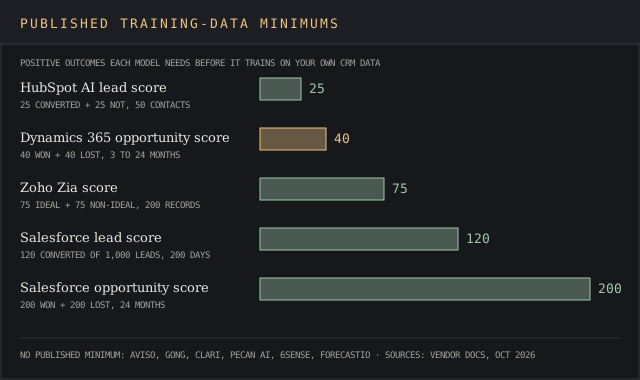
Predictive models learn from historical data on closed outcomes, and the vendor should say how many it needs. Pull the count from the documentation and compare it with your CRM's last 24 months. Dynamics asks for 40 won and 40 lost deals, Salesforce asks for 200 of each, and a vendor that sets the bar on a consultant call fails the test.
Prediction types shipped, out of four
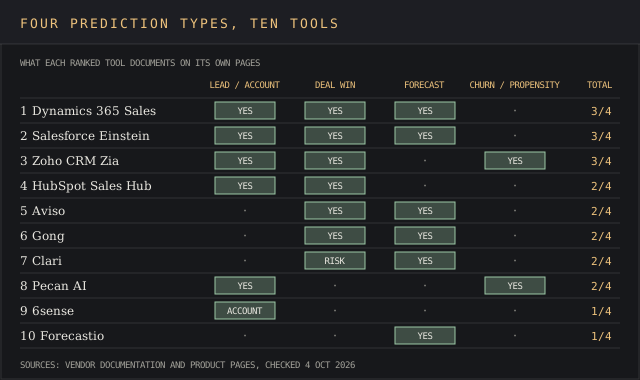
The four types are a lead or account score, a deal win probability, a revenue forecast and a churn or propensity score on existing customers. Count only what the product documentation describes. Predictive analytics tools that score three of four types replace more spreadsheets than one scoring a single type.
A named reason behind every score
A score with no reasons gets ignored by sales reps within a quarter. Dynamics shows the top five positive and negative reasons, HubSpot shows the top five factors and Zia shows a scorecard.
Open one scored record and check that the factors are listed.
A price on record
A list price per seat, or a Vendr median built from anonymised buyer data with its purchase count. A demo form alone fails.
An accuracy figure with a method or a sample
Forecast accuracy measures how closely predicted sales match actual results. The claim passes when it names the sample, the period or the metric. Dynamics grades every model on your own history with accuracy, recall, AUC and F1, and Aviso once named its sample. A 98% headline with no sample behind it is talk, and talk is cheap.
The 10 best predictive sales analytics tools, ranked
Microsoft Dynamics 365 Sales
Best fit
Microsoft 365 organisations with at least three months of closed deals that want lead scores, opportunity scores and a forecast on one published price list.
Dynamics 365 Sales trains its predictive lead scoring model once your org has created and closed 40 qualified and 40 disqualified leads inside a window you choose, from three months to two years. Opportunity scoring uses the same 40-and-40 floor, and a per-stage model weighs each attribute at each step of the sales process, which Dynamics calls the business process flow. Both models retrain every 15 days when automatic retraining is on.
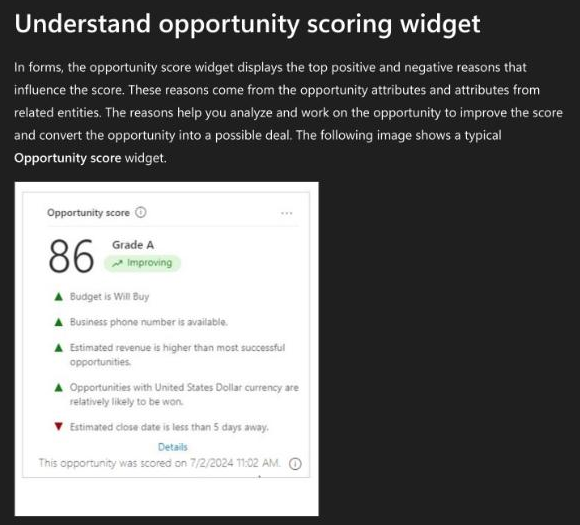
Every score lands on a 0 to 100 scale with an A to D grade, a trend arrow and the top five positive and negative reasons. The model's Performance tab grades it against your own history with accuracy, recall, AUC, F1 and a confusion matrix, the closest thing to an audit trail in this category.
Key features
- Predictive lead scoring and predictive opportunity scoring, 1,500 scored records a month on Sales Enterprise
- Per-stage opportunity models that weight attributes at each business process flow stage
- Premium forecasting that needs more than 10 closed opportunities with actual and estimated values
- Model Performance tab with accuracy, recall, AUC, F1 and a confusion matrix
- 1,000 Copilot Credits and Sales Insights bundled with Sales Premium
Pricing
Sales Professional costs $65, Sales Enterprise $105 and Sales Premium $150 per user per month, paid yearly. Enterprise unlocks scoring through quick setup with the 1,500-record monthly cap; Premium adds Sales Insights and the Copilot credits. Premium forecasting isn't offered in GCC tenants, France or India. On a Microsoft stack, that's the shortest route to all three predictive sales analytics outputs.
Pros
- Lowest published floor for opportunity scoring at 40 won and 40 lost deals
- Accuracy, AUC and F1 shown on your own data before anyone trusts a score
- Every predictive tier carries a list price, topping out at $150
Cons
- Sales Enterprise caps scoring at 1,500 records a month
- Premium forecasting is blocked in France, India and GCC tenants
- Three tiers plus Copilot add-ons turn licensing into homework
That last con is the recurring one. A small-business owner rating Dynamics 2.5 of 5 on G2 on 6 October 2025 summed the tiers up as "Licensing is powerful but confusing". A mid-market business development executive on G2 described the payoff on 6 May 2026:
"You can create opportunities within it, and as you move through each step, it indicates the likelihood of closing and winning the deal."
Business development executive, mid-market, G2, 6 May 2026, rating 4.5 of 5
Why it’s ranked #1. Dynamics beats Salesforce on criterion one: its opportunity model trains on 40 won and 40 lost deals, a fifth of Salesforce's 200-and-200 floor, and every predictive tier carries a list price that tops out at $150.
Salesforce Sales Cloud with Einstein
Best fit
Salesforce orgs with two years of opportunity history and enough volume to clear 200 won and 200 lost deals.
Einstein Opportunity Scoring gives each open deal a score from 1 to 99 and lists the factors pushing it up or down. To build a model on your own data, Salesforce wants at least 200 closed-won and 200 closed-lost opportunities in the last 24 months, each open for at least 2 days.
Below that line Einstein falls back to a global model trained on anonymous data from many Salesforce customers. For a small org, beggars can't be choosers: the score arrives on day one, built from other companies' deals.
Einstein's other models carry their own thresholds:
- Einstein Lead Scoring asks for 1,000 leads created in the last 200 days, with at least 120 converted.
- Einstein Forecasting needs 12 months of opportunity use and an Amount on 80% of open opportunities.
- Trailhead says the model refreshes weekly and posts new insights several times a day.
For predictive sales analytics on a Salesforce org, those three thresholds are the whole checklist.
Key features
- Einstein Opportunity Scoring in three bands: High 67 to 99, Med 34 to 66, Low 1 to 33
- Einstein Lead Scoring with a separate model per lead segment
- Einstein Forecasting on the User Role forecast type; territory forecasts aren't supported
- Global model fallback for orgs below the data floor
- Deal insights that read activities, synced email and calendar data
Pricing
Starter Suite costs $25, Pro Suite $100, Core $195, Advanced $395 and Max $550 per user per month, billed annually, and AI is added to Core and above through a sales rep. The help documentation lists Opportunity Scoring as available "with or without a Sales Cloud Einstein license", while Lead Scoring costs extra on Enterprise Edition.
Vendr's anonymised buyer data puts the median Salesforce contract at $77,376 a year across 2,555 purchases, from $13,200 to $249,631.
Pros
- Three prediction types, each with a documented data requirement
- The global model scores deals from day one
- Score bands and factors show in list views as well as on records
Cons
- The 200-and-200 floor is five times what Dynamics asks
- AI on Core and above is priced by a rep, with no list price for scoring add-ons
- Forecasting skips territory forecasts
- A $77,376 median contract
"Many features are add-ons from Salesforce or third party partners, so your investment will probably go up over time and the complexity of administration/maintenance will go up too."
Chief executive officer, small business, G2, 14 September 2023, rating 5 of 5
A mid-market sales executive rating Sales Cloud 3 of 5 on G2 on 9 June 2026 put the scoring payoff in one line: "The AI-powered recommendations help sales reps prioritize opportunities and focus on high-value activities."
Why it’s ranked #2. Salesforce beats Zoho with a global model that scores deals below its 200-deal floor and a forecast built on 12 months of history. It loses to Dynamics, whose 40-deal floor and $150 top list price are both lower.
Zoho CRM with Zia
Best fit
Small and mid-size sales teams that want lead, deal and churn predictions for less than $50 a seat.
Zoho's pricing page says Professional predicts the likelihood of a lead converting, a deal closing or a customer churning. Zia needs a minimum of 200 records to start scoring and 75 records each for ideal and non-ideal outcomes. It returns a score out of 100 with a scorecard of positive and negative factors, and the first scores take anywhere from a few minutes to 24 hours.
Enterprise adds Prediction Builder, capped at 2 prediction models per org, and Ultimate raises the cap to 20. That's where custom predictions for renewals or upsell timing live, and it makes Zoho the predictive sales analytics solution with the lowest list price that covers churn.
Key features
- Zia scores in three bands: 0 to 50, 51 to 75 and 76 to 100
- Prediction Builder: 2 models per org on Enterprise, 20 on Ultimate
- Scoring rules: 25 per module on Enterprise, 40 on Ultimate
- Anomaly detectors on 10 trends in Enterprise, 20 in Ultimate
- Daily QuickML calls on Ultimate for custom models
Pricing
Standard costs $14, Professional $23, Enterprise $40 and Ultimate $52 per user per month, billed annually, and a free edition covers 3 users. Twenty sellers on Professional cost $5,520 a year, a drop in the bucket next to Aviso's $73,662 Vendr median.
Pros
- Three prediction types, churn included, at the lowest list price on this page
- Documented minimums of 200 records and 75 per outcome
- A factor scorecard on every Zia score
Cons
- Prediction Builder stops at 2 models on Enterprise
- Zia's documentation lists 3 score bands and 0 accuracy metrics
- First scores can take 24 hours to appear
"The AI features feel limited in depth, and I've run into integration bugs."
Business growth partner, computer software, small business, G2, 2 April 2026
A mid-market reviewer on G2 in October 2023 listed what Zia added: "AI capabilities with Zia. Enhanced lead prediction, automation suggestion, email suggestions and sales forecasting tools."
Why it’s ranked #3. Zoho ships three prediction types, churn included, at $23 a seat, which beats HubSpot's two types on a $90 seat. It loses to Salesforce, whose global model scores orgs below the 200-record floor Zoho enforces.
HubSpot Sales Hub
Best fit
HubSpot teams that want a deal score with its reasons attached, plus marketing teams already paying for Marketing Hub Enterprise.
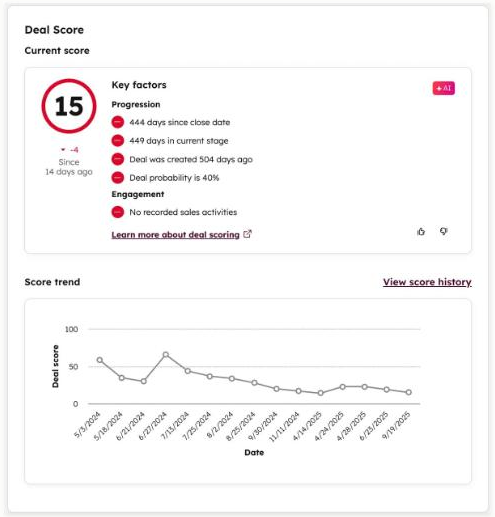
Deal scores in HubSpot run 0 to 100, each point a percentage probability of closing, and show the top five factors with plus and minus markers. Sales Hub Professional or Enterprise is required. New deals get a first score within about 36 hours, updates take up to 6 hours, and closed deals stop scoring.
HubSpot splits predictive sales analytics across two hubs, and predictive lead scoring lives in the marketing one. AI lead scores need Marketing Hub Enterprise and a sample of at least 50 contacts, 25 converted and 25 non-converted, the smallest published floor on this page.
Marketing Hub Enterprise starts at $3,600 a month with 5 core seats and a $7,000 onboarding fee, which costs an arm and a leg for a team that only wanted lead scores.
Key features
- Deal scores from 0 to 100 with the top five factors marked plus or minus
- AI lead scores trained on a 50-contact sample in Marketing Hub Enterprise
- Up to 5 lead scores on Sales Hub Professional and 10 on Enterprise
- Forecasting across team hierarchies on Sales Hub Enterprise
- A deal score history panel showing each past score
Pricing
Sales Hub Professional costs $90 per seat per month on annual billing with a $1,500 onboarding fee; Enterprise costs $150 a seat with $3,500 onboarding. Twenty Professional seats run $21,600 a year, plus the fee.
Pros
- Five named factors on every deal score
- The smallest published training sample in the category at 25 and 25
- Published seat prices and onboarding fees
Cons
- AI lead scoring sits behind a $3,600-a-month marketing tier
- Reopened deals get no score, so reps must create a new deal
- A first score takes up to 36 hours
"The main package includes only a few sales seats, and each additional seat is expensive."
North America regional manager, small business, G2, 27 July 2026
A mid-market sales development lead described the visibility side:
"The pipeline view gives us and leadership a clear picture of where every deal stands, which makes forecasting and prioritizing much easier."
Sales development lead, mid-market, G2, 23 September 2026
Why it’s ranked #4. HubSpot publishes a 50-contact training floor and $90 list price, which beats Aviso's unpublished floor and quote-only price. It loses to Zoho, which adds churn prediction as a third type for $23 a seat.
Aviso
Best fit
Forecast-led enterprise sales organisations that want a win score on each deal and an accuracy record with a stated sample.
Aviso is the one vendor here that published deal-prediction accuracy with a sample attached. A 19 December 2018 release reported WinScores averaging 92% accuracy across hundreds of thousands of deals in Q3, and 91% day-one forecast accuracy across its customer base.
In the same release Dell EMC said Aviso hit 99.8% in its first quarter, while its internal team ran in the high 80s.
Read between the lines of the current homepage: it claims 98%+ accurate forecasts and 450+ revenue teams, with no sample beside the 98%. Its Time Series AI Engine reads every change in omnichannel data over your past eight quarters. Aviso also ranks #6 on our revenue intelligence ranking, which scores its full predictive sales analytics and conversation bundle.
Key features
- WinScore, a win probability on every open deal
- Time Series AI Engine over eight quarters of history
- Revenue forecasting, pipeline inspection and deal acceleration modules
- Conversation intelligence and relationship intelligence add-ons
- Homepage customer results: 12% win rate improvement, 23% shorter sales cycle time
Pricing
Aviso sells by quote, and its pricing page offers a tailored proposal. Vendr's anonymised buyer data shows a $73,662 annual median, from $24,035 to $85,310, with no purchase count in the header.
Pros
- A sampled accuracy figure: 92% across hundreds of thousands of deals
- Deal-level win scores and a forecast from one model layer
- Vendr's range spans 3.5x, a tight spread for an enterprise contract
Cons
- The sampled accuracy evidence dates to 2018
- Advertised integrations turn into custom API builds for some buyers
- Implementation has overrun a quoted six weeks by months
- The only stated data requirement is the eight-quarter lookback window
"Despite various integrations mentioned on the Aviso website, most turn out to be custom API builds with no native functionality."
Verified user in computer software, mid-market, G2, 29 July 2026, rating 0 of 5
The same reviewer added:
"We were touted a 6 week implementation during the sales cycle which has overrun by months, and was farcical to begin with."
Same verified user, G2, 29 July 2026
On the positive side, an enterprise senior sales operations analyst wrote:
"I like the forecast tab because it helps me move from Excel models to a better AI-integrated source."
Senior sales operations analyst, enterprise, G2, 11 May 2026
Why it’s ranked #5. Aviso's 92% WinScore accuracy across hundreds of thousands of deals is the only sampled claim here, which beats Gong's unsampled 20% figure. It loses to HubSpot, which publishes a 50-contact floor and a $90 list price.
Gong
Best fit
Revenue teams already recording calls in Gong that want deal predictions trained on conversation signals.
Gong's predictive sales analytics start from recorded conversations: Gong Forecast predicts deal outcomes from 300+ signals and claims 20% more precision than algorithms built on CRM data alone, with Upwork quoted at 95% forecast accuracy. Our Gong review covers call recording in full.
Gong's blog says its predictive analytics can increase win rates by 35%, citing Gong Labs data, says Gong Forecast can predict pipeline outcomes with up to 90% accuracy, and quotes Piano's revenue operations VP at that figure.
Unsampled accuracy claims are par for the course in this category. Our conversation intelligence software ranking compares the recording tools that feed models like this one.
Key features
- Deal outcome predictions built from 300+ signals
- Forecast boards with snapshot reporting
- The Revenue AI OS joining calls, email and CRM activity
- Customer accuracy claims named: Upwork at 95%, Piano at 90%
Pricing
Vendr's anonymised buyer data puts the Gong median at $55,346 a year across 1,144 purchases, from $11,491 to $203,767, the largest sample of any tool here. Our revenue intelligence pricing report breaks down the platform fee and seat lines.
Pros
- 300+ signals per deal, many from recorded calls
- The largest Vendr sample in this ranking at 1,144 purchases
- Named customer accuracy figures
Cons
- The 20% precision claim names no sample or period
- The model's edge depends on Gong recording your calls
- A $55,346 median puts it out of reach for teams under 20 sellers
"Predictive forecasting, revenue operations cadence, and nonengaged accounts didn't work well for me."
Manager, operations, small business, G2, 11 September 2026
A mid-market senior revenue operations manager wrote:
"I also really appreciate Gong's forecast snapshot reporting, which lets me dig in and more closely analyze our forecast accuracy."
Senior revenue operations manager, mid-market, G2, 30 September 2026
Why it’s ranked #6. Gong's 300-signal deal model sits on a $55,346 median across 1,144 purchases, $20,654 below Clari's. It loses to Aviso, whose 92% accuracy figure names its sample.
Clari
Best fit
Enterprise RevOps teams that roll a forecast up a deep hierarchy and already budget near Clari's median.
Clari now sells under Salesloft: the merger completed on 3 December 2025, and the merged company claims 10 billion revenue interactions, 1 trillion data signals and 4,000+ customer organisations.
Clari Labs' March 2025 benchmark analysed 10 million opportunities and found the top 2% of sellers drive 37% of revenue.
Clari's predictive sales analytics now ship as the AI Forecast Agent, which grounds each forecast in historical deal data and live rep activity, and flags slipping deals and stalled buying activity early. The jury's still out on how that forecast roadmap changes under one merged product line.
Key features
- AI Forecast Agent reading historical deals and current rep activity
- Early risk detection on slipping deals
- Pipeline filters by bookings, renewals, region, segment and period
- Plain-language questions answered without a RevOps ticket
Pricing
Vendr's anonymised buyer data shows a $76,000 median across 291 purchases, from $19,065 to $415,001, last updated February 2026. That's the highest median in this ranking.
Pros
- A 10 million-opportunity benchmark dataset behind the models
- Forecast and deal risk in one view
- Engagement and forecasting on one contract after the merger
Cons
- The highest median here at $76,000
- CRM changes take up to 20 minutes to appear, per a TrustRadius reviewer
- The forecasting page carries 3 analyst and review badges and 0 accuracy figures
"the analytics tools most of the time are hard to trust, as well as the Clari score."
Contributor in sales, marketing and advertising, 1,001 to 5,000 employees, TrustRadius, 23 October 2025, rating 6 of 10
A sales director at a 501 to 1,000 employee hospitality company rated Clari 10 of 10 two days earlier on TrustRadius: "Forecast accuracy was a prior problem and now we track 5% to forecast each quarter."
Why it’s ranked #7. Clari's 10 million-opportunity benchmark and a median on 291 purchases beat Pecan, which has no price on record. It loses to Gong, whose $55,346 median is $20,654 lower.
Pecan AI
Best fit
Data and RevOps teams that need churn, customer lifetime value and upsell models from warehouse data without hiring data scientists.
Pecan builds churn, lifetime value, lead scoring, upsell and cross-sell, winback and demand forecasting models, and says most teams deploy a first model in under a day, so a data team can hit the ground running.
It connects to Salesforce, HubSpot, Snowflake, BigQuery, Databricks, Redshift and 15+ other sources. The homepage claims a 28% average reduction in customer churn, a vendor figure with no sample beside it. Pecan extends predictive sales analytics past the pipeline to existing customers and their customer lifetime value.
Key features
- Churn, lifetime value, upsell, winback and lead scoring models
- Connectors for Salesforce, HubSpot, Snowflake, BigQuery and Databricks
- Predictions written back into the CRM
- Starter at 2 prediction batches a month and 500M rows of storage
Pricing
The pricing page lists Starter (2 monthly prediction batches, 500M rows), Team (10 batches, 2Bn rows) and Business (custom batches, 5Bn rows), annual billing only, no setup fee and prices through sales. G2 lists 44 reviews averaging 4.7.
Pros
- The only tool here built around churn and lifetime value models
- Warehouse connectors, so the model reads product usage alongside CRM data
- A $0 setup fee
Cons
- Prices come only from a sales call
- Starter caps predictions at 2 batches a month
- Reviewers report setup that still needs vendor help
"Not fully self service yet, getting the predictive question right takes a few iterations"
Verified user, computer software, enterprise, G2, 6 August 2026
A small-business data and automation analyst described the sales use on G2 on 20 April 2026: "Pecan helps us identify high-value customers so our sales team can prioritize personalized outreach".
Why it’s ranked #8. Pecan covers churn and propensity, a type 6sense lacks, starting at 2 prediction batches a month. It loses to Clari, which carries a $76,000 Vendr median where Pecan has no price on record.
6sense
Best fit
Account-based marketing and sales teams scoring a large target list by fit and buying stage.
6sense applies predictive sales analytics at the account level and runs six model types: Account Profile Fit, Contact Profile Fit, Intent, Contact Reach, Account Reach and Persona Importance. Our 6sense review walks through the four buying stages it assigns, from awareness to purchase.
Setup runs through 6sense consultants, who check that your relevant opportunity definition yields enough closed-won deals without publishing the number. Unpublished thresholds are a red flag for a buyer who wants to check the model before signing.
Key features
- Six predictive model types, from account fit to persona importance
- Buying stage per account: awareness, consideration, decision, purchase
- A Predictive Model Insights report plus 6QA Analytics and 6QA Trends
- Intent data feeding the account scores, compared on our intent data providers ranking
Pricing
Vendr's anonymised buyer data puts the median 6sense contract at $62,440 across 385 purchases, from $11,376 to $176,809. The free Sales Intelligence plan ended on 12 August 2026. Our 6sense pricing report covers the credit model.
Pros
- Six documented model types
- A model insights report for checking what drives account scores
- A Vendr median on 385 purchases
Cons
- Account scores only, with no deal win probability or forecast
- Training thresholds set by consultants and unpublished
- Reviewers describe the scoring as a black box
"Lead Analysis, Predictive Scoring, and Lead Scoring are frustrating because the algorithms feel like a 'black box.'"
Analyst, mid-market, G2, 16 September 2026
An enterprise performance marketing specialist wrote:
"The data takes time to trust. Early on you second-guess the intent scores because you don't know if the signal is real or noise."
Performance marketing specialist, enterprise, G2, 24 July 2026
Why it’s ranked #9. 6sense documents six model types and a Predictive Model Insights report, which beats Forecastio's single forecast with no method. It loses to Pecan, which adds churn prediction where 6sense stops at account scores.
Forecastio
Best fit
HubSpot-only sales teams under 20 sellers that want a predictive forecast for $249 a month.
Forecastio is the narrowest predictive sales analytics tool here: one CRM, one output. It's built for HubSpot and sells AI sales forecasting, weighted pipeline forecasting and time-series forecasting on both plans.
Its pricing page claims teams can "reach up to 95% accuracy" with no method beside the number, and offers a one-month free pilot, which puts the ball in your court: pay only after the forecast proves itself. G2 lists 24 reviews averaging 4.5.
Key features
- AI, weighted pipeline and time-series forecasting on both plans
- Pipeline Intelligence and Deal Intelligence on the upper plan
- AI revenue agents for deal review and win-loss analysis
- A one-month pilot paid only after the team confirms value
Pricing
Sales Forecasting costs $249 a month billed annually with 2 seats and $49 per extra seat; Forecasting & Revenue Intelligence costs $369 with 2 seats and $69 per extra seat. Twenty sellers on the first plan cost $13,572 a year.
Pros
- A published price starting at $249 a month
- A one-month free pilot
- Time-series forecasting on HubSpot data with no engineering work
Cons
- HubSpot is the only CRM supported
- One prediction type, the forecast
- The 95% accuracy claim names no method
"If we have a wrong data in our Hubspot, forecasting will be less accurate."
CEO, small business, G2, 13 August 2024
A software associate flagged the price for the smallest teams:
"Pricing might be fair for small to mid-sized businesses but might feel a bit steep for startups."
Software associate, G2, December 2024
Why it’s ranked #10. Forecastio's $249 entry is the cheapest standalone forecast here and its price is public. It loses to 6sense on criterion three, since 6sense documents a model insights report and Forecastio's 95% claim names no method.
What predictive sales analytics does
Four kinds of analytics sit in a sales stack, and only one of them looks forward. Descriptive analytics reports what happened last quarter, diagnostic analytics explains why a segment missed, predictive analytics estimates future outcomes from patterns in historical sales data, and prescriptive analytics recommends the next step. Most sales analytics dashboards stop at the first two.
Advanced analytics used to mean a data science project: data scientists cleaned raw data, wrote the model and handed sales operations a spreadsheet. The ten predictive analytics tools above package advanced statistical models inside a CRM or a forecasting app, so a sales manager can forecast future outcomes and spot future sales trends without a data analytics backlog.
Predictive models use machine learning to find customer behavior patterns that precede a win, a loss or a cancellation, and to anticipate customer needs before the buyer states them. The model reads past deal amounts, stage durations, email and meeting counts, then scores open records against those patterns.
That moves a team from reactive to proactive: sales managers can nip a slipping deal in the bud in week two of a quarter, before the miss shows up in week twelve. The statistical model replaces a rep's gut-feel commit with a number checked against history, which takes the guesswork out of resource allocation.
The cost of guessing is on record. Zoho's guide cites Clari's 2024 Revenue Leak Report: nearly 61% of sales teams missed their revenue targets for 2023, and 71% admitted their forecasts were erroneous.
Predictive sales analytics examples
- Lead scoring: ranks prospects by their likelihood to convert, so sales efforts go to the top decile first, with higher conversion rates from the same headcount as the goal. HubSpot trains its version on as few as 50 contacts.
- Win probability: a 0 to 100 or 1 to 99 score per open deal, the core output of Dynamics, Salesforce and HubSpot deal scores. Forecast models add deal closure timing from estimated close dates.
- Revenue forecasting: time-series models projecting the quarter from pipeline and history, as in Aviso, Gong, Clari and Forecastio.
- Churn prediction: flags existing customers at risk from usage and engagement metrics, the Pecan and Zoho use case.
- Upsell and cross-selling timing: predicts when an account is ready for a second product.
Recommendation engines are the consumer version of the last item. McKinsey reported in October 2013 that 35 percent of what consumers purchase on Amazon comes from product recommendations based on such algorithms. B2B sales teams apply the same logic to personalized offers for accounts that hit a usage milestone.
Who uses predictive sales analytics
Five roles read the scores, and each wants a different output:
- Sales leaders and sales managers: the forecast call, revenue targets, sales strategies and sales planning for the next two quarters.
- Sales operations: territory and quota sales planning, plus resource allocation across segments that convert at different rates.
- Sales reps: a daily call list ordered by win probability, allowing sales teams to work the top-scored deals first.
- Marketing: lead scores synced to the marketing automation platform, so marketing efforts and marketing strategies follow the segments that close.
- Customer success: churn and upsell scores for customer retention and expansion.
Sales management gets the most from the shared view. When marketing, sales and customer success read the same scores, sales strategies change through data-driven decisions: a segment whose win probability falls for two straight months gets less budget before the quarter closes.
Sales strategies built this way respond to market changes and industry trends inside a quarter. The aim of predictive sales analytics here is to boost sales and maximize revenue from pipeline already in the CRM, and to boost revenue from existing customers through renewals and upsells tied to the sales process.
How predictive sales analytics works inside a CRM
The CRM is the training set, and its historical data decides how good the predictive models get. Every vendor on this list reads closed opportunities, lead conversions and activity history from Salesforce, Dynamics, HubSpot or Zoho, so the first purchase decision is the CRM, and the predictive layer follows it. A predictive analytics tool with pre-built connectors to your CRM skips months of manual data entry and pipeline work.
Three data sources feed most sales analytics models:
- Sales data: deal amount, stage history, close dates and win or loss outcomes across the sales pipeline.
- Engagement metrics: emails, calls and meetings logged against each record, which HubSpot's deal score reads directly.
- Product and support data: usage, customer satisfaction scores and feature adoption rates, which churn models such as Pecan read from a warehouse.
Retraining cadence is the next detail to check. Dynamics retrains every 15 days, Salesforce refreshes weekly, and Zoho's first scores take up to 24 hours. A model trained once and left alone drifts as market changes alter customer behavior, so ask how often it retrains and when it last did.
Adoption decides the return. Put the score where sales reps already work, in list views and record pages, so predictions arrive as actionable insights inside daily sales operations, and pair it with a dashboard that sales leaders review weekly, so reps and leadership stay on the same page about pipeline health.
Bring two or three reps into the pilot early so the reasons behind each score get tested against what they hear on calls; a model the team distrusts gets ignored, and the 6sense reviewers above describe that distrust in their own words.
Key metrics for judging predictive sales analytics
Five key metrics show if the sales analytics model earns its seat price. Track them as key performance indicators for the first two quarters after rollout:
- Forecast accuracy: the forecast divided by actual bookings, quarter by quarter. One Clari customer on TrustRadius reported tracking within 5% of forecast, a usable bar for sales forecasting accuracy.
- Win rate by score band: deals in the top band should win at a multiple of the bottom band. If they don't, the scores aren't accurate predictions.
- Sales cycle length: days from creation to close for scored deals against the prior year.
- Pipeline coverage: sales pipeline value divided by the quarter's target.
- Customer retention rates: renewal rates for accounts flagged at risk against accounts that weren't.
Judge on all five; a team that watches forecast accuracy alone puts all its eggs in one basket. Compare each metric with the sales figures from the year before rollout. More accurate sales forecasts are the first payoff to check. Win rate moves later, because the work to improve sales performance runs through a full sales cycle.
A model that made accurate predictions on last year's deals and misses this quarter has drifted, so retrain it before the next forecast call.
Reasons attached to each score turn it into actionable insights a rep can use on the next call. Over two quarters those insights become data-driven decisions about which segments get headcount, and the business outcomes show up in the sales performance numbers above.
Pricing across predictive sales analytics tools
List prices make the CRM-native sales analytics tools easy to compare, so we priced one scenario: 20 sellers for one year at annual billing.
- Zoho Professional: $5,520
- Forecastio Sales Forecasting: $13,572
- HubSpot Sales Hub Professional: $23,100, including the $1,500 onboarding fee
- Dynamics Sales Enterprise: $25,200
- Dynamics Sales Premium: $36,000
- Salesforce Core: $46,800 before any AI add-on
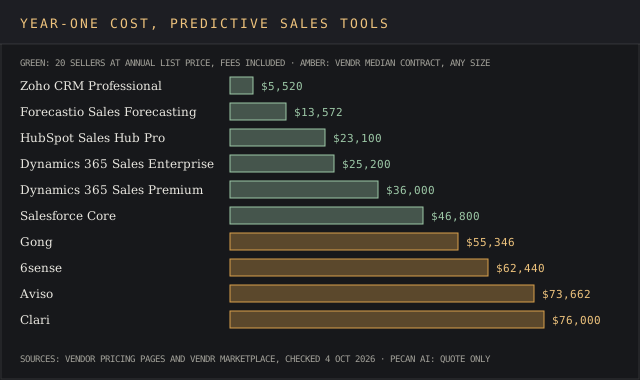
The forecasting platforms price by quote, and Vendr's medians are the only public markers: Gong at $55,346, 6sense at $62,440, Aviso at $73,662 and Clari at $76,000 a year. Those medians cover whole contracts of varying seat counts, so treat them as a budget range and expect the final quote to land anywhere inside Vendr's low-to-high spread.
The hidden costs sit in four places:
- Onboarding fees: $1,500 and $3,500 on HubSpot Sales Hub, $7,000 on Marketing Hub Enterprise.
- Record caps: 1,500 scored records a month on Dynamics Sales Enterprise.
- Add-on AI: Salesforce sells AI, its predictive analytics included, on Core and above through a rep, and Einstein Lead Scoring costs extra on Enterprise Edition.
- Batch limits: 2 prediction batches a month on Pecan Starter.
Our CRM software cost report covers seat prices across ten CRMs, and the devil's in the details there too: free tiers stop at 2 or 3 users.
Predictive pricing, discounts and customer churn prevention
Sales teams use the same models outside the pipeline. Vendavo's glossary describes using historical transaction data to set optimized price points and identify the discount level that wins a deal without eroding margin. That's the territory of price optimization tools such as Pricefx, compared on our pricing intelligence tools ranking.
Predictive analytics turns customer retention into a ranked call list. A churn score combines customer behavior signals such as usage drops, support tickets, customer satisfaction and engagement into one number, so customer success managers call the riskiest existing customers first. Zoho's guide lists the early warning signs: waning interest, poor product usage, low trust and negative interactions with the brand.
Customer lifetime value models do the reverse job. They pick the accounts worth an upsell call and the timing for it, which keeps sales efforts on the accounts with room to grow. A model that ranks both churn risk and upsell readiness kills two birds with one stone. Pecan is the only ranked tool built around both models; for a full customer data layer underneath them, see our customer data intelligence ranking.
How to run a predictive analytics trial
A two-week predictive analytics trial answers most of the questions a demo dodges. Run these five steps against your own CRM:
- Count your closed deals. Pull won and lost opportunities for the last 24 months and compare them with each vendor's floor: 40 and 40 for Dynamics, 200 and 200 for Salesforce.
- Backtest one quarter. Score last quarter's deals from historical data as they stood on day one, then compare the scores with what closed.
- Read the reasons. Open ten scored deals with a sales manager and check that the listed factors match what the reps know about each stage of the sales process.
- Measure forecast accuracy. Divide the forecast by actual bookings for each of the last four quarters and track the gap.
- Price the full year. Add onboarding, record caps and AI add-ons to the seat price.
Predicted sales come from a weighted pipeline: multiply each open deal's amount by its win probability and add the results.
A $100,000 deal at a 40% score contributes $40,000.
Our win rate calculator sets the baseline the model has to beat, and our win-loss analysis template records why deals closed, which feeds the next retrain.
Three buying mistakes repeat across reviews:
- Teams buy before checking their data floor, then go back to square one when the vendor falls back to a generic model.
- Teams take a vendor's headline accuracy at face value.
- Teams score leads while ignoring existing customers, where churn models protect revenue growth already booked.
Consolidation in predictive sales analytics
Sales analytics vendors are consolidating into larger platforms. HG Insights announced its acquisition of MadKudu, a predictive lead scoring specialist, on 11 August 2025, and madkudu.com/pricing now redirects to the HG Insights homepage. Clari and Salesloft completed their merger on 3 December 2025. 6sense closed its free plan on 12 August 2026.
Buyers of standalone predictive analytics should keep an eye on contract terms that survive an acquisition: data export rights, model ownership and renewal caps. The CRM-native scorers at the top of this ranking carry less of that risk, because the model sits inside a CRM contract the buyer already holds.
For the contact and account data feeding these models, see our sales intelligence tools ranking and the lead intelligence software ranking; demand planners should use the demand forecasting software ranking, which covers inventory management forecasts.
Predictive sales analytics FAQ
What is predictive analytics?
Predictive analytics uses statistical and machine learning models trained on past outcomes to estimate future ones. Predictive sales analytics applies that to CRM records, and the outputs are lead scores, win probabilities, revenue forecasts and churn scores.
What are examples of predictive analytics?
Dynamics 365 scoring each open deal from 0 to 100, Salesforce Einstein flagging deals in its 1 to 33 Low band, Zoho Zia predicting which customers will churn, and Netflix and Amazon recommending products from viewing and purchase history.
How can I calculate my predicted sales?
Multiply each open deal's value by its win probability and sum the results. Ten deals of $50,000 at a 30% average probability project $150,000. Tools that forecast sales this way replace stage-based probabilities with a per-deal score trained on your own history.
Which tool is best for predictive analytics?
For sales teams on Microsoft 365, Dynamics 365 Sales: it trains on 40 won and 40 lost deals and publishes a $150 top tier. Salesforce orgs with 200 of each should use Einstein, and teams under 50 sellers get three prediction types from Zoho at $23 a seat.
Bottom line
Predictive sales analytics pays back when the scores reach the people working the deals. Dynamics 365 Sales wins for any organisation already on Microsoft 365, because its 40-and-40 floor and its model accuracy tab let a team prove the scores on its own data before rolling them out. Salesforce wins for orgs with two years of history, and Zoho wins on price for teams under 50 sellers.
HubSpot suits teams that already run their marketing there. Aviso, Gong and Clari fit enterprises that want a forecast built from conversations and activity and can budget $55,000 to $76,000 a year. Pecan is the pick for churn and lifetime value, 6sense for account scores, and Forecastio for HubSpot teams that only need a forecast.