Customer data intelligence platforms: 10 tools ranked for 2026
 By Jan Suski. I go deep on every review, checking every number against its source and digging up details other coverage misses, a habit from six years of SEO and link building for tech companies. Bylines at Surfer, Brand24, and Senuto. How the scoring works.
· Prefer this source on Google
Quick comparison of customer data intelligence platforms
Ten platforms with the number of our five tests each one passes, the lowest price a buyer can see before a sales call, and the buyer each fits. Rows marked Quote route buyers to a sales call for pricing.
| # | Platform | Tests passed | Entry price | Best fit |
|---|---|---|---|---|
| 1 | Salesforce Data 360 | 5 of 5 | $240 per 1,000 profiles a year | Salesforce CRM customers |
| 2 | Hightouch | 4 of 5 | Free for 2 syncs, $15,000 Vendr median* | Warehouse-first teams |
| 3 | Twilio Segment | 4 of 5 | $0, then $120 a month | Product-led companies |
| 4 | Treasure AI | 4 of 5 | Quote, priced on profiles and events | Global B2C brands |
| 5 | Oracle Unity | 3 of 5 | $400,000 a year minimum (10M profiles at $40 per 1,000) | Oracle CX estates |
| 6 | Microsoft Dynamics 365 | 3 of 5 | $1,700 a month per tenant | Dynamics and Azure shops |
| 7 | Adobe Real-Time CDP | 2 of 5 | Quote, per 1,000 profiles | Adobe shops |
| 8 | Uniphore CDP Agent | 1 of 5 | Quote after a demo | Zero-copy stacks |
| 9 | Amperity | 1 of 5 | Quote, billed in Amps | Retail identity |
| 10 | Medallia | 1 of 5 | $13,338 Vendr median* | Feedback data |
Medians marked * are Vendr's anonymized buyer-reported contract values. Every other price is the vendor's own published list price, and Oracle's row is the smallest order on its 12 June 2025 global price list.
Where these figures come from
Prices, connector counts and identity limits are each vendor's own published figure, read for this ranking in September 2026. The two medians marked * come from Vendr's marketplace pages, Gartner placements from the 2026 Magic Quadrant for CDPs, and review counts from each product's G2 page. Treasure AI, Adobe, Uniphore and Amperity sell by quote, so their rows name the pricing model with no figure.
Hightouch and Twilio Segment also appear on our market and customer segmentation ranking, which Segment leads, and Medallia ranks second on our customer feedback analysis ranking. This page judges the profile layer underneath on price, Gartner placement, identity limits, connectors and review volume.
Customer data intelligence, the data layer of customer intelligence (CI), joins every buyer record into one profile, then acts on it. The ten customer intelligence tools below resolve orders, app events, support tickets and survey scores into one ID and push audiences back to ad, email and customer experience tools.
Unifying it is easier said than done, and Qualtrics' 2026 CX Catalyst research found 74% of organizations rate customer experience a critical priority.
Organizations in the same Qualtrics research that have reached advanced customer experience maturity. The report also cites McKinsey figures of 1.5x revenue growth over three years for users of next-generation customer insights tools, and churn cut by up to 20% where machine learning drives customer intelligence.
This ranking of customer intelligence systems is for data, marketing and customer experience leads who already own a CRM and want a unified view of customer needs on top of it. Audience tools sit in our audience segmentation ranking, and our customer intelligence guide covers the discipline.
Evaluation criteria for customer intelligence systems
Five criteria decide this customer intelligence shortlist, and the ranking below applies them in this order. Each is a pass or fail checkable on a public page. Rank is the pass count, and a tie goes to the tool that passed the earlier criterion. Scoring rules sit on our methodology page.
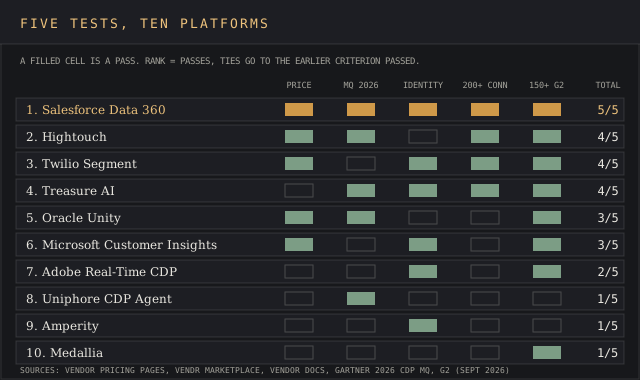
Published pricing or Vendr buyer data
A vendor passes if it lists a price on its own site, or if Vendr's marketplace shows a median built from at least 100 anonymised purchases.
Customer intelligence vendors on this list that fail the pricing test. That's par for the course in enterprise software, and it leaves buyers negotiating blind.
2026 Gartner customer data platform placement
Tools in the Leaders or Challengers box of Gartner's 2026 Magic Quadrant for CDPs pass.
Identity resolution for a unified view
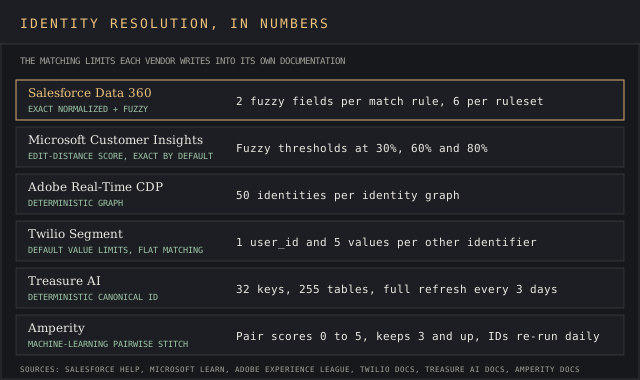
The vendor's documentation has to state a number for its matching: a fuzzy threshold, an identity-graph cap, a key limit or a score scale. Without a stated threshold, a customer intelligence analytics team can't explain why two customers became one profile.
Published connector count for data integration
Pass at 200 or more pre-built sources and destinations, stated by the vendor. The count sets how many systems feed customer intelligence data into a profile.
Review volume as a customer satisfaction check
At least 150 G2 reviews earns a pass. Below that, a rating rests on too few customer intelligence buyers.
The 10 best customer intelligence tools, ranked
Salesforce Data 360
Best fit
Salesforce CRM customers who want to unify customer data in place.
Salesforce renamed Data Cloud to Data 360 and lists 200+ connectors plus zero-copy links to Snowflake & Databricks. Gartner named it a CDP Leader for the third year. It kills two birds with one stone, with customer relationship management and profiles on one contract.
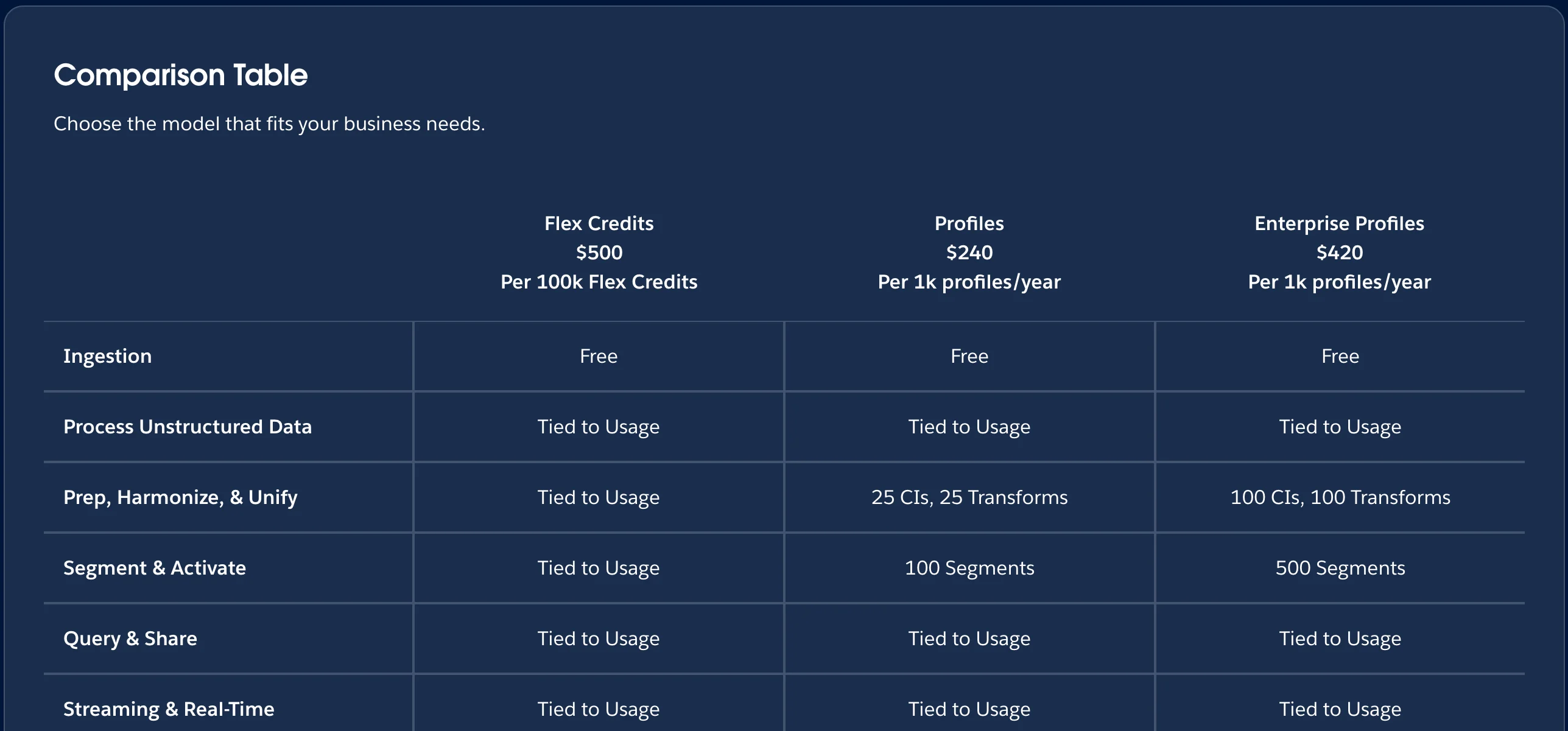
Salesforce's own Data 360 pricing page, comparison table.
Key features
- Identity rulesets with up to 2 fuzzy fields per match rule and 6 per ruleset, first name excluded
- 25 calculated insights and 100 segments on Profiles, 100 and 500 on Enterprise Profiles
- Free data ingestion on every plan
- Profiles feeding AI agents across Salesforce apps
Pricing
Salesforce publishes three meters, at $500 per 100,000 Flex Credits, $240 per 1,000 profiles a year on Profiles and $420 per 1,000 on Enterprise Profiles. Existing customers get a capped free edition.
Pros
- Every tier priced in public
- Customer profiles beside CRM records
- 768 G2 reviews
Cons
- Flex Credits meter every action, so usage sets the bill
- G2 rating of 4.2 trails seven of the other nine
- Value drops outside the Salesforce stack
"The initial setup, data modeling, and identity resolution often require experienced resources to get right. Pricing may be high for smaller businesses"
Chirag C., Senior Software Engineer, Mid-Market, G2, 7 August 2026
Why it's ranked #1. It's the only customer intelligence platform passing all five tests. It beats Hightouch on identity resolution by publishing a 6-field fuzzy limit, and it holds 768 G2 reviews.
Hightouch
Best fit
Data teams with a modeled Snowflake, BigQuery or Databricks warehouse.
Hightouch is a composable CDP whose identity graph runs inside the buyer's own warehouse, with 300+ integrations. Gartner named it a Leader for the first time in 2026. Without a modeled warehouse, a team is back to square one before the first sync.
Key features
- Deterministic identity resolution in-warehouse, plus a probabilistic option
- Golden Record table with one row per person
- Reverse ETL to 300+ tools
- Agentic Marketing Platform tier
Pricing
A free tier covers 2 active syncs with unlimited seats, and Hightouch quotes the paid Composable CDP and Agentic Marketing Platform plans after a demo. Vendr's anonymised buyer data puts the median contract at $15,000 a year across 178 purchases, from $9,600 to $75,000.
Pros
- Vendr median about a quarter of Segment's $55,600
- Customer data stays in the buyer's own warehouse, one copy to govern
- 4.6 on G2 from 410 reviews
Cons
- Needs a clean, modeled warehouse first
- Identity docs describe deterministic and probabilistic matching in words only
- Paid plans quoted after a demo
"The drag-and-drop and simple logic rules within the CDP are easy to manage for non-technical users with very little ramp up time needed."
Verified User in Food & Beverages, Small-Business, G2, 2 September 2026
Why it's ranked #2. This customer intelligence platform passes 4 of 5, beating Segment with a 2026 Gartner Leader placement. It loses to Salesforce on the identity test, which needs a stated number such as Salesforce's 6-field fuzzy limit.
Twilio Segment
Best fit
Product-led companies tracking customer behavior in-app.
Segment began as a behavioral data pipeline, and its Free tier covers 1,000 visitors a month and 2 sources. Twilio's pricing page lists 700+ integrations and 550+ pre-built destinations.
Key features
- One tracking API feeding 550+ destinations
- Unify profiles with default limits of 1 user_id and 5 values per other identifier
- Protocols for data quality checks
- Engage for journeys and predictive traits
Pricing
Segment's Free plan costs $0, and Team starts at $120 a month with 10,000 visitors. The CDP tier with Unify and Engage is quoted. Vendr's anonymised buyer data shows a $55,600 median across 614 purchases, from $14,815 to $198,400. At that ceiling, event volume can cost an arm and a leg.
Pros
- Monthly paid plan from $120
- Largest Vendr sample, 614 deals
- 4.5 on G2 from 567 reviews
Cons
- Gartner 2026 Niche Player
- Highest Vendr median of the three tools with one
- Unify and Engage sit on the quoted CDP tier
An enterprise education user named the cost driver on G2 in April 2026: "Cost is one factor that can increase quickly if the consumer sends too many events."
Why it's ranked #3. Segment's customer intelligence stack passes 4 of 5 and beats Treasure AI by publishing a $120 entry price. It sits below Hightouch because Gartner placed it a Niche Player.
Treasure AI (formerly Treasure Data)
Best fit
Global consumer brands with many regional data sources.
Treasure Data renamed itself Treasure AI on 20 April 2026 and lists 400+ integrations, the most here. Its ID unification builds a canonical ID from up to 32 keys across 255 tables, with a full refresh every three days. Teams without a data engineer rarely hit the ground running.
Key features
- Deterministic canonical-ID graph
- CDP, customer engagement and personalization in one Agentic Experience Platform
- Treasure AI Studio agents for campaign work
- Snowflake, Databricks and BigQuery links
Pricing
Treasure AI sells its Intelligent Customer Data Platform as an annual subscription and quotes it after a demo. Its pricing page ties the price to customer profiles and behavioral events, counted in what it calls a P+B unit, and includes Treasure AI Studio credits with any plan.
Pros
- 400+ connectors
- Gartner 2026 Challenger
- 4.5 on G2 from 165 reviews
Cons
- Quote-only pricing, set on profiles and behavioral events
- Three-day full refresh
- Steep learning curve, among pain points in several 2026 reviews
A quality engineer flagged an audience-layer gap on G2 in June 2026: "The audience layer only shows email addresses after I create a segment. I should be able to view more attributes as well".
Why it's ranked #4. This customer intelligence platform passes 4 of 5 with the most connectors, at 400+, and beats Oracle Unity on documented identity limits. It falls below Segment on the first criterion, published pricing, which Segment passes with a $120 Team plan.
Oracle Unity
Best fit
Enterprises already on Oracle CX, Eloqua or Responsys with 10 million or more known profiles.
Oracle now calls it Oracle Unity Data Platform and ships 27+ ready-to-use AI models for propensity, lookalikes and product recommendations, plus 50+ prebuilt attributes. Gartner named Oracle a 2026 CDP Leader. It fits where Oracle CX already holds the lion's share of customer records.
Key features
- B2B, B2C and B2B2C data models
- Predictive analytics workbench for analyzing data with 27+ models
- Behavioral intelligence priced per 1,000 sessions
- Deduplication rules on email, address and zip code
Pricing
Oracle's global price list, dated 12 June 2025, prices Oracle Unity Customer Data Orchestration Platform Cloud Service at $40 a year per 1,000 known profiles, with a minimum metric quantity of 10,000. Oracle counts that minimum in licence units, so the smallest order is 10 million known profiles, $400,000 a year.
The smallest Oracle Unity order a year, 10,000 units at $40 each. The price list defines one unit as "1,000 total unique 'known' profile records stored within CX Unity."
Pros
- Lowest published per-profile rate here, $40 per 1,000
- Gartner 2026 Leader
- 395 G2 reviews at 4.3
Cons
- Oracle counts its 27+ AI models and 50+ attributes and lists connectors without a total
- Identity docs give deduplication examples only
- $400,000 minimum order, 10 million profiles
An enterprise user's complaint on G2 in February 2023 was speed: "It sometimes takes time to open".
Why it's ranked #5. Oracle's customer intelligence platform passes 3 of 5, beating Microsoft through its 2026 Gartner Leader placement. It trails Treasure AI, which publishes 400+ connectors and a 32-key identity limit.
Microsoft Dynamics 365 Customer Insights
Best fit
Dynamics 365 and Azure customers that want profiles inside Dataverse.
Microsoft pairs customer analytics and a journeys module under one licence. Its fuzzy matching scores edit distance against thresholds of 30%, 60% and 80%, with exact match as the default. Sales, service & marketing stay on the same page about customer relationships because profiles live in Dataverse.
Key features
- Unlimited users on every licence
- 5 attach-in-place connectors plus Power Query
- 1,000 combined active segments and measures
- Customer journey orchestration in the same tenant
Pricing
Microsoft lists Customer Insights at $1,700 a month per tenant, paid yearly, covering 100,000 unified people and 10,000 interacted people. Attach costs $1,000 a month beside another Dynamics 365 app.
Pros
- Full public rate card
- 1,362 G2 reviews at 4.6, the largest base here
- Documented fuzzy thresholds
Cons
- Outside Gartner's 2026 CDP Leaders and Challengers
- 5 attach-in-place connectors, with other sources routed through Power Query
- G2 count includes the journeys module
A sales manager described the data unification value on G2 in August 2022: "It's enable an organisation to build customer 360 and get deeper business insights by integration multiple systems".
Why it's ranked #6. Microsoft's customer intelligence suite passes 3 of 5, beating Adobe with a published $1,700 monthly price. It loses to Oracle, a 2026 Gartner CDP Leader, on the second criterion.
Adobe Real-Time CDP
Best fit
Adobe Experience Cloud customers running Target or Journey Optimizer for personalized marketing.
Adobe licenses Real-Time CDP per pack or per 1,000 profiles, with 5 sandboxes and a 75-kilobyte average profile richness cap. Its guardrails allow 50 identities per identity graph and 1,500 inbound events a second of customer behavior for streaming segmentation. Teams that know the ropes of XDM schemas move faster.
Key features
- Up to 4,000 active audiences per sandbox
- 150 active edge audiences per sandbox
- XDM schemas shared across Adobe apps
- 500 kilobytes of first-generation export per profile a year
Pricing
Real-Time CDP is quoted per 1,000 profiles or per pack, with add-on packs for richness, sandboxes and query users.
Pros
- Published guardrails for identity and throughput
- 180 G2 reviews
- Public licence metric
Cons
- Gartner 2026 Visionary
- Quote-only pricing
- 4.1 on G2, tied lowest here
"I find Adobe Real-Time CDP isn't really for casual marketers. It requires deep knowledge, and you can't just use experience from other CDPs; you have to learn it specifically."
Nooruddin S., Web Developer, Cosmetics, Mid-Market, G2, 24 July 2026
Why it's ranked #7. Adobe's customer intelligence platform passes 2 of 5, beating Uniphore on its 50-identity graph cap and 180 reviews. It loses to Microsoft, which publishes a $1,700 price.
Uniphore CDP Agent (formerly ActionIQ)
Best fit
Fortune 1000 enterprises that want zero-copy audiences on the warehouse.
Uniphore announced its purchase of ActionIQ on 5 December 2024 and sells it as CDP Agent. Gartner named Uniphore a 2026 CDP Leader, and the vendor reports 65% faster audience creation at Atlassian. With 45 G2 reviews, it flies under the radar next to Salesforce's 768.
Key features
- Zero-copy, composable architecture
- Infoworks data engineering, bought in the same deal
- Integrations across advertising, analytics, engagement and sales tools
- Suite used by 1,600 enterprises
Pricing
Uniphore quotes CDP Agent after a demo. Its product page routes buyers to Book a demo, and its FAQ says buyers can "get started with CDP Agent by requesting a demo."
Pros
- Gartner 2026 Leader
- Vendor-reported 71% more conversions at Atlassian
- Zero-copy audiences read customer data where it sits in the warehouse
Cons
- 45 G2 reviews
- Quote-only pricing, with integrations grouped by category and left uncounted
- SQL needed for some attributes
An enterprise publishing user said as much on G2 in July 2023: "I dislike that attributes have to be written in SQL and I think it adds an unnecessary layer of complexity to the platform."
Why it's ranked #8. Uniphore's customer intelligence agent passes 1 of 5, and that pass is the second criterion, so it beats Amperity. It trails Adobe, which clears 2 tests including 180 reviews.
Amperity
Best fit
Retail, travel and hospitality brands with messy customer loyalty records and point-of-sale transactional data.
Amperity's Stitch engine scores record pairs with machine learning on a 0-to-5 scale, keeps exact, excellent and high matches, and reassesses every Amperity ID daily. The vendor reports New Look resolved 3.4 million fragmented profiles. At that volume, manual matching is a needle in a haystack.
Key features
- Jaro-Winkler and Levenshtein comparisons
- Daily ID reassessment
- Forrester Wave Strong Performer, B2C CDPs, Q3 2026
- Connectors for Snowflake, Databricks, Braze and Klaviyo
Pricing
Amperity bills in Amps, its standardized consumption unit, and prices contracts through its sales team, which forecasts a buyer's Amp needs with a calculator. Up to 10% of unused capacity rolls into the next contract.
Pros
- Most detailed identity method in the ranking
- Unused Amps roll over
- 4.4 on G2
Cons
- 53 G2 reviews
- Gartner 2026 Niche Player
- Amp rate quoted per contract
"the amperity_id logic has proven time and time again to be a reliable customer identity resolution solution that is fairly easy to use."
Jonathan G., MarTech Data Quality Analyst, Enterprise, G2, 21 February 2023
Why it's ranked #9. Its one pass is identity, on a 0-to-5 scoring scale, which beats Medallia's lone pass on the fifth criterion. It trails Uniphore, whose single pass is a 2026 Gartner Leader placement.
Medallia
Best fit
Customer experience teams that need customer feedback and attitudinal data joined to the profiles a CDP builds.
Gartner has named Medallia a Voice of the Customer Leader for the fifth consecutive year, and it holds SOC 2, HIPAA, FedRAMP and HITRUST certifications. It brings feedback from customer interactions to the table, tagged by AI theme detection. Our Medallia review covers the 2026 lender takeover.
Key features
- Sentiment analysis and text analytics that turn comments into themes and pain points
- Contact-center & digital analytics
- Total Experience profiles
- Integrations with Salesforce, Adobe & ServiceNow
Pricing
Vendr's anonymised buyer data shows a $13,338 median across 32 purchases, from $6,739 to $112,044. Our Medallia pricing report and Medallia vs Qualtrics comparison break down the contract model.
Pros
- Lowest Vendr median in the ranking
- 210 G2 reviews at 4.5
- Deepest attitudinal data source here
Cons
- Fails the identity-resolution test, the third criterion
- Dashboard design limits named in reviews
- Vendr high of $112,044, over 8x the median
"I like being able to quantify qualitative feedback and organise it into trackable topics, so I can clearly see how performance and sentiment change over time."
Verified User in Retail, Enterprise, G2, 22 April 2026
Why it's ranked #10. It passes 1 of 5, the review test, with 210 G2 reviews. It loses to Amperity, whose one pass comes on the earlier identity test.
Transactional data and the other types of customer intelligence data
Customer intelligence data falls into five types, and Zendesk's customer intelligence explainer uses the same split. Each type answers a different question about customer needs, so keep an eye on which ones a vendor collects natively.
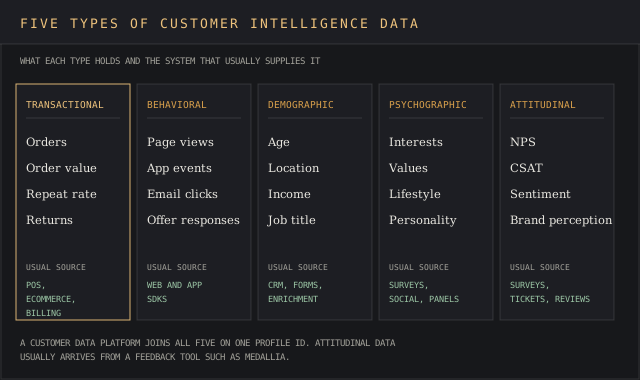
- Transactional data holds purchase history, average order value and purchase frequency.
- Behavioral data records how customers interact with websites, apps and promotions. Our behavioral segmentation guide builds on it.
- Demographic data covers age, location & income, often from data enrichment tools.
- Psychographic data captures interests, values and customer preferences from customer surveys, panels and social media platforms.
- Attitudinal data measures customer satisfaction, customer sentiment and brand perception.
CI data collection across first-, second- and third-party sources
CI data collection pulls first-party data from owned channels, second-party data from partners and third-party consumer data from brokers. Each source adds a match key and more data points to reconcile, so any customer intelligence strategy has to test identity resolution hardest.
Data governance comes with CI data collection. A unified customer database handles access and deletion requests under GDPR & the California Consumer Privacy Act from one place, as AWS's CDP explainer notes.
A profile nobody can trace to its sources is a red flag under GDPR and the California Consumer Privacy Act. Data management checks like Segment's Protocols stop bad events before they reach a profile.
Customer intelligence vs business intelligence vs customer relationship management
Customer intelligence produces one output per person, such as a churn score, a next-best action or a segment membership. Teradata's definition sets customer intelligence (CI) against business intelligence, which "provides reporting and dashboards for enterprise metrics across finance, operations, and other functions."
Customer intelligence analytics scores what one customer does next from that customer's orders, sessions and tickets. Salesforce's Data 360 help library covers Tableau Semantics, so those scores can reach the revenue & productivity dashboards business intelligence runs.
A CRM stores customer relationships as contacts, cases and opportunities, and a customer intelligence solution reads those records alongside web, app and support customer interactions, then writes scores back. Business intelligence tools read the same warehouse for enterprise reporting, and our market intelligence comparison draws the same business intelligence line at market level.
What customer intelligence software costs
A buyer with 100,000 known profiles pays $24,000 a year on Salesforce's Profiles plan or $20,400 on Microsoft's customer analytics tenant. Oracle Unity's smallest order is 10 million known profiles at $40 per 1,000, or $400,000 a year, 16.7 times the Salesforce bill.
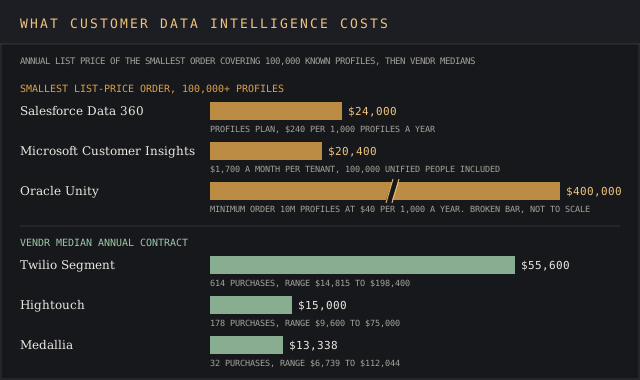
Vendr medians fill in the rest, at $55,600 for Segment, $15,000 for Hightouch and $13,338 for Medallia, with Segment's range topping out at $198,400. Adobe, Uniphore, Treasure AI and Amperity, the other four customer intelligence software vendors here, sell by quote only.
Customer intelligence data volume drives Salesforce's Flex Credits, Amperity's Amps and Microsoft's interacted-people packs, so tie each meter to business outcomes before signing.
Customer intelligence examples for customer behavior, customer lifetime value and advanced analytics
The benefits of customer intelligence (CI) for business growth show up in four jobs built on customer behavior. Braze notes most customer intelligence programs underinvest in activation, the step that turns data into actionable insights.
- Identifying at-risk customers. Braze lists declining open rates, reduced session frequency and longer gaps between purchases as early churn risk signals. A CDP turns them into a customer churn score that protects customer relationships.
- Personalized marketing. Sprinklr puts a number on customer expectations, citing research that 77% of consumers have chosen, recommended or paid more for a brand offering personalized service. Zendesk's CX Trends Report puts customers wanting more at 62%.
- Customer lifetime value scoring. Ranking segments by purchase history and predicted value moves marketing efforts toward high-value buyers and customer retention.
- Product feedback. Attitudinal data surfaces customer pain points, customer complaints & feature requests, and data analysis turns them into actionable insights.
Customer intelligence efforts often start in support, so improving customer service is a common first customer experience goal.
Customer service agents in Zendesk's research who say a lack of CI hurts their ability to give good care.
Real-time customer intelligence analytics helps teams understand customer preferences and spot emerging trends early. Our real-time market intelligence guide covers broader market trends, and customer journey mapping ties signals to a customer lifecycle stage with our free journey map template.
Customer intelligence FAQs
What does customer intelligence do?
Customer intelligence (CI) turns customer data into a churn score, a next-best action or an audience for an ad platform. An effective customer intelligence strategy starts from the customer needs marketing teams, sales and service must answer, and our customer intelligence template structures that brief.
What are the four types of customer data?
The usual four are demographic data, behavioral data, transactional data and attitudinal data, and Zendesk adds psychographic data as a fifth. Our guide to demographic segmentation covers the first type in depth.
What is a CDP used for?
A customer data platform exists to collect customer data from every source, resolve it into one profile per person and send segments to activation tools at each customer journey stage.
How much do customer data intelligence platforms cost?
List prices put 100,000 profiles at $24,000 a year on Salesforce Data 360 and $20,400 on Microsoft Dynamics 365 Customer Insights, and Oracle Unity's smallest order is $400,000 a year for 10 million profiles. Vendr medians run from $13,338 for Medallia to $55,600 for Twilio Segment.
Which customer data platform suits Salesforce users?
Salesforce Data 360, ranked first here and the only platform passing all five tests, keeps customer profiles beside CRM records on one contract at $240 per 1,000 profiles a year.
What skills does a customer insights analyst need?
Analyzing customer data at profile level takes SQL, statistics and predictive analytics. Customer analytics roles also need one CDP's identity model.
Bottom line
Of these customer intelligence tools, Salesforce Data 360 is the pick for Salesforce CRM customers and the only one passing all five tests. Hightouch wins for warehouse-first teams at $15,000. Segment suits product-led companies starting free.
Treasure AI and Oracle Unity fit large B2C estates, with Oracle's price list starting at 10 million profiles. Microsoft is the transparent choice for Dynamics shops managing customer relationships in Dataverse. Adobe, Uniphore and Amperity need a quote first. Medallia belongs beside any of the nine as the customer experience feedback source.