Market and customer segmentation tools: 10 platforms ranked for 2026
 By Jan Suski. I go deep on every review, checking every number against its source and digging up details other coverage misses, a habit from six years of SEO and link building for tech companies. Bylines at Surfer, Brand24, and Senuto. How the scoring works.
· Prefer this source on Google
Quick comparison of market and customer segmentation tools
Segmentation method, price and best fit come from each vendor’s own site or Vendr’s marketplace listing, as cited in the entries below; rank reflects the five criteria in the next section.
| # | Provider | Segmentation method | Entry price | Best fit |
|---|---|---|---|---|
| 1 | Segment (Twilio) | Predictive, Recommendation and Generative Audiences; 700+ destinations | $120/mo (Team) | Teams that need a CDP with the widest activation network |
| 2 | Amplitude | Predictions, a transformer-based scoring model | Free (2M events/mo) | Product teams building behavioral cohorts without engineering |
| 3 | Mixpanel | Behavioral cohorts plus a five-agent AI orchestrator | Free (1M events/mo) | Growth teams wanting analytics-grade segmentation below Amplitude's cost |
| 4 | 6sense | Predictive account-level intent segmentation | $63,199/yr median* | B2B teams segmenting accounts by buying-stage intent |
| 5 | Hightouch | Warehouse-native Customer Studio, reinforcement-learning decisioning | Free (2 active syncs) | Teams that already model customer data in a warehouse |
| 6 | Customer.io | Attribute-filter segments run by a named AI Agent | $100/mo (Essentials) | Lifecycle marketing teams that want a published flat rate |
| 7 | Google Analytics 4 | Membership-based Audiences plus predictive purchase and churn metrics | Free (standard tier) | Teams that want free segmentation tied to Google Ads |
| 8 | Qualtrics XM | Advanced-methodology segmentation: conjoint, MaxDiff, TURF | $30,000/yr median* | Market research teams that need methodology depth over dashboards |
| 9 | QuestionPro | Filter-based response segmentation, up to 10 criteria | $99/user/mo (Advanced) | Research teams that want a published per-seat rate |
| 10 | Monetate | Rule-based audience segments inside its personalization suite | Custom, no public pricing | Retailers already running Monetate's personalization or SiteSpect testing stack |
Medians marked * are Vendr’s anonymized buyer-reported contract values, used where a vendor publishes no rate card of its own. Everything else is the price the vendor publishes itself, or “Custom” where none is published.
Where these figures come from
Segmentation mechanisms, G2 ratings, review counts and published pricing are each vendor’s own site or G2 listing, checked this session. Medians marked * in the table are Vendr’s anonymized buyer-reported contract values, used where a vendor publishes no rate card of its own: 6sense and Qualtrics XM.
Eight of the ten platforms carry a Vendr-tracked contract value, detailed in the criteria section below. Monetate carries no Vendr listing at all, and neither of Google Analytics 4’s two tiers does either.
Segment and Amplitude also appear on our marketing segmentation software ranking, evaluated there against broader marketing-automation platforms, a different peer set than segmentation and activation tools specifically, which produces a different order. Read that page for the wider marketing-stack comparison; read this one for segmentation and activation depth.
Market segmentation tools split a total addressable market into groups worth building a campaign around, using surveys, panels and demographic or geographic segmentation. Customer segmentation software does a narrower job: it sorts people already inside a company's customer data by what they bought, clicked or abandoned, using behavioral segmentation and purchase history it already has on record.
This ranking of the best customer segmentation tools and market segmentation tools covers both jobs, because the ten platforms below split cleanly across them. Product analytics tools and customer data platforms handle behavioral customer segmentation on existing customers; Qualtrics and QuestionPro handle market segmentation research on people who may never have bought anything yet.
This page ranks ten market segmentation tools and customer segmentation tools spanning product analytics, customer data platforms, account-based intent scoring and survey-based market research. Each entry states what a buyer would pay, the named mechanism the customer segmentation software uses to build a segment, and a sourced complaint or compliment pulled from a verified reviewer.
The roster deliberately skips the ad-activation and identity-resolution tools already covered in MarketIntelligenceTools' audience segmentation tools ranking, since those platforms build and reach an audience segmentation before a customer relationship exists.
Everything ranked here as a customer segmentation tool works with data collected after a visitor becomes a lead, a trial user or a paying customer, and everything ranked here as a market segmentation tool works with survey or panel data collected on request.
Review volume separates this roster of customer segmentation tools and market segmentation tools more than star rating alone. Google Analytics 4 carries 6,865 G2 reviews, the largest count of any platform here, while Monetate carries 130. A 4.1-star average built on 130 reviews and a 4.5-star average built on 6,865 are different kinds of evidence, and that gap matters more to a buyer evaluating customer segmentation software than a tenth of a star.
Two vendors here also show up on the sibling marketing segmentation software ranking: Segment and Amplitude both build customer segments, so they get scored twice, once as broad customer-data and product-analytics platforms here, once as CRM-bound marketing segmentation tools there. Buy from whichever framing matches the actual job.
How these customer segmentation tools were evaluated
Five criteria decided the ranking of these market segmentation tools and customer segmentation tools, applied in this order: segmentation methodology depth, activation and integration breadth, third-party review validation, published pricing transparency, and Vendr contract cost. Every criterion below traces to a specific, checkable fact. None of it comes from a vendor's own "best customer segmentation tools" marketing claim.
Segmentation methodology depth
This criterion checks a vendor's own documentation for a named mechanism behind a segment: a transformer-based prediction model, a reinforcement-learning decisioning engine, a documented conjoint or MaxDiff methodology, or a plain filter-and-tag builder. Generic "ai powered segmentation" copy without a named model doesn't count, and neither does an "advanced segmentation" label with no methodology attached to it.
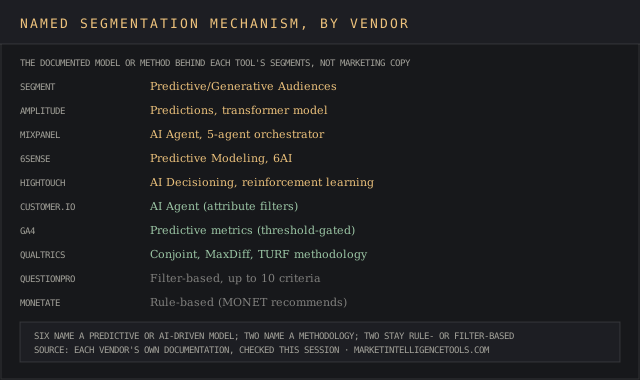
Six platforms name a specific predictive or AI-driven mechanism; four rely on rule- or filter-based segmentation alone.
Activation and integration breadth
Once a segment exists, it has to reach a destination, an ad platform, or one of the data warehouses a team already runs. This criterion counts the integrations, destinations or data-source connections each vendor documents on its own site.
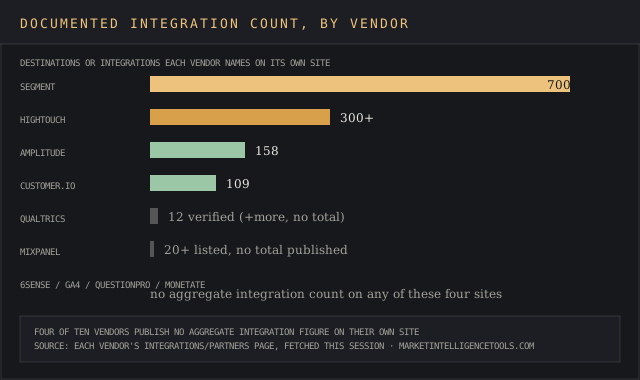
Four of the ten platforms publish no aggregate integration count on their own site.
Third-party review validation
G2 star rating and review count together, since a rating built on a few hundred reviews carries a different confidence level than one built on several thousand.
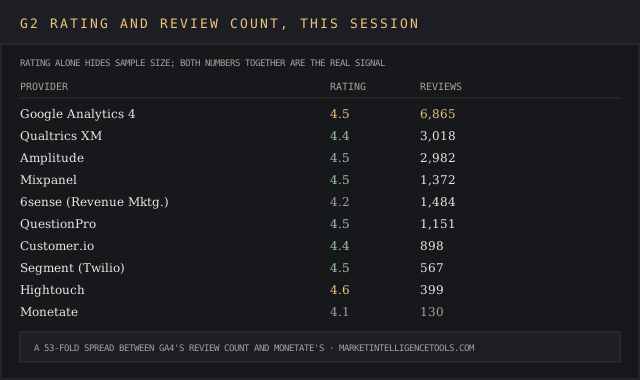
A 53-fold spread in review count between the most and least validated platform in this roster.
Published pricing transparency
Six platforms here list at least one flat, published dollar figure; the other four route every deal through a quote request with no published number anywhere on their site.
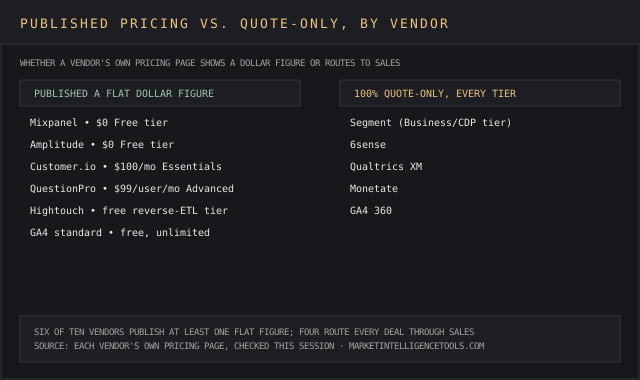
Six of ten vendors publish at least one real number; four never do.
Vendr contract cost
Where Vendr tracks a vendor, its median annual contract and negotiated range give a buyer a number to hold against the first sales quote.
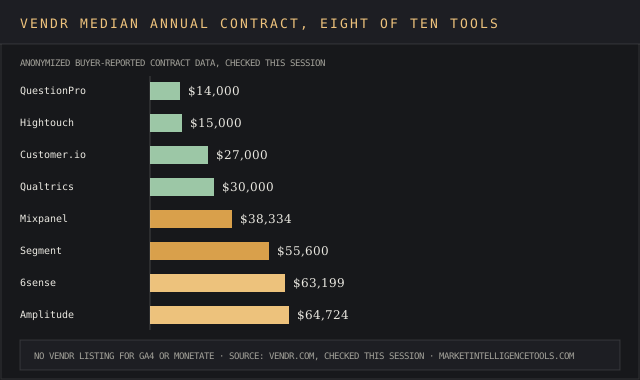
Amplitude’s $64,724 Vendr median against QuestionPro’s $14,000, the widest tracked gap between any two platforms in this roster.
Amplitude's median contract runs more than four times QuestionPro's, for platforms serving overlapping segmentation use cases.
The 10 best market and customer segmentation tools, ranked
The ten entries below cover the best customer segmentation tools for behavioral, predictive and account-level work, plus the best customer segmentation tools for market research where no purchase relationship exists yet. Each of these market segmentation tools and customer segmentation tools is scored against the same five criteria, so the gap between any two adjacent entries traces to a specific, named figure.
Segment (Twilio)
Best fit
Teams that need a customer data platform with the widest activation network for the segments it builds.
Segment, sold today as Twilio Segment, splits into two products: a Customer Data Pipeline for collection and reverse ETL, and a full Customer Data Platform that adds Unify (identity resolution) and Engage (audience building and journeys). Twilio's own pricing page withholds every dollar figure behind a sales conversation, but G2's pricing widget lists a Team tier at $120 per month and a free Developer tier, with Business priced custom.
Key features
- Unify identity resolution with Predictive Traits and Recommendation Traits
- Engage audience builder with Generative Audiences and Predictive Audiences
- 700+ destination integrations plus reverse ETL and a public API
- Protocols add-on for data-quality governance on the Pipeline tier
Pricing
G2 lists Team at $120/month and a free Developer tier; Business is custom. Vendr's tracked median annual contract is $55,600, with a range of $14,810 to $198,600 across 379 deals and average negotiated savings of 17.35%.
Pros
- 700+ named destinations, the widest activation network in this roster
- Predictive, Recommendation and Generative Audiences cover behavioral, lookalike and natural-language segment building in one product
- 4.5-star G2 rating across 567 reviews
Cons
- No published price for the full CDP tier; every deal routes through sales
- G2's aggregated complaint tags flag pricing and a steep event-taxonomy learning curve
- Enterprise contracts run past $198,600/year at the high end Vendr tracks
"From implementation woes to awful support, Segment has failed us at every bend. The $400k price tag doesn't help. I can't recommend this product and won't be taking it to my next employer."Verified User, Computer & Network Security, enterprise company, G2 review, November 2024
Why it's ranked #1. Segment's 700+ named destinations beat every other platform here on activation breadth, and its three distinct audience-building modes (Predictive, Recommendation, Generative) give it a broader methodology footprint than Amplitude's single Predictions model below it.
Amplitude
Best fit
Product teams that need to build behavioral cohorts and predictive segments without pulling in an engineer.
Amplitude's segmentation runs on Behavioral Cohorts, groups defined by in-product actions inside a time window, and a named predictive layer called Predictions. Predictions uses transformer-based sequence models over event, event-property and user-property data to score the likelihood of a future action, and Amplitude's own documentation claims a 5 to 20 percent lift over behavioral targeting alone.
Amplitude ranks first on our customer intelligence platforms ranking, which scores predictive models and CRM write-back.
Key features
- Behavioral Cohorts with time-windowed action definitions, capped at 5 on the Plus tier
- Predictions, a transformer-based model scoring purchase, churn and other action likelihoods
- 158 documented integrations
- SSO and unlimited monitoring on the Growth and Enterprise tiers
Pricing
Free covers 2 million events per month; Plus starts at $0 with a card on file and scales to 70 million events; Growth and Enterprise are event-based custom pricing. Vendr's median annual contract is $64,724 across 237 deals, ranging from $24,625 to $370,790.
Pros
- 4.5-star G2 rating across 2,982 reviews, the largest validated review base among the analytics-tier platforms here
- Predictions ships a documented, cited lift figure (5 to 20 percent)
- Free tier covers real usage at 2 million events/month before any card is required
Cons
- Plus tier caps behavioral cohorts at 5, forcing an upgrade for teams running more segments
- Reviewers describe a steep learning curve for non-technical users setting up event taxonomy
- Vendr's tracked range tops out at $370,790/year, the highest ceiling of any platform in this roster
"Pricing and limits can bite once volume grows. Worth it, but not zero maintenance."Stratulat R., Software Engineer, mid-market company, G2 review, June 2026
Why it's ranked #2. Amplitude's 2,982 G2 reviews outweigh Segment's 567 on raw validation, but its 158 documented integrations trail Segment's 700+ destinations, keeping it one spot behind on activation breadth.
Mixpanel
Best fit
Growth teams that want behavioral cohort segmentation and AI-assisted analysis at a lower contract cost than Amplitude.
Mixpanel builds behavioral cohorts and unlimited saved metrics starting on its Growth tier, then layers a named AI orchestrator called Mixpanel Agent on top. Mixpanel Agent runs five sub-agents: Onboarding, Dashboard, Experiment, Root Cause Analysis and KPI Monitoring, each handling a distinct analysis task, five specialized roles in one system.
Key features
- Behavioral cohort building with unlimited saved metrics on Growth and above
- Mixpanel Agent, an orchestrator with five named sub-agents for onboarding, dashboards, experiments and root-cause analysis
- Mixpanel MCP, letting Claude, ChatGPT or Cursor query segmentation data conversationally
- Metric Trees linking behaviors to KPIs on the Enterprise tier
Pricing
Free covers up to 1 million events per month; Growth is usage-based with no flat rate published, scaling to 20 million events; Enterprise is custom, scaling to 1 trillion events. Vendr's median annual contract is $38,334 across 219 deals, with a range of $13,000 to $118,063 and average savings near 19%.
Pros
- 4.5-star G2 rating across 1,372 reviews
- Vendr median contract of $38,334 runs well below Amplitude's $64,724 for comparable behavioral segmentation
- Startups under 5 years old with $8 million or less in funding get their first year free
Cons
- No flat Growth-tier price published; buyers are pushed to an interactive usage calculator instead
- Reviewers cite a cumbersome setup process for pulling data from every part of a platform
- 1,372 G2 reviews trail Amplitude's 2,982, a thinner validation base for the same tier of tool
"The setup was a little cumbersome. It took us quite a while to make sure that we were getting data from all aspects of our platform."Aaron K., VP of Product Management, small-business company, G2 review, May 2026
Why it's ranked #3. Mixpanel's $38,334 Vendr median beats Amplitude's $64,724 for a comparable behavioral segmentation product, but its 1,372 G2 reviews trail Amplitude's 2,982, and its Growth tier caps out at 20 million events against Amplitude's 70 million on the equivalent tier.
6sense
Best fit
B2B teams that need to segment whole accounts by buying-stage intent.
6sense builds segments at the account level, using Predictive Modeling and an Account Prioritization engine branded 6AI to score which accounts are actively researching a purchase. Intent Data, Audience Builder and List Builder turn that scoring into activatable segments for advertising and sales outreach.
Key features
- Predictive Modeling and Account Prioritization 6AI for intent-based account scoring
- Audience Builder and List Builder for turning intent signals into activatable segments
- RevvyAI, a conversational GTM intelligence layer, plus Sales Copilot 6AI and Email Agents 6AI
- Two separate G2 listings: 6sense Revenue Marketing and 6sense Sales Intelligence
Pricing
6sense publishes no dollar figures; its pricing page lists three feature bundles gated behind a demo request. Vendr's median annual contract is $63,199 across 383 purchases, ranging from $11,753 to $177,404, with average negotiated savings of 16.77%.
Pros
- Account-level predictive segmentation, a distinct capability from every individual-level tool ranked above it
- 383 Vendr-tracked purchases, more than every other custom-priced platform in this roster
- Reviewers credit dynamic account segmentation over static list-building
Cons
- 4.2-star G2 rating on its Revenue Marketing listing, the lowest among the analytics and CDP tier here
- Enterprise onboarding runs two to three months, per reviewers
- Split across two separate G2 product listings, fragmenting review signal
"The initial setup was a bit lengthy, taking about two to three months for onboarding."Krishna K., ABM/Campaign Lead, enterprise company, G2 review, March 2026
Why it's ranked #4. 6sense's 1,484 reviews on its Revenue Marketing listing beat Hightouch's 399 below it, and its account-level predictive segmentation is a documented capability none of the warehouse or reverse-ETL tools in this roster match, even though its 4.2-star rating trails Mixpanel's 4.5 above it.
Hightouch
Best fit
Teams that already model customer data in data warehouses and want to build segments right there, without exporting to a separate tool.
Hightouch's Customer Studio builds segments visually against whatever data already sits in a company's data warehouses, including behavioral events, purchase history and predictive scores, then syncs those segments out through reverse ETL. Its named AI feature, AI Decisioning, uses reinforcement learning to automate next-best-action decisions per customer, continuously adapting where static rules would stay fixed.
Key features
- Customer Studio, a visual segment builder running directly against data warehouses such as Snowflake or BigQuery
- AI Decisioning, reinforcement-learning-based next-best-action automation
- No-code calculated traits, such as lifetime value, without writing SQL
- 300+ integrations for syncing segments to CRM, email and ad platforms
Pricing
A free Basic Reverse ETL tier covers up to 2 active syncs with unlimited destinations and seats. The Agentic Marketing Platform and Composable CDP tiers are usage-based and quote-only. Vendr's median annual contract is $15,000 across 177 purchases, ranging from $9,600 to $75,000, with average savings near 26%.
Pros
- 4.6-star G2 rating, the highest of any platform in this roster
- Warehouse-native segmentation avoids duplicating customer data in a second system
- 300+ integrations for activation once a segment is built
Cons
- 399 G2 reviews, the thinnest validation base of any platform ranked here
- A reviewer describes an unannounced pricing change that made an account unaffordable within two months, with no data-migration path offered
- No exact usage-based pricing formula published; only the free tier carries a stated limit
"After having used Hightouch for more than 2 years, they decided to completely change the conditions of us making it unaffordable, all within 2 months. And they did not communicate properly about the changes making our account completely unaccessible, and leaving us with no way to migrate our data."Mael T., COO, small-business company, G2 review, November 2025
Why it's ranked #5. Hightouch's 4.6-star G2 rating beats every platform in this roster, including 6sense above it, but its review base of 399 is less than a third the size of 6sense's 1,484, and that thinner sample keeps it below 6sense despite the higher average score.
Customer.io
Best fit
Lifecycle marketing teams that want a published flat rate they can see without going through a quote-only sales process.
Customer.io segments customers through filter-and-attribute logic, then runs that segmentation through a named AI Agent with three branded sub-capabilities: Remember (persistent brand-voice context), Build (prompt-to-launched-campaign logic) and Analyze (surfacing underperforming messages and recommending fixes). The Agent can also build segments through an MCP server integration.
Key features
- AI Agent with Remember, Build and Analyze sub-capabilities
- Attribute-filter segmentation for creating sub-segments from existing customer data
- 109 documented integrations across Data In, Data Out and Partner categories
- HIPAA option available on the Premium tier
Pricing
Essentials starts at $100/month for 5,000 profiles and 1 million emails; Premium starts at $1,000/month, billed yearly, with elevated Agent limits and 10 object types; Enterprise is custom. A Startup Program offers 12 months free to companies that have raised under $10 million. Vendr's median annual contract is $27,000 across 58 tracked deals, ranging from $9,946 to $145,217.
Pros
- Published flat pricing at every tier below Enterprise, unlike Segment, 6sense or Hightouch above it
- Reviewers describe filtering users by attributes as simple to use for building sub-segments
- 4.4-star G2 rating across 898 reviews
Cons
- A reviewer flags the pricing model as built around B2B assumptions, disadvantaging B2C and e-commerce buyers
- Segmentation stays attribute- and filter-based, without a named predictive-modeling layer like Amplitude's or 6sense's
- Multiple reviewers cite a cluttered interface and a learning curve for building campaign flows
"I like going to customer.io to crease sub segment of our users. The ability to filter user by attributes is very simple to use."Li Rou C., Growth role, information technology company, Capterra review, June 2023
Why it's ranked #6. Customer.io's published $100/month Essentials rate gives buyers a number Hightouch and 6sense above it never disclose, but its filter-based segmentation lacks the named predictive model those platforms document, dropping it below them on methodology depth.
Google Analytics 4
Best fit
Teams that want free segmentation tied directly to Google Ads and DV360 without a separate contract.
GA4 builds Audiences, membership-based groups users dynamically enter and exit based on ongoing behavior, and shares them directly with linked Google Ads and DV360 accounts for remarketing. A named Predictive metrics feature scores purchase probability, churn probability and predicted revenue, but eligibility requires at least 1,000 returning users meeting the condition and 1,000 not meeting it, inside a 7-day window within the last 28 days.
Key features
- Audiences, dynamic membership-based segments shareable with Google Ads and DV360
- Predictive metrics for purchase probability, churn probability and predicted revenue
- Free BigQuery export on standard properties, capped near 1 million events/day
- GA4 360 adds streaming export with no volume cap, at $0.05/GB
Pricing
Standard GA4 is free. GA4 360 is quote-only through Google sales; a third-party estimate from Cardinal Path puts the suggested retail price near $50,000/year for 25 million events per month, though Google does not publish that figure itself. No Vendr listing exists for either tier.
Pros
- Free at the standard tier, with predictive purchase and churn segmentation included
- 4.5-star G2 rating across 6,865 reviews, the largest review base of any platform in this roster
- Native audience sharing with Google Ads and DV360 removes a separate activation step
Cons
- Predictive metrics require a 1,000-user minimum on both sides of the condition inside a 7-day window, locking out lower-traffic properties
- Standard-tier data retention defaults to 2 or 14 months, after which user-level data is deleted monthly and unrecoverable
- G2's aggregated tags show "Learning Curve" (99 mentions) and "Not Intuitive" (59) as the two most-mentioned complaint clusters
"It is simply impossible to find what you need. Nothing intuitive about it. the old version of this product was intuitive. This version is almost unusable unless you have a certification. And there is no support available."Bradley B., Vice President, Digital Marketing, mid-market company, G2 review, February 2026
Why it's ranked #7. GA4's free standard tier and 6,865 G2 reviews beat Customer.io above it on cost and validation volume, but its predictive purchase and churn scoring locks behind a 1,000-user minimum that Customer.io's attribute segmentation doesn't require, and standard-tier sampling above 10 million events per query caps how far that segmentation scales.
Qualtrics XM
Best fit
Market research teams that need documented methodology, such as conjoint analysis or MaxDiff.
Qualtrics builds market segmentation through a named "Advanced methodology" toolkit: choice-based conjoint with hierarchical Bayes analysis, MaxDiff with TURF, Van Westendorp price sensitivity, Gabor-Granger pricing tests, brand tracking and concept testing. Stats iQ and Text iQ handle statistical and open-text analysis, and an early-access Research Agent drafts study scoping and questionnaires from a prompt.
Key features
- Choice-based conjoint with hierarchical Bayes analysis, plus MaxDiff, TURF, Van Westendorp and Gabor-Granger methodologies
- Dynamic segmentation under the XM Platform's experience-gap tooling
- Research Agent (early access) for AI-guided study scoping and questionnaire drafting
- Synthetic panels for simulated respondent data
Pricing
Qualtrics publishes no dollar figures; every quote routes through a "Request Pricing" form structured around product family and interaction volume. Vendr's median annual contract is $30,000 across 318 purchases, ranging from $6,910 to $139,920, with average savings of 11.28%.
Pros
- 3,018 G2 reviews, the largest validated base among the survey-based research tools here
- A full advanced-methodology suite (conjoint, MaxDiff, TURF, Van Westendorp) that QuestionPro's filter-based segmentation doesn't match
- Stats iQ and Text iQ handle statistical and open-text analysis inside the same platform
Cons
- 100% quote-only pricing, with no published tier or per-seat rate anywhere on the site
- G2's aggregated tags show "Survey Issues" (79 mentions) and "Pricing Issues" (47) among the top complaint clusters
- A reviewer describes a "land and expand" pattern where the initial quote more than doubled at renewal once switching costs were high
"Horrible product. Not intuitive, overly complicated. There are major gaps in survey design, programming and analysis tools that much better, less expensive tools commonly have."Verified User, Computer Software, enterprise company, G2 review, November 2022
Why it's ranked #8. Qualtrics's 3,018 G2 reviews trail GA4's 6,865 above it, and its fully quote-only pricing gives buyers no published number the way GA4's free tier does, but its advanced-methodology suite beats QuestionPro's filter-based segmentation below it on methodology depth.
QuestionPro
Best fit
Research teams that want a published per-seat rate, already set without a negotiation.
QuestionPro segments survey responses through filters on survey status, question response, and custom or system variables, combinable with AND/OR logic across up to 10 criteria depending on license tier. A separate Audience panel product adds demographic and market segmentation across 32 countries and more than 22 million panelists.
Key features
- Response-based segmentation filters, combinable with AND/OR logic across up to 10 criteria
- QuestionPro Audience panel spanning 32 countries and 22 million-plus panelists
- TextAI for topic modeling and multilingual sentiment analysis
- Survey Agent, a prompt-to-survey builder
Pricing
Essentials is free for 1 user and 200 responses/survey. Advanced runs $99/user/month billed annually for 25,000 responses/year. Team Edition runs $83/user/month for 5+ users and 100,000 responses/year. Research Suite is custom. Vendr's median annual contract is $14,000, ranging from $6,920 to $282,000.
Pros
- Published per-user pricing at every tier below Research Suite, a rarity among the survey-based tools in this roster
- 4.5-star G2 rating across 1,151 reviews
- Vendr's $14,000 median is the lowest of any platform tracked in this roster
Cons
- Response caps are hard limits by tier (200/survey free, 25,000/year Advanced, 100,000/year Team), not unlimited
- Segmentation stays filter-based, without Qualtrics's conjoint, MaxDiff or TURF methodologies
- Reviewers describe significant price jumps between tiers and a steep learning curve for dashboard customization
"Customer service feels like it's passing the buck, and they sometimes don't understand what's going on."T K., enterprise company, G2 review, March 2026
Why it's ranked #9. QuestionPro's published $99/user/month rate beats Qualtrics's quote-only pricing above it on transparency, but its filter-based segmentation lacks the conjoint and MaxDiff methodologies Qualtrics documents, and its 1,151 G2 reviews trail Qualtrics's 3,018 on validation.
Monetate
Best fit
Retailers already running Monetate's personalization platform or its 2025 SiteSpect acquisition for testing.
Monetate builds rule-based audience segments inside its personalization suite, covering product recommendations, product finder, social proof and dynamic bundles. A named GenAI layer called MONET offers on-demand best-practice recommendations and autonomous real-time optimization, and a separate Maestro suite runs the A/B and feature-flag testing those segments get evaluated against.
Key features
- A personalization suite for segment-driven product recommendations, social proof and dynamic bundles
- MONET, a named agentic AI layer for optimization recommendations
- Maestro experimentation suite for A/B and dynamic testing of segments
- SiteSpect, acquired June 2025, adding zero-flicker server- and client-side testing
Pricing
Monetate publishes no dollar figures; its pricing page states every plan is custom-built per account. No Vendr listing exists for Monetate, so no median contract or negotiated range is publicly trackable.
Pros
- Its personalization suite bundles segmentation, recommendations and testing (via Maestro) into a single product covering all three
- The 2025 SiteSpect acquisition adds testing infrastructure without a separate contract
- Backed by investors managing more than $400 billion in assets, per the company's own announcement, with stated 30%+ annual growth
Cons
- 4.1-star G2 rating across 130 reviews, the smallest and lowest-rated review base in this roster
- No Vendr listing, leaving buyers with no third-party contract benchmark before a sales call
- Reviewers repeatedly describe the interface as dated and slow to learn
"The interface is not user friendly" and "takes a long time to learn."Verified User, R&D, large company (5,001-10,000 employees), TrustRadius review, June 2024
Why it's ranked #10. Monetate's 130 G2 reviews are the smallest base in this roster, well below QuestionPro's 1,151 above it, and its lack of any Vendr listing leaves buyers with no third-party cost benchmark that the other nine platforms all provide in some form.
Segmentation tool buying mistakes to avoid
Buyers often shortlist customer segmentation software on G2 star rating alone, and that number hides sample size. Hightouch's 4.6 stars comes from 399 reviews; Google Analytics 4's 4.5 comes from 6,865.
A rating built on a few hundred reviews can swing with the next dozen; one built on thousands is a stable read on customer satisfaction across industries and company sizes. Check the review count next to the rating before treating either as decided.
A second mistake is skipping Vendr's published contract data before the first sales call. Every custom-priced market segmentation tool in this roster, including Segment, 6sense, Hightouch and Qualtrics, will price a deal to whatever a buyer signals they can pay.
Hightouch's own reviewer describes a renewal where pricing terms changed within two months and the account became unaffordable with no data-migration path offered; Qualtrics has a documented pattern of quotes doubling once switching costs make an account hard to leave. A Vendr median and range gives a buyer a number to negotiate against before either conversation starts.
Skipping a vendor's minimum data volume threshold is a third misstep. GA4's Predictive metrics require at least 1,000 returning users on both sides of a condition inside a 7-day window, which locks out lower-traffic properties entirely.
Amplitude's Plus tier caps behavioral cohorts at five, which pushes any team running more active segments into a Growth-tier upgrade sooner than the marketing page implies. Confirm the threshold or the cap applies to actual data volume and segment count before assuming a predictive feature will work at signup.
Conflating market segmentation with customer segmentation is a fourth mistake buyers make when scoping the purchase. Qualtrics and QuestionPro run customer surveys and market research studies on respondents who may never have interacted with the buyer's product.
Segment, Amplitude, Mixpanel, Hightouch, Customer.io and GA4 segment customer relationship management and product-usage data already sitting in a company's own customer engagement platform. A team that needs pre-purchase market sizing and buys a customer data platform instead will find no survey tooling and no conjoint methodology anywhere in the product.
A fifth mistake treats every stage of the customer journey the same way. Behavioral segmentation and predictive segments work well once a data warehouse holds months of purchase history and churn risk signals, but a new account with thin historical data won't have enough volume for a model like Amplitude's Predictions or GA4's predictive metrics to activate.
Marketing automation and campaign execution downstream of a segment only work as well as the segmentation feeding them, so match the tool's data requirement to the actual customer journey stage being measured before signing a contract.
Market and customer segmentation tools FAQ
What are the main types of market segmentation?
Most market segmentation frameworks name four core types: demographic segmentation (age, income, job title), geographic segmentation, where geographic segmentation divides a market by region, climate or market density, psychographic segmentation (values, lifestyle, personality) and behavioral segmentation (purchase history, usage frequency, brand loyalty).
Some frameworks add firmographic and needs-based segmentation as a fifth and sixth type for B2B and services categories, and every type feeds a different set of marketing campaigns aimed at a defined target audience.
How is customer segmentation different from market segmentation?
Customer segmentation groups people already inside a company's own customer data, using signals such as purchase history, product usage and customer preferences collected through normal product or CRM activity. Market segmentation groups a wider population, including people who have never bought anything, using customer surveys, panels and demographic or geographic data collected specifically for a research study.
Segmentation tools built for one job, like Segment or Mixpanel for customer segmentation, generally don't do the other job well without a separate market segmentation tool such as Qualtrics or QuestionPro alongside them.
What is a segmentation tool?
A segmentation tool is software that groups a market or a customer base into smaller sets sharing a defining trait, then makes each group actionable for a campaign, a product change or a research study. The ten platforms ranked above split into two families: CDPs and product analytics tools that group people already inside a company's data, and market research platforms that group respondents in a study before any purchase relationship exists.
What tools are used for market and customer segmentation?
Customer data platforms such as Segment and Hightouch, product analytics tools such as Amplitude and Mixpanel, account-based intent platforms such as 6sense, lifecycle marketing tools such as Customer.io, free analytics tools such as Google Analytics 4, and survey-based market research platforms such as Qualtrics and QuestionPro all build segments, each on a different mechanism and a different slice of data.
What software do market analysts use for segmentation?
Market analysts researching a total addressable market before a purchase relationship exists typically reach for Qualtrics or QuestionPro, since both ship the conjoint, MaxDiff and TURF methodologies a demographic or psychographic segmentation study requires. Analysts studying existing customer behavior instead use a product analytics or customer data platform, since that data already lives inside the company's own systems.
Which of these ten tools has a genuinely free tier?
Four do: Amplitude (2 million events/month), Mixpanel (1 million events/month), Hightouch (2 active reverse-ETL syncs, unlimited seats) and Google Analytics 4 (unlimited at the standard tier, with sampling limits above 10 million events per query). QuestionPro's Essentials tier is also free but caps at 200 responses per survey.
What features should customer segmentation software have?
Effective customer segmentation software builds custom segments and dynamic segments that update automatically as customer behavior changes. A static list goes stale within a quarter. It resolves fragmented data across every data collection point into unified customer profiles, so contact details, mobile app activity and past customer interactions all feed a single unified record.
Segmentation features worth checking include filters on shared characteristics such as customer lifetime value or purchase history, and machine learning algorithms that identify patterns and high value customers a manual review would miss. That combination is what lets a team identify high value segments, create precise segments for a campaign, and analyze customer interactions without exporting data by hand.
What data do these tools need before segmentation works?
Most customer segmentation tools need to collect data on how customers interact with a product before segmentation specifically becomes useful: purchase history, activity across mobile apps and web, and enough historical data to clear a vendor's own minimum. Data quality matters as much as data volume; a segmentation model trained on duplicate or fragmented records will misfire on the exact high value customers a team most wants to reach.
Once that data collection is in place, a tool with genuine segmentation features can create segments and actionable segments automatically, sort customer segments by shared characteristics into specific, exportable groups, and surface actionable insights a manual spreadsheet review would miss. Weaker tools stop at letting a user identify segments manually, with no automatically group customers step and no improved personalization layered on top.
Which tools handle churn risk and predictive segments best?
Amplitude and Google Analytics 4 both fold churn risk into their predictive segments: Amplitude's Predictions model and GA4's predictive metrics each flag likely-to-lapse customers before a human analyst would spot the pattern. 6sense runs a comparable ai powered scoring layer at the account level, feeding its own advanced segmentation into targeted campaigns through a separate marketing automation platform.
That kind of customer behavior data becomes useful once a customer engagement platform can analyze data fast enough to create segments automatically. Nobody has to manually sort a spreadsheet by hand. Mobile apps activity and customer satisfaction scores from post-purchase surveys both feed that loop, and understanding user behavior before a campaign launches improves every one of the custom segments built after it.
Bottom line
Segment leads this roster of the best customer segmentation tools on activation breadth, with 700+ named destinations and three distinct AI-assisted audience-building modes, but every dollar figure beyond its $120/month Team tier stays behind a sales call.
Amplitude and Mixpanel both name a specific, documented predictive mechanism behind their segments, and Mixpanel's $38,334 Vendr median undercuts Amplitude's $64,724 for comparable behavioral cohort tooling.
Teams segmenting B2B accounts by buying-stage intent have no substitute for 6sense's account-level predictive modeling in this roster; teams already running their customer data through data warehouses get more out of Hightouch's Customer Studio than a second export step into a standalone CDP.
Customer.io and QuestionPro are the two platforms here that publish a flat, checkable price at every tier below Enterprise, which matters more to a team evaluating on a fixed budget than a marginally higher star rating elsewhere.
For market segmentation ahead of a product launch, Qualtrics's conjoint and MaxDiff methodology outweighs QuestionPro's simpler filter-based segmentation, provided the buyer confirms pricing against Vendr's $30,000 median before the first sales conversation.
Google Analytics 4 remains the only platform in this roster that costs nothing to start, though its predictive segmentation only activates once a property clears the 1,000-user threshold Google documents for that feature.
None of these ten enterprise platforms replace a documented segmentation strategy. A tool that can automatically group customers into a hundred micro-segments still needs a marketer to decide which segments drive marketing messages worth sending and which existing customers get left alone.
The site's separate marketing segmentation software ranking covers the CRM-bound lifecycle tools this roster skips, for teams whose segmentation strategies start inside a CRM.
Choosing among these market segmentation tools and customer segmentation tools comes down to where a company's data already lives and what marketing efforts and data analysis it plans to run against that data. A team running continuous data analysis on product usage needs one of the customer segmentation tools ranked above; a research team scoping a customer journey study before a launch needs one of the market segmentation tools instead.
A market segmentation tool built for audience segmentation research won't sort existing customer segments the way Segment or Amplitude does, and neither category of segmentation tools substitutes for the other on marketing campaigns or targeted campaigns aimed at customer segments that don't exist in a company's data yet.
The specific segments a market study builds for one type of audience segmentation rarely transfer into the customer segments a CDP builds from product usage. An ai powered layer, an advanced segmentation methodology, or a marketing automation connection downstream only work as well as the segmentation features feeding them, and how customers interact with a brand before a purchase looks nothing like how customers interact after one.