Customer intelligence systems: 10 platforms ranked for 2026
 By Jan Suski. I go deep on every review, checking every number against its source and digging up details other coverage misses, a habit from six years of SEO and link building for tech companies. Bylines at Surfer, Brand24, and Senuto. How the scoring works.
· Prefer this source on Google
Quick comparison of customer intelligence platforms
The table reads in rank order. The source column repeats test 5 below, which a vendor passes with a stated count.
| # | Platform | Published source count | Entry price | Best fit |
|---|---|---|---|---|
| 1 | Amplitude | 159 integrations | $0 for 2M events a month | Product teams reading behavioral data |
| 2 | Zendesk | 1,000+ marketplace apps | $55 per agent a month, billed yearly | Support teams mining support tickets |
| 3 | Enterpret | 50+ feedback tools | $36,302/yr median* | Product orgs unifying feedback data |
| 4 | Gainsight CS | None published | $49,313/yr median* | B2B customer success teams |
| 5 | Introhive | None published | $36,000/yr median* | Law, accounting and consulting firms |
| 6 | Brandwatch | 100m+ online sources | $50,000/yr median* | Consumer brands tracking public sentiment |
| 7 | Fullstory | None published | $0 for 30,000 sessions a month | Digital teams diagnosing friction |
| 8 | SAS Customer Intelligence 360 | None published | Quote from SAS | Enterprise marketing teams running decisioning |
| 9 | Dovetail | None published | $0 for one project | Research teams building an insight repository |
| 10 | Attest | 150M+ consumers in 59 markets | Credit plans, quote from Attest | Brand teams surveying consumers |
Medians marked * are anonymised buyer-reported contract values published by Vendr. Everything else is the price the vendor publishes itself.
Where these figures come from
Source counts are each vendor's own published figure, read on 4 October 2026, so the unit differs by row: integrations, apps, feedback tools, online sources or consumers. Medians marked * are Vendr's anonymised buyer data, and Zendesk's $55 is its published list price. Gainsight, Introhive, Fullstory, SAS and Dovetail publish no source or connector count, and SAS and Attest publish no price, so those rows say so.
CDP vendors such as Salesforce Data 360 and Twilio Segment rank on our customer data intelligence ranking. Survey and CX suites are graded on our customer feedback analysis tools ranking, and Gong and its peers on our conversation intelligence ranking. This page scores what a tool predicts about each customer and where it sends that score.
Customer intelligence (CI) turns what buyers do, say and pay into decisions a team can act on this quarter. The ten customer intelligence platforms below read product events, support tickets, survey answers, account records and public posts, then score, route or segment the customer behind them.
Buyers keep raising the bar. McKinsey's November 2021 study found 71% of consumers expect personalized interactions and 76% get frustrated when they don't get them. Meeting customer expectations at that level needs customer data from at least two systems.
This page ranks customer intelligence systems in the broad sense: tools that read feedback, conversations, behaviour and account data. Buyers who want a customer data platform for identity resolution should read our customer data intelligence ranking, and the discipline itself is covered in our customer intelligence guide.
It's written for product, customer success, support, marketing and customer experience teams choosing their first customer intelligence software, or replacing one that never left the dashboard. Every price links to the vendor's own page or to Vendr's anonymised buyer data, read on 4 October 2026.
Evaluation criteria for customer intelligence platforms
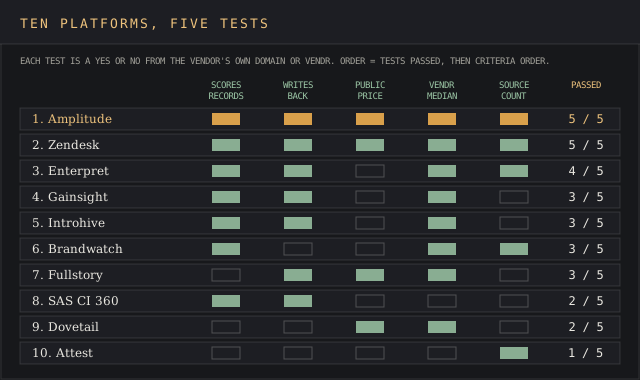
Five criteria decide the shortlist, and the ranking below applies them in this order. Each one is a yes or a no a buyer can check on the vendor's own domain or on Vendr in under ten minutes, for any of the customer intelligence tools on this page.
A documented model that scores each customer or record
The vendor's own documentation names a model that labels every record: churn risk, purchase likelihood, account health or a sentiment class. A dashboard of counts fails. The test is a named feature, such as SAS's likelihood-to-churn model or Zendesk's five-class sentiment field.
Writes results back into a named CRM or engagement tool
A score has to reach the people handling customer interactions. The test passes when the docs name a destination, Salesforce, Braze, HubSpot or the vendor's own agent workspace, that receives the score or segment.
A free plan or list price on the vendor's domain
A buyer can price the first year before a sales call. Amplitude, Zendesk, Fullstory and Dovetail pass. Six vendors quote every deal.
A Vendr median for the product
Vendr publishes a median annual contract and range from anonymised purchases. Eight of the ten have one. A company-wide median covering unrelated products fails.
A published source or connector count
The vendor states how many integrations, sources or respondents it reads. A number lets a buyer compare data integration breadth across tools and see how much customer intelligence data each one can reach.
Tools passing the same number of tests sit in the order of the first test where they differ. Where every test matches, the lower published entry price wins, then the larger Vendr purchase count.
The 10 best customer intelligence platforms in 2026
Amplitude
Best fit
Product and growth teams that need customer analytics on in-app behaviour, want to analyze customer data without a data team, and want to start free.
Amplitude is a product analytics platform whose free plan covers 2 million events a month with unlimited seats. Its integration directory lists 159 sources and destinations.
Amplitude also sits on our market and customer segmentation tools ranking for building segments. Here it's scored on what it predicts and where it sends the result.
Behavioural cohorts sit at the centre, built from customer behavior inside the product. A team builds a cohort from purchase frequency, a funnel step or a retention curve, then syncs it to Salesforce, Braze or HubSpot. Amplitude also takes in feedback: the free plan includes 2,000 AI feedback records, so attitudinal data lands beside the events.
Key features
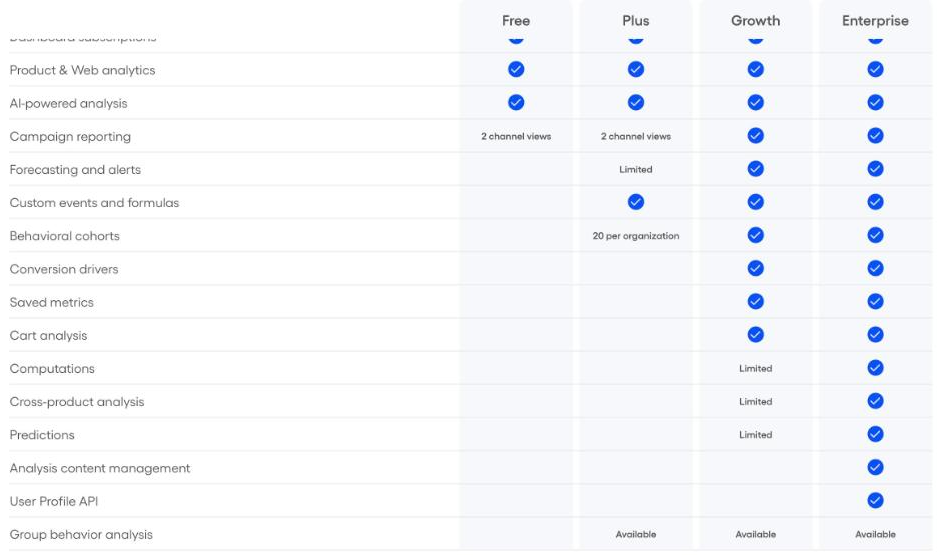
- Predictions, limited on Growth and included on Enterprise
- Cohort syncs to Salesforce, Braze and HubSpot, one-time on Free
- Session Replay with 10,000 monthly replays on Free
- User Privacy API for GDPR and CCPA deletion requests
- SOC 2 Type II and ISO 27001, per its security page
Pricing
Free covers 2M events, 10 saved charts and 1 year of data access. Plus starts at $0 and scales to 700,000 MTUs or 70M events. Growth and Enterprise are custom. Vendr's anonymised buyer data puts the median at $64,000 a year across 421 purchases, from $24,750 to $382,219.
Pros
- Free plan with unlimited seats and 2M events
- 159 listed integrations for data integration both ways
- Startups under $10M in funding and 20 employees get one free year of Growth
Cons
- Predictions are absent from Free and Plus
- SSO starts on Growth
- Free keeps 1 year of data, Plus 2 years
"Now, any PM on the team can spin up a funnel or retention curve in under 15 minutes."
Dmitry H., Product Manager, Mid-Market, G2, 13 August 2025
The cost jump past Plus is a bitter pill to swallow for growing teams. In the same G2 review, Dmitry H. wrote that "the cost ramp from the Growth tier to Enterprise is aggressive."
Why it’s ranked #1. It passes all 5 tests, as Zendesk below does, and wins the tie-break on published entry price: $0 for 2M events and unlimited seats against Zendesk's $55 per agent a month.
Zendesk
Best fit
Support and customer experience organisations that want customer sentiment and topic data from every ticket.
Zendesk reads customer interactions in the support queue. Its intelligent triage labels each ticket by topic, sentiment, language and entities, in about 150 languages, on Suite Professional and above. That turns customer complaints into a field a manager can filter.
The sentiment field has five classes, from most positive to most negative. Routing rules act on it inside the agent workspace, which is where improving customer service shows up first. Managers use the field to nip a run of negative tickets in the bud and improve customer satisfaction on those topics. The marketplace lists 1,000+ prebuilt apps.
Key features
- Intelligent triage on topic, sentiment, language and entities
- Prebuilt analytics dashboards on every Suite plan
- AI agents billed per automated resolution, 5 per agent a month on Team and Professional
- Copilot add-on at $50 per agent a month, billed yearly
- Quality assurance as a separate add-on
Pricing
Zendesk publishes Suite Team at $55 per agent a month billed yearly ($69 monthly) and Suite Professional at $115 ($149 monthly). Vendr's median is $53,035 a year across 1,202 purchases, from $8,618 to $267,131.
Pros
- List prices for Team and Professional
- Sentiment analysis on every ticket at Professional
- 1,202 Vendr purchases, the largest buyer sample here
Cons
- Triage needs Professional at $115 per agent
- QA and Copilot cost extra
- Reads support conversations, so product usage needs a second tool
"Pricing can be quite high, especially as you scale or need advanced features. Some customisations and reporting setups are a bit complex and require time to learn."
Sonu P., Systems Analyst, Consumer Goods, Capterra, 3 May 2026
Why it’s ranked #2. It passes all five tests but loses the tie to Amplitude's $0 entry, since its cheapest Suite costs $55 per agent. It beats Enterpret on published price: $55 per agent against a quote.
Enterpret
Best fit
Product organisations drowning in feedback from tickets, reviews, calls and surveys.
Enterpret connects 50+ feedback tools, from Zendesk and Intercom to Gong, G2 reviews and app stores, then classifies every item against an adaptive taxonomy. That's customer intelligence analytics built for the product team, and it turns one complaint across 50+ tools from a needle in a haystack into a search. Its homepage says Canva has analysed 220M+ pieces of customer feedback in it.
The angle here differs from our customer feedback analysis tools ranking, which grades survey and CX suites. Enterpret ties each comment to customer context from CRM data and product usage, so a product manager sees revenue behind pain points and gets insights into customer needs by account.
Key features
- Connectors for Salesforce, Snowflake, Amplitude, Mixpanel and Jira
- Wisdom, an AI assistant that answers questions from feedback
- Adaptive taxonomy that labels each record
- SOC 2 Type 2 report, per its security page
Pricing
Enterpret quotes every deal. Vendr's median is $36,302 a year, from $23,040 to $98,000.
Pros
- 50+ sources unify customer data from support, sales and reviews
- Feedback linked to account revenue
- SOC 2 Type 2 plus GDPR and CCPA processor terms
Cons
- Every contract goes through sales
- Vendr median shown without a purchase count
- Value depends on taxonomy tuning
"onboarding was hard and a long, drawn-out process. I'm still struggling to create my own dashboards accurately."
Stephanie Redfern, Director of Product Design, The Predictive Index, TrustRadius, 20 April 2026
Why it’s ranked #3. It passes 4 of 5 tests and drops behind Zendesk on public price, a test Zendesk passes at $55 per agent. It beats Gainsight on source count, with 50+ feedback tools where Gainsight lists connectors without a total.
Gainsight CS
Best fit
B2B customer success teams managing renewals across hundreds of accounts.
Gainsight CS builds a Customer 360 per account: health scorecards, product usage, support history from customer interactions, renewal dates and a stakeholder map in one record. Pre-built risk, handoff and expansion agents run on top.
The product page claims 20%+ churn reduction and renewal-forecast accuracy reaching 95%. Those are Gainsight's own figures.
That record shows customer relationships at the account level, across every contact at the customer. Risk agents keep an eye on usage and support signals ahead of renewal. Gainsight has bought its way into new data. Its newsroom lists Northpass in July 2023, Staircase AI in August 2024 and Skilljar in April 2025.
Key features
- Health scorecards per account
- Risk agents flagging customer churn ahead of renewal
- Connectors for Salesforce, Snowflake, Zendesk, Gong and Jira on its integrations page
- Gainsight MCP exposing account context to external LLMs
- Survey and call-summary analysis
Pricing
Gainsight quotes every deal. Vendr's median is $49,313 a year across 377 purchases, from $13,477 to $183,199.
Pros
- One account record across usage, support and renewal data
- 377 Vendr purchases to benchmark against
- TrustRadius score of 8.8 out of 10 across 697 ratings
Cons
- Price set per contract by sales
- Dashboards need admin time
- Built for B2B accounts, a poor fit for consumer volume
"It cost us a lot of bandwidth in setting up the dashboard based on our Senior management's liking."
Sadan Shabir, Customer Success, Aryaka Networks, TrustRadius, 27 August 2026
The same reviewer said the payoff is call prep.
"before the customers calls we just have to take 5 minutes to look at the present state of the customer."
Sadan Shabir, Aryaka Networks, TrustRadius, 27 August 2026
Why it’s ranked #4. It passes 3 tests and trails Enterpret, which adds a 50+ source count for a fourth pass. It sits above Introhive on the same 3 passes because Vendr shows 377 Gainsight purchases and an Introhive median with the count hidden.
Introhive
Best fit
Law, accounting and consulting firms whose customer relationships live in partners' inboxes.
Introhive captures relationship data automatically and pushes it into the firm's CRM, so contact records stop decaying.
Introhive claims 90% data accuracy across contact records and quotes Freshfields at 97% for its CRM systems.
Its relationship intelligence layer adds Signals for account health and tracks the strength of each connection. That keeps customer relationship management (CRM) records current from captured activity, so partners see customer relationships across the firm.
Key features
- Automated contact capture into the CRM
- Signals for account health and engagement needs
- Data quality cleanup on existing records
- Relationship maps across a firm's partners
Pricing
Introhive quotes every deal. Vendr's median is $36,000 a year, from $19,333 to $47,400.
Pros
- Fixes data quality at the source
- Built for professional-services CRMs
- Narrow Vendr range, $19,333 to $47,400
Cons
- Quoted per firm, with the integration list behind a login
- 12 Capterra reviews
- Configuration drags on for multinational client structures
"The 12 month retro sweep was not particularly useful and confused staff during the rollout process."
Carrie G., Marketing Adviser, Legal Services, Capterra, 17 December 2020
Why it’s ranked #5. It matches Gainsight's 3 passes and loses the tie on Vendr evidence, a median without a purchase count against Gainsight's 377. It beats Brandwatch on write-back, since Introhive writes contacts into the CRM and Brandwatch fails that test.
Brandwatch
Best fit
Consumer brands that want customer sentiment and broader market trends from public conversation.
Brandwatch Consumer Research indexes 1.4+ trillion posts back to 2008 from 100m+ online sources, adding 496 million posts a day. Iris, its AI assistant, writes summaries, and custom machine learning classifiers label posts.
Brandwatch also ranks on our social listening ranking for alerts and share of voice. Here it earns its place as the psychographic data source: what customers value and complain about on social media platforms, outside any survey. Our Brandwatch pricing report covers the contract side.
Key features
- Historical data to 2008
- Iris AI summaries
- Image analysis
- Custom machine learning classifiers for sentiment analysis and topics
Pricing
The pricing page lists standard and enterprise plans and routes every price to a demo. Vendr's median is $50,000 a year across 40 purchases, from $19,542 to $81,200.
Pros
- 18 years of post history
- 100m+ sources, the broadest public-data reach here
- Capterra rating of 4.2 across 255 reviews
Cons
- Standard and enterprise plans priced through sales
- Reads public posts, so it can't see a named account
- Query setup takes training before new users know the ropes
"When data pulled through Brandwatch was compared to data pulled from in platform, the figures did not match. It made it hard to rely on the platform."
Jordan H., Social Media Coordinator, Retail, Capterra, 15 May 2026
Why it’s ranked #6. It passes 3 tests and falls behind Introhive on write-back to a named destination. It beats Fullstory on the first criterion, because Brandwatch runs custom classifiers over 1.4+ trillion posts and Fullstory documents 0 scoring models.
Fullstory
Best fit
Ecommerce and SaaS teams that need to see where a checkout or signup breaks.
Fullstory records sessions and turns clicks into behavioral data, the customer analytics that shows where a customer journey breaks in checkout. The free plan covers 30,000 sessions a month, 12 months of retention and up to 10 users.
Fullstory Anywhere: Activation sends real-time behaviour signals into a CRM, CDP or email tool to trigger messages. That's the write-back test passed, and one feed kills two birds with one stone: replay for diagnosis, signals for messaging.
Key features
- Session replay across web and app
- StoryAI agents as an add-on
- Activation to CRM, CDP and BI tools
- Mobile analytics and guides as add-ons
Pricing
Business, Advanced and Enterprise are quoted. Vendr's median is $28,240 a year across 455 purchases, from $10,000 to $115,936.
Pros
- 30,000 free sessions a month
- 455 Vendr purchases to benchmark against
- Self-serve dashboards
Cons
- Leaves churn and sentiment scoring to other tools
- Business, Advanced and Enterprise priced through sales
- Reads web and app sessions only
"Price, it is one of the most (if not the most) expensive of the session recording options out there, which is a bit hard for a lot of startups to justify."
Lorenq H., VP of Operation, Human Resources, Capterra, 30 October 2025
The same reviewer named one upside, the dashboards.
"I also really liked how easy it was to self-serve create custom dashboards without having to involve my developer team"
Lorenq H., VP of Operation, Human Resources, Capterra, 30 October 2025
Why it’s ranked #7. It passes 3 tests and trails Brandwatch on the first criterion, a scoring model. It beats SAS CI 360 by 1 test, with a $0 plan covering 30,000 sessions a month where SAS quotes every contract.
SAS Customer Intelligence 360
Best fit
Large banks, insurers and retailers running next-best-action across channels.
SAS Customer Intelligence 360 carries the category's name in its product title. Its Marketing AI ships out-of-the-box likelihood-to-churn and likelihood-to-purchase models built on transactional data and channel history, so scores feed offers directly. Forrester named it a Leader in three Waves between Q4 2024 and Q2 2026.
It's the decisioning engine of the ten: Audiences, Journeys, Destinations and Marketing Decisioning on an embedded CDP. Every customer journey runs through one rules layer, and buyers bite the bullet on setup time.
Key features
- Likelihood-to-churn and likelihood-to-purchase models
- Next-best-action templates
- Journey orchestration across email, mobile, social and CRM
- Embedded CDP with a hybrid data architecture
Pricing
SAS quotes CI 360 per contract. Vendr's SAS page aggregates every SAS product into one median, which fails the product-level test.
Pros
- Predictive models ship ready to use
- Reads on-premises and cloud data in place
- Gartner Peer Insights average of 4.3 across 63 ratings
Cons
- Priced per contract, and Vendr's median covers every SAS product
- Interface needs training
- Licensing priced for enterprises
"The enterprise licensing model is complex and expensive, making it harder to budget for and cost-prohibitive for smaller businesses."
Rachel W., Construction, 11-50 employees, Software Advice, September 2026
A marketing and advertising reviewer on the same page praised the data access in August 2025.
"It works very well with both on-prem and cloud databases without the need to copy data, just pulling metadata."
Marketing and advertising reviewer, Software Advice, August 2025
Why it’s ranked #8. It passes 2 tests, 1 fewer than Fullstory's 3, so the free session plan above it wins. It beats Dovetail on the first criterion, because SAS ships 2 predictive models and Dovetail documents 0.
Dovetail
Best fit
UX research teams turning interviews into a searchable insight repository.
Dovetail stores interviews, transcripts, support tickets and survey data, then tags them into themes for qualitative data analysis of customer needs. Its integrations include Zendesk, Intercom, Gong, Salesforce Service Cloud, HubSpot Service Hub and Snowflake. It holds a SOC 2 Type II report, per its security page.
Key features
- Automatic transcription and AI summaries
- Tagging into themes across projects
- Channels that import tickets and calls
- Salesforce and HubSpot contact imports
Pricing
The free plan covers one channel, one project and one dashboard. Enterprise is custom on net-30 terms. Vendr's median is $21,600 a year across 41 purchases, from $10,800 to $76,800.
Pros
- Lowest Vendr median of the eight with one
- Free plan to test the workflow
- Capterra rating of 4.6 across 97 reviews
Cons
- Fails the scoring and write-back tests
- Features moved up tiers on renewal
- Taxonomy is the buyer's job
"It was a near 4x leap in costs to maintain parity with what we had before to maintain our existing repository structure."
Emi F., User Experience Researcher, Information Technology and Services, Capterra, 30 October 2024
"The tool has reduced my team’s time from synthesis to actionable insights from days to hours."
Paula B., Manager HCD, Medical Devices, Capterra, 10 October 2024
Why it’s ranked #9. It passes 2 tests, tied with SAS, and loses on the first criterion, scoring. It beats Attest by 1 test, with a free plan and a $21,600 Vendr median Attest can't match.
Attest
Best fit
Brand and insight teams that need fast consumer surveys across countries.
Attest reaches 150M+ consumers in 59 markets in 70+ languages. It fills the gap the other nine leave: demographic and attitudinal answers from people who aren't customers yet, so a team can test customer needs before a launch.
Attest also appears on our market research tools ranking. Here the angle is narrower: Attest is the survey arm a customer intelligence strategy calls on when product events can't explain a drop.
Key features
- Credits: one answer from one person is one credit
- Same audience fee for niche targeting
- A named research expert on every plan
- Unlimited seats
Pricing
Plans run on credits: Basic up to 50,000, Standard 100,000, Elite 200,000 and Custom 400,000+. The per-credit rate comes from a demo call.
Credits a 10-question survey to 500 people uses on Attest, where one answer from one person is one credit.
Pros
- 150M+ respondents in 59 markets
- Capterra rating of 4.7 across 981 reviews
- Credit math published
Cons
- Per-credit rate set in a sales call
- Passes 1 of 5 tests
- Reads stated opinion, which drifts from behaviour
Head of Marketing Benjamin T. put the catch in one line on Capterra on 11 March 2024: "The limitation is cost, which can be high for smaller companies or startups".
Why it’s ranked #10. It passes 1 test, its 150M-respondent count, against Dovetail's 2. It makes the list ahead of unranked survey tools because it samples non-customers in 59 markets, which none of the other 9 do.
What customer intelligence software does
Customer intelligence (CI) software collects records about buyers, labels them, and pushes actionable insights to the team that acts. Sprinklr's CI explainer calls CRM systems "a primary source of customer intelligence data", which is why write-back to customer relationship management systems carries a criterion here. Teams that already own business intelligence software still need this layer, since business intelligence reports aggregates by region or product.
Customer intelligence focuses on the person or account behind a number. A business intelligence dashboard reports revenue by region from the company's own ledgers. A customer intelligence solution flags the account whose weekly usage dropped after a price change and opens a task for its owner. That account-level action is the job of customer intelligence analytics.
The work runs in four steps:
- Data collection from product events, tickets, calls, surveys and CRM fields
- Integrating data into one record per customer or account
- Analyzing data with machine learning and advanced analytics: sentiment, topic, churn risk, purchase likelihood
- Sending the score to Salesforce, Braze, HubSpot or an agent queue
Teams that skip step 4 end up with a dashboard nobody opens.
A vendor that can't show where the score lands on Monday is waving a red flag, whatever business outcomes its deck promises.
Types of customer intelligence data
There are five types of customer intelligence, and each needs a different source. Zendesk's customer intelligence guide and LiveRamp's CI explainer define them the same way:
- Transactional data: purchase history, order frequency, average order value, subscription status
- Behavioral data: how customers interact across website, app and social touchpoints along the customer journey
- Demographic data: age, gender, income, education, location
- Psychographic data: attitudes, interests, values and lifestyle
- Attitudinal data: how customers feel about products, from customer satisfaction scores to pain points
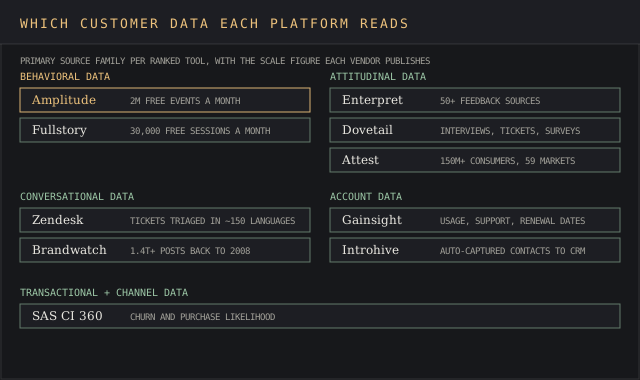
Customer intelligence examples make the split concrete. Amplitude reads behavioural events and purchase frequency. Enterpret and Dovetail read attitudinal data from customer surveys and tickets. Attest supplies demographic answers. Brandwatch reads psychographic signals in public posts, the raw material of brand reputation.
Transactional data is where most stacks start, and it's the thinnest. Purchase history, average order value and customer lifetime value show the outcome, and they can't say why a buyer left. Pairing them with attitudinal data from surveys and support adds the reason, and consumer data from panels like Attest's adds the people who never bought.
Customer intelligence platforms versus customer data platforms
A customer data platform resolves identity: it merges every email, device and order into one profile so systems share a unified view. Customer intelligence platforms work on top of that profile, scoring and explaining it.
The two lists barely overlap, and Google's results for the two phrases barely share a URL. Buyers whose job is to unify customer data and remove data silos should start with the CDP list in our customer data intelligence ranking, where Salesforce Data 360 and Twilio Segment sit.
Most teams need both eventually. A CI tool fed duplicate profiles scores the same buyer twice, so the order runs identity first, then the analysis layer that turns a unified view into customer insights.
Why companies buy customer intelligence now
Four published figures explain the customer experience budget line. Each one is attributed to the body that published it:
- LiveRamp cites an Acxiom survey in which 87% of executives agree analytics give them an edge in improving customer experiences
- The same LiveRamp page, citing Winterberry Group, puts US data-driven marketing spend at over $270 billion in 2023, up from $85.7 billion in 2004
- Zendesk's CX Trends research found 62% of customers wish businesses did more personalization
- Sprinklr's CX statistics page reports 77% of consumers have chosen, recommended or paid more for a brand offering a personalized experience
The usual revenue lift from personalization in McKinsey's 2021 study.
Personalized marketing pays when it lands, and that lift is the business case for customer intelligence: measured customer preferences feeding offers, product fixes and renewal calls, with the customer experience as the scoreboard.
Churn is the other driver. Gainsight's risk agents and SAS's churn model both exist to flag an account before it leaves, which protects customer loyalty and business growth with the same data.
Pricing across customer intelligence platforms
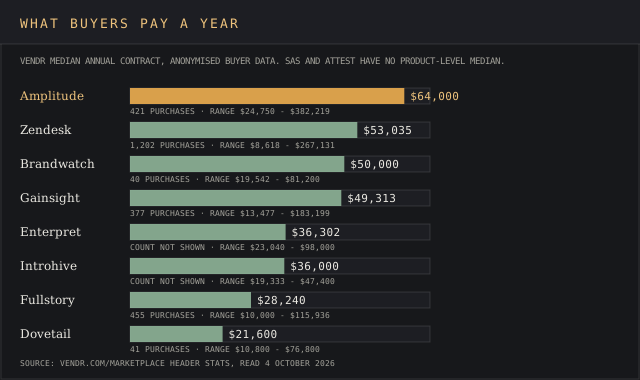
Vendr medians for the eight ranked tools with one run from $21,600 for Dovetail to $64,000 for Amplitude.
The spread between the lowest and highest Vendr median here, across customer intelligence tools that all claim to explain customer behavior.
Three tools start at $0: Amplitude, Fullstory and Dovetail. Zendesk lists $55 per agent a month, and the other six quote every deal. Watch for these costs on top of the platform fee:
- Add-ons: Zendesk prices Copilot at $50 per agent a month and QA separately
- Tier gates: Amplitude's Predictions start on Growth, and SSO does too
- Renewal moves: one Dovetail reviewer reported a near 4x cost jump to keep the same features
- Usage meters: Amplitude counts events, Fullstory counts sessions, Attest counts answers
Read the range beside each median. Amplitude's high runs to $382,219 and Zendesk's to $267,131, five to six times their medians, so a large deployment can cost an arm and a leg next to the middle bar.
Data governance and privacy checks
Every tool here processes personal data, so data governance belongs in the shortlist. Check three things on the vendor's own domain before a trial:
- A SOC 2 Type II report: Amplitude, Enterpret and Dovetail state one on their security pages
- Deletion tooling for GDPR and CCPA: Amplitude documents a User Privacy API for deletion requests
- Processor terms: Enterpret states it acts as a GDPR processor and a CCPA service provider
Data quality is the second half of governance, and the devil's in the details. Introhive sells cleanup as a product because CRM contact data decays, and any team feeding a scoring model stale records gets stale scores.
Data management rules, owners and refresh dates, should exist before the first sync.
How to choose the right customer intelligence platform
Start from the data the team already owns, then work outward. The right customer intelligence platform is the one that reads the system where customer needs show up first.
- List the systems where you analyze customer data today: product events, support tickets, survey data, calls, CRM
- Pick the gap: missing usage visibility points to Amplitude or Fullstory, a blind spot on support points to Zendesk, and scattered feedback points to Enterpret or Dovetail
- Ask for a destination demo: watch a score land in your CRM
- Price year two: check the Vendr low and high beside the median
- Run a 30-day pilot on one question, such as why trial users churn in week two, to get the ball rolling
Product teams can start on Amplitude's free plan. Enterprise marketing teams running campaigns across channels fit SAS. Customer success teams tracking renewals go to Gainsight, and our customer intelligence framework guide covers who owns each source.
Common buying mistakes
Buying analysis before the data exists tops the list. Teams jump the gun on models with too few records. A sentiment model needs ticket volume before its trend lines mean anything, and Zendesk's triage only earns its $115 per agent at scale.
A second mistake is treating conversation tools as the whole picture. Call recordings carry customer concerns, but our conversation intelligence ranking covers Gong and its peers for sales coaching, a different job from account scoring.
Skipping segmentation costs the most later. Customer intelligence feeds segments, and a team with weak segments gets weak marketing efforts. Our guides to behavioral market segmentation and demographic market segmentation cover the setup, and Amplitude is compared head-to-head in Hotjar vs Amplitude.
Customer intelligence platforms FAQ
What does customer intelligence do?
Customer intelligence (CI) turns customer data into decisions about named accounts: which account is at risk, which feature causes complaints, which segment buys again. A business intelligence report covers the same revenue as regional totals. The ten tools above score records, then send the result to a CRM or agent queue so marketing teams and support act on it.
What is a customer intelligence platform?
Customer intelligence software that collects behavioural, transactional and attitudinal records, applies sentiment analysis or predictive models for customer intelligence analytics, and writes the output to the tools teams use. Amplitude and Zendesk pass all 5 of our tests, and Enterpret passes 4.
How much do customer intelligence platforms cost?
Vendr medians for the eight ranked tools with one run from $21,600 a year for Dovetail to $64,000 for Amplitude. Amplitude, Fullstory and Dovetail start on a free plan, and Zendesk lists Suite Team at $55 per agent a month, billed yearly.
What is a CDP used for?
A customer data platform merges identities into one profile across the customer lifecycle and sends audiences to ad and email tools. It's the identity layer under customer intelligence. Our CDP ranking lists ten of them.
What are examples of CX tools?
Zendesk for support, Gainsight for customer success, Fullstory for digital experience and Dovetail for research are four of the customer intelligence tools on this list. Each reads a different slice of the customer experience, so most teams run two.
How do teams leverage customer intelligence for retention?
They score accounts on usage and sentiment, then trigger a call before renewal. Gainsight's risk agents and SAS's churn model do this out of the box. Amplitude does it on Enterprise with Predictions.
Bottom line
Amplitude wins for product teams: it passes all five tests and starts at $0. Zendesk wins for support-led companies that want customer sentiment on every ticket. Enterpret wins when feedback sits in a dozen tools and the product team needs one answer.
Gainsight fits B2B customer success, Introhive fits partner-led firms, and Brandwatch fits consumer brands reading the public. SAS fits enterprises that run next-best-action across channels and accept a quoted contract.
For identity resolution, go to the CDP ranking. For everything that explains why a customer stays or leaves, start with the customer intelligence software that reads the data your team already has.