Business Consulting Services: 10 Firms Ranked on Published Numbers (2026)
 By Jan Suski. I go deep on every review, checking every number against its source and digging up details other coverage misses, a habit from six years of SEO and link building for tech companies. Bylines at Surfer, Brand24, and Senuto. How the scoring works.
· Prefer this source on Google
Quick comparison of the top business consulting firms
Ten business consulting firms in ranked order, with the consulting revenue each one publishes, its entry price and the buyer it fits.
| # | Firm | Consulting revenue published | Entry price | Best fit |
|---|---|---|---|---|
| 1 | Accenture | $35.11B (FY2025) | Quote per engagement | Technology-led business transformation at enterprise scale |
| 2 | Deloitte | $70.5B whole firm, no consulting split | Quote per engagement | Regulated companies that want risk, tax and technology from one network |
| 3 | PwC | $24.3B advisory (FY2025) | Quote per engagement | Deals and finance-led transformation |
| 4 | EY | $16.4B consulting (FY2025) | Quote per engagement | Transaction advisory plus implementation in 150+ countries |
| 5 | KPMG | $16.4B advisory (FY2025) | Quote per engagement | Risk management and finance operations work |
| 6 | BCG | $14.4B whole firm | Quote per engagement | Growth strategy with an AI build team attached |
| 7 | McKinsey & Company | Not published | Quote per engagement | Board-level strategy in 65+ countries |
| 8 | Bain & Company | Not published | Quote per engagement | Private equity diligence and customer loyalty work |
| 9 | RSM | 40% of $5.0B (FY2026) | Quote per engagement | Middle-market companies |
| 10 | America's SBDC network | Not applicable | $0 | Small businesses and first-time owners |
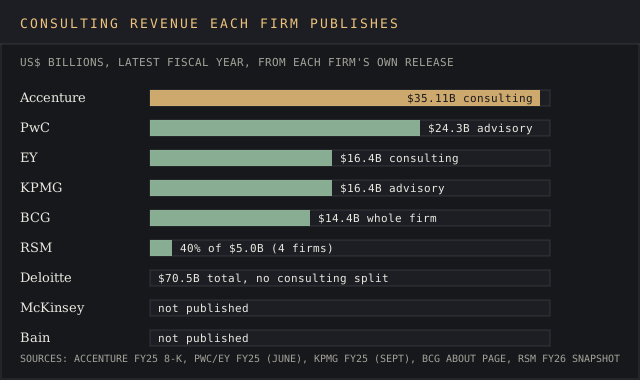
Revenue figures come from each firm’s own latest fiscal-year release. None of the nine paid firms publishes a rate card, so each of their price cells reads quote per engagement.
Where these figures come from
Revenue, headcount and country counts are each firm’s own published figure, taken from the annual results, press releases and about pages linked in each entry and read in October 2026. Deloitte and BCG publish whole-firm revenue only, and RSM states consulting as a 40% share of its $5.0 billion. No firm here publishes a rate card or its partner-to-junior staffing mix, so no row claims either one.
This ranking covers firms that sell advice by the engagement. Subscription sources for the research half of a consulting brief are ranked separately: syndicated stats and market sizing in the market database ranking, and company, deal and audience data in the tools for market analysis ranking.
Business consulting services sell outside expertise by the week: a team of consultants studies an operating problem, recommends a fix and, at the larger firms, stays to build it. Accenture alone earned $35.11 billion of consulting revenue in fiscal 2025, so the market is big enough that every firm claims to be the right one.
This page ranks 10 business consulting firms on numbers each firm publishes about itself: consulting revenue, headcount, country reach and price. It's built for decision makers and business leaders shortlisting one of the consulting firms below for a strategy, operations, technology or deal project, and for owners of small businesses who need advice without a six-figure retainer.
Most top-10 lists of consulting firms rank on reputation. This one ranks on figures a reader can check in an annual review in 10 minutes, and the gap between firms that publish them and firms that keep them private is the most useful thing a buyer learns before the first call.
Evaluation criteria for business consulting services
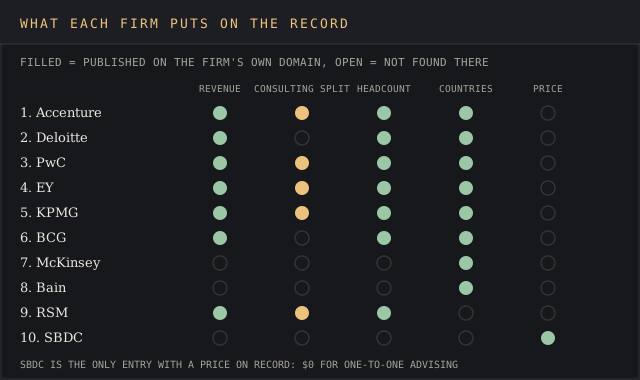
Five criteria decide the shortlist, and the ranking below applies them in this order. Each one is a test a buyer can run in 10 minutes on the firm's own website, and each produces a number or a yes/no.
1. Published consulting revenue
Does the firm state, on its own domain, how much revenue its consulting or advisory business earned last fiscal year? A firm that splits out consulting revenue lets a buyer size the practice they're hiring. A firm that reports one blended figure, or none, asks the buyer to take scale on trust.
2. Published headcount
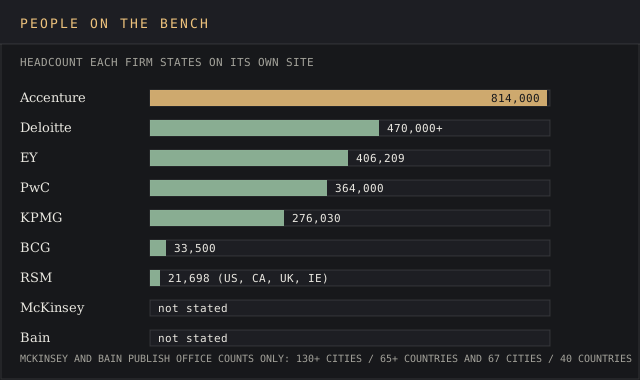
How many people does the firm say it employs? Headcount sets how fast a firm can staff a 40-person program or replace a consultant who leaves mid-project. Partner-to-junior mix isn't published by any firm here, so this is the closest public proxy.
3. Country reach
How many countries does the firm list? A supply chain redesign across 12 plants in 9 countries needs local teams in each one. The count comes from the firm's own about page or annual review.
4. Coverage of the five consulting service types
Does the firm sell strategy, operations, digital and technology, people and change management, and deal or restructuring work? A firm missing one of the five hands that workstream to a second vendor, and the client manages the seam between them.
5. Price on record
Is any price published? Only one entry here passes. The other nine quote per engagement, which is why the pricing section further down leans on government wage data.
The SBDC network is the only entry with a price on record: $0 for one-to-one advising.
The 10 best business consulting services firms, ranked
Each entry follows one shape: who the firm fits, what it publishes, its consulting services, pricing, pros and cons, a quote from someone who worked with it, and the reason for its rank.
Accenture
Best fit
Large organizations buying a technology-led business transformation that runs from strategy through system build and managed operations.
Accenture is the only firm on this list that files audited results with the SEC, and its fiscal 2025 release breaks revenue into $35.11 billion of consulting out of $69.7 billion total, with $80.62 billion in new bookings. Its company index lists 814,000 employees, offices in 52 countries & more than 9,000 clients in over 120 countries.
Key features
- $5.9 billion of new generative AI bookings in fiscal 2025, the only AI bookings figure any firm here publishes
- Consulting and managed services reported as two separate revenue lines
- Operations in 200+ cities across 52 countries
- 9,000+ clients served across more than 120 countries
Pricing
No published rate card. Engagements are quoted per scope, and the public bookings figure is the only aggregate a buyer can see.
Pros
- Audited consulting revenue, split from managed services
- 814,000 people, the largest bench in the ranking
- Strategy, implementation and support sold by the same firm
Cons
- Large programs carry large failure exposure
- No rate card, even for small scopes
- Offices in 52 countries, fewer than Deloitte's 150+
The size cuts both ways. A Hacker News commenter writing in January 2026 described the downside of a big systems integrator at work:
"They messed up a $30 million dollar project big time at a previous company."
Hacker News user victor106, 16 January 2026, on Accenture
A former Accenture consultant who worked on transit fare-card programs made the opposite case: "sometimes it is the best option" (Hacker News, December 2022).
Why it’s ranked #1. Accenture wins criterion 1 outright: $35.11 billion of consulting revenue, broken out and audited. Deloitte reports a bigger $70.5 billion but no consulting split, so Accenture is the one buyer-checkable consulting practice of this size.
Deloitte
Best fit
Regulated organizations in financial services, life sciences or the public sector that want risk, tax and technology advisory services from one network.
Deloitte reported $70.5 billion of aggregate revenue for the year ending 31 May 2025, up 4.8% in local currency, with over 470,000 people in more than 150 countries and territories. Its consulting business is reported as two units, Strategy, Risk & Transactions and Technology & Transformation, which grew 5.5% and 4.7%. Dollar figures for those units aren't disclosed.
Key features
- Strategy, Risk & Transactions unit: growth strategy, risk management, transaction advisory and restructuring
- Technology & Transformation unit: digital transformation, ERP, cloud and software development programs
- Audit & Assurance and Tax & Legal inside the same network
- Americas revenue up 7.1% in local currency in fiscal 2025
Pricing
No published rate card. Engagements are quoted per scope.
Audit clients face independence rules that limit which consulting services Deloitte can sell them.
Pros
- 150+ countries and territories, tied for widest reach
- All five service types under one brand
- 470,000+ people
Cons
- No consulting revenue figure in dollars
- Audit relationships can block consulting work
- Implementation teams vary in seniority
Staffing is the recurring complaint. One Hacker News commenter described a system rollout that a smaller vendor later finished:
"Deloitte stuck 4 junior consultants along with 5 senior consultants and spent a couple million dollars for 12 months"
Hacker News user S_A_P, 31 January 2021
Why it’s ranked #2. Deloitte's $70.5 billion and 150+ countries beat PwC's $56.9 billion and 136 countries. It trails Accenture because it doesn't publish a consulting revenue line, which is criterion 1.
PwC
Best fit
Companies buying deal work, finance transformation or strategy from a firm that also knows their audit file.
PwC firms recorded $56.9 billion of gross revenue in the 12 months to 30 June 2025, and advisory revenue rose 4.5% to $24.3 billion. The network counts 364,000 people serving clients in 136 countries. Strategy work runs under the Strategy& brand.
Key features
- Advisory reported as its own $24.3 billion line
- Strategy& for business strategy and operating model design
- Deals practice covering transaction advisory, valuation and restructuring
- 364,000 people in 136 countries
Pricing
No published rate card. Big 4 hourly rates are quoted per role and engagement.
Pros
- Advisory revenue published in dollars
- Deals and finance depth
- 136 countries
Cons
- Revenue growth of 2.9% in fiscal 2025, the slowest of the Big 4
- Independence rules limit work for audit clients
- Junior hours billed at Big 4 rates
The rate structure is the thing buyers notice first. An accountant on Hacker News put the first-year associate rate in plain terms back in 2010:
"If you're hiring a "big 4" firm like pwc, kpmg, deloitte or e&y then their standard hourly rate is 375 per hour"
Hacker News user camz, 27 October 2010
Why it’s ranked #3. PwC's $24.3 billion advisory line beats EY's $16.4 billion consulting line on criterion 1. It sits below Deloitte, whose 150+ countries and $70.5 billion outrun PwC's 136 countries and $56.9 billion.
EY
Best fit
Companies running a sale, carve-out or acquisition that want transaction advisory and the follow-on integration from one firm.
EY reported $53.2 billion of revenue for fiscal 2025, up 4.0% in local currency, and consulting grew 5.2% to $16.4 billion. Headcount was 406,209 at the end of June 2025, across more than 150 countries and territories. Strategy and deal work sells under the EY-Parthenon brand.
Key features
- Consulting reported as a $16.4 billion service line
- EY-Parthenon for strategy and transaction advisory
- 406,209 people, published to the single digit
- Services in more than 150 countries and territories
Pricing
No published rate card. Ask for a fixed fee per deal phase so the bill can't get out of hand during a long close.
Pros
- Exact headcount and consulting revenue on record
- 150+ countries
- Deals and implementation in one firm
Cons
- Consulting line half the size of Accenture's
- Audit independence limits apply
- Brand split between EY and EY-Parthenon confuses scoping
The Big 4 case is price and practicality. A Hacker News commenter comparing the Big 4 with McKinsey, BCG and Bain wrote in 2021:
"Big 4 typically has more down to earth / implementation experience due to commanding lower prices"
Hacker News user harperlee, 27 February 2021
Why it’s ranked #4. EY ties KPMG at $16.4 billion but wins on reach: 150+ countries against KPMG's 138, and 406,209 people against 276,030. It loses to PwC's $24.3 billion advisory line.
KPMG
Best fit
Finance, risk and compliance leaders in organizations that want advisory work tied to controls and reporting.
KPMG reported $39.8 billion of revenue for the year to 30 September 2025, up 5.1% in local currency. Advisory brought in $16.4 billion and grew 2.9%. Headcount reached 276,030 across 138 countries and territories.
Key features
- Advisory reported as a $16.4 billion line
- Risk management, data governance and regulatory compliance work
- Deal advisory and restructuring
- 276,030 people in 138 countries
Pricing
No published rate card.
Pros
- Advisory revenue published in dollars
- Strong risk and controls focus
- Fiscal year ends in September, so figures are the freshest of the Big 4
Cons
- Advisory grew 2.9%, slower than EY consulting's 5.2%
- Smallest Big 4 bench at 276,030
- Deliverables can lean on spreadsheets
That last point comes from a client. A Hacker News commenter wrote in 2019 that "KPMG consultants sent us a lot of forms built in spreadsheets", work they felt should have been a web form.
Why it’s ranked #5. KPMG's $16.4 billion advisory figure beats BCG's $14.4 billion whole-firm revenue. It falls behind EY on reach, 138 countries to 150+, and on headcount, 276,030 to 406,209.
Boston Consulting Group
Best fit
Leadership teams buying growth strategy and an AI build team under one contract.
BCG's about page lists $14.4 billion of annual revenue, 33,500 employees and offices in 100+ cities across more than 50 countries. It says 40% of revenue comes from tech and AI work, delivered largely through BCG X, its build-and-design unit.
Key features
- 16 industries and 20 capabilities served, supported by 9 specialty businesses
- 40% of revenue from tech and AI
- BCG X for product development, AI builds and innovation work
- Claims Top 100 clients earn 12% higher shareholder returns than the S&P 1200
Pricing
No published rate card.
Pros
- The only strategy-first firm here that publishes revenue
- Large tech and AI share of work
- Strategy depth across 16 industries
Cons
- 33,500 people, a fraction of any Big 4 bench
- No consulting split because the whole firm is consulting
- Strategy fees on questions an internal team could answer
The fee question isn't hypothetical. An insurance company employee on Hacker News recalled in 2024 that their employer:
"paid a million dollars to the Boston Consultancy Group on if we should use agile or not for development"
Hacker News user azemetre, 16 May 2024
Why it’s ranked #6. BCG publishes $14.4 billion of revenue, which McKinsey doesn't publish at all. It ranks below KPMG's $16.4 billion advisory line and 276,030-person bench.
McKinsey & Company
Best fit
Boards and CEOs buying strategic planning, market analysis and research-backed growth plans.
McKinsey runs offices in over 130 cities in more than 65 countries, and half of those offices sit in fast-growing markets. Its overview page counts over 50,000 former colleagues in nearly 140 countries. Revenue and current headcount aren't on either page. The McKinsey Global Institute publishes research under five themes, from productivity and prosperity to technology and markets of the future.
Key features
- McKinsey Global Institute research across 5 themes
- QuantumBlack, its artificial intelligence and analytics unit
- 130+ cities in 65+ countries
- 50,000+ alumni in nearly 140 countries, many now company executives
Pricing
No published rate card.
Pros
- Widest office footprint of the strategy firms
- Deep public research library
- Alumni network inside client companies
Cons
- No revenue or headcount published
- Recommendations can outrun what a client can execute
- Premium pricing with no public benchmark
The execution gap is the most specific complaint on record. A commenter whose team inherited a McKinsey plan for implementation wrote:
"They had written down all this smart sounding stuff, but it was unworkable and really not fit to purpose."
Hacker News user tootie, 14 February 2023
Why it’s ranked #7. McKinsey's 65+ countries beat Bain's 40, so it wins the reach test between the two. It loses to BCG because BCG publishes $14.4 billion of revenue and 33,500 employees and McKinsey publishes neither.
Bain & Company
Best fit
Private equity firms running diligence, and companies working on customer loyalty and customer satisfaction programs.
Bain has worked with clients since 1973 and operates across 67 cities in 40 countries. The firm has pledged $1 billion of pro bono consulting work and says it has taken the #1 overall spot on Glassdoor a record seven times. It doesn't publish revenue or headcount. Bain created the Net Promoter System, the customer loyalty measure behind NPS scores.
Key features
- Net Promoter System for customer loyalty measurement
- Private equity diligence and portfolio work
- Annual Technology Report on artificial intelligence and emerging technologies
- $1 billion pro bono commitment
Pricing
No published rate card.
Pros
- Deep PE and diligence bench
- Training that clients notice in junior staff
- Seven #1 Glassdoor rankings
Cons
- No revenue or headcount published
- 40 countries, the narrowest reach of the large firms
- Thin implementation capacity next to the Big 4
The training reputation holds up even among critics of the industry. A 2019 Hacker News commenter defending consulting wrote:
"Places like Bain take someone with raw intelligence and give her a tremendously valuable set of skills"
Hacker News user mrosett, 19 January 2019
Why it’s ranked #8. Bain's 40 countries trail McKinsey's 65+, and neither firm publishes revenue. Bain still outranks RSM because its 67 cities and global PE practice cover deals that RSM's 119 transatlantic locations can't.
RSM
Best fit
Middle-market organizations, roughly the band between small businesses and the Fortune 1000, that want audit, tax and consulting from one firm.
RSM's fiscal 2026 snapshot reports $5.0 billion of revenue across its US, Canada, UK and Ireland firms, with consulting at 40% of the mix, or about $2.0 billion. Those four firms employ 21,698 people in 119 locations. The wider RSM International network lists 56,000 people and 500 offices.
Key features
- Consulting at 40% of a $5.0 billion transatlantic practice
- 21,698 employees in 119 locations
- Integrated audit, tax and consulting for the middle market
- Network of 56,000 people in 500 offices
Pricing
No published rate card. RSM quotes per engagement, like every paid firm on this list.
Pros
- Built for middle-market budgets
- Consulting share of revenue published
- Fiscal 2026 figures, the newest here
Cons
- No country count published
- Smaller bench for global programs
- Less strategy depth than MBB firms
The positioning is how practitioners describe it too. A 2018 Hacker News commenter ranking the accounting tiers wrote that "Grant Thornton, BDO, and RSM are the next step down" from the Big 4.
Why it’s ranked #9. RSM publishes a 40% consulting share of $5.0 billion, a figure Bain doesn't match, but its 119 locations can't cover Bain's 40-country deal work. It beats the SBDC network on depth: 21,698 paid staff.
America's SBDC network
Best fit
Owners of small businesses and first-time founders who need business consulting at no cost.
America's Small Business Development Centers run nearly 1,000 local centers offering no-cost business consulting and low-cost training. Advisors cover business plans, financing, cash flow, market research and solutions to the problems that improve performance in the first three years.
Key features
- Nearly 1,000 local centers
- One-to-one advising at $0
- Low-cost training workshops and ongoing support services
- Free help for companies at the idea stage, hosted by universities, such as the University of Houston SBDC
Pricing
$0 for advising. Training is sold at low cost, and each center sets its own schedule.
Pros
- The only price on record in this ranking: $0
- Local advisors who know the regional market
- No contract or retainer
Cons
- Advisor quality varies by center
- No deal, restructuring or large technology work
- Limited capacity per client
Quality varies from center to center, and not everyone comes away impressed. One 2023 Hacker News commenter wrote that "SBDCs are usually populated by olds".
Why it’s ranked #10. The SBDC network is the only entry that passes criterion 5 with a $0 price. It ranks last because it doesn't sell deal, restructuring or large technology work, 3 areas RSM's 21,698 staff cover.
Types of business consulting services
Business consulting services split into five types, and the firms above sell all five in different proportions. The split below follows the one NMS Consulting and CGI both publish.
- Strategy consulting: market analysis, growth planning, business strategy and strategic objectives for the next 3 to 5 years.
- Operations consulting: process redesign to improve operational efficiency, cut costs and increase productivity in business operations and the supply chain.
- Digital and technology consulting: digital strategy, digital transformation and IT delivery support, including artificial intelligence and data governance.
- People and change consulting: organization design, human resources, talent acquisition, succession planning and change management.
- Deal and restructuring consulting: transaction advisory for mergers, acquisitions and restructuring.
Financial consulting, covering budgeting, forecasting and risk management, sits across the strategy and deal types at most firms. At the Big 4 it's sold through the advisory line. Strategic financial planning, a budget plus a 3-year forecast, supports growth by showing what the company can fund. Digital transformation drives process improvement when consultants redesign workflows before they automate them.
Change management deserves its own line in any scope, because a new process only pays back once staff in the organizations involved use it, and business agility depends on that adoption.
The work covers stakeholder analysis, communication planning and training for the employees who'll run the new process, and it's how a firm minimizes resistance and disruption once the recommendation lands. Organizations with strong change management practices report higher success rates on transformation programs, which is the main reason implementation-heavy firms like Accenture and Deloitte bundle it in.
What a business consulting firm does to help clients
A business consulting firm sells three services to organizations: a neutral outside view, specialized expertise for a fixed period, and spare capacity. The outside view uncovers blind spots an internal team has stopped seeing. The fixed period is the point. A company can hire 6 supply chain specialists for 14 weeks without a long-term commitment to any of them.
In practice consultants work in four steps: analyze the issue, design solutions, help clients define goals and desired outcomes, then support implementation. The firms at the top of this list stay for the last step. Strategy-first firms often hand off after the second, and the client ends up between a rock and a hard place, holding a plan with no team to build it.
Good engagements turn initiatives into results a CFO can measure and help a company reach its full potential in business operations: cost savings from simpler processes, faster close cycles, higher customer satisfaction scores.
Business agility is the other payoff for business goals that keep moving, since a firm that has run the same digital solutions program 50 times knows where it breaks. That's the competitive advantage a client pays for: a team that has already hit the failure points on someone else's budget.
When to hire business consulting services
Organizations hire business consultants for three reasons: a decision too big to get wrong, a skill they don't have in-house, or a deadline their own team can't hit. A board weighing a $400 million acquisition buys transaction advisory. A retailer whose customer expectations shifted to same-day delivery buys supply chain and digital transformation work. A founder with 6 employees and no finance lead buys a few hours of strategic planning.
The fit test is the same for all three organizations. If the work has a start date, an end date and a deliverable your team will own afterwards, outside consulting services make sense. If it's a permanent function, bite the bullet and hire for it. Professional services firms are expensive staff augmentation when they're kept on for years.
Consulting firms that serve various industries bring pattern recognition to organizations. BCG lists 16 industries, and the Big 4 each run sector teams for financial services, energy, life sciences and the public sector. The value shows up when a firm has seen the same unique challenges at 30 other organizations and can tell you which fix stuck.
How business consulting firms support business growth
Business consulting services support business growth in two ways: they find market opportunities, and they remove the operating limits that stop a company from chasing them. The first is business strategy and market analysis, the same work our guide to market analysis and competition walks through with the HHI. The second is operations, technology and people work, which is where most consulting revenue comes from.
The firms that drive business transformation at scale pair strategy with build capacity. Accenture's $35.11 billion consulting line and BCG's 40% tech and AI share both point at the same shift: clients want innovation shipped, and they pay for consultants who stay through development and launch. Focus on firms whose proposals name the engineers alongside the strategists, and on solutions with a named owner after go-live.
Risk is the other half. Business consulting helps organizations manage risk before it lands: regulatory change, cyber exposure, a single supplier carrying 40% of volume. KPMG and Deloitte both sell risk management as a core business consulting line, and a useful first deliverable is a register of the top 10 risks with an owner for each.
Business consulting services for middle-market companies and small businesses
Middle-market organizations face constant pressure from competition, market demands and regulatory change, and they often lack the resources to improve operational efficiency on their own. Kaufman Rossin builds its business consulting practice around that gap, as does RSM at #9.
For small businesses the math is different, and it pays to cut to the chase on budget. A Big 4 junior hour can cost an arm and a leg next to a $0 SBDC session, so the sensible sequence is to start with an SBDC advisor, use free market research tools to test the idea, and hire a paid firm only once the scope is clear. Our market research cost report lists real prices from 27 vendors for the research half of that work.
How much business consulting services cost
None of the nine paid firms here publishes a rate card, so the public benchmark is wage data. The U.S. Bureau of Labor Statistics puts the median pay for management analysts at $101,860 a year, or $48.97 an hour, in May 2025, across 1,077,100 jobs.
Projected growth in management analyst employment from 2025 to 2035, per the BLS.
Billing rates for business consultants sit well above that wage, since a firm's rate covers salary, benefits, bench time and partner margin. That's why $100 an hour reads as a fair rate for an independent business consultant and a low one for a firm. Three cost traps show up in nearly every contract:
- Junior-heavy staffing: the partner sells the work and associates deliver most of the hours.
- Scope creep: a 12-week diagnostic turns into a 12-month implementation, and the devil's in the details of the change-order clause.
- Research fees: market sizing billed at consulting rates that a subscription tool covers. Compare our Gartner pricing teardown before paying a firm for analyst-style research.
How to choose a business consulting firm
Business consulting services only pay off when the buyer controls the scope. Write it before the first call. A one-page brief naming the business challenges, the business goals and the budget lets each firm hit the ground running on day one. Then focus the shortlist: run the five criteria above against each shortlisted firm's own website, and ask each one for three references from the last 24 months in your industry. A firm that can't produce them is a red flag.
Check industry expertise in your focus industries by asking who on the proposed team has run this exact project, and how many times. A firm with deep understanding of life sciences or energy will name the regulator and the system.
Management consultants who claim expertise across multiple industries should show a case from yours. Before the RFP, do the homework yourself, starting with account and firmographic data from company data providers: a market intelligence strategy and a quick market size estimate tell you which market opportunities are worth paying a firm to chase. Companies tracking rivals can start with competitive intelligence tools and bring the firm in once the question is sharp.
Ask for a fixed fee per phase with an exit after the diagnostic, and tie the second phase to two or three numbers that improve performance, such as days to close or cost per order. That keeps the ball in your court if the first deliverable misses the mark, and it gives business consultants a reason to focus on results early.
FAQ about business consulting services
What do business consulting services include?
Business consulting services include strategy, operations, digital and technology, people and change management, and deal or restructuring work. Most management consulting firms sell all five, and advisory services at the Big 4 add risk, tax and audit-adjacent work.
What does a business consulting firm do?
A business consulting firm sends a team of consultants to analyze a problem, design solutions and support implementation. Management consulting firms like McKinsey focus on business strategy; the Big 4 and Accenture add technology delivery and advisory services such as transaction advisory and risk management.
What are the different types of consulting services?
The five common types of consulting services are strategy, operations, digital and technology, people and change management, and deals. Financial, human resources and IT consulting are subsets that sit inside those five at most consulting firms.
Who are the Big 5 consulting firms?
The phrase usually means Deloitte, PwC, EY, KPMG and Accenture, the five largest firms by published revenue. In fiscal 2025 they reported $70.5 billion, $56.9 billion, $53.2 billion, $39.8 billion and $69.7 billion. McKinsey, BCG and Bain form a separate strategy tier, often called MBB.
How much does a business consultant usually cost?
Business consultants at independent shops set their own rates, and firms here don't publish rates. The BLS median wage for management analysts is $48.97 an hour, and firm billing rates run above that wage because they cover overhead and margin. SBDC advising is free.
Do business consultants make a lot of money?
The median management analyst earned $101,860 in May 2025, per the BLS. No firm in this ranking publishes partner pay.
Bottom line
Accenture wins for enterprises that want business transformation built as well as designed, and it's the only firm whose $35.11 billion consulting business is audited and broken out. Deloitte, PwC, EY and KPMG are the pick for regulated companies and deal work, with PwC strongest on advisory scale and EY on reach.
BCG, McKinsey and Bain stay the choice for board-level strategy, with the caveat that two of the three don't publish revenue at all. RSM fits the middle market, and the SBDC network is where a small business should start, since its price is $0.