Gartner pricing 2026: what a subscription costs, seat by seat
 By Jan Suski. I go deep on every review, checking every number against its source and digging up details other coverage misses, a habit from six years of SEO and link building for tech companies. Bylines at Surfer, Brand24, and Senuto. How the scoring works.
Gartner's fullest public rate card sits in a federal filing. Its GSA schedule price list, contract 47QTCA18D008L, lists a single Gartner for IT Leaders Reference license at $33,346 a year and a Global CIO Team Plus team leader at $240,600, at prices current through Modification PS-0053, effective 30 January 2026.
Vendr's buyer data puts the median Gartner contract at $76,002 a year across 149 purchases. Straight from the horse's mouth, Gartner's 2Q26 earnings supplement shows its average technology client carrying $352,000 of annual contract value.
This report covers what each license lists for, what the contract adds, how prices moved since 2024 and where customers find room at renewal. It's written for IT directors and procurement leads in organizations budgeting a first subscription, and it pairs with our market research cost report, which prices 27 research vendors.
The figures matter because Gartner contracts are non-cancelable, so the seat count signed today sets the bill for the term.
The numbers Gartner pricing, checked 6 October 2026
Vendr's median customer spends about 1.5 Advisor seats' worth, $76,002 against $49,576 on the federal list.
A seat bought in May 2024 listed 5.0% to 8.1% higher by January 2026, and renewing customers absorb that rise.
Gartner's technology client count fell from 12,432 to 11,347 in 18 months while contract value per client climbed from $315K to $352K.
How much does a Gartner subscription cost
A Gartner subscription costs $33,346 to $240,600 per license per year on the federal list, and the core IT and functional Advisor seats sit between $49,576 and $78,070. Gartner sells named licenses, one person per seat, priced by that person's role and the product category. The GSA list is the fullest rate card in public view, and New York State's OGS contract PS66085 says its own pricing "is the same as the pricing Gartner offers on its GSA Contract".
| License | Single license | Multi license |
|---|---|---|
| IT Leaders, Reference | $33,346 | $21,301 |
| IT Leaders, Advisor | $49,576 | $37,730 |
| Sales Leaders, Advisor | $49,860 | n/a |
| Supply Chain Leaders, Advisor | $50,451 | n/a |
| Technical Professionals (1 leader, up to 4 members) | $69,424 per group | n/a |
| CISOs, Individual Access | $76,700 | $69,700 |
| CIOs, Individual Access Advisor | $78,070 | $71,042 |
| CFOs, Individual Access Advisor | $112,519 | n/a |
| Chief Marketing Executives, Member | $138,017 | n/a |
| CISOs, Executive Individual Access | $147,000 | $133,600 |
| Executive Programs v2, Guided Individual Access | $148,400 | $134,900 |
| Global CIO Team Plus, leader seat | $240,600 | n/a |
All figures are annual list prices on GSA schedule 47QTCA18D008L, current through Modification PS-0053 of 30 January 2026. Multi-license prices need two or more qualifying licenses on one order.
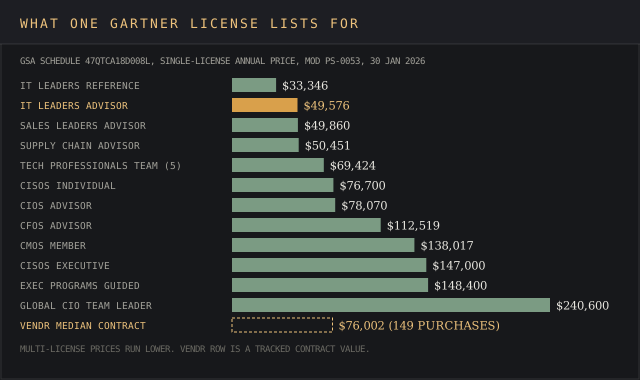
The devil's in the details of the multi-license column, which applies once a buyer holds at least two qualifying licenses on one order with a common Bill To address. That rule cuts a single Advisor seat from $49,576 to $37,730, a saving of $11,846 or 23.9% per seat.
Gartner license types and what each tier gates
Reference and Advisor seats
Reference and Advisor are the two access levels on Gartner for IT Leaders, $16,230 apart on a single license. New York's 2022 service description defines the product as access "to research and advice" that "affords Users the option of inquiry with Gartner Analysts".
Gartner's inquiry usage policy limits analyst sessions to a "Licensed User with Inquiry Service", so analyst access belongs to the named seat holder.
Team licenses
Team products bundle seats under one leader and carry their own purchasing rules in the GSA price list:
- The Technical Professionals bundle covers one leader and up to four members for $69,424, and each extra member costs $13,310.
- Leadership products require "three (3) Team Members per Leader/Advisor Leader".
- A group holds one leader and up to ten members at most.
- All licenses in a group "must be coterminous", so every seat renews on one date.
Role seats for business functions
Gartner prices its functional products by the title of the person reading. A sales leader's Advisor seat lists at $49,860, a CFO's at $112,519, a CHRO's at $113,436 and a chief marketing executive's Member seat at $138,017. Gartner's client page names the functions it covers, from Audit & Risk and Customer Service & Support to Tech Marketing, and each role category carries its own price.
Executive Programs and Global CIO
Executive seats cost an arm and a leg. Executive Programs Guided Individual Access lists at $148,400 and a Self-Directed leader seat at $76,800.
Higher tiers add analyst access. New York's May 2024 price list charges $21,619 for two extra face-to-face strategy meetings with an assigned "Executive Partner", and its service description says that on Gartner for Technical Professionals, "Advisor-level access includes the option of scheduling dialogues with Analysts".
What a Gartner license includes beyond the Magic Quadrant
A seat buys the research library, analyst inquiry where the license carries it, and Gartner's tools, with the Magic Quadrant and the Hype Cycle listed as featured tools on the client page. Gartner's Hype Cycle page says "The Hype Cycle research is reserved for paying clients."
The client page advertises "direct access to 2,400+ analysts" and the AskGartner AI tool, and the IT leaders page claims 510,000+ client interactions and "Confidential 1:1s" with analysts. The library also holds vendor due diligence tools such as a 2025 vendor health assessment for procurement teams.
The inquiry policy sets hard edges on that access:
- Inquiry is sized in 30-minute sessions, and the policy turns away requests that "cannot be fulfilled in a 30-minute Inquiry session".
- Document review and proposal review stop at 20 pages.
- Gartner "will not provide any written responses, redline markups or line-by-line pricing analysis".
Inquiry works best when it's focused on one decision, so cut to the chase. Bring a vendor selection shortlist, a vendor viability worry or a question about a vendor's product roadmap, and a single inquiry session earns its keep. Support quality, implementation risk and day-to-day support come from reference customers and Peer Insights reviews, so call two references before signing with any vendor Gartner recommends.
Conferences raise the final price of a Gartner subscription. The Gartner IT Symposium/Xpo in Orlando, 19 to 22 October 2026, lists at $8,200 standard and $6,125 for the public sector, with one free pass for every four paid.
Gartner Peer Insights reviews sit outside the analyst research paywall, and Gartner prints this disclaimer under every Gartner Peer Insights product page:
"Gartner Peer Insights content consists of the opinions of individual end users based on their own experiences, and should not be construed as statements of fact, nor do they represent the views of Gartner or its affiliates. Gartner does not endorse any vendor, product or service depicted in this content nor makes any warranties, expressed or implied, with respect to this content, about its accuracy or completeness, including any warranties of merchantability or fitness for a particular purpose."
Gartner, Peer Insights product page footer
Contract terms that raise the real cost
The GSA terms and Gartner's 10-K set four conditions that shape the real cost:
- Payment up front. "Invoicing and payment in full is authorized concurrent with commencement of deliverables", on net 30 terms.
- No exit. Open-market items are "Non-cancelable and may be terminated only for material breach by either party, upon 30 days prior written notice".
- Coterminous groups. The ability to add a member mid-term comes with the group's renewal date attached, which makes seats easy to manage and hard to cut.
- Multi-year terms. Gartner's 10-K for fiscal 2025 says it typically has "a minimum contract period of twelve months" and that 77% of its contracts were multi-year at 31 December 2025, so most client organizations sign for two years or more.
Paid in full on day one, the subscription lands on the balance sheet as a prepaid asset and runs through the expense line month by month. The risk sits with a company whose seat holders never book inquiry calls, since all twelve months are already paid, a bitter pill to swallow at the first usage review.
Renewals carry the second cost. A review of the New York price list of 13 May 2024, which mirrored GSA rates, against the January 2026 schedule shows every line rose.
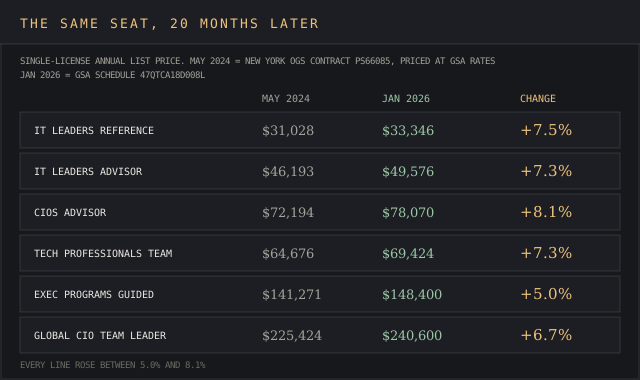
Gartner calls a spade a spade in its 10-K, where the company says it seeks to grow revenue "through more effective pricing of our products and services". The CIOs Advisor seat rose fastest, by $5,876 or 8.1%, an implied 4.8% a year, and the Executive Programs Guided seat rose slowest at 5.0%.
What buyers pay in practice
Across 149 Gartner purchases in Vendr's market data, the median customer pays $76,002 a year, the tracked low is $27,126 and the high is $289,667, and Vendr reports 14.17% average savings across 153 deals handled.
At the end of Q2 2026 Gartner's Global Technology Sales unit had 11,347 client enterprises paying an average $352K in contract value, and Global Business Sales had 4,437 enterprises at $289K each. Gartner counts more than 13,000 enterprises in about 90 countries and territories as customers, per the 10-K.
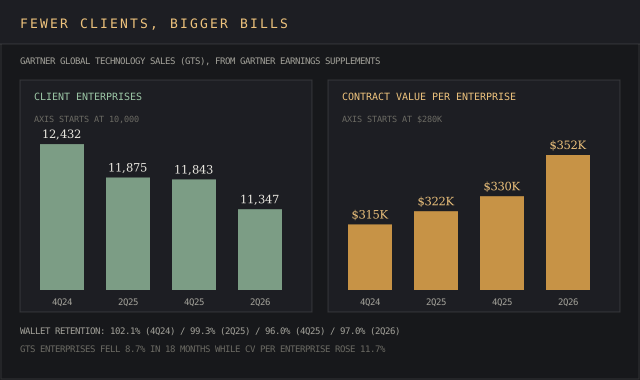
Wallet retention fell from 102.1% in Q4 2024 to 96.0% in Q4 2025, per the 4Q25 earnings supplement, and recovered to 97.0% by Q2 2026. CEO Gene Hall told analysts on the Q4 2025 earnings call that most of the retention loss came from customers trimming seats, and he used a 10-seat client dropping to nine as the example.
A software engineer at a large company wrote in a G2 review in August 2025:
"The biggest downside for me is how expensive and limited access can be. Unless your company has a subscription, it's hard to get the full value from their reports."
Shubham C., Software Engineer, enterprise (more than 1,000 employees), G2, 1 August 2025
A Hacker News commenter put a number on it in May 2013, writing that "A Gartner seat is over $50k now per annum (assuming non-volume pricing)".
How to negotiate a Gartner subscription
The federal schedule is public, and that list price gives a commercial buyer leverage in the first negotiation. Gartner's terms and filings supply six more levers.
- Order two years. The GSA list applies a 5% discount to the first year of a two-year order, which prices a Technical Professionals bundle at $135,376 for both years against $138,848 at the single-year rate.
- Read the entitlements. Confirm in writing which seats carry inquiry and document review support, since the policy ties both to the named license.
- Stack licenses. Two qualifying licenses on one purchase order trigger multi-license pricing, 23.9% off a single Advisor seat.
- Right-size seats before the date. Hall's own example of retention loss is one of his customers cutting from 10 seats to nine, and with coterminous groups the renewal date is the one clean moment to do it.
- Count the conference tickets. The Symposium page invites clients to ask about "using Gartner conference tickets as partial or full payment".
- Quote the Vendr spread. Vendr's 14.17% average savings figure gives a procurement team a target to put on the table.
Procurement teams that already manage software renewals will recognize the playbook from our procurement software pricing report. Run a usage review 90 days out, count inquiry calls per seat, and cut your losses on any seat with low adoption before the date passes.
A Hacker News user who was assigned an executive partner on signing up wrote in November 2018 that "I know people that swear by Gartner and renew year after year" and then judged the seat: "I don't want to call it a complete waste, but it wasn't worth it."
Magic Quadrant ratings, vendor money and the pay-to-play question
Vendors pay Gartner too, and the Magic Quadrant controversy starts there. Gartner's content compliance policy says "you must purchase a reprint if you would like to use any graphic that evaluates or otherwise lists organizations, such as Gartner Magic Quadrant". Those paid reprints are the free Gartner reports buyers download from vendor sites.
Google Cloud is one example. Google's 3 September 2026 post on its ninth straight Leader placement for Strategic Cloud Platform Services links a complimentary copy, a use Gartner's policy prices as a reprint.
Gartner's Magic Quadrant research list, updated throughout the year, carried 190 Magic Quadrants on 6 October 2026, and 101 of them had been updated in the previous 12 months. The Magic Quadrant methodology page sorts evaluated vendors into Leaders, Visionaries, Niche Players and Challengers, and it tells readers "focusing on the leaders' quadrant isn't always the best course of action".
The methodology's interactive version lets clients reweight criteria behind the ratings.
Vendors evaluated in a Magic Quadrant can brief analysts at no charge. The vendor briefings page describes sessions "typically 45 minutes in length with 1-2 analysts", and says analysts schedule them "not because of any fee or contractual relationship". Gartner's Ombuds FAQ adds that "Influence over content or the amount of research coverage focused on any vendor, sector or topic is not, and has never been, for sale by Gartner."
Two vendors took their ratings to court. ZL Technologies sued in May 2009, seeking about $1.7 billion according to Computerworld's report on the case.
The dismissal order records ZL's allegation that vendors "pay $25,000 or more for a basic annual Gartner subscription in order to obtain time with analysts". Judge Jeremy Fogel of the Northern District of California dismissed the case in 2010 without leave to amend, writing that "an inherent economic bias does not strip away First Amendment protection of pure opinion."
NetScout, evaluated in the 2014 Magic Quadrant, declined to buy the consulting services Gartner calls "Strategic Advisory Services" and landed in the Challenger quadrant. It sued, and in January 2020 the Connecticut Supreme Court affirmed summary judgment for Gartner, holding that its statements were "nonactionable expressions of opinion". Trade media covered the ruling.
One Hacker News user wrote in January 2022 that a former employer "tried for years to get onto the magic quadrant, and never succeeded" until it paid Gartner for access to its "specialist knowledge", then landed "in the lower left, with gartner pushing them to pay more to get better access".
Another Hacker News user wrote in August 2025 that a Magic Quadrant spot "can be transformative for enterprise sales pipeline", adding "I always feel bad for the purchasing decision makers as non of this is good data."
The content compliance policy requires this disclaimer wherever vendors quote Gartner research:
"Gartner does not endorse any company, vendor, product or service depicted in its publications, and does not advise technology users to select only those vendors with the highest ratings or other designation. Gartner publications consist of the opinions of Gartner's business and technology insights organization and should not be construed as statements of fact. Gartner disclaims all warranties, expressed or implied, with respect to this publication, including any warranties of merchantability or fitness for a particular purpose."
Gartner, Content Compliance Policy
The same policy requires vendors to present any claim of "validation" made with the Gartner brand in their media as their own company's opinion.
Gartner against Forrester, IDC and other subscription models
Forrester and IDC sell the closest Gartner alternatives in the analyst research market, and Vendr's data puts both medians below Gartner. AlphaSense, a search vendor, sells a platform in a different price category, at about a quarter of Gartner's median.
| Provider | Vendr median annual contract | Vendr tracked range | Purchases in median |
|---|---|---|---|
| Gartner | $76,002 | $27,126 to $289,667 | 149 |
| IDC | $68,870 | $14,400 to $114,240 | n/a |
| Forrester | $64,240 | $25,444 to $173,860 | 67 |
| AlphaSense | $18,375 | $9,750 to $51,300 | 40 |
All figures are Vendr median annual contract values and tracked ranges from anonymized buyer data, read on 6 October 2026. Vendr's IDC page shows no purchase count.
Our AlphaSense pricing breakdown covers that seat model in detail.
The subscription models differ in what a dollar buys. Gartner bills per named seat with analyst support attached. Expert network vendors bill per call, which our expert network cost report prices contract by contract. Platforms in our market research tools ranking mostly sell self-serve subscription models with no analyst on the other end.
Competitive intelligence platforms, a separate software category, run a fourth set of subscription models, covered in our competitive intelligence pricing report. Gartner earns its line item on a board-level business decision that needs outside context. The split mirrors the one in our guide to market intelligence vs market research.
Why Gartner stock fell and what it means at renewal
Gartner shares lost 47.9% in 2025, according to The Motley Fool's year-end analysis, which cited federal cost-cutting and IT budgets moving toward AI adoption.
Gartner cut its revenue forecast for Insights, its renamed research segment, by $100 million on 5 August 2025, Reuters reported, and the 10-K says revenue from US federal agencies fell about $58 million in 2025 on "reductions in discretionary spending".
The company still brings home the bacon. It booked $6.5 billion of 2025 revenue with 20,244 employees. It also closed the sale of Capterra, Software Advice and GetApp, which G2 agreed to buy, for about $110 million on 5 February 2026, a deal covered in our reports on G2's legitimacy, Capterra, Software Advice and GetApp.
A seller with shrinking client counts and 96.0% wallet retention two quarters ago has every reason to hold renewals, which gives buyers leverage and the ability to push on price.
Frequently asked questions
How much does a Gartner membership cost?
A Gartner membership costs $33,346 to $240,600 per license per year on the January 2026 GSA schedule, and Vendr's median contract is $76,002.
How much is a Gartner license?
A single IT Leaders Advisor license lists at $49,576 a year, or $37,730 per license when organizations hold two or more on one order.
What are the different Gartner levels?
Gartner sells Reference and Advisor access levels, group licenses of up to eleven seats, role seats priced by job title, and executive products such as Executive Programs and Global CIO Team Plus.
How can you access Gartner reports for free?
Vendors buy reprint rights and post Gartner reports such as Magic Quadrants on their own sites. Gartner Peer Insights reviews and ratings are free to read. For a startup, those sources plus secondary market intelligence methods cover most early research.
Who is Gartner's biggest competitor?
Forrester and IDC sell the closest alternatives in the research market. Vendr tracks a $64,240 median Forrester contract and a $68,870 median IDC contract, against $76,002 for Gartner.
How trustworthy is Gartner?
Gartner calls its ratings opinions, and two courts agreed, dismissing ZL Technologies' suit in 2010 and affirming judgment against NetScout in 2020. Read a Magic Quadrant as one firm's weighted opinion of the vendors evaluated and check it against Peer Insights reviews, reference customers and your own trial.
Bottom line
Among research subscription models, a Gartner subscription is a named-seat contract priced by job title, paid up front and locked for its term. The federal schedule gives every buyer the list price, from $33,346 for a Reference seat to $240,600 for a Global CIO leader, and Vendr's median shows commercial customers landing at $76,002.
Two questions decide the budget. The first is who will book analyst calls often enough to justify an Advisor seat, and the second is how many of those seats survive a usage review before the coterminous renewal date. Answer both before the first year ends, because the non-cancelable terms remove any ability to cut a seat before that date.
Over the life of a multi-year deal the list price climbs, and Gartner's own numbers show fewer clients each paying more. Many organizations still pay it. Organizations that manage the renewal with the GSA list price, the 23.9% multi-license rate and Vendr's 14.17% average savings figure bring three numbers to the table.
Sources behind each Gartner figure, and the rate card Gartner never posts
List prices come from Gartner's GSA schedule 47QTCA18D008L price list on gsaadvantage.gov, current through Modification PS-0053 of 30 January 2026, and New York OGS contract PS66085 on ogs.ny.gov, effective 13 May 2024. Client counts, contract value and wallet retention come from Gartner's 4Q25 and 2Q26 earnings supplements on investor.gartner.com and its 10-K for fiscal 2025 on sec.gov.
Contract medians are Vendr header figures on vendr.com. Inquiry, compliance, briefing and Magic Quadrant rules are Gartner's own pages on gartner.com, and the Magic Quadrant counts were taken from its research list on 6 October 2026. Court records are from courtlistener.com and law.justia.com, and user quotes from G2 and Hacker News. All figures checked 6 October 2026.
Gartner publishes no commercial rate card, and none of its own pages prices a single seat.