What market research costs in 2026: surveys, focus groups, reports and AI interviews
 By Jan Suski. I go deep on every review, checking every number against its source and digging up details other coverage misses, a habit from six years of SEO and link building for tech companies. Bylines at Surfer, Brand24, and Senuto. How the scoring works.
The numbers Market research cost, checked 30 September 2026
The same 400 survey responses cost $380 on Pollfish at $0.95 each and start at $5,000 through an agency, a 13x gap on our math.
Of the 27 vendors in this report, 19 publish at least one price you can read without a sales call, while Qualtrics, Gartner, Forrester, Listen Labs, Outset, Conveo and Cint publish none and MX8 Labs publishes estimates only.
Two of the five pricing claims checked here don't hold up, and two more can't be tested because the vendor behind them publishes no price.
Market research costs from $0.95 a response on a self-serve panel to $5,000 to $15,000+ for a 400-response agency survey and $7,000 to $20,000+ per focus group, per the ranges Drive Research publishes. Analyst-firm contracts track higher, at a $64,240 average for Forrester and $75,650 for Gartner in Vendr's buyer data.
This report prices the four things businesses buy in market research: a survey, a focus group or interview, a syndicated report, and a platform or analyst-firm contract. It covers 27 vendors, from Pollfish & SurveyMonkey to Qualtrics, Gartner and the AI interview platforms, and every price carries its type (list price, tracked contract, estimate or vendor claim).
It's written for small businesses pricing a first survey, insights managers weighing an agency against a DIY panel, and procurement managers holding a Qualtrics or Gartner renewal. The sections below rank the factors that move a quote (audience, method, geography, license scope), test five pricing claims against the vendor's own page and set a budget for each buyer type.
The market research cost a buyer faces depends on one choice between a posted rate and a private quote, and the two sit 13x apart for the same 400 responses. Scope stays with primary research, syndicated reports and analyst subscriptions in the US. Social listening has its own pricing report, and the line between the two disciplines is drawn in market intelligence vs market research.
Market research costs $0.95 a response on a DIY panel and $5,000+ for the same survey through an agency
Two markets sell market research in 2026, and they barely overlap. One posts rates anyone can read, from $0.95 a response on Pollfish to $30 for an AI-moderated interview at User Intuition. The other sells on private quotes, and the only public anchor is Vendr's tracked data, which puts the average Qualtrics contract at $30,000 across 211 deals.
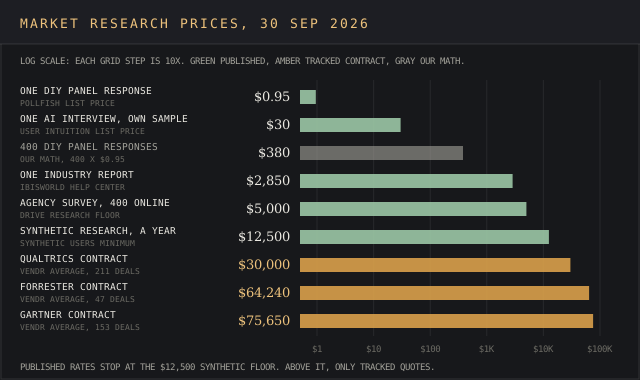
The fastest cost change of 2026 hit qualitative market research. Listen Labs claimed in a pricing guide dated 20 May 2026 that AI-moderated interviews run "$25–$50 each", while MX8 Labs, itself an AI vendor, estimates a traditional interview at $400 to $800. Both figures rest on assumptions about sample, and User Intuition's $30 rate assumes you bring your own respondents.
Actions speak louder than words, and investor demand for AI interview vendors backed the claim with cash. Listen Labs' funding success came first. The company raised a $69M Series B led by Ribbit Capital on 14 January 2026, and on 29 September Salesforce signed a definitive agreement to acquire the company. Dealroom, citing Business Insider, reported a deal value of about $2B, and the parties disclosed no terms.
Incumbent market research companies bought scale in the same window. Qualtrics completed its $6.75B acquisition of Press Ganey Forsta on 18 May 2026, and Outset raised a $30M Series B in late 2025. ESOMAR's Global Market Research 2025 sizes market research software at US$62 billion and research services at US$56 billion, growing 11.5% and 4.8% a year.
Listen Labs CEO and Co-Founder Alfred Wahlforss set out the benefits of the company's pitch in the Salesforce announcement.
"Companies have always wanted to hear from every customer, but until now it was only possible to talk to a handful," [...] "With AI, a company can now have thousands of real conversations at once and even simulate how customers will respond before making a move. Together with Salesforce, we'll put that understanding at the heart of every decision."
Alfred Wahlforss, CEO and Co-Founder at Listen Labs, in the Salesforce newsroom, 29 September 2026.
Skeptics count a different risk. Phil Sutcliffe, Managing Partner at Nexxt Intelligence, wrote in GreenBook on 16 July 2026: "My concern is that, just like with food, cheap and fast will triumph over better."
Talk is cheap, and Burke's June 2026 study put a number on that worry. It found LLM-based synthetic data reached false conclusions in roughly 60% of tested business scenarios at about 80% accuracy, as MRWeb reported.
Quick answers on market research cost: $0 for federal data, $380 for 400 DIY responses, $30 for an AI interview
- Is market research affordable for small businesses? Yes. SBA-listed federal sources and consulting at nearly 1,000 SBDC centers cost $0, and 400 DIY panel responses run $380 at Pollfish's $0.95 list rate (our math).
- How much does it cost to hire someone? An agency quotes $5,000 to $15,000+ for 400 online responses in Drive Research's published pricing, about 13x the $380 DIY floor, and a Fiverr market researcher averages $111 for a fixed-price job (Fiverr marketplace estimate).
- How does AI research compare with an agency? Published AI-moderated interviews start at $30 with your own sample at User Intuition (list price), and MX8 Labs, an AI vendor, estimates a traditional interview at $400 to $800.
- Is it beginner-friendly? A beginner can buy SurveyMonkey Audience responses from $1 each, and conjoint & advanced statistics sit in Alchemer Full Access at $1,895 a year (both list prices).
- What are the main limitations? The low rates cover general-population sample. B2B recruiting adds $140 to $280 per AI interview at User Intuition, and Burke found LLM-based synthetic output reached false conclusions in roughly 60% of tested scenarios.
How market research pricing works, from a $0.95 rate card to a $30,000 average quote
Every market research quote shares one cost structure with two halves. Fixed work covers questionnaire design, programming, analysis and the report, and two factors, methodology and project complexity, determine its price. Variable cost is the sample, priced per response, and it's the only half a DIY panel's per-response rate covers.
Published estimates show how large each half gets, and each carries its own assumptions about sample size. MX8 Labs, an AI research vendor, estimates a traditional concept test with 250 respondents at $43,000 to $79,000 and a traditional brand tracker at $150,000 to $240,000 a year. Agency sample runs $50 to $150 per online response at Hope Research Group, and Prolific adds a 42.8% platform fee on top of participant pay for corporate studies (33.3% for academic ones).
| Line item | How it's billed | Published figure | Source type |
|---|---|---|---|
| Traditional concept test, 250 respondents | Fixed project price | $43,000 to $79,000 | Estimate, MX8 Labs |
| Traditional brand tracker | Fixed, recurring each year | $150,000 to $240,000 a year | Estimate, MX8 Labs |
| Omnibus survey, 10 to 15 questions | Fixed per question block | $2,000 to $5,000 | Agency pricing page, Hope Research Group |
| Online sample through an agency | Variable, per response | $50 to $150 | Agency pricing page, Hope Research Group |
| Phone sample through an agency | Variable, per response | $75 to $200 | Agency pricing page, Hope Research Group |
| In-person sample through an agency | Variable, per response | $100 to $300 | Agency pricing page, Hope Research Group |
| Platform fee on participant rates | Variable, % of participant fees | 42.8% corporate, 33.3% academic | List price, Prolific |
Figures are list prices, agency pricing-page ranges or published estimates, as the last column labels each one.
The fixed half buys tangible benefits in the form of a questionnaire, a sample plan and an analysis someone else stands behind. The devil's in the details of that half, since the method you pick drives its complexity. Clear research objectives keep two quotes comparable, DIY moves the design and analysis effort to the buyer, and our guide to market research methods explains what surveys, focus groups, interviews and desk research each involve before a quote arrives.
The second split is a two-market system. Panels, survey software, report stores and a few AI interview vendors post a rate card. Agencies, Qualtrics, the analyst firms and most AI interview platforms quote privately, and a tracked Vendr contract is the only public number a buyer can use to test a quote. Which market a vendor sits in determines if you can price a study before a sales call.
Primary market research collects original data from the target market through surveys, interviews, focus groups and observation of how customers behave in a store or on a website. Secondary market research reuses existing knowledge from government sources and industry reports, and that half can cost $0, since the SBA lists free federal resources next to its guide on research into competitors.
Surveys are the standard quantitative tool. Qualitative work trades measurement for depth.
Outset CEO Aaron Cannon described the old cost structure of qualitative work on the company blog in April 2026.
"For decades, qualitative research could only be as productive as the team running it. Every study required a moderator, scheduling, and synthesis before insights could surface."
Aaron Cannon, CEO at Outset, Outset blog, 7 April 2026.
Cannon dates that constraint back decades, and AI interview vendors now compete against it at $30 an interview.
Norbert Sari, CEO & Creative Director at Rodeo13, a brand agency that works with insights companies, argued the agency side of the cost debate for an audience of research-agency heads.
"You cannot commoditize a philosophy. You can compare the price of a focus group recruit, but you cannot compare the price of "Cultural Anthropology-led Strategic Foresight"."
Norbert Sari, CEO & Creative Director at Rodeo13, GreenBook, 21 April 2026.
Self-serve market research pricing, from $0.95 a response to $1,895 a year without a sales call
The self-serve market research tier covers three different purchases. Sample is priced per response, software per seat per year, and finished reports per report, with the license setting the rate. Add the three together and a working study costs under $2,000 a year for businesses polling a general audience, while a B2B audience brings recruiting effort and surcharges per session or per interview.
The benefits of the tier are a price you can read and a purchase without a sales call, and Pollfish leads the self-serve market at $0.95. A list price comes straight from the horse's mouth, and every self-serve figure here was read on the vendor's own page.
| Vendor | Entry tier | Price | What it includes |
|---|---|---|---|
| Pollfish | DIY panel | $0.95 per response | Self-serve responses from Pollfish's market research panel |
| SurveyMonkey Audience | Panel responses | From $1 per response | General-population responses, Express delivery +$1 each |
| SurveyMonkey | Advantage Annual | $468 a year | 1 user, 15,000 responses a year, $0.15 per extra response |
| SurveyMonkey | Premier Annual | $1,668 a year | 1 user, 40,000 responses a year |
| Alchemer | Collaborator, Professional, Full Access | $315, $1,075, $1,895 a year | Professional allows up to 3 users; Full Access adds conjoint & advanced statistics |
| Typeform | Growth Flow | $266 a month billed annually, $379 monthly | 10,000 responses a month |
| Typeform | Basic | $25 to $29 a month* (Vendr estimate) | 100 responses a month |
| Prolific | Participant rate | $8 an hour minimum, $12 recommended | Plus a 42.8% platform fee (33.3% academic) |
| User Interviews | Advanced B2B targeting | +$49 a session (+$41 or +$36 on subscription tiers) | 3% processing fee on the incentive portion of the bill |
| Respondent | Annual commitment | From $7.5K a year | Recruiting volume for B2B studies |
| User Intuition | AI voice interview | $30 own sample, $60 with panel | $2,499 a month buys 100 interviews ($25 each), 3-month minimum |
Prices are vendor list prices read on each vendor's own page on 30 September 2026. The figure marked * is Vendr's estimate for Typeform Basic.
† Mintel and Statista list these prices in euros, so they're quoted as published. At the European Central Bank reference rate of 1 EUR = 1.1403 USD, published 25 September 2026 and refreshed weekly, EUR 4,400 is about $5,017, EUR 199 is about $227 and EUR 599 is about $683.
If you're wondering what 400 responses cost on a DIY panel, for example for launch planning, Pollfish's $0.95 floor puts them at $380 and SurveyMonkey Audience's $1 floor at $400, before targeting premiums (our math on the list prices).
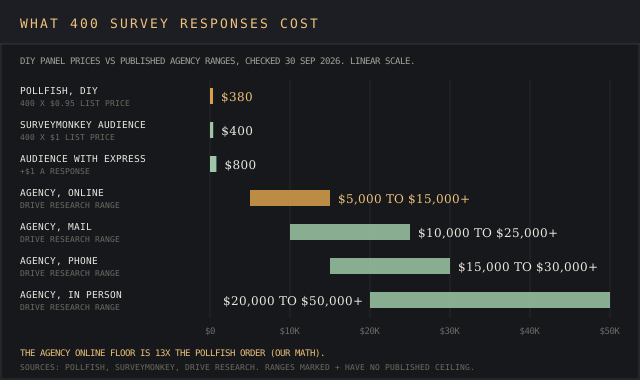
Seat plans work as a volume system and scale with responses, which makes a first study feasible on one seat. SurveyMonkey's $0.15 charge for each response over the plan limit is a drop in the bucket on a 15,000-response Advantage seat, and the same $468 seat also runs surveys of clients or employees on your own contact list.
Alchemer Professional caps the account at 3 users, which sets the limit for teams with more employees in the tool. Feature scores for the software in this tier sit in our market research tools ranking.
Market research report stores charge by license, a system that sets one rate per reader or site. Kentley Insights reports start at $295 in the MarketResearch.com store, an IBISWorld Spotlight from the company's own store costs $800 and a full Industry Research Report $2,850, and a 263-page Packaged Facts report runs $4,250 for a single user, $6,375 for a department and $8,500 for a global site.
Two market research store prices reflect the euros each site served. The Mintel store lists a 2026 US report at EUR 4,400† excluding tax, and Statista lists Starter and Personal seats at EUR 199† and EUR 599† a month billed annually.
"It's about managing complexity without sacrificing the science. SurveyMonkey allowed us to do both," Myles Johnson, a product manager at Noom, said in SurveyMonkey's 1 September 2026 release about a large study his team ran.
Norbert Sari's GreenBook piece compares a generalist shop, Agency A, with a specialist agency that states a point of view, and it prices that difference in words.
"They may use the exact same AI and survey tools as Agency A, but their framing changes the conversation from "cost per complete" to "cost of being wrong"."
Norbert Sari, CEO & Creative Director at Rodeo13, GreenBook, 21 April 2026.
The quote-only tier: $30,000 average contracts at Qualtrics and $75,650 at Gartner
Each market research vendor in this section quotes privately for its core product, and the benefits a buyer gets depend on what the contract bundles. Every figure below is an agency's own published range, a tracked Vendr contract, a Vendr estimate, a public procurement record or a vendor claim, and each carries that label. Medallia runs the same quote system, covered in what Medallia costs.
| Vendor | Tracked average contract value | Deals tracked | Average savings | Source |
|---|---|---|---|---|
| Gartner | $75,650* | 153 | 14.17% | Vendr |
| Forrester | $64,240* | 47 | n/a | Vendr |
| Qualtrics | $30,000* | 211 | 11.28% | Vendr |
| Statista | $26,000* | 32 | n/a | Vendr |
| Typeform | $9,448* | 97 | 25.01% | Vendr |
Figures marked * are Vendr average contract values from tracked buyer deals, pulled 30 September 2026.
The tracked averages reflect real deals, and they're the only tangible anchor a buyer has for a quote. Read between the lines of the savings rates Vendr prints, 11.28% at Qualtrics, 14.17% at Gartner and 25.01% at Typeform, and the first number on a quote opens a negotiation. Gartner leads the tracked contracts in this market at $75,650, and negotiation factors into every one of them.
If your concern is hidden cost, Vendr's Qualtrics buyer guide puts professional services at 10% to 30% of contract value, premium support at 10% to 20% and renewal escalation at 5% to 10% a year (Vendr estimate).
Full-service market research agencies: $5,000 to $15,000+ for 400 online responses
Drive Research publishes its ranges for 400 responses by mode: $5,000 to $15,000+ online, $10,000 to $25,000+ by mail, $15,000 to $30,000+ by phone and $20,000 to $50,000+ in person. Ten to 15 in-depth interviews run $5,000 to $15,000, and one focus group $7,000 to $20,000+.
The benefits of a full-service agency are the recruit, the moderator and the analysis, and Drive Research's figures reflect full-service US projects.
Hope Research Group, a market research company, prices one focus group at $5,000 to $12,000 with recruit, facility, moderator & report included. A full quantitative study runs $25,000 to $75,000, a multi-country project over $100,000, and an omnibus that caps complexity at 10 to 15 questions $2,000 to $5,000. Pollfish also offers a full-service general-population study from $5k per market, and its enterprise package starts at $10k+ a year.
Qualtrics: $30,000 average contract, with synthetic credits sold only through an Account Executive
Qualtrics quotes privately, which leads buyers to Vendr's tracked data. Vendr tracks its contracts at a $30,000 average across 211 deals with 11.28% average savings. Synthetic panels come in sizes of 50 to 10,000 responses, and the Qualtrics help center says the credit system runs only through an Account Executive. The X4 release of 18 March 2026 promises US synthetic panels "at half the cost of human panels" and prints no per-response credit price to halve.
"With our synthetic model, we started with the hardest problem: building synthetic panels that deliver research-grade accuracy."
Brad Anderson, President of Products, Engineering, User Experience, and Security at Qualtrics, Qualtrics X4 news release, 18 March 2026.
Burke answered claims of this kind three months later. "Organizations are hearing increasingly strong claims about synthetic data," Eli Moore, Vice President, Data Strategy at Burke, said in the firm's 15 June 2026 release, which set out its FAR Framework for testing synthetic output. Buyers pricing Qualtrics against its closest CX rival can read Medallia vs Qualtrics.
Gartner and Forrester: $75,650 and $64,240 average contracts
Vendr tracks Gartner at a $75,650 average contract across 153 deals, and businesses buying Gartner through Vendr saved 14.17% on average. Vendr's own estimates put a Gartner advisory hour at $3,000 to $7,000 and technology-specific research for 1 to 5 named users at $25,000 to $60,000 a year. An advisory hour at that rate costs an arm and a leg next to a $2,850 IBISWorld report a team keeps.
Forrester's tracked average is $64,240 across 47 deals, a smaller scale of sample than Gartner's. Vendr estimates a custom research project there at $50,000 to $250,000+ and a senior analyst consulting day at $5,000 to $15,000. Buyers weighing an analyst seat against category data can compare Circana, NielsenIQ and Omdia in their reviews.
Market research report subscriptions and public contracts: $26,000 average at Statista
Statista's average contract value is $26,000 across 32 Vendr deals, against a published Starter entry of EUR 199† a month billed annually. GlobalData pricing covers another syndicated publisher priced by subscription.
Two records from the UK public procurement system add dated benchmarks. UKRI's past contract for an IBISWorld subscription ran from 17 December 2024 to 28 February 2026 at £19,250 excluding VAT, including a £1,750 extension, with the supplier printed on the Contracts Finder record as "IBS World".
Network Rail's 8-year market research framework carries an estimated tender value of £37,389,422 excluding VAT in a Find a Tender notice published 22 June 2026, ahead of any award. Lot 1 is estimated at £28,811,228.45 and Lot 2 at £8,578,193.55, direct awards are capped at £100,000 on Lot 1 and £60,000 on Lot 2, and contract dates are estimated from 5 February 2027 to 5 February 2036.
| Buying the answer off the shelf | Figure | What it buys | Source type |
|---|---|---|---|
| Single report | From $295 (Kentley); $800 and $2,850 (IBISWorld); $4,250 (Packaged Facts, single user); EUR 4,400† (Mintel) | One report, licensed per reader or site | List price and help center |
| Self-serve subscription | EUR 199† or EUR 599† a month billed annually | Statista Starter or Personal seat | List price, Statista |
| Tracked subscription | $26,000 average*, 32 deals | Statista contract | Tracked contract, Vendr |
| Public subscription contract | £19,250 excluding VAT, past contract | UKRI's IBISWorld subscription, December 2024 to February 2026 | Public procurement record |
| Analyst firm | $64,240 average* (Forrester, 47 deals); $75,650 average* (Gartner, 153 deals) | Analyst contract | Tracked contract, Vendr |
| Analyst extras | $3,000 to $7,000 an hour*; $50,000 to $250,000+ per engagement* | Gartner advisory time; Forrester custom research | Estimate, Vendr |
Vendr supplies the figures marked *, tracked contract averages for Statista, Forrester and Gartner plus its own estimates for Gartner advisory time and Forrester custom research. The rest are list prices, a help-center price or a public procurement record.
AI interview and synthetic platforms: $12,500 a year is the only published floor
Synthetic Users publishes token plans from $12,500 a year, with 1,250 tokens per 10-question text interview and up to 20% rollover. That token system ties the bill to question count, so a longer interview spends more tokens.
Listen Labs quotes privately. The only price figure in circulation, about $20K a year base plus $300 to $400 a session, is a competitor-reported estimate that User Intuition, one of Listen Labs' direct competitors, published from one anonymous buyer's April 2026 quote. The jury's still out on what the company will charge once the Salesforce deal closes.
Outset's pricing page reads "Our pricing is not one-size-fits-all", and Conveo's reads "Just get a demo and ask your burning questions." Cint, which includes Lucid, runs a rate card system, setting cost per complete from a Rate Card kept on the Cint Exchange, under legal terms v2025/01 dated 1 December 2025.
What SurveyMonkey's Express delivery adds: $1 a response, taking a 400-response order from $400 to $800
SurveyMonkey Audience starts at $1 a response, and the SurveyMonkey help center lists Express delivery at another $1 a response. On 400 general-population responses that takes the order from $400 to $800, a 100% uplift at the base rate (our math). Run the math before checkout to realize the full price of speed.
Speed is priced like sample in SurveyMonkey's per-response system, so the add-on grows with the order and benefits teams on a deadline. Targeting premiums come on top, and the same help page says the "cost for each option may increase based on how common the criteria is among our panelists." Audience is also unavailable to businesses whose accounts sit on SurveyMonkey's European data center, which is the fit limit for EU-hosted teams.
SurveyMonkey relaunched on 1 September 2026 as "Today's SurveyMonkey", selling human feedback against AI assumptions. CEO Eric Johnson set out the pitch in the release.
"AI is changing how work gets done, but businesses shouldn't have to choose between moving fast and understanding the people they serve."
Eric Johnson, CEO at SurveyMonkey, SurveyMonkey release via TechEdge AI, 1 September 2026.
Five pricing claims that don't hold up, starting with a "$15 to $50 per response" survey that costs $0.95 on Pollfish
Of five market research pricing claims checked against the vendor's own page, two fail, one holds, and two can't be tested because the vendor behind them publishes no price.
| Claim | Where it appears | Real number | Verdict |
|---|---|---|---|
| "online surveys cost $15 to $50 per response for general audiences" | Preuve AI blog, updated 4 August 2026 | Pollfish from $0.95 a response, SurveyMonkey Audience from $1, agency all-in $50 to $150 per complete, Resourcera $2 to $5 per general-consumer response. The DIY floor sits 94% below the claim's low end (our math) | Doesn't hold |
| "AI-powered research tools deliver automated reports for $0 to $29 in minutes" | Preuve AI blog; Preuve sells a $29 report | Tools that interview or simulate respondents: Synthetic Users from $12,500 a year, User Intuition $30 to $60 an interview, Qualtrics synthetic credits through an Account Executive only, Listen Labs about $20K a year base (competitor-reported estimate) | Doesn't hold, except for desk-research report generators |
| "Estimated cost: $7,000 to $20,000+ per group" | Drive Research; Preuve AI gives "$7,000 to $12,000" per in-person session | Drive's own range matches. Hope Research Group's all-in price is $5,000 to $12,000, so Drive's low end sits $2,000 above another agency's floor | Holds for US full-service groups |
| "AI-moderated qualitative research platforms deliver interviews at $25–$50 each" | Listen Labs pricing article, 20 May 2026 | User Intuition lists $30 with your own sample, $60 with its panel and $25 on the $2,499 a month plan. B2B recruiting adds $140 to $280 an interview. For Listen Labs, a competitor-reported estimate reads about $300 to $400 a session plus about $20K base | Can't be tested for Listen Labs; holds for published self-serve rates with your own sample |
| "at half the cost of human panels" (also "50% estimated lower cost") | Qualtrics X4 release, 18 March 2026, and the Qualtrics audiences page | No per-response credit price is public, credits go through an Account Executive, the average contract is $30,000*, and Burke measured about 60% false conclusions at about 80% accuracy | Can't be tested |
Pollfish, SurveyMonkey Audience, User Intuition and Synthetic Users figures are list prices. The Qualtrics figure marked * is a Vendr tracked contract average, and the Listen Labs figure is a competitor-reported estimate published by User Intuition.
The benefits claimed in the second row belong to desk-research report generators. Two claims fail on the vendor's own numbers. A price guide that skips the source raises a red flag, and it leads buyers to budget from the wrong floor.
The fourth claim comes from Anish Rao, Head of Growth at Listen Labs, in the company's pricing article dated 20 May 2026 and last updated 27 July 2026. Read it as the claim under test. Listen Labs posts no rate card of its own, and the one figure a buyer can find for it is the competitor-reported estimate above.
Phil Sutcliffe wrote in the same GreenBook piece about how these claims reach buyers.
"But I've been in this industry long enough to know that the sales conversation and the caveat conversation rarely happen in the same breath."
Phil Sutcliffe, Managing Partner at Nexxt Intelligence, GreenBook, 16 July 2026.
AI search engines also repeat a Barbados figure of USD 12,000 to 22,000 for market research. On Hope Research Group's Barbados page that range covers one method, a tourism intercept of 200 to 300 respondents, and the same page runs from $4,500 for one focus group to $55,000 for annual brand tracking.
Common challenges that lead to increased costs, starting with a $140 to $280 B2B recruit per interview
Increased costs on a market research study usually start with the audience or the contract terms, and each fix is a question to ask before signing.
Recruiting a B2B audience adds $140 to $280 per AI interview
User Intuition's recruit pricing system lists past costs per AI interview of $50 to $115 for niche consumers, $140 to $280 for B2B professionals and $250 to $500 for senior B2B. Businesses that market to other businesses face those recruit rates.
The reality of B2B recruiting is more effort per interview and higher costs per head. User Interviews adds $49 a session for advanced B2B targeting. Price the recruit as its own line, since audience complexity drives it, and write the user persona before you ask for a quote so the vendor quotes the right audience.
Services, support and renewal escalators sit outside the Qualtrics quote
Vendr estimates Qualtrics professional services at 10% to 30% of contract value, premium support at 10% to 20% and renewal escalation at 5% to 10% a year. Discuss all three and get them in writing before signing. The escalator works like an insurance premium that rises at every renewal, and it compounds on the full contract value.
Synthetic output reached false conclusions in about 60% of Burke's tests
Over the course of its March to June 2026 study, Burke surveyed 5,000 people, built 1,000 synthetic personas and found LLM-based synthetic output reached false conclusions in roughly 60% of tested business scenarios at about 80% accuracy, per MRWeb and Quirk's. Burke built its FAR Framework to measure the reliability of synthetic data against that human baseline.
The benefits of synthetic panels are speed and price, and Qualtrics customer Gabb described a blended setup in the X4 release.
"Synthetic data became our 'cultural radar,'cutting research timelines from a week to hours while giving us confidence to test messaging against emerging trends. The blended approach lets us move faster on early-stage testing, then validate high-stakes decisions with human panels,"
Garred Sheppard, Marketing Research Director at Gabb, Qualtrics X4 news release, 18 March 2026.
A single-user report license covers one reader for $4,250
Packaged Facts charges $4,250 for a single-user license on its Durable Dog & Cat Pet Care report and $8,500 for a global site license, twice the cost. Check seat scope before checkout, and teams that share one report should bite the bullet on the site license. The Mintel store takes up to 20% off when you buy several reports together, per its pricing page.
Features that drive higher costs: $2 a consumer complete vs $200 to $500+ for a specialist
Four factors produce higher costs in this market, and audience incidence leads every other cost factor because it determines the price of each complete. Resourcera estimates sample at $2 to $5 per general-consumer complete, $40 to $150 per B2B complete and $200 to $500+ for hard-to-reach specialists, so the specialist end runs 100x the consumer floor (our math, $200 vs $2).
Ranked by how far they move the bill, the cost factors run audience (100x), then mode (4x), then geography. Moving the same 400 responses from online to in person takes Drive Research's floor from $5,000 to $20,000 (our math).
Resourcera estimates each added country at 20% to 40% of project cost, or $3,000 to $8,000 for one extra market, because translation & local compliance add complexity. Single-market studies skip that line.
| Cost factors | Low end | High end | Source |
|---|---|---|---|
| Audience, per complete | $2 to $5, general consumer | $200 to $500+, hard-to-reach specialists | Estimate, Resourcera |
| Focus group honorarium, per person | $50 to $100, general public | $200 to $250, business professionals | Agency pricing page, Drive Research |
| Survey mode, 400 responses | $5,000 to $15,000+ online | $20,000 to $50,000+ in person | Agency pricing page, Drive Research |
| Method | $50 to $150 per online response | $5,000 to $12,000 per focus group | Agency pricing page, Hope Research Group |
| Geography | +20% to 40% per added country | Over $100,000 for a multi-country project | Estimate, Resourcera; agency pricing page, Hope Research Group |
| Cadence | $43,000 to $79,000, one concept test | $150,000 to $240,000 a year, brand tracker | Estimate, MX8 Labs |
| Speed, per response | $1 base on SurveyMonkey Audience | $2 with Express delivery | List price and help center, SurveyMonkey |
| Report license | $4,250 single user | $8,500 global site | List price, MarketResearch.com |
| Expert time | 42.8% Prolific platform fee | $3,000 to $7,000 a Gartner advisory hour* | List price, Prolific; estimate, Vendr |
The Gartner advisory figure marked * is a Vendr estimate. The rest are list prices, agency pricing pages or published estimates, as the Source column labels them.
Qualitative work costs more per respondent. A Hope Research Group focus group bundles recruit, facility and moderator for $5,000 to $12,000, and the same agency charges $50 to $150 per online survey response. Quantitative research measures at scale, so sample cost scales with every response a larger study adds. Focus groups put a small group in one room to react to a concept, and in-depth interviews go deeper with one person.
For example, the audience takes the lion's share of the spread in the table, 100x against 4x for mode. Buyers who cut corners by polling general consumers at $2 to $5 a response get cheap answers from the wrong people when the real buyers are specialists.
Outset's Cannon draws the line between the methods in the same April post.
"Focus groups are best led by researchers. Large-scale concept testing is most efficiently handled by AI. But most projects benefit from a blend of approaches."
Aaron Cannon, CEO at Outset, Outset blog, 7 April 2026.
Thania Farrar, Senior Vice President, Corporate Innovation at Burke, made the case for keeping people in the sample.
"There's an opportunity to combine high-quality human data, advanced modeling, and expert judgment to create faster, smarter, more confident outcomes, while keeping real human voices at the heart of research."
Thania Farrar, Senior Vice President, Corporate Innovation at Burke, Burke release via AOL, 15 June 2026.
Key limitations and cost vs value, with services adding 10% to 30% to a Qualtrics contract
A market research quote understates the bill when services and escalators sit outside it. At Qualtrics, Vendr estimates services at 10% to 30% and renewal escalation at 5% to 10% a year on top of a $30,000 average contract.
In reality, cheap synthetic output carries its own cost when it points the wrong way, because it reflects a model's assumptions about your customers. Burke measured false conclusions in roughly 60% of tested scenarios at about 80% accuracy, and a decision built on that output alone puts all your eggs in one basket.
Those factors settle if a study earns back its cost. Paid market research earns its price when the decision is large, a launch's success depends on it and the audience is hard to reach. Weigh the benefits against the size of the decision, and use a tangible number to gain confidence before signing.
The extra spending buys confidence in the answer. A free federal source or a $380 DIY sample settles smaller questions, and a penny saved is a penny earned, since Vendr's Typeform buyers negotiated 25.01% off on average across 97 deals.
Before deciding on a vendor, businesses weighing a $30,000 platform against internal resources can check three cases where a cheaper option wins. An analyst-firm seat bought for general reading can give way to the $0 SBA list and a $2,850 IBISWorld report. A single-user license bought for a whole team belongs on a site license, and a synthetic panel bought for a decision that needs quantitative accuracy belongs on a human sample.
Burke's president framed the test as fit for purpose.
"Our goal is always to help our clients make the best decisions for their business," [...] "This research allows us to help our clients feel confident about each method's strengths, limitations, and best-fit uses."
Tara Marotti, President & CEO at Burke, Burke release via AOL, 15 June 2026.
Aman Naimat, who runs AI Labs at Salesforce, described the value Salesforce saw in Listen Labs in the deal announcement.
"Listen Labs has reimagined customer experience, market research, and customer simulation with AI agents that can conduct meaningful research and uncover context behind customer and user feedback"
Aman Naimat, President of AI Labs at Salesforce, Salesforce newsroom, 29 September 2026.
How to budget: $0 to $800 for a small business, $30,000 to $75,650 a year for enterprise
Budget planning follows the buyer's size more than the method, and the audience determines most of the rest. Small businesses can answer most early questions under $1,000, while enterprise spending is set by platform and seat contracts. The first consideration is the audience, because it sets the price point for everything after it and leads to a budget line leadership can sign.
Small businesses: $0 to $800 for a first study
For most small businesses, $0 gets the ball rolling on a first study. It buys the SBA's list of federal sources and consulting at nearly 1,000 SBDC centers. 400 DIY panel responses run $380 to $800 on Pollfish and SurveyMonkey Audience (our math, $800 with Express), and a SurveyMonkey Advantage seat costs $468 a year.
Sample size, audience and speed are the three factors in that budget. A manufacturer testing demand before it develops a new product line can establish a feasible first read inside that budget, for example a 400-response concept check.
SurveyMonkey's own survey of 963 small-business owners, fielded 16 to 30 July 2026, found 83% call customer feedback useful and 54% collect it beyond once or twice a year. The benefits at this level are speed, a feasible scope and a cost under $1,000. Free trend resources and SBDC resources cover some of the same ground, and our trend research tools ranking and Exploding Topics pricing report compare them.
Mid-market teams: $1,075 a year to $75,000 a project
Mid-market teams develop their own questionnaires, so their spending starts with software, and study complexity sets when a team moves to an agency. Alchemer Professional and Full Access cost $1,075 and $1,895 a year. An agency online survey adds $5,000 to $15,000+ per project, a full agency quant study runs $25,000 to $75,000 at Hope Research Group, and Typeform contracts track at a $9,448 average across 97 Vendr deals.
Enterprise: $30,000 to $75,650 a year in tracked contracts
Enterprise market research spending runs on a seat system that scales with employees and users, and the benefits buyers get are platform scale, services and analyst access.
Qualtrics tracks at a $30,000 average contract value plus 10% to 30% for services. Gartner and Forrester average $75,650 and $64,240, and MX8 Labs estimates a traditional brand tracker at $150,000 to $240,000 a year. Priyanshu Anand, an author at TechnologyMatch, put the analyst-seat test in one line on the TechnologyMatch blog on 24 September 2026: "General reading rarely justifies an Advisor seat."
Beginners and advanced users: $1 a response to $7.5K a year
Beginners start at $1 a response on SurveyMonkey Audience or a $111 average Fiverr job, where hourly rates run $40 to $300. Advanced users with statistics knowledge buy the benefits of method depth, with conjoint in Alchemer Full Access at $1,895 a year, Prolific's 42.8% fee on corporate studies and Respondent's B2B recruiting from $7.5K a year.
- Write down the decision, establish what success looks like, and note the audience and the research objectives before you price anything.
- Check the free sources first, starting with the SBA's federal source list and your local SBDC, both $0.
- Price sample for that audience, then add software or agency fees for design and analysis, and test assumptions with a small DIY poll first.
- Obtain two quotes, ask for services, support and escalators in writing, and hold the first number up to the tracked Vendr average.
Agency vs DIY vs AI, where one interview costs $30 on a published AI rate card and an estimated $400 to $800 through a traditional agency
| Criterion | Agency | DIY | AI |
|---|---|---|---|
| 400-response survey | $5,000 to $15,000+ (Drive Research) | $380 to $400 (our math, Pollfish and SurveyMonkey Audience) | No published survey rate; Qualtrics' synthetic "half the cost" claim carries no price |
| One interview | $400 to $800 (MX8 Labs estimate); $333 to $1,500 at Drive's in-depth interview range (our math) | n/a | $30 own sample, $60 with panel, $25 on the $2,499 a month plan (User Intuition) |
| One focus group | $5,000 to $12,000 (Hope Research Group) to $7,000 to $20,000+ (Drive Research) | n/a | n/a; Outset's CEO says focus groups are best led by researchers |
| Annual commitment | Per project | $468 a year for SurveyMonkey Advantage | From $12,500 a year (Synthetic Users); $2,499 a month with a 3-month minimum (User Intuition) |
| Who designs and analyzes | Agency | Buyer, with in-house knowledge and effort | Vendor AI analysis, buyer reviews |
| Main benefits | Hard-to-reach recruits, moderated groups, full analysis | Lowest cost per response | Lowest cost per interview with your own sample |
Every figure here is a list price, an agency's published range or a vendor estimate, with the publisher named in the cell.
A quick and dirty DIY poll tests assumptions for $380 and wins on cost for general-population surveys, and AI wins on cost for interviews when you bring your own sample. On 400 responses, a $4,620 difference separates the Pollfish order from the agency floor (our math).
Each route's benefits line up with its audience, and a blend gives the best of both worlds for most teams. The agency keeps focus groups and hard-to-reach audiences, and the $400 to $800 traditional-interview figure comes from MX8 Labs, an AI vendor. Buyers collecting feedback from their own customers can compare platforms in our buyer feedback tools ranking.
27 market research vendors side by side, from $0.95 a response to a $75,650 average contract
| Vendor | Entry price | Pricing model | Published or quote-only | Tracked average contract |
|---|---|---|---|---|
| Pollfish | $0.95 per response | DIY per response; full service from $5k per market; enterprise from $10k+ a year | Published | Not tracked |
| SurveyMonkey | $1 per response (Audience); $468 a year (Advantage Annual) | Panel per response; annual seat; $0.15 overage; Express +$1 a response | Published | Not tracked |
| Alchemer | $315 a year (Collaborator; $55 billed monthly) | Per-user annual tiers up to $1,895 | Published | Not tracked |
| Typeform | $25 to $29 a month* (Basic, Vendr estimate); $266 a month annual Growth Flow | Monthly tiers; add-ons +$25 and +$75 a month | Published | $9,448* (97 deals) |
| Prolific | $8 an hour minimum per participant | Participant rate plus 42.8% fee (33.3% academic) | Published | Not tracked |
| User Interviews | +$49 a session, advanced B2B targeting | Per session plus subscription tiers; 3% incentive fee | Published | Not tracked |
| Respondent | From $7.5K a year | Annual recruiting commitment | Published minimum | Not tracked |
| Qualtrics | Quote only | Quote; synthetic credits via Account Executive | Quote-only | $30,000* (211 deals) |
| IBISWorld | $800 Spotlight; $2,850 full report | Per report; subscription by quote | Published per report | Not tracked; UKRI past contract £19,250 |
| Statista | EUR 199† a month billed annually | Yearly seats; Professional via sales | Published entry | $26,000* (32 deals) |
| Mintel | EUR 4,400† excluding tax per 2026 US report | Per report in its own store; up to 20% off bundles | Published | Not tracked |
| Packaged Facts | $4,250 single user | Per report by license, $6,375 department, $8,500 global site | Published | Not tracked |
| Kentley Insights | From $295 | Per report | Published | Not tracked |
| LP Information | $3,660 | Per report on MarketResearch.com | Published | Not tracked |
| VPA Research | $3,680 | Per report, title dated December 2025 | Published | Not tracked |
| Gartner | Quote only | Seats; advisory $3,000 to $7,000 an hour* (Vendr estimate) | Quote-only | $75,650* (153 deals) |
| Forrester | Quote only | Custom research $50,000 to $250,000+* (Vendr estimate) | Quote-only | $64,240* (47 deals) |
| Synthetic Users | From $12,500 a year | Yearly token plan; 1,250 tokens per 10-question interview | Published minimum | Not tracked |
| User Intuition | $30 per interview (own sample) | Per interview; $2,499 a month for 100 interviews | Published | Not tracked |
| Listen Labs | Quote only | Quote; about $20K a year base plus $300 to $400 a session (competitor-reported estimate) | Quote-only | Not tracked |
| Outset | Quote only | Custom | Quote-only | Not tracked |
| Conveo | Quote only | Demo first | Quote-only | Not tracked |
| Cint (with Lucid) | Quote only | Cost per complete from an exchange Rate Card by territory, length and incidence | Quote-only | Not tracked |
| MX8 Labs | Publishes estimates | Traditional interview $400 to $800 vs AI $100 to $300 | Estimate | Not tracked |
| Drive Research | $5,000 to $15,000+, 400 online responses | Per project | Published bands | Not tracked |
| Hope Research Group | $50 to $150 per online response | Per project; omnibus $2,000 to $5,000 | Published bands | Not tracked |
| Fiverr freelancers | $111 average fixed price | Per job, or $40 to $300 an hour | Marketplace averages | Not tracked |
| U.S. SBA and America's SBDC (free, outside the count) | $0 | Federal sources; consulting at nearly 1,000 centers | Published | n/a |
Entry prices are vendor list prices unless the cell names another source. Vendr supplies the figures marked *, tracked average contract values in the last column plus its estimates where the cell says so. UKRI's £19,250 is a past public contract, December 2024 to February 2026.
Qualtrics, Gartner, Forrester, Listen Labs, Outset, Conveo and Cint publish no price for their core product, and MX8 Labs publishes cost estimates only. The same quote-only system holds in customer experience software, as our Medallia review shows, and in syndicated data, covered in the GlobalData review.
Frequently asked questions
How much does market research cost for a small business?
A single market research survey can start at $0.95 a response on Pollfish (list price), and SBA-listed federal sources plus SBDC consulting cost $0. Agency projects start around $5,000 for 400 online responses in Drive Research's published range. Most early questions for launch planning fit under $1,000 with a DIY panel, and the factors that push a budget past that are a B2B audience and an agency.
How much do market research companies charge?
Agency ranges in the US market run $5,000 to $15,000+ for a 400-response online survey and $7,000 to $20,000+ per focus group at Drive Research. Hope Research Group quotes $25,000 to $75,000 for a full quantitative study and over $100,000 for multi-country work. Forrester custom research runs $50,000 to $250,000+ on Vendr's estimate. Agencies price by methodology and complexity, so shopping around for two quotes is par for the course.
How much does a market research report cost?
Single reports run from $295 for Kentley Insights in the MarketResearch.com store to $2,850 for an IBISWorld Industry Research Report. Packaged Facts charges $4,250 for a single user and $8,500 for a global site license, and a 2026 Mintel US report lists at EUR 4,400†. Statista subscriptions track at $26,000 on average across 32 Vendr deals.
How much does a market research survey cost?
DIY panel responses start at $0.95 on Pollfish and $1 on SurveyMonkey Audience (list prices). Agency-run online surveys cost $50 to $150 per response at Hope Research Group. For 400 responses that's $380 DIY against $5,000 to $15,000+ through an agency, on our math and Drive Research's published figures.
What does a focus group cost?
One focus group costs $5,000 to $12,000 at Hope Research Group and $7,000 to $20,000+ at Drive Research, both published agency figures. Incentives run $50 to $100 a person for the general public and $200 to $250 for business professionals, per Drive Research.
How much does Qualtrics cost?
Qualtrics quotes privately, and Vendr tracks a $30,000 average contract across 211 deals. Services can add 10% to 30%, premium support 10% to 20%, and renewals escalate 5% to 10% a year (Vendr estimates). Services, support and escalators are the factors that push a Qualtrics bill past the quote, and synthetic panel credits sit in a separate credit system sold only through an Account Executive, per the Qualtrics help center.
Are AI-moderated interviews cheaper than agency interviews?
Published rates in the AI interview market start at $30 an interview with your own sample and $60 with a panel at User Intuition, against an estimated $400 to $800 for a traditional interview from MX8 Labs, an AI vendor.
Listen Labs quotes privately, and a competitor, User Intuition, reports one anonymous buyer's quote of about $20K a year plus $300 to $400 a session. B2B recruiting adds $140 to $280 an interview. The benefits of a published AI rate for businesses are a known price before the first session.
Are synthetic respondents worth the money?
Synthetic Users starts at $12,500 a year (published contract minimum), and Qualtrics claims synthetic panels come "at half the cost of human panels" without publishing a credit price.
Burke's March to June 2026 study found LLM-based synthetic data reached false conclusions in roughly 60% of tested business scenarios at about 80% accuracy. The benefits Gabb's research director reports are timelines cut from a week to hours. Use synthetic output for early exploration and check big decisions on a human sample.
How much do Gartner and Forrester cost?
Vendr tracks a $75,650 average Gartner contract value across 153 deals and a $64,240 average Forrester contract across 47 deals. Gartner advisory hours run $3,000 to $7,000 and Forrester senior analyst days $5,000 to $15,000, both Vendr estimates.
Can I do market research for free?
Businesses can do secondary market research for $0, because the SBA lists free federal sources and nearly 1,000 SBDCs consult at no cost. Free resources stop at secondary sources, and primary data starts at $0.95 a response on Pollfish.
Bottom line
In a nutshell, price the audience before anything else. Of the cost factors in this market, it moves a single complete furthest, from $2 for a general consumer to $500+ for a hard-to-reach specialist on Resourcera's figures, and it decides if a 400-response survey costs $380 on a DIY panel or $5,000+ through an agency.
Small businesses should start with the $0 route, the SBA's federal sources and your local SBDC. Then price 400 responses on a DIY panel at $380 to $400 to gain a first answer and test assumptions, get one agency quote to see the gap, and treat the $380 as cheap insurance on a launch decision before weighing the benefits of a bigger study.
For Qualtrics, Gartner or any other quote-only vendor, hold the first number up to the tracked Vendr average and ask for services and escalators in writing. The market research report template and the market potential calculator turn the answer into a planning document, and more posts and resources on sizing a market sit in the market sizing template and the TAM template.
Sources, and the prices eight vendors keep behind a sales call
Self-serve prices were read on each vendor's own page on 30 September 2026: pollfish.com, surveymonkey.com and help.surveymonkey.com, alchemer.com, typeform.com, prolific.com, userinterviews.com, respondent.io, syntheticusers.com and userintuition.ai. Report prices came from help.ibisworld.com, store.mintel.com, statista.com and two marketresearch.com listings, checked the same day.
Tracked contract averages and Vendr estimates for Qualtrics, Gartner, Forrester, Statista and Typeform are from vendr.com, pulled 30 September 2026. Agency ranges are from driveresearch.com and hoperesearchgroup.com, sample estimates from resourcera.com, traditional-study estimates from mx8labs.com (7 May 2026) and freelance averages from fiverr.com.
Public contract figures are from contractsfinder.service.gov.uk (UKRI, 17 December 2024 to 28 February 2026) and find-tender.service.gov.uk (Network Rail, published 22 June 2026). Free sources are sba.gov and americassbdc.org.
Vendor claims and releases come from qualtrics.com (X4 release, 18 March 2026, plus its synthetic panels help page and audiences page), listenlabs.ai (20 May 2026, updated 27 July 2026), salesforce.com (29 September 2026), outset.ai (7 April 2026), conveo.ai, legal.cint.com (v2025/01, 1 December 2025), preuve.ai (updated 4 August 2026) and SurveyMonkey's 1 September 2026 release via techedgeai.com.
Deal and market figures come from finsmes.com (14 January 2026), gurufocus.com and dealroom.co on the Listen Labs deal, hitconsultant.net (18 May 2026), mrweb.com, and ESOMAR's Global Market Research 2025 on researchworld.com. Commentary and study coverage comes from greenbook.org (16 July and 21 April 2026), quirks.com and mrweb.com on Burke's March to June 2026 study, Burke's 15 June 2026 release via aol.com, and technologymatch.com (24 September 2026).
Qualtrics, Gartner, Forrester, Listen Labs, Outset, Conveo and Cint publish no price for their core product, and MX8 Labs publishes estimates only. Qualtrics prints no per-response price for the synthetic credits its X4 release says cost half as much as human panels, and the one Listen Labs price in circulation is a competitor-reported estimate.