Market research methods: a practical guide to primary and secondary research
 By Jan Suski, six years working in digital. How the scoring works.
·
Market research methods are the specific techniques a team uses to answer a defined question about buyers, competitors, or a market, from a five-person interview to a 2,000-response online survey. Hanover Research groups most of them into four families: data analytics, surveys, qualitative research, and secondary research. Picking the wrong one for the question at hand wastes both budget and time.
This guide breaks primary market research down into its individual techniques, surveys, focus groups, in-depth interviews, observation, and experiments, then covers secondary research, sampling, and the metrics that turn a finished study into a number a marketing strategy can use. It also covers where each method tends to fail.
It's written for a marketer, product manager, or founder picking between a low-cost online survey and a costly custom study. Ninety-five percent of businesses report a positive return on market research spending, according to Hanover Research, so the cost of choosing the wrong method rarely sits with the research itself; it sits with the decision made on bad data.
Most teams reach for whichever method they used last time, a habit that doesn't always fit the question in front of them.
The short version 12 points · 60 seconds
- 01Sort methods into primary and secondary firstPrimary collects new data; secondary reuses data someone else gathered
- 02Most techniques fall into four categoriesData analytics, surveys, qualitative research, secondary research, per Hanover Research
- 03Surveys scale; they don't go deepDrive Research puts the engagement sweet spot at 15 to 20 questions
- 04Interviews trade sample size for depthOnly 40% of companies run them, the least-used primary technique
- 05Secondary research usually belongs firstIt's faster and cheaper, and shows what a primary study still needs
- 06Four research designs map onto qualitative and quantitative workExploratory and ethnographic lean qualitative; descriptive and experimental lean quantitative
- 07Survey format changes the kind of response, beyond costMailed surveys, oddly, post better response rates in restricted industries
- 08A federal law governs when a phone survey can callThe TCPA bars calls before 8 a.m. or after 9 p.m. local time
- 09Running a study follows seven stepsSkipping sample design is the most common way a study becomes unusable
- 10Probability sampling generalizes; convenience sampling doesn'tA convenience sample tells you about the people you happened to reach
- 11CSAT, CAC, and CES turn a study into a tracked numberA CSAT score of 75 to 85 is considered good; above 85 is exceptional
- 12AI's current foothold sits in three research tasksAnalyzing data, updating reports, preparing and integrating data
What market research methods are
A market research method is the specific technique used to collect or analyze data for a defined business question, distinct from market research itself, which is the broader process the method serves. That distinction also separates market research from market intelligence, which is ongoing monitoring.
Hanover Research's practitioner framework sorts most techniques into four categories: data analytics, survey research, qualitative research, and secondary research. Businesses also choose between custom research, funded by one company to answer its own question, and syndicated research, sold by a research firm to any buyer and built around industry-wide data.
Hanover Research and Drive Research, the two market research companies this guide draws usage data from, both track the same four-category split.
Usage varies sharply by category. Data analytics, sometimes folded into marketing analytics platforms, is the most common, with almost 70% of companies using it in at least one project over the past year, followed by surveys at over 60% and secondary research at 55%, according to Hanover Research's tracking data. Qualitative interviews sit at the bottom, at 40%, the smallest share of any category the firm tracks.
Primary market research methods
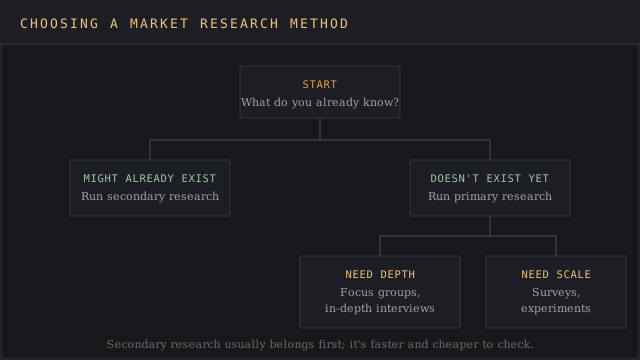
Primary market research collects new data directly from the people a question is about: customers, competitors, or prospects who haven't bought yet. Coursera's guide names four core primary techniques: interviews, surveys, focus groups, and experiments. Primary research is slower and more expensive than secondary research, but it's the only option when the question is specific enough that no existing dataset answers it.
Surveys and online surveys
A survey gathers structured answers from a representative sample large enough to generalize to a wider population within a stated margin of error. Online surveys, the most common quantitative research format, are cheap to field and fast to return, and Drive Research's guidance puts the sweet spot at 15 to 20 questions, since engagement drops once a survey runs past ten minutes to complete.
Surveys can't be adjusted mid-flight and don't leave room for the open-ended follow-up an interview allows. They also need enough respondents to be statistically meaningful, and depending on the audience, that sample can be hard to reach without a paid incentive. Even so, surveys gather insights a moderated conversation would take hours to reach, just narrower ones, and reduce every answer to statistical data a report can cite without a footnote.
Focus groups
A focus group is a moderator-led discussion with a small, representative group, typically eight to twelve participants per OpenStax's marketing textbook, though Drive Research runs sessions as small as four. Just over half of companies ran at least one focus group in the past year, per Hanover Research, making it the second most common qualitative technique after data-analytics-adjacent work.
A focus group tests reactions from a narrow slice of the target market: eight to twelve people standing in for everyone else who might buy. Customer focus groups surface reactions a fixed-choice survey can't, since participants build on each other's answers in real time.
The tradeoff is sample size: results from eight to twelve people don't generalize to a market, and a skilled moderator is required to keep one or two vocal participants from dominating the room. Drive Research recommends running two separate groups on the same questions specifically to catch that bias before it skews a final report.
In-depth interviews
An in-depth interview is a one-on-one, semi-structured conversation, usually lasting 30 to 90 minutes per Drive Research, built to reveal a respondent's decision-making process, not merely their final answer. Only 40% of companies conducted one in the past year, per Hanover Research, the least-used of the four core categories, largely because qualified participants are hard to recruit and each conversation takes a trained interviewer's full attention.
B2B research leans on this method more than consumer research does. Coursera notes that B2B studies emphasize qualitative data over quantitative data specifically because B2B respondent pools are too small to produce statistically significant survey results, which makes a handful of well-run interviews with the right buyers more useful than a survey nobody in that niche will answer.
A project like this earns its cost when secondary sources have already run dry and only target customers themselves can answer what's left.
Observational and ethnographic research
Observational research collects data by watching what people do, and OpenStax's marketing textbook classifies it as ethnographic when researchers watch behavior in its natural setting. Unobtrusive observation, where the subject doesn't know they're being watched, catches genuine behavior a survey response would sanitize; mechanical observation, using sensors or vehicle counters, removes the human observer altogether.
This method answers questions a self-reported survey answer gets wrong more often than researchers expect, like which product feature customers use versus which one they claim to use. Buying habits are the clearest example: what a shopper does at the shelf and what the same shopper reports afterward routinely disagree.
Experiments and concept testing
Experimental, or causal, research isolates a cause-and-effect relationship by exposing separate groups to different treatments and comparing the outcome, the design behind A/B testing. Ad concept testing applies the same logic to marketing messages before a campaign spends real money, using either an online survey or a focus group to compare which version resonates with the target audience, per Drive Research.
The upside: a poorly performing concept gets killed before the marketing budget does, ahead of a launch.
Secondary research
Secondary research, sometimes called desk research or desktop research, reuses data that already exists, and it typically comes first in a research plan because it's the fastest and cheapest place to look. Hanover Research reports 55% of companies conducted secondary research for a project in the past year, more common than qualitative interviews but less common than surveys or data analytics.
Industry reports built to track market trends across a category are often the fastest way to catch a shift before a competitor's primary study does.
Coursera's step-by-step guide recommends starting with secondary research specifically so the primary study that follows can focus on the gaps secondary data doesn't close, instead of re-asking questions someone else has already answered.
Secondary data sources
These sources split into internal records, like a company's own past sales data, and external sources, per OpenStax's marketing textbook:
- Industry reports.
- Government agencies.
- Other public domain data.
- Academic journal articles.
- University research centers.
- Syndicated data available through paid subscription.
The tradeoff runs the opposite direction from primary data: it's inexpensive and fast to access, but it can be outdated, might not match the exact parameters a project needs, and the same public report is available to every competitor reading it too.
Secondary market research also covers competitive analysis: pricing pages, public filings, and job postings, nobody has to survey anyone to read them, and it's one of the cheapest ways to build a competitive advantage before a product ships.
Choosing qualitative or quantitative research
Methodology is the layer above technique: qualitative data captures a respondent's own words, and quantitative data reduces the same subject to a number a chart can display. OpenStax's marketing textbook organizes methodology into four research designs, exploratory, descriptive, experimental, and ethnographic, each suited to a different kind of question.
Descriptive research, run mostly through surveys, produces numerical data that describes a market's current attitudes or behaviors at scale, using statistical analysis to turn raw responses into a number a report can defend. Experimental research isolates cause and effect. Ethnographic research observes behavior directly.
Quantitative market research leans on quantitative methods, mainly surveys and experiments, to answer how many and how much; qualitative market research answers why. Drive Research notes the two are strongest when paired, since a survey can quantify customer preferences an interview first surfaced as a hypothesis.
Exploratory research
Exploratory research is used when a team needs general information about an unfamiliar market before it can even write a specific research question, and OpenStax recommends collecting it through focus groups, interviews, or a review of existing secondary data. Setting the research objectives before picking a method is what separates exploratory work from a study that wanders.
A company weighing a new product for a market it hasn't tested yet is a textbook exploratory case: the goal isn't to prove a hypothesis, it's to find one worth testing next.
Choosing a survey format
Format changes what a survey can collect. It also changes the cost. OpenStax's marketing textbook lays out the tradeoffs across the four traditional formats, and Drive Research's fieldwork adds real response-rate data on top of them.
| Format | Strength | Weakness |
|---|---|---|
| Mailed survey | Reaches large populations; convenient for the respondent | Slow and expensive; still used for the U.S. Census |
| Phone survey | Respondent can ask questions; collected in real time | Time-intensive; restricted by federal calling-hour law |
| In-person survey | Follow-up questions possible; door-to-door census backup | Labor-intensive; many people decline to stop |
| Electronic survey | Cheap and fast; a mail-based survey can take months, this takes about a week | Read as spam; typically the lowest response rate |
| Intercept survey | Captures in-the-moment feedback right after an experience | Requires venue permission; lower participation than other formats |
Format tradeoffs per OpenStax's Principles of Marketing textbook and Drive Research's fieldwork guidance.
Mail surveys look outdated next to an electronic link, but Drive Research reports an average response rate of 10 to 15% against the 1 to 2% a typical direct-mail piece gets, and they remain the practical option in industries where personal data restrictions block digital outreach, such as banking.
Phone surveys carry their own legal constraint: the Telephone Consumer Protection Act, passed by Congress in 1991, bars calls before 8 a.m. or after 9 p.m. in the recipient's time zone, a rule researchers have to build their calling window around.
Data collection best practices
Primary research lives or dies on the sample it draws from. A representative sample starts with a sample frame, the specific population a study draws from, say college students living on campus or small businesses with fewer than ten employees, per OpenStax. Two sampling categories exist.
Probability sampling gives every member of the population a known chance of selection, through methods like a simple random sample or a stratified sample that draws proportionally from subgroups; results from a probability sample can be generalized to the wider population with a stated confidence level.
Nonprobability sampling, including convenience sampling, where a researcher recruits whoever's easiest to reach, and judgment sampling, where the researcher hand-picks participants they believe fit the criteria, produces findings that can't be extended past the people sampled. A convenience sample answers "what did these twenty people say," not "what does the market think."
Instrument design matters as much as who answers it. A pilot test, run on a small group before full launch, catches a confusing question before it corrupts the research data a thousand responses would otherwise produce. Documenting metadata and consent records at collection time avoids a scramble to reconstruct them during analysis. Statistical methods turn that raw data into a mean, a median, or a mode a report can cite with a straight face.
Running a market research project step by step
OpenStax's marketing textbook lays out a seven-step process that holds regardless of which method, primary research or secondary, a project uses:
Define the problem and the specific research question it produces.
Develop the research plan, including timeline and budget.
Select the data collection method, primary, secondary, or both, and gather data against the research objectives set in step one.
Design the sample: who gets included and how they're selected.
Collect the data using the chosen instrument.
Analyze data and interpret the results.
Prepare the research report and route it to whoever makes the decision.
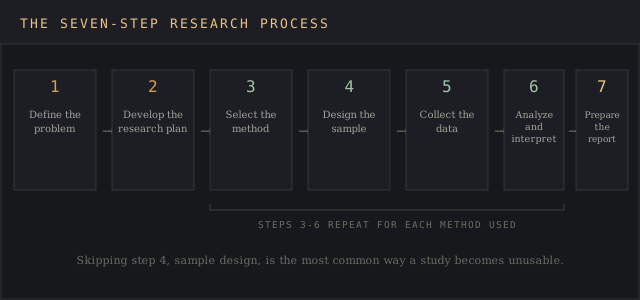
Coursera's condensed version of the same sequence, identify a focus area, select a method, collect data, analyze it, and use the findings, skips the sample-design step almost entirely, exactly the step most likely to produce a report nobody can defend once it's presented to a skeptical stakeholder. Followed in order, the process separates working strategies from expensive guesses.
Research methodology checklist
Checking a market research methodology before fieldwork starts costs nothing. Checking it after data collection wraps costs the whole study. A defensible research methodology puts three things on the record before analysis starts:
- The sampling rationale: why the team chose this frame and this sample size.
- The variable definitions, so "satisfied" or "aware" means the same thing to every person coding the results.
- Where the analysis allows for it, a pre-registered analysis plan that states what the team was looking for before it saw the data.
None of these steps cost much time relative to fielding the study itself, and all three separate a report a stakeholder trusts from one they quietly discount.
Turning market research into a marketing strategy
Raw data becomes a marketing strategy once it's attached to a metric someone tracks over time. OpenStax's marketing textbook defines three of the most common:
- Customer satisfaction score, or CSAT, scored 0 to 100%, where 75 to 85 is generally considered good and anything above 85 is exceptional.
- Customer acquisition cost, or CAC, calculated by dividing total acquisition spend by new customers gained.
- Customer effort score, or CES, a short survey measuring how easy an interaction with a company was.
These work well as key performance indicators because they're cheap to recalculate every quarter against a company's own sales data, unlike a full study.
Concept testing, mystery shopping, and feasibility studies extend the same logic into specific business decisions and protect marketing efforts from a message that tests poorly before real budget follows it. Concept testing compares marketing messages before a campaign launches, and overlaps with brand research when the messages being tested carry a company's own name.
Mystery shopping sends trained shoppers into a real store to evaluate service quality a satisfaction survey alone would miss, since a shopper notices things a customer filling out a form after the fact forgets to mention. A feasibility study, per Drive Research, combines fieldwork with secondary sources to predict if a new product, service, or location in a new market will succeed before a company commits real budget to it.
Where AI and automation fit into research methods now
AI's role in market research is narrower than the marketing around it suggests. The 2026 GRIT Insights Practice Report from Greenbook, based on data collected in the first quarter of 2026, found the industry has converged on three specific tasks where agentic AI is already embedded: analyzing data, updating reports, and preparing and integrating data. Designing the study and interpreting what the findings mean for a business decision remain untouched so far.
Fraud detection tooling shows a similar pattern of quiet, functional adoption: the same GRIT report found 70 to 88% of research teams across every segment now use fraud detection tools regularly, a response to synthetic and low-quality survey responses that would otherwise contaminate a dataset before a human ever reviews it. AI's use case, so far, is compressing the mechanical middle of a research project. The judgment calls at either end still sit with a person.
Common mistakes in market research methods
The most common failure isn't picking the wrong technique; it's skipping secondary research and going straight to an expensive primary study that a free industry report would have partly answered. A close second is treating a small qualitative sample, eight focus group participants or twelve interviews, as if it generalizes to an entire market the way a 500-response survey would.
Leading questions distort survey data quietly, since a respondent often just answers the question as phrased. Skipping a pilot test on a new instrument produces the same problem at scale: a confusing question that seemed clear to the person who wrote it corrupts every response that follows it.
Frequently asked questions
What are market research techniques?
Market research techniques are the specific tools within primary and secondary research: surveys, focus groups, in-depth interviews, observational and ethnographic research, experiments, and secondary or desk research. Which one applies depends on one question: does it need new data, or can existing data already answer it?
What are the four methods of market research?
Hanover Research's practitioner framework names four: data analytics, survey research, qualitative research, and secondary research. Usage varies widely across them: data analytics leads at almost 70% of companies using it in the past year, followed by surveys at over 60%, secondary research at 55%, and qualitative interviews at 40%.
What are the 10 market research methods?
Drive Research's practitioner guide lists eleven specific techniques: online surveys, phone surveys, customer surveys, mail surveys, intercept surveys, concept testing, PR surveys, mystery shopping, focus groups, in-depth interviews, and feasibility studies. Most fall under the broader survey or qualitative categories covered above.
What are the different market research methodologies?
Methodology sits above technique: qualitative versus quantitative, and primary versus secondary. OpenStax's marketing textbook further splits methodology into four research designs, exploratory, descriptive, experimental, and ethnographic, each matched to a specific kind of research question ahead of budget or format.
What are the 7 types of marketing research?
No single list is universally agreed on, but combining Hanover Research's four categories with OpenStax's research designs produces seven commonly cited types: survey research, focus groups, in-depth interviews, observational or ethnographic research, experimental research, secondary or desk research, and data analytics.
What are the five methods of market research?
Coursera names four core primary research methods: interviews, surveys, focus groups, and experiments. Add observational research, standard in OpenStax's marketing textbook, and the commonly cited count rises to five.
Bottom line
Market research methods aren't interchangeable tools for the same job. A survey answers a scale question, an interview answers a why question, and secondary research answers a question somebody else already paid to research. The 95% of businesses reporting positive ROI on market research, per Hanover Research, mostly got there by matching the technique to the question before collecting a single response.
Get the sampling wrong, skip the pilot test, or reach for a costly primary study when a free industry report already had the answer, and the resulting report costs real money while adding little a team didn't already half-know.
Get the method right, and even a small study, eight focus group participants or a dozen well-chosen interviews, holds up when it's presented to someone who's going to ask hard questions about how the data was collected. Primary research earns its cost when the question is specific enough that nothing else answers it; secondary research earns its keep everywhere else.
For related reading, see our guides to market intelligence vs market research, how to gather market intelligence, and the market intelligence process.