Customer feedback management platforms: 10 tools ranked for 2026
 By Jan Suski. I go deep on every review, checking every number against its source and digging up details other coverage misses, a habit from six years of SEO and link building for tech companies. Bylines at Brand24 and Senuto. How the scoring works.
Quick comparison of customer feedback management platforms
Ten platforms, the figure that most tells you what each one is, what it costs to start, and who it fits. Figures are each vendor's own published number, Vendr's tracked buyer medians, or G2's public review count.
| # | Provider | Telling figure | Entry price | Best fit |
|---|---|---|---|---|
| 1 | Qualtrics | $30,000/yr Vendr median*, 323 purchases | Quote only | Enterprise CX across every channel |
| 2 | Medallia | $13,338/yr Vendr median*, 32 purchases | Quote only | Multi-location contact-centre feedback |
| 3 | Chattermill | 238 G2 reviews, 4.4/5 | Quote only | AI-tagged sentiment at volume |
| 4 | SurveyMonkey | 24,040 G2 reviews, 4.4/5 | $30/seat/mo (3-seat floor) | A known brand, tight budget |
| 5 | Survicate | 214 G2 reviews, 10 seats on Growth | $114/mo billed yearly | Web + in-app under 10 seats |
| 6 | Delighted | 500 responses/mo cap, top tier | $19/mo | One-question NPS, fast setup |
| 7 | Qualaroo | 50 responses free, forever | $0 | Targeted website micro-surveys |
| 8 | Zonka Feedback | No published rate card | Quote only | Omnichannel without seat pricing |
| 9 | Canny | 10-seat hard cap, Pro plan | $0 (25 tracked users) | Feature-request tracking, not CX |
| 10 | Productboard | 5-maker minimum, every plan | Quote only | Roadmap teams bolting on feedback |
Medians marked * are anonymized buyer-reported contract values published by Vendr. Everything else is the price or figure the vendor, or G2, publishes itself.
Where these figures come from
Review counts and ratings are each vendor's own G2 listing, pulled this session; pricing is each vendor's own pricing page where one exists. Qualtrics and Medallia publish no price list, so their medians are Vendr's anonymized buyer-reported contract values, read this session. Chattermill and Zonka Feedback publish no price list and no Vendr listing either; both rows name the pricing model and carry no invented number.
Customer feedback management platforms collect NPS, CSAT and open-text responses across email, web, SMS and in-app surveys, then route the result to a support ticket, a product backlog or a dashboard a VP checks on Monday. Ten customer feedback tools make this list, chosen from vendors with a documented price, review count or Vendr contract behind every claim.
This page ranks them on six testable criteria, set before the list below it: published pricing, a free or low entry tier, a named AI analytics capability, channel breadth, integration count and independent review volume.
Call it customer feedback software or a feedback management tool, the same six criteria apply to matching a platform against actual customer needs, and every entry carries a sourced figure, a user quote and a closing sentence naming the number that separates it from its neighbors.
The buyer here runs a customer experience management, product or support team of five to five hundred people, choosing between an enterprise VoC platform billed by the year and a $19-a-month NPS tool that does one thing well.
Both belong on this page because teams graduate from one to the other, usually around the point a Vendr contract starts making more sense than a per-seat invoice. A feedback management tool that fits a five-person team looks nothing like one that fits five hundred.
Two 2026 wrinkles are worth tracking before anyone signs anything. Qualtrics folded Delighted into its own platform back on 12 April 2018 and still runs it as a separate SKU, so a "ten independent vendors" shortlist already has shared ownership baked in. Medallia changed hands again this year in a Thoma Bravo debt-for-equity swap, the kind of ownership churn that tends to show up first in renewal pricing, quietly, long before any press release.
Evaluation criteria for customer feedback management platforms
Six criteria decide the shortlist below, and the ranking applies them in this order: published pricing, a free or low-cost way in, a named AI analytics capability, channel breadth, integration depth and independent review volume. A tool that fails one criterion can still rank; a criterion nobody can test gets cut.
This page ranks collection platforms: NPS, CSAT and open-text survey tools judged on price, free tiers, AI tagging, channel breadth, integrations and review volume.
Our customer feedback analysis tools ranking covers a different, overlapping set of vendors, Medallia, Qualtrics XM, Chattermill and Zonka Feedback among them, and judges them on how well they turn responses into text-analytics insight. This page judges the same four shared vendors on how they collect that feedback in the first place, and the two rankings land in a different order because they're testing different things.
Published pricing
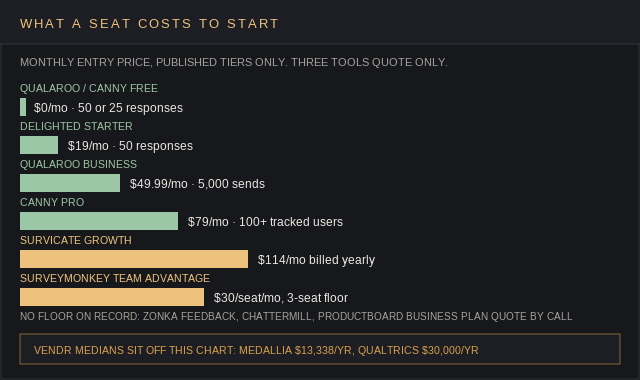
A buyer runs this test by opening the vendor's own pricing page and checking for a dollar figure that doesn't require a demo call. SurveyMonkey states $30 a seat and Survicate states $114 a month; Qualtrics, Medallia, Chattermill, Zonka Feedback and Productboard quote every deal individually.
A free or low-cost entry tier
The test is a dollar amount paired with a response or seat cap on the cheapest tier. Qualaroo's free plan runs 50 responses forever, no trial attached; Canny's free plan caps at 25 tracked users; Delighted's cheapest paid tier is $19 a month for 50 responses.
A named AI analytics capability
This is ahead of the curve compared to generic "AI-powered" marketing copy. The test is a named, specific function, such as auto-tagging or sentiment analysis. Chattermill's AI Feedback Intelligence tier, priced separately by data credit, is the sharpest example on this list.
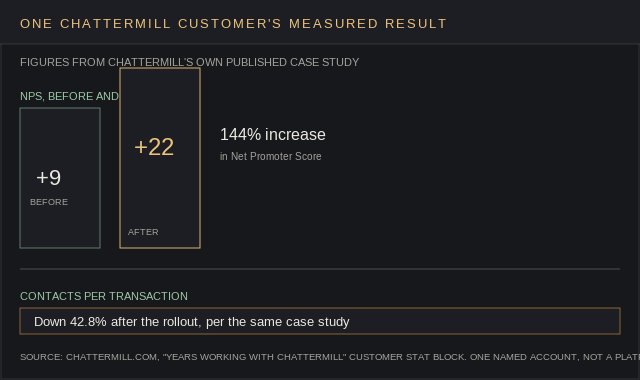
The NPS lift Chattermill's own published customer case reports, from +9 to +22, alongside a 42.8% drop in contacts per transaction. No other entry on this page can cite a measured result like it.
Channel breadth
Count the distinct collection channels the vendor documents on its own site: web, email, SMS, in-app, contact centre. Medallia names five, including contact-centre calls; Qualaroo's free tier runs website micro-surveys only.
Integration depth
The test is named connectors, not "and more." Delighted listed 15-plus named integrations, including Salesforce, HubSpot, Slack and Zendesk, at the time Qualtrics acquired it; Productboard caps its Business plan at five Jira and five Azure DevOps connections.
Independent review volume
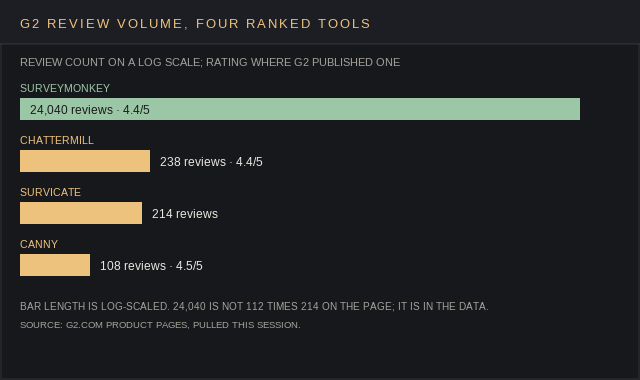
G2 review count and rating are the test, since a platform that survived 24,000 buyers' scrutiny carries a different kind of proof than one with 100. Finding the honest quote inside that pile is its own needle in a haystack; a five-star review that reads like ad copy gets skipped below, and negative feedback carrying a specific detail gets quoted instead.
Pull up the vendor's own pricing page before a sales call, every time. Half the entries below quote everything by demo, and walking in already knowing the one independent number that exists, a Vendr median, a G2 count, a published case result, changes who's negotiating from strength.
The ranking
Criteria set, numbers sourced. Here's the list, cut to the chase.
Qualtrics
Best fit
Enterprise CX teams running feedback across every channel at once, with budget for a full platform.
Qualtrics' median Vendr-tracked contract runs $30,000 a year across 323 logged purchases, ranging from $7,040 to $137,847 (vendr.com/marketplace/qualtrics, accessed this session; the same page's header tile shows 211 deals, a conflict that sits on Vendr's side). The platform's own site quotes every tier by sales call and publishes no number, so that median is the only real anchor a buyer gets before signing.
The acquisition that matters here predates the ranking period. Qualtrics bought Delighted on 12 April 2018, when Delighted was five years old and served over 1,500 mostly small and mid-size customers (qualtrics.com/news, accessed this session). Qualtrics still runs Delighted as its own $19-a-month SKU and hasn't folded it into the main platform's pricing, so two entries on this list share an owner without sharing a price.
Key features
- XM Discover runs advanced analytics, tagging open-ended responses across call transcripts, chat logs and surveys in one taxonomy.
- The Delighted SKU runs one-question NPS, CSAT or CES surveys by email, web, SMS or a mobile-optimized link.
- 15-plus named integrations on the Delighted side alone, including Salesforce, HubSpot, Slack and Zendesk.
- Predictive analytics flags accounts at churn risk ahead of a renewal date, while there's still time to act.
- Feedback scores tie to account records for enterprise renewal forecasting.
Pricing
The core XM platform quotes every deal individually; Delighted, the SKU Qualtrics owns, publishes a rate card starting at $19 a month for 50 responses and topping out at $249 a month for 500 (delighted.com/pricing, accessed this session).
Pros
- XM Discover covers text, voice and digital signals in one taxonomy, a breadth few competitors on this list match.
- Delighted's integration list beats most SMB-tier tools ranked here.
- Predictive churn scoring ties feedback data directly to account records.
Cons
- No published price for the flagship platform; every deal needs a sales call.
- Capterra reviewer Ryan C., an Analytics Manager at a 51-200-employee real estate firm, wrote it "could be costly and set up is tedious with a lot of customizations required" (capterra.com, 29 October 2025).
- Running two SKUs under one brand, XM and Delighted, means support and update cadence differ sharply depending on which one a buyer signs.
Why it's ranked #1. Qualtrics wins the channel-breadth criterion: XM Discover ties text, voice and digital signals into one taxonomy, which nothing else here matches. It beats #2 Medallia on that same breadth count, though Medallia's $13,338 median Vendr contract runs at 44% of Qualtrics' $30,000.
Medallia
Best fit
Large, multi-location brands needing one feedback layer across web, contact-centre and in-store touch points.
Medallia's median Vendr-tracked contract runs $13,338 a year across 32 purchases, ranging from $6,739 to $112,044 (vendr.com/marketplace/medallia, accessed this session). Our full Medallia review covers the platform's Experience Cloud and the 2026 ownership change in more depth.
That ownership change is the fact worth carrying into a renewal conversation: Blackstone's creditors took over via a debt-for-equity swap earlier this year, per our existing review, the kind of event that tends to sharpen the incentive to raise prices at the next contract cycle.
Key features
- Experience Cloud automates collection across hundreds of locations for a single chain, mapping the customer journey from first contact to resolution, so nobody hand-fields surveys per site.
- Contact-centre calls trigger a survey, score and same-day manager alert in one pipeline.
- Text analytics turns ten thousand free-text comments into a ranked list of problems, shown through dashboards that support informed decisions without exporting a spreadsheet.
- Signal types span chat transcripts, call transcripts, support tickets, social listening and employee ideas, scored separately.
Pricing
No published rate card; price depends on business size, industry, how much customer data the contract covers and the modules a buyer adds. The $13,338 Vendr median above is the only independent anchor.
Pros
- Five documented channels, including contact-centre calls, outnumber any pure text-analytics specialist on this list.
- Same-day alert routing turns an angry response into an owned follow-up the same day.
- Employee idea capture sits alongside customer feedback in one taxonomy.
Cons
- No price transparency anywhere on the public site.
- Trustpilot reviewer Nanette Barrett called the survey experience itself "annoying," pointing to a mandatory 18-digit receipt code before any question loads (trustpilot.com, 18 May 2026).
- The Thoma Bravo debt-for-equity swap raises renewal-price risk the public pricing page can't disclose.
Why it's ranked #2. Medallia beats #1 Qualtrics on contract price, its $13,338 Vendr median runs at 44% of Qualtrics' $30,000, but loses on review-validated purchase count: 32 logged deals against 323. It ranks above #3 Chattermill because five documented channels beat one specialty.
Chattermill
Best fit
Teams with high response volume who want AI-tagged sentiment at scale.
Chattermill holds 4.4 out of 5 across 238 reviews on G2 (g2.com, pulled this session). One published customer case cites a 144% increase in Net Promoter Score, from +9 to +22, alongside a 42.8% drop in contacts per transaction (chattermill.com, accessed this session). A stub review sits at reviews/chattermill on this site, still awaiting its full build.
Pricing splits in two: Feedback Management is priced by response volume, AI Feedback Intelligence by data credit, with an option to bundle both (chattermill.com/pricing, accessed this session). Neither tier states a number without a demo request.
Key features
- AI auto-tags thousands of open-text comments and runs sentiment analysis across them without a data-science team.
- Feedback Management and AI Feedback Intelligence can run as separate plans or one bundle.
- Salesforce integration drew a "top tier" rating from reviewer Leon D., a law-practice CTO (G2, 3 February 2025).
- A 14-day free trial is available before any plan commitment.
Pricing
No published tiers; quoted by response volume and AI data credit, bundled or separate, with a 14-day trial.
Pros
- A published case shows a 144% NPS lift, a number no other entry here can cite.
- Katy D., in a 201-500-employee Creative role, said it's "very quick to get to insights without having any data analytics background" (capterra.com, 3 September 2024).
- Salesforce integration praised directly by a named reviewer.
Cons
- No published price floor on either tier.
- 238 G2 reviews trail SurveyMonkey's 24,040 by two orders of magnitude.
- Splitting pricing into response volume plus AI data credits complicates budgeting for the AI tier specifically.
Why it's ranked #3. Chattermill ranks third on measured AI results: its published case shows a 144% NPS lift, a figure no competitor here can cite. It loses to #2 Medallia's five-channel breadth and beats #4 SurveyMonkey on AI depth, even though SurveyMonkey's 24,040 reviews dwarf Chattermill's 238.
SurveyMonkey
Best fit
Teams who already know surveys and want the best-reviewed brand in the category.
SurveyMonkey holds 4.4 out of 5 across 24,040 reviews on G2, the largest review base of any tool on this list by a wide margin (g2.com, pulled this session). Team Advantage runs $30 a seat a month with a 3-seat floor and 50,000 responses a year; Team Premier runs $92 a seat with 100,000 responses a year, and survey responses beyond either cap cost $0.15 each (surveymonkey.com/pricing, accessed this session).
Both paid tiers include unlimited surveys and questions, which is more generous than the response caps most of the smaller tools on this list impose. A free Basic tier exists but doesn't publish its viewing limit.
Key features
- Team Advantage: $30/seat/month, 3-seat floor, 50,000 responses/year.
- Team Premier: $92/seat/month, 100,000 responses/year.
- Unlimited surveys and questions on both paid tiers.
- Overage billing at $0.15 per response beyond the annual cap, with no hard cutoff.
Pricing
As above; Enterprise is quote-only, the one tier here that breaks the published-pricing pattern.
Pros
- 24,040 G2 reviews at 4.4 out of 5 is more independent validation than any other platform ranked here.
- Unlimited surveys and questions on both named paid tiers.
- Per-seat pricing is rare transparency for a brand this size.
Cons
- Digvijay S M, a self-employed Founder, wrote he "felt the cost constantly, and the way useful features are parceled out across tiers" (capterra.com, 27 June 2026).
- Cody M., a Roofer by trade, found the free plan "restrictive, especially when it comes to advanced customization" (capterra.com, 12 August 2026).
- The 3-seat floor on Team Advantage makes a one-person account costlier per seat than Delighted's single-user plan.
Why it's ranked #4. SurveyMonkey wins the review-validation criterion outright with 24,040 G2 reviews, more than every other platform on this list combined. It loses to #3 Chattermill's AI-tagging depth and beats #5 Survicate on price, since $30 a seat undercuts Survicate's $114 Growth plan before any seat math runs.
Survicate
Best fit
Product and CX teams who want web, email and in-app feedback under 10 seats, without per-seat enterprise pricing.
Survicate holds 214 reviews on G2 (g2.com, pulled this session). Its Growth plan runs $114 a month billed annually, covering 10 user seats and 2 teams per the pricing card, with up to 1,000 Research Hub data points a month tracking survey responses across channels (survicate.com/pricing, accessed this session).
A 14-day free trial, no card required, covers up to 25 responses before any purchase decision.
Survicate's own pricing page disagrees with itself: the comparison table lists 500 Growth-tier responses, the plan card lists 250. Neither figure above can resolve that for you, so get the real number on a call before signing.
Key features
- Growth plan: $114/month billed annually, 10 seats, 2 teams.
- Research Hub data points: up to 1,000/month on Growth, per the pricing card.
- 14-day free trial with full feature access, up to 25 responses.
- Multi-channel distribution across web feedback widgets, email and in-app surveys, built from short feedback forms that stay under a minute to complete.
Pricing
Growth at $114/month billed annually; Pro and Enterprise step up to $349 and $569 a month, the latter quoted per response pool.
Pros
- 10 seats included at the Growth tier, cheaper per seat than SurveyMonkey's Team Advantage past four users.
- A 14-day trial with no card required.
- Mariana N., a Product Marketing Specialist, called it "really, really good at surveys, in all shapes and forms" (capterra.com, 13 November 2025).
Cons
- Survicate's own pricing page contradicts itself on the Growth plan's response cap, 500 against 250.
- 214 reviews is a smaller base than any of the four tools ranked above it.
- No contact-centre channel, unlike Medallia.
Why it's ranked #5. Survicate beats #4 SurveyMonkey's seat economics past four users, $114 for 10 seats against $30 per seat with a 3-seat floor, but loses on review count, 214 against 24,040. It ranks above #6 Delighted because its in-app and web channels outnumber Delighted's email-first design.
Delighted
Best fit
Small teams wanting one-question NPS or CSAT running within a day of signing up.
Qualtrics acquired Delighted on 12 April 2018, when it served over 1,500 mostly small and mid-size customers (qualtrics.com/news, accessed this session).
Pricing runs Free at $0 for 25 responses, Starter at $19/month for 50, Growth at $39/month for 100, Advanced at $149/month for 250 and Premium at $249/month for 500 (delighted.com/pricing, accessed this session). That 500-response ceiling on the top plan is a drop in the bucket next to Survicate's higher Research Hub allowance at a comparable price.
Fifteen-plus named integrations, including Salesforce, HubSpot, Slack and Zendesk, shipped at the time of acquisition, and the one-question feedback forms cover NPS, CSAT, CES or a five-star rating sent by email, web, SMS or a mobile-optimized link.
Key features
- One-question NPS, CSAT, CES or 5-star surveys.
- Delivery by email, web, SMS or a mobile-optimized URL.
- 15-plus named integrations, including Salesforce, HubSpot, Slack and Zendesk.
- Response caps double roughly every tier, up to 500/month on Premium.
Pricing
As above; Delighted's own comparison table and detailed plan sections list two different user counts per tier (2 vs 1, 3 vs 5, and so on), an inconsistency the vendor hasn't resolved.
Pros
- Loretta B., a Customer Experience Manager at a small retail business, said "when they were acquired by Qualtrics, Delighted made a few quick improvements that saved me hours and hours of time" analyzing data (capterra.com, 21 October 2020).
- Ray L., a CEO in apparel, cited "best value for money, no hidden costs" as his reason for choosing it (capterra.com, 11 June 2019).
- Fastest setup among the enterprise-owned tools on this list.
Cons
- 500-response ceiling on Premium is thin next to Survicate's Growth-tier allowance.
- Two conflicting user counts per tier on Delighted's own pricing page.
- Single-question format can't reach the open-text depth Chattermill's AI tagging covers.
Why it's ranked #6. Delighted beats #7 Qualaroo on question variety, shipping CSAT and CES alongside NPS where Qualaroo's free tier runs NPS-style micro-surveys only. It ranks below #5 Survicate on response capacity, 500 a month against Survicate's higher research allowance, and above Qualaroo on named integrations, 15-plus against none published.
Qualaroo
Best fit
Website teams who need targeted micro-surveys by segment, nothing heavier.
Qualaroo's free plan runs 50 responses forever, no strings attached, not as a time-limited trial, plus 500 email sends and 10,000 pageviews a month (qualaroo.com/pricing, accessed this session). Foli R., a Chief Product Officer at a small business, credited the segment targeting directly: "the targeting feature allows us to ask tailored questions to specific segments" (g2.com, 23 September 2026).
Essentials runs $19.99/month for 1,000 email sends; Business runs $49.99/month for 5,000 sends and 100,000 pageviews, adding Nudge and Link Nudge surveys, NPS, exit intent, heatmaps and the Identify API, tools built for continuous customer engagement, not a one-time survey; Enterprise starts at $149.99/month with custom volume, SSO and API access.
Qualaroo's own Enterprise tier shows an annual total, $1,798.88, that doesn't match $149.99 times 12 ($1,799.88). A one-dollar typo, but worth flagging before billing.
Key features
- Nudge and Link Nudge targeted on-page surveys that capture feedback by audience segment.
- NPS, exit-intent and heatmap modules on the Business tier.
- Identify API for user-level targeting on Business and Enterprise.
- A $300/year White Label add-on removes "Powered By" branding.
Pricing
Free at $0 for 50 responses forever, Essentials at $19.99/month, Business at $49.99/month, Enterprise from $149.99/month.
Pros
- A genuinely free tier, not a trial, at 50 responses forever.
- Segment targeting named directly by a reviewer, in their own words.
- Akshay S., a Senior SEO Associate at a mid-market company, said "before qualaroo, we relied on email surveys, which barely got responses" (g2.com, 23 February 2025).
Cons
- Qualaroo's own Enterprise tier shows an annual total, $1,798.88, that doesn't match $149.99 times 12 ($1,799.88), a typo worth flagging before billing.
- Website-only focus misses the SMS and contact-centre channels Medallia covers.
- Far smaller brand recognition than SurveyMonkey's 24,040-review base.
Why it's ranked #7. Qualaroo wins the free-tier criterion outright, 50 responses forever against Canny's 25-tracked-user model, which measures something different. It loses to #6 Delighted on question variety and beats #8 Zonka Feedback on price transparency: a published rate card against none.
Zonka Feedback
Best fit
Teams wanting omnichannel survey distribution without SurveyMonkey's per-seat math, so long as they're fine calling for a price.
Zonka Feedback publishes no rate card. Pricing is quoted per response volume for its Feedback Management plan, with AI Feedback Intelligence priced separately by data credit and a bundle option available (zonkafeedback.com/pricing, accessed this session). A 14-day free trial runs before any commitment. A stub sits at reviews/zonka-feedback on this site.
Its Salesforce integration drew a direct "top tier" rating from a named reviewer, which is more than most of the custom-quote tools on this list can show.
Key features
- Separate Feedback Management and AI Feedback Intelligence plans, standalone or bundled.
- Salesforce integration rated "top tier" by reviewer Leon D., a law-practice CTO (G2, 3 February 2025).
- Pricing billed by response volume, with no seat count attached.
- 14-day free trial ahead of any quote.
Pricing
No published floor; quoted per response volume, with AI Feedback Intelligence priced separately by data credit.
Pros
- Salesforce integration praised directly, in a reviewer's own words.
- Bundle-or-standalone plan structure suits teams that don't need AI tagging yet.
- No seat-based billing, unlike SurveyMonkey and Canny.
Cons
- Kristina A., a CEO at a 2-10-employee health and wellness company, wrote that "once I have paid the plan 'Starter' my survey started work incorrectly and I have lost many responses" (capterra.com, 19 November 2024).
- No published price floor forces a sales call before a buyer can even estimate cost.
- The smallest documented review base of any tool on this list.
Why it's ranked #8. Zonka Feedback loses the published-pricing criterion outright, unlike all seven tools ranked above it. It beats #9 Canny on integration proof, since a named reviewer rated its Salesforce connection "top tier," a specific claim Canny's listing can't match.
Canny
Best fit
Product teams tracking and prioritizing feature requests ahead of a roadmap meeting.
Canny's free tier runs $0 for 25 tracked users; Pro runs $79/month billed yearly for 100-plus tracked users, hard-capped at 10 total seats; Business is quote-only for 5,000-plus tracked users, adding SSO and CRM integrations (canny.io/pricing, accessed this session). It holds 4.5 out of 5 across 108 reviews on G2 (g2.com, pulled this session).
Named case studies include Ahrefs, CircleCI, Axios, ClickUp and Harness, though none of them publish a usage figure on Canny's own site.
Key features
- Automatic user feedback capture starts on the free tier, no manual tagging required.
- Product-management tool integrations on the Pro tier.
- SSO and CRM integrations reserved for the Business tier.
- A "255,000-plus" tracked-user figure sits beside Canny's own pricing slider, a usage metric measuring activity, separate from a customer count.
Pricing
Free at $0 for 25 tracked users; Pro at $79/month for 100-plus tracked users with a hard 10-seat cap; Business quote-only for 5,000-plus tracked users.
Pros
- Emily H., a Program Manager in Customer Experience at a 201-500-employee e-learning company, called it "very intuitive" and easy for customers to understand (capterra.com, 25 November 2025).
- Named customers include Ahrefs and ClickUp.
- Automatic capture is included on the free tier from day one.
Cons
- Junaid Gulzar M., a Senior PM at a 201-500-employee IT company, said "the total seat count at Pro plan is hard-capped at 10 users which feels like a big compromise" (capterra.com, 5 November 2025).
- Built for feature requests and roadmaps, outside the NPS or CSAT lane.
- 108 reviews is a far smaller base than SurveyMonkey's 24,040.
Why it's ranked #9. Canny wins the free-tier criterion on tracked-user count, 25 free against a response-based model measured differently elsewhere on this list, but loses the channel-breadth criterion outright: it runs feature requests, outside the NPS or CSAT lane entirely. It ranks above #10 Productboard, whose Business plan publishes no price at all.
Productboard
Best fit
Product teams who already run roadmaps and want feedback intake inside the same tool.
Productboard's Business and Enterprise plans publish no base price. Business requires a 5-maker minimum and includes 500 AI credits per maker a month; Enterprise includes 1,500 base AI credits plus 800 per additional maker (productboard.com/pricing, accessed this session). Credit top-ups cost $5 for 50 credits on monthly billing, or $60 for 600 credits a year, the one number on the page that doesn't require a sales call.
Business includes up to 25 contributors and 2 Product Portals, plus up to 5 Jira and 5 Azure DevOps integrations; Enterprise adds SAML SSO, SCIM provisioning, custom roles and a native Salesforce integration.
Key features
- AI credits bundled per maker, a model that scales with the team.
- Up to 25 contributors and 2 Product Portals on Business.
- Up to 5 Jira and 5 Azure DevOps integrations on Business.
- SAML SSO, SCIM provisioning and Salesforce integration reserved for Enterprise.
Pricing
No published base price on either plan; a 5-maker minimum applies before any plan starts, and credit top-ups run $5 per 50 credits monthly or $60 per 600 credits annually.
Pros
- AI credit top-ups are published at a fixed rate, rare transparency for a feature most competitors bundle invisibly.
- Native Jira and Azure DevOps connectors named explicitly, useful for engineering-adjacent product teams.
Cons
- A Verified User in Mid-Market IT wrote that "the pricing model is based on the number of users, so scaling it to match actual usage is always a challenge" (g2.com, 17 June 2026); par for the course among the credit-based tools on this list.
- A Verified User in Enterprise Computer Software said "the new AI features do not yet provide real added value" (g2.com, 14 June 2024).
- A 5-maker minimum locks out the smallest buyers before a single plan can even start.
Why it's ranked #10. Productboard ranks last on published pricing: neither plan states a base number, where even quote-only Zonka Feedback discloses a 14-day trial window. It loses to #9 Canny on access, since Canny's free tier lets a one-person team start, while Productboard's 5-maker floor locks out the smallest buyers this list otherwise serves.
What customer feedback management tools do
Every tool on this list exists to collect customer feedback from a single customer interaction, score it against NPS, CSAT or CES, and turn it into customer insights a team can act on: a support ticket, a product backlog or a review meeting.
The split between the ten entries is in that middle step. Medallia's text analytics turns ten thousand free-text comments into a ranked list of problems; Chattermill's AI Feedback Intelligence auto-tags thousands of open-text comments and runs sentiment analysis without a data-science team.
That puts both tools ahead of the curve against anything still sorting comments by hand, delivering actionable insights a raw spreadsheet never would.
The lightweight end of the list skips the analytics layer entirely. Delighted and Qualaroo send one-question customer surveys, collect feedback and a score, and leave the work of analyzing customer feedback to a human reading the raw responses.
Enterprise VoC platforms vs lightweight survey tools
Two different buying motions sit on this one list. Qualtrics and Medallia price by sales call and Vendr contract, $30,000 and $13,338 a year respectively, and cover multiple channels a five-person team will never need, like contact-centre call capture. Delighted, Qualaroo and Survicate publish a rate card between $19 and $114 a month, keeping feedback collection simple and inexpensive while skipping the enterprise modules outright.
Canny and Productboard sit in a third lane: product-feedback and roadmap tools that happen to intake customer requests on the side, short of a full customer-experience platform. A team that wants to cut to the chase on cost picks from the middle lane; a team with a dedicated CX function and procurement already in the room picks from the top.
Where the pricing breaks down
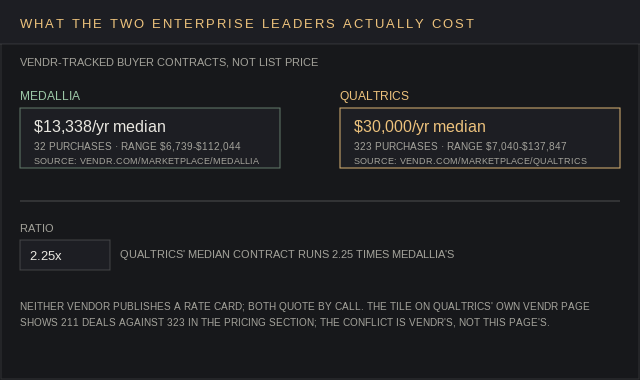
The elephant in the room on this list is that four of the ten tools, Qualtrics, Medallia, Chattermill and Productboard, publish no number at all. Vendr's tracked buyer contracts are the only independent anchor for the first two: $30,000 a year for Qualtrics against $13,338 for Medallia, a 2.25x gap neither vendor's own site discloses.
Among the tools that do publish, the spread runs from Qualaroo's $0 free tier to SurveyMonkey's $92-a-seat Team Premier, with per-response overage at $0.15 a head once a plan's annual cap runs out.
Common buying mistakes with feedback platforms
The most common one is signing a seat-based annual contract before testing real response volume, which leaves a team back to square one when SurveyMonkey's $0.15-per-response overage or Delighted's 500-response ceiling turns out to be the actual constraint, past the seat count entirely. Skipping the free trial to cut corners on evaluation is the second: Survicate and Chattermill both offer one, and neither requires a card.
The third is choosing a tool on G2 review count alone. SurveyMonkey's 24,040 reviews prove longevity more than fit.
A buyer at the end of their rope after reading two hundred five-star posts that read like ad copy should go find the specific complaint instead, the kind review sites rarely surface without digging, and this page quotes directly from Capterra and G2. Closing the feedback loop on a single bad quarter matters less than confirming the response cap survives a busy one.
Qualtrics vs Medallia: the enterprise VoC decision
These two account for the two biggest Vendr medians on this list and the two broadest channel counts. Our Medallia vs Qualtrics comparison runs the full head-to-head; the short version is that Qualtrics' $30,000 median buys XM Discover's text, voice and digital signal taxonomy in one platform, while Medallia's $13,338 median buys a narrower but still five-channel system at under half the price.
A team already running contact-centre operations at scale, where Medallia's same-day call-to-alert pipeline matters most, tends to land on Medallia. A team that wants everything, survey, call, chat and digital signal, under one taxonomy pays the premium for Qualtrics.
Frequently asked questions
What is the best software for customer service?
It depends on budget and channel count. SurveyMonkey carries the widest independent review base at 24,040 on G2; Medallia covers the widest channel set, including contact-centre calls, for teams that need more than surveys; Canny or Productboard fit teams tracking user satisfaction with specific features ahead of overall CX.
What are three ways to get feedback from customers?
Direct surveys that gather feedback by email, web or SMS, the model Delighted and Survicate run; passive capture through app behavior and support tickets, which Chattermill's auto-tagging reads without a new survey; and live contact-centre interaction, which Medallia scores the same day a call ends.
What is an example of a CSAT survey?
Delighted's one-question CSAT fires right after a support interaction closes, by email or SMS, asking a single 1-to-5 or 1-to-10 customer satisfaction score with an optional comment field, the fastest signal a support team gets to improve customer satisfaction before the next renewal. Read between the lines of a low score and the open comment usually names the exact step that failed.
Bottom line
Qualtrics wins on breadth for enterprise buyers who can clear a $30,000 median contract. Medallia wins the same category at 44% of that price if contact-centre capture is the priority. Chattermill is the pick for AI-tagged sentiment at volume, with a published 144% NPS case to back it. SurveyMonkey suits a team that wants the most-reviewed brand under real budget scrutiny, and Delighted or Qualaroo fit a team starting from zero budget today.
Survicate splits the difference for product teams under 10 seats, Zonka Feedback trades price transparency for Salesforce depth, and Canny or Productboard fit teams that need feedback bolted onto a roadmap ahead of a full CX program. The ball is in your court on which channel count and which price tier match the team signing the contract.