Survey software pricing in 2026: from $0.95 a response to a $30,000 median contract
 By Jan Suski. I go deep on every review, checking every number against its source and digging up details other coverage misses, a habit from six years of SEO and link building for tech companies. Bylines at Surfer, Brand24, and Senuto. How the scoring works.
The numbers Survey software, 13 tools and 5 Vendr listings, checked 6 October 2026
The cheapest dedicated survey plan for 12,000 responses a year costs $315 at Alchemer, and Qualtrics doesn't sell that volume online at all.
Qualtrics' median tracked contract is about six times its own $5,040 published plan, so the quote sets the bill.
Two research houses put the global market 2.9 times apart for neighboring years, which says more about their definitions than about survey tools.
A one-person survey program runs $315 to $1,788 a year at list price on most survey platforms, and quoted enterprise contracts run to $138,884 a year. The median Qualtrics buyer signs for $30,000 a year across 322 purchases tracked by Vendr. Pollfish sells a single panel response for $0.95.
This report prices 13 survey tools from each vendor's own pricing page, checked on 6 October 2026, and sets the tracked contracts from Vendr beside them. It covers the pricing models, a like-for-like cost for 12,000 responses a year, what each free plan caps, which features sit in higher tier plans, the hidden costs in the billing terms, and why research houses size the same market anywhere from $1.35 billion to $3.91 billion.
It's written for researchers, CX teams and marketers buying online survey tools, and for anyone holding a renewal quote. The figures matter because the billing unit sets the bill, and a SurveyMonkey Advantage user who collects 20,000 responses in a year pays $750 of overage on top of a $468 plan.
Every price below links to the page it came from, because survey platforms change plans often and an AI answer quoting last year's rate card is a pricing error waiting to happen.
How survey tools are priced: five models
Survey platforms meter five different things, and the unit decides who pays most. A plan priced per seat punishes a large team. A plan capped at 1,000 responses a month punishes a single big customer satisfaction study. Reading between the lines of a pricing page means finding the meter first and the dollar figure second.
- Freemium, a free plan with a hard cap. Typeform's free plan allows 100 responses a month for one seat, and Qualtrics' free plan allows 500 responses in total, 3 active surveys and 30 questions per survey.
- Flat-rate subscription, a fixed fee for a fixed tier of features. SurveyMonkey Advantage Annual costs $468 a year for one user with 15,000 responses included.
- Per-seat team plans, priced per user with a minimum. SurveyMonkey's Team Advantage costs $30 per user a month, billed annually, with a 3-user floor.
- Response-volume pricing, where the bill scales with usage. Pollfish charges from $0.95 per response and adds fees for targeting criteria, and Zonka Feedback says its pricing is "primarily based on the number of responses" on its pricing page.
- Custom enterprise pricing, quoted to the organization's response volume, headcount and modules, with data security controls such as SSO in the package. Qualtrics' enterprise research plan, Medallia, SurveyMonkey Enterprise and Typeform Enterprise all sit here.
Most survey platforms combine two or three of these meters in one plan. SurveyMonkey's annual plans are flat-rate subscriptions with a response cap, and every response past that cap bills at $0.15. Typeform caps responses monthly and resets the count every month, so a June spike can't borrow from a quiet May.
The models also map onto four buyer segments. Free plans serve a student or a one-off poll, flat plans from $25 to $139 a month serve small businesses, per-seat team plans serve mid-market research teams, and quoted contracts serve enterprise research programs with thousands of employees. The sections below price each segment from the vendor's own page.
What 12,000 survey responses a year cost on 10 survey platforms
Survey tools price on incompatible units, so the only fair comparison is one workload priced everywhere. Headline prices alone send a buyer barking up the wrong tree. The scenario here is one user collecting 12,000 survey responses a year, about 1,000 a month, on annual billing wherever the vendor offers it. That's the size of a monthly customer satisfaction survey for a mid-sized customer base, or a year of post-purchase feedback.
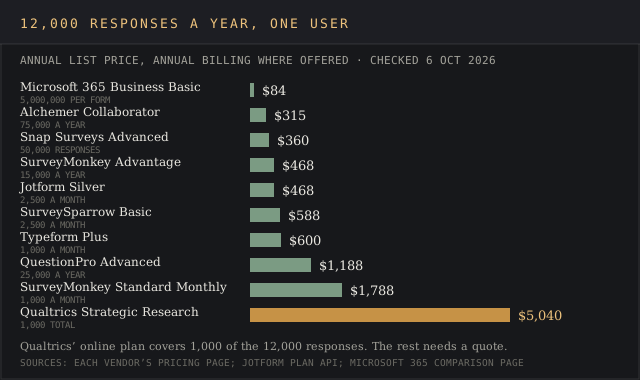
| Survey tool and plan | Annual list price | Response allowance | Users included |
|---|---|---|---|
| Microsoft 365 Business Basic (Microsoft Forms) | $84 | 5,000,000 per form | 1 (per-user price) |
| Alchemer Collaborator | $315 | 75,000 a year | 1 (per-user price) |
| Snap Surveys Advanced | $360 | 50,000 | 1 |
| SurveyMonkey Advantage Annual | $468 | 15,000 a year | 1 |
| Jotform Silver | $468 | 2,500 a month | 1 owner |
| SurveySparrow Basic | $588 | 2,500 a month | 1 |
| Typeform Plus | $600 | 1,000 a month | 3 |
| QuestionPro Advanced | $1,188 | 25,000 a year | 1 |
| SurveyMonkey Standard Monthly | $1,788 | 1,000 a month | 1 |
| Qualtrics Strategic Research online | $5,040 | 1,000 in total | Unlimited |
| Pollfish, panel included | $11,400 | 12,000 at $0.95 each | Not metered |
Every price in this table is a vendor list price, read off the vendor's own pricing page on 6 October 2026. The Pollfish row multiplies its published $0.95 base rate by 12,000 responses, and Vendr medians sit in the tracked-contracts table further down.
The spread runs 21 to 1 between Microsoft 365 Business Basic and SurveyMonkey's monthly plan for the same workload, before Qualtrics enters the picture. Pollfish sits in its own row because its $11,400 buys the respondents as well as the survey builder, which every other row leaves to you.
The devil's in the details, and two traps hide in the cheap rows. Jotform's Bronze plan at $408 a year allows 1,000 submissions a month, but its plan record caps total stored submissions at 10,000, so a 12,000-response year needs Silver at $468. Typeform Plus covers 1,000 a month exactly, and one busy month pushes the form into private mode.
What 13 survey tools cost, vendor by vendor
The 13 survey tools below are priced from their own domains, except Medallia, priced here from Vendr. List prices are as rendered on 6 October 2026, annual billing unless marked.
| Vendor | Free plan | Entry paid tier | Top published plan | Billing unit |
|---|---|---|---|---|
| SurveyMonkey | 10 questions per survey | $39 a month, annual | $92 per user a month, Team Premier | Per user, response cap |
| Typeform | 100 responses a month | $25 a month, annual | $266 a month, Growth Flow | Monthly response cap |
| Qualtrics | 500 responses in total | $420 a month, $5,040 a year | Quote only | Responses, unlimited users |
| Alchemer | None listed | $315 per user a year | $1,895 per user a year | Per user, annual responses |
| Jotform | 100 submissions a month | $408 a year | $1,188 a year, Gold | Forms and submissions |
| QuestionPro | 200 responses per survey | $99 per user a month | $83 per user a month, 5+ users | Per user, annual responses |
| SurveySparrow | 75 responses a quarter | $49 per user a month | Quote only | Per user, monthly responses |
| SmartSurvey | 100 responses a month | £70 a month, annual | £100 per user a month | Per user, annual responses |
| Snap Surveys | 200 responses | $30 a month | $95 per user a month, Elite | Per user, responses |
| Microsoft Forms | 200 responses per form | $7 per user a month in Microsoft 365 | $32 per user a month | Per user |
| Google Forms | Not on the pricing page | Included in every Workspace tier | Workspace Enterprise | Per user |
| Pollfish | None | $0.95 per response | $10,000+ a year, Enterprise | Per complete |
| Medallia | None | Quote only | $13,338* median, Vendr | Quoted |
Prices are vendor list prices from each vendor's own pricing page, checked 6 October 2026. The Medallia figure marked * is a Vendr median annual contract value from anonymized buyer data, because Medallia publishes no rate card.
SurveyMonkey: $39 a month, or $90 a month for a 3-seat team
SurveyMonkey sells three individual plans and three plans for teams, per its individual pricing page. Advantage Annual costs $39 a month, billed as $468, with 15,000 responses a year and unlimited surveys. Premier Annual costs $139 a month, billed as $1,668, with 40,000. Standard Monthly costs $149 a month with 1,000 responses a month and no annual commitment.
The monthly plan costs 3.8 times Advantage Annual for a year of use, the steepest annual-billing gap on this page, so paying monthly for an always-on program can cost an arm and a leg.
Plans for teams start lower per head and higher in total. Team Advantage costs $30 per user a month with a 3-user minimum, so the smallest team pays $1,080 a year for 50,000 responses. Team Premier costs $92 per user a month with 100,000 responses, and Enterprise starts at 5 users with SSO and a choice of US, Canadian or EU data centers.
The key features on Advantage are thematic analysis and AI analysis, while multilingual surveys, block randomization, crosstabs and phone access to the support team sit on Premier. SurveyMonkey's sentiment analysis marks each open-text answer as positive, negative or neutral, and the feature runs "on some paid plans in the US and EU data centers." SurveyMonkey says on its about page that it answers more than 20 million questions every day.
An investor group led by STG took SurveyMonkey's parent, Momentive Global, private on 31 May 2023 for about $1.5 billion, or $9.46 a share, per the company's announcement. Momentive's last public full-year revenue was $480.9 million for 2022, according to its results release.
Typeform: interactive surveys from $25 a month
Typeform meters responses per month and seats per plan. Basic costs $25 a month on yearly billing or $29 monthly, with 100 responses a month and 1 seat. Plus costs $50 a month yearly with 1,000 responses and 3 seats, and Business costs $83 with 10,000 responses and 5 seats. Plus also removes Typeform's own branding, which matters for professional surveys sent to clients, per Typeform's pricing page.
The paid Basic plan carries the same 100-response cap as the free plan, a red flag for anyone buying it for volume. The $25 buys AI-powered form creation, unlimited typeforms and the paid feature set, and a team that needs volume skips straight to Plus. Typeform's Growth Flow plan runs $266 a month yearly with 1,500 enriched responses a month, and the Talent plan for hiring runs $119.
Typeform builds interactive surveys that show one question per screen, and its help center puts the average completion rate of a typeform at 47%. When a form reaches 100% of the monthly cap it goes into private mode and stops taking responses, per Typeform's response limits article. Unused survey responses don't carry over, and deleted ones still count.
Qualtrics: a $5,040 online plan, and a $30,000 median quote
Qualtrics publishes one paid price. Strategic Research online costs $420 a month, billed as $5,040 a year, with 1,000 responses shared across unlimited users and 23 question types, per its buy-online page. The enterprise version of the same plan starts at 5,000 responses and is quote-only.
The key features at that price are unlimited users, 23 question types and dashboards. At 1,000 responses, the online plan works out to $5.04 per response, the highest unit price in this report. Vendr's tracked contracts show where real buyers land, at a $30,000 median and a $7,020 to $138,884 range, with 11.28% average savings. Our Qualtrics pricing report breaks the quote into its meters.
The quote buys statistical tools a basic survey builder lacks. Qualtrics' Stats iQ runs a linear regression on survey data with a numeric outcome and a logistic regression on a categorical one, and uses relative importance as its default output, per Qualtrics support.
That statistical testing suits complex research projects and academic research, with a learning curve to match. A team running a 10-question event survey pays for the whole nine yards and uses a fraction of it.
Qualtrics reported full-year 2022 revenue of $1,458.6 million, up 36%, in its last annual results release before going private. 6sense tracks Qualtrics at a 60.41% share of the employee engagement category. For a CX-platform view, our Medallia vs Qualtrics comparison puts the two side by side.
Alchemer: $315 a year, the cheapest paid seat for volume
Alchemer prices per user on annual or monthly terms. Collaborator costs $315 per user a year or $55 a month, with 75,000 annual responses and unlimited surveys. Professional costs $1,075 a year with 100,000 responses, and Full Access costs $1,895 with 125,000, both capped at 3 users, per Alchemer's plans page.
The annual discount runs 43% to 52%, the deepest in this report. A penny saved is a penny earned, and yearly billing saves $345 on one Collaborator seat. The key features Full Access adds are advanced research question types and statistical tools for analysis.
Past 3 users, Alchemer moves the account to a quoted business platform plan, and Vendr's tracked Alchemer median is $24,274 across 36 purchases. KKR made a majority investment in Alchemer in 2022, per Alchemer's about page.
Jotform: $408 a year, with a stored-submissions cap
Jotform's pricing page renders its table in the browser, and the same numbers sit in Jotform's public plan records. Bronze costs $39 a month or $408 a year with 25 forms and 1,000 submissions a month. Silver costs $49 or $468 a year with 50 forms and 2,500 a month. Gold costs $129 or $1,188 a year with 100 forms and 10,000 a month.
Each paid tier caps total stored survey data at 10 times its monthly submissions, up to 100,000 on Gold, and the free plan stores 500. HIPAA compliance features sit on Gold and Enterprise only, per Jotform's pricing FAQ. Jotform's plan records also carry sale prices, $234 a year for Bronze against $408 at list, so keep an eye on the checkout price, which can differ on a given day from the figures here.
QuestionPro: $99 per user a month, and a panel of 22 million
QuestionPro's free Essentials plan allows 200 responses per survey and 30 question types. Advanced costs $99 per user a month on annual billing with 25,000 responses a year and 38 question types. Team Edition costs $83 per user a month for 5 or more users with 100,000 responses, so the smallest team pays $4,980 a year, per QuestionPro's pricing page.
The quoted Research Suite starts at 10 users and adds conjoint, MaxDiff and A/B testing, community tools, and access to what QuestionPro calls "22+ million respondents." A buyer pricing panel work against Pollfish or SurveyMonkey Audience should get that audience panel access priced as a separate line in the quote, so the panel cost doesn't slip under the radar.
SurveySparrow: $49 per user a month
SurveySparrow's Basic plan costs $49 per user a month on yearly billing with 2,500 responses a month, per its pricing page. The free plan allows 75 responses a quarter, 3 surveys and 10 questions per survey. Starter raises the cap to 15,000 responses a month and adds survey translation, and Business raises it to 36,000 with 3 users, custom branding and workflow automation.
Enterprise is quote-only and carries advanced features such as auto-translation into 130+ languages, key driver analysis and HIPAA compliance. SurveySparrow sells extra responses as an add-on through sales, and a startup program offers $2,000 of credit for $500.
SmartSurvey: £70 a month, and a free plan with no card
SmartSurvey prices in sterling and excludes VAT. The free Basic plan allows 100 responses a month for one user and needs no credit card. Advanced costs £70 a month billed annually, or £90 monthly, with 30,000 responses and 90,000 email invites a year. Growth costs £100 per user a month with 90,000 responses, per SmartSurvey's pricing page.
Sentiment analysis and text analysis start on Advanced, and thematic analysis, SSO and HIPAA compliance sit on the quoted Scale plan. SmartSurvey launched in 2010, per its about page, and its own blog says it "has processed over 3 billion survey responses" in a March 2026 post.
Snap Surveys: the offline surveys tier at $95 per user
Snap Surveys is the clearest example of offline data collection priced as a tier on top of online survey software. The free Starter plan gives 200 responses, and Advanced costs $30 a month, or $360 a year, with 50,000 responses and 100,000 email invites. Neither includes offline surveys, per the Snap Surveys pricing page.
Elite, at $95 per user a month, adds offline surveys and kiosk mode through an interviewer app, with 150,000 responses, for teams that run surveys where data collection happens without a signal. Multilingual surveys need the quoted Ultra plan. For field research teams, paying more than three times the Advanced price for one feature is a bitter pill to swallow.
Microsoft Forms and Google Forms: survey tools inside an office suite
Microsoft Forms is free with a personal Microsoft account and capped at 200 responses per form, per Microsoft's Forms limits page. A paid personal account raises that to 1,000, and a Microsoft 365 business or education account can collect responses up to 5,000,000 per form, enough for basic data collection at almost any scale. Every account type allows up to 400 forms and 200 questions per form.
The cheapest business route is Microsoft 365 Business Basic at $7 per user a month on an annual subscription, which Microsoft lists with its online survey, quiz and poll creator. That makes it the $84 row in the scenario table, and a small office that needs email anyway kills two birds with one stone.
Google lists its Forms survey builder in all four Workspace tiers on its Workspace pricing page, and responses land in Google Sheets for analysis. 6sense counts 558,673 companies on Google Forms and gives it a 47.78% share of the survey category, ahead of Jotform at 17.85% and Typeform at 8.28%. Free survey tools at that scale set the price floor every paid vendor sells against.
Pollfish and SurveyMonkey Audience: paying per respondent
Panel-based survey platforms charge for the people answering. Pollfish starts at $0.95 per response, adds $0.50 to $5.75 for 1 to 6 screening questions, and adds $1.00 per response for MaxDiff or conjoint, per its pricing calculator. Full-service projects start at $5,000 and Enterprise packages at a $10,000 annual commitment.
Market research firms charge more for the same respondents. Drive Research puts an agency online survey at $5,000 to $15,000+ for 400 responses, against $380 for 400 at Pollfish's base rate.
Pollfish's own August 2026 guide lists 16 question types and says broad US surveys can reach "500+ responses within hours." SurveyMonkey Audience starts at $1 per response from a global respondent panel of "335M+ people in over 130 countries," with over 200 targeting options, per its Audience page.
Each screener and quota stacks on the base rate, so a narrow B2B audience costs a multiple of the $0.95 headline. Finding 400 respondents in one niche job title is a needle in a haystack, and the screener fees price that in. Our market research cost report prices panel work against agency fieldwork, and the focus group cost breakdown covers the qualitative side.
Medallia: a $13,338 median for enterprise customer feedback
Medallia's enterprise pricing is quote-only, and Vendr's tracked Medallia contracts show a $13,338 median across 32 purchases, from $6,739 to $112,044, per its Medallia marketplace page. That median covers enterprise customer feedback programs quoted case by case.
Medallia's ownership and debt shape its renewals, which our Medallia review and Medallia pricing report cover in depth. Buyers comparing CX suites can start from our customer experience intelligence rankings.
What each free plan caps on online survey tools
Every free plan in this report caps something different, and the cap decides if the plan can run a real survey. SurveyMonkey's free Basic plan limits a survey to 10 questions, and responses over a survey's limit "aren't viewable and will be deleted," per its response limits article.
| Free plan | Response cap | Other cap |
|---|---|---|
| Qualtrics free plan | 500 in total | 3 active surveys, 30 questions per survey |
| QuestionPro Essentials | 200 per survey | 1 user, 30 question types |
| Microsoft Forms, personal account | 200 per form | 400 forms, 200 questions per form |
| Snap Surveys Starter | 200 | 1 user |
| Typeform Free | 100 a month | 1 seat |
| SmartSurvey Basic | 100 a month | 1 user, no email invites |
| Jotform Starter | 100 a month, 500 stored | 5 forms, 10,000 views a month |
| Zoho Survey Free | 100 per survey | 10 questions per survey |
| SurveySparrow Free | 75 a quarter | 3 surveys, 10 questions |
Qualtrics' 500 total responses is the most generous lifetime allowance, and once it's spent the account is back to square one with a paid tier. Typeform and SmartSurvey reset monthly, so 100 responses a month adds up to 1,200 a year on a free plan with no expiry.
Zoho Survey's pricing page gates offline response collection and multilingual surveys to its paid tiers, and lists unlimited responses a year on Plus, Pro and Enterprise with a monthly cap of 3,000 to 7,000 per survey.
Advanced features that sit in higher tier plans
Feature gates are par for the course on survey platforms, and the same five features recur across vendors. Each of the advanced features below is priced at the cheapest plan that carries it.
Sentiment analysis reads open-text answers and tags customer sentiment. It's on SurveyMonkey's paid tiers and SmartSurvey Advanced at £70 a month. Thematic analysis groups those answers into themes. It's on SurveyMonkey Advantage at $39 a month, and SmartSurvey keeps it for the quoted Scale plan.
Multilingual surveys run one questionnaire in several languages and pool the results. SurveyMonkey lists them with Premier at $139 a month, Snap Surveys keeps them for the quoted Ultra plan, and SurveySparrow's Enterprise plan auto-translates into 130+ languages. Offline surveys collect answers without a connection, from $95 per user a month at Snap Surveys.
Data security features gate the enterprise tier everywhere. SSO sits on SurveyMonkey Enterprise, Typeform Enterprise and SmartSurvey Scale. HIPAA compliance for sensitive data, such as patient feedback, needs Jotform Gold at $1,188 a year or a quote from Typeform, SmartSurvey or SurveySparrow. A healthcare team can't run its patient customer satisfaction surveys on an entry plan at any of those vendors.
Advanced survey logic and survey design controls are the fifth gate. The learning curve rises with the tier, since Qualtrics' $5,040 plan carries 23 question types against 8 on its free plan.
Key features that change what survey tools cost
Four groups of key features separate a $25 plan from a $5,040 one. Survey platforms put each in a different tier, so the key features a team needs pick its plan before the response count does.
Survey design and advanced survey logic
A basic survey with skip logic runs on a free plan at Qualtrics and Typeform. Qualtrics' free plan lets one user create surveys with skip, display and branch logic across 8 question types, and Typeform's free plan includes conditional logic. That covers most survey design for a short feedback form.
Advanced survey logic costs more. SurveyMonkey keeps advanced logic and block randomization for Premier at $139 a month, and Alchemer adds "Additional logic, scripting, publishing, and analysis" on Professional at $1,075 a year. SmartSurvey lists logic and personalization on Advanced at £70 a month, the tier where personalized surveys start.
Advanced survey design for complex surveys, such as conjoint and MaxDiff, sits in QuestionPro's quoted Research Suite or costs $1.00 extra per response at Pollfish. Each step up adds a learning curve too. QuestionPro's question types climb from 30 on Essentials to 52 on Research Suite.
AI-powered analysis and sentiment analysis
Survey vendors have jumped on the bandwagon, and AI-powered features now sit in most paid tiers. Typeform's $25 Basic plan includes AI-powered form creation, and Qualtrics' Strategic Research plan lists AI-powered video summarization. SurveyMonkey's Advantage plan includes Analyze with AI, which lets a user analyze responses with 20 prompts per survey, and Premier raises that to 50, per SurveyMonkey's feature comparison page.
Sentiment analysis tags customer sentiment in open-text survey data, and thematic analysis groups those answers into topics. Both cut manual analysis of comments when teams analyze surveys at volume. SurveyMonkey also lists multi-survey analysis on Advantage, for researchers who analyze surveys across several waves.
Data export, reporting dashboards and Google Sheets
Data export decides how far survey data can travel. SurveyMonkey's paid plans export results as CSV, XLS, PPT or PDF, and SmartSurvey's free plan exports to Word, with more formats from Advanced. Reporting dashboards start on SmartSurvey Growth at £100 per user a month, and unlimited dashboards need the quoted Scale plan.
Google Forms sends response data to Google Sheets, so a small team can skip paid analysis tools for simple tallies. Data analysis past crosstabs costs extra elsewhere. Alchemer's Full Access adds "Advanced statistical analysis tools" and "Advanced reporting tools" at $1,895 a year.
Workflow automation is often sold as an add-on. Typeform's Contacts & Automations add-on costs $25 a month for 2,400 actions or $75 for 12,000, and the Growth Flow plan at $266 a month includes the Salesforce integration that moves survey data into a CRM. Teams running multiple tools for feedback pay for each connection.
Panels, response rates and data quality
Response rates decide how many invitations a program needs. Typeform puts its average completion rate at 47%, so a form opened by 2,000 people returns about 940 completes at that rate. Typeform's Business plan adds drop-off rates, which show where response rates fall inside a form.
Screener fees are the price of data quality on a panel, and they nip off-target respondents in the bud. Pollfish's screening questions add $0.50 to $5.75 per response and its quotas add $0.55 to $2.20, the cost of filtering respondents before they reach the survey data. Good data quality on a niche audience can double the $0.95 base rate.
Hidden costs in survey software contracts
The sticker price on survey platforms leaves out four costs that show up on the invoice. The first is overage. SurveyMonkey bills $0.15 per response past a paid tier's limit, and its help center states, "All responses, including ones you delete, count towards your overage." The charge lands at the next renewal date. A 20,000-response year on Advantage Annual adds $750 to a $468 plan.
The second is auto-renewal. Qualtrics' payment-card amendment renews a card-billed subscription automatically at "a price increase no greater than five percent (5%)," unless either side gives written notice at least 24 hours before the term ends. Annual subscriptions buy the discount with a 12-month commitment, and the renewal charge arrives on schedule when nobody sends notice.
Seat minimums are the third. SurveyMonkey's team plans start at 3 users, QuestionPro Team Edition at 5, and QuestionPro's Research Suite at 10. A two-person research team buying Team Advantage pays for a third seat nobody uses. Money doesn't grow on trees, and that idle seat costs $360 a year.
Add-ons priced outside the plan are the fourth. Answering a question about API access on the Qualtrics community forum in May 2024, a level-6 member wrote that "API integration is optional ad-on as well." Typeform's automation add-on and Pollfish's full-service setup at $5,000 a project sit outside the plan price too. Get each line priced before signing, because a stitch in time saves nine at renewal.
Duke University shows what a renewal can do to an enterprise contract. Its Office of Information Technology wrote on 15 July 2024 that its 2025 Qualtrics cost would be about 70% above 2024, and that the vendor's first proposal "would have amounted to a 6x increase over the life of the contract, relative to 2023." The ball is in the buyer's court at renewal, and Duke negotiated a five-year term through 31 December 2029.
What buyers pay in practice: Vendr's tracked contracts
Vendr's marketplace tracks what organizations sign for when they buy survey tools, and its header figures put every median in this table above $9,000 a year. The table below takes only Vendr's header stat block, checked on 6 October 2026.
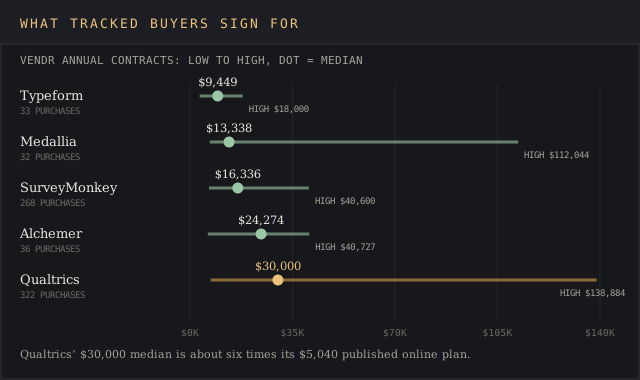
| Vendor | Median annual contract | Low to high | Purchases tracked | Average savings |
|---|---|---|---|---|
| Typeform | $9,449* | $3,300* to $18,000* | 33 | 25.01% |
| Medallia | $13,338* | $6,739* to $112,044* | 32 | Not shown |
| SurveyMonkey (Momentive) | $16,336* | $6,498* to $40,600* | 268 | 18.31% |
| Alchemer | $24,274* | $6,075* to $40,727* | 36 | 15.11% |
| Qualtrics | $30,000* | $7,020* to $138,884* | 322 | 11.28% |
Figures marked * are Vendr median, low and high annual contract values from anonymized buyer data, taken from each vendor's Vendr header stat block on 6 October 2026. They are signed-contract figures, separate from the vendor list prices in the tables above.
SurveyMonkey's $16,336 median buys about 15 Team Premier seats at the $1,104 annual list price per seat. Typeform's $9,449 median equals 9.5 years of the $996 Business plan. Alchemer's median equals 12.8 Full Access seats.
Average savings run from 11.28% at Qualtrics to 25.01% at Typeform. Talk is cheap on a sales call, and those percentages are what negotiation moved on signed contracts. The smallest average discount belongs to Qualtrics, the vendor with the largest median contract.
What users say about the price of survey tools
Review scores for survey tools split along billing practices. SurveyMonkey holds a 2.7 out of 5 TrustScore across 1,072 reviews on Trustpilot, with 62% of reviews at one star. SmartSurvey holds 4.5 across 82 reviews on Trustpilot. Our report on Trustpilot's review moderation covers how far those scores hold up.
On G2, Zonka Feedback scores 4.7 out of 5 across 84 reviews and Pollfish scores 4.6 across 57 reviews. Our G2 legitimacy report explains how G2 collects and rewards reviews.
The low SurveyMonkey reviews cluster on renewal and annual billing. "They deliberately hide the renewal charge, and make it difficult to access," wrote PHM Plant Services Ltd, a UK reviewer, in an October 2026 Trustpilot review of SurveyMonkey.
A US reviewer, Parker Willard, wrote in a June 2026 Trustpilot review:
"Sneaky Auto-Renewal puts me at over $500 for one survey that was over a year ago."
Parker Willard, Trustpilot review of SurveyMonkey, 23 June 2026
Both complaints concern annual billing and renewal, and SurveyMonkey still holds an A+ rating on its Better Business Bureau profile. SurveyMonkey's pricing page prints both numbers, $39 a month and $468 billed annually, side by side.
Survey software market in numbers
Research houses size the market for online survey tools between $1.35 billion and $3.91 billion, depending on the house and the year. Grand View Research's Online Survey Software Market Size Report, 2024-2030, published in September 2024, puts 2023 at $3.6 billion and 2030 at $8.9 billion, a 14.3% CAGR. North America held 32.0% of 2023 revenue and enterprise-grade products held 62.1%.
The Business Research Company's Online Survey Software Market Report 2026 puts 2025 at $3.91 billion, 2026 at $4.58 billion and 2030 at $8.61 billion, a 17.1% CAGR. Verified Market Research's Global Online Survey Software Market report, report ID 231495 and last updated in September 2026, puts 2024 at $1.35 billion and 2032 at $4.05 billion, an 11.91% CAGR.
P&S Intelligence's U.S. Online Survey Software Market report, code 13414, sizes the US alone at $1.36 billion in 2024 and $4.00 billion by 2032, a 14.6% CAGR. Lucintel's April 2025 Survey Software Market Report forecasts a 12.8% CAGR from 2025 to 2031 without a published dollar base.
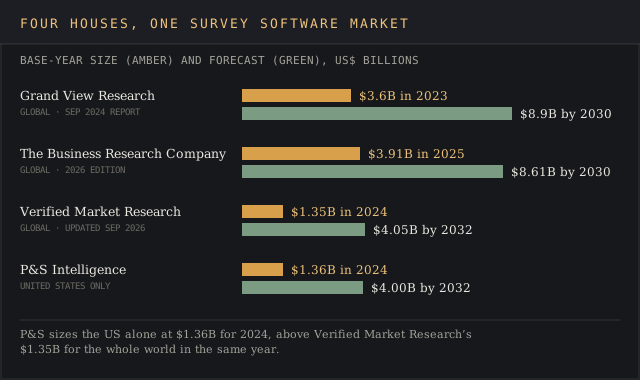
| Research house | Scope | Base-year size | Forecast | CAGR |
|---|---|---|---|---|
| Grand View Research, Sep 2024 | Global | $3.6B in 2023 | $8.9B by 2030 | 14.3% |
| The Business Research Company, 2026 edition | Global | $3.91B in 2025 | $8.61B by 2030 | 17.1% |
| Verified Market Research, updated Sep 2026 | Global | $1.35B in 2024 | $4.05B by 2032 | 11.91% |
| P&S Intelligence | United States | $1.36B in 2024 | $4.00B by 2032 | 14.6% |
| Lucintel, Apr 2025 | Global | Not published | To 2031 | 12.8% |
Why the published market estimates diverge
The houses disagree by a factor of 2.9 between neighboring years. Verified Market Research's $1.35 billion for 2024 and The Business Research Company's $3.91 billion for 2025 would imply 190% growth in one year, against forecast CAGRs of 11.91% to 17.1%.
Scope is the first split. P&S Intelligence sizes the United States at $1.36 billion for 2024, $10 million above Verified Market Research's figure for the entire world in the same year. One of the two counts something the other leaves out, and neither page publishes the vendor list behind its total. The houses aren't on the same page about what a survey tool is.
Vendor revenue is the second check, and it favors the higher estimates. Qualtrics reported $1,458.6 million of revenue for 2022 and Momentive reported $480.9 million, together $1.94 billion from two vendors two years before Verified Market Research's base year. Qualtrics' revenue includes employee and customer experience software beyond survey collection, and a $1.35 billion global total leaves little room for anyone else once those two vendors are counted.
Definitions are the third split. Grand View Research splits the market into enterprise-grade and individual-grade products, with enterprise grade at 62.1%, and counts retail as the largest application at 21.1%. Google Forms ships inside Workspace subscriptions, so its 47.78% share of installs carries no separate survey revenue for any house to count.
Base years differ too, at 2023, 2024 and 2025 across the three global houses. The growth rates converge better than the sizes, between 11.91% and 17.1% a year. The jury's still out on which definition is right, and the market data above carries five definitions, so a buyer sizing a vendor's addressable market should quote the house and year together.
What a customer satisfaction survey program costs
Customer satisfaction programs run on volume, so they hit response caps sooner than one-off research. A post-purchase customer satisfaction survey returning 1,000 answers a month lands in the 12,000-response scenario above, at $84 to $1,788 a year on a self-serve plan from one of the survey tools priced here.
A program that hits its cap in month nine sits between a rock and a hard place, paying overage at SurveyMonkey or watching a Typeform go private until the month resets.
Dedicated customer feedback platforms price the same work by quote. Zonka Feedback bases its feedback management pricing on the number of responses, and Vendr's tracked Medallia median is $13,338 a year. Both survey platforms quote customer satisfaction surveys at that scale case by case.
The channels used to collect feedback move the price. SmartSurvey keeps SMS for its quoted Scale plan, and SurveyMonkey's Anywhere app turns a tablet into a kiosk with an inactivity timer and passcode lock on paid accounts. Teams that collect feedback at a front desk or a store counter need that kiosk mode.
The analysis side decides the tier. A program that wants customer satisfaction comments tagged by theme needs SurveyMonkey Advantage at $468 a year or a SmartSurvey quote. One that wants customer satisfaction scores on shared reporting views needs SmartSurvey Growth at £1,200 per user a year. Vendors sell AI-powered tagging as the route from customer feedback to actionable insights, and SurveyMonkey lists "programs for recurring insights" on Advantage.
How to budget for survey tools by team size
Get the ball rolling with the annual response count, then the seat count, then the gated feature list. The four segments below use the list prices above, before any negotiated discount.
- One person, under 1,200 responses a year. A free plan covers it, with Typeform or SmartSurvey at 100 responses a month, or Microsoft Forms at 200 per form.
- Small business, up to 15,000 responses a year. Budget $315 to $600 a year for one seat at Alchemer, Snap Surveys, SurveyMonkey, Jotform, SurveySparrow or Typeform.
- Mid-market research teams of 3 to 5 people. Budget $1,080 to $4,980 a year for SurveyMonkey Team Advantage or QuestionPro Team Edition, plus an overage reserve at $0.15 a response.
- Enterprise research programs. Budget from Vendr's medians, $9,449 to $30,000 a year, and hold a reserve for a renewal that Duke saw rise 70% in one year.
Panel respondents sit outside every line above. A 400-response consumer study costs $380 on Pollfish at $0.95 a response, before screeners. Our guide to market research methods covers when a survey is the right instrument for actionable insights, and the market research tools rankings compare platforms beyond survey builders.
Teams turning survey data into a write-up can start from our free market research report template. Buyer-side feedback programs, such as win-loss surveys, have their own buyer feedback intelligence rankings.
Frequently asked questions
How much does survey software cost?
Survey software costs $0 on a free plan. Paid survey tools run $315 to $1,788 a year for one user running an online survey program, and quoted contracts tracked by Vendr have medians of $9,449 to $30,000 a year. Panel responses add $0.95 to $1 each.
What is the best free survey software?
Qualtrics' free plan gives the most total survey responses, 500, and Typeform and SmartSurvey give 100 a month that reset. Microsoft Forms allows 200 responses per form on a free personal account. SurveyMonkey's free Basic plan stops at 10 questions per survey, enough for a basic survey.
Can SurveyMonkey be used for free?
Yes. SurveyMonkey's Basic plan lets 1 user create surveys for $0, with unlimited surveys, 10 questions per survey and a limited number of viewable responses per survey. Responses over the limit can't be viewed and get deleted.
Is SurveyMonkey free anymore?
The free Basic plan still exists on SurveyMonkey's pricing page as of 6 October 2026. Paid tiers start at $39 a month billed annually, and the team plans start at $30 per user a month with 3 users.
Which software is best for surveys?
The best survey tool depends on volume and features. Among the survey platforms priced here, Alchemer gives the most responses per dollar on a paid seat, Qualtrics carries the deepest statistical testing for complex research projects and the survey design depth to match, Snap Surveys prices offline collection openly, and Pollfish sells the respondents with the survey.
What are the top 5 survey apps?
By installs, 6sense ranks Google Forms first at 47.78% of the survey category, then Jotform at 17.85%, Typeform at 8.28% and 123FormBuilder at 7.45%. SurveyMonkey answers more than 20 million questions a day, by its own count.
How much does a customer satisfaction survey tool cost?
A tool for customer satisfaction surveys costs $315 to $1,788 a year for 12,000 responses on a self-serve plan, and a dedicated customer feedback platform such as Medallia has a $13,338 tracked median. Online survey tools with sentiment analysis start at $468 a year on SurveyMonkey Advantage, and teams that collect feedback at a kiosk need a paid SurveyMonkey plan for the Anywhere app.
Is there survey software with unlimited responses?
Zoho Survey lists unlimited responses a year on Plus, Pro and Enterprise, with each survey capped at 3,000 to 7,000 responses a month. Microsoft 365 business accounts allow 5,000,000 responses per form, and staff already working in Microsoft 365 skip the learning curve of a new survey builder.
Do AI-powered survey features cost extra?
Mostly they come with a paid tier. Typeform's AI-powered form creation starts on Basic at $25 a month, and SurveyMonkey's Analyze with AI starts on Advantage at $39 a month with 20 prompts per survey. SurveyMonkey's free Basic plan leaves out the thematic analysis tools, which start on Advantage.
Bottom line
Survey tools split into two price worlds. Self-serve plans cost $315 to $1,788 a year for one user and publish every limit, and quoted contracts run from a $9,449 median at Typeform to $30,000 at Qualtrics.
Response caps, a $0.15 overage, 3-seat minimums and gated features such as offline surveys or HIPAA decide the invoice. Price your own annual response count and seat count against each plan before reading any marketing page.
Read every renewal clause before the first signature. A card-billed Qualtrics plan renews at up to 5% more unless someone gives notice 24 hours before the term ends, and annual SurveyMonkey plans bill the full year up front.
How each survey price was sourced, and which numbers the vendors keep to themselves
Every list price, response cap and plan limit on this page was checked against the vendor's own site on 6 October 2026, with Medallia priced from Vendr, and each source is linked where it is first cited.
Origin domains, in order of first use: pollfish.com, surveymonkey.com, qualtrics.com, vendr.com, help.surveymonkey.com, 6sense.com, thebusinessresearchcompany.com, verifiedmarketresearch.com, typeform.com, zonkafeedback.com, api.jotform.com, help.typeform.com, alchemer.com, jotform.com, questionpro.com and surveysparrow.com.
Later sections add smartsurvey.co.uk, smartsurvey.com, snapsurveys.com, support.microsoft.com, microsoft.com, workspace.google.com, driveresearch.com, zoho.com, community.qualtrics.com, oit.duke.edu, uk.trustpilot.com, g2.com, bbb.org, grandviewresearch.com, psmarketresearch.com and lucintel.com.
Research documents and their dates: Grand View Research's Online Survey Software Market Size Report, 2024-2030 (September 2024), The Business Research Company's Online Survey Software Market Report 2026, Verified Market Research's report 231495 (last updated September 2026) and Lucintel's Survey Software Market Report (April 2025).
Company documents and their dates: SurveyMonkey's announcement of STG completing the Momentive Global take-private on 31 May 2023, the Momentive and Qualtrics full-year 2022 results releases, Duke OIT's renewal post (15 July 2024), the Qualtrics community API answer (May 2024), SmartSurvey's blog post (March 2026) and Pollfish's survey software guide (August 2026).
Tracked-contract figures are the header stat blocks on vendr.com/marketplace for Qualtrics, Typeform, Medallia, Momentive and Alchemer.
Some numbers stay unpublished. SurveyMonkey prints no response cap for its free Basic plan, Medallia prints no rate card, Typeform discloses no revenue as a private company, Qualtrics prints no price for its enterprise plans and Lucintel prints no dollar base. Verified Market Research and P&S Intelligence publish no vendor list behind their market totals.