Sentiment analysis pricing in 2026: what APIs, listening suites and CX platforms charge
 By Jan Suski. I go deep on every review, checking every number against its source and digging up details other coverage misses, a habit from six years of SEO and link building for tech companies. Bylines at Surfer, Brand24, and Senuto. How the scoring works.
The numbers Sentiment analysis APIs, listening suites and CX platforms, checked 6 October 2026
The cheapest per-review route, an LLM API at list rates, undercuts the cheapest dedicated sentiment analysis system by roughly 10x at 1 million reviews ($62 against $600 on Amazon Comprehend).
A listening suite costs more per text because it also collects the text: Awario's $29 plan includes 30,000 mentions a month gathered from online conversations.
CX sentiment analysis software sits highest at entry, with Thematic's published floor at $25,000 a year and Qualtrics's tracked median at $30,000.
Sentiment analysis pricing runs from $0 to six figures a year, and the spread tracks what gets bundled around the classifier. Scoring one million 600-character reviews costs $62 through OpenAI's cheapest model at list token rates, $995 through Google Cloud Natural Language and $1,500 through IBM Watson. A Brandwatch contract that bundles sentiment into social listening has a tracked median of $50,000 a year.
This report checked the rate cards of 4 cloud NLP APIs, 3 LLM providers, 8 social listening and media monitoring suites and 5 CX and text analytics platforms on 6 October 2026. Unpublished prices come from Vendr's tracked-purchase data.
It's written for whoever has to put a sentiment analysis cost into a budget line: a product manager wiring a sentiment score into an app, a marketing lead comparing sentiment analysis tools for social media monitoring, or a CX team pricing customer feedback analysis across survey responses, tickets and reviews. The worked example converts all three routes to the same 1,000, 100,000 and 1 million reviews.
How does sentiment analysis pricing work
Three pricing models cover the whole market for sentiment analysis tools, and each one bills a different unit.
- Per unit of text. Cloud natural language processing APIs charge per block of characters: Google per 1,000 characters, Azure per 1,000-character text record, Amazon Comprehend per 100 characters, IBM per item of up to 10,000 characters. LLM APIs charge per token, roughly 4 characters of English text each.
- Per topic, keyword or mention. Social listening and social media monitoring suites price by tracked keywords, mention volume and seats. Sentiment analysis capabilities ride along inside the plan with no separate line.
- Per contract. CX and text analytics platforms sell annual contracts sized to comment volume, data sources and users, usually through a sales call.
Usage-based pricing dominates API sentiment analysis tools. The unit cost falls as volume climbs. Google's sentiment rate drops from $1.00 to $0.50 to $0.25 per 1,000 units across three volume bands, and Azure's falls from $1.00 to $0.25 across four. That's the devil in the details for anyone comparing quotes: the headline rate only applies to the first band.
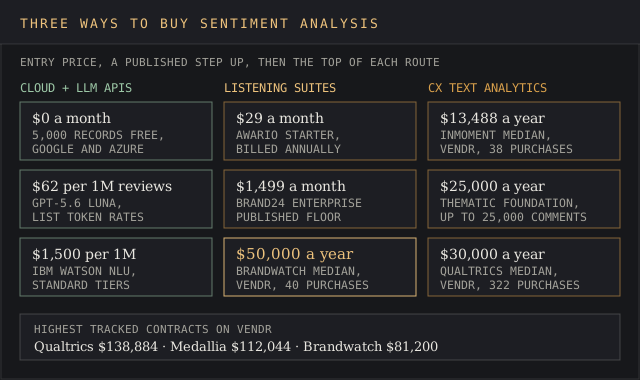
Feature complexity moves the price of sentiment analysis tools inside each route. Basic polarity detection, which labels text as positive, negative or neutral, is the cheapest tier everywhere. Aspect-based sentiment analysis, emotion detection and custom-trained models sit higher, and the sections below price each one.
How sentiment analysis works, and what each method costs to run
Sentiment analysis turns unstructured data, the free text in reviews, tickets and social media posts, into a positive sentiment, negative sentiment or neutral sentiment label plus a sentiment score. AWS's sentiment analysis explainer groups the sentiment analysis algorithms behind it into four families, and each has its own cost profile.
- Rule-based sentiment analysis scores text against predefined lexicons of positive and negative words. It's free to run on a laptop; VADER, an MIT-licensed lexicon, is one example.
- ML sentiment analysis uses machine learning algorithms trained on labeled datasets. Prebuilt machine learning models sit behind every cloud API on this page; custom ones cost extra to train.
- Hybrid systems combine rule-based and machine learning techniques to balance speed and accuracy.
- Generative AI uses large language models that read human language in context, sarcasm and mixed reviews included, and bills per token.
Buyers pay for the output, which feeds data-driven decisions. A one-star review that praises the packaging returns negative sentiment overall with positive sentiment on one aspect, and a dashboard rolls those labels into an overall sentiment share against the neutral sentiment remainder.
A brand team tracks overall sentiment and sentiment trends to protect brand reputation; a product team will analyze feedback by feature to find what needs fixing in customer feedback. Market researchers analyze sentiment toward rivals as well as their own brand to feed market research, and CX teams tie sentiment data to customer satisfaction.
Each of those jobs comes down to analyzing customer feedback and other text data in large volumes, past what a human team can read. Understanding customer sentiment across 100,000 reviews a month is one of the three volumes the worked example prices.
Cloud sentiment analysis tools priced per character and record
Four hyperscaler APIs sell sentiment analysis as a metered call. All four publish their rates and offer a free tier or trial allowance. A developer sends text data in and gets a sentiment score back; collecting the text is the buyer's job.
| API | Billing unit | Free allowance | First paid tier | Units for one 600-character review |
|---|---|---|---|---|
| Google Cloud Natural Language | 1,000 characters | 5,000 units a month | $1.00 per 1,000 units | 1 |
| Amazon Comprehend | 100 characters, 3-unit minimum | 50,000 units a month for 12 months | $0.0001 per unit | 6 |
| Azure Language | 1,000-character text record | 5,000 records a month (free tier) | $1.00 per 1,000 records | 1 |
| IBM Watson NLU | Up to 10,000 characters per feature | 30,000 items a month (Lite) | $0.003 per item | 1 |
All figures are list prices from each provider's own pricing page or documentation, checked 6 October 2026. None is a Vendr median.
Google Cloud Natural Language
Google's pricing page bills Sentiment Analysis on textual data per 1,000-character unit. The first 5,000 units each month are free, then units 5,001 to 1,000,000 cost $1.00 per 1,000, units up to 5 million cost $0.50 and everything past that costs $0.25.
Entity Sentiment Analysis, Google's advanced sentiment analysis feature that scores sentiment for each named thing in a sentence, costs double: $2.00 per 1,000 units in the first band. Google's own example bills three requests of 800, 1,500 and 600 characters as four units, so short social media posts round up to a full unit each.
Amazon Comprehend
Amazon Comprehend charges $0.0001 per 100-character unit for the first 10 million units, $0.00005 up to 50 million and $0.000025 beyond. Every request carries a 3-unit minimum, so a 40-character tweet bills as 300 characters. AWS's own worked example prices 10,000 comments of 550 characters at $6.00, a drop in the bucket next to any listening contract.
Comprehend is priced for large volumes, and Targeted Sentiment, the aspect-level call, bills at the same $0.0001 per unit. The catch is language: Comprehend's language table lists 12 languages for standard sentiment and English only for targeted sentiment, a limit for teams working across multiple languages. The free tier covers 50,000 units a month, but only for 12 months from the first request.
Azure Language
Microsoft now lists the product as Azure Language in Foundry Tools. Standard pay-as-you-go pricing runs $1.00 per 1,000 text records up to 500,000, $0.75 to 2.5 million, $0.30 to 10 million and $0.25 past that, with a sales contact required above 10 million.
Opinion mining, Azure's aspect-based sentiment analysis, is billed inside the standard sentiment call at no extra charge. Commitment tiers cut the bill for steady volume: $700 a month buys 1 million text records, against $875 for the same million at pay-as-you-go rates.
IBM Watson Natural Language Understanding
IBM Watson Natural Language Understanding, IBM's natural language processing API, is still sold on Lite and Standard plans. Straight from the horse's mouth, IBM's docs define one NLU item as one text unit of up to 10,000 characters analyzed for one feature, so running sentiment and emotion analysis on the same textual data bills two items.
Standard costs $0.003 an item for the first 250,000, $0.001 up to 5 million and $0.0002 past that. Lite gives 30,000 free items and one custom model a month, the largest permanent free tier of any sentiment analysis system here.
LLM API pricing for sentiment analysis
Large language models now work as general-purpose sentiment analysis tools: a plain prompt makes a quick and dirty sentiment classification setup in minutes, priced per token. OpenAI's help center puts one token at about 4 characters of English, so a 600-character review is about 150 tokens before the instruction is added.
Rates below are each provider's cheapest current model on 6 October 2026, and each bills the same per-token rate for text in multiple languages, so multilingual sentiment analysis costs nothing extra here.
OpenAI
GPT-5.6 Luna lists at $0.20 per 1M input tokens and $1.20 per 1M output tokens. The Batch API cuts both by 50% for jobs that can wait 24 hours.
Anthropic
Claude Haiku 4.5 lists at $1 per 1M input tokens and $5 per 1M output tokens on Anthropic's pricing page, with the same 50% batch discount.
Google Gemini
Gemini 3.5 Flash-Lite lists at $0.30 input and $2.50 output per 1M tokens on Google's Gemini API pricing page, $0.15 and $1.25 in batch. Google bills thinking tokens as output, so a sentiment prompt should switch extended reasoning off or the label costs more than the review.
An LLM can also analyze sentiment, emotional tone, sarcasm flags and per-aspect labels in the same call, which prices advanced sentiment analysis at the same per-token rate, with more output tokens per review. One Hacker News commenter made the counterpoint on accuracy and cost in November 2024:
"LLMs are not beating smaller, purpose built models on tasks like POS tagging, NER, sentiment analysis, etc. And the inference costs scale quite poorly (unless you are self hosting llama or something)."
pfisherman, Hacker News, 16 November 2024
What sentiment analysis costs at 1,000, 100,000 and 1 million reviews
Sentiment analysis tools price different units, so this section fixes one scenario and runs every published rate through it. Each review is 600 characters. On the LLM side that's about 150 tokens of text plus a 100-token instruction, so 250 input tokens, and the model returns a label and a sentiment score in 10 output tokens. All volume lands in one month, at list rates, without batch discounts.
| Option | Arithmetic per review | 1,000 reviews | 100,000 reviews | 1 million reviews |
|---|---|---|---|---|
| GPT-5.6 Luna | 250 x $0.20/1M + 10 x $1.20/1M = $0.000062 | $0.06 | $6.20 | $62 |
| Gemini 3.5 Flash-Lite | 250 x $0.30/1M + 10 x $2.50/1M = $0.0001 | $0.10 | $10 | $100 |
| Claude Haiku 4.5 | 250 x $1/1M + 10 x $5/1M = $0.0003 | $0.30 | $30 | $300 |
| Amazon Comprehend | 6 units x $0.0001 = $0.0006 | $0.60 | $60 | $600 |
| Azure Language (Standard) | 1 record x $1.00/1,000; $0.75 past 500,000 | $1.00 | $100 | $875 |
| Google Cloud Natural Language | 1 unit x $1.00/1,000 after 5,000 free | $0 | $95 | $995 |
| IBM Watson NLU (Standard) | 1 item x $0.003; $0.001 past 250,000 | $3.00 | $300 | $1,500 |
All figures are list prices at pay-as-you-go rates, checked 6 October 2026; none is a Vendr median. LLM rows assume 250 input tokens (about 150 tokens of review text plus a 100-token instruction) and 10 output tokens per review, with no batch discount.
The 1 million column follows from the tiers. Azure bills the first 500,000 records at $1.00 per 1,000 ($500) and the next 500,000 at $0.75 ($375). IBM bills 250,000 items at $0.003 ($750) and 750,000 at $0.001 ($750). Google charges nothing for the first 5,000 units and $1.00 per 1,000 for the other 995,000.
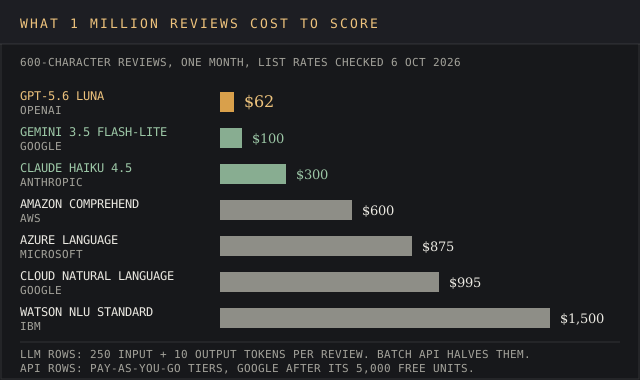
Batch pricing halves every LLM row, so GPT-5.6 Luna drops to $31 per million. The API rows return a sentiment score in a fixed response format, while an LLM label that drifts between runs is a red flag for any dashboard, so the prompt needs testing first.
Per review, the range runs from $0.000062 to $0.003, roughly 48x. For an app that embeds real-time sentiment analysis, the API route is the cheapest way in by a wide margin.
Social media sentiment analysis tools in listening suites
Listening suites are sentiment analysis tools that bundle three jobs: collecting social media conversations from social media platforms, news sites and blogs, storing the social media data and running social media sentiment analysis over the collected data. A suite kills two birds with one stone, which is why its per-text cost looks high next to an API. The nine-vendor comparison lives in the social listening pricing report; this section prices the sentiment layer.
| Suite | Entry price | Sentiment on entry plan | How the price is set |
|---|---|---|---|
| Awario | $29/mo billed annually ($49 monthly) | Yes | Published: 3 topics, 30,000 mentions |
| Brand24 | $199/mo billed annually ($249 monthly) | Yes | Published: 3 keywords, 2,000 mentions |
| YouScan | $499/mo billed annually | Yes, aspect sentiment | Published Starter; Unlimited is quote-only |
| Sprout Social | $199/seat/mo, Listening extra | Add-on only | Listening add-on quoted by sales |
| Meltwater | $25,800/yr Vendr median* | Bundled | Quote-only, 12-month minimum |
| Brandwatch | $50,000/yr Vendr median* | Bundled | Quote-only, per suite |
| Talkwalker | $13,298/yr legacy Vendr median* | Bundled | Hootsuite deal announced April 2024 |
| Mention | Demo-gated | Yes | Single Company plan, price on request |
Prices marked * are Vendr median annual contract values from tracked purchases; every other price is the vendor's published list price, checked 6 October 2026.
Brand24
Brand24's price list includes AI sentiment analysis on all five plans: Individual $199, Team $299, Pro $399 and Business $599 a month billed annually, then Enterprise from $1,499. What climbs with the tier is everything around the sentiment analysis capabilities, and the data sources run from social media platforms such as Facebook, Instagram and X to podcasts and newsletters.
- Individual updates every 12 hours; Team updates hourly; Pro and up update in real time.
- AI Insights, pitched at online conversations, covers 2 projects on Pro, 5 on Business and unlimited on Enterprise; AI Topics covers 2 projects on Pro and is unlimited from Business up.
- API access costs an extra $149, on Pro and Business.
Brand24's plan table describes the Insights module as "Get actionable insights and personalized suggestions for your brand growth." At the full mention allowance, Individual works out to about $0.10 a mention ($199 for 2,000) and Business to $0.006 ($599 for 100,000). The Brand24 pricing breakdown walks each tier, and the Brand24 review covers the platform in full.
Awario
Awario is the cheapest published social media monitoring tier on the market at $29 a month billed annually, $49 month to month. Its features page lists sentiment analysis that sorts mentions as positive, negative or neutral. Pro costs $89 billed annually for 15 topics and 300,000 mentions; Enterprise costs $249 for 100 topics and 1 million mentions.
At Starter's full 30,000-mention allowance, that's about $0.001 a mention, the same as Google's per-record API rate with mention collection included, the best of both worlds at that volume.
YouScan
YouScan's Starter 3 costs $499 a month billed annually for 3 topics and up to 15,000 mentions, and it's the only entry plan here that lists aspect sentiment analysis by name. Visual insights, its image recognition layer, and the deeper insights of its Audience Insights add-on sit only on the quote-only Unlimited plans. Brand24 gates its AI layers by plan the same way, so advanced sentiment analysis capabilities climb with the tier.
Brandwatch, Meltwater and Talkwalker
None of the three publishes a price. Sentiment analysis comes bundled into every contract. Vendr's Brandwatch listing tracks a $50,000 median across 40 purchases, ranging from $19,542 to $81,200, with 15.29% average savings. That median works out to $4,167 a month, and the $81,200 high to $6,767. Meltwater tracks a $25,800 median across 126 purchases, $5,375 to $56,993, and Meltwater's pricing page states a 12-month minimum contract.
Hootsuite announced it would acquire Talkwalker on 8 April 2024, and Vendr's Talkwalker page still shows a $13,298 median from standalone contracts. Those contracts predate the acquisition, so chasing that figure for a 2026 purchase is a wild goose chase.
The Brandwatch pricing report splits that $50,000 median by suite, and the Meltwater pricing report covers its notice periods. For a head-to-head, the Brand24 vs Brandwatch comparison covers the two sentiment analysis tools side by side.
A G2 reviewer flagged the pricing unit itself:
"Mention limits can be frustrating, especially since they are one of the only competitors that have a mention limit and use that as the basis for charging."
Jarad M., Social Media Strategist / Community Manager, mid-market company, G2, 5 December 2017
The same reviewer wrote: "I also spend a fair amount of time re-categorizing mis-filed sentiment markings."
Sprout Social and Mention
Sprout Social, a social media management platform first, sells Social Listening as an add-on to Standard ($199 per seat a month) and up. The add-on's page promises "Sentiment tracking and scoring" and spike alerts on volume or negative sentiment changes that threaten brand reputation, and the price stays under the radar until a demo. The Sprout Social pricing report runs the seat math.
Mention now sells one Company plan with sentiment analysis capabilities and trend identification for spotting emerging trends. Its pricing page leaves buyers to read between the lines: it lists the features and shows a price only after a demo request. The social listening tools ranking and the brand intelligence software ranking score these social media sentiment analysis tools on features.
CX sentiment analysis software and text analytics platforms
CX sentiment analysis tools run over first-party customer feedback: survey responses, support tickets, chat logs and app reviews. They add theme detection, dashboards and workflow routing on top of the sentiment analysis model, and they price as annual contracts. The goal is understanding customer sentiment by product and channel and tying it to customer satisfaction scores.
Clarabridge and MonkeyLearn, two former standalone sentiment vendors, now sit inside Qualtrics and Medallia.
Qualtrics and Clarabridge
Qualtrics completed its Clarabridge acquisition on 1 October 2021, folding Clarabridge's sentiment analysis software and speech analytics into its CX suite. The buy-online page lists a $420-a-month Strategic Research plan ($5,040 billed annually) for 1,000 responses, and the advanced analysis features sit on custom plans.
Vendr's Qualtrics listing tracks a $30,000 median across 322 purchases, from $7,020 to $138,884, with 11.28% average savings. The Qualtrics pricing report covers renewal caps and the online plans in detail.
Medallia and MonkeyLearn
Vendr's Medallia listing tracks a $13,338 median across 32 purchases, ranging from $6,739 to $112,044. The Medallia pricing report explains the EDR contract model behind that spread, and the Medallia review covers the platform.
MonkeyLearn, the self-serve sentiment analysis tool that once sold a free plan, now redirects from monkeylearn.com to medallia.com. Bloomberg Línea reported Medallia's purchase of the Uruguayan machine learning startup on 6 May 2022. Buyers weighing the two suites can read the Medallia vs Qualtrics comparison.
Thematic
Thematic is the rare sentiment analysis software vendor with a published floor: Foundation costs $25,000 a year for a comment volume of up to 25,000 and up to 3 datasets. A CX team bites the bullet on that floor to get customer sentiment broken into themes.
The price includes thematic and sentiment analysis capabilities, a summarizer for deeper insights and API integrations, which saves the build work an API route leaves to the buyer. Thematic counts a review, a survey verbatim, a complaint, a chat or a support ticket as one comment.
InMoment and Lexalytics
InMoment announced it had completed its Lexalytics acquisition on 10 September 2021. Lexalytics publishes no standalone rate card. Vendr's InMoment listing tracks a $13,488 median across 38 purchases, $5,424 to $61,752, which is about $1,124 a month at the median.
Chattermill
Chattermill, built for analyzing customer feedback with sentiment analysis, sells by demo only. For teams comparing CX sentiment analysis tools on capability, the customer experience intelligence ranking scores the field.
All of these platforms sell customer feedback analysis at scale, from qualitative data in open-ended survey answers to ticket text, and none of them removes the modeling cost underneath. A Hacker News commenter who worked on sentiment projects described that cost in July 2019:
"I've worked with companies spending on the order of millions per year on producing training data for automated sentiment analysis models not unlike the ones in the parent post."
kuzehanka, Hacker News, 24 July 2019
The same comment closed on accuracy: "Claiming that sentiment analysis is 90something percent accurate, or even close to being solved, is extremely misleading."
Free sentiment analysis tools and free tiers
Published free allowances on sentiment analysis tools run from 500 total responses at Qualtrics to 30,000 permanent items a month at IBM.
- IBM Watson NLU Lite: 30,000 items and one custom model a month, permanent.
- Google Cloud Natural Language: 5,000 sentiment units a month, permanent.
- Azure Language free tier: 5,000 text records a month, shared across sentiment, key phrases and entity recognition.
- Amazon Comprehend: 50,000 units a month (5 million characters), for the first 12 months only.
- Gemini API: a free tier on both Flash and Flash-Lite models.
- Qualtrics Surveys: 500 total responses on the free plan.
- Trials: Brand24 14 days, Sprout Social 30 days, Awario on its Starter plan.
Open-source free sentiment analysis tools cost nothing to license and something to run. VADER, a lexicon and rule-based model released by Hutto and Gilbert at ICWSM in June 2014, ships under the MIT license for analyzing text data and is "specifically attuned to sentiments expressed in social media." It's the predefined-lexicon method AWS describes: score the positive and negative words, then sum.
Hosting a transformer model from scratch costs more. Hugging Face Inference Endpoints start at $0.03 an hour for a 1-vCPU CPU instance and $0.50 an hour for an NVIDIA T4 GPU, which is $21.60 and $360 for a 720-hour month. A researcher on Hacker News compared the two approaches on one corpus in May 2025:
"I recently did an analysis on a large corpus and VADER was essentially free while the cloud costs to run a Llama based sentiment model was about $1000. I ran both because VADER costs nothing but minimal CPU time."
teruakohatu, Hacker News, 1 May 2025
What drives sentiment analysis cost up
Five variables move the bill for sentiment analysis tools, and they compound. Volume and text length set the floor; the other four multiply it.
Volume and text length
Every API here bills by characters or tokens. A 2,000-character support ticket costs 2x to 3.3x a 600-character review. Google bills it as 2 units against 1, Comprehend as 20 against 6. Volume cuts the unit rate past each band, and above 10 million records a month Azure routes buyers to negotiated pricing.
Aspect-based sentiment analysis and emotion detection
Aspect-based sentiment analysis scores each product attribute separately, so a review that praises battery life and slates the screen gets two labels. Google charges $2.00 per 1,000 units for entity sentiment against $1.00 for document sentiment. Azure includes opinion mining at its base rate.
Emotion detection and fine-grained emotional tone scoring, the advanced sentiment analysis tier, add cost where they're metered as a separate feature. IBM bills each feature as its own item, so sentiment plus emotion detection on one text costs $0.006 in the first band, twice the single-feature price.
Multiple languages
Multilingual sentiment analysis rarely carries a per-language fee; the cost shows up as coverage gaps. Comprehend handles 12 languages for document sentiment, and the aspect-level call handles one. A team analyzing reviews in several languages picks an API whose language list covers them, or sends the text to an LLM at the same per-token rate.
Custom models
Custom-trained machine learning models cost more at every vendor that sells them, though on the hyperscalers they needn't cost an arm and a leg. Azure charges $5 per 1,000 records for custom text classification against $1 for prebuilt sentiment, plus $3 an hour to train the machine learning algorithms on your labels. Comprehend charges $3 an hour to train a custom classifier, $0.50 a month to keep it and $0.0005 per unit for asynchronous inference, 5x its prebuilt rate.
A G2 reviewer on Comprehend's custom models put the constraint plainly: "The accuracy of custom models depends heavily on the quality and quantity of training data." (Atharva P., Cloud BI Engineer, enterprise, G2, 30 July 2026)
Historical data and data access
APIs score text you already hold; collecting it is a separate bill. The X API, the paid route into one of the major social media platforms, charges $0.005 per post read, capped at 3 million reads a month, so pulling 100,000 posts costs $500 before the first call to analyze sentiment. Add Google's $95 for scoring them and a DIY pipeline on one network costs $595, against $599 for Brand24 Business with 100,000 mentions across news, blogs, Reddit, YouTube and TikTok.
Finding one complaint in 100,000 unfiltered posts is a needle in a haystack, and listening suites fold that collection cost into the plan price. They cap history by plan too: Awario keeps 5,000 mentions per topic on Starter and 50,000 on Enterprise.
What to budget for sentiment analysis
Budget follows two numbers: monthly text volume and who collects the text data. The three tiers below price sentiment analysis tools from published rates and Vendr medians on this page, matched to what each team's sentiment analysis needs look like.
Small team: under 10,000 texts a month
A developer scoring customer feedback from app reviews pays $0 on Google up to 5,000 units and $5 for 10,000; on IBM Lite, 30,000 items are free. A marketer who also needs mentions collected pays $348 a year for Awario Starter (30,000 mentions) or $3,588 for Brand24 Team (10,000 mentions). Either way, the yearly sentiment analysis cost stays under $3,600. Under 5,000 texts a month, the Google and Azure free tiers cover the whole job.
Mid-market: 10,000 to 100,000 texts a month
Mid-market sentiment analysis solutions split three ways at this volume. The API route costs $6.20 to $300 a month, depending on provider. A listening suite costs $599 a month on Brand24 Business, which caps mentions at 100,000; past that, Brand24 moves buyers to Enterprise at $1,499 and up.
A CX platform that ingests customer feedback from customer satisfaction surveys and tickets starts at $25,000 a year on Thematic, and Medallia's and InMoment's tracked medians land at $13,338 and $13,488.
Enterprise: 1 million texts a month and up
APIs cost $62 to $1,500 a month at 1 million reviews, and Azure's $700 commitment cuts its row by 20%. Contracts take the lion's share of an enterprise budget. Vendr's medians run $25,800 for Meltwater, $30,000 for Qualtrics and $50,000 for Brandwatch, with tracked highs of $138,884 at Qualtrics and $112,044 at Medallia. Negotiated savings on those three run 11.28% to 15.29%.
Teams applying sentiment analysis to competitor tracking can check the competitive intelligence pricing report, where 18 vendors run from $0 to a $30,000 contract, against their market research budgets.
Frequently asked questions
Can ChatGPT do a sentiment analysis?
Yes. ChatGPT and the API behind it perform sentiment analysis from a prompt that asks for a positive, negative or neutral label, and the API can analyze sentiment for $0.000062 a review on GPT-5.6 Luna under this page's 250-token scenario.
Is sentiment analysis still relevant?
Vendors still ship it as a default. Brand24 includes AI sentiment analysis on all five plans, Sprout Social sells it inside its Listening add-on, and Azure bundles opinion mining into its $1.00-per-1,000 standard rate. G2's summary of Brandwatch reviews counts 16 mentions of sentiment inaccuracy, so overall sentiment and negative sentiment flags still need a human check.
Can AI be used for sentiment analysis?
Yes. Every method on this page is a form of it, from VADER's lexicon to ML models and LLM prompts, and any of them can perform sentiment analysis on text data at the rates above.
What is the best sentiment analysis tool?
The right sentiment analysis tool depends on who supplies the text. An app that needs to analyze customer sentiment in its own text data gets the lowest cost per review from an LLM API or Amazon Comprehend; a brand that needs mentions found pays $29 to $599 a month for Awario or Brand24; a CX team with survey and ticket volume budgets $13,338 to $30,000 a year at tracked medians.
What are the three main types of sentiment analysis?
Document-level polarity, which labels a whole text positive, negative or neutral; aspect-based sentiment analysis, which scores each attribute; and emotion detection, which labels the emotional tone as joy or anger.
Bottom line
Sentiment analysis pricing splits on one question: does the buyer already hold the text data? If yes, scoring a million reviews costs $62 to $1,500 a month on published API rates, and the free tiers cover the first 5,000 to 30,000 texts. If no, the price includes collection, which is why Awario starts at $29 and Brandwatch's tracked median sits at $50,000.
CX sentiment analysis tools cost the most at entry because they sell themes, dashboards and routing on top of the sentiment score. Thematic's $25,000 floor and Qualtrics's $30,000 median both buy that whole layer. The sentiment label itself is the cheapest part of all three sentiment analysis solutions.
Where every sentiment analysis price came from
Rate cards, documentation pages and Vendr listings were checked on 6 October 2026, and each source is linked where it's first cited.
Sources in order of first use: aws.amazon.com, cloud.google.com, docs.aws.amazon.com, azure.microsoft.com, cloud.ibm.com, help.openai.com, openai.com, platform.claude.com, ai.google.dev, news.ycombinator.com, brand24.com, awario.com, youscan.io, vendr.com, meltwater.com, hootsuite.com, g2.com, sproutsocial.com, mention.com, qualtrics.com, bloomberglinea.com, getthematic.com, inmoment.com, github.com, huggingface.co and docs.x.com.
Dated sources: Talkwalker acquisition announcement on hootsuite.com (8 April 2024), Clarabridge acquisition on qualtrics.com (1 October 2021), Lexalytics acquisition on inmoment.com (10 September 2021), MonkeyLearn purchase on bloomberglinea.com (6 May 2022), Hacker News comments dated 24 July 2019, 16 November 2024 and 1 May 2025, and G2 reviews dated 5 December 2017 and 30 July 2026.
Tracked-contract figures are the header stat blocks on vendr.com/marketplace for Brandwatch, Meltwater, Talkwalker, Qualtrics, Medallia and InMoment. Brandwatch, Meltwater, Talkwalker, Mention, Chattermill and Lexalytics publish no price, and Sprout Social shows its Listening add-on price only after a demo.