Brand24 vs Brandwatch
 By Jan Suski. I go deep on every review, checking every number against its source and digging up details other coverage misses, a habit from six years of SEO and link building for tech companies. Bylines at Surfer, Brand24, and Senuto. How the scoring works.
· Prefer this source on Google
| WHAT EACH ONE DOES | BRAND24 | BRANDWATCH |
|---|---|---|
| Core job | Live brand monitoring | Consumer research |
| Trends span | 30 days of data | Sixteen years |
| Mentions per month | 2,000 to 100,000 | Not published |
| Phrase search | No quote syntax | Quotes documented |
| Query grouping | No parentheses | Brackets and NEAR/x |
| Sentiment rollup | Weekly brand health | By audience and topic |
| Who runs it | A marketing hire | A dedicated analyst |
| Skip it if | History decides it | Nobody writes queries |
| WHAT YOU GET | BRAND24 | BRANDWATCH |
|---|---|---|
| Published pricing | Five tiers, all public | None at all |
| Entry price | $199/mo billed yearly | Quote only |
| Annual cost | $7,188, Business plan | $50,000 Vendr median |
| Free trial | 14 days, no card | None |
| Cancellation notice | 7 days to two months | Not published |
| Public terms of use | Yes, 29 June 2026 | None published |
| Owner | Semrush, via Prowly | Cision, via Platinum |
| Status page | None | 24 components |
StrongerWeakerNo edge
Thirty-four further documented limits sit behind the button below: keyword and mention quotas, refresh intervals, API rate limits, sampling thresholds and what each plan gates. Brand24 figures come from its own pricing page and terms of use. Brandwatch publishes neither, so its price column carries Vendr's tracked purchase data and its terms column stays empty. Every figure is sourced in the section its row links to.
| Brand24 | WHAT IT DOCUMENTS |
|---|---|
| Published tiers | Five, $199 to $1,499 billed annually |
| Keyword quota | 3, 7, 12, 25, then custom by plan |
| Data refresh | 12 hours Individual, 1 hour Team, real time Pro |
| Archive retention | 1 month Individual, 12 months from Team |
| User seats | 1 on Individual, unlimited from Team |
| Language support | 108 languages |
| AI Insights gate | 2 projects Pro, 5 Business, unlimited Enterprise |
| AI Topic Analysis | 2 projects Pro, unlimited from Business |
| AI Events Detection | Pro tier and up |
| Advanced Reports | Business tier and up |
| Smart Context Search | Paid add-on from Pro up |
| AI Visibility module | Add-on on all five plans, 9 LLMs* |
| API add-on price | $99 extra on Business, included on Enterprise |
| MCP server | OAuth at mcp.brand24.com, subscribers only |
| Trial social cap | 100 X and Instagram mentions a day |
| Instagram hashtags | 30 unique hashtags per integration |
| Chat support gate | Chat from Team, priority from Pro |
| Money-back window | 30 days, custom plans excluded |
| Brandwatch | WHAT IT DOCUMENTS |
|---|---|
| CR API rate limit | 30 calls per 10 minutes, per client |
| Mentions page size | 1 to 5,000 a page, 10,000 cap by paging |
| Analysis API window | 24-hour maximum range per query |
| Query backfill default | Start date defaults to 30 days back |
| Online news via API | 256-character snippet, nothing more |
| LinkedIn via API | No snippet and no full text returned |
| Data upload batch | 1,000 documents per request |
| Custom fields | 10 fields and 10 categories a document |
| Upload text limits | 16k characters content, 64k raw metadata |
| Reddit and news depth | Reddit from 2011, news and forums from 2010 |
| Listen indexing | 2,500 mentions a day per saved search |
| Listen sampling | 5,000 a day cuts 50%, 10,000 cuts 75% |
| Listen history | 1 year saved search, 2 years paid* |
| Listen export | 5,000 a day per org, PDF capped at 100 |
| Iris AI sample | 240 highest-impact mentions, 5 cached summaries |
| Measure retention | 2 years 3 months |
*A marked figure is one the vendor states two ways on its own domain. Brand24's features page sells AI Visibility across "seven leading AI chatbots" and, a few lines below, "9 top AI models"; the AI Visibility page names nine individually, which is the figure used above. Brandwatch's help centre gives Listen quick search only the last month of data in one article and one year at 5% sampling in another.
Sources, and what neither vendor publishes
Every row comes from a vendor property.
- Brand24: brand24.com/prices, its AI Visibility page and help.brand24.com.
- Brandwatch: developers.brandwatch.com, consumer-research-help.brandwatch.com and social-media-management-help.brandwatch.com.
Brandwatch publishes no price for any product and no named tiers. Its gating lives in help articles as per-contract variables, with two-year Listen history, extra Benchmark slots and image search all sold through a customer success manager.
Brand24 publishes no project cap, no API rate limit and no uptime figure, so no row above claims one.
Brand24 collects nothing older than 30 days. Brandwatch holds 1.7 trillion online conversations going back to 2010. If your question is "what did people say about our brand last quarter", one of these tools can answer it and the other can't, at any price on either rate card.
Everything else is downstream of that. Both tools sell brand monitoring; only one sells brand history. This page covers eight things.
- Both rate cards.
- What each listening tool indexes.
- The two vendors' pages about each other.
- The review samples.
- The cancellation clauses.
- Data export.
- What each company owes its customers when the platform breaks.
- What the rest of the category charges.
It's written for a marketing or PR team choosing between a self-serve social listening tool at $199 a month and an enterprise consumer intelligence contract with a five-figure median.
One thing worth knowing before either demo: both vendors changed owners inside fifteen months, and on the Brand24 side the terms you sign describe a different cancellation process from the one the pricing page advertises.
↑ COMPARISONThe 30-day collection window
Brand24's own help centre settles this in four words. Asked if the tool collects historical data, the article opens "TLDR: No older than 30 days, with the exception of special cases", and adds that "All projects you set up with us are going to be started off with a sample set of data from the last 30 days."
So a new brand monitoring project shows the last month & then accrues forward. Set one up the week a crisis breaks and the conversation that started it already sits outside the window. That's a property of the platform: no company plan on the card buys a deeper archive of brand mentions.
Brandwatch sells the opposite tool. Its consumer intelligence platform publishes 1.7 trillion historical conversations back to 2010, 501 million new conversations added daily, and monitoring across 100 million unique sites.
Its own Brand24 alternative page states the archive as 1.6 trillion, so the vendor contradicts itself by 100 billion conversations across two of its pages; the flagship product page carries the higher figure and the newer build. It's one of sixteen vendor self-contradictions our report on software pricing errors logs across the site's compare pages.
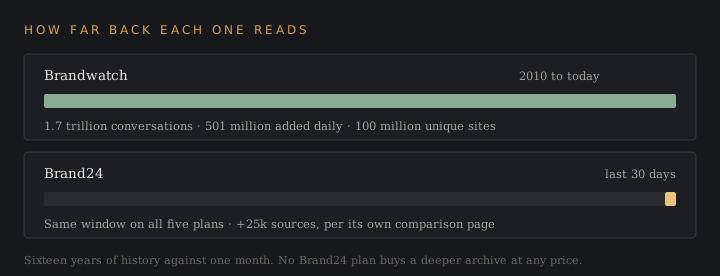
That gap decides most evaluations before pricing enters the room. Monitoring online conversations and emerging trends from today forward is a real job and Brand24 does it well; that's its focus and the whole platform is built around it. Answering what changed in brand sentiment between 2019 and 2024 is a different job, and only one of these tools holds the historical data to attempt it.
↑ COMPARISONBrand24's rate card, and the $79 figure that isn't on it
| Plan | Billed monthly | Billed annually | Keywords | Mentions per month | Update frequency |
|---|---|---|---|---|---|
| Individual | $249 | $199 | 3 | 2,000 | Every 12 hours |
| Team | $349 | $299 | 7 | 10,000 | Hourly |
| Pro | $499 | $399 | 12 | 40,000 | Real time |
| Business | $699 | $599 | 25 | 100,000 | Real time |
| Enterprise | From $1,499, annual only | From $1,499 | Custom | Custom | Real time |
Brand24 pricing page, last modified 27 July 2026, accessed 7 August 2026. Individual carries one user; every tier above it carries unlimited users, allowing teams to share a subscription. Two add-ons sit outside the table: API access at $99, and the AI Visibility module, available on all five plans.
Three different starting prices circulate for Brand24 and only one is on the vendor's page. The $199 figure is right, as the Individual rate billed annually. The $199-to-$1,499 range is right too, reading down the annual column. The $79 figure appears nowhere: no plan at either billing cadence costs $79, and there's no free tier below Individual.
Monthly billing runs 16.7% to 25.1% above the annual rate depending on the tier, which is the arithmetic behind the "up to 3 months free" label on the annual toggle. Annual billing isn't self-serve either. The pricing FAQ says "To subscribe annually, simply start a free 14-day trial and then contact us."
The row that reshapes shortlists is update frequency. Brand24 markets real-time alerts, and real-time tracking of new brand mentions starts on Pro at $399 a month billed annually. Individual refreshes every 12 hours and Team hourly, so a $199 subscription can sit half a day behind a story. Any team buying this social listening tool to stay ahead of fast-moving mentions needs Pro or above for real-time updates.
Sources are gated the same way. LinkedIn, Medium, Quora, YouTube and TikTok unlock on Team and up, so the major social networks aren't all monitored at entry level; Reviews, Twitch and Newsletters unlock on Pro and up, and podcasts sit on Business and Enterprise only.
Free trials run 14 days with no credit card required, and the pricing FAQ offers a 30-day money-back guarantee excluding custom plans. Fourteen days is long enough to judge the interface and the alert volume, and short of what it takes to judge the insights, which need a full reporting cycle.
See the full rate card
Sign up for Brand24
$199 to $1,499 a month, every tier published. 14-day trial, no credit card required.
 Visit Brand24 →
May earn a commission if you sign up through this link, at no extra cost to you. Full affiliate disclosure.
↑ COMPARISONWhat Brandwatch contracts have cost
Brandwatch publishes no price at all. Its plans page names three product lines, Consumer Intelligence, Social Media Management and Influencer Marketing, lists no tier, quotes no figure, and routes every button to a demo form. Capterra's vendor-supplied block reads "Custom Quote Available" and "Free trial not available", so there's no self-serve path in and no trial to evaluate the platform on.
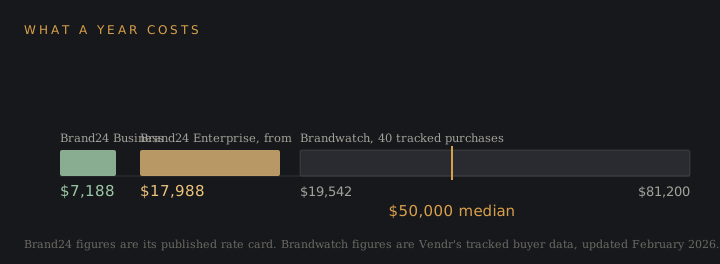
Median annual Brandwatch contract across 40 purchases tracked by Vendr, with a low of $19,542, a high of $81,200 and average negotiated savings of 15.29%. Those are Vendr's anonymized buyer figures, updated February 2026.
Custom pricing on the vendor side means the only public number about Brandwatch enterprise pricing comes from a procurement platform, and its customers reach a negotiation with no published anchor to argue from.
Put the two together and the ratio is stark. Brand24's Business plan at $599 a month comes to $7,188 a year, 37% below Vendr's tracked Brandwatch floor of $19,542 and roughly one seventh of the $50,000 median. Even Brand24 Enterprise, from $1,499 a month, annualises to $17,988 and still lands under that tracked floor.
↑ COMPARISONBoth vendors lost their independence inside fifteen months
| Date | Event |
|---|---|
| 31 January 2020 | Platinum Equity takes Cision private, all cash, about $2.7 billion |
| 1 June 2021 | Cision closes its $450 million acquisition of Brandwatch |
| April 2024 | Prowly, a Semrush company, buys control of Brand24 for PLN 55 million |
| November 2024 | Moody's moves Cision's borrower entity to Caa2, outlook negative |
| 29 April 2025 | Cision closes a refinancing that strips substantially all restrictive covenants from the 2028 indenture |
| May 2025 | S&P cuts the same borrower to 'D' on the completed distressed exchange, later raising it to CCC+ |
| November 2025 | Adobe agrees to acquire Semrush, Brand24's ultimate parent, for $1.9 billion |
| 11 February 2026 | Prowly settles a compulsory buyout of the remaining shares and reaches 100% of Brand24 |
| 7 May 2026 | Brand24 shares withdrawn from the Warsaw Stock Exchange; the company stops filing |
The two paths diverge on debt. Cision's refinancing closed on 29 April 2025 with roughly $250 million of new-money first-out term loans, the existing loans exchanged on a cashless basis for about $1,300 million and €430 million of second-out loans, and roughly $294 million of notes swapped for about $268 million of 10.00% senior secured notes due 2031. Brandwatch's own press page has published nothing since December 2024; announcements now issue under cision.com.
Brand24 went the other way, into a larger parent. Its final published accounts, for FY2025, show consolidated revenue of PLN 42.6 million against PLN 35.3 million restated for 2024, EBITDA of PLN 8.2 million, net profit of PLN 2.8 million, and ARR of PLN 47.9 million at year end, up PLN 10.3 million. Operational MRR was $973 thousand at the close of Q4 2025, about 34% up year on year, with 85% of revenue coming from customers outside Poland.
The cost of the delisting is that FY2025 is the last report. Brand24 was founded in Wrocław in 2011, listed on NewConnect in January 2018, moved to the WSE main market in May 2021 and left it on 7 May 2026, when it "loses the status of a public company and ceases to perform disclosure obligations" in the exchange's own wording. Michał Sadowski remains chief executive; Semrush's Eugene Levin chairs the supervisory board.
↑ COMPARISONEach vendor's page about the other, checked
Brandwatch runs a Brand24 alternative page whose metadata puts its last update at 2 June 2026. It's built on WordPress 6.9.4 while the rest of brandwatch.com runs 7.0.3, which fits the content: the Forrester quote on it links a 2020 report, and its "1.6 trillion historical conversations" is the figure the flagship page has since revised upward.
The page makes no claim about Brand24. Not one. What it claims is about itself, in four lines.
- "More than 100 million unique data sources".
- "Official firehose access to Twitter and Tumblr, and the best compliant Facebook and Instagram coverage".
- An offer to "Discover and distribute actionable insights with the industry's most advanced AI, powerful data storytelling tools and eye-catching, live reporting".
- The assertion that "When it comes to understanding consumers, businesses choose Brandwatch ahead of any other tool."
Its supporting testimonial praises "the ability to gather and analyze vast amounts of consumer data from various sources" and is credited only to "G2 Review by verified customer", with no name and no date. The same page carries the standing line that many of the world's biggest brands use Brandwatch every day.
Brand24 publishes two pages in the other direction & is more specific. Its blog piece, "Brandwatch Alternatives Compared: What to Use Instead in 2026", updated 9 February 2026, states correctly that "Brandwatch uses custom, enterprise-level pricing, and there is no public price list."
It then runs a head-to-head on four metrics.
- Reach, about 4.1 million against Brand24's 1.3 million.
- Presence Score, 38 against 31.
- Advertising value equivalent, $316,000 against $102,000.
- Positive brand mentions, 14% against Brandwatch's 6%.
Those figures measure how often each vendor's own brand gets discussed online, and the page states no measurement window. They say nothing about either platform's capability. The same page scores eight Brandwatch alternatives on G2 and Capterra and gives no score for Brandwatch itself, and it carries a visible copy-paste error referring to "Keyhole alternatives".
Brand24's second page, at /brandwatch-competitors/, carries no date and is set to noindex, so the company keeps it out of Google. It reproduces a G2 scorecard putting Brandwatch at 4.4 overall with ease of use 8.2, ease of setup 7.9 and quality of support 8.6, against Brand24's 4.6, 9.2, 8.8 and 9.6.
It also describes Brand24 as a tool that tracks "+25k sources". Set that beside Brandwatch's 100 million and the two vendors' own source counts for the same category differ by a factor of four thousand.
↑ COMPARISONWhat each platform indexes, and how you query it
| Capability | Brand24 | Brandwatch |
|---|---|---|
| Historical archive | 30 days, all plans | 1.7 trillion conversations, back to 2010 |
| Sources monitored | +25k, per its own comparison page | 100 million unique sites |
| Boolean search operators | {AND}, {OR}, {NOT}, {IS}, curly brackets required | Quotes, AND, OR, NOT, NEAR/x, wildcards, brackets |
| Wildcards and grouping | Neither documented | 150 short wildcards per query |
| Visual listening | Not offered | Objects, actions, scenes and logos |
| Podcasts | Business and Enterprise plans | Not published |
| YouTube captions | All plans | Not published |
| Publishing and scheduling | Not offered | Social Media Management line |
| Influencer database | Not offered | 30m+ creators |
| API | $99 add-on | Six named APIs, no published limits |
Brand24 pricing page and help centre, Brandwatch consumer intelligence suite and developer documentation, all accessed 7 August 2026.
Boolean search exists on both tools and they aren't the same instrument. Brand24's help article, updated 11 June 2026, documents four operators, requires them inside curly brackets, and offers no quotation-mark phrase syntax, no parentheses for grouping and no wildcard. It ships on all five plans.
Brandwatch's Listen operator reference, dated 10 December 2025, adds source operators, location operators and filters on authorFollowers, engagementType and imageType, and publishes its own limits.
Visual listening is the clean break. Brandwatch's Consumer Research feature page describes Image Analysis detecting "objects, actions, scenes and logos in images", though the developer docs gate it behind a module your CSM has to enable. Brand24 documents no image, logo or visual analysis of any kind.
Its nearest equivalent works from speech: an 8 June 2026 help article explains that the tool analyses YouTube video titles, descriptions and auto-generated captions, on all plans.
Four capabilities run on both platforms: AI-powered sentiment analysis, automated reporting, flexible dashboards and social media monitoring across the main social platforms. Both market a user friendly interface.
What each one stacks on top of that is where they part.
- Brandwatch adds audience segmentation, consumer behavior breakdowns and machine learning classifiers, with advanced analytics built for market research questions about emerging trends.
- Brand24 adds AI Insights, capped at two projects on Pro and five on Business, plus an AI Visibility add-on sold separately on every tier. Its analytics stop at the 30-day boundary whatever the tier.
The sentiment engines answer different questions too. Brand24 scores each mention positive, negative or neutral and rolls that into a brand health reading you can watch week to week. Brandwatch's analytics segment brand sentiment by audience, demography and topic, which is what turns raw brand mentions into the insights a research team can present.
Neither tool is short of insights; the difference is how far back those insights reach. Both platforms ship trends dashboards, and the trends differ in span: Brand24 reads 30 days of listening data, Brandwatch reads sixteen years.
↑ COMPARISONReview scores, sample sizes and who paid for them
| Source | Brand24 | Brandwatch |
|---|---|---|
| G2 overall | 4.6 from 355 reviews | 4.4 from 728 (Consumer Intelligence) |
| G2, second listing | None | 4.0 from 983 (Social Media Management) |
| Capterra overall | 4.7 from 255 reviews | 4.2 from 255 reviews |
| Capterra features | 4.4 from 195 | 3.9 from 248 |
| Capterra value for money | 4.5 from 224 | 3.8 from 187 |
| Capterra customer service | 4.8 from 215 | 4.4 from 219 |
G2 and Capterra listings, accessed 7 August 2026. Capterra last updated both pages on 3 August 2026.
Brand24 wins every column, and two caveats belong beside that.
Brandwatch carries two G2 listings that disagree by four tenths of a star, and the lower one holds the larger sample: 4.0 from 983 reviews on the Social Media Management product, tagged by G2 as "previously Falcon.io".
Quoting Brandwatch at 4.4 means quoting the 728-review listening product and dropping the other 983. Across both listings, 1,711 reviews average about 4.17.
Customer support is the one sub-score where both vendors read well: 4.8 on Capterra for Brand24 across 215 reviews, 4.4 for Brandwatch across 219. Support quality rarely separates listening tools at this end of the market. Value for money splits them hardest, 4.5 against 3.8, which is what a published $199 rate card does to a customer's sense of a fair deal.
The second caveat cuts both ways. On Capterra, every one of the ten most recent reviews for each vendor carries the disclosure "Vendor Referred - Incentive Offered", so both companies run incentivised review programmes and the recency-weighted scores reflect that.
Brandwatch's reviewer base also skews small: 54% of its Capterra reviewers work at small businesses, for a platform sold to large enterprises. Teams evaluating alternatives to either tool should focus on the sample composition before the headline star.
↑ COMPARISONBrand24's cancellation terms against its cancellation copy
The pricing FAQ says "Naturally! There is no commitment. You can cancel your subscription at any time." The terms of use, last updated 29 June 2026, describe three different notice periods and none of them is zero.
Section VI.11 requires cancellation by email to help@brand24.com "up to 7 days before the start of the new Subscription Period", so there's no in-app cancel button in the contract. Section XI.2 sets the longest clock of the three: asking for a data export or a provider change "is equivalent to termination of the Agreement by the User with a two-month notice period".
Section III.9 gives fixed-term agreements one month's notice and warns that failing to terminate at least 30 days before the end converts the agreement to an indefinite one "with the obligation to pay the Subscription Fees for the subsequent Subscription Periods in advance".
The refund position splits the same way. The pricing page offers a 30-day money-back guarantee excluding custom plans; that phrase never appears in the terms, whose only refund right, section VI.1, covers "a refund of the Fee up to 1 month back if the User does not use the Service".
Cancelling a promotional fixed-term deal early lets the operator claw back "a proportionally reduced amount of the discounts granted", and section XI.12 adds exit charges including a fee equal to the subscription fee for every month of the transition period. Downgrades take effect only from the next period with no refund for the current one.
None of this makes Brand24 an unusual vendor. It makes the pricing-page copy a poor summary of the contract, and a business planning a three-month listening pilot should read section III.9 before the second invoice arrives.
↑ COMPARISONGetting your mentions out
Brand24 supports export and doesn't gate it by plan, which matters most to customers moving a year of brand tracking to another tool. The help centre documents an .xlsx report from the Mentions dashboard, and the pricing table lists Excel, PDF, PowerPoint, white-labelled and QuickShare reports as standard rows.
Two limits matter. Mentions from Twitter, Facebook and Instagram can't be exported into the Excel report, because those platforms' terms don't permit it, and the interface raises a pop-up saying so. Section XI.8 confirms that project data (mentions) transfers out while "Mention-based reports and analyses (e.g. AI Insights)" do not, so the derived analytics stay behind even when the raw mention record leaves.
The clocks after that are short.
- Section XI.9 gives 30 days from the end of the transition period to download.
- Section XI.10 then deletes everything irrevocably.
- Section VIII.9 gives EU customers 14 days to export personal data before the operator may delete it.
- On non-payment, access is blocked within 7 days, monitoring stops within 14, and the account is deleted within 92.
Section V.8 states plainly that the operator "is not obligated to backup any content provided by the User".
Brandwatch publishes no comparable public terms, so there's nothing on that side to quote. That's an asymmetry in Brand24's favour: a vendor whose exit terms its customers can read before signing is a vendor a business can plan around.
↑ COMPARISONStatus pages, downtime and what each vendor owes you
Brandwatch runs a public status page monitoring 24 components across Consumer Intelligence, Social Media Management and Influence. It publishes no rolling uptime percentage on any of them, so the only measurable signal is incident count: three Consumer Research incidents in the eight days to 5 August 2026, running 1 hour 9 minutes on 31 July, 44 minutes on 4 August and 1 hour 57 minutes on 5 August.
Brand24 publishes no status page. The only vendor-run subdomain of that type is a changelog, so there's no incident history to read and no way to monitor availability from outside the platform. What it does carry is a contractual remedy Brandwatch doesn't publish: section VII.3 of the terms extends your subscription by one day for every day of a technical break lasting more than 24 hours.
Both positions cost something. A vendor publishing a status page can be measured and will look worse for it; a vendor publishing none can't be checked at all. Brandwatch gives its customers visibility with no service credit, and routes everything else through support. Brand24 gives them a credit with no incident feed to read.
↑ COMPARISONWhat the rest of the category charges
Two of these listening vendors publish a rate card and the rest don't, which is the shape of the whole market. Buying either way is a different business process: one is a credit card, the other is a procurement cycle.
Grand View Research sizes this market across two separate reports.
- Media monitoring tools: USD 5.5 billion for 2024, an estimated USD 7.0 billion for 2026, and a projected USD 12.0 billion by 2030 on a 14.1% compound rate.
- Social media listening: USD 9.2 billion for 2024, USD 11.7 billion for 2026 and USD 20.2 billion by 2030.
The $6.2 billion figure that circulates for 2025 came from an earlier edition of the media monitoring report and is no longer on the live page.
| Tool | Entry price | Published rate card | Owner |
|---|---|---|---|
| Awario | $29/mo annual, $49 monthly | Three tiers, all figures public | Independent |
| Brand24 | $199/mo annual, $249 monthly | Five tiers, all figures public | Semrush, via Prowly |
| Mention | Not published | One plan, no figure shown | Agorapulse |
| Talkwalker | Not published | Three tiers, quote only | Hootsuite |
| Meltwater | Not published | Four tiers, quote only | Marlin Equity and Altor |
| Brandwatch | Not published | No tiers named | Cision, via Platinum Equity |
Vendor pricing pages, all accessed 8 August 2026.
Awario is the cheapest way into social listening with real numbers attached, and its plans price listening per topic. Starter runs $49 a month or $29 billed annually for 3 topics and 30,000 new mentions; Pro is $149 or $89 for 15 topics and 300,000 mentions; Enterprise is $399 or $249 for 100 topics and a million mentions. The trial is 7 days with no card, and data export is gated to Pro and above.
Mention has gone the other way. Its pricing page now shows a single plan called Company with the price field empty, and the old Solo/Pro/ProPlus ladder is gone, so any per-plan mention counts on third-party roundups are stale. The listening tool still claims monitoring of "over 1 billion sources daily", historical data and API access sell as paid add-ons, and the free trial button routes to a 30-day Agorapulse trial.
At the top of the market, Talkwalker now trades as Lumen by Talkwalker under Hootsuite, monitoring 150 million websites, 30+ social networks and 300+ review sites across three quote-only tiers with unlimited users.
Meltwater, taken private by Marlin Equity Partners and Altor on 9 August 2023 at NOK 18.00 a share and delisted from the Oslo exchange, describes a pool of 200 billion conversations on its own blog while its press boilerplate says it analyses around 1 billion pieces of content a day. Its four tiers are all quote-only with a 12-month minimum, serving 27,000 companies through sales-led support.
Syncly markets itself on video-first listening, and Signal AI, founded in 2013, took a $165 million growth-equity investment led by Battery Ventures announced on 24 September 2025 that gave Battery a majority stake. Every one of these listening tools sells the same promise, insights on industry trends from public conversation, and prices it across two orders of magnitude.
↑ COMPARISONWhich social listening tool fits which team
Brand24 suits small businesses, growing teams and PR functions that need to know today what's being said about their brand's presence today, at a cost that clears procurement without a committee. Take the Pro plan at $399 a month billed annually if speed decides it, because that's where real-time collection starts.
It's a cost effective, affordable monitoring tool with an interface a new hire can run in an afternoon, and 4.7 on Capterra across 255 reviews reads the same way. The insights it produces are shallow by design, and for a business whose question is this week's brand sentiment that's the right trade.
Brandwatch suits large enterprises with a dedicated analyst, a multi-year research question, and a budget surviving a $50,000 median. Everything making the platform powerful, Boolean depth, visual listening, audience segmentation, 100 million sources, needs someone whose focus is writing queries. Buying it without that person is the standard way this purchase fails, because the insights arrive only as fast as someone can build the query behind them.
Many tools sit between the two, so if neither profile matches your specific needs, the category is deep. Awario and Mention undercut Brand24 on price for basic brand listening. Talkwalker and Meltwater sit alongside Brandwatch on listening scale and match it on price opacity.
Sprout Social sits closer to publishing and engagement than to research, and sells its own listening as a paid add-on. Its customers get analytics on the accounts their publishing team runs. Web-wide listening, the monitoring that feeds it & the insights it produces stay a separate line item wherever you focus the budget.
Weeks, not years, of history
Try Brand24 free for 14 days
No credit card required; Individual starts at $199/mo against Brandwatch's $19,542-plus tracked contracts.
Visit Brand24 →
May earn a commission if you sign up through this link, at no extra cost to you. Full affiliate disclosure.
↑ COMPARISONCommon questions about Brand24 and Brandwatch
Is Brand24 reliable?
As a reliable tool for current brand mentions, its scores support it: 4.6 from 355 G2 reviews and 4.7 from 255 on Capterra, with customer service at 4.8. The reliability question that matters more is structural. There's no status page for its customers to monitor availability against, and the platform holds no data older than 30 days, so it can't answer a historical brand question at any tier.
Is Brandwatch real or fake?
It's a real platform, in market since 2006, owned by Cision since June 2021 and used by named enterprise customers. The scepticism behind the question tends to come from the pricing: no published rate card, no free trial, and a tracked contract range from $19,542 to $81,200 that a buyer can't sanity-check before a sales call.
What are good alternatives to Brand24?
For the same self-serve shape at lower cost, Awario starts at $29 a month billed annually against Brand24's $199. For deeper media monitoring across traditional media and news sites, Meltwater and Talkwalker, both quote-only. For enterprise consumer intelligence, deeper analytics and audience insights, Brandwatch and Sprinklr. A Brandwatch alternative and a Brand24 alternative are rarely the same tool, which is why shortlists mixing them stall.
Who are Brandwatch's main competitors?
Sprinklr, Meltwater, Talkwalker, Sprout Social and Signal AI at the enterprise end; Brand24, Awario and Mention at the self-serve end. Brand24's own Brandwatch alternative post ranks eight competitors and publishes no review score for Brandwatch itself, which is worth noticing before treating it as a neutral list of the best tools.
Does Brand24 have a free trial?
Yes, 14 days with no credit card required. Brandwatch has none, per Capterra's vendor-supplied listing, so evaluating that platform means a demo and a paid pilot.
↑ COMPARISONWhich one to buy
Take Brand24 if the reporting horizon is weeks. Few tools in this space publish every price the way it does, the trial costs nothing, the Business plan at $7,188 a year sits 37% under Brandwatch's tracked contract floor, and it wins every review column outright, customer support included. Budget for Pro or above if real-time matters, read section III.9 before the second invoice, and accept that the archive begins the day you sign.
Take Brandwatch if the reporting horizon is years. 1.7 trillion conversations back to 2010, 100 million sources, visual listening and a query language with documented operators have no equivalent on the Brand24 side. Price that at Vendr's $50,000 median, add an analyst whose focus is turning listening data into insights, and expect a parent company that completed a distressed exchange in April 2025 and hasn't published under the Brandwatch name since December 2024.
The comparison neither vendor's marketing will make for you is the one that decides it. These platforms sit seven to one apart on price because they answer different questions about your brand. Work out which question you're paying to answer, then pick the right tool for the data it can reach.
Sources for Brand24: brand24.com/prices (modified 27 July 2026); brand24.com/terms (last updated 29 June 2026); help.brand24.com articles on historical data, Boolean search, Excel reports and YouTube caption monitoring.
Also for Brand24: brand24.com/blog/brandwatch-alternatives (updated 9 February 2026); brand24.com/brandwatch-competitors; brand24.pl investor relations, FY2025 consolidated financial statements and management board report, both dated 30 April 2026; Warsaw Stock Exchange current report 9/2026 dated 5 May 2026.
Sources for Brandwatch: brandwatch.com/plans; brandwatch.com/suite/consumer-intelligence; brandwatch.com/products/consumer-research/features; brandwatch.com/p/brand24-alternative; social-media-management-help.brandwatch.com operator reference dated 10 December 2025.
Also for Brandwatch: developers.brandwatch.com; status.brandwatch.com; vendr.com/marketplace/brandwatch; platinumequity.com; cision.com financing release dated 29 April 2025; S&P Global Ratings and Moody's actions on Castle US Holding.
Other sources: awario.com/pricing; mention.com/en/pricing; talkwalker.com/pricing and /products/data; meltwater.com/en/pricing and its 9 August 2023 take-private release; grandviewresearch.com media monitoring tools and social media listening market reports; signal-ai.com press release dated 24 September 2025; G2 and Capterra listings for both vendors. Accessed 7 and 8 August 2026.