Sprinklr pricing 2026: what enterprise contracts cost
 By Jan Suski, six years working in digital. How the scoring works.
The numbers Sprinklr enterprise contracts, checked 14 August 2026
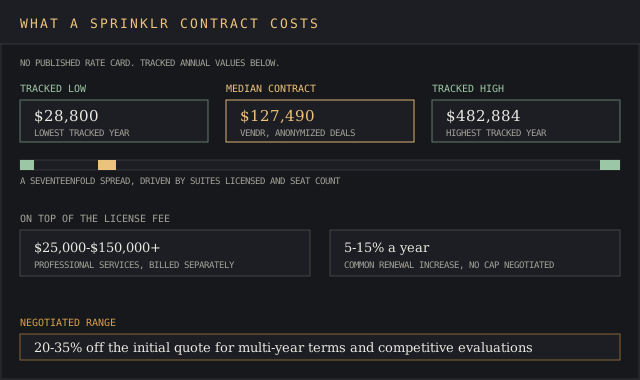
The gap between the $28,800 floor and the $482,884 ceiling is a seventeenfold spread, and none of it comes from a published tier chart.
Professional services alone can add $150,000 to a first-year bill on top of the license fee.
A company generating $219.5 million in a single quarter still won't quote a number without a scoping call.
Sprinklr publishes no price page. The only way to find out what Sprinklr costs is a sales call, and the number that comes back depends on which of the platform's four product suites a team licenses, how many named users it needs, and how much message volume runs through it. That opacity is by design: Sprinklr sells to large organizations running social media management, contact center solutions and customer insights through one contract instead of four.
Sprinklr's own website describes the platform as a unified customer experience management solution, or Unified-CXM, built for enterprise teams that need one governance layer across every customer-facing channel.
Sprinklr offers four suites under that platform: Sprinklr Social for social media management software, Sprinklr Service for a customer service solution and contact center software, Sprinklr Insights for listening and analytics, and Sprinklr Marketing for campaign and paid media work.
This report uses anonymized contract data from Vendr, Sprinklr's own product and legal pages, and Sprinklr's investor filings to lay out what buyers pay. It covers the plan tiers and what each one gates, the add-ons priced outside the base platform fee, the hidden costs procurement teams miss on a first read, and how negotiated pricing compares to the number Sprinklr's sales team opens with.
It's written for a buyer who has already sat through a demo and needs a real budget number before the next call, the kind of detail a marketing overview skips. Sprinklr's contracts run from under $30,000 to nearly half a million dollars a year, and knowing which end of that range a given deployment lands on changes the whole negotiation.
How much does Sprinklr cost
Sprinklr's pricing model runs on named user licenses, the product suites a company selects, message and channel volume, and contract length. There's no flat per-seat rate a buyer can look up. The sales process is consultative: a team requests a demo, a Sprinklr rep scopes the deployment, and a custom quote follows. There is no checkout page and no published starting price.
Sprinklr discontinued its Self-Serve program on April 30, 2026, closing the last self-service path into the platform. Existing Self-Serve customers, who had paid roughly $199 to $299 per seat a month for Sprinklr Social and Sprinklr Service on a card, kept access until that date; every new customer since goes through the same enterprise sales process regardless of team size.
Contract length shapes total cost as much as headcount does. Sprinklr rewards 24- and 36-month commitments with lower per-unit pricing, and annual prepayment typically unlocks a deeper discount than quarterly billing. A buyer negotiating a 12-month deal with quarterly invoices is negotiating from the most expensive corner of Sprinklr's pricing model.
Sprinklr products all sit on the same underlying platform, so a company adding a second suite later isn't buying a separate piece of infrastructure, it's extending a contract that already covers identity, permissions and customer experience data.
That's the mechanical reason bundled quotes discount faster than adding suites one renewal at a time, and it's also why contact centers evaluating Sprinklr Service alongside Sprinklr Insights should scope both in the same sales conversation.
Sprinklr's product suites: what each tier gates
Sprinklr's own navigation lists four product suites under its Unified-CXM platform: Sprinklr Service, Sprinklr Social, Sprinklr Insights and Sprinklr Marketing. A company can license one suite or bundle several, and bundling is where Sprinklr's volume discounts live.
Sprinklr Social
Sprinklr Social is the social media management product: publishing, engagement and analytics across Facebook, Instagram, X, LinkedIn and TikTok. Pricing runs on user licenses and the number of social profiles under management, with a base platform fee plus per-user and per-profile charges. Buyers who commit to multi-year terms or bundle Social with another suite commonly see 20–35% off the initial quote.
Sprinklr Service
Its Service suite (also sold under the name Sprinklr Care) is the contact center and customer service product, unifying social, messaging, email, chat and voice into a single agent console. Pricing scales with agent licenses and inbound message volume across channels, and teams with seasonal spikes need tiered volume pricing built into the contract.
Sprinklr Insights
Sprinklr Insights is the AI-driven listening and analytics product, tracking social, review and survey data for competitive benchmarking and sentiment analysis. Pricing is driven by user licenses, the number of data sources connected and how many concurrent listening queries a team runs. Narrowing data-source scope or query count is the fastest lever for trimming an Insights quote. The social listening rankings place Sprinklr Insights against the rest of the category.
Sprinklr Marketing
Sprinklr Marketing covers campaign planning, content marketing, marketing automation and social advertising, including the Advertising capability that used to sell as a standalone product. Pricing follows user licenses, campaign volume and the number of channel integrations, with tiered pricing kicking in at higher monthly send or impression counts.
Why the price holds against cheaper alternatives
Sprinklr has sold Unified-CXM contracts for nearly a decade, and two analyst firms back the premium with independent placement. Sprinklr was named a Leader in The Forrester Wave for Social Suites, Q4 2024, and a Strong Performer in The Forrester Wave for CCaaS Platforms, Q2 2025. In July 2026, Sprinklr was named a Leader in the Gartner Magic Quadrant for Social Media Management and Listening.
None of that analyst recognition lowers the number a buyer negotiates.
It explains why Sprinklr rarely drops to the bottom of its tracked range even against cheaper point tools: enterprise procurement teams weigh a Forrester Wave or Gartner Magic Quadrant placement alongside price once a contract crosses into seven figures, and a single platform covering social media management, contact center software and customer feedback carries weight that a stack of point tools doesn't.
What Sprinklr AI and support add to the price
Sprinklr AI is included with every suite, and it's the mechanism behind sentiment analysis, predictive customer satisfaction scoring and the daily trend reports Sprinklr Insights generates for managers. Sprinklr AI Agents and Agent Copilot extend that into Sprinklr Service, drafting responses and summarizing calls so agent assist speeds up a human reply instead of replacing it.
The Service suite adds a unified agent desktop, workforce management for scheduling contact center staff, and omnichannel routing across multiple channels, so a customer contacting a brand through social, chat or voice reaches the same case record regardless of channel.
Sprinklr Marketing pairs campaign management and social advertising with paid media budgets managed inside the same login, and Sprinklr Social includes employee advocacy tools for pushing approved content through staff accounts and customer communities.
Sprinklr Insights turns that same activity into audience insights, competitor insights and reputation management, tracking key metrics like message volume and customer sentiment across a brand's own channels and its rivals'. None of it prices separately from the suite it lives in, which is the mechanical reason a quote depends on which suites a company buys.
Support scales with contract size. Enterprise contracts typically include a dedicated account manager and technical support with a defined response time, while smaller license tiers route through Sprinklr's help center and community forum instead of unified communications with a named rep.
Sprinklr's pre-built integrations connect to major platforms including Salesforce, Adobe Experience Cloud, Google Analytics and Microsoft Dynamics; anything outside that list is a custom integration, priced and built separately from the base license.
What drives a Sprinklr quote
Four variables move a Sprinklr number more than anything else: how many named users are on the contract, which suites those users touch, how much message and channel volume runs through the platform, and how long the contract term runs. License types matter inside that user count too: admin and analyst seats price higher than publisher or agent seats, so a buyer who audits roles before renewal can right-size the license mix instead of over-licensing by default.
Buyers with 10 to 50 users typically license one or two suites and land between $50,000 and $200,000 a year. Teams with 50 to 200 users usually run multiple suites together and see $200,000 to $750,000.
Above 200 users, a company running the full suite across global teams can clear $750,000 and reach into the millions for multi-region deployments. Every one of those bands assumes the standard negotiation happens; a buyer who accepts the first quote pays more inside every band.
Hidden costs a Sprinklr quote won't show up front
The base license fee is the start of a Sprinklr contract. It isn't the total. Professional services for onboarding, data migration and workflow configuration run $25,000 to $75,000 for a standard one- or two-suite deployment, and $75,000 to $150,000 or more for a multi-suite rollout across regions.
Buyers should get a written breakdown of what's included before signing, because these fees are quoted separately from the license and often represent 15–30% of total contract value.
Custom integrations beyond Sprinklr's pre-built connectors to Salesforce, Adobe Experience Cloud and Microsoft Dynamics can add $10,000 to $50,000 or more in development fees. Extended data retention past the baseline 12–24 month window runs $5,000 to $20,000 a year.
Exceeding a contract's monthly message or campaign volume triggers overage charges priced 20–50% above the baseline per-unit rate, and annual maintenance fees for platform updates and support can add 15–20% of license value on top, sometimes bundled into the base contract and sometimes not.
Sprinklr contracts typically renew automatically, and that's where an unmanaged deal quietly gets more expensive. Renewals without a negotiated price cap commonly carry 5–15% annual increases, and Sprinklr's standard renewal notice window runs 60–90 days, which is tight for a team that wants time to run a competitive evaluation before the deadline.
What Sprinklr buyers pay in practice
Vendr's anonymized contract data puts the median Sprinklr buyer at $127,490 a year, with the tracked range running from $28,800 at the low end to $482,884 at the high end.
Those figures come from closed deals, so they show what negotiation produces. Every dollar figure in this report traces back to that dataset or to Sprinklr's own published pages, never to a competitor's blog restating someone else's number.
| Buyer segment | Typical deployment | Annual contract value |
|---|---|---|
| Small to mid-market (10–50 users) | One or two suites, single region | $50,000–$200,000 |
| Mid-market to enterprise (50–200 users) | Multiple suites bundled | $200,000–$750,000 |
| Large enterprise (200+ users) | Full suite, multi-region rollout | $750,000 and up |
Segment bands reflect the deployment patterns and contract values described in this report, drawn from Vendr's tracked Sprinklr contracts.
Discounting is routine. Buyers who commit to 24- or 36-month terms with annual prepayment typically land 20–30% below list, and buyers who demonstrate an active competitive evaluation against Salesforce, Khoros, Emplifi or Hootsuite Enterprise during Sprinklr's fiscal quarter-end can push that to 30–40% off.
How to negotiate Sprinklr pricing
Sprinklr's fiscal year ends in January with quarterly closes in April, July and October, and sales teams face real pressure to close before those dates. Engaging 90 to 120 days before a decision deadline gives room for multiple proposal rounds, and naming a specific competitor in the evaluation tends to produce faster concessions than a vague mention of "shopping around."
Buyers get better outcomes anchoring to their own budget range, backed by comparable data. Negotiating module scope and license tiers separately from the headline price, and pushing for a capped renewal increase (no more than 5% a year) and a 90-to-120-day notice window, are the specific asks that show up across successful renewals.
Real users describe what that first number looks like before negotiation starts. A senior digital strategist reviewing the platform on Capterra put it plainly:
"Amazing brand management and digital/social marketing platform. Great support. But super expensive... Price. Way too expensive. Otherwise not much to complain about."Gabriel S., Senior Digital Strategist, Marketing and Advertising, Capterra review, 21 October 2024
A digital community manager who stayed with the platform for years reached a similar conclusion about where the money goes:
"Sprinklr is one of the more expensive examples of these tools, unfortunately, but that can be expected with so many different modules and top of the line tools."Chris H., Digital Community and Content Manager, Printing, Capterra review, 13 November 2025
Smaller organizations feel the contract floor more acutely. A marketing agency owner reviewing on Capterra warned other small teams away from it directly:
"I would hesitate to recommend Sprinklr for a small business given the price."John T., Owner, Marketing and Advertising, Capterra review, 11 October 2022
Enterprise buyers reach the same number from a different angle, weighing tier gates against total spend. A brand marketer who paid for the top license tier described the tradeoff:
"We were fortunate enough to shell out for the enterprise solution, but it is on the expensive side. More cost effective credentialing significantly impact the features, which is a bummer for teams who can't afford the top level tiers."Daniel H., Brand Marketing, Retail, Capterra review, 13 June 2017
Not every account gets the value that price is supposed to buy. A community strategist at an enterprise account paired the cost complaint with a service complaint:
"It's so buggy. Nothing is smooth. It's very complicated... The support you do get is extremely poor. It's expensive."Joe G., Community Strategist, Enterprise (1,000+ employees), G2 review, 8 July 2025
One reviewer on TrustRadius framed the cost as acceptable only because of what the platform replaces:
"While they might be slightly expensive, the functionalities the platform provides justify the price tag."Verified User, TrustRadius review, 29 January 2019
A nonprofit buyer put a number on how thin that justification runs once budget tightens:
"If it were to suddenly become much more expensive to us as a nonprofit, we would likely discontinue and look for a more affordable service."AGAzy Groth, Lead Writer in Social Media, Invisible Children Inc., TrustRadius review, 28 October 2013
What buyers say about the learning curve and support
Sprinklr's platform complexity increases the learning curve for new users, and reviewers on G2 and Capterra cite that complexity, along with onboarding length, as the most common criticism across every product line. Three to six months of sales cycle and implementation is the realistic minimum for a full enterprise rollout.
Reporting is a specific pressure point inside that complexity. Reviewers describe Sprinklr's reporting tools as difficult to configure and not user-friendly out of the box, which is part of why professional services and training show up as a separate line item.
Support for smaller teams is limited now that the Self-Serve program has ended: standard support routes through the help center and community forum, and a named technical contact for customer interactions arrives only with an enterprise contract.
Where small teams end up instead
Sprinklr isn't competing with Salesforce or Khoros at the bottom of the market, because there's nothing at the bottom of the market to compete for. Teams priced out of the $28,800 floor typically land on point tools instead: Social Champ advertises pay-per-profile plans from $4 a profile a month, billed yearly, with a free tier and no enterprise sales process attached.
Vertical specialists fill the same gap from a different angle, Chatarmin, for one, positions itself as a WhatsApp marketing and customer service platform built specifically for DACH e-commerce brands.
On the contact center side, Sprinklr Service also competes with Nextiva, Five9 and NiCE CXone, three CCaaS providers that G2 reviewers list among Sprinklr's top-rated alternatives. None of them publish a Fortune 100 client roster the way Sprinklr does, and none of them require a six-figure floor to get started.
Who Sprinklr's pricing is built for
Sprinklr's contract floor and its consultative sales process both point the same direction: this is software priced for large organizations with dedicated marketing, customer service and insights teams. A lone social media manager running one brand page pays for suites and seats they'll never touch. A $28,800 minimum tracked contract, paid annually with a sales cycle attached, prices out most small teams before the negotiation even starts.
The buyers who get the most value are enterprise teams consolidating several point tools, social listening, contact center software, campaign management and reputation management, into one enterprise governance model with role-based permissions across global teams. A company already running four separate contracts for those functions is comparing Sprinklr's total cost against four renewal invoices. A single cheaper tool isn't the real comparison.
Marketing teams, support teams and customer experience teams each touch a different suite, which is why Sprinklr's sales process usually involves more than one stakeholder before a contract closes.
A social customer service team evaluating Sprinklr Social against other social media tools is having a different conversation about digital channels and message volume than a customer care team scoping Sprinklr Service for contact centers, even though both quotes land on the same enterprise plan. Our Sprinklr review scores the platform's feature set, support quality and compliance against this same pricing.
Sprinklr against its alternatives
Sprinklr sits in the mid-to-high range among enterprise customer experience platforms. Salesforce Marketing Cloud typically carries higher list pricing for comparable multi-cloud deployments; Khoros usually runs 10–20% below Sprinklr for mid-market buyers; Emplifi and Hootsuite Enterprise both undercut Sprinklr's list price by a wide margin, though with narrower feature coverage.
| Platform | Typical contract minimum | Professional services |
|---|---|---|
| Sprinklr | $50,000–$100,000 a year | $25,000–$150,000+, separate |
| Salesforce Marketing Cloud | $75,000–$150,000 a year | $30,000–$200,000+, separate |
| Khoros | $40,000–$80,000 a year | $20,000–$100,000+, separate |
| Emplifi | $30,000–$60,000 a year | $15,000–$75,000+, separate |
| Hootsuite Enterprise | $20,000–$50,000 a year | $10,000–$50,000+, separate |
Sprinklr's contract minimum and professional-services range come from Vendr's tracked contracts, cited above. Figures for Salesforce Marketing Cloud, Khoros, Emplifi and Hootsuite Enterprise are typical market ranges.
Buyers who run a genuine competitive evaluation against two or three of these alternatives during negotiation typically land 20–35% below Sprinklr's initial quote, which brings the effective price closer to the mid-market platforms while keeping Sprinklr's broader suite coverage.
Buyers comparing Sprinklr against other platforms in the wider category can go deeper with the Brandwatch vs Sprinklr comparison or the Sprout Social vs Sprinklr comparison, and check Brandwatch's own pricing report or Sprout Social's pricing report against the numbers above; our Brandwatch review and Sprout Social review score both platforms on the same criteria.
What to budget for a Sprinklr contract
A realistic first-year budget adds three lines together: the license fee for the suites and seats a team needs, professional services for onboarding and any custom integrations, and a buffer for message or campaign volume that runs past the contracted tier. Skipping the third line is the most common budgeting mistake, since overage pricing runs well above the baseline rate once a team exceeds its monthly allowance.
Renewal budgeting matters just as much as the first-year number. A team that doesn't negotiate a capped increase should plan for 5–15% growth at renewal by default, and a team planning to expand seats or add a suite should model that expansion against the segment bands above.
Procurement teams comparing multiple tools should ask Sprinklr's sales process for the same scenario, in writing, that they're asking Salesforce, Khoros or Hootsuite Enterprise to price.
Sprinklr's own pricing tiers aren't transparent pricing in the way a self-serve tool's plan page is, so a fair Sprinklr compare against an alternative means forcing every vendor to quote against one identical set of users, suites and channel volume, then weighing monthly cost and annual total side by side.
Frequently asked questions
How much does Sprinklr cost per month?
Nothing on the Sprinklr website lists a monthly figure, and it hasn't since the Self-Serve program closed on April 30, 2026. Sprinklr cost isn't published on a monthly basis.
Contracts are quoted and billed annually, with tracked annual values running from $28,800 to $482,884 and a median around $127,490, depending on suites, seats and message volume. Sprinklr Social pricing, Sprinklr Service pricing and Sprinklr Insights pricing all follow the same annual, quote-based structure.
What is Sprinklr's sales process like?
Sprinklr's sales process starts with a demo request, moves through a scoping call to gather requirements, and ends with a custom quote. Sprinklr support during that process typically includes a solutions engineer who maps the quote to specific customer feedback and customer conversations use cases before the deal reaches procurement.
How much does a social media post cost on Sprinklr?
Sprinklr doesn't price individual posts. Sprinklr Social is licensed by user seat and social profile count, so the effective cost per post depends on total publishing volume weighed against that fixed annual fee. There's no per-post rate.
Is Sprinklr a social media management tool?
Sprinklr Social is a social media management platform, one of four suites inside the broader Sprinklr Unified-CXM platform, which also covers customer service, insights and marketing beyond social publishing and engagement.
How does Sprinklr compare to Hootsuite?
Hootsuite Enterprise typically carries a $20,000–$50,000 annual minimum against Sprinklr's $50,000–$100,000, and Sprinklr's broader module coverage, contact center software and enterprise governance account for most of that gap.
What exactly does Sprinklr do?
Sprinklr is a Unified Customer Experience Management platform combining social media management, contact center software, marketing and AI-driven insights so a company runs every customer conversation from one login instead of separate contracts for each function.
Is Sprinklr a CRM platform?
Sprinklr isn't a CRM. It's built around social channels, customer service interactions and marketing campaigns, and it integrates with CRM platforms like Salesforce.
Bottom line
Sprinklr's pricing rewards buyers who show up prepared and penalizes buyers who don't. The tracked spread between a $28,800 floor and a $482,884 ceiling has nothing to do with company size alone; it tracks which suites a team licenses, how many seats it right-sizes before signing, and if it negotiates against a real alternative during the sales cycle.
A buyer who treats the first quote as the number to beat, budgets professional services and overage separately from the license fee, and negotiates a renewal cap before signing walks away paying closer to the 20–35% discounted range than the sticker price. One who doesn't ends up as the Capterra reviewer who called it "way too expensive" without ever finding out what a negotiated number looked like.
Sources, and what Sprinklr doesn't publish on its own pricing page
Contract value figures (median, low, high, professional-services range, negotiated discount range, and renewal increase range) are Vendr's anonymized contract data, read off vendr.com/marketplace/sprinklr. Enterprise customer count, Fortune 100 penetration and quarterly revenue are Sprinklr's own figures from its investor relations and newsroom pages at sprinklr.com.
Analyst placements cite Forrester's Wave reports for Social Suites (Q4 2024) and CCaaS Platforms (Q2 2025), and Gartner's Magic Quadrant for Social Media Management and Listening (July 2026). Buyer quotes are verbatim from named reviewers on Capterra, G2 and TrustRadius, dated where the review itself carries a date. All figures checked 14 August 2026.
Sprinklr publishes no rate card, no per-seat price and no self-serve signup; every number in this report traces to a closed deal, a vendor filing, or a named review.