Customer Experience Intelligence Platforms: 10 Tools Ranked for 2026
 By Jan Suski. I go deep on every review, checking every number against its source and digging up details other coverage misses, a habit from six years of SEO and link building for tech companies. Bylines at Surfer, Brand24, and Senuto. How the scoring works.
· Prefer this source on Google
Quick comparison of AI customer experience platforms
Ten customer experience intelligence platforms in ranked order, with each one’s headline coverage figure, its entry price and the buyer it fits.
| # | Provider | Coverage figure | Entry price | Best fit |
|---|---|---|---|---|
| 1 | Medallia | 100+ signal types in one record | $13,338/yr median* | VoC programs that want speech and text analytics inside one price |
| 2 | Qualtrics XM | 3.5B+ conversations and interactions a year | $30,000/yr median* | Enterprises joining survey, care and review data |
| 3 | Amazon Connect | Voice, chat and email analyzed in one rate | $0.038 per voice minute | Teams already running on AWS |
| 4 | Genesys Cloud CX | 70+ transcription languages | $155/agent/mo (CX 3) | Global omnichannel contact centers |
| 5 | NICE CXone Mpower | 100% of interactions analyzed | $209/agent/mo (Complete) | Large centers buying analytics with workforce tools |
| 6 | Sprinklr Service | 30+ voice, social and digital channels | Quote only | Brands where social care carries real volume |
| 7 | Talkdesk | Phone, chat and email in one analytics view | $85/user/mo | Mid-size centers that want a published seat price |
| 8 | Zendesk | 100% AutoQA coverage | $55/agent/mo, QA extra | Ticket-first support teams |
| 9 | Verint | 80+ of the Fortune 100 as customers | $49,451/yr median* | Regulated enterprises mining recorded calls |
| 10 | InMoment | 24 native text analytics languages | $13,488/yr median* | Current InMoment customers weighing a renewal |
Medians marked * are anonymized buyer-reported contract values published by Vendr. Every other price is the lowest published tier that includes AI analytics. Checked 4 October 2026.
Where these figures come from
Coverage figures and seat prices are each vendor’s own published figure, read on 4 October 2026. The four medians marked * are Vendr’s anonymized buyer-reported contract values for Medallia, Qualtrics, Verint and InMoment. Sprinklr publishes no rate card for Service and Vendr shows no median for it, and Talkdesk and Zendesk publish no price for their analytics and QA add-ons.
Medallia and Qualtrics XM rank second and third in the customer feedback analysis tools ranking, and Medallia closes the customer data intelligence ranking at #10. Sprinklr ranks third among social listening tools, and Zendesk ranks second in the customer intelligence systems ranking.
Sales-call recorders such as Gong sit in the conversation intelligence software ranking, and phone analytics such as CallMiner and Observe.AI in the call intelligence software ranking.
CX intelligence software reads what customers say on calls, in chats, in emails and in surveys, then tells you why they're unhappy before they churn. It's the analytics half of AI in customer experience, and it runs on customer data you already collect. Qualtrics alone says it now captures and analyzes more than 3.5 billion conversations and interactions a year.
This page ranks ten platforms on figures their own sites publish, plus Vendr's anonymized buyer data where a vendor hides its rate card. Every price links to where it came from, straight from the horse's mouth wherever the vendor publishes one.
It's written for the person who signs the contract: a CX director, the head of a customer service team, or the operations buyer who inherits the renewal on a customer experience contract. Survey-only feedback tools sit on a separate page, our customer feedback analysis tools ranking.
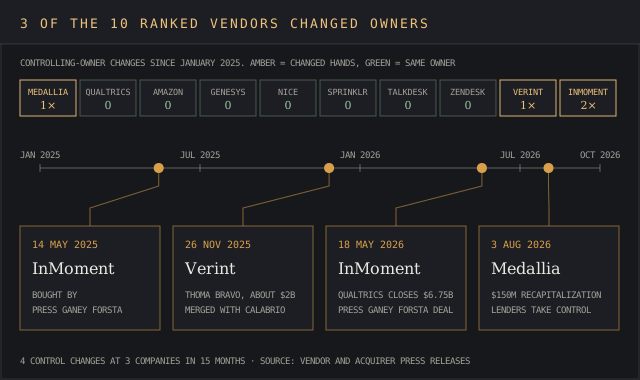
The vendor map moved in the last 18 months. Medallia's lenders took the company over, Verint went private and merged with Calabrio, and InMoment's parent was bought by Qualtrics. Three of the ten companies on this list changed owners since January 2025, so a 2024 shortlist is already out of date.
Evaluation criteria for AI customer experience tools
Five criteria decide the shortlist, and the ranking below applies them in this order. Each one is a test you can run yourself in an afternoon with the vendor's pricing page open, before implementing AI in customer service across your contact centers.
AI analytics included in the quoted price
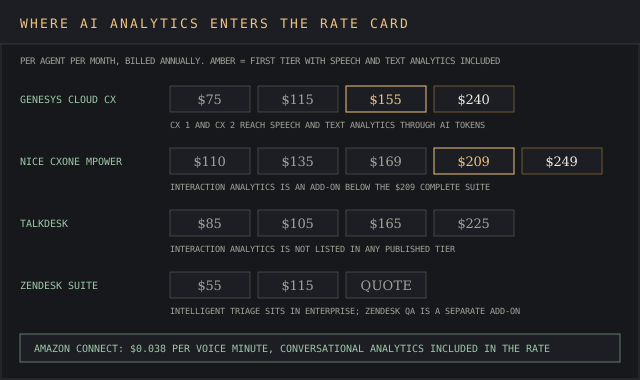
Open the rate card and find the first tier where speech and text analytics shows as included. Genesys includes it from the $155 CX 3 tier; NICE includes Interaction Analytics from its $209 Complete Suite. Below those lines it's an add-on, and add-ons are where a quote starts to cost an arm and a leg.
A price you can check before the demo
A published seat or per-minute rate scores highest. A Vendr median with its purchase count comes next, because it shows what real buyers paid. Quote-only with no buyer data scores lowest, because the buyer is left to read between the lines of a sales deck.
Signal sources past the phone queue
Count the sources the vendor's own documentation lists beside calls and chats: surveys, public reviews, social posts, web sessions. Each one shows customer needs the phone queue never hears, and fills gaps in the customer journey that predictive analytics needs to call churn. Amazon's documentation lists voice, chat and email. Qualtrics lists call center conversations, chat logs, survey responses, social media posts and product reviews.
Analysis while the customer is still on the line
Real-time call analytics catches an angry caller during the call, while the agent can still change the outcome and protect service quality. The test is a documented feature name and the tier it sits in, such as Amazon's real-time call analytics and real-time chat analytics. A sentiment flag that arrives after the call can't anticipate customer escalations.
Ownership changes since January 2025
Count how many times the company's controlling owner changed. Roadmaps follow owners, and a platform that changed hands twice in 12 months is a red flag for anyone signing a three-year term.
Owner changes since January 2025 across the ten companies ranked here: Medallia scores one, Verint one, InMoment two.
The 10 best AI customer experience platforms
Medallia
Best fit
Experience teams running a multi-channel voice of the customer program who want speech, text and acoustic analytics inside one contract metric with no per-user fees.
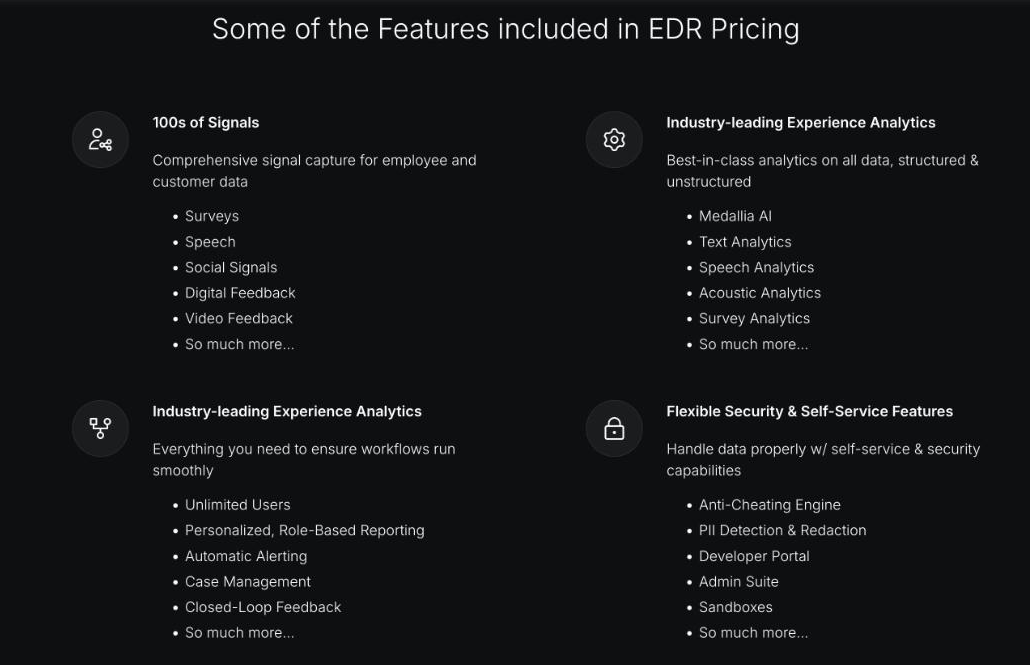
Medallia prices on the Experience Data Record, defined as "all data associated with a discrete interaction between an end-customer (or employee) and a company", and states that "pricing based on survey response volumes or number of users is obsolete." That single metric covers 100+ signal types, from surveys and speech to social, digital and video customer feedback, so customer interactions from every channel land in one record.
The company's balance sheet changed in 2026. Medallia closed a recapitalization on 3 August 2026 that brought in $150 million of new capital, handing control to an investor group led by Blackstone-managed funds with Apollo and FS KKR. Medallia says 7 of the Fortune 10 are customers. Our Medallia review covers the ownership history in full.
Key features
- Experience Data Record pricing with unlimited users, role-based reporting and case management included
- Medallia AI text analytics, speech analytics and acoustic analytics in the same metric
- Acoustic analysis of silence, overtalk, clarity and surface acoustic emotion on recorded calls
- Transcription across dozens of languages and dialects, from mono, stereo or on-premises audio
- PII detection and redaction, sandboxes and a developer portal listed under the same price
Pricing
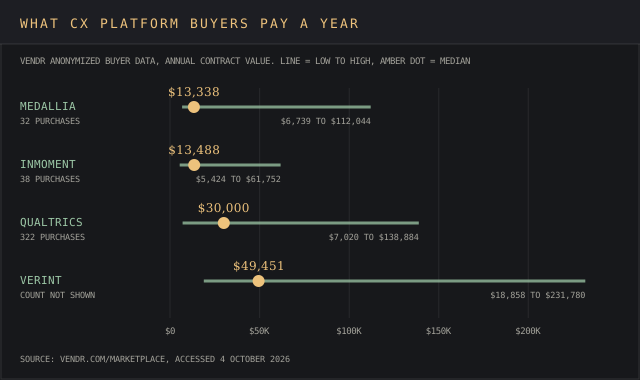
Medallia publishes no dollar figure. Vendr's anonymized buyer data puts the median at $13,338 a year across 32 purchases, low $6,739, high $112,044. That sample skews departmental, so the largest enterprise contracts fly under its radar.
Pros
- Text, speech and acoustic analytics sit inside one metric, so the analytics line can't balloon separately
- Unlimited users, which removes the seat count from the renewal fight
- 100+ signal types, the widest documented source list here
Cons
- No rate card; the EDR count is the number you'll negotiate blind
- Lender-controlled since August 2026, with the roadmap set by new owners
- A 2026 G2 reviewer couldn't design dashboards without Medallia's help
A Medallia user in retail, on G2 on 22 April 2026, put both sides in one review. The upside: "I like being able to quantify qualitative feedback and organise it into trackable topics." The complaint: "I dislike that I can’t design a dashboard myself." Santiago G., a CX executive at an enterprise account, told G2 on 23 July 2024 that Medallia turns "a large volume of survey responses into clear, digestible, and actionable insights."
Why it's ranked #1. Medallia beats Qualtrics on the first criterion: text, speech and acoustic analytics ship inside one EDR price with unlimited users, at a $13,338 Vendr median against Qualtrics' $30,000. The trade-off is lender ownership since August 2026. See the full Medallia vs Qualtrics comparison for how the two price their platforms and who owns each.
Qualtrics XM
Best fit
Large enterprises that want survey data, contact center conversations and public reviews analyzed by one vendor, and can absorb a renewal negotiation.
Qualtrics publishes the biggest volume claim in the category: over 3.5 billion conversations and interactions a year, including call center conversations, chat logs, survey responses, social posts and product reviews. The same 7 October 2025 release says over a third of customers have upgraded to its AI capabilities. Our Qualtrics XM review tracks the product line.
It's also buying the category. Qualtrics closed its $6.75 billion purchase of Press Ganey Forsta on 18 May 2026, which put InMoment, ranked #10 below, under the same roof. Qualtrics also powers more than 1 billion surveys every year, and InMoment customers should keep an eye on what the merger does to their roadmap.
Key features
- Experience Agents, announced at X4 in March 2025, built to resolve issues in real time
- Conversation analytics over call center conversations and chat logs
- XiD customer profiles
- Native integrations with Adobe, Zendesk, Salesforce, Genesys and HubSpot
Pricing
Qualtrics prices on interactions, defined on its pricing page as "a data record collected or/and processed by Qualtrics," with no dollar figure shown. Vendr's buyer data puts the median at $30,000 a year across 322 purchases, low $7,020, high $138,884.
Pros
- Survey, care, social and review data in one platform, documented by the vendor
- 3.5 billion analyzed interactions a year, the largest training base disclosed here
- Vendr's 322-purchase sample makes the median the most reliable buyer figure on this page
Cons
- Every product is quote-only, priced on interaction volume
- Renewal increases have been documented by customers in writing
- The Press Ganey Forsta integration lands on InMoment customers too
"The 2025 annual cost will be roughly 70 percent more than what the University paid in 2024"
Duke University Office of Information Technology, a Qualtrics customer, on its contract renewal notice, 15 July 2024
The same notice put the cost at "2.5x the license cost from 2023."
Why it's ranked #2. Qualtrics beats Amazon Connect on signal sources, with surveys, social posts and reviews inside its 3.5 billion interactions. It loses to Medallia on price: a $30,000 Vendr median against $13,338, with analytics billed per product.
Amazon Connect
Best fit
Support teams already on AWS that want conversational analytics metered by the minute, with no seat floor and no separate analytics line.
Amazon went back to the drawing board on its rate card and rebuilt it around channels. Voice costs $0.038 per voice minute, chat $0.010 per message and email $0.080 per email, and the pricing appendix lists conversational analytics, post-contact summaries, real-time agent assistance and agent performance evaluations inside those rates. Standard telephony rates still apply on voice.
The analytics layer, formerly sold as Contact Lens, uses natural language processing across voice, chat and email, performs sentiment analysis, detects issues and categorizes contacts automatically. Customer service agents see the sentiment trend on the contact record as the conversation runs.
Key features
- Real-time call analytics and real-time chat analytics while the contact is live
- Sentiment graph showing how customer sentiment moves through each contact
- Redaction of names, addresses and credit card numbers from transcripts and audio
- Automatic categorization and contact summaries on email as well as voice and chat
- Amazon Lex and AWS Lambda for self service and interactive voice response flows
Pricing
Pay per use with no seat licence: $0.038 per voice minute, $0.010 per chat message, $0.014 per SMS or third-party message and $0.080 per email, per Amazon's pricing page.
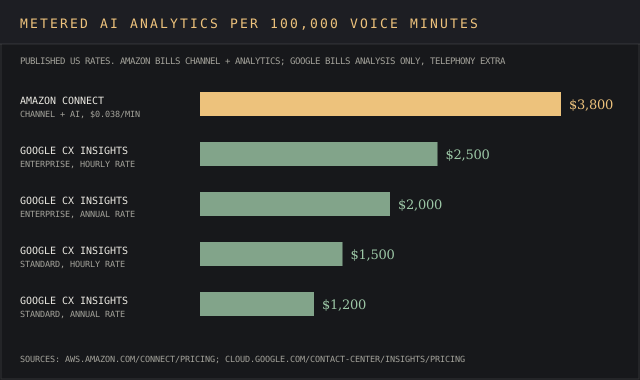
What 100,000 voice minutes a month cost at Amazon Connect’s rates, before telephony.
Pros
- Analytics included in the per-minute rate, with no tier to climb
- Real-time analysis on voice and chat documented in the admin guide
- Pay-per-use billing with no per-seat licence
Cons
- Documentation lists voice, chat and email as the analyzed channels, with surveys and reviews left to other tools
- Custom KPIs get built outside Amazon Connect, per a 2023 user
- Telephony is billed on top of the $0.038 rate
"After 3 years of use, we have more than 60% of the contacts automated and confirmed the resolution by the customer, and around 20% attended by an agent."
Héctor Morán Blázquez, Head of IT at Madrileña Red de Gas, on TrustRadius, 26 August 2023
The same review lists "Poor analytics, specific KPIs need to be developed out of Amazon Connect" under needs improvement.
Why it's ranked #3. Amazon beats Genesys on the first criterion: analytics sits inside a $0.038 per-minute rate at any volume, where Genesys gates it at a $155 seat. It loses to Qualtrics on signal sources.
Genesys Cloud CX
Best fit
Global omnichannel contact centers that want speech and text analytics, workforce management and quality tools from one published seat price.
Genesys publishes four tiers: CX 1 at $75, CX 2 at $115, CX 3 at $155 and CX 4 at $240 per user per month, billed annually. Speech and text analytics is token-based on CX 1 and CX 2 and included from CX 3. The platform transcribes interactions with native AI translation in over 70 languages.
Ownership is stable. Salesforce and ServiceNow invested $1.5 billion on 31 July 2025, while Hellman & Friedman and Permira remain the majority owners. Genesys reports more than 8,000 customer organizations in over 100 countries.
Key features
- Speech and text analytics with topic spotting, customer sentiment and agent empathy scoring on customer interactions
- Agent Copilot, sold through AI Experience tokens below CX 4
- Workforce management, forecasting and scheduling included in CX 3
- Social listening, predictive routing and predictive customer engagement as token add-ons
Pricing
Published per user per month on annual billing: $75, $115, $155 and $240. The cheapest tier with speech and text analytics included is CX 3 at $155, or $93,000 a year for 50 agents.
Pros
- Published prices on all four tiers
- 70+ transcription languages for multinational queues
- Majority owners unchanged, with $1.5 billion of fresh strategic capital
Cons
- Copilot and several AI features run on tokens until the $240 tier
- Stock dashboards push some teams toward Snowflake, per a 2026 G2 reviewer
- Speech and text analytics costs AI tokens at the $75 and $115 price points
"Standard out-of-the-box reporting and dashboard customization can feel rigid, often requiring custom API work or third-party tools like Snowflake."
Verified user in financial services, enterprise, on G2, 19 September 2026
Why it's ranked #4. Genesys beats NICE on the first criterion, including speech and text analytics at $155 a seat against NICE's $209. It loses to Amazon, whose $0.038 per-minute rate includes analytics with no seat tier at all.
NICE CXone Mpower
Best fit
Large service operations that want interaction analytics, quality management and workforce management from the same vendor and contract.
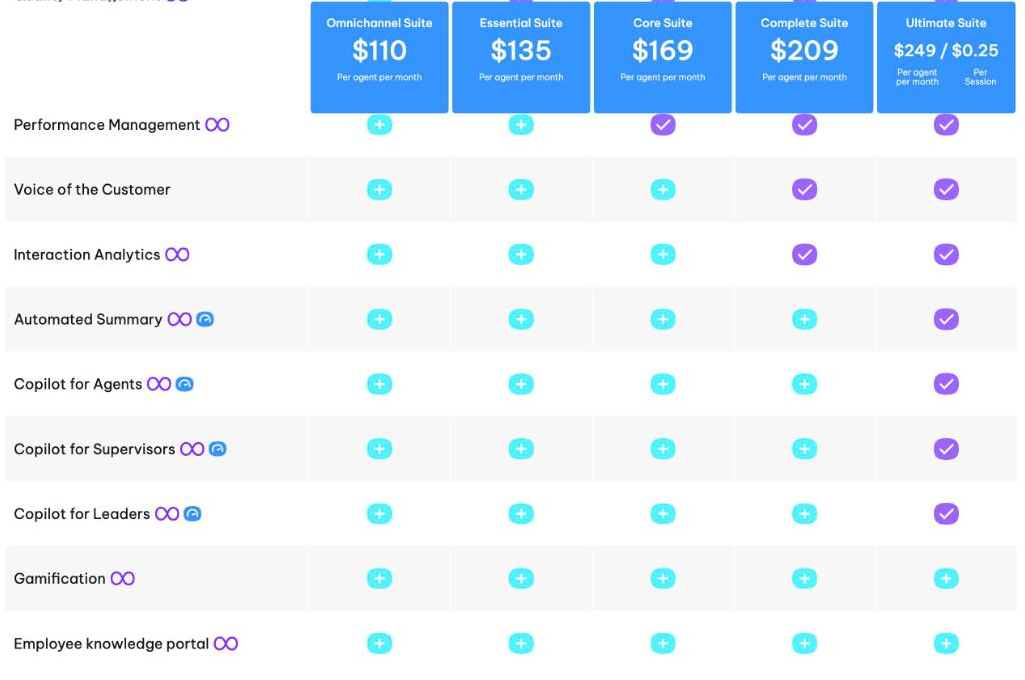
NICE says its Interaction Analytics delivers "AI-powered insights from 100% of interactions". Its rate card runs from $110 to $249 per agent per month, and Interaction Analytics plus Voice of the Customer are included only from the $209 Complete Suite. For analytics buyers, the $110 entry price is close but no cigar.
NICE bought conversational AI firm Cognigy in a deal valued at about $955 million, announced 28 July 2025. Cognigy brought AI agents available in over 100 languages, used by over 1,000 brands.
Key features
- Interaction Analytics across voice and digital customer interactions, included at Complete
- Automated Summary and Copilot for Agents, Supervisors and Leaders, included at Ultimate
- Bring your own transcription engine, included on every suite
- Cognigy AI agents and virtual assistants for self service, sold as add-ons
Pricing
Five published suites per agent per month: Omnichannel $110, Essential $135, Core $169, Complete $209 and Ultimate $249 plus $0.25 per session. For 50 agents, the first tier with analytics included costs $125,400 a year.
Pros
- Published prices for all five suites
- 100% interaction coverage claimed on the product page
- Quality, workforce and analytics tools from one vendor
Cons
- Analytics is an add-on on the three cheapest suites
- Copilot needs the $249 Ultimate Suite and a $0.25 per-session charge
- Reporting customization draws repeat complaints
A NICE user in health and wellness told G2 on 7 October 2024 that the "improved analytics and reporting" gave supervisors "better visibility into agent performance and customer interactions." Alex L., a real time analyst at an enterprise account, wrote on G2 on 28 September 2025 that "the reporting tools could offer more customization."
Why it's ranked #5. NICE beats Sprinklr on price visibility: five published suites from $110 against Sprinklr's quote-only model. It loses to Genesys, which includes analytics at $155 a seat where NICE needs $209.
Sprinklr Service
Best fit
Consumer brands where social media care carries real volume alongside phone and chat.
Sprinklr Service unifies interactions across 30+ voice, social and digital channels, including customer engagement on 25+ social channels, and adds conversational analytics and Agent Copilot on top. Gulf Bank cut its average first response time from 58 minutes to under 6, according to Sprinklr. Our Sprinklr review covers the full suite, and its listening side ranks in our social listening tools list.
Key features
- One queue for 30+ voice, social and digital channels
- Conversational Analytics over care interactions
- Sprinklr AI Agents and Agent Copilot
- Shared platform with Sprinklr Insights, Social and Marketing
Pricing
Sprinklr publishes no rate card for Service, and Vendr's Sprinklr page shows no median from tracked purchases. Budget for a sales-led quote; the ball is in Sprinklr's court on price.
Pros
- 25+ social channels in the same agent queue as voice
- Vendor-published case results with numbers attached
- Care, listening and marketing on one platform
Cons
- Price set in a sales-led quote, with no Vendr median to benchmark it
- A 2022 reviewer reported gaps in historical data pulls
- More platform than a voice-only center needs
Alagu Sathappan, IT Emerging Technology Manager at wasl group, wrote on TrustRadius on 9 February 2023 that Sprinklr's "advanced voice analytics capabilities have given us a deeper understanding of our customer's needs and preferences." An FMCG user on TrustRadius listed "Historical data sometimes not fetched" among the cons.
Why it's ranked #6. Sprinklr beats Talkdesk on signal sources, with 25+ social channels in one queue against Talkdesk's phone, chat and email. It loses to NICE, whose five suites carry published prices from $110.
Talkdesk
Best fit
Mid-size support teams that want a published seat price and AI help on live calls.
Talkdesk publishes four plans: Digital Essentials at $85, Voice Essentials at $105, Elite at $165 and Industry Experience Clouds at $225 per user per month. Its Interaction Analytics uses speech-to-text and natural language processing to find topics and sentiment across phone, chat and email, and Talkdesk says the British Columbia Lottery Corporation reached a CSAT of 90 after deployment.
Key features
- Interaction Analytics with mood insights explaining why sentiment shifted
- Talkdesk Copilot, which reads the conversation during the call and suggests relevant responses
- Quality Management that tracks service quality by selecting calls automatically by threshold
- Studio flow builder and Autopilot virtual agent
Pricing
Four published plans from $85 to $225 per user per month. Interaction Analytics isn't listed inside any plan's feature list, so expect it to turn up out of the blue on the quote as an add-on.
Pros
- Published per-user prices on all four plans
- Copilot keeps transcribing when a call's audio drops, per a 2026 G2 user
- Analytics spans voice and digital channels
Cons
- Analytics priced on request, outside the four published plans
- Custom dashboards take effort to build
- Bot configuration carries a 1,500-character limit
"Talkdesk's Quality Management system is fantastic - it automatically selects calls within a certain threshold and we've also found we can store 1-on-1 documents there to have all team members information in one place."
Verified user in banking, mid-market, on G2, 24 September 2026
Tyra S., a customer support supervisor, wrote on G2 on 26 June 2025: "I dislike having only 1500 characters to tell the chatbot everything she needs to be."
Why it's ranked #7. Talkdesk beats Zendesk with Interaction Analytics covering phone, chat and email from an $85 seat, where Zendesk puts sentiment triage in a quote-only Enterprise tier. It loses to Sprinklr's 25+ social channels.
Zendesk
Best fit
Ticket-first support teams that want automated quality scoring on every conversation their customer service agents, AI agents and outsourced staff handle.
Zendesk Suite costs $55 per agent per month on Team and $115 on Professional, paid yearly, with Intelligent Triage reserved for Enterprise. Zendesk QA, which came from the Klaus acquisition completed 12 February 2024, scores 100 percent of interactions, where Klaus' co-founder said most QA software reaches 5 percent, a drop in the bucket on a busy queue.
Key features
- AutoQA across all channels, including voice, BPOs and AI agents
- Out-of-the-box empathy, solution and tone categories plus custom prompt-based categories
- Intelligent Triage for intent and sentiment on Enterprise
- AI agents billed per automated resolution, with human support on escalation
Pricing
Suite Team $55 and Professional $115 per agent per month, yearly. Zendesk QA is an add-on for any Support or Suite plan, priced on request. AI agent resolutions cost $1.50 committed or $2.00 pay as you go.
Pros
- Lowest published entry seat on this page
- 100% QA coverage against the 5% manual sampling Klaus described
- Voicebot handoffs carry topic, sentiment and summary to the agent
Cons
- Zendesk QA is priced on request
- Sentiment-based triage needs the Enterprise tier
- AI sentiment reads can mislabel fast talkers as angry
"The AI summary occasionally gets the sentiment read wrong, flagged a customer as upset once when they were actually just talking fast and impatient about time, not angry about the actual issue, so the agent walked in expecting a harder conversation than it was."
Franklin T., Marketing Operations Manager, enterprise, reviewing Zendesk Contact Center on G2, 27 August 2026
Why it's ranked #8. Zendesk beats Verint on price visibility, with a published $55 seat against Verint's quote-only model and $49,451 Vendr median. It loses to Talkdesk, whose analytics covers voice without an Enterprise-tier gate.
Verint
Best fit
Regulated enterprises, banks and insurers above all, that mine recorded calls for compliance risk and call drivers.
Verint agreed on 25 August 2025 to be acquired by Thoma Bravo for $20.50 a share, about $2 billion, and said AI annual recurring revenue made up 50% of its total. Thoma Bravo completed the deal on 26 November 2025 and combined Verint with Calabrio. The jury's still out on how the two product lines merge.
More than 80 of the Fortune 100 are Verint customers, per the same release. Its speech and text analytics holds an 8.4 out of 10 on TrustRadius across 114 reviews and ratings, where 24% of recent reviewers raised transcription accuracy on specialized terminology.
Key features
- Verint Speech and Text Analytics with machine learning categories for call driver detection
- Key phrase identification that combines tone and words
- Intelligent virtual assistants on the Verint Open Platform
- Calabrio workforce engagement under the same owner
Pricing
No prices appear on Verint's site. Vendr's buyer data shows a median of $49,451 a year, low $18,858, high $231,780, the highest median on this page.
Pros
- Deep call-driver categorization for compliance teams
- Large enterprise base, 80+ of the Fortune 100
- Verint and Calabrio tools now sold by one owner
Cons
- Highest Vendr median here at $49,451
- One speech analyst reports a 100-category cap
- Owner changed in November 2025, with the Calabrio merger still settling
A Verint speech analyst handling a center of 3 million+ calls a year listed "Category limitations (100 current active/published category limit)" and "Transcription accuracy even after a LAC and boosting 500+ words" as cons on TrustRadius in June 2026. A director in finance at a 10,001+ employee firm wrote on TrustRadius that "it is particularly well suited to identify customers who are in financial hardship."
Why it's ranked #9. Verint beats InMoment on ownership, with one owner change since January 2025 against InMoment's two. It loses to Zendesk on price visibility: Zendesk publishes a $55 seat, Verint's median runs $49,451.
InMoment
Best fit
Existing InMoment customers deciding on a renewal under the platform's new owner.
InMoment says more than 3,000 brands use its XI Platform, which collects survey, contact center, social review, video and web session data. Its text analytics, from the Lexalytics acquisition, runs natively across 24 languages.
The ownership chain is two levels deep. Press Ganey Forsta acquired InMoment on 14 May 2025, and Qualtrics closed its purchase of Press Ganey Forsta a year later.
Hold your horses on a multi-year renewal until Qualtrics says where InMoment fits.
Key features
- Emotion and sentiment analysis with anomaly detection
- Conversational intelligence over contact center interactions
- AI Survey Builder
- Out-of-the-box connectors for Salesforce, Marketo and Zendesk
Pricing
InMoment sells on quote. Vendr's buyer data puts the median at $13,488 a year across 38 purchases, low $5,424, high $61,752.
Pros
- 24 native text analytics languages
- Vendr median close to Medallia's
- Survey, contact center, review and web data in one platform
Cons
- Two parent changes in 12 months
- Roadmap now sits inside Qualtrics' portfolio
- A Capterra reviewer called the dashboard too crowded to explain sentiment to owners
A verified consultant reviewing on Capterra on 5 January 2026 wrote that InMoment's "text analytics lets me gain insights from the unstructured data like long textual feedback." Jace H., a Sr. Project Manager, flagged "The lack of innovation" on the same site on 16 December 2024.
Why it's ranked #10. InMoment's $13,488 median rivals Medallia's, but two owner changes since May 2025 put it last. It loses to Verint, which changed hands once in that window.
What CX intelligence platforms do
CX intelligence is the practice of analyzing customer data from every place a customer talks to you, then routing what it finds to the team that can fix it. The platforms above do three jobs: they transcribe, they classify, and they alert.
Transcription turns calls into text. Classification runs natural language processing and machine learning over that text to tag topics, customer intent and customer sentiment, which is how a platform can understand customer intent at the scale of 3.5 billion interactions a year. Alerting pushes the result to a person, such as a supervisor while the call is live.
The useful part of AI in customer service analytics is aggregation. A complaint about a billing page shows up as a call, a chat, a one-star review and a survey comment, and only a platform that sees all four can count it once; spread across four tools, it's a needle in a haystack. That's how teams find friction points in the customer journey, trace the root causes behind customer behavior and see which customer needs go unmet.
Predictive analytics is the next layer of customer experience AI. Zendesk's QA product flags churn risk alongside sentiment patterns and outliers, which lets a team spot changing customer needs, move from reactive to proactive service and call an at-risk account before it leaves, where customer lifetime value is won or lost. Sharing that signal across support, product and marketing keeps every team on the same page about why customers churn.
Customer context is the second payoff, and it changes the customer experience on the next call. When an agent opens a contact and sees the customer history, recent customer requests and the sentiment of the previous call, the conversation starts where the last one ended. Analyzing customer data this way is also how teams understand customer behavior over months, beyond a single ticket.
AI in customer experience: what the numbers show
AI in customer service has the best published evidence of any AI use case. A study of 5,179 support agents found AI assistance raised productivity by 14% on average, measured as issues resolved per hour, with the biggest gains among newer agents. That's the clearest measure of agent productivity anyone has published, and the reason AI tools for agents get bought before AI for customers.
IBM's Institute for Business Value reported in March 2025 that mature AI adopters saw 17% higher customer satisfaction and 38% lower average inbound call handling time, per IBM's summary of the study. Those are self-reported figures from companies already invested in AI tools, so read them as a ceiling for improving customer satisfaction.
Demand is rising on both sides. Salesforce's State of Service research found 82% of service pros say customer demands have increased, and 81% of service professionals say customer expectations for a personal touch are higher than ever. Customers expect fast answers and a human touch at the same time.
Zendesk's CX Trends research found 67 percent of consumers expect more personalized service now that AI can analyze their past interactions. Customer preferences from earlier conversations, order history included, let a platform anticipate customer needs, suggest personalized offers and feed personalized interactions, personalized service and personalized support on the next contact. Personalized interactions at that scale are the part customers notice.
Personalization is where the money shows up. McKinsey found that personalization most often drives a 10 to 15 percent revenue lift, and a second McKinsey study found that companies that excel at CX achieved more than double the revenue growth of CX laggards between 2016 and 2021.
Key benefits of AI in customer service
The gains of AI in customer service split into four buckets, and each one maps to a feature on the ranked list.
- Automating routine tasks: AI agents and virtual assistants answer routine inquiries and customer inquiries such as order status, with Zendesk billing $1.50 to $2.00 per automated resolution
- Faster, more accurate answers and higher agent productivity: agent copilots search the knowledge base and surface relevant resources and accurate responses during the call, the job of Genesys Agent Copilot and NICE Copilot for Agents
- Consistent service at full coverage: AutoQA scores 100% of customer conversations, where Klaus said most QA software scores up to 5 percent
- Lower operational costs: IBM's 38% cut in handling time for mature adopters is a cost saving that shows up directly in staffing and wait times
Customer service strategies built on these automation features still keep human customer service teams in the loop. AI handles customer queries and customer inquiries in parallel, while human agents take complex issues and emotional calls where human interaction matters.
Generative AI and AI agents in contact centers
Generative AI changed what AI systems do on a contact. Earlier AI powered systems handled intelligent routing and spotted keywords; conversational AI now drafts summaries, writes replies and runs AI agents that take routine tasks and customer requests end to end. Amazon now lists post-contact summaries inside its $0.038 voice rate.
AI technology pricing changed with it. Generative AI features now bill in units older AI systems never used:
- Genesys sells AI Experience tokens
- NICE charges $0.25 per session on Ultimate
- Zendesk bills $1.50 per automated resolution
AI models built on machine learning are only as good as their transcripts. A misheard product name produces a wrong category and a wrong answer, and a vendor that cuts corners on transcription can't fix it downstream, which is why 24% of recent Verint reviewers raised transcription accuracy. Implementing AI starts with testing the transcript, and AI technology that can't hear your jargon can't meet customers' expectations.
The deployment pattern that works keeps human agents on escalation and human oversight on the bot, including agentic AI that acts on its own. The Amazon Connect customer quoted above automated more than 60% of contacts and kept around 20% for human support, and the customer service operations around that split decide how businesses interact with customers when the bot runs out of answers.
Customer experience AI pricing: three models
Customer experience AI prices three ways, and they don't convert into each other cleanly. Interaction-based platforms (Medallia, Qualtrics, InMoment) bill on data records. Seat-based customer service solutions (Genesys, NICE, Talkdesk, Zendesk) bill per agent per month. Metered clouds (Amazon Connect, Google) bill per minute or per message.
Here's one scenario, 50 agents for 12 months on the cheapest tier with analytics included:
- Genesys CX 3 comes to $93,000
- NICE Complete comes to $125,400
- Talkdesk Elite comes to $99,000 before an analytics add-on
- Zendesk Professional comes to $69,000 before the QA add-on
Metered pricing moves with volume. Amazon Connect charges $3,800 per 100,000 voice minutes including analytics, before telephony. Google's Customer Experience Insights charges $0.012 to $0.025 per voice minute for analysis alone, and its Quality AI runs $50 per named agent a month for up to 2,000 conversations.
Interaction-based contracts hide the scale until the quote arrives. Vendr's medians run from $13,338 for Medallia to $49,451 for Verint, and the highs reach $231,780.
Renewals are the bitter pill to swallow: Duke's Qualtrics renewal came in at 2.5 times its 2023 license cost.
How to run an evaluation before implementing AI
BCG's rule of thumb for AI in customer experience and every other AI program puts 10% of the effort on algorithms, 20% on technology and data, and 70% on people and processes. The software is the smallest line, and people and processes take the lion's share. Plan the evaluation around the 70%.
- Export 500 recorded calls with your own product names and jargon, and score each vendor's transcripts word by word.
- Ask for the category or topic limit in writing; one Verint user reports a 100-category cap.
- Confirm which tier includes analytics, using the vendor's own pricing page, and list the AI powered tools that run on tokens or add-ons.
- Test real-time sentiment analysis and alerts on a live queue for one week, with your own AI tools switched off.
- Get the renewal cap in the contract before signing year one.
The devil's in the details on step one. Transcription accuracy on specialized terminology was the top complaint in 24% of recent Verint reviews, and a model that mishears your product name will mis-tag every call that mentions it.
Market consolidation in CX intelligence
Seven deals reshaped the AI in customer experience market in 30 months:
- Zendesk bought Klaus in February 2024.
- Press Ganey Forsta bought InMoment in May 2025.
- Genesys took $1.5 billion from Salesforce and ServiceNow in July 2025.
- NICE agreed to buy Cognigy for about $955 million the same month.
- Thoma Bravo closed Verint in November 2025 and merged it with Calabrio.
- Qualtrics closed Press Ganey Forsta, and with it InMoment, in May 2026.
- Medallia's lenders took control in August 2026.
A buyer signing a three-year term today should ask who will own the vendor at renewal, and nip that risk in the bud with a change-of-control clause and predictive analytics exports written into the exit terms.
Customer experience intelligence FAQ
How is AI used in customer experience?
Artificial intelligence in customer experience transcribes calls, tags customer sentiment and customer intent, drafts suggested responses for agents, and runs AI agents and chatbots that resolve routine tasks without a human. That's AI in customer service at its most visible. Amazon, Genesys and NICE all sell real-time agent assistance that reads the live conversation.
Is AI replacing customer service?
AI in customer service is taking routine inquiries and customer queries, and human agents keep complex issues. The Amazon Connect deployment quoted above automated more than 60% of contacts and still routed around 20% to agents.
Will AI eventually replace call center agents?
The published evidence on AI customer service points to assistance. The NBER study measured a 14% productivity gain for agents working with AI, and Zendesk now bills AI agents per automated resolution at $1.50 to $2.00 while selling seats for the humans who handle escalations.
What are the 5 key CX metrics?
Customer satisfaction (CSAT), Net Promoter Score (NPS), customer effort score (CES), first contact resolution and average handle time. CX platforms add a sixth input: sentiment analysis across every interaction, beyond the survey sample.
How is CX different from CRM?
A CRM stores customer data: who the customer is, their purchase history and their customer history. CX intelligence measures how the customer felt about each interaction and why. Most platforms here feed CRM systems such as Salesforce.
What is the 10/20/70 rule for AI?
It's BCG's guideline that AI programs spend 10% of effort on algorithms, 20% on technology and data, and 70% on people and processes.
Bottom line
Medallia wins for customer experience teams that want speech, text and acoustic analytics inside one EDR price at a $13,338 median. Qualtrics wins on breadth for enterprises that can negotiate a renewal hard. Amazon Connect wins for AWS shops that want analytics metered by the minute.
Genesys and NICE fit large contact centers that want AI customer experience analytics bundled with workforce tools; Genesys gets there $54 a seat cheaper. Sprinklr suits social-heavy care. Talkdesk and Zendesk are the published-price AI customer service picks for mid-size teams, and Verint and InMoment both make sense mainly for customers already under contract.