Chatbot statistics 2026: 49% of U.S. adults use AI chatbots, up from 33% in 2024
 By Jan Suski. I go deep on every review, checking every number against its source and digging up details other coverage misses, a habit from six years of SEO and link building for tech companies. Bylines at Surfer, Brand24, and Senuto. How the scoring works.
The numbers US and global chatbot use, market and customer service, checked 4 October 2026
Chatbot usage among U.S. adults grew 16 points in two years on Pew's measure, while Gartner finds company chatbot use among customers statistically unchanged since 2022.
ChatGPT still takes the lion's share of AI chatbot traffic at about 53%, and Gemini rose from under 9% to 27-28% in eleven months.
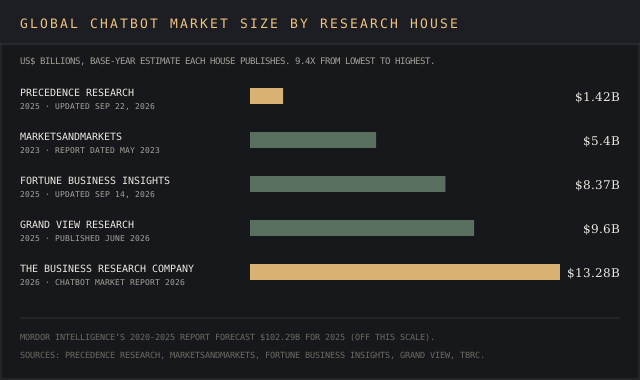
The 9.4x spread in chatbot market estimates comes from base years and growth assumptions, so a market figure needs its house named next to it.
Half of American adults now use AI chatbots. Pew Research Center surveyed 5,119 U.S. adults from February 17 to 23, 2026 and found 49% use them, up from a third in 2024, with 24% using a chatbot every day.
Chatbots run by businesses haven't kept pace. In a Gartner survey of 3,566 customers published September 2, 2026, 7% used a chatbot in their most recent customer service interaction, though 49% of customers said they'd have used one if offered.
This report collects chatbot statistics for 2026 on usage, platform share, market size, business adoption, customer support, banking & e-commerce. It's written for businesses budgeting for AI chatbots, customer service leaders weighing human agents against automation, and analysts sizing the chatbot market.
Chatbot usage statistics: 49% of U.S. adults use AI chatbots
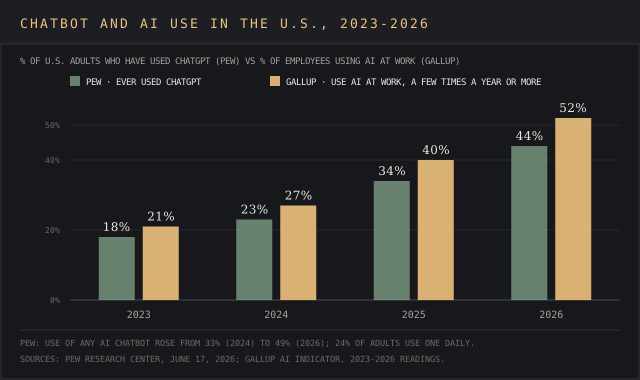
Pew's chatbot usage statistics track a 16-point rise in chatbot adoption in two years. Use of AI chatbots rose from about one in three adults in summer 2024 to 49% in February 2026. Pew's longer series on ChatGPT alone ran 18% in 2023, 23% in 2024, 34% in 2025 and 44% in 2026.
24% of U.S. adults use chatbots daily, including 12% several times a day and 4% almost constantly. Another 25% use them several times a week or less.
Age splits usage. 57% of adults under 50 use AI chatbots, against 28% of those 50 and older.
What people use AI chatbots for
Information search leads, and work comes second.
| Task | Share of U.S. adults |
|---|---|
| Searching for information | 42% |
| Tasks at work (employed adults only) | 38% |
| Fun | 25% |
| Creating or editing images and video | 24% |
| Medical advice | 20% |
| Diet and fitness information | 20% |
| Getting news | 13% |
| Emotional support | 10% |
| Companionship | 4% |
Source: Pew Research Center chatbot usage statistics, survey of 5,119 U.S. adults, February 17-23, 2026.
One in five adults asks a chatbot for medical advice. Chatbot technology reaches everyday life even for people who never open a chat window: 60% of adults read the AI summaries on search results. Only 30% say using chatbots helps how productive they are, so read between the lines of any vendor's productivity claim.
Chatbot usage statistics at work: 52% of employees use AI
Gallup's workplace series climbed from 21% in 2023 to 27% in 2024, 40% in 2025 and 52% in May 2026. 30% use it frequently and 15% use it every day.
65% of employees say AI has a positive effect on their productivity, and 47% say their organization has integrated AI. But on Gallup's question about AI's power to transform business operations, 14% strongly agree that AI has transformed how work gets done in their organization.
AI adoption at work depends on the industry. Daily use runs 42% among technology workers, 27% in finance and 22% in professional services. For the wider AI market, the AI statistics report tracks spending, jobs and revenue.
ChatGPT holds 53% of AI chatbot traffic as Gemini reaches 27%
Among general-purpose digital assistants and conversational AI apps, ChatGPT is still the most popular chatbot by a wide margin. Sam Altman told the OpenAI DevDay audience on September 29, 2026 that ChatGPT has 1.2 billion weekly users, per Engadget's live coverage. Google said on August 11, 2026 that the Gemini app passed 1 billion monthly users.
Pew measured which digital assistants adults use.
| Chatbot | Owner | Share of U.S. adults who use it |
|---|---|---|
| ChatGPT | OpenAI | 44% |
| Google Gemini | 24% | |
| Microsoft Copilot | Microsoft | 17% |
| Meta AI | Meta | 14% |
| Grok | xAI | 8% |
| Claude | Anthropic | 6% |
| Character.ai | Character.ai | 3% |
Source: Pew Research Center, June 17, 2026.
Traffic data shows ChatGPT losing ground to Google. Similarweb tracked these shares of generative AI website visits from June 2025 to May 2026:
- ChatGPT: about 76% to roughly 53%
- Gemini: under 9% to 27-28%
- Claude: about 2% to close to 9%
The category's rapid growth continued: Similarweb counted 9.5 billion average monthly visits to generative AI sites (+70%). More in the AI traffic report and the Similarweb review.
On model quality the jury's still out, because rankings change month to month. The Arena text leaderboard ranks large language models from 8.6 million user votes, and it had a preliminary Gemini model from Google at the top with a score of 1525 on October 2, 2026. Citation share is tested in the Reddit AI visibility study.
Chatbot market size: $1.42 billion to $13.28 billion, depending on the house
Market-size chatbot statistics vary by house. The global chatbot market is worth $9.6 billion in 2025 and $11.8 billion in 2026, according to Grand View Research's chatbot market report, published June 2026. The market is projected to reach $41.2 billion by 2033 at a 19.6% annual growth rate.
Grand View's segmentation shows where chatbot revenue comes from:
- Component: conversational AI software (solutions) holds 61.8% of revenue, with services the rest.
- Vertical: retail & e-commerce is the largest.
- Application: customer service is the largest.
- Business function: sales & marketing is the largest.
Two other current houses forecast faster market growth. Fortune Business Insights puts the chatbot market at $8.37 billion in 2025 and $10.42 billion in 2026, reaching $60.21 billion by 2034 at 24.51% a year. The Business Research Company (TBRC) starts its Chatbot Market Report 2026 at $13.28 billion in 2026 and reaches $37.53 billion by 2030 at 29.7%.
The low estimate comes from Precedence Research, updated September 22, 2026: $1.42 billion in 2025, $1.70 billion in 2026 and $7.96 billion by 2035 at 18.81% a year.
Precedence defines a chatbot as a program that uses artificial intelligence and natural language processing to understand customer inquiries and automate responses. It sizes the U.S. chatbot market at $407.54 million in 2025 and gives bots for service 36% of revenue. Every house forecasts rapid market growth from a different base.
Why the published chatbot market estimates diverge
Sizing is where chatbot statistics disagree most. Six houses publish a global figure, and the devil's in the details of when each one measured and what it assumed.
| House | Base year value | Forecast | CAGR | Edition |
|---|---|---|---|---|
| Precedence Research | $1.42B (2025) | $7.96B (2035) | 18.81% | Updated Sept. 22, 2026 |
| MarketsandMarkets | $5.4B (2023) | $15.5B (2028) | 23.3% | Report TC 4647, May 2023 |
| Fortune Business Insights | $8.37B (2025) | $60.21B (2034) | 24.51% | Updated Sept. 14, 2026 |
| Grand View Research | $9.6B (2025) | $41.2B (2033) | 19.6% | June 2026 |
| The Business Research Company | $13.28B (2026) | $37.53B (2030) | 29.7% | 2026 edition |
| Mordor Intelligence | $17.17B (2019) | $102.29B (2025) | 34.75% | 2020-2025 forecast |
Four causes account for most of the gap:
- Edition age. MarketsandMarkets' live page is a May 2023 report that sizes 2023 at $5.4 billion. Mordor Intelligence's page still carries a 2020-2025 forecast that expected $102.29 billion for 2025, 10.7 times the highest 2025 figure any house publishes now.
- Growth assumptions. CAGRs run from 18.81% at Precedence to 29.7% at TBRC. Over four years, 18.81% multiplies a base 1.99 times and 29.7% multiplies it 2.83 times.
- Forecast horizon. Headline forecasts end anywhere from 2028 to 2035, so the end-year figures answer five different questions.
- Regional splits. North America is 31.3% at Grand View, 39.55% at Fortune and about 41% at Precedence, a spread that's par for the course. Fortune's own regional box reads USD 156.7 million for North America, against the $3.31 billion its 39.55% share of $8.37 billion implies.
For 2026, Fortune, Grand View and TBRC land between $10.42 billion and $13.28 billion, and Precedence sits at $1.70 billion. Quoting one house's figure alone puts all your eggs in one basket; check its base year and horizon, and cite the house with the number.
Chatbot adoption by businesses: 19.8% of U.S. businesses use AI
Businesses adopt AI chatbots slower than consumers do. The U.S. Census Bureau's Business Trends and Outlook Survey found 19.8% of U.S. businesses using AI as of May 3, 2026.
Chatbot adoption among U.S. businesses tracks size and sector:
- Businesses with 250 or more employees: 37%
- Information sector businesses: 39.7%
- Finance and insurance businesses: 33.9%
Surveys of executives at businesses worldwide report far higher use. In McKinsey's State of AI 2026 survey of 1,719 respondents, published August 25, 2026, nearly nine in ten report regular use of AI in at least one function, and 56% use it in three or more. The small business statistics report covers the firms behind the Census average.
Sales, marketing and lead generation
Sales & marketing is the largest business function for AI chatbots in Grand View's split, and lead generation is where AI agents show measurable volume. Siemens uses an AI agent to work through 2,800 unqualified inbound leads a week, per Salesforce's Agentic Enterprise Index, its agentic AI usage data from February 2025 to April 2026.
Intercom prices lead qualification by its Fin agent at $9.99 per outcome on its pricing page. Businesses buying for client interactions on calls compare conversation intelligence software.
Customer service chatbot statistics: 49% would use one, 7% did
Gartner's chatbot statistics from its September 2026 study of 3,566 B2B and B2C customers, fielded February to March 2026, measure the gap between willingness and use:
- 49% of customers would have used a chatbot if one had been offered.
- 7% of customers used a chatbot in their most recent service interaction.
- 27% of customers would try a chatbot again after a negative experience.
- 87% of customers say access to a human is essential.
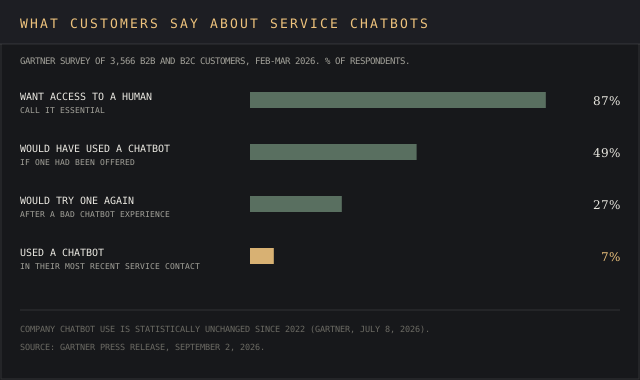
Once bitten, twice shy: after a bad chatbot experience, 27% of customers would try a chatbot again and the other 73% wouldn't commit to trying one again, so customer satisfaction with the first chatbot decides the channel's future.
A July 8, 2026 Gartner release found customers three times more likely to turn to third-party GenAI, the digital assistants they already use, than to company self-service chatbots. Company chatbot use is statistically unchanged since 2022, while third-party use nearly doubled in a year.
B2B customers are ahead of the curve with those AI assistants. 58% of customers who used GenAI had the tool complete a service task for them, and 74% of B2B users did.
Spending is rising anyway. In a survey of 199 customer service leaders, AI spending in customer support rose 38% while the function's budget rose 2%, and leaders expect generative AI chatbots to be their most valuable channel within two years. Service functions put a median 12% of their 2025 budget into AI, yet 24% show positive financial returns. Gartner found in February 2026 that 91% of service leaders are under executive pressure to implement AI.
Resolution rates and response time
Resolution rate is the customer experience number chatbot vendors publish, so read it as a vendor claim. Intercom puts its Fin agent's average self-service resolution success rate at 76% across 12,000+ customers, at 2 million resolutions a week, and its site says Fin answers customers in dozens of languages, 24 hours a day, every day. That's 24/7 support outside business hours, in multiple languages.
Salesforce's index found AI agents solved 7 in 10 customer interactions in service chat without a human. At Pandora, an agent handles 60% of routine requests, and the jeweler's net promoter score, its customer satisfaction measure, rose 10%. Chatbots excel at the routine tasks, repetitive questions and common inquiries customers send most:
- Order status and order tracking ("where is my order")
- Account inquiries
- Client inquiries outside business hours that need instant responses
Response time drives customer satisfaction with self-service. Deloitte's banking survey found 78% of chatbot fans cite quick responses and 69% cite help with simple queries.
What a chatbot resolution costs
Conversational AI and chatbot vendors now price per resolution, so businesses can measure the cost of answering customers with AI chatbots against support tickets. Published rate cards on October 4, 2026:
| Conversational AI product | Billing unit | Published price |
|---|---|---|
| Intercom Fin | Per resolved outcome, 50 outcomes a month minimum | $0.99 |
| Intercom Fin lead qualification | Per qualified lead outcome | $9.99 |
| Intercom Copilot | Per agent seat, monthly | $35 |
| Salesforce Agentforce | Per customer conversation | $2 |
| Salesforce Flex Credits | Per standard action (20 credits) | $0.10 |
| Salesforce Flex Credits | Order-status request (40 credits) | $0.20 |
All six prices are vendor list prices read off the Intercom and Salesforce pricing pages; none is a Vendr median.
Flex Credits sell at $500 per 100,000 credits and bill each agent action, the unit of workflow automation in Agentforce.
Per chatbot interaction in customer support, list prices run from $0.99 per resolved outcome at Intercom to $2 per conversation at Salesforce.
These prices are why businesses expect chatbots to reduce customer support costs and operational costs. Lower operational costs are easier said than done: Gartner's 24% positive-return figure says most service teams haven't converted the rate card into reduced costs yet. Seat-based contact center pricing for human support runs per agent, covered in call center software pricing and CRM software cost.
Human agents still handle complex issues
AI is changing human agents' jobs at the businesses Gartner surveys. Gartner surveyed 321 service leaders in late 2025:
- 85% are adding tasks to human agents' roles.
- 75% are moving agents into new roles.
- 63% are reducing headcount through attrition.
- 31% have implemented or plan layoffs through the first quarter of 2027.
Customers want human oversight on complex issues. In Gartner's survey of 5,801 U.S. customers, 54% trust humans more than AI, against 32% who trust AI more, a customer experience gap chatbots haven't closed.
84% of service leaders plan new agent skills, and over half (58%) will upskill agents into knowledge management. Disputes and exceptions require human judgment, so customer care and customer support teams keep human intervention one click away. That handoff is the core of any customer experience strategy built on chatbots.
Users on Hacker News split the same way. One commenter wrote on August 21, 2025:
"I've had a software bug escalated to the appropriate team within a couple of minutes. And all these interactions were probably 10x faster, at least, than they would have been with a human."
crazygringo, Hacker News, August 21, 2025
Another, whose project replaced tier-1 reps with a chatbot, recalled asking at the kickoff, on June 26, 2026:
"if you get rid of tier 1 & 2 reps, how are you going to train up the tier 3 reps who know enough about how things work to handle these most-complicated problems?"
kjs3, Hacker News, June 26, 2026
Banking chatbot statistics
Bank of America's Erica digital assistant had 20.6 million users and nearly 700 million interactions in 2025, and more than 3.2 billion since its 2018 launch, the bank said in a March 10, 2026 release.
Deloitte surveyed 2,027 U.S. bank customers in January 2025, and 37% had never used a banking chatbot. Customers use chatbots for technical support (60%) and existing-account inquiries (53%). 74% of bank customers still prefer a human for routine queries, and 57% want better accuracy, so digital assistants in banking have a trust gap to close.
Ecommerce chatbot statistics: AI traffic to retail sites rose 693.4%
Shoppers took AI chatbots into e-commerce during the 2025 holidays. U.S. consumers spent $257.8 billion online from November 1 to December 31, up 6.8%, while traffic to retail sites from generative AI tools rose 693.4% and AI traffic on Cyber Monday rose 670%, Adobe reported.
Adobe's 2026 holiday forecast calls for $275.1 billion online (+6.7%) and AI traffic up 130%:
- Thanksgiving: +159%
- Black Friday: +95%
- Cyber Monday: +88%
Many consumers say AI shopping help pays off. In Adobe's July 2026 survey of 5,000 consumers, 77% of customers who used AI for online shopping felt more confident in their purchase and 69% were less likely to return the item, a customer experience gain retailers can count. Adobe also logged the first uptick in consumers using AI-powered chat for online shopping, from finding deals to locating products.
Amazon's Rufus chatbot shows what digital assistants do to conversion. Andy Jassy said on the Q4 2025 earnings call on February 5, 2026 that more than 300 million customers used Rufus in 2025, and customers who use Rufus are about 60% more likely to complete a purchase. Retail businesses using AI agents saw holiday sales grow at a rate four times higher than those without, Salesforce found.
The research houses agree e-commerce businesses are the top vertical for conversational AI: 21% of revenue at Precedence, and the largest vertical at Grand View. Consumer preferences shift by category, so ecommerce chatbot statistics are worth checking against store data with ecommerce analytics tools and the retail industry statistics.
Attitudes toward AI chatbots: 63% of Americans say AI moves too fast
Usage and comfort don't move together. 63% of U.S. adults told Pew that AI is advancing too quickly, in the same survey where 49% use AI chatbots.
Gen Z users of AI chatbots are souring. Gallup and the Walton Family Foundation surveyed 1,572 Americans aged 14 to 29 from February 24 to March 4, 2026, and Gallup reported on April 8 that 51% use AI daily (22%) or weekly (29%). Their feelings shifted in a year:
- Anxious: 42%, unchanged
- Angry: 31%, up 9 points
- Excited: 22%, down 14 points
- Hopeful: 18%, down 9 points
Talk is cheap in vendor decks, so keep an eye on the surveys: these AI chatbot statistics show chatbot adoption outpacing comfort with AI tools, a gap businesses have to plan around.
Where each chatbot figure comes from, and which estimates are out of date
Usage and attitudes: pewresearch.org (17 June 2026, survey fielded 17 to 23 February 2026), gallup.com and news.gallup.com (workplace AI indicator, May 2026; Gen Z survey, 8 April 2026), census.gov (Business Trends and Outlook Survey, May 2026) and mckinsey.com (State of AI, 25 August 2026).
Platforms and traffic: engadget.com (OpenAI DevDay coverage, 29 September 2026), blog.google (11 August 2026), aisearch.similarweb.com and arena.ai (text leaderboard, 2 October 2026).
Market size: precedenceresearch.com (updated 22 September 2026), fortunebusinessinsights.com (updated 14 September 2026), grandviewresearch.com (June 2026), thebusinessresearchcompany.com (2026 edition), marketsandmarkets.com (May 2023) and mordorintelligence.com (2020-2025 forecast).
Customer service and vendors: gartner.com (releases of 18 February, 28 April, 8 July, 26 August and 2 September 2026), salesforce.com (Agentic Enterprise Index and Agentforce pricing), fin.ai (Intercom Fin site and pricing), news.ycombinator.com (21 August 2025 and 26 June 2026).
Banking and ecommerce: newsroom.bankofamerica.com (10 March 2026), deloitte.com (survey of January 2025), news.adobe.com (7 January 2026 and the 2026 holiday forecast) and fool.com (Amazon Q4 2025 call transcript, 5 February 2026).
Every figure was checked against its source on 4 October 2026. MarketsandMarkets' live page dates from May 2023 and Mordor Intelligence's still carries a 2020-2025 forecast, so neither house publishes a current base year. The resolution rates on this page are Intercom's and Salesforce's own measurements of their own products.
Frequently asked questions
What percentage of people use chatbots?
49% of U.S. adults use AI chatbots and 24% use a chatbot daily, per Pew's chatbot statistics from February 2026.
Is ChatGPT losing market share?
Yes, in web traffic: from about 76% of generative AI visits in June 2025 to roughly 53% in May 2026, per Similarweb.
What is the current market share of AI chatbots?
In May 2026, ChatGPT had about 53% of generative AI web visits, Gemini 27-28% and Claude close to 9%, per Similarweb.
Which is the smartest chatbot?
On the Arena text leaderboard of October 2, 2026, a preliminary Google Gemini model ranked first at 1525.
Where does Copilot rank in AI?
Third: 17% of U.S. adults use Microsoft Copilot, behind ChatGPT at 44% and Gemini at 24%, per Pew.
Why is Gen Z against AI?
31% of Americans aged 14 to 29 feel angry about AI, up 9 points in a year, and excitement fell 14 points to 22%, per Gallup's 2026 survey.
Bottom line
These chatbot statistics describe two markets. Consumer AI chatbots reached half of U.S. adults by 2026, and customers already ask those general digital assistants their service questions.
Company chatbots sit far behind, used by 7% of customers in their last service contact. Estimates of the market range 9.4x, so businesses should quote the house with every figure. Per-resolution prices make the support case easy to model, and Gartner's 24% positive-return rate shows how few businesses have closed it.