AI environmental impact statistics 2026: 485 TWh, and Google's water use up 34%
 By Jan Suski. I go deep on every review, checking every number against its source and digging up details other coverage misses, a habit from six years of SEO and link building for tech companies. Bylines at Surfer, Brand24, and Senuto. How the scoring works.
Data centers used 485 TWh of electricity in 2025, up 17%, and those built for artificial intelligence grew 50%, the International Energy Agency (IEA) reported in April 2026. Google's water consumption rose 34% to 10.9 billion gallons. Energy usage per AI task, meanwhile, falls at least 10 times a year.
These figures on generative AI's environmental impact, and the wider environmental impacts of data centers, come from 2026 reports by the IEA, UN University, two forecasters of US demand, three cloud providers and two state governments. Older numbers still in circulation sit beside the figures that replaced them, with data source attribution for each. User and revenue counts sit in our AI statistics report.
The numbers data center energy, water, carbon and e-waste, 2025 and 2026, checked 30 September 2026
Efficiency and totals move apart, with energy per AI task falling at least 10 times a year while electricity use by data centers grew 17%.
Power plants hold most of the water, 211 of the 228 billion gallons US data centers used in 2023 (93%, our calculation).
Data centers in the AI boom: 485 TWh in 2025, 950 TWh by 2030
The IEA expects electricity demand from data centers to reach about 950 TWh by 2030, roughly 3% of world demand, with use at AI-focused data centers tripling.
Generative AI changes the load per building, whatever the use case, from chatbots to market research. An MIT News explainer on the explosive growth of generative AI reported in January 2025 that a generative AI training cluster might consume seven or eight times more energy than a typical computing workload.
The explainer drew on Noman Bashir, a Computing and Climate Impact Fellow at the MIT Climate and Sustainability Consortium, and defined a data center as "a temperature-controlled building that houses computing infrastructure," from servers to network equipment.
AI server power density rose 11 times from 2020 to 2025. And 90% of AI-specialised computing power sits in 2 countries, which puts all the eggs in one basket and leaves a few grids and rivers carrying the load.
"More efficient and affordable AI and energy mean more consumption of AI, making the overall footprint far bigger than what we save through efficiency gains."
Kaveh Madani, Director, UNU-INWEH, on the rebound effect, 3 June 2026
Why the IEA, UNU, LBNL and BNEF forecasts for data centers disagree
Four publishers released 2026 numbers for data centers, and they split on scope, base year and method. Buyers of energy market intelligence will see 2030 carry four figures.
| Forecaster | Scope | Latest year | 2030 | Beyond 2030 |
|---|---|---|---|---|
| IEA | Global | 485 TWh (2025) | 950 TWh | 350 MtCO2 a year by 2035 |
| UNU-INWEH | Global | 448 TWh (2025) | 945 TWh | n/a |
| LBNL | US | About 4.5% of US power | 649 TWh (521 to 843) | n/a |
| BloombergNEF | US | 5.9% of US power | n/a | 194 GW, 20% of US power by 2035 |
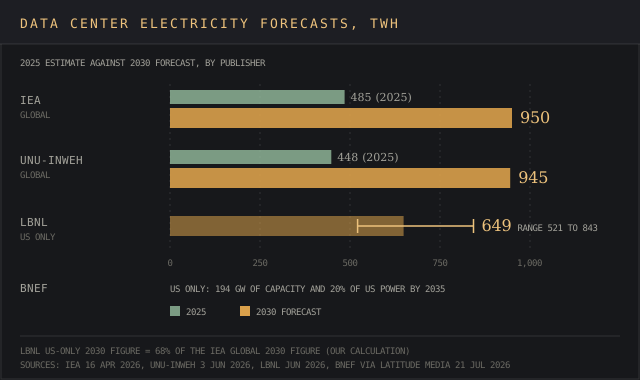
The IEA, which models national energy systems, put 2025 at 485 TWh. UNU's 448 TWh is 37 TWh lower (our calculation), and its 945 TWh for 2030 matches the IEA's 2025 Energy and AI report. Our reading is that UNU sits on that older path.
Lawrence Berkeley National Laboratory (LBNL) puts US data centers at 649 TWh in 2030, 68% of the IEA's global figure (our calculation), built bottom-up from planned equipment shipments with a 521 to 843 TWh range.
BloombergNEF went back to the drawing board in July, raising its 2035 forecast 83% to 194 GW, and puts today's US share at 5.9%.
Data center water consumption: 228 billion gallons, 93% of it at power plants
US data centers used about 228 billion gallons of water in 2023, LBNL scientists estimate. About 17 billion gallons cooled servers inside data centers, and power generation took 211 billion. The total could reach 469 billion to 844 billion gallons by 2028, depending on the mix of energy sources feeding the electric grid.
Company figures cover on-site water consumption. AWS reports 0.12 litres per kWh, a seventh of the 0.84 industry average it cites (our calculation), and Microsoft 0.27 L/kWh. Most data centers report water usage only inside company totals, leaving little public data per site.
A medium-sized data center uses roughly 110 million gallons of water a year for cooling purposes, Fortune reported, or about 301,000 gallons a day (our calculation).
A December 2025 Patterns paper by Alex de Vries-Gao put the water usage of artificial intelligence systems at 312.5 to 764.6 billion litres in 2025. A 2023 paper co-written by UC Riverside's Shaolei Ren estimated that training GPT-3 could evaporate 700,000 litres of fresh water.
Location decides the environmental impacts on water supplies and natural ecosystems. Ceres found 66% of the water-based power serving data centers in 7 states comes from medium-high to extreme water-stress areas.
GeekWire, citing a 2025 Bloomberg analysis, reports that nearly two-thirds of US data centers built or planned in the prior three years sit in water-stressed areas, a red flag for local utilities.
In Northern Virginia, data centers took 9% of consumptive use of the Potomac's water resources around Washington in 2025, up to 12% in summer, per the Interstate Commission on the Potomac River Basin. Peaks hit harder. UC Riverside and Caltech estimate US data centers will need 697 million to 1.45 billion gallons a day of new peak capacity by 2030, with peak days at 6 to 10 times the average.
That enormous strain on utilities costs USD 10 billion to 58 billion. "Money can't buy more snowpack," Ren said in March.
Generative AI's environmental impact per prompt varies by 2,000 times
The generative AI per-query numbers repeated online are old. EPRI's 2024 report put a ChatGPT request at 2.9 Wh, 10 times a Google search at 0.3 Wh, and the Google figure traces to a January 2009 Google blog post.
Microsoft researchers writing in Joule in April 2026 put tuned frontier generative AI models at a median of 0.31 Wh per query and found high-profile estimates overstate energy use by 4 to 20 times. UNU's inputs work out to about 0.42 Wh per ChatGPT prompt (our calculation). Each gen AI prompt is a drop in the bucket, and 2.5 billion a day add up to 383 GWh a year for one product.
Task type moves energy usage by orders of magnitude. Per UNU, a generative AI chat query uses about 200 times more energy than text classification, a traditional AI task, and an image about 1,450 times, with gen AI video the most energy-intensive of the three.
Reasoning AI models use more energy too, and running 10% of requests as long reasoning queries can more than double inference energy, per Joule.
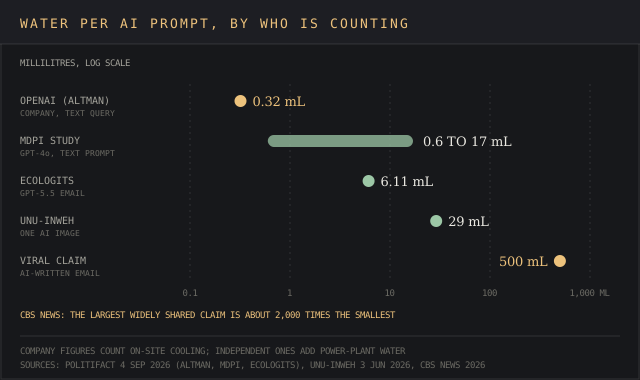
Water claims spread wider. CBS News lined up three widely shared claims about generative AI (Google's five drops per query, Sam Altman's one-fifteenth of a teaspoon and a viral half-litre bottle per AI-written email) and found the largest about 2,000 times the smallest.
Company figures for their own AI models count on-site cooling, independent studies add power-plant water and longer prompts, and the devil's in the details.
| Source | Water per generative AI prompt or task | Date |
|---|---|---|
| OpenAI, Sam Altman | 0.32 mL | Jun 2025, restated Sep 2026 |
| UN University | 29 mL per image, 4.1 L per complex video | 3 Jun 2026 |
| MDPI study, GPT-4o | 0.6 to 17 mL | 1 Sep 2026 |
| EcoLogits, GPT-5.5 email | 6.11 mL | Sep 2026 |
Altman called 17-gallon claims "completely untrue, totally insane, no connection to reality" in February (Business Standard), and PolitiFact rated his September almond comparison Mostly False.
Carbon emissions from AI data centers: Microsoft up 25%, Google 18%, Amazon 16%
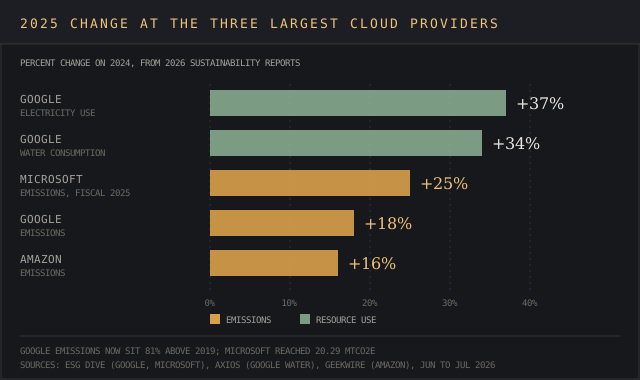
Scope 3 carbon emissions, from construction and chips, drive the growth. Google's emissions rose 18%, to 81% above 2019, as its electricity use rose 37%, with scope 3 at 80% of the total. Amazon's rose 16% to 80.9 MtCO2e, 76% of it scope 3.
The IEA projects about 350 MtCO2 a year from data centers by 2035, around 2% of power-sector emissions. For artificial intelligence alone, de Vries-Gao put the 2025 carbon footprint at 32.6 to 79.7 million tonnes of carbon dioxide, against New York City's 52.2 million in 2023.
Read between the lines of Microsoft's rise to 20.29 million tonnes of carbon dioxide equivalent. Its scope 2 share jumped from 2% to 13% after it stopped buying unbundled certificates, so anyone pulling these numbers from ESG data providers should check the scope 2 method.
Training estimates for generative AI models moved too. The 626,000 pounds of carbon dioxide equivalent still quoted came from a 2019 UMass Amherst study of models including BERT and GPT-2, nearly five times the lifetime emissions of an average car in the US.
MIT News cites 1,287 megawatt hours of electricity for GPT-3 from a 2021 paper, and UNU uses 50 to 70 gigawatt hours of electricity for GPT-4.
Environmental costs beyond climate change, from e-waste to air pollution
UNU tracks the environmental impacts beyond carbon. It expects 2.5 million tonnes of AI e-waste a year by 2030, and electricity for data centers to need over 14,500 km² of land, about twice metro Jakarta, a figure that belongs in land use planning.
Switching from coal to bioenergy, one of the renewable energy sources, cuts carbon per kWh about 70% but raises the water footprint 30-fold and the land footprint 100-fold, leaving planners between a rock and a hard place.
AI technology draws water before it reaches a rack. A single chip fab uses roughly 20 to 38 million litres a day, including ultrapure water for rinsing wafers, Robeco reported in March 2026.
Air pollution adds a health bill. A December 2024 Caltech and UC Riverside study projected about 1,300 premature deaths a year by 2030 from the pollution of data centers, with public health costs near USD 20 billion a year. Backup generators in Northern Virginia alone carry USD 190 million to 260 million a year.
Fossil fuel fills the gaps in the grid. Gas turbine orders rose 70% in 2025, per the IEA, and 15 to 27 GW of onsite natural gas could supply the power needed by data centers by 2030, a shift oil and gas market intelligence already tracks.
MIT News warned that the pace of building new data centers means most of their electricity must come from fossil fuel power plants. The IEA expects a shortage of high-bandwidth memory in AI hardware supply chains to last until at least the end of 2027.
How data center operators cut the environmental impacts of cooling
Four levers show up in 2026 disclosures and studies:
- Closed-loop cooling. Microsoft raised the bar, with about 90% of its 2025 owned fleet on low- or zero-water cooling.
- Reclaimed water. Microsoft's Singapore site runs on 99% recycled, reused or non-potable water, and AWS pipes reclaimed water from treatment plants to spare drinking water supplies.
- Immersion cooling. A Microsoft study of the environmental impacts of cooling from May 2025 found cold plates and two immersion cooling technologies cut greenhouse gas emissions 15% to 21% and water consumption 31% to 52% against air cooling.
- Leaner AI technology. The Joule authors see an 8x to 20x cut in generative AI inference energy, and dry cooling can cut water use up to 50% at a cost in energy efficiency, Ren told CalMatters.
Clean energy purchases lower scope 2 while scope 3 keeps rising, and UNU asks for caps on tokens and default resolution.
Public opposition and 2026 laws on AI's environmental impact
The sustainability implications now reach local politics. Gallup found 71% of Americans oppose an AI data center in their area. An ITIF and Public First poll found 26% support and 46% oppose, a gap that comes from scale design, since Gallup's four points force a side and ITIF's leave 28% neutral or unsure. More than 50 US cities have enacted bans or moratoria on new data centers (Fortune).
Texas moved on 14 September 2026, when Governor Greg Abbott ordered penalties after fewer than 30% of 329 data centers answered the 2025 state water survey. Keep an eye on the compliance update due 14 October. The 49 billion gallon Texas figure for 2025 still quoted by Fortune was an earlier HARC estimate, and HARC's January 2026 paper puts current use at 25 billion gallons a year, rising to 29 to 161 billion by 2030.
California followed on 21 September, when Governor Gavin Newsom signed 7 bills on data centers, including AB 2469 and AB 2619 on water-use disclosure. For public sector researchers, both states now ask data center operators for water data.
Older AI environmental figures still quoted, and what replaced them
Many pages still carry figures from 2009 to 2025. Each one below has a 2026 replacement from the publisher that tracks the same subject.
| Figure still quoted | Where it came from | 2026 figure to use |
|---|---|---|
| 2.5 billion tonnes of CO2 from AI data centers by 2030 | 2024 bank estimate, cumulative | About 350 MtCO2 a year from data centers by 2035 (IEA) |
| 24 to 44 Mt of CO2 a year from AI by 2030 | November 2025 study | About 350 MtCO2 a year from all data centers by 2035 (IEA) |
| 0.4 to 1.6 Gt CO2e by 2035 from AI-enabled growth | Absent from the UN page it is credited to | AI-driven growth adds 1% to 4% to global energy demand in 2035 (IEA) |
| 16 million tons of electronic waste from generative AI by 2030 | 2024 study, cited by MIT News in January 2025 | 2.5 million tonnes a year by 2030 (UNU) |
| AI data center demand quadruples by 2030 | IEA, 2025 report | AI-focused use triples by 2030 (IEA) |
| AI at 19% of data center power by 2028 | 2025 estimate | 15% to 20% already (IEA via CBS News) |
| 0.3 Wh per Google search | Google blog, 2009 | Under 4 TWh a year if every web search ran as an AI text query (IEA) |
| 731 to 1,125 million m³ of water a year for AI | November 2025 study | 469 to 844 billion gallons for US data centers by 2028 (LBNL) |
Frequently asked questions
How much water is wasted by using AI?
The water usage of US data centers reached about 228 billion gallons in 2023, and the IEA attributes 15% to 20% of electricity demand from data centers to AI.
Is ChatGPT wasting water?
OpenAI's figure, from Sam Altman's June 2025 blog, is 0.32 mL per average ChatGPT query. Independent work puts large language models such as GPT-4o at 0.6 to 17 mL per generative AI prompt, so the jury's still out.
How much water did ChatGPT use last year?
OpenAI hasn't published a total. UNU puts the electricity needed for ChatGPT's 2.5 billion daily prompts at about 383 GWh a year.
Is AI going to cause us to run out of water?
UNU projects 9.3 trillion litres for the electricity of data centers worldwide in 2030. The risk is local, with US data centers needing 697 million to 1.45 billion gallons a day of new peak capacity by 2030.
Is artificial intelligence damaging to the environment?
Its environmental impacts span carbon, water, land and e-waste, with a carbon footprint heading for about 350 MtCO2 a year from data centers by 2035 (IEA).
What is the #1 polluter on planet Earth?
Burning fossil fuel tops the list. Coal, oil and gas are the largest contributor to climate change, the UN says, causing around 68% of global greenhouse gas emissions and nearly 90% of carbon dioxide emissions. A large chunk of global emissions comes from producing electricity and heat.
Is AI bad for the environment in 2026?
Totals rose in 2025 as generative AI demand grew, with emissions up 16% at Amazon, 18% at Google and 25% at Microsoft.
Does ChatGPT use more water than Google?
Per query, the two companies' own figures are on the same page, Google's five drops against Altman's one-fifteenth of a teaspoon. An MIT News explainer featuring MIT Climate and Sustainability Consortium researchers reported that a ChatGPT query uses about five times more electricity than a web search.
Bottom line
Every per-unit number in this report fell and the total environmental impacts rose. Energy per AI task drops at least 10 times a year, yet electricity use by data centers grew 17% in 2025 and Google's water consumption 34%.
The sustainability implications turn on two numbers operators rarely publish, peak-day water and power-plant water. California's 7 laws and the Texas update due 14 October are the first hard answer on both.
Where each figure comes from, and what operators keep to themselves
Electricity, forecast, emissions and efficiency figures are the IEA's Key Questions on Energy and AI (16 April 2026) and its 2025 Energy and AI report, read on iea.org. Water, e-waste, land and per-task energy figures are UN University INWEH's release of 3 June 2026 on unu.edu. US forecasts are Lawrence Berkeley National Laboratory's 2025 update (eta.lbl.gov, June 2026) and BloombergNEF via Latitude Media (21 July 2026).
Company figures come from Google's 2026 environmental report via Axios and ESG Dive, Microsoft's water post of 24 June 2026 and its sustainability report via ESG Dive, and Amazon's report via GeekWire. Per-prompt figures come from PolitiFact (4 September 2026), CBS News via News9 (June 2026) and Microsoft Research's Joule paper (April 2026).
State and local figures come from the Texas Tribune (14 September 2026), HARC (21 January 2026), the California governor's office (21 September 2026), the Interstate Commission on the Potomac River Basin and UC Riverside (9 March 2026). Polls are Gallup and ITIF with Public First via Route Fifty. Every figure was checked on 30 September 2026.
No operator publishes peak-day water draw per site or the water used at the power plants feeding it, and OpenAI publishes no yearly water total for ChatGPT, so those two gaps stay open here.