The best ESG data providers in 2026: how the top 10 compare
 By Jan Suski. I go deep on every review, checking every number against its source and digging up details other coverage misses, a habit from six years of SEO and link building for tech companies. Bylines at Surfer, Brand24, and Senuto. How the scoring works.
· Prefer this source on Google
Quick comparison: the top 10 ESG data providers ranked
Ten providers with the coverage figure each one publishes, what a contract costs to start, and the buyer each fits best. Coverage figures are vendor-reported except where marked; medians marked * are Vendr's anonymized buyer-reported contract data.
| # | Provider | Published coverage | Entry price | Best fit |
|---|---|---|---|---|
| 1 | MSCI ESG Research | 17,000+ issuers, 999,000+ securities | Custom enterprise quote | Asset managers who need the most widely cited fund-labeling standard |
| 2 | Sustainalytics (Morningstar) | 16,000+ companies, 800+ analysts | Custom enterprise quote | Fund managers already using other Morningstar products |
| 3 | S&P Global Sustainable1 | 13,000+ companies, 3,500+ direct participants | Custom enterprise quote | Analysts who want issuer-disclosed, engagement-based scoring |
| 4 | LSEG Data & Analytics | 16,000+ companies, 99% of FTSE All-World | Custom enterprise quote | Workspace terminal users who want ESG data bundled in |
| 5 | Bloomberg ESG Data Services | 12,000+ companies, 60,000+ funds scored | Custom enterprise quote | Bloomberg Terminal shops that do not want a second vendor |
| 6 | FactSet (Truvalue Labs) | 260,000+ companies, 300,000 signals/month | $25,160/yr median* | Teams that need continuous AI-driven signal monitoring |
| 7 | Moody's ESG Solutions | 300 million+ modelled scores | Custom enterprise quote | Insurers and lenders covering private companies and SMEs |
| 8 | EcoVadis | 175,000+ companies rated | $29,082/yr median* | Procurement teams scoring suppliers, not investment portfolios |
| 9 | CDP | 22,000+ companies disclosed | Free for companies to disclose | Corporates responding to investor climate-disclosure requests |
| 10 | ISS ESG | 5,200 companies, ~240 factors per company | Custom enterprise quote | Governance and proxy-voting teams, not broad portfolio screening |
Medians marked * are anonymized buyer-reported contract values published by Vendr. Everything else is the price or pricing model the vendor publishes itself.
Where these figures come from
Coverage counts are each vendor's own published figure, read in August 2026. Medians marked * are Vendr's anonymized buyer-reported contract values, from FactSet's and EcoVadis's marketplace pages at vendr.com/marketplace/factset and vendr.com/marketplace/ecovadis. Neither MSCI, Sustainalytics, S&P Global, LSEG, Bloomberg, Moody's, nor ISS ESG publishes a price list, so no row for those seven claims one; each sells through custom enterprise licensing instead.
Sustainable investing runs on numbers a company itself did not calculate. An ESG data provider gathers Environmental, Social, and Governance (ESG) disclosures, regulatory filings, news, and third-party sources, then turns them into a score, a letter grade, or a risk rating an asset manager, a lender, or a procurement team can use for due diligence and investment decisions.
The market spans financial-data giants that bolted ESG data onto an existing terminal and specialist ESG ratings providers that do nothing else.
This guide ranks the ten ESG data providers investors, corporates, and supply-chain teams cite most often, in the order their coverage, methodology transparency, and regulatory readiness earn it. Every figure below traces to the provider's own site or a Vendr-tracked contract, and every entry names at least one thing it does better and one thing it does worse than the vendor next to it.
It's built for three readers: an asset manager choosing a primary ESG ratings feed for portfolio screening, a corporate sustainability team deciding which raters to engage with directly, and a procurement team picking a supplier-risk platform that is a different product entirely from an investment-grade ESG rating. The distinction matters more than most comparisons admit, and the ranking below treats it as a criterion that shapes the order below.
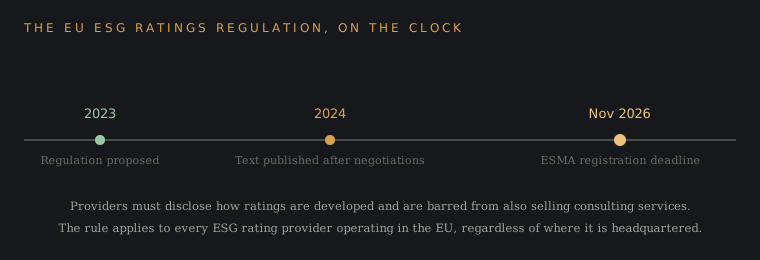
Regulation is compressing the timeline for this decision. Every one of the EU's ESG ratings providers has to register with ESMA by November 2026 under the ESG ratings providers regulation, which now bars a rater from also selling consulting services on the side. That reshapes who stays in this market over the next year and how they price, and it is one more reason investment decisions built on a single provider's ESG performance score deserve a second look.
This is one of ten categories in our data providers guide, which places ESG data against the financial, alternative and company data categories it overlaps with.
Six of the ten providers ranked here also show up on our financial data providers ranking, judged there as terminals and feeds; the two rankings apply different criteria and produce different orders on purpose. EcoVadis also appears on our procurement intelligence tools ranking, where it is judged as a supplier-risk platform.
Evaluation criteria for ESG data providers
Six criteria decide the shortlist, and the ranking below applies them in this order: coverage breadth, methodology transparency, refresh cadence, bundling with existing financial data infrastructure, EU regulatory readiness, and pricing transparency. Each one is something a buyer can check directly against a published number or document.
Coverage breadth
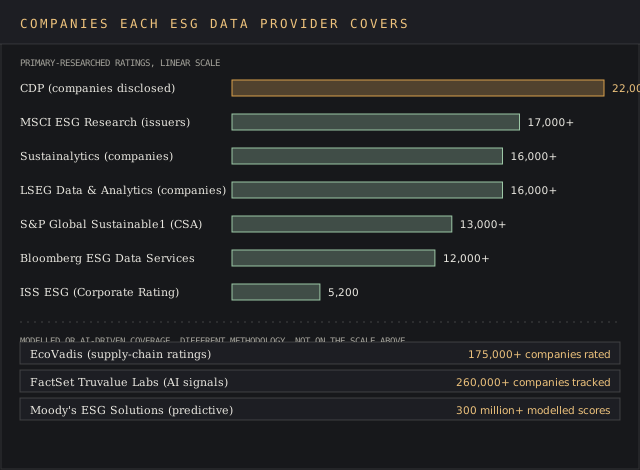
A published number of companies or issuers rated, stated by the provider itself. Sustainalytics states 16,000 companies. ISS ESG states 5,200. The gap between those two numbers alone rules out treating coverage as a solved problem across the category.
Methodology transparency
the provider publishes a methodology document a buyer can read before signing a contract. MSCI publishes both a methodology PDF and a symbols-and-definitions document explaining exactly how an AAA rating differs from a BBB one. A provider that will not show its work before a sales call fails this test outright.
Refresh cadence
How often the underlying score updates: a fixed annual assessment cycle, or continuous monitoring as new disclosures and news appear. FactSet's Truvalue Labs processes over 4.5 million data points and generates roughly 300,000 signals a month, which is a different cadence than S&P Global's Corporate Sustainability Assessment, which runs on an annual questionnaire cycle with roughly 3,500 companies directly participating.
Bundling with existing financial infrastructure
the ESG data ships inside a terminal or workstation a buyer may already pay for, or requires a standalone contract on top of everything else. Bloomberg and LSEG both bundle ESG scores into a terminal subscription; MSCI, Sustainalytics, and ISS ESG sell ESG data as its own line item regardless of what else a buyer already licenses.
Ask which line the ESG feed sits on before the sales call. A rater bundled into a terminal you already pay for is a rounding error on the renewal; a standalone contract is a new budget line that needs its own justification.
EU regulatory readiness
the provider is positioned to register with ESMA ahead of the November 2026 deadline under the ESG Ratings Regulation, which also bars raters from selling consulting services alongside a rating. This is new enough that no provider has a finished public record to point to, so the honest test here is if the provider has said anything about it at all.
Pricing transparency
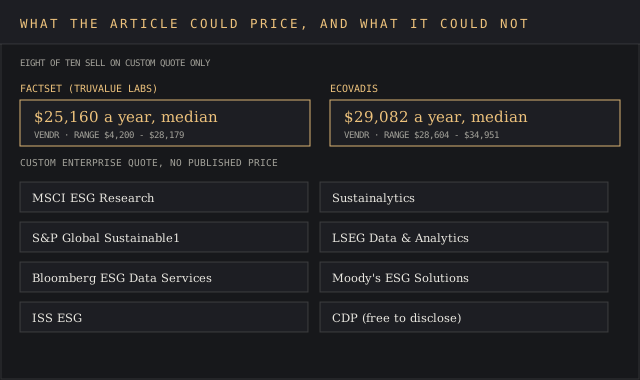
A published price, or a Vendr-tracked contract range, beats "contact sales" every time. Two of the ten providers in this ranking, FactSet and EcoVadis, have a Vendr-tracked median. The other eight sell exclusively on custom enterprise quote.
Providers in this ranking with a public, Vendr-tracked contract median. The other eight route every prospective buyer straight to a sales call with no published price to check first.
The top 10 ESG data providers, ranked
Ranked on coverage breadth, methodology transparency, refresh cadence, bundling with existing financial infrastructure, EU regulatory readiness, and pricing transparency, in that order.
Companies FactSet's Truvalue Labs tracks, the largest figure in this ranking and more than 15 times MSCI's 17,000-plus issuers, though the two measure different things: continuous signals against a formally researched rating.
MSCI ESG Research
Best fit
Asset managers who need the ESG rating most widely embedded in fund labeling and index construction.
MSCI's ESG ratings cover more than 17,000 issuers and 999,000 securities worldwide as of its most recent public disclosure, rating each company on an industry-relative AAA-to-CCC scale against peers based on financially relevant ESG factors in the same sector. MSCI has produced a continuous ratings time series since 2007, giving it 18 years of history in developed markets and 12 in emerging markets.
Key features
- AAA-to-CCC industry-relative letter rating, recalculated on an ongoing basis.
- Public methodology and symbols-and-definitions documents, downloadable without a sales call.
- 999,000+ securities mapped across 17,000+ issuers.
- Coverage of both developed and emerging markets, with 18 and 12 years of history respectively.
Pricing
MSCI doesn't publish a price list for ESG Ratings. Access runs through custom enterprise licensing tied to seats, data feed volume, and if a buyer also licenses MSCI's index or analytics products.
Pros
- The most widely cited rating for fund-level ESG labeling and index construction.
- Full methodology published and downloadable without a login.
- Longest continuous ratings history of any provider in this list, dating to 2007.
Cons
- No public price; every contract is negotiated.
- Methodology revisions can move a company's letter grade without any change in its operations.
- Ratings correlate only loosely with other major providers, a documented problem shared across the whole category.
Why it's ranked #1. MSCI's 17,000+ issuer count, published methodology, and 18-year developed-market history outweigh Sustainalytics' larger 800-analyst research team; the two are close on raw coverage, but MSCI's ratings sit inside more fund prospectuses today, which is the criterion that decides adoption in this market.
Sustainalytics (Morningstar)
Best fit
Fund managers already reporting through Morningstar's fund-level sustainability tools who want the underlying company data from the same source.
Sustainalytics' research universe covers more than 16,000 companies across public equity, fixed income, and private markets, built by over 800 ESG research analysts working across multiple offices. The ESG Risk Ratings categorize exposure into five absolute risk levels, negligible, low, medium, high, and severe, measuring exposure across more than 20 industry-specific material risks.
Key features
- Five-level absolute risk scale (negligible to severe), distinct from peer-relative letter grades.
- Over 20 industry-specific material risk categories per company.
- 200+ indicators and 1,800+ underlying data points per rating.
- 800+ in-house ESG research analysts.
Pricing
No public price. Sustainalytics sells through custom enterprise contracts, typically bundled with or alongside Morningstar's fund data products.
Pros
- Largest in-house analyst headcount of any provider in this ranking at 800+.
- Absolute risk scale answers a different question than peer-relative letter grades, useful alongside MSCI.
- Deep integration into Morningstar's fund research tools, which many asset managers already pay for.
Cons
- No public pricing, same as most of this category.
- 16,000-company coverage trails FactSet's Truvalue Labs and EcoVadis by a wide margin, though those two measure different things.
- Absolute and relative scales aren't interchangeable, so a portfolio using both MSCI and Sustainalytics needs a team that understands why the same company can look fine on one scale and flagged on the other.
Why it's ranked #2. Sustainalytics' 800+ analysts is the largest research headcount in this ranking, and its five-level absolute risk scale answers a question MSCI's peer-relative letters don't, but its 16,000-company count still sits below MSCI's 17,000+ issuers, which keeps it second on the coverage criterion that leads this list.
S&P Global Sustainable1
Best fit
Analysts who want scores built on direct issuer engagement.
S&P Global's Corporate Sustainability Assessment covers more than 13,000 companies globally, with over 3,500 of them directly participating in the assessment through 62 industry-specific questionnaires. Scores run on a 0-to-100 scale, with up to 1,000 transparently disclosed ESG datapoints per assessed company.
Key features
- 0-to-100 CSA score built from 62 industry-specific questionnaires.
- Up to 1,000 disclosed ESG datapoints per assessed company.
- 3,500+ companies directly participate in the assessment.
- Distribution through the S&P Global Sustainable1 platform and S&P Capital IQ Pro.
Pricing
No public price for CSA data access. It sells through S&P Global's Market Intelligence contracts, which a related S&P Capital IQ Pro review on G2 describes as recurring, license-based, and renewal-dependent: "it is expensive and you have to keep renewing your license to be a part of it," one Senior Associate wrote in a G2 review.
Pros
- Deepest per-company data among providers that rely on direct engagement, up to 1,000 datapoints.
- 0-100 numeric score is easier to benchmark across a portfolio than a letter grade.
- 62 industry-specific questionnaires tailor the assessment more precisely than a one-size-fits-all model.
Cons
- 13,000-company coverage is the second-smallest true "rating" figure in this ranking, behind only ISS ESG.
- Annual questionnaire cycle refreshes slower than continuously monitored competitors like FactSet's Truvalue Labs.
- "Sometimes the value is different from thr reported figures," one Enterprise-tier Accounting user wrote of the underlying S&P Capital IQ Pro data in a G2 review, a data-quality complaint about the same data infrastructure the CSA draws on.
Why it's ranked #3. S&P Global's 3,500-company direct-participation model produces the deepest per-company dataset of the top three, up to 1,000 points per issuer, but its 13,000-company total coverage trails both MSCI's 17,000+ and Sustainalytics' 16,000+, and its annual assessment cycle refreshes slower than either.
LSEG Data & Analytics
Best fit
Workspace terminal users who want ESG scores bundled into data they already pay for.
LSEG (formerly Refinitiv) provides ESG scores and data for more than 16,000 companies, covering 99% of the FTSE All-World Index by market capitalization. The platform draws on 240-plus standardized indicators and 2,000-plus data points, and relaunched its ESG data suite in July 2026, moving the prior methodology to legacy status.
Key features
- 16,000+ companies covered, 99% of the FTSE All-World Index by market cap.
- 240+ standardized ESG indicators, 2,000+ underlying data points.
- Coverage of 1 million-plus fixed income instruments.
- New scoring suite launched July 2026, replacing the legacy Refinitiv ESG scores.
Pricing
No public price for the ESG data suite. It licenses through LSEG's Workspace and Data & Analytics contracts, priced per seat and data-feed scope.
Pros
- 99% FTSE All-World Index coverage by market cap is among the highest index-coverage figures any provider in this list publishes.
- Bundled inside Workspace, so a buyer already paying for LSEG market data adds ESG without a second vendor relationship.
- "It is a very wide database that covers multiple industries, topics, regions etc," one Enterprise-tier Consumer Goods user wrote of LSEG Workspace in a G2 review.
Cons
- The 2026 methodology relaunch means the current scoring suite has a shorter public track record than MSCI's or Sustainalytics'.
- "Our billing period was changed multiple times without our consent," one Small-Business Financial Services user wrote in a G2 review, describing confusion over Refinitiv's billing practices.
- Best used with hands-on onboarding: "Best utilised with 1:1 training," an Enterprise-tier Research Analyst noted of the platform.
Why it's ranked #4. LSEG's 16,000-company count matches Sustainalytics and its 99% FTSE All-World coverage beats every other provider's stated index figure, but a mid-2026 methodology relaunch gives it a shorter proven track record than the three raters ranked above it, which is why it sits fourth.
Bloomberg ESG Data Services
Best fit
Bloomberg Terminal shops that want ESG scoring without adding a second data vendor to the stack.
Bloomberg's ESG Scores cover more than 12,000 companies, reaching 99% of the Bloomberg World Large & Mid Cap Index by market cap and 90% of Bloomberg's U.S. and European investment-grade bond indices. The methodology weighs 30-plus risk factors treated as financially material by the Sustainability Accounting Standards Board, and also scores 60,000-plus mutual funds and roughly 10,000 ETFs.
Key features
- 12,000+ companies scored, with 99% coverage of the Bloomberg World Large & Mid Cap Index.
- 90% coverage of Bloomberg's U.S. and European investment-grade bond indices.
- 60,000+ mutual funds and roughly 10,000 ETFs scored on the same methodology.
- Government climate scores for 135 countries.
Pricing
Bloomberg doesn't publish ESG-specific pricing; ESG Scores ship as part of a Bloomberg Terminal subscription, which itself sells on a custom enterprise quote.
Pros
- Already inside the Terminal most institutional investors use daily, so no new login or workflow.
- Fund- and ETF-level scoring at a scale, 60,000+ funds, none of the standalone raters in this list match.
- "It contains a ton of information including news, charts, graphs, earnings reports, opinions, research, chat, emails, and live time data," one Investment Banking Associate wrote in a G2 review.
Cons
- 12,000-company coverage is the smallest among the terminal-bundled providers in this ranking.
- Terminal cost is a frequent complaint independent of the ESG module: "Bloomberg is not a cheap tool that everyone can afford," one Portfolio Manager wrote in a G2 review, and a Founder called the price "very high for a normal user to use."
- ESG Scores exist to serve Terminal users first; a buyer who doesn't already run Bloomberg gets little reason to adopt it just for ESG data.
Why it's ranked #5. Bloomberg's 12,000-company coverage is the smallest of the five terminal-bundled and financial-data providers ranked above it, trailing LSEG's 16,000-plus by a wide margin, but its 60,000-fund scoring reach and existing Terminal distribution keep it ahead of the specialist and AI-driven providers ranked below.
FactSet (Truvalue Labs)
Best fit
Teams that need continuous, AI-driven ESG signal monitoring.
FactSet's Truvalue Labs platform tracks more than 260,000 public and private companies, drawing from over 200,000 sources including news, NGO and watchdog publications, trade blogs, and industry press. It processes 4.5 million-plus data points and generates roughly 300,000 signals a month, spanning 26 ESG categories and 16 UN Sustainable Development Goals.
Key features
- 260,000+ companies tracked, public and private.
- 200,000+ source publications monitored continuously.
- 4.5 million-plus data points processed and roughly 300,000 signals generated monthly.
- 26 ESG categories mapped to 16 UN Sustainable Development Goals.
Pricing
FactSet's Vendr-tracked median contract runs $25,160 a year*, with a range from $4,200 to $28,179 based on 2026 anonymized buyer data. FactSet prices on quote-based enterprise contracts scaled by user count, data feed volume, and analytics modules, with each rate negotiated individually.
Pros
- Largest company coverage of any provider in this ranking, at 260,000-plus.
- Continuous monitoring, roughly 300,000 signals a month, refreshes far faster than annual-cycle competitors.
- One of only two providers in this ranking, alongside EcoVadis, with a public Vendr-tracked price.
Cons
- "It is really expensive. We want to download data from it and it's only possible using vb scripting. To get API access they want us to pay more," one Mid-Market Investment Management user wrote in a G2 review.
- "The data isn't always accurate. Sometimes data is missing and we end up needing to search the internet to find company and financial information," a Mid-Market Financial Services user wrote of FactSet in a G2 review.
- Signal-based coverage answers a different question than a formally researched rating, so a fund relying on FactSet alone for regulatory ESG disclosure may still need a rated provider like MSCI or Sustainalytics alongside it.
Why it's ranked #6. FactSet's 260,000-company coverage beats every other provider in this ranking by more than an order of magnitude, and its 300,000 monthly signals give it the fastest refresh cadence, but it trades formally researched ratings for AI-driven signals, which is why it ranks behind the five analyst-reviewed raters above it.
Moody's ESG Solutions
Best fit
Insurers, lenders, and underwriters who need ESG scores for private companies and SMEs that never publish a sustainability report.
Moody's ESG Solutions, built on the former Vigeo Eiris research now branded V.E, provides access to more than 300 million modelled ESG scores across public and private companies and securities globally. Its ESG Score Predictor was trained on 100,000-plus firms, extends to 220 countries and 12,000 sub-national locations, and generates 50-plus standardized metrics, including an energy transition score and a physical risk management score.
Key features
- 300 million-plus modelled ESG scores across public and private entities.
- ESG Score Predictor trained on 100,000-plus companies, extending to 220 countries and 12,000 sub-national locations.
- 615 NACE 4 industry classifications for granular sector modeling.
- 50-plus standardized metrics, including a dedicated energy transition score and physical risk score.
Pricing
No public price. Moody's ESG Solutions sells through enterprise licensing, typically bundled with or adjacent to Moody's credit-rating and risk-analytics contracts.
Pros
- Coverage no directly researched rating can match, by definition, since modeling extends reach to companies with no public disclosure at all.
- Purpose-built for private-market and SME risk use cases that MSCI, Sustainalytics, and S&P Global don't directly serve.
- Integration with Moody's existing credit-rating infrastructure, useful for lenders already using Moody's for credit risk.
Cons
- Modelled scores trade precision for reach; a predicted score for a company with no disclosure carries a lower evidentiary standard than MSCI's or Sustainalytics' analyst-reviewed ratings.
- No public price, and no independent review presence on G2, Capterra, or TrustRadius to check buyer sentiment against.
- Best suited to private-market and underwriting use cases, a narrower fit for portfolio managers screening large-cap public equities.
Why it's ranked #7. Moody's 300 million-plus modelled scores outreach every rated provider in this list by orders of magnitude, but modeling carries a different evidentiary standard than FactSet's continuously monitored signals or MSCI's analyst-reviewed ratings, which keeps it behind the six providers built on direct research above it.
EcoVadis
Best fit
Procurement and supply-chain teams scoring suppliers for ESG risk across a vendor base.
EcoVadis has rated more than 175,000 companies across 180-plus countries and 230-plus industries, screening as many as 3 million suppliers in aggregate for its enterprise clients. Its methodology combines AI analysis of roughly 3 million documents a month, monitored by 500-plus in-house analysts, translating into a bronze-to-platinum medal system layered on a 0-100 supplier score.
Key features
- 175,000+ companies rated across 180+ countries and 230+ industries.
- Bronze, silver, gold, and platinum medal tiers on a 0-100 supplier score.
- 500+ in-house sustainability analysts reviewing AI-flagged documents.
- 3 million documents processed monthly across 8 languages.
Pricing
EcoVadis' Vendr-tracked median contract runs $29,082 a year*, with a range from $28,604 to $34,951. Program-level pricing scales sharply with supplier volume, per Vendr's 2026 buyer-data analysis:
- $10,000 to $30,000 annually for 1 to 50 suppliers.
- $30,000 to $80,000 for 51 to 200 suppliers.
- $75,000 to $200,000 for 201 to 500 suppliers.
- $200,000-plus for enterprise programs above 500 suppliers.
A separate self-serve "Rate My Company" tier starts at €279 a year, per G2's pricing page.
Pros
- Largest directly researched, analyst-reviewed coverage figure in this ranking at 175,000-plus companies.
- "EcoVadis is both thorough and legitimate, requiring backup for declarations and allowing adjustments if needed," a Senior Director of Global Sustainability wrote in a G2 review.
- Purpose-built corrective action tools a generic investment-grade rating does not offer.
Cons
- "The assessment is time consuming and this affects small companies significantly," an IT Manager wrote in a G2 review.
- "The package price is quite expensive for small industries," a Small Business reviewer wrote in a G2 review, and G2's aggregated pros-and-cons summary describes the pricing as expensive relative to smaller buyers' budgets.
- "The reasons given for a document's rejection are quite generic, making it hard to determine exactly what needs improvement," an Enterprise-tier Manufacturing reviewer wrote in a G2 review.
Why it's ranked #8. EcoVadis' 175,000-plus rated companies is the largest directly researched coverage figure in this entire ranking, ahead of Sustainalytics, MSCI, and S&P Global combined, but it scores supply-chain risk for procurement buyers. The six investment-grade raters above it score investment risk for portfolio managers, and that is why it ranks eighth, behind them and ahead only of the disclosure platform and governance specialist below it.
CDP
Best fit
Corporates responding to investor-driven climate disclosure requests who need a free, standardized reporting channel.
CDP, founded in 2000 as the Carbon Disclosure Project, ran the world's first independent environmental disclosure system and remains free for companies to respond to. In 2025, more than 23,100 organizations responded to CDP's questionnaires, including 22,000-plus companies and nearly 11,000 SMEs on a simplified track. Disclosing companies span 75% of the S&P 500 and 78% of the STOXX Europe 600 by index weight.
Key features
- Free for responding companies; CDP monetizes investor and enterprise access to the resulting dataset.
- 22,000+ companies disclosed in 2025, plus nearly 11,000 SMEs on a simplified track.
- 1,000+ cities, states, and regions disclosing alongside corporates.
- Disclosed companies span 75% of the S&P 500 and 78% of the STOXX Europe 600 by index weight.
Pricing
Disclosure is free for responding companies. CDP charges investors and enterprise users for access to the underlying scored dataset through separate licensing, with no public list price for that access tier.
Pros
- Free entry point for companies, unlike every other provider in this ranking except the self-serve tier of EcoVadis.
- 26 years of continuous operation since its 2000 founding, the longest track record of any provider in this list alongside MSCI's predecessor lineage.
- Underlying data other raters, including several ranked above it here, draw on directly.
Cons
- Scores disclosure completeness and quality, a narrower evidentiary standard than a fully researched rating.
- No independent review presence on G2, Capterra, or TrustRadius to check against.
- A company's CDP participation says more about its willingness to disclose than about its underlying ESG performance, a distinction the other raters in this list are built to correct for.
Why it's ranked #9. CDP's 22,000-plus disclosing companies outnumber every rated provider in this list except FactSet, EcoVadis, and Moody's modelled reach, but it scores disclosure quality, which is why it sits below every investment-grade and supplier rating in this ranking and ahead only of ISS ESG's narrower governance focus.
ISS ESG
Best fit
Governance and proxy-voting teams who need disclosure-quality scoring more than broad portfolio-wide ESG screening.
ISS ESG's Corporate Rating covers 5,200 companies and other issuers, the smallest coverage figure of any provider in this ranking, drawn from mainstream filings, sustainability reports, integrated reports, and publicly available policies. The methodology examines 380-plus individual ESG factors, though only roughly 240 are assessed per company, concentrated on disclosure practices and transparency.
Key features
- 5,200 companies and issuers covered.
- 380+ individual factors in the full framework, roughly 240 assessed per company based on industry.
- Disclosure-quality and transparency focus, distinct from performance-based risk ratings.
- Deep integration with ISS's existing proxy-voting and governance research infrastructure.
Pricing
No public price. ISS ESG sells through enterprise licensing, commonly bundled with ISS's proxy-voting and governance research products for institutional investors.
Pros
- Deepest governance and disclosure-quality lineage in this ranking, predating the ESG label itself.
- Focused factor set, roughly 240 per company, avoids diluting governance analysis across unrelated categories.
- Tight integration with proxy-voting workflows many institutional investors already run through ISS.
Cons
- 5,200-company coverage is the smallest of any provider in this ranking, a fraction of MSCI's 17,000-plus or Sustainalytics' 16,000-plus.
- Measures disclosure quality and transparency more than independently verified performance, a narrower claim than a full ESG risk rating.
- No public pricing and no independent review presence on G2, Capterra, or TrustRadius to check against.
Why it's ranked #10. ISS ESG's 5,200-company coverage is the smallest in this ranking, a fraction of the 12,000-plus every terminal-bundled competitor above it covers, and its disclosure-quality focus answers a narrower question than the risk ratings ranked above it, though its governance depth keeps it ahead of nothing else on this list precisely because every provider above it covers more ground.
What ESG data providers do
An ESG data provider is a different product from ESG reporting software. Reporting software, the kind a corporate sustainability team uses to draft a CDP submission or a CSRD filing, has reporting capabilities that help a company produce its own sustainability data and sustainability performance disclosures.
An ESG data provider consumes disclosures, if a company's own or a supplier's, and turns them into a score a third party can act on: an investor deciding if to buy a stock, a lender pricing credit risk, or a procurement team deciding if to keep a supplier on an approved list.
The ten providers in this ranking split into three distinct groups by what decision they support:
- MSCI, Sustainalytics, S&P Global, LSEG, and Bloomberg build investment-grade ratings for portfolio management and index construction.
- FactSet's Truvalue Labs and Moody's ESG Solutions build continuously updated or machine learning-driven data feeds for analysts and underwriters who need speed or reach over analyst-reviewed precision.
- EcoVadis and CDP serve supply-chain and disclosure use cases that sit adjacent to investing.
ISS ESG sits between governance research and a full risk rating.
Coverage of governance performance and environmental impact matters as much as the headline score. A rating that blends carbon footprint, carbon emissions, and governance factors into one number hides which one is driving it, so an investor running due diligence on a specific holding usually pulls the sub-scores apart.
That is one reason institutional investors building real investment strategies around ESG data rarely rely on a single provider's esg metrics in isolation, and why esg ratings from two providers can point in different directions on the same company without either one being wrong.
How ESG metrics and scoring scales differ across providers
A rating from one provider does not convert to a rating from another, and the five scales in this ranking illustrate why:
- MSCI uses a seven-step, industry-relative letter grade from AAA to CCC.
- Sustainalytics uses a five-level absolute risk scale from negligible to severe.
- S&P Global scores companies 0 to 100 across 62 industry-specific questionnaires.
- ISS ESG scores roughly 240 factors per company from a 380-factor universe, weighted toward disclosure quality.
- EcoVadis layers a bronze-to-platinum medal system on top of its own 0-100 supplier score.
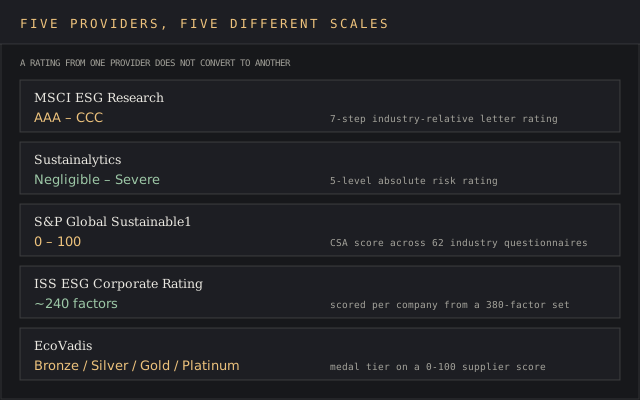
None of these methodologies were designed to agree with each other, because none of them are measuring the identical thing: relative-to-peers risk, absolute risk, disclosure quality, and supplier compliance are four different questions that happen to share the same three-letter label.
A company can carry a strong MSCI letter grade and a mediocre Sustainalytics risk rating at the same time without either provider being wrong, and neither reading alone captures the full mix of risks and opportunities a portfolio manager is pricing.
The EU ESG Ratings Regulation is compressing this market's timeline
The EU's ESG Ratings Regulation was proposed in 2023 and published in 2024 after negotiation, and it applies to every ESG rating provider operating inside the EU regardless of where the provider is headquartered.
Two provisions matter most for buyers evaluating this category in 2026: providers must disclose how their ratings are developed, and the regulation restricts providers from also selling consulting services alongside a rating. Every ESG rating provider covered by the rule has to register with ESMA by November 2026, the timeline shown in the figure near the top of this guide.
That deadline sits a few months out from this article's publication, and none of the ten providers ranked here has a finished public compliance record to cite yet. A buyer signing a multi-year contract in the second half of 2026 should ask directly where a provider stands on ESMA registration, since a rater that misses the deadline cannot legally continue operating in the EU market under the same terms.
No provider in this ranking has a finished public ESMA compliance record as of this article's publication. Ask directly where a prospective rater stands on registration before signing a multi-year contract that runs past November 2026.
Pricing across ESG data providers
Eight of the ten providers in this ranking sell exclusively on custom enterprise quote, with no published price a prospective buyer can check before a sales call. Only FactSet and EcoVadis have a Vendr-tracked contract median: FactSet at $25,160 a year* with a range from $4,200 to $28,179, and EcoVadis at $29,082 a year* with a range from $28,604 to $34,951, both based on Vendr's 2026 anonymized buyer data.
EcoVadis pricing also scales sharply with supplier program size, from $10,000 for a 50-supplier program to $200,000-plus for an enterprise rollout above 500 suppliers.
CDP is the outlier at the other end: disclosure itself is free for the company reporting, and CDP instead monetizes investor and enterprise access to the resulting dataset. That makes it the closest thing to a free entry point in this entire category, though a company only gets a CDP score by doing the disclosure work first, which isn't free in staff time even when it is free in licensing cost.
The custom-quote-only pattern across MSCI, Sustainalytics, S&P Global, LSEG, Bloomberg, Moody's, and ISS ESG is not unusual for enterprise financial data, but it does mean a buyer can't comparison-shop by price the way a buyer comparing SaaS tools on G2 can. Budget conversations start with a sales call for those seven providers.
Getting a complete view of ESG performance means combining providers
No single provider in this ranking gives a portfolio manager, a corporate sustainability lead, or a procurement team a complete view on its own, because no two of the ten measure the identical thing.
An institutional investor screening a large-cap public equity portfolio typically layers MSCI or Sustainalytics for the core risk rating, checks CDP for climate-disclosure depth on carbon-intensive holdings, and uses FactSet's Truvalue Labs or Bloomberg for faster-moving controversy signals between formal rating updates.
A procurement team runs EcoVadis for supplier risk and has no reason to also buy MSCI, since the two answer different questions entirely.
Before signing anything, ask each shortlisted provider for its methodology document and a sample rating on a company you already know well. A provider that hesitates on either request is telling you something about the sales call you just avoided.
Smaller firms without a dedicated ESG data management team tend to start with one provider and add a second only once a specific gap shows up, a missing private-company name, a stale disclosure, a supplier EcoVadis has scored but MSCI has not.
Sustainable investing and sustainable finance mandates increasingly write a named provider into the investment policy itself, which is one more reason a buyer should read that provider's evaluation criteria alongside its headline coverage number before signing. Readers newer to the category can start with our guide to what market intelligence is and how ESG data fits inside it.
ESG data providers FAQ
What is an ESG rating
An ESG rating is a score, letter grade, or risk category a third-party provider assigns to a company based on its environmental, social, and governance performance or disclosure. It is built to speed up investment decision making for investors, lenders, or business partners evaluating that company without researching it from scratch.
It differs from ESG controversies tracking, which flags specific incidents, such as environmental risks or regulatory fines.
What is considered a good ESG score
It depends entirely on the scale. An MSCI AA or AAA is considered strong on its industry-relative letter scale; a Sustainalytics rating in the negligible-to-low range is considered strong on its absolute risk scale; an S&P Global CSA score is typically judged against the industry average for that year's Sustainability Yearbook rankings. None of those thresholds transfer across providers.
Where can I get ESG data
Directly from a provider like the ten ranked above, through a financial data terminal that bundles it in, such as Bloomberg or LSEG Workspace, or through a company's own disclosures filed with a body like CDP.
Does Bloomberg have ESG data
Yes. Bloomberg's ESG Scores cover more than 12,000 companies, plus more than 60,000 mutual funds and roughly 10,000 ETFs, delivered inside the Bloomberg Terminal.
What is an ESG service
An ESG service can mean the rating or data feed itself, sold by the ten providers ranked above, or an advisory engagement that helps a company improve its ESG practices and ESG initiatives ahead of its next assessment; the ESG ratings providers regulation now bars the same firm from selling both to the same client.
What are the top ESG data providers
The names that come up most often across investment, corporate, and procurement use cases are MSCI, Sustainalytics, S&P Global, LSEG, Bloomberg, FactSet, Moody's ESG Solutions, EcoVadis, CDP, and ISS ESG, the same ten ranked in this guide, though no regulator or industry body publishes an official ranking of its own.
Is ESG still relevant in 2026
The EU's ESG Ratings Regulation, with its November 2026 ESMA registration deadline, is a live compliance requirement for every provider in this ranking that operates in the EU, which is a stronger signal of continued relevance than any single provider's marketing claim.
Bottom line
MSCI wins the top spot on the combination that matters most to the largest share of buyers in this category: 17,000-plus issuers, a published methodology, and 18 years of continuous ratings history that sits inside more fund labels than any competitor here.
Sustainalytics is the strongest alternative for a team that wants an absolute risk scale alongside MSCI's relative one, and FactSet's Truvalue Labs is the pick for anyone who needs continuous signal monitoring. It updates in real time, skipping the fixed annual or ongoing rating cycle other providers run on.
The providers ranked sixth through tenth are not weaker versions of the top five; they answer different questions entirely. EcoVadis exists for procurement teams evaluating suppliers. CDP exists to collect the disclosures other raters build on. Moody's exists to reach private companies no analyst team could research by hand. Buying the wrong one of these ten for the decision at hand costs more than buying none at all.