AI adoption statistics 2026: 19.8% of US firms use AI, 45.2% of workers do
 By Jan Suski. I go deep on every review, checking every number against its source and digging up details other coverage misses, a habit from six years of SEO and link building for tech companies. Bylines at Surfer, Brand24, and Senuto. How the scoring works.
The numbers US, EU and Canadian AI adoption, checked 7 October 2026
US business AI adoption rose from 3.7% to 19.8% in 32 months, and about 8 points of that rise arrived with a wider survey question in November 2025.
Three statistics offices on two continents land within 0.8 points of each other: 19.2% in Canada, 19.8% in the US and 20.0% in the EU.
Generative AI reached 54.6% of US adults three years after launch, against 30.1% for the internet and 19.7% for the PC at the same point.
The US Census Bureau counted 19.8% of American businesses using AI on May 3, 2026, in its Business Trends and Outlook Survey. In the same month, 45.2% of employed US adults told the Real-Time Population Survey they'd used generative AI for work. One counts firms, the other counts people.
This report tracks the Census series since 2023, Eurostat, Statistics Canada and the main household and enterprise surveys, each figure dated and linked.
It's for analysts, business leaders and marketers who need an adoption rate they can defend. Wider artificial intelligence usage, market size and investment figures sit in the AI statistics report; AI chatbots' usage and traffic shares are in the chatbot statistics report.
Business AI adoption in the US: the Census series since 2023
The Census Bureau's Business Trends and Outlook Survey (BTOS) is the closest thing the US has to a headcount of firms that run AI. It runs every two weeks, samples about 1.2 million businesses and has asked about AI since autumn 2023. For firm counts, it's straight from the horse's mouth.
The first reading put adoption at 3.7% in September 2023. By February 2024 it was 5.4%, with firms expecting 6.6% within six months, per the working paper "Tracking Firm Use of AI in Real Time". The Federal Reserve Board's April 3, 2026 note on monitoring AI adoption puts the increase over the year to September 2025 at 68%, or 3.9 percentage points.
About 10% of businesses were using AI to produce goods or services in late 2025, the Minneapolis Fed reported on May 29, 2026. Most companies still had no AI in production.
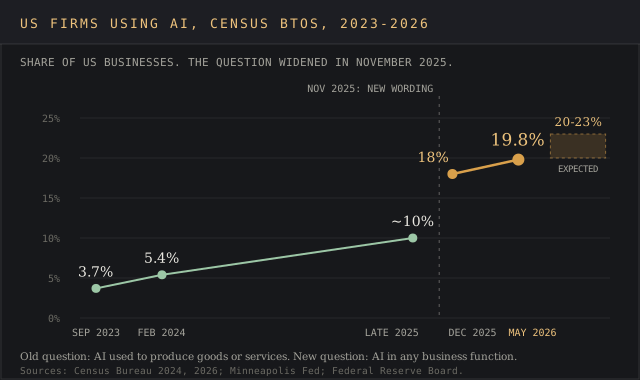
Before and after the November 2025 question change
The devil's in the details of the wording. In November 2025 the Census Bureau switched from asking about AI "in producing goods or services" to AI "in any business function". Under the new wording, about 18% of firms reported using AI at year-end 2025, per the Fed Board, and the rate held between 17% and 20% from December 14, 2025 to May 3, 2026.
The jump between the legacy and revised series ranged from 47% (10.6 points) in professional services to 159% (7.5 points) in manufacturing. The new wording counts AI-driven back-office work such as accounting, hiring and marketing, which the production question left out.
Firms expect more. Between 20% and 23% of businesses expect to be using AI within six months, the Census survey reveals. Use rose among firms with at least 20 employees from December 2025 to May 2026 and held flat among smaller ones; the small business statistics report covers the firms behind that flat line.
AI adoption by industry: information leads, construction trails
Every statistics office that publishes a sector split finds the same order, so information at the top is par for the course in industry trends. Canadian information and cultural industries use AI at more than 9 times the rate of agriculture, 42.3% against 4.5%. EU information and communication firms (62.5%) run at almost 6 times construction (10.8%).
| Sector | Share that uses AI | Country, period | Published by |
|---|---|---|---|
| Information and communication | 62.5% | EU, 2025 | Eurostat |
| Information and cultural industries | 42.3% | Canada, Q2 2026 | Statistics Canada |
| Information | 39.7% | US, May 3, 2026 | US Census Bureau |
| Finance and insurance | 40.4% | Canada, Q2 2026 | Statistics Canada |
| Finance and insurance | 33.9% | US, May 3, 2026 | US Census Bureau |
| Professional, scientific and technical services | 40.4% | EU, 2025 | Eurostat |
| Retail trade | 14% | US, May 3, 2026 | US Census Bureau |
| Construction | 10.8% | EU, 2025 | Eurostat |
| Agriculture, forestry, fishing and hunting | 4.5% | Canada, Q2 2026 | Statistics Canada |
Financial services firms and professional services
The unit of measure moves the number. The Census put about 30% of financial firms using AI in December 2025, while 63% of financial-sector workers used generative AI for work in the Real-Time Population Survey, the highest of any sector, per the Fed Board. Professional services ran 33% and 62%.
Healthcare, manufacturing and retail
Half of US healthcare leaders said their organizations had implemented generative AI in McKinsey's healthcare survey of April 16, 2026, up from 25% in Q4 2023 and 47% in Q4 2024. Its 150 respondents split evenly across payers, healthcare providers and services firms; the Minneapolis Fed puts health care at 20% of businesses, triple its 2023 rate.
Manufacturing sits at roughly 12% of firms in the Minneapolis Fed's reading of BTOS, double its 2023 level. Deloitte's 2025 Smart Manufacturing and Operations Survey of 600 executives (May 1, 2025) found 29% running AI-driven systems (AI and machine learning) at the facility or network level and 24% running generative AI at that scale.
Retail trade, which includes e-commerce sellers, sat near 14% in May 2026 with about 17% expected, per the Census Bureau. AI referral traffic to US retailers and e-commerce sites is tracked in the AI traffic report.
AI adoption by country: the US, Canada and the EU all sit near 20%
Eurostat counted 20.0% of EU enterprises with 10 or more employees using at least one of the AI technologies it tracks in 2025, up from 13.5% in 2024, 8.1% in 2023 and 7.7% in 2021. The lion's share of that climb came in two years: 11.9 points between 2023 and 2025, against 0.4 points between 2021 and 2023.
- Highest: Denmark 42.0%, Finland 37.8%, Sweden 35.0%
- Lowest: Romania 5.2%, Poland 8.4%, Bulgaria 8.5%
- By size: 55.0% of large enterprises, 30.4% of medium and 17.0% of small
Denmark sits well ahead of the curve, at 8 times Romania's rate after a 14.5-point gain in one year. Statistics Canada's series moved faster than the EU's: 6.1% of businesses in Q2 2024, 12.2% in Q2 2025 and 19.2% in Q2 2026.
Generative AI adoption rates for US workers and consumers
Generative AI spread through US households faster than the PC or the internet did. Alexander Bick, Adam Blandin and David Deming found 54.6% of US adults aged 18 to 64 using it in August 2025, up 10 points in a year, in their St. Louis Fed analysis of November 13, 2025. At the same three-year mark, the PC had reached 19.7% of adults (1984) and the internet 30.1% (1998).
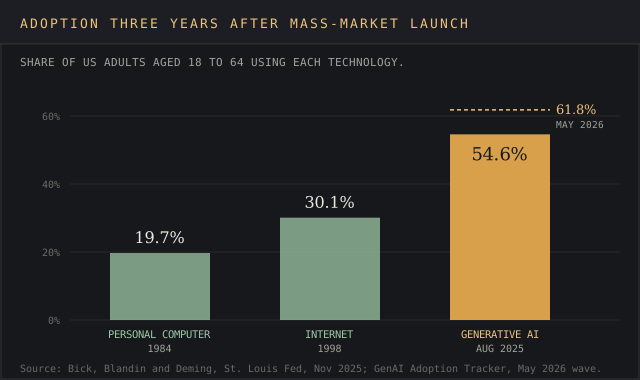
Households jumped on the bandwagon before employers did. Between August 2024 and August 2025, work use rose from 33.3% to 37.4% while use outside work rose from 36.0% to 48.7%. The May 2026 wave of the GenAI Adoption Tracker reads 61.8% of adults and 45.2% of employed respondents using generative AI for work.
Use is still light. Generative AI took 6.3% of total work hours in May 2026, and AI-driven time savings came to 2.2% of hours, a drop in the bucket next to the 45.2% headline. Bick, Blandin and Deming estimate generative AI may have raised US labor productivity by as much as 1.3%. The Fed Board's reading of the November 2025 wave found daily use at less than a third of the overall rate; 35% of users spent up to one hour a week with AI tools.
Inside firms, text analysis and AI-generated content lead the AI technologies and AI algorithms Eurostat tracks. In 2025, AI-driven text analysis (natural language processing of written language) reached 11.8% of EU enterprises, AI-generated images, video or audio 9.5%, written or spoken content generation 8.8% and speech-to-text, another natural language processing tool, 7.2%.
Adoption of AI automation through robotic process automation (RPA) sat below 7.2% of EU enterprises in 2025, as did AI algorithms for image recognition (computer vision) and machine learning for data analysis, the technique behind predictive analytics.
In McKinsey's 2025 global survey, 79% of respondents said their organizations use generative AI, up from 71% the previous year, and the Atlanta Fed found 54% of the US labor force at firms using large language models in November 2025.
Enterprise AI adoption surveys: McKinsey, Microsoft, Ramp and Stanford
McKinsey's "The state of AI in 2026: On the road to ROI" (August 25, 2026; 1,719 respondents in 97 countries, fielded May 4 to June 8) says nearly nine in ten respondents' organizations use AI regularly in at least one business function.
Scaling is easier said than done. 44% of respondents say AI is scaling across the enterprise, up from 38%: 54% at organizations with more than $1 billion in revenue, about one-third at smaller ones. On AI agents, 40% of large-organization respondents report scaling them, up from 27%, while smaller organizations sat flat at 22%.
The shift to agentic AI systems shows up in usage logs. McKinsey's November 2025 edition had 62% experimenting with AI agents and 23% scaling agentic systems. Microsoft's 2026 Work Trend Index (May 5, 2026; 20,000 workers in 10 countries) logged 15-fold year over year growth in active agents in Microsoft 365, and 18-fold in large enterprises.
Weekly use is now routine for US executives. Wharton Human-AI Research and GBK Collective's "Accountable Acceleration: Gen AI Fast-Tracks Into the Enterprise" (October 28, 2025; 800 decision-makers at US companies with more than $50 million in revenue) found 82% using gen AI at least weekly, up from 37% in 2023, and 46% daily.
Three in four of those leaders report positive returns, and 88% expect gen AI budgets to rise within 12 months.
Spending data: Ramp's AI Index
Ramp's AI Index, built from card and bill-pay transactions at more than 70,000 US businesses, showed 50.6% paying for AI tools in April 2026. Its June 9, 2026 index had 41% of businesses paying for Anthropic's AI solutions and 39.5% paying OpenAI, the two AI companies behind the Claude and ChatGPT AI assistants and the AI models under them.
AI-driven spending is lopsided. The median firm on Ramp spent $11.38 per employee per month on AI solutions, the top 10% spent $611 and the top 1% spent $7,450. A roughly 650-fold gap between the median and the top 1% sits inside the generative AI market's single adoption figure. Software budgets are in the SaaS statistics report.
Global AI investment behind the adoption numbers
Money runs ahead of use in the AI market. Stanford's 2026 AI Index puts total corporate AI investment at a record $581.69 billion in 2025. Private AI funding reached $344.66 billion of that. US AI investment reached $285.88 billion, against $20.92 billion in Europe and $12.41 billion in China, so the US takes most of the global AI market's capital.
Gartner's May 19, 2026 forecast puts worldwide spending on artificial intelligence at $2.59 trillion in 2026, up 47% from $1.765 trillion in 2025, and $3.493 trillion in 2027.
Grand View Research's AI market size outlook puts the global market for artificial intelligence at $390.9 billion in 2025 and projects market growth of 30.6% a year from 2026 to 2033, for a market value of $3.497 trillion by 2033.
AI could boost economic growth rates by 1.7 percentage points by 2035, a weighted average across 16 industries in 12 economies, in Accenture and Frontier Economics' June 21, 2017 estimate.
Stanford's AI Index also reports global AI adoption by organizations rising from 55% in 2023 to 88% in 2025, and 60% of McKinsey's 2026 respondents expect to raise AI investment next year. The power and water cost of the build-out is in the AI environmental impact statistics.
AI in marketing statistics: 75% of marketers have adopted AI
In the EU data, marketers use AI more than any other function: 34.7% of EU enterprises using AI applied it to marketing or sales in 2025, ahead of business administration, an operational efficiency use, at 31.1%. McKinsey's 2025 survey finds the largest revenue benefits from AI in marketing and sales.
Among AI marketing statistics, Salesforce's State of Marketing report (10th edition, February 19, 2026; 4,450 marketing decision makers surveyed October 8 to November 17, 2025) found 75% of marketers have adopted AI. Marketers report their output hasn't caught up: 84% admit to running generic marketing campaigns, and 78% say content creation can't keep pace with the personalized content they need.
CMO budgets are rising to match. BCG's survey of 200 CMOs (June 2, 2025) found 71% plan to invest more than $10 million a year in GenAI over the next three years, up from 57% a year earlier.
Marketers use AI tools for content creation and for prediction. 38% of marketers using AI run AI-driven segmentation on predicted customer behavior, a predictive analytics use case, and 39% of marketing teams report fully integrated AI. Vendors for predictive analytics are compared in the predictive sales analytics software ranking. 88% have started optimizing for AI-generated answers in ChatGPT and Google AI Overviews.
Marketing professionals will find more marketing statistics, including marketing campaigns data, in the B2B marketing statistics, AI-generated content and content creation figures in the content marketing statistics, and the sales statistics.
AI adoption against deployment at scale
Running AI across the whole business is a much smaller club. McKinsey's December 2025 chart put respondents whose organizations use AI at 88% and those reporting AI fully scaled at 7%. Nearly two-thirds were still at an early stage, experimenting or piloting, in 2025, so most organizations ran AI initiatives without enterprise-wide deployment.
Financial results trail. 37% of McKinsey's 2026 respondents attribute at least some EBIT impact to AI, and 6% qualify as AI high performers, McKinsey's label for organizations attributing 5% or more of EBIT to AI. Productivity gains lead: 80% say AI has improved their individual productivity, and 50% say it helps them make better, data-driven decisions.
In the 2025 edition, almost half reported better customer satisfaction and competitive differentiation from AI. Cost benefits, the operational efficiency side of the ledger, came most often in software engineering, manufacturing and IT. On customer satisfaction work, Salesforce found 81% of marketers would trust AI to respond to customers but are held back by poor data quality.
The jury's still out on jobs. About 96% of US firms using AI reported no change in employment, per the Minneapolis Fed. In McKinsey's 2026 survey, 14% said AI contributed to a decline in workforce size over the past year, while 39% expect AI-driven declines next year and 43% expect little or no change.
Forecasts run larger than the firm data. The McKinsey Global Institute's "Generative AI and the future of work in America" (July 26, 2023) estimated that 29.5% of hours worked in the US could be automated by 2030 with generative AI, against 21.5% without it. Repetitive tasks, data collection and elementary data processing are the most exposed.
The World Economic Forum's Future of Jobs Report 2025 (January 7, 2025) expects AI and other trends to create 170 million new jobs and displace 92 million by 2030, a net gain of 78 million. 40% of its surveyed employers expect to cut staff where AI can automate tasks.
Why AI adoption estimates diverge
Published adoption rates for the same economy run from 19.8% to 88%. Federal Reserve Board economist Jeffrey S. Allen put the cause plainly in his April 2026 note:
"The biggest driver of variation in these estimates likely relates to differences in sampling distributions and units of analysis, but question framing, the materiality of reported usage, information asymmetries between different target respondents, and social desirability bias may play a role as well."
Jeffrey S. Allen, Federal Reserve Board, FEDS Notes, April 3, 2026
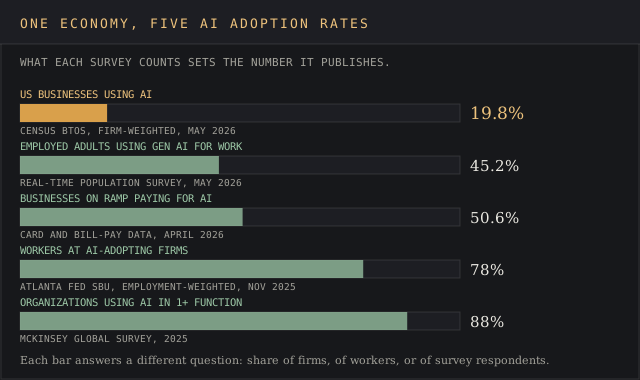
| Survey | Rate | What it counts | Date |
|---|---|---|---|
| US Census Bureau, BTOS | 19.8% | US businesses with AI, firm-weighted | May 3, 2026 |
| Statistics Canada | 19.2% | Canadian businesses with AI | Q2 2026 |
| Eurostat | 20.0% | EU enterprises with 10+ employees using AI | 2025 |
| Real-Time Population Survey | 45.2% | Employed US adults using generative AI for work | May 2026 |
| Ramp AI Index | 50.6% | Businesses on Ramp paying for AI tools | April 2026 |
| Salesforce State of Marketing | 75% | Marketers who have adopted AI | Oct to Nov 2025 fieldwork |
| Atlanta Fed Survey of Business Uncertainty | 78% | US labor force at AI-adopting firms, employment-weighted | November 2025 |
| McKinsey Global Survey | 88% | Respondents' organizations using AI in 1+ function | 2025 edition |
- Unit of analysis. A firm count gives a five-person roofing company the same weight as a 50,000-employee bank. Weighted by employment, the Atlanta Fed gets 78% of workers at adopting firms in November 2025, when the BTOS counted about 18% of firms.
- Definition of use. The BTOS question widened in November 2025 and the rate nearly doubled. McKinsey counts use in any one function, so a single team's AI-driven pilot qualifies. Salesforce asks only about the tools marketers use.
- Sample frame. Ramp measures its own 70,000-plus customers, firms already running spend through its cards. McKinsey's respondents answer for their own organizations, and its scaling rate climbs to 54% at $1 billion-plus firms.
- Person and firm. The RPS counts workers using AI chatbots and other AI tools on their own, at firms that may not count as adopters.
Read between the lines and the Fed's verdict is simple: "The BTOS is the best source for an estimate of the percentage of U.S. businesses that have adopted AI. The RPS is the best source for an estimate of the share of the labor force that uses GenAI at work." A firm count makes sense for sizing a customer base; the market research methods guide covers how sample frames shape survey results.
Barriers to AI adoption: expertise, legal clarity and relevance
Of EU enterprises that considered AI technologies and didn't adopt them in 2025, 70.9% cited a lack of relevant expertise, a gap in AI-related skills. 52.5% cited unclear legal consequences and 48.8% concerns about data protection and privacy. Only 20.7% said AI wasn't useful.
Canadian firms answer differently. 40.0% said AI isn't relevant to their business, with cybersecurity or privacy concerns (13.4%) and cost (10.6%) the top named obstacles. US non-users in the BTOS most often say AI doesn't apply to their business, per the Minneapolis Fed. The cybersecurity statistics report covers the breach costs behind the data privacy answer.
Cost and implementation challenges show up once AI is running. About 20% of McKinsey's 2026 respondents, business leaders answering for their organizations, said AI-related operating costs, token costs included, constrained their AI rollouts. Deloitte subtitled its 2025 factory survey "Navigating challenges to implementation"; 23% of its respondents were still piloting AI/ML.
Data privacy and ethical considerations have their own rulebook. In November 2021, UNESCO's 193 member states adopted the Recommendation on the Ethics of Artificial Intelligence, which UNESCO calls "the first global standard on AI ethics".
Public acceptance sets its own limit. In a Pew Research Center survey fielded December 12 to 18, 2022, 71% of US adults opposed AI making final hiring decisions and 66% wouldn't want to apply for a job where AI helps decide. Among adults who see racial or ethnic bias in hiring as a problem, 53% said more AI would improve it and 13% said it would make bias worse.
Every survey behind these adoption rates, and how often each one updates
Official statistics: census.gov (Business Trends and Outlook Survey release, 26 May 2026; working paper CES-WP-24-16, March 2024), ec.europa.eu (Eurostat news release, 11 December 2025; Statistics Explained on AI in enterprises) and www150.statcan.gc.ca (11 June 2026).
Federal Reserve research: federalreserve.gov (FEDS Notes, 3 April 2026), minneapolisfed.org (29 May 2026), stlouisfed.org (13 November 2025) and genaiadoptiontracker.com (Real-Time Population Survey, May 2026 wave).
Enterprise and marketing surveys: mckinsey.com (The state of AI, 5 November 2025 and 25 August 2026; chart of 10 December 2025; healthcare survey, 16 April 2026; McKinsey Global Institute, 26 July 2023), microsoft.com (Work Trend Index, 5 May 2026), knowledge.wharton.upenn.edu (28 October 2025), deloitte.com (1 May 2025), salesforce.com (19 February 2026), bcg.com (2 June 2025) and ramp.com (AI Index, May and June 2026).
Investment, forecasts and attitudes: hai.stanford.edu (2026 AI Index), gartner.com (19 May 2026), grandviewresearch.com, newsroom.accenture.com (21 June 2017), weforum.org (Future of Jobs Report 2025, 7 January 2025), pewresearch.org (20 April 2023) and unesco.org.
Every figure was checked against its source on 7 October 2026. The Census survey publishes every two weeks, Statistics Canada quarterly and Eurostat once a year, so the US business rate is the first of the three to move.
Frequently asked questions
What is the AI adoption rate in the US?
19.8% of US businesses used AI on May 3, 2026, per the Census Bureau's BTOS, and 45.2% of employed adults used generative AI for work in May 2026.
Is AI adoption increasing or decreasing?
Increasing, on every tracked series. US firms went from 3.7% (September 2023) to 19.8% (May 2026), Canadian businesses from 12.2% to 19.2% in a year, and US adult generative AI adoption from 44.6% (August 2024) to 61.8% (May 2026).
Which country has the highest AI adoption rate?
Among EU enterprises, Denmark leads at 42.0% in 2025, followed by Finland (37.8%) and Sweden (35.0%).
What is the failure rate of AI adoption?
McKinsey's 2026 survey is the closest published proxy. 37% of respondents attribute at least some EBIT impact to AI, so 63% report none yet, and 6% reach the 5%-of-EBIT bar for high performers. Softer outcomes score better: almost half of 2025 respondents reported customer satisfaction gains.
How many people have adopted AI?
In the US, 61.8% of adults aged 18 to 64 used generative AI in May 2026; Pew's figures on adults using AI chatbots are in the chatbot statistics report.
Bottom line
Every adoption rate on this page answers a different question. Official firm counts in the US, Canada and the EU agree near 20%. Household surveys put generative AI use at 45% to 62% of adults. Executive surveys report 88%. Quoting any of them without its unit will miss the mark.
All this points one way: up, and faster since 2024. The gap to watch for 2027 sits between use and scale, 88% against 7% in McKinsey's data. In a nutshell, a business strategy built on these numbers should zero in on the second one.