Sales statistics for 2026: 48% of reps hit quota and sellers sell 40% of the time
 By Jan Suski. I go deep on every review, checking every number against its source and digging up details other coverage misses, a habit from six years of SEO and link building for tech companies. Bylines at Surfer, Brand24, and Senuto. How the scoring works.
The numbers B2B sales teams, buyers and U.S. sales jobs, checked 4 October 2026
A significant majority of sellers miss quota on Ebsta's CRM data, so a missed number is par for the course in 2025 and 2026.
Buyers want less time with reps, at 67% in Gartner's survey, and 6sense found they first contact sellers 61% of the way through their buying process.
AI is near universal on the sell side, at 87% of sales organizations, and The Bridge Group's heaviest AI users reached 57% of reps at quota against 39%.
Sales reps spend 40% of their working time selling, per Salesforce's survey of 4,050 sales professionals, and 48% of account executives finished at quota in The Bridge Group's 2026 study. Ebsta's pipeline data puts the miss rate at 78% of sellers.
This report collects 2026 sales statistics on seller time, quota attainment, AI adoption, prospecting, sales cycles, buyer behavior, headcount and pay. Every figure links to its publisher, and one section names where the houses disagree and why.
It's written for sales leaders, revenue operations teams & founders setting sales targets, since quota plans, hiring and tool budgets get set against these numbers. The benchmark you pick moves the share of reps at quota anywhere between 22% and 60%.
Sales productivity statistics: reps spend 40% of their time selling
The average seller spends 40% of the week selling, and Gen Z reps manage 35%, per Salesforce's State of Sales, 7th edition, fielded August to September 2025. Salesforce's companion page of 40 sales statistics puts the other side of the ledger at 60% of time on non-selling tasks.
Sales process efficiency is where AI tools pick up the slack. Gartner's survey of 210 chief sales officers and senior sales leaders, published May 19, 2026, found AI saves sellers 4.8 hours a week. 72% of the sales teams surveyed report low reinvestment of that time in high-value selling.
The teams that reinvest are 2.2 times more likely to exceed customer growth goals and 3.1 times more likely to exceed their goals for lead-to-opportunity conversion rates. Both multiples come from the same 210 leaders, so sales productivity in Gartner's data turns on what managers do with the freed hours.
Data quality decides how much admin AI can absorb. 74% of sales teams with AI prioritize data hygiene to support it, and 51% of sales leaders with AI say tech silos delay or limit their AI projects. Clean CRM data is a competitive edge: high performers prioritize data hygiene at 79%, against 54% of underperformers.
The raw material is messy. 70% of data and analytics leaders say the most valuable insights for their organizations are trapped in unstructured data, per Salesforce's State of Data and Analytics.
A rep who sells two days out of five spends three on research, admin & CRM entry, and Gartner's data shows most teams haven't redeployed the 4.8 hours AI saves.
Quota attainment: between 22% and 60% of reps hit quota
The Bridge Group's 2026 AE Models, Motions & Metrics report, built from 158 B2B companies, puts quota attainment at 48% of account executives, down from 51% in 2024. Its 2025 SDR report, covering 351 companies, has 60% of sales development reps at quota, the lowest in the study's history.
Ebsta reads CRM and pipeline data. Its 2025 benchmarks, released April 22, 2025 on $48 billion of pipeline, found 78% of sellers missed quota, so 22% of sales reps hit quota. In the 2024 edition with Pavilion, covering 4.2 million opportunities at 530 companies, 69% of reps fell short, leaving 31% at quota. Only 15% of sales teams had over 50% of reps reach 80% of quota, so in the other 85% half or fewer got there.
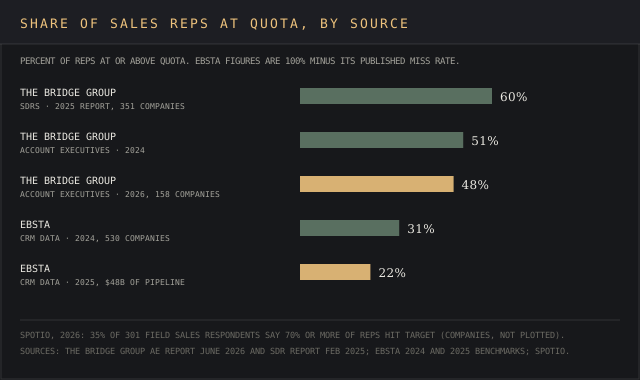
Field teams look similar. SPOTIO's State of Field Sales 2026 asked 301 respondents who track quota, and 35% said 70% or more of their reps consistently hit target. 73% of field sales teams still reported revenue growth, and changes in customer buying behavior topped the list of external top challenges.
Revenue concentrates at the top. Ebsta's 2024 data reveals that 17% of reps generated 81% of revenue, the lion's share, and top performers outsold the rest by 8.9 times, up from 6 times in the first half of 2023. By 2025 Ebsta measured top performers who close deals 11 times faster than their lower-performing peers.
Quota targets move under the numbers. Ebsta's 2024 edition found average quotas cut 19%, and had quotas stayed flat, 79% of reps would have missed. The Bridge Group's median AE quota sits at 4.6 times on-target earnings, so sales leaders who set quotas from historical attainment, deal size and close rates can check if a target is realistic before reps leave over it.
Missing quota puts a rep with the majority on Ebsta's data and near the median on The Bridge Group's, so the benchmark you pick decides how hard your sales targets look and how you grade sales performance.
Why the published sales statistics disagree
The houses disagree on quota attainment by 38 points, on buyer AI use by 49 points, and on the direction of the sales cycle. Each gap traces back to the sample, the definition or the publisher's product.
| Metric | House and figure | Sample | What it counts |
|---|---|---|---|
| Reps at quota | The Bridge Group: 48% of AEs at quota | 158 B2B companies | Reps at or above quota, reported by the company |
| Reps at quota | Ebsta: 78% missed | $48B of pipeline, 2,000 CROs | CRM revenue closed against quota |
| Reps at quota | SPOTIO: 35% | 301 field sales respondents | Companies where 70%+ of reps hit target |
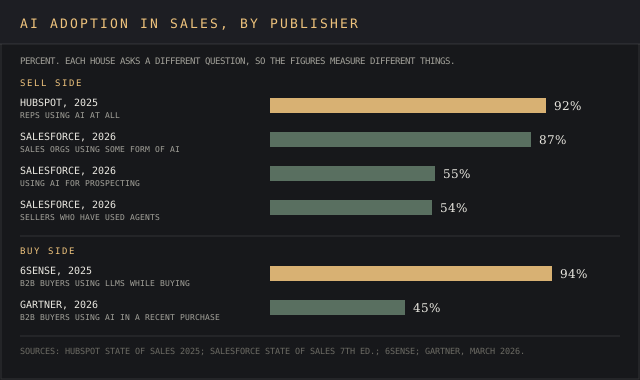
| AI on the sell side | Salesforce: 87% | 4,050 sales professionals | Organizations using some form of AI |
| AI on the sell side | HubSpot: 92% | 1,000 sales professionals | Individual reps using AI at all (8% don't) |
| AI on the buy side | 6sense: 94% | Nearly 4,000 B2B buyers | Any LLM use during the buying process |
| AI on the buy side | Gartner: 45% | 646 B2B buyers | AI used during one recent purchase |
| Sales cycle | Salesforce: 57% say it's longer | 4,050 sales professionals | Seller perception of the trend |
| Sales cycle | 6sense: 10.1 months, from 11.3 | Nearly 4,000 B2B buyers | Buyer-reported cycle length |
The devil's in the details of each method, and four of them move the numbers.
- Sample. The Bridge Group surveys companies, 83% of its SDR respondents B2B SaaS firms. Ebsta reads CRM records, 4.2 million opportunities in 2024, a count of what reps closed.
- Definition. Ebsta and The Bridge Group count reps, SPOTIO counts companies, and Salesforce counts organizations using "some form of AI" for any of a list of tasks.
- Publisher interest. Salesforce sells Agentforce agents and HubSpot sells AI features inside its CRM; 6sense sells buyer-intent data, Ebsta sells revenue intelligence, and SPOTIO sells field sales software. Each headline lands on its publisher's product category, and the sales intelligence market report sizes those categories.
- Timing. The sources in the table were published between April 2025 and June 2026.
Sales leaders reading market trends off one survey inherit its sample, so read the sample line before the headline.
AI in sales: 87% of sales organizations use it and 54% of sellers have tried agents
87% of sales orgs use AI for tasks like prospecting, forecasting, lead scoring or drafting emails, per Salesforce. 54% of sellers say they've used agents, and nearly 9 in 10 plan to by 2027. 55% of sales professionals use AI for prospecting, with another 38% planning to.
Prospect research before outreach is the first job agents take over. Once agents are fully in place, sellers expect them to cut prospect research time by 34% and email drafting by 36%, and top performers are 1.7 times more likely than underperformers to use agents for prospecting.
HubSpot's 2025 State of Sales, a survey of 1,000 sales professionals updated September 9, 2025, found only 8% of reps don't use AI at all. 84% say AI saves time and optimizes processes. Usage outside sales is tracked in the AI statistics report.
Two studies tie AI use to quota. Gartner's 2024 survey of 1,026 B2B sellers found those who partner effectively with AI are 3.7 times more likely to meet quota. The Bridge Group's highest AI-engagement tercile had 57% of reps at quota, against 39% in the lowest.
Returns split down the middle. Gartner publishes no average ROI on AI in sales: 25% of the sales orgs it surveyed report a return of 50% or more on each dollar invested, and 20% report a negative return of 50% or more. Reinvesting the saved hours is easier said than done.
Sellers carry the learning load. 72% of sellers in Gartner's 2024 survey felt overwhelmed by the number of skills their job requires and 50% by the amount of sales technology, and overwhelmed sellers were 45% less likely to attain quota. Teams pricing the essential tools of a sales tech stack can compare revenue intelligence pricing, CRM software cost and the conversation intelligence software ranking.
88% of reps with agents say the technology raises their odds of hitting sales targets, per Salesforce, and the measured quota gap in The Bridge Group's data is 18 points.
Sales prospecting statistics: cold calls book meetings at 4.82%
Cognism's State of Cold Calling 2024 tracked 55,701 cold calls. 9,247 connected, 5,265 turned into conversations and 254 booked meetings, a 4.82% success rate on conversations, up from 2% the year before. The conversion rates at each step: 16.6% of dials connected, 57% of connected calls became conversations, and 1 dial in 219 booked a meeting.
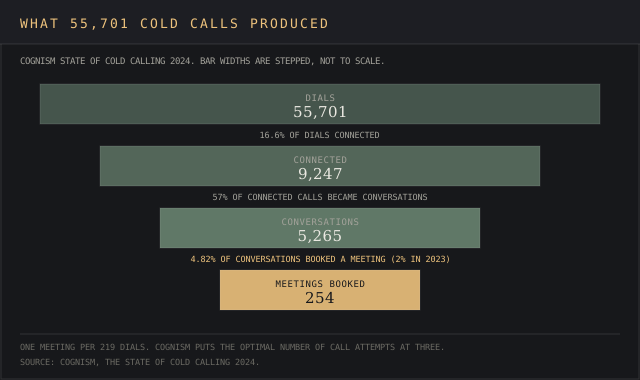
Any single dial is a long shot, so follow-ups carry the odds. Cognism puts the optimal number of call attempts at three, which means two follow-up calls belong in every sequence before a rep moves on.
The opener matters too. Gong, which records sales calls, analyzed more than 300 million cold calls for its opener study, published July 24, 2024. The success rates ran from 11.24% for "Heard the name tossed around?" to 2.15% for "Did I catch you at a bad time?"
Sales development reps spread their effort across channels and hand sales-ready meetings to AEs at a ratio of 1 SDR to 2.4 AEs. The Bridge Group's SDR report counts 112 activities a day:
- 44 phone calls and 41 emails
- 19 LinkedIn touches and 8 texts or other
- 4.1 quality conversations a day, the study's first rebound
- $3.78 million of pipeline per SDR, up from $2.83 million
The sequencing software behind those touches is priced in the sales engagement pricing report.
Cold outreach response rates favor social channels. Asked which channel produces the highest response rates, 42% of HubSpot's respondents named social media, 26% email and 23% phone. Nearly half of sales reps call cold calling the worst part of their job, per Salesforce. Teams buying contact data can start with the sales intelligence tools ranking, the Cognism review or the ZoomInfo review.
At Cognism's conversion rates a rep needs about 219 cold calls per meeting, and Gong's openers move the meeting rate fivefold, so dial volume and the first sentence decide how many sales opportunities a week produces.
B2B buyers: 67% prefer a rep-free buying process
Gartner surveyed 646 B2B buyers from August to September 2025: 67% prefer a rep-free experience and 45% used AI during a recent purchase. Confident buyers were twice as likely to report a high-quality deal, so value propositions have to land in content a buyer reads alone, before the sales process starts. Gartner analyst Alyssa Cruz tells enablement leaders to move past static content distribution to AI-driven support that fits into sellers' daily workflow.
Buyers decide early, and the early bird catches the worm. 6sense's survey of nearly 4,000 buyers found they first contact sellers 61% of the way through their purchase, down from 69%. The winning vendor was already on the Day One shortlist 95% of the time, and the first vendor contacted ended up winning deals about 80% of the time.
More people sign off. Forrester's State of Business Buying 2026, published January 21, 2026, counts 13 internal participants and nine external influencers in a typical buying decision. Procurement professionals are among the decision makers in 53% of cycles, and over 60% of buyers use a trial.
High-value deals and digital buying
78% of buyers making purchases of $10 million or more run a trial first, per Forrester. McKinsey's 2026 B2B Pulse, nearly 4,000 decision makers in 13 countries, puts the average number of channels buyers use at ten. Customer interactions run in hybrid models, split roughly evenly between in-person, remote and digital.
71% of B2B companies now offer e-commerce, and a significant portion of their revenue, about a third, comes through it. 73% of buyers are comfortable ordering over $50,000 online, up from 59% in 2022. McKinsey's market leaders were nearly three times as likely as laggards to post double-digit revenue growth, 60% against 21%.
With the first-contacted vendor winning about 4 deals in 5, most of the buying process is settled before a seller's first call, and intent data providers sell the signal of who's researching.
Sales and marketing alignment: thought leadership and influencer marketing
Hidden buyers stay under the radar of sales teams. In Edelman & LinkedIn's 2025 B2B Thought Leadership Impact Report, 71% of hidden buyers say they have little or no interaction with sales teams, and over 40% of B2B deals stall on internal misalignment.
Thought leadership reaches them. 95% of hidden buyers say strong thought leadership makes them more receptive to sales and marketing outreach, and 79% are more likely to advocate for a proposal in an RFP when the vendor consistently publishes high-quality thought leadership. At the moment of purchase they value understanding of their business challenges (85%), of industry trends (76%) and domain expertise (74%).
Influencer marketing budgets are rising while revenue tracking lags. In Influencer Marketing Hub's 2026 benchmark report, published May 4, 2026, 87.49% of respondents expect their influencer marketing budget to increase. Among the most aggressive budget scalers, 25% select attributable revenue or sales as a KPI.
Sales and marketing need to be on the same page about content, since 95% of the hidden buyers sellers rarely meet say thought leadership shapes how they receive outreach.
Sales cycle length: 57% of sellers say deals take longer
Closing is getting harder in sellers' eyes: 57% of sales professionals say the sales cycle is getting longer, per Salesforce. Ebsta's 2024 data measured sales cycles 16% longer in the first half of 2023 and 38% longer than in 2021, before they shortened 23% as the year closed. 6sense's buyers report the opposite trend, an average of 10.1 months in 2025 against 11.3 in 2024, while evaluating more vendors.
Qualification shortens the entire sales cycle. Ebsta's qualification report, released August 1, 2025 on more than 655,000 opportunities worth $48 billion, measured these gaps between well-qualified and poorly qualified deals:
- 6.3 times more likely to close
- Close deals 21.6% faster on average
- 1.9 times less likely to slip past the forecast close date
- 50% win rates, against 8%
Successful sales reps qualify harder: Ebsta found top performers manage nearly twice as much pipeline by disqualifying faster. Only 36% of deals that pass Discovery carry both a qualification score and notes, a gap in the sales process most teams can measure. When a champion shares a digital sales room internally at least twice, the sales cycle shortens by 15% on average.
Slippage is common. Ebsta's 2024 benchmarks found 44% of deals pushed back, and reps blamed "indecision" for 61% of lost deals. New hires take longer to hit the ground running: The Bridge Group measured AE ramp at 6.2 months, the longest in its history, with experience at hire up to 3.7 years from 2.7 in 2022.
Sales cycle length depends on who's asked, and the measurable lever is qualification, which Ebsta ties to 21.6% faster closes.
Win rates, deal size and the reasons deals are lost
RAIN Group's Top-Performing Sales Organization research, 472 respondents, split companies into tiers, and its most successful sales teams post a win rate near three in four. Elite Performers, the top 7%, hold a 73% win rate and Top Performers 62%; the other 80% close 40% of the time, an average win rate of 40%.
Ebsta's 2024 data showed win rates down 18% against 2022 and 27% against 2021. Deal size moved the other way: Ebsta's 2025 benchmarks found deal values up 54% year over year, and The Bridge Group's median AE quota reached $960,000. Pricing models are shifting too, with 76% of sales leaders saying usage pricing matters more to customers than a year ago (Salesforce).
Most lost deals miss the mark on fit and value. HubSpot's respondents named no product fit (37%) and a poor value proposition (35%) as the top deal-killers, so product fit and value propositions top the list of fixes. These are the key sales metrics they use to measure success, by share of respondents:
- Annual recurring revenue: 42%
- Average profit margin: 30%
- Conversion rates: 29%
- Win rate: 28%
Winning deals at RAIN's elite rate of 73% against 40% produces 82% more deals from the same active pipeline, a bigger lift than the 54% rise in deal values Ebsta measured.
Sales headcount and pay: 13.4 million U.S. sales jobs at a $54,960 mean wage
The Bureau of Labor Statistics counted 13,424,300 jobs in sales and related occupations in May 2025, out of 155,495,730 across all occupations. Their mean annual wage was $54,960, against $69,770 for all jobs, and the median hourly wage was $18.52.
| Occupation | U.S. employment | Mean annual wage |
|---|---|---|
| Sales and related occupations | 13,424,300 | $54,960 |
| Retail salespersons | 3,897,860 | $37,310 |
| Cashiers | 3,110,940 | $33,220 |
| Sales representatives, services | 2,371,490 | $87,040 |
| Sales representatives, wholesale and manufacturing | 1,522,990 | $89,490 |
| First-line supervisors of sales workers | 1,336,190 | $60,750 |
| Sales managers | 637,080 | $164,350 |
| Sales engineers | 51,790 | $130,140 |
Source: BLS Occupational Employment and Wage Statistics, May 2025, Table 1.
B2B software pay sits well above the BLS mean. The Bridge Group's median AE on-target earnings reached $200,000, up from $190,000 in 2024, against a median quota of $960,000, 4.6 times OTE. Median SDR on-target earnings were $80,000, and 38% of AEs now own renewal and expansion.
Sales roles carry high turnover. The Bridge Group's median SDR attrition is 40% a year (13% involuntary, 11% voluntary, 16% promotions), and Ebsta measured rep turnover rising from 22% to 36%. Lack of career advancement is the #1 reason sales reps want to change jobs, per Salesforce, so growth opportunities double as retention. 76% of reps want more transparency in how their pay is calculated, and leaders setting it can check compensation benchmarking tools.
High turnover at 36% to 40% a year means a team replaces over a third of its reps annually, and each new AE needs 6.2 months to ramp.
Sales training and coaching statistics
Training quality separates the tiers in RAIN Group's research. 51% of Elite Performers rate their sales training "extremely or very effective", against 30% of Top Performers and 14% of the rest, and Top Performers are 63% more likely to call their sales training investment excellent or good.
Gartner's 2024 seller survey names the skills that pay. Tactical flexibility raises the likelihood of reaching quota 3.4 times, and mentalizing, inferring a buyer's unspoken beliefs and intentions, raises it 2.9 times. That's effective communication measured in quota.
Peer groups show up in the data too. High performers are 3.2 times more likely to join a sales community, and 81% of sales reps say a community improves their sales performance, per Salesforce.
Team performance follows leadership follow-through. When leaders set priorities, 69% of Top Performers say they get executed, against 51% of the rest. RAIN ties sales excellence to customer value: 91% of Elite Performers focus on maximum customer value, against 61% of the rest.
Sales training pays when sellers rate it effective, and the 51% to 14% gap in RAIN's data separates RAIN's elite top 7% from the bottom 80%.
Customer retention, upselling and referrals
Acquiring a new customer costs "anywhere from five to 25 times" more than retaining one, per Harvard Business Review, which credits Bain's Frederick Reichheld with the finding that a 5% rise in retention lifts profits by 25% to 95%. RAIN Group puts expansion at 5 to 7 times less expensive than new business.
Top Performers in RAIN's data are effective at selling more to existing accounts at a 61% rate, against 32% for the rest. HubSpot's respondents named these upsell drivers, all of them forms of relationship building that put the long-term customer connection ahead of a one-off sale:
- Understanding customer goals: 42%
- Building trust and rapport: 40%
- Providing consistent value: 39%
Maintaining strong relationships pays in referrals too. A Journal of Marketing study of a German bank's referral program, tracking about 10,000 customers over nearly three years, found the average referred customer's value sits at least 16% above that of nonreferred customers with similar demographics.
Strong relationships and customer satisfaction carry a price tag, 25% to 95% more profit on a 5% retention gain.
U.S. retail sales statistics: $773.9 billion in August 2026
U.S. retail and food services sales reached $773.9 billion in August 2026, up 1.2% from July and 6.0% from August 2025, per the Census Bureau's advance estimate released September 16, 2026.
Online sales grow faster. Census e-commerce sales reached $340.2 billion in the second quarter of 2026, up 12.2% year over year against 6.7% for total retail, and made up 17.1% of total retail sales revenue.
Store owners build their own sales statistics from order data. Average order value is revenue divided by orders, Google Analytics 4 reports purchase revenue and transactions in its monetization reports, and store conversion rates are purchases divided by sessions. Retailers running loyalty programs to encourage repeat purchases track both numbers for returning customers. The retail industry statistics report covers the wider store data.
Keep an eye on the e-commerce share, which grew 12.2% against 6.7% for all retail, since that gap shows where retail sales revenue is moving.
The surveys, CRM datasets and government tables behind each sales figure
Seller surveys: salesforce.com (State of Sales, 7th edition, 3 February 2026, and its State of Data and Analytics), blog.hubspot.com (2025 State of Sales, updated 9 September 2025), spotio.com (State of Field Sales 2026) and rainsalestraining.com (Top-Performing Sales Organization research).
Quota, pipeline and calls: bridgegroupinc.com (2026 AE Models, Motions & Metrics, 22 June 2026; 2025 SDR report), ebsta.com (2024 benchmarks with Pavilion; 2025 GTM Benchmarks, 22 April 2025; qualification report, 1 August 2025), cognism.com (State of Cold Calling 2024) and gong.io (opener study, 24 July 2024).
Buyers and marketing: gartner.com (releases of 16 September 2024, 9 March 2026 and 19 May 2026), 6sense.com (Buyer Experience Report 2025), forrester.com (State of Business Buying 2026, 21 January 2026), mckinsey.com (2026 B2B Pulse), edelman.com (2025 B2B Thought Leadership Impact Report with LinkedIn) and influencermarketinghub.com (4 May 2026).
Jobs, retail and retention: bls.gov (Occupational Employment and Wage Statistics, May 2025), census.gov (advance retail sales, 16 September 2026; quarterly e-commerce), hbr.org and journals.sagepub.com (Journal of Marketing).
Every figure was checked against its source on 4 October 2026. Gartner publishes no average return on AI in sales, and the quota figures come from company surveys and CRM records counted on different definitions, so no single attainment rate covers every sales team.
Frequently asked questions
What are the statistics for follow-up sales?
Cognism found three cold calls give the best chance of connecting with a lead, and its 2024 data converted 4.82% of conversations into meetings. The Bridge Group's SDRs log 112 activities a day across phone, email & LinkedIn in the early sales process.
What are some interesting facts about sales?
17% of reps generated 81% of revenue in Ebsta's 2024 data. The vendor a buyer contacts first wins about 80% of the time, per 6sense.
Why are sales down right now?
Sales professionals in HubSpot's survey named inflation (75%), recession (74%) & interest rates (70%) as macroeconomic concerns, and Ebsta measured win rates down 18% against 2022. 60% of HubSpot's respondents still reported being on track to meet their sales goals, and 73% of SPOTIO's field sales teams grew revenue.
Are U.S. retail sales down?
U.S. retail sales rose 6.0% year over year to $773.9 billion in August 2026, per the Census Bureau, and e-commerce grew 12.2% in the second quarter.
How to calculate a sales forecast?
Multiply each open deal size by the win probability of its stage in your sales process, then add the results for the period. Ebsta's data shows why stage weights need qualification data: well-qualified deals win 50% of the time and poorly qualified ones 8%.
Bottom line
These sales statistics agree on direction and split on degree. 48% of account executives hit quota in The Bridge Group's data and 22% of sellers in Ebsta's, and AI sits in 87% of sales orgs.
The divergence comes from method. Leadership surveys report higher attainment than CRM records, sell-side AI adoption depends on the question asked, and every vendor survey lands on its publisher's category. Benchmark your own sales teams against the house whose sample matches yours, and set sales goals from your own win rates and deal size.
The buyer side moved furthest. Two-thirds of B2B buyers want a rep-free process and contact sellers late, so the sales performance numbers that matter come early: shortlist presence, qualification and the first conversation.