Call center software cost in 2026: $15 to $360 per agent across 11 rate cards
 By Jan Suski. I go deep on every review, checking every number against its source and digging up details other coverage misses, a habit from six years of SEO and link building for tech companies. Bylines at Surfer, Brand24, and Senuto. How the scoring works.
The numbers Call center software pricing, checked 1 October 2026
The top published seat price is 24 times the bottom one, because a $15 business phone line and a $360 omnichannel suite with workforce management solve different problems.
A 50-seat minimum puts Five9's cheapest published configuration at $71,400 a year, so seat minimums decide the buying shortlist before features do.
License type moves a bill as much as tier does: a concurrent seat costs about half again as much as a named one and pays off below 68% concurrency.
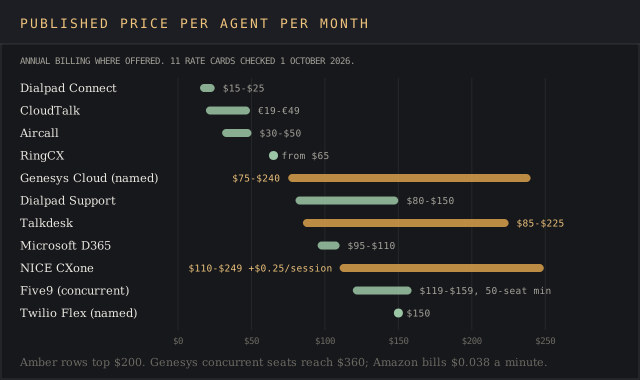
Call center software costs $15 to $360 per agent per month on the 11 rate cards checked on 1 October 2026. The floor is Dialpad Connect Standard at $15 a user billed annually. The ceiling is a Genesys Cloud CX 4 concurrent license at $360. Amazon Connect skips the seat entirely and bills $0.038 per voice minute.
The entry cards are a drop in the bucket next to the contracts. Vendr's anonymized buyer data puts the median annual Aircall contract at $14,256 and the median Talkdesk contract at $88,536. Seat count, license type and add-ons move a call center quote more than the plan name does.
This report covers pricing models, every published plan, Vendr's tracked contracts, costs outside the license, and budgets for 5, 20 and 100 agents. It's written for support team leads and operations managers buying inbound call center software for 5 to 500 agents.
What inbound call center software covers, and how it ties to call center performance
Inbound call center software takes incoming customer calls, queues them, routes them to an agent and records what happened. Plans from $30 add IVR, call recording and reporting to the phone line. Suites such as Talkdesk Digital Essentials at $85 add chat and email as communication channels, so one contact center solution doubles as a customer support platform beside the ticketing system a support team already runs.
Service quality is what customer experience teams pay up for. Zendesk's CX Trends 2025 found 63% of consumers willing to switch to a competitor after one bad experience, so customer satisfaction and customer experience scores ride on the answer times and resolution rates the higher tiers measure across customer interactions.
Self service options are the newest automation features on the bill. CloudTalk's AI Receptionist covers 50 minutes a month at €0, its AI Specialist costs €349 a month for 1,000 minutes, and Dialpad sells AI agents on conversation-based pricing. These automation tools engage customers before an agent picks up.
How call center software pricing models work
Call center software providers use three pricing models: a monthly fee per named agent, a fee per concurrent seat, and pure usage billed by the minute or the hour. Genesys sells all three for the same software solution on one pricing page, the cleanest place to compare different pricing models.
Per-agent (named user) pricing
Named-user pricing charges a flat monthly fee for every person who holds a login, the model most call center software built for small teams uses. Aircall, Dialpad, CloudTalk, Talkdesk, RingCentral and Microsoft all sell this way. The fee is set in stone per seat, and that's where the predictability ends: Aircall lists $30 and $50 a license on annual billing but charges $40 and $70 month to month, a 33% to 40% markup for the freedom to cancel.
Add-ons break the flat fee too. Aircall's pay-as-you-go AI Voice Agent minutes cost $0.49 each, so 2,000 bot minutes a month add $980 to a bill whose seat line never moved.
Concurrent user pricing
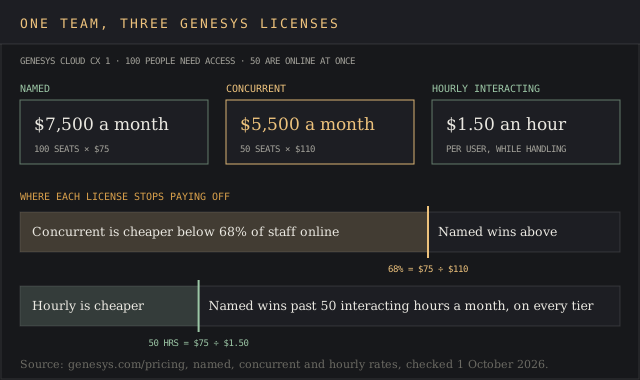
Concurrent pricing charges for the number of agents logged in at the same moment, which suits contact center operations that run shifts and remote teams spread across time zones. Genesys defines it plainly: if 100 people need access but only 50 use it at once, the customer buys 50 concurrent licenses. Five9 prices every published seat this way, at $119 and $159 per concurrent user with a minimum of 50 seats.
The catch is the premium: Genesys charges $110 for a concurrent CX 1 seat against $75 named, and $360 against $240 on CX 4. For 100 people with 50 online at once, CX 1 costs $7,500 a month named and $5,500 concurrent, and concurrent stops paying off above 68% concurrency.
Usage-based pricing by the minute or the hour
Usage pricing bills the activity and skips the seat, so the invoice tracks call volume minute by minute. Amazon Connect charges $0.038 per voice minute, $0.010 per chat message, $0.080 per email and $0.014 per SMS, with standard telephony rates on top and no minimums. AWS's worked example prices 100,000 voice minutes at $3,800 a month, plus $0.90 for a US phone number held 30 days. Scraper APIs meter requests the same way, as our web scraping pricing report shows.
Twilio Flex sells the hour: $1 per active user hour, or $150 per named user per month, with 5,000 free hours for new accounts. The break-even sits at 150 active hours, so a full-time agent logging 168 hours a month is cheaper on the named plan. Genesys runs the same logic with its Hourly Interacting license at $1.50 to $4.80 an hour, which matches the named price at exactly 50 interacting hours on every tier.
Don't jump the gun on a license type. Pull three months of call volume and agent login reports first. Call volume that swings 3x between peak and off-peak weeks favors usage or concurrent pricing. A flat, predictable queue of inbound calls favors named seats, and a vendor that offers all three has flexible pricing worth testing.
What 11 call center software providers publish, plan by plan
Eleven call center software providers publish a price and a list of key features per tier that a buyer can check without a sales call. All 11 sell a cloud based solution billed by the month, the year, the minute or the hour. Five9 keeps the advanced features of its Plus, Pro and Enterprise tiers behind a quote, Genesys and NICE publish every tier, and Aircall publishes everything up to 25 licenses.
Inbound call center software for small teams: Dialpad Connect, CloudTalk and Aircall
The cheapest inbound call center services come bundled in cloud based business phone systems that route calls, record them and log them through CRM integrations. Dialpad Connect costs $15 a user on Standard and $25 on Pro billed annually, or $27 and $35 monthly. CloudTalk lists four plans at €19, €25, €29 and €49 a user on annual billing, and Expert at €49 needs three users.
Aircall sits one step up at $30 for Essentials and $50 for Professional, with a three-license minimum on both and a Custom plan for 25 licenses or more that adds an SLA for reliable performance, SSO and dedicated onboarding. Professional carries the lion's share of the routing features an inbound team needs.
- Key features on Essentials ($30): unlimited calls within the US and Canada, IVR and basic call flows, call recording and AI transcripts, basic dashboards, 250+ integrations with CRM integrations among them.
- Key features on Professional ($50): smart call routing, queue callback, Power Dialer and outbound call campaigns, call whispering and barge, user-level analytics, live monitoring and full API access.
- Extra phone numbers cost $6 a month each on both plans, so a support team running local phone numbers in 10 cities adds $60 a month.
Each of the three has a basic plan cheap enough for a 3-person support team to start for under $100 a month. That's the segment where inbound software for small businesses gets chosen on the minimum order, and where our call intelligence ranking scores Dialpad, Aircall and CloudTalk on transcription and coaching.
Mid-market cloud contact center suites: RingCX, Dialpad Support, Talkdesk and Microsoft
A cloud contact center solution adds omnichannel routing, real-time dashboards and quality tools to the phone line, so one unified platform handles phone calls, chat and email for office and remote teams. RingCX starts at $65 per agent a month with unlimited minutes. Dialpad's contact center plans run $80 for Essentials, $115 for Advanced and $150 for Premium billed annually, or $95, $135 and $170 monthly.
Talkdesk lists Digital Essentials at $85, Voice Essentials at $105, Elite at $165 and its Industry Experience Clouds at $225 per user a month. Elite is where workforce management and custom reporting arrive. Talkdesk Express gives businesses under 50 employees 25 licenses and $100 in credit with no strings attached: Talkdesk says no commitment or contract is required.
Customer experience suites sell a contact center inside a larger contract. Sprinklr Service ships as one module of Sprinklr's CXM bundle, covered in our Sprinklr pricing report, and post-call survey platforms that track customer satisfaction and customer experience price separately, as the Medallia pricing breakdown shows.
Dynamics 365 Contact Center costs $110 a user a month paid yearly, or $95 for the Voice-only or Digital-only editions. Voice runs on Azure Communication Services, a cloud-based service priced separately, and AI agents draw on Copilot Credits sold separately too.
Enterprise contact center platform tiers: Genesys, NICE and Five9
Enterprise contact center platforms publish four or five tiers and negotiate dedicated support and compliance terms on top of the list price. Genesys Cloud CX costs $75, $115, $155 and $240 a named user per month on annual billing. CX 2 adds quality assurance and compliance, CX 3 adds the full workforce engagement suite, and CX 4 adds 30 AI Experience tokens per agent each month.
NICE CXone Mpower publishes five suites, billed monthly in arrears with no prepay. The key features each suite adds:
- Omnichannel Suite, $110 per agent per month: voice and digital channels, omnichannel routing, recording and compliance.
- Essential Suite, $135: adds screen recording and quality management.
- Core Suite, $169: adds WFM and performance management.
- Complete Suite, $209: adds interaction analytics and voice of the customer.
- Ultimate Suite, $249 plus $0.25 per session: adds AI routing, automated summaries and Copilot for agents, supervisors and leaders.
Five9 publishes two prices, Digital at $119 and Core at $159 per concurrent seat, and sends Plus, Pro and Enterprise to sales. NICE prices outbound engagement as an add-on on all five suites, so a team mixing inbound calls with an outbound call program buys it separately. The 50-seat minimum makes Five9 the one of three enterprise platforms here that a 20-agent team can't buy from the rate card, a bitter pill to swallow.
Cloud-based developer platforms: Twilio Flex and Amazon Connect
Twilio Flex's $1 hour or $150 seat covers the agent interface; Twilio's own primitives, such as Conversations, TaskRouter, Studio and Functions, are charged by usage with no free quotas. Amazon Connect lists forecasting, agent scheduling, real-time agent assist and conversational analytics among the capabilities on the page that carries its $0.038 voice minute.
Both carry a steep learning curve, because engineers build the agent desktop and the call flows. Both suit inbound call center services whose call volume swings 3x between seasons, because the bill follows the minutes and the hours worked.
| Vendor | Entry price | Top published price | Billing unit | Minimum | Vendr median* |
|---|---|---|---|---|---|
| Dialpad Connect | $15 | $25 | Named user, annual | 1 user | $28,461 (all Dialpad) |
| CloudTalk | €19 | €49 | Named user, annual | 1 user (3 on Expert) | n/a |
| Aircall | $30 | $50 | License, annual | 3 licenses | $14,256 |
| RingCX | $65 | $65 | Agent, monthly | Not stated | n/a |
| Genesys Cloud CX | $75 | $360 | Named, concurrent or hourly | Not stated | $49,890 |
| Dialpad Support | $80 | $150 | Named user, annual | Not stated | $28,461 (all Dialpad) |
| Talkdesk | $85 | $225 | Named user | Not stated | $88,536 |
| Microsoft D365 Contact Center | $95 | $110 | Named user, annual | Not stated | n/a |
| NICE CXone Mpower | $110 | $249 + $0.25/session | Agent, monthly in arrears | Not stated | $41,417 |
| Five9 | $119 | $159 | Concurrent seat | 50 seats | $19,280 |
| Twilio Flex | $1/hour | $150 | Active hour or named user | None | n/a |
| Amazon Connect | $0.038/min | Usage | Minute, message, email | None | n/a |
Prices per agent per month from each vendor's rate card, checked 1 October 2026. *Vendr median annual contract value from anonymized buyer data, pages last updated February 2026; n/a where Vendr shows no tracked figure for that product.
What buyers pay on Vendr against the list price
Vendr's tracked contracts show what closed, and the medians land between $14,256 and $88,536 a year for the six call center software vendors it covers. Vertice, a procurement software vendor, bought Vendr on 1 June 2026, the same ownership note our procurement software pricing report carries.
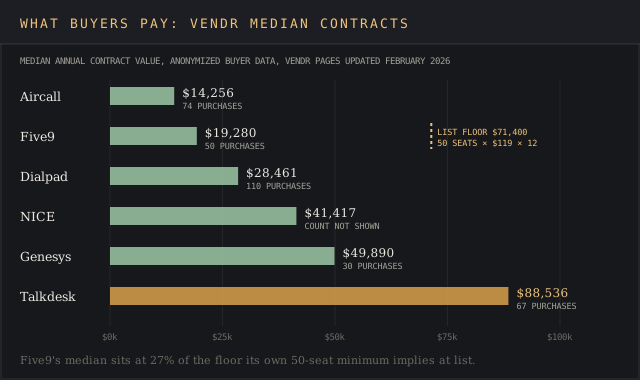
- Aircall: $14,256 median across 74 purchases, $3,065 to $51,795, buyers saving 22.61% on average.
- Five9: $19,280 median across 50 purchases, $3,131 to $70,996.
- Dialpad: $28,461 median across 110 purchases, $2,951 to $178,460, 17.81% average savings.
- NICE: $41,417 median, $2,736 to $77,025, with no purchase count shown.
- Genesys: $49,890 median across 30 purchases, $3,600 to $240,390, about 55 CX 1 named seats at list.
- Talkdesk: $88,536 median across 67 purchases, $16,566 to $768,775, 21.33% average savings, about 70 Voice Essentials seats at list.
Five9's highest tracked contract, $70,996, sits below the $71,400 that 50 Digital seats cost for a year at list. Read between the lines and ask in writing what the 50-seat minimum binds to.
The 17.81% to 22.61% average savings are the cost savings Vendr's tracked buyers negotiated off list. The same split between a self-serve card and a quote-only contract runs through our social listening pricing report, the competitive intelligence pricing breakdown and the market intelligence platform pricing tiers.
Hidden costs: telephony, add-ons, onboarding and support
Telephony, add-ons, onboarding and support fees sit beside the license on most quotes. Amazon, Microsoft, Five9 and Twilio each state on their own pricing pages that usage is billed in addition to the seat or the minute.
| Cost outside the license | Vendor | Published price |
|---|---|---|
| AI coaching add-on | Aircall AI Assist Pro | $49 a seat a month |
| Analytics add-on | Aircall Analytics+ | $15 a seat a month |
| CRM integrations: Salesforce Voice | Aircall | $30 a seat a month |
| Extra phone numbers | Aircall | $6 a number a month |
| Power dialer | CloudTalk | €15 a user a month |
| AI conversation intelligence | CloudTalk | €9 a user a month |
| Telephony per inbound call minute | Amazon Connect | Standard telephony rates on top of $0.038 |
| Paid support plan | Twilio Production | Greater of $250 or 4% of monthly spend |
The devil's in the details on add-ons, because they scale with seats. Ten Aircall Professional licenses cost $500 a month, and AI Assist Pro on all ten adds $490, which nearly doubles the bill. Advanced features priced per seat follow the same arithmetic on every vendor that sells them separately, and CRM integrations are the add-on buyers forget to price.
Support fees are a separate line on developer platforms. Twilio's support plans run from the greater of $250 or 4% of monthly spend on Production to $5,000 or 8% on Personalized. A 20-seat Flex team paying $3,000 a month hits the $250 floor, an effective 8.3% surcharge.
Onboarding and setup fees go unpublished, and the contracts show they exist. RingCentral's add-on service description lists a set-up fee for Cognigy deployments and an "Implementation pack (required per project)" for NovelVox, with no price beside either. Ask for implementation as its own quoted line, with the hours it covers.
Total cost of ownership for year one is the sum of five lines: licenses, telephony usage, add-ons, implementation and support. A quote that prices only the first is a red flag.
Key features that move call center software into a higher tier
Every vendor gates the same call center features in roughly the same order, par for the course across all 11 rate cards, so the list of key features predicts the tier. Call routing, IVR and call recording sit on entry plans. Workforce optimization, quality monitoring and AI contact center tools sit two or three tiers up.
Call routing, IVR and call queues
Interactive voice response (IVR) systems guide inbound calls through automated voice menus, and Aircall includes IVR and basic call flows on its $30 Essentials plan. Smart call routing directs calls to the right agent by skill, language or customer value; Aircall puts it, with queue callback, on the $50 Professional plan. Skills-based routing matches a caller's language or product line to the agents tagged for it before the call joins one of the call queues.
AI call routing that predicts the best agent for each inbound call costs more. NICE marks AI routing as a consumption-based add-on on its Omnichannel, Essential, Core and Complete suites and includes it only in Ultimate at $249 plus $0.25 per session.
Call recording, quality management and speech analytics
Call recording sits on entry plans: Aircall Essentials includes recordings and AI transcripts, Dialpad Support Essentials transcribes and records calls, and NICE includes recording and compliance from its $110 Omnichannel Suite. Quality management, which scores recorded customer interactions, costs more. NICE adds it from Essential at $135, Genesys from CX 2 at $115, and Dialpad's $150 Premium plan adds AI-powered quality management.
AI-driven speech analytics give real time insights into customer interactions while the call is still live. Dialpad sells live coach cards on Advanced at $115. NICE includes interaction analytics from Complete at $209, and our conversation intelligence ranking covers the standalone tools that do the same job for sales teams. The revenue intelligence ranking scores Gong, Clari and eight others on forecasting built from call data.
Workforce management and workforce optimization
Workforce management tools forecast call volumes, schedule agents against them and track agent productivity against the schedule. NICE includes WFM from Core at $169, Talkdesk from Elite at $165, and Genesys from CX 3 at $155 as part of its workforce engagement suite. Amazon Connect lists forecasting and agent scheduling on the same page as its per-minute rate.
Forecasting feeds the 80/20 service level, which Talkdesk describes as answering 80% of incoming calls within 20 seconds. Hitting it at peak needs more agents on shift, and every extra agent is another seat on the invoice.
Omnichannel support, dashboards and customer data
Omnichannel capabilities route inbound calls, email, chat and SMS through one queue on a unified platform, and vendors price multiple channels directly. Talkdesk charges $85 for Digital Essentials and $105 for Voice Essentials. Microsoft charges $95 for either single-channel edition and $110 for both. A team that adds digital channels later pays the difference on every seat.
Analytics dashboards that track resolution, agent performance, agent productivity and team performance start as basic dashboards on entry plans. They grow into custom reporting on Talkdesk Elite and user-level analytics on Aircall Professional.
A platform that centralizes customer data from CRM integrations gives agents the caller's history before they answer; the customer intelligence guide covers what that data includes and how it feeds customer experience reporting.
Six call center pricing claims checked against the vendors' own pages
Six figures about call center software cost repeat across vendor blogs and AI answers, and each one was checked straight from the horse's mouth: the vendor's own rate card on 1 October 2026. Wrong prices travel this way across software categories, as our pricing errors study showed for 12 AI answers.
- "$10 to $250+ per agent per month." Calilio's 2026 breakdown states it with no source. The published floor is $15 on Dialpad Connect and the ceiling is $360 per concurrent seat on Genesys CX 4, or $249 plus $0.25 a session on NICE Ultimate.
- "Talkdesk costs $75 per agent." The CX Lead, updated 24 February 2026, uses $75 as the top of its SaaS range. Talkdesk's lowest published plan is $85, and voice starts at $105.
- "Five9 charges a flat $149 a month regardless of user count." Same article. Five9 publishes $119 and $159 per concurrent seat with a 50-seat minimum.
- "Basic voice-only systems are the cheapest type." True for business phone lines like Dialpad Connect at $15. Inside contact center suites it reverses: Talkdesk prices digital-only $20 below voice-only, and Microsoft prices both at $95.
- "61% of consumers abandon a company after poor service." The figure traces to Zendesk's CX Trends 2022, fielded in July and August 2021 with 3,511 consumers. Zendesk's CX Trends 2025 puts it at 63% willing to switch after one bad experience, across nearly 5,100 consumers in 22 countries.
- "Concurrent pricing fits shift-based operations better." It holds below 68% concurrency on Genesys CX 1, where a concurrent seat costs $110 against $75 named.
Capterra's pricing report, last updated 19 January 2024, gives "$15 to over $150 per user per month" across 15 products. The $15 floor matches Dialpad's card today, while three vendors now publish named-seat prices of $165 to $249.
How to budget for call center software solutions by team size
A call center budget starts with three numbers: how many agents, how many of them work at once, and how many minutes they handle.
5 agents: inbound call center software for one support team
Five agents on Aircall Essentials cost $1,800 a year at list, or $3,000 on Professional for smart call routing and live monitoring. Dialpad Connect Standard costs $900 for the same five. At this size the best call center software is the one that clears the minimum order. Free trial availability shows on both rate cards: Dialpad's Support Essentials carries a Try free button and Aircall's plans open with Get free access.
20 agents: where cloud contact center suites compete
Twenty agents is the size where every pricing model competes, and growing teams that pass 25 agents cross into Aircall's Custom plan. List prices for one year:
- Aircall Professional: $12,000
- RingCX: $15,600
- Genesys Cloud CX 1, named: $18,000
- Dialpad Support Essentials: $19,200
- Talkdesk Voice Essentials: $25,200
- Dynamics 365 Contact Center: $26,400, plus Azure voice usage
- Twilio Flex, named: $36,000, plus usage
- NICE Core Suite with workforce management: $40,560
The spread is 3.4x for the same 20 people. The $12,000 option buys smart call routing and call recording, and the $40,560 option adds the key features NICE gates behind its Essential and Core suites: workforce management, quality management and screen recording. The best call center software at 20 agents is the cheapest tier that carries the feature the queue can't run without.
100 agents on shifts: price the license type first
At 100 agents, the license type outweighs the tier. On Genesys CX 3, 100 named seats cost $186,000 a year. If two shifts mean 50 are online at once, 50 concurrent seats cost $138,000, a $48,000 saving. On Five9 Core, 100 concurrent seats list at $190,800.
Bite the bullet and pull real concurrency data before the negotiation starts.
Frequently asked questions
What does inbound call center software cost?
Inbound call center software costs $30 to $50 a license on Aircall and $80 to $150 on Dialpad's contact center plans billed annually, and $65 an agent a month on RingCX. Inbound calls within the US and Canada are unlimited on Aircall Essentials, while Amazon Connect bills every inbound call minute at $0.038 plus telephony.
How much does call center software cost per agent?
Published rate cards run from $15 a user a month (Dialpad Connect Standard, annual) to $249 per named agent (NICE Ultimate, plus $0.25 a session) and $360 per concurrent seat (Genesys CX 4). Most contact center suites list between $75 and $159 for their first two tiers.
How much does it cost to set up a call center?
The software line for a 10-agent inbound call center runs $3,600 a year on Aircall Essentials to $20,280 on NICE Core, before telephony, phone numbers at $6 each on Aircall, and any implementation fee. Five9 and other vendors with seat minimums start higher: 50 Five9 Digital seats cost $71,400 a year.
What is the best call center software for small businesses?
For under 10 agents, the inbound software with low minimums wins: Dialpad Connect from one user at $15, CloudTalk from one user at €19, and Aircall from three licenses at $30. Talkdesk Express gives businesses under 50 employees 25 licenses with $100 in credit and no contract.
What is the 80/20 rule in a call center?
It's a service level target: answer 80% of calls within 20 seconds. Talkdesk calls it widely accepted as the standard.
What are the top call center software options by price?
By published entry price: Dialpad ($15), CloudTalk (€19), Aircall ($30), RingCX ($65), Genesys ($75), Talkdesk ($85), Microsoft ($95), NICE ($110) and Five9 ($119 per concurrent seat).
Is concurrent licensing cheaper than named licensing?
It's cheaper below 68% concurrency on Genesys CX 1, because Genesys charges a 47% to 50% premium per concurrent seat.
Bottom line
Call center software cost is a function of three numbers: agents, concurrency and minutes. The rate cards run from $15 to $360 per seat, and Vendr's medians run from $14,256 to $88,536 a year, so the plan name tells a buyer less than the license type and the add-on list do.
Small teams buy inbound call center software with a phone system underneath and watch the license minimum. Mid-size teams compare suites on the key features each tier gates, starting with WFM and quality monitoring. The best call center software for growing teams is the tier that matches next year's headcount. Shift-based operations price concurrent and hourly licenses before signing anything named.
Sources, and what call center vendors leave off their rate cards
Every price and quote on this page was checked against its origin on 1 October 2026, and each links to its source on first use.
Sources in order of first use are dialpad.com, genesys.com, aircall.io, five9.com, aws.amazon.com, cloudtalk.io, ringcentral.com, talkdesk.com, microsoft.com, nice.com, tech.eu, vendr.com, twilio.com, calilio.com, thecxlead.com, web-assets.zendesk.com, zendesk.com and capterra.com. Twilio Flex seat and hourly rates come from twilio.com/en-us/flex/pricing.
Tracked-contract figures are the header stat blocks on vendr.com/marketplace, which carry "Last updated: February 2026". Zendesk published CX Trends 2025 on 20 November 2024.
Five9 keeps Plus, Pro and Enterprise behind a quote. No vendor checked here prints an implementation or onboarding fee, and RingCentral names its set-up fees with no figure beside them.