UserTesting pricing in 2026: Session Units, seats and what contracts cost
 By Jan Suski. I go deep on every review, checking every number against its source and digging up details other coverage misses, a habit from six years of SEO and link building for tech companies. Bylines at Surfer, Brand24, and Senuto. How the scoring works.
The numbers UserTesting rate cards and tracked deals, checked 16 October 2026
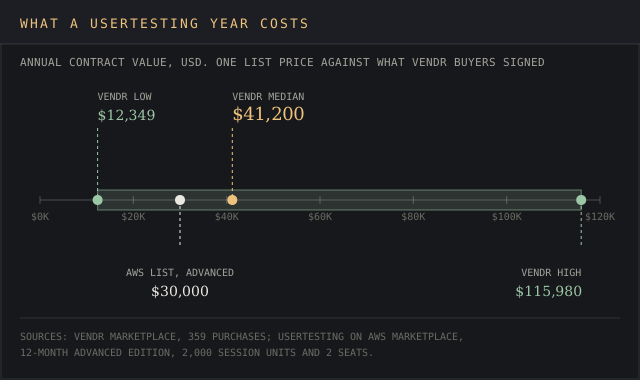
The $30,000 AWS bundle sits $11,200 under the Vendr median, so the typical buyer is paying for extras on top of 2,000 Session Units and two seats.
At £8.30 a unit, a five-person think-out-loud test on the UserTesting panel costs £415 before seats.
Seats and Session Units are two separate meters in UserTesting pricing, and a quote moves on both.
UserTesting doesn't print a price on its plans page. Every one of its three editions ends in a "Request pricing" button. The numbers exist anyway: UserTesting's own AWS Marketplace listing sells its Advanced edition for $30,000 a year, and its UK government G-Cloud 14 pricing document lists every seat and Session Unit price down to the penny.
This research report puts those vendor-published figures next to the Vendr median of $41,200 a year, then works out what one test costs under UserTesting's session rate card.
The $11,200 between that list bundle and the median is money a buyer can negotiate back, but only if they know the meter before the first call. This report covers the pricing tiers, the two billing models, hidden costs, negotiation, the best UserTesting alternatives on user testing pricing, and what UserTesting pays its testers, which is a separate question that lands on the same search results.
It's written for product, design and research leads who have to put a user testing cost into a budget before UserTesting has quoted them. Talk is cheap on a sales call, so every figure below links to the document it came from. If you want the product verdict, the UserTesting review covers features, panel quality and fit.
How much does UserTesting cost
A UserTesting contract runs $12,349 to $115,980 a year, with the middle of the market at $41,200, per Vendr's 359 tracked purchases. It's an annual subscription quoted by a sales team; the pricing page offers a demo form and a trial request, and every plan is billed annually.
That's the opposite of transparent pricing, and for a company that sells research into user friendly design, its pricing page gives a buyer no number to work with. UserTesting's own FAQ says the price "varies depending on the number of users, types, and features" and routes every buyer to an account team. Usertesting users get upfront pricing only after a call.
The cheapest list price UserTesting publishes anywhere is the AWS one: $30,000 for 12 months of the Advanced edition with 2,000 Session Units and 2 seats, sold by UserTesting itself. Divide it out and the bundle lands at $15 per Session Unit with the two seats included. That buys 200 think-out-loud sessions, or 40 five-person tests.
So the honest answer to how much does UserTesting cost is a floor near $12,000 and a typical bill a little over $40,000. For bigger companies running moderated testing every week, the top of that spread is where the usertesting cost stops being a drop in the bucket.
UserTesting pricing tiers: Advanced, Ultimate and Ultimate+
The current pricing structure has three editions, listed on the UserTesting plans page with no price beside any of them. The edition decides which features you get; the pricing model, covered in the next section, decides how you pay for usage. Across the three pricing tiers, each edition includes everything in the one below it.
Advanced plan
The Advanced plan is the entry edition of the Human Insight Platform. It includes the test builder and template gallery, unmoderated tests (surveys, interaction tests and think-out-loud), moderated Live Conversation, AI-generated Insight Summaries, sentiment analysis, transcripts, click maps, unlimited workspaces and the global participant panel across 60+ countries.
Integrations cover Slack, Teams, Jira, Figma, FigJam and Miro. Those basic integrations come with every edition. What the Advanced plan leaves out, per the page's own comparison grid, is AI-generated test creation, card sorting and tree testing, custom audience management, secure Figma prototype testing and approval flow. The research repository is an add on at this tier.
Ultimate plan
The Ultimate plan carries the page's "POPULAR" badge. It adds AI-generated test creation, AI powered analysis, smart tags, the Insights Hub with its Insight Discovery search, card sorting & tree testing, custom audiences, secure prototype hosting and approval flow, which is how it squeezes deeper insights out of the same recorded sessions.
Premier Support with 30-minute Power Sessions is optional, and the G-Cloud document prices Premier Support at 15% of annual licence value.
Ultimate+
Ultimate+ is the enterprise tier. It bundles the Team-based Unlimited plan, the Figma plugin, premium onboarding, insights strategy, insights delivery, custom audience sourcing and Premier Support+ with a dedicated consultant and one-hour Power Sessions included.
Dedicated account management is where UserTesting's two pages disagree. The plans grid marks a dedicated Customer Success Manager as Ultimate+ only, while the subscription options article in UserTesting's help center lists one under Advanced. Get it written into the order form.
The Essentials plan and the current pricing page
Older write-ups describe a three-plan lineup of Essentials, Advanced and Ultimate, and Vendr's buyer notes still mention Essentials. The current pricing page lists Advanced, Ultimate and Ultimate+ and nothing else, so a 2026 quote starts at Advanced. Treat any Essentials figure you find as a snapshot of the old lineup.
UserTesting pricing models: Test-based Consumption against Team-based Unlimited
UserTesting sells each edition on one of two pricing models, and the pricing model decides what you're metered on. Pick the wrong one and you'll pay for capacity your user research never touches.
- Test-based Consumption. You buy Session Units up front and each completed session burns some. The plans page promises "Unlimited users across the enterprise (no per-seat charges)" and pitches it at teams with variable testing needs.
- Team-based Unlimited. Unlimited tests "within a defined enterprise scope", with predictable pricing for scaling across teams and geographies. It's the only model that includes the Figma plugin automatically.
The word doing the work in Team-based Unlimited is "scope". The plans page doesn't say who sets it or how it's measured, so the devil's in the details: ask which teams, regions and test types the scope covers before you sign.
How Session Units drive UserTesting pricing per test
A Session Unit is UserTesting's own meter, defined in its session rate card. You buy a block before you start testing, and each completed session spends units according to what kind of test it is, how long it runs and where the participants came from.
| Test type | UserTesting Network | Custom Network | Invite Network |
|---|---|---|---|
| Survey, up to 10 minutes | 2 | n/a | 0 |
| Short test, up to 5 minutes | 5 | 3 | 1 |
| Interaction test, up to 20 minutes | 5 | n/a | 1 |
| Think-out-loud or Quick Answers, up to 20 minutes | 10 | 5 | 2 |
| Live Conversation, first 30 minutes | 20 | 10 | 5 |
| Live Conversation, each extra 15 minutes | 5 | 2 | 1 |
Moderated sessions cost two to four times what recorded unmoderated tests do. A 30-minute Live Conversation on the UserTesting panel takes 20 units against 10 for a think-out-loud and 5 for an interaction test. At the £8.30 entry rate from UserTesting's G-Cloud price list, that's £166, £83 and £41.50 per session, and a survey response is £16.60.
The clock is strict, too. There's a 15-minute grace period, so a 45-minute call bills as 30 minutes, but UserTesting's own example shows a 46-minute call costing 25 units where a 45-minute one costs 20. The session starts when anyone joins, and the default Live Conversation cap on Test-based plans is 100 participants.

What one test costs under UserTesting's G-Cloud pricing
The G-Cloud 14 pricing document is the only place UserTesting attaches a currency to the unit, and it's the most detailed research a buyer can do before a sales call. Pair it with the rate card and a single test gets a price.
| Session Units bought | Price per Session Unit |
|---|---|
| 0 to 1,000 | £8.30 |
| 1,001 to 3,000 | £7.47 |
| 3,001 to 5,000 | £7.06 |
| 5,001 to 10,000 | £6.72 |
| 10,001 to 15,000 | £6.64 |
| 15,001 to 20,000 | £6.56 |
Prices are UserTesting's own list prices per Session Unit, from its G-Cloud 14 pricing document dated 7 May 2024.
What a landing page test costs
Five people talking through a landing page on the UserTesting panel is 5 think-out-loud sessions at 10 units each: 50 units, or £415 at the £8.30 entry rate. The same test sent to five of your own testers through the Invite Network costs 10 units, £83. Swap the think-out-loud for a two-question survey and each panel response costs £16.60.
Five recorded sessions collect user feedback from five people on one page, enough to spot the usability issues they share before launch.
Moderated sessions scale faster. Five 30-minute Live Conversations with recruited participants from the UserTesting Network spend 100 units, £830 at the entry rate, and running each to 60 minutes takes that to 150 units.
Units against seats
Seats are billed separately in the G-Cloud schedule: £6,225 each for 1 to 5 seats, £3,735 for 6 to 10 and £2,656 for 11 to 25. Rebuild the AWS bundle from those rates, assuming the tier price applies to the whole block, and 2 seats plus 2,000 units comes to £27,390. AWS sells the same two seats and 2,000 units for $30,000, so both lists put a starter year in the same bracket.
A 2,000-unit block covers 40 five-person think-out-loud tests, roughly one a week for 40 weeks. Teams that test less often than that are buying units that expire.
Testing with your own participants against the UserTesting panel
Where participants come from changes the user testing price of a session by up to 80%. A think-out-loud session costs 10 units with the UserTesting Network, 5 with a Custom Network and 2 when you invite your own participants from a customer list.
The catch sits with participant incentives. On the Invite Network the customer sets and pays the incentive, per UserTesting's participant compensation article. On the UserTesting Network the incentive is inside the unit price. Bring your own testers and the units get cheaper while the participant incentives move onto your card. UserTesting's own Custom Network rates, $10 for a 20-minute test and $30 to $120 for a live call, are a sensible floor for what you offer.
The participant panel earns its price on reach. UserTesting's plans page says its network delivers "80% of sessions in just a few hours", which matters when the potential customers you need to hear from aren't on your mailing list. Its panel quality and recruiting speed are covered in the ranking of customer insights platforms, where it holds the top spot; customer insights from a recruited panel are the thing the extra 8 units per session buy.
Hidden costs in UserTesting pricing: seats, support, add-ons and expiring units
The sticker price on a user testing quote from UserTesting is the units and the seats. Five other lines can move the total spend:
- Seats on a "no per-seat" plan. The plans page says Test-based Consumption has no per-seat charges. The AWS listing still prices 2 seats into its bundle, and the May 2024 G-Cloud document charges £6,225 a seat for the first five.
- Premier Support. 15% of annual licence value. On the £27,390 rebuild above that's another £4,109.
- Add-ons. The insights repository is an add-on on Advanced, and the Figma plugin is an add-on everywhere outside Team-based Unlimited.
- Units that expire. The AWS listing says entitlements expire if you don't renew, and Vendr reports that "Unused credits typically expire at the end of the contract term."
- Overage. AWS bills nothing beyond the committed amount; you contact UserTesting for more capacity. Vendr warns that "overage pricing can be punitive."
Renewals are the sixth line, and the quietest. UserTesting's help article on renewing your subscription says "Some subscriptions may renew automatically" and sends you to the order form for the end date. Vendr notes renewal quotes "often include annual increases."
What buyers pay against UserTesting list pricing
Vendr's figure is the closest thing to market pricing for UserTesting, and the cheapest research a buyer can do on contract value. Its marketplace page puts the median buyer at $41,200 a year across 359 purchases, with average savings of 17% off the first quote, and a tracked spread from $12,349 to $115,980.
Read against the AWS listing, the median buyer pays $11,200 more than the published Advanced bundle. That $11,200 has to cover whatever the buyer added: an Ultimate upgrade, extra seats, a bigger unit block or Premier Support. Vendr doesn't break the spread down by edition, so treat the $115,980 high as a ceiling on what anyone in its data paid, with no tier attached.
Vendr's body text also publishes credit-bundle estimates per tier, such as 10,000 to 15,000 credits a year for Essentials, 25,000 to 75,000 for Advanced and over 75,000 for Ultimate. Those don't square with UserTesting's own price list. At the G-Cloud rate of £6.72 a unit, 10,000 units cost £67,200, above Vendr's own $41,200 median, and 25,000 units at the cheapest published tier of £6.56 would cost £164,000.
Trust the tracked contracts and the vendor's rate card, and set the tier estimates aside.
What UserTesting users say about the price
Reviewers rarely quote a dollar figure, but they agree on the direction. A Verified User in computer software at a mid-market company wrote on G2 in January 2025:
"It's one of the more expensive options out there and the subscription caps the number of seats. This became a challenge as our team expanded, and it wasn't cost-effective."
That seat cap sits awkwardly next to the "no per-seat charges" line on today's pricing page. A design reviewer at a mid-market firm, also on G2 in January 2022, put the trade-off this way:
"The pricing structure is a little high but well worth the value if your company can afford it"
An engineering reviewer at a 501 to 1,000 person company told TrustRadius in 2026 that "It may be expensive to use as per budget constraints", adding that it was "not to be opratable due to price constraint for small start up product." On Hacker News in March 2022, user janeerie wrote: "It's very expensive, but very much worth it."
Older comments split the same way. A 2015 Hacker News comment from user LargeCompanies reads "I used usertesting before and it's crazy expensive." A mid-market G2 reviewer, Grant S., wrote in April 2020 that "It is not cheap, but the insights end up saving money."
How to negotiate UserTesting pricing
The G-Cloud tiers show where the money is. The unit price falls 21% from £8.30 to £6.56 as volume rises, and the seat price falls 57% from £6,225 to £2,656. Those are the two numbers to negotiate.
- Ask for the per-unit price. Vendr's advice is to "Ask for a breakdown of per-credit pricing and negotiate that rate directly." Quote the G-Cloud tier for your volume back at your account executive.
- Start 60 to 90 days before your target start date. Vendr says that window "gives you room to negotiate without time pressure." Wait until the week your renewal lands and you're negotiating against the clock. Vendr also reports that UserTesting's fiscal year ends in January, so a quote landing in December or January meets a sales team closing its year.
- Price the multi-year option. Vendr reports that 2 to 3 year agreements "often unlock lower per-credit pricing."
- Write rollover and overage into the order form. The AWS terms let entitlements expire, so negotiate unused-unit rollover and a fixed overage rate up front.
- Cap the renewal increase. Ask for a fixed percentage ceiling, since UserTesting's renewal article doesn't publish one.
- Use your own participants. Shifting think-out-loud tests to the Invite Network cuts each session from 10 units to 2.
Vendr's tracked buyers saved 17% on average off the first quote. Getting there is easier said than done on a first contract, when you have no usage history to argue from; at renewal you'll know how many units you burned, and that number is the strongest card you hold. Don't put all your eggs in one basket either: a live quote from one of the usertesting alternatives below gives the sales team a reason to move.
Who UserTesting pricing is built for: team size and test cadence
UserTesting prices for enterprise teams with UX researchers on staff, a dedicated user research budget and a steady weekly test cadence. Its plans page claims 3,000+ enterprise customers in 40+ countries and 75 of the Fortune 100, and the $30,000 floor on AWS assumes that kind of buyer.
Team size matters less on Test-based Consumption, where users are unlimited, and more on contracts carrying seat fees. A part time research function at one of the smaller companies, with one researcher and no research operations team, running a test a month to validate concepts, would use about 600 of the 2,000 units in the $30,000 bundle: twelve five-person tests at 50 units each.
For small teams, the user testing cost per insight is better value on other platforms; money doesn't grow on trees in a five-person design group.
The sums change for an organisation running user research across several product lines: user interviews, usability tests and surveys every week. There, unlimited users on Test-based Consumption and the Ultimate edition's AI powered analysis get more value out of each unit, because one test feeds qualitative insights to several teams. That's the buyer UserTesting built its pricing for.
UserTesting does run two free routes. Its Education Partner Program gives qualifying institutions free access, and nonprofits can apply to Insights for Impact, which launched in February 2025 with free licenses and replaced the older OneWorld discount program for charities. The pricing page also lets you run one free test and "receive a video of a real person reviewing your website, typically in less than an hour."
Best UserTesting alternatives by price
Among user testing platforms, four usertesting alternatives publish a price list, which is the first thing that sets them apart from UserTesting pricing. Each figure below comes from the vendor's own pricing page.
| Platform | Entry paid price | What it includes | Free plan |
|---|---|---|---|
| UserTesting | $30,000 a year (AWS) | 2,000 Session Units, 2 seats | One free test |
| Lookback | $299 a year | 10 sessions, 1 seat | 5-session trial |
| Userbrain | €45 a month | 3 panel testers a month, 1 seat | 30-day trial, 2 testers |
| Lyssna | $166 a month, billed annually | 5 seats, 5 in-depth studies a month | 3 seats, 15 responses |
| Maze | Custom quote | Unlimited seats, 7M+ panel | 1 study a month, 5 seats |
Prices are each vendor's published list price, read off its own pricing page; UserTesting's is the list price on its AWS Marketplace listing. None of these figures is a Vendr median.
Lookback for moderated user interviews
Lookback pricing is published in full, which suits research teams that want a number before a call. Its Team plan is $1,782 a year for 100 sessions and 10 collaborators, and the Insights Hub plan is $4,122 for 300 sessions. Extra panel participants cost $49 each on pay-as-you-go. For teams doing moderated testing and user interviews with their own customers, that's a cost effective way to buy live conversations.
Lyssna for five second tests and surveys
Lyssna covers five second tests, first-click testing, prototype testing, card sorting and tree testing on a $166-a-month Growth plan. Panel pricing sits outside the plan fee on every tier. It suits teams whose research is mostly quick unmoderated sessions and who want user feedback inside a week.
Userbrain pricing runs from €45 a month for 3 testers to a €990 yearly Flex plan with 30 testers and unlimited seats. Maze's free plan allows one study a month across 5 seats, with panel credits on pay-per-use. All four price by study, session or tester, so compare them to UserTesting on the cost of one whole test.
For wider context on what research costs outside this category, the site's reports on focus group cost and survey software pricing cover the two methods buyers most often weigh against a user testing platform.
Ownership and pricing since Thoma Bravo, UserZoom and Auros
UserTesting went private on 12 January 2023, when Thoma Bravo and Sunstone Partners completed an all-cash deal at $7.50 a share, valued at about $1.3 billion, per UserTesting's press release. Thoma Bravo had taken majority control of UserZoom in April 2022.
The two companies announced their merger on 3 April 2023, keeping the UserTesting name and claiming 3,400+ customers. QXscore, UserZoom's benchmarking method, now sits inside interaction tests on the rate card, and the UserZoom UX Research Platform still appears in UserTesting's site footer as a separate product.
For buyers, the merger matters at renewal. Over 100 companies used both platforms at the time of the announcement, and anyone holding two contracts was a candidate for consolidation onto one bill. If you're one of them, price the combined contract before you cross that bridge, since the merged rate card meters UserZoom-style benchmarking through the same Session Units.
Two more changes landed in 2026. UserTesting acquired User Interviews on 7 January 2026, and on 30 September 2026 Research Live reported that the company had renamed itself Auros, keeping UserTesting and User Interviews as product brands. A renewal signed this quarter goes to a different corporate parent than the last one, so check the legal entity named on the order form.
What UserTesting pays testers, separate from buyer pricing
A lot of people searching for UserTesting pricing want the other side of the market: what the company pays contributors. Joining takes a practice test and a demographic form, and from then on the money flows to the tester. UserTesting's Custom Network compensation table lists these rates:
- $4 for a 5 to 7 minute short test
- $10 for a standard 15 to 20 minute unmoderated test
- $30, $60, $90 and $120 for Live Conversations of 30, 60, 90 and 120 minutes
Pay arrives by PayPal, the only method, usually 14 days after the test, per the get-paid-to-test page. UserTesting doesn't withhold tax, and the practice test you submit to join is unpaid. On the Custom Network a think-out-loud session costs the buyer 5 units, £41.50 at the entry rate, while the contributor gets $10.
Gaps like that are a dime a dozen among panel platforms, because the buyer's units also cover recruiting, screening, the recording and the transcript. Neither number tells you the other: tester pay comes from a fixed table, and the buyer's cost comes from a negotiated contract.
What to budget for UserTesting
Budget $30,000 a year as the floor for user testing on UserTesting and $41,200 as the typical contract, then add for each extra that applies.
- Seats beyond two: £3,735 to £6,225 each on the G-Cloud schedule
- Premier Support: 15% of licence value
- Ultimate features (card sorting, tree testing, AI test creation): the move up from Advanced
- Incentives for your own participants on the Invite Network
Run a bigger team through the G-Cloud schedule and the number climbs fast. Ten seats at £3,735 come to £37,350, and 5,000 units at £7.06 add £35,300, so £72,650 before Premier Support and £83,548 with it, assuming each tier price applies to the whole quantity. Put that figure in the business plan, then negotiate down from it. Cutting corners on the unit count to hit a budget only means buying a top-up mid-year at whatever rate the sales team names.
Want a broader view of research budgets? The market research cost report prices 27 vendors, from $0.95 survey responses to agency studies.
Frequently asked questions
How much does UserTesting cost?
UserTesting pricing runs between $12,349 and $115,980 a year, with a $41,200 median, per Vendr. UserTesting's own AWS listing prices the Advanced edition at $30,000 for 2,000 Session Units and 2 seats.
Do you have to pay to use UserTesting?
Buyers pay an annual subscription at quote-only pricing, and UserTesting pays the testers. You can run one free test from the pricing page, and qualifying institutions get free access through the Education Partner Program.
Is UserTesting worth it?
For enterprise teams running weekly user research with moderated and unmoderated tests, reviewers on G2 and Hacker News call it expensive and worth it. For a team running one test a month, a $299 Lookback plan or a €45 Userbrain plan returns recorded sessions and qualitative insights for a fraction of the user testing cost.
Is UserTesting legit to make money?
Yes. It's a real company, owned by Thoma Bravo since 2023 and trading under the parent name Auros since September 2026, that pays contributors by PayPal about 14 days after each test. Expect $10 for a standard test and $30 to $120 for a live conversation.
How much does UserTesting pay per test?
$4 for a short test and $10 for a 15 to 20 minute test, per UserTesting's Custom Network rates. Your dashboard shows the exact amount before you accept a test.
Can I become a tester and earn $10 per test?
Yes. Apply with a short practice test and basic demographic details. You'll need a microphone, and the practice test itself isn't paid.
How much does it cost to test an app?
User testing an app on UserTesting with five think-out-loud sessions from its panel uses 50 Session Units, £415 at the G-Cloud entry rate, before seat and platform fees.
Bottom line
UserTesting keeps prices off its own pricing page and publishes them on AWS and the UK G-Cloud catalogue. Read together, they show a two-meter pricing structure: seats from £2,656 to £6,225 a year, and Session Units from £6.56 to £8.30, spent at 2 to 20 a session on the UserTesting panel.
As the contracts stand today, the median buyer signs for $41,200 a year, $11,200 above the $30,000 Advanced bundle, and that gap is the extras a growing team adds. Negotiate the per-unit rate, write rollover into the contract and move routine tests onto your own participants, and the bill stays nearer the floor.
For smaller teams with modest testing needs and tight user testing costs, the honest answer is one of the alternatives with a published price. For the product side of the decision, read the full UserTesting review linked at the top of this page, or see how a quote-only vendor compares on price in the Qualtrics pricing report.
Where every UserTesting price on this page was read, and what the company leaves unpublished
Edition names, feature gates, the two pricing models and the free test come from usertesting.com/plans. The $30,000 Advanced bundle, its 2,000 Session Units, two seats and expiry terms are from UserTesting's own AWS Marketplace listing. Seat and Session Unit prices in pounds are from UserTesting's G-Cloud 14 pricing document on the UK Digital Marketplace, dated 7 May 2024, which also carries the 15% Premier Support rate.
Unit costs per test, the grace period and the 100-participant cap are from the session rate card on help.usertesting.com. Subscription options, renewals, participant compensation and Custom Network tester pay are from the same help center; PayPal timing is from usertesting.com/get-paid-to-test.
The $41,200 median, the $12,349 to $115,980 spread, 359 purchases, 17% average savings and the buyer guidance quoted in the negotiation section are Vendr's, read off vendr.com/marketplace/usertesting. Reviews are quoted from g2.com, trustradius.com and news.ycombinator.com, each dated in the text.
Alternative prices are read off lookback.com, userbrain.com, lyssna.com and maze.co. Ownership history comes from UserTesting's newsroom, thomabravo.com, businesswire.com and research-live.com. Figures were checked on 16 October 2026.
UserTesting publishes no dollar price on its own site, no per-unit rate outside the UK G-Cloud catalogue, no overage rate, no renewal cap and no edition-level split of what buyers pay. Vendr doesn't break its spread down by edition either.