Omdia review: technology analyst research and market data
 By Jan Suski. I go deep on every review, checking every number against its source and digging up details other coverage misses, a habit from six years of SEO and link building for tech companies. Bylines at Surfer, Brand24, and Senuto. How the scoring works.
· Prefer this source on Google
Best for
Multi-market enterprise teams with a procurement process, buying across telecom, cloud, AI, cybersecurity or media at once and wanting a named analyst accountable for the call.
Not for
A single-market buyer such as a solo marketer or founder; GSMA Intelligence, Counterpoint Research and GlobalData are the named alternatives to check instead.
What it costs
No published rate card; sales sets every number. Research subscriptions are scoped by coverage area and seat count, with advisory and custom research priced separately.
- Analyst bench
- More than 400 analysts
- Markets covered
- 150 technology markets
- Sectors
- Telecom, cloud, AI, cybersecurity, media, consumer and industrial technologies
- Subscription research
- Reports, market data and insights delivered through the website
- Advisory services
- Time in a room with analysts on positioning questions
- Custom research
- Commissioned work for a vendor's sales and marketing operations
- Report formats
- Market overview and forecast reports, data trackers, and short-form analyst insights, all on one contract
- Named accountability
- A principal analyst owns a research agenda, a practice leader runs a team across related markets, and both titles appear on published research
- Analyst inquiry
- Clients book time with the analysts behind a report and pressure-test the call against their own data
- Insight cadence
- Short-form reads publish on news as it breaks, ahead of the quarterly cycle
- Services forecast
- $1.3 trillion system integrator opportunity by 2031
- AIOps forecast
- $10.4 billion market by 2031
- Enterprise AI warning
- 90% of enterprise AI projects may fail without moving beyond proof-of-concept
- Telecom forecasts
- Network traffic up sixfold by 2035, and Canada at 75% fiber coverage in 2026
- Security research
- Breaches up over 30% from 2022 to 2023, 40% of organizations on fully managed security, 88% piloting agentic AI
- Consumer forecast
- Global AI glasses shipments over 10 million units by 2026
- Telecom lineage
- Ovum, Heavy Reading and Tractica, decades on telecom before the Omdia name existed
- Brand consolidation
- Intelligence & Advisory operations now sell under one name
- Parent's H1 2026
- Informa TechTarget: £165.0 million revenue, underlying growth of -1.3%, £41.2 million statutory operating loss
- List price
- None published; the number comes from sales
- Research subscription
- Scoped by coverage area and seat count
- Advisory and custom
- Carry separate costs from the research subscription
- What's bundled
- Reports, market data, insights and analyst inquiry inside one subscription
- Breadth penalty
- A client buying for one market pays for an operation built to cover 150
- Scoping risk
- The subscription works when someone owns the scoping; the trouble starts when nobody does
GSMA Intelligence
Not forA buyer who wants cloud, security and media coverage on the same contract. This bench stops at mobile.
Counterpoint Research
Not forA telecom operator timing network investment. This bench counts devices; carrier strategy is Omdia's territory.
Pairs well with Omdia
Where these forecasts come from, and whose numbers the parent figures are
Every forecast in the left-hand table is Omdia's own published 2026 research, restated as the firm's claim: the $1.3 trillion integrator opportunity, the $10.4 billion AIOps market, the sixfold telecom traffic rise and the 90% failure warning all come from its own output.
The revenue, growth and loss figures are Informa TechTarget's reported results for the six months to 30 June 2026, since Omdia's own revenue isn't broken out. No price appears here because the firm publishes none. Figures current as of this review's update on 5 August 2026.
This Omdia review covers what the analyst house does, who owns it after the TechTarget merger, how its research services are organized, and what its 2026 research argues across telecom, cloud, AI and cybersecurity. Omdia runs on more than 400 analysts covering 150 technology markets, which makes it one of the broadest research operations in the world a buyer can subscribe to.
↑ FACT SHEETWhat does Omdia do
Omdia is a technology research and advisory firm. It sells research services built on analyst coverage: market data, forecasts, reports and direct access to the analysts who write them, spanning the telecom industry, cloud services, AI technologies, cybersecurity, media, consumer technologies and industrial technologies.
The output takes three forms:
- Subscription research services deliver reports, data and insights through the website.
- Advisory services put clients in a room with analysts for positioning questions and direct advice.
- Custom research services produce commissioned work for vendors' sales and marketing operations.
Clients use all three to identify market opportunities across their industries, size markets before entering them, and check their own positioning against competitors.
The breadth across tech markets is the differentiator: few rivals cover telecom operators, semiconductor companies and media services with the same analyst bench, and fewer can name the market leader in each. That breadth keeps Omdia ahead of the curve against single-market research shops that can't staff the same coverage.
↑ FACT SHEETWho owns Omdia
Omdia is part of Informa TechTarget, the company formed when Informa Tech's digital businesses merged with TechTarget in December 2024, trading on Nasdaq as TTGT. Before the merger, Omdia was Informa Tech's research arm.
The brand itself is an assembly. Omdia was built from legacy Ovum, Heavy Reading, and Tractica research operations, firms that spent decades on the telecom industry before the Omdia name existed.
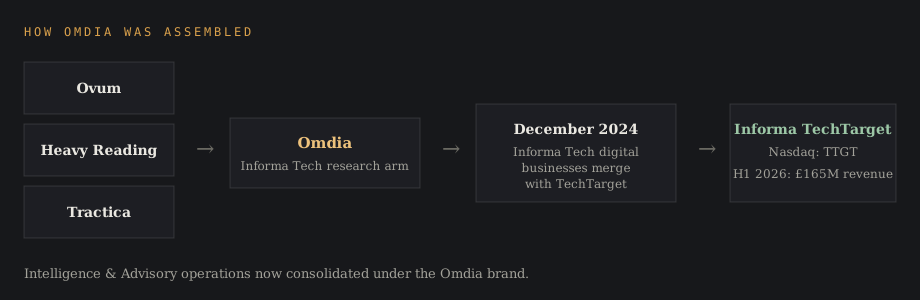
The structure has since settled in Omdia's favour: the group consolidated its Intelligence & Advisory operations under the Omdia brand, so the research business a buyer contracts with now carries one name. The parent calls this a Foundation Year of integration.
Omdia's own revenue isn't broken out, so the parent's results are the read. Informa TechTarget reported £165.0 million of revenue for the six months to 30 June 2026, underlying revenue growth of -1.3%, adjusted operating profit of £4.7 million and a statutory operating loss of £41.2 million.
Patrick Martell became chair on 1 March 2026. That operating loss leaves the parent skating on thin ice while it works through the TechTarget integration, even with adjusted profit still positive.
None of that stops the research publishing, but a buyer should confirm which analyst bench sits behind the specific services in scope.
How the research services are organized: Omdia experts by practice
Omdia experts are organized by practice, with named analysts accountable for coverage areas. Titles map to seniority: a principal analyst owns a research agenda and the analysis within a market, and a practice leader runs a team of analysts across related markets.
Both the principal analyst and practice leader titles appear on published research, so a client can see who owns a call before buying it.
Named accountability: James Crawshaw and the practice leader model
The practical difference from anonymous research: a telecom client reading a report on network operations can book time with the analysts behind it, James Crawshaw among the Omdia experts covering service provider transformation.
That client can pressure-test the analysis against their own data before making decisions with it. James Crawshaw publishes as a practice leader on that beat, alongside principal analyst colleagues on the same network technologies. Analysts who know the ropes on a beat this specific are hard to replace with a generic research feed.
Reports, data and insights: the formats
The research services land in three formats:
- Market overview and forecast reports carry the long-form analysis.
- Data trackers carry the numbers behind each report.
- Analyst insights carry the short-form reads on news as it breaks, the latest insights arriving ahead of the quarterly cycle.
Each format tracks the same technologies from a different altitude. A forecast report sizes the future of a market; the trackers measure where its technologies stand today. Analysts publish across all three, so the analysis in a report and the insights on a news day trace to the same named people. For customers, the practical benefit is one contract covering all three.
Access runs through subscriptions to research services scoped by coverage area, with reports, market data, insights and analyst inquiry bundled. Pricing isn't published; like the rest of the enterprise analyst market, the cost process runs through sales. Enterprise analyst subscriptions like this one can cost an arm and a leg, and Omdia gives no rate card up front to check that against.
↑ FACT SHEETKey themes in Omdia's 2026 research
The latest insights across Omdia's practices sketch a technology market reorganizing around AI. The key themes below come from its published research, and the AI applications inside them are what most of the forecasts turn on.
Cloud, infrastructure and IT services
Cloud vendors must support AI workloads at scale, and AI is changing cloud competition by requiring infrastructure built for those workloads. Infrastructure spending is shifting from ownership to as-a-service models at the same time.
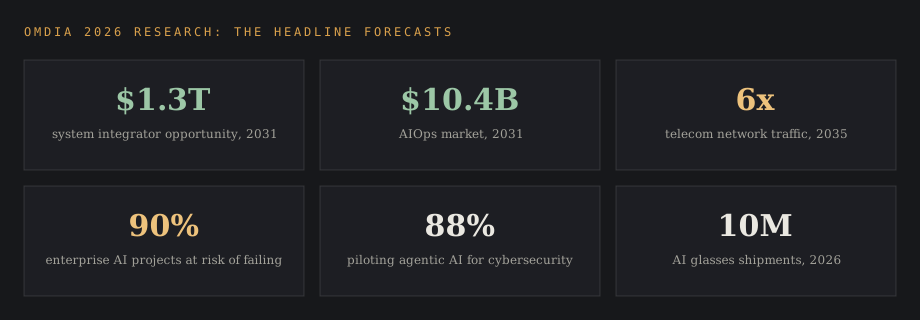
The services opportunity is the headline number: Omdia puts the global opportunity for system integrators at $1.3 trillion by 2031.
Over 70% of companies have deployed digital projects involving AI, while 53% of organizations still rely on legacy infrastructure. That gap between ambition and installed base, organizations sweating assets built for the last cycle, is where integration services revenue growth lives.
Enterprise AI applications and agentic software
AI is becoming foundational for enterprises, shifting from experimental to operational use, and organizations are prioritizing measurable business outcomes in AI projects. The warning in the research is blunt: 90% of enterprise AI projects may fail if they do not move beyond proof-of-concept, and moving past the concept phase is the filter. Plenty of those projects bite off more than they can chew at the pilot stage and never reach the filter Omdia describes.
The future Omdia expects to arrive fastest is agentic: the enterprise agentic AI software market is forecast to grow strongly through 2030, and the AIOps market, where AI runs IT operations, is projected to reach $10.4 billion by 2031.
Organizations focus on practical technology investments, and businesses lean on partners and partnerships to stitch products into integrated technology stacks.
Accelerating those AI applications from pilot to production is the recurring theme across the practice.
Telecom industry research
Telecom is Omdia's deepest bench, and the 2026 research reads like an operator's planning agenda. AI will increase telecom network traffic sixfold by 2035, telecoms are integrating Control and User Plane Separation with IP metro networks to monetize AI, and network APIs are transforming the telecom industry through 2026.
The structural themes run alongside: telecom sovereignty is reshaping strategies across the telecom industry, 6G is expected to unlock new AI infrastructure opportunities, and Canada has reached 75% fiber coverage in 2026. Operators use the network forecasts to time investments in the network technologies underneath all of it.
Cybersecurity risks and managed security
Cybersecurity breaches increased by over 30% from 2022 to 2023, and the volume of ransomware attacks has soared in recent years. Omdia's security research tracks the response: 40% of organizations are using fully managed security services, and 88% of organizations are piloting agentic AI for cybersecurity. That climb is a red flag Omdia's security practice keeps returning to across every research update.
The structural read is a shift from foundational IT security to a unified digital framework, with cybersecurity risks ranking as the top concern customers report in industrial networking. Security services and automation carry the growth in this practice, and cybersecurity risks tied to AI agents are the fastest-moving part of it.
Consumer, media and industrial technologies
Consumer technology trends include growth in AI-enabled devices, with global AI glasses shipments forecast to exceed 10 million units by 2026. AI is reshaping smartphone security and user protection tools, and AI is changing the music industry by generating new songs, one of the stranger consumer shifts of recent years.
Media coverage tracks the platform shift: online video is projected to surpass linear TV by 2026 in India.
On the industrial side, digitalization is a core driver of the industrial market. The challenges are physical too:
- Global labor shortages are driving investments in automation.
- Government funding is increasing for digitalization initiatives.
- Regionalizing production is a key strategy for improving supply chain resilience across manufacturing.
Digital transformation, in Omdia's framing, aims to increase productivity and improve energy management, tying the industrial research to sustainability budgets, and sustainability shows up again in its data centre and energy coverage. A manufacturer chasing both goals under one budget line gets to kill two birds with one stone, pairing productivity gains with energy savings.
Who uses Omdia
The client base follows the coverage:
- Telecom operators and network vendors on the telecom side, working with network technologies.
- Cloud and software companies positioning their solutions on the IT side.
- Makers of consumer devices.
- Enterprise customers using the research to time technology investments.
Vendors also license the data services, reports and insights for sales enablement and channel partners, using market sizing to frame their own story to customers.
The common purchase driver is coverage a client can't staff internally. A strategy team can follow one market on its own; following 150 technology markets, and the technologies inside them, with named analysts is what customers buy with the subscription.
How companies put the research to work
The focus differs by buyer. Vendors build the sales story: a software or hardware company uses Omdia's market sizing and positioning work to show customers where its solutions sit against the field, licenses the numbers for the pitch deck, and partners co-selling into the same accounts borrow the same slides.
A vendor that can cite an analyst calling it the market leader in a segment has bought something a brochure can't manufacture.
Talk is cheap in a pitch deck. A named analyst's call carries weight a brochure alone can't buy.
The interest is commercial; the research is the credibility.
Operators and enterprises buy the advice. A telecom operator planning network investments, a manufacturing company weighing factory automation, or an enterprise moving operations to cloud services uses the forecasts to time the spend and the analyst inquiry to sanity-check the plan. The challenges differ by industry; the process is the same: read the report, book the analysts, decide.
Investors and corporate development teams read the same research for a different reason: assets change hands on these forecasts. A growth story in agentic software reads differently with a $10.4 billion AIOps projection beside it, and the reality check an analyst provides costs less than a bad deal, whatever the interest driving it. That reality check is a stitch in time, costing far less than the deal it might prevent.
Across all three, the world Omdia describes is the one its customers operate in: industries reorganizing around AI, services displacing products, and companies planning for a future their current tooling wasn't built for. In recent years that frame has spread from the research services into most of the industry's strategy decks.
↑ FACT SHEETOmdia pricing
Omdia doesn't publish pricing. Research services sell as subscriptions scoped by coverage area and seat count, advisory and custom work carry separate costs, and the number comes from sales.
Omdia competitors
The closest companies on our shortlist sit in the same mobile and telecom research category. GSMA Intelligence competes on operator data as the industry body's own research arm; Counterpoint Research focuses on device and smartphone market share tracking; GlobalData competes on breadth, with 2,000 in-house experts across industries.
| Tool | Where it competes |
|---|---|
| Omdia | Analyst-led breadth: 400+ analysts, 150 technology markets, deepest on telecom |
| GSMA Intelligence | Operator-level data from the mobile industry's own trade body |
| Counterpoint Research | Device and smartphone market share tracking |
| GlobalData | Cross-industry analyst coverage, 2,000 in-house experts |
Omdia's position among them is the analyst-led breadth play: wider than the specialists, deeper on telecom than the generalists.
That combination gives a buyer the best of both worlds, breadth most specialists can't match and telecom depth the generalists don't reach.
Buyers comparing them should match the analyst bench against the markets they follow, and weigh ownership too: Omdia's parent is a listed company working through an integration, while GSMA Intelligence sits inside a trade body with no such pressure.
↑ FACT SHEETStrengths and weaknesses
The strengths are bench and lineage: 400-plus analysts publishing reports and insights, 150 markets covered, named principal analyst accountability, and telecom research depth inherited from Ovum, Heavy Reading and Tractica. The forecast catalog spans enough industries that one services contract can serve strategy, product and sales teams at once.
The weaknesses are structural. Pricing is opaque, the parent posted a statutory operating loss in H1 2026 while integrating two businesses, and breadth cuts both ways: a client buying for one market pays for an operation built to cover 150. The success of a subscription depends on scoping it to the markets a team will use, and the challenges start when nobody owns that scoping process.
Getting the scoping wrong is the real risk, since the devil's in the details and a bad boundary wastes budget on markets a team will never touch.
Bottom line
Omdia earns its place as the analyst house for technology markets that need genuine coverage: telecom first, with cloud, AI, security, media and industrial research beside it. The named-analyst model and the $1.3 trillion services thesis are forecasts a client can interrogate.
The buying decision is about scope. A telecom operator or network vendor gets the deepest version of what Omdia sells; a single-market client should scope narrowly and resist the full catalog; and every buyer should confirm the analyst bench behind their markets before signing, while the parent works through its integration.
FAQ
What does the company Omdia do?
Omdia is a technology research and advisory firm with more than 400 analysts covering 150 technology markets. It sells subscription research services, market data, forecasts and analyst access across telecom, cloud, AI, cybersecurity, media, consumer and industrial technologies around the world.
What is the revenue of Omdia?
Omdia doesn't report standalone revenue. Its results sit inside Informa TechTarget, the Nasdaq-listed company (TTGT) formed by the December 2024 merger, which reported £165.0 million of revenue for the first half of 2026 with underlying growth of -1.3%.
Who owns Omdia?
Informa TechTarget, following the December 2024 merger of Informa Tech's digital businesses with TechTarget. Before the merger, Omdia was Informa Tech's research arm, itself assembled from legacy Ovum, Heavy Reading and Tractica operations. The group has since consolidated its Intelligence & Advisory operations under the Omdia brand.
Who are Omdia's competitors?
GSMA Intelligence, Counterpoint Research and GlobalData are the closest on this site's shortlist: operator data, device tracking and cross-industry analyst coverage respectively. Omdia competes as the analyst-led breadth option with the deepest telecom bench. A buyer already up to speed on those three names will recognize Omdia's angle immediately, a broader analyst bench paired with deeper telecom lineage.