Mobile market intelligence
 By Jan Suski. I go deep on every review, checking every number against its source and digging up details other coverage misses, a habit from six years of SEO and link building for tech companies. Bylines at Surfer, Brand24, and Senuto. How the scoring works.
· Prefer this source on Google
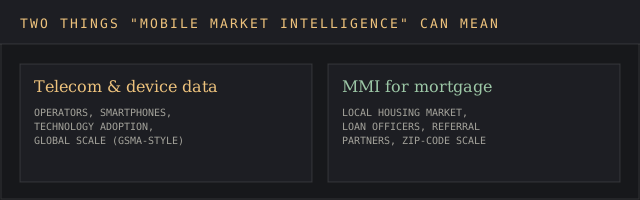
This term covers two related but distinct things depending on who's asking. In the telecom and technology sense, it's the data industry that tracks mobile operators, devices, smartphones, and users worldwide to spot market trends and emerging trends before they become obvious.
In a narrower business sense, Mobility Market Intelligence, usually shortened to MMI, is a specific data platform mortgage and real estate industries professionals use to track local housing market activity.
This guide covers both, since the same underlying discipline, continuous data collection about a market drives each.
Best mobile market intelligence tools
| Rank | Tool | Best fit | Signals | Watch-outs | Review |
|---|---|---|---|---|---|
| 1 | GSMA Intelligence | Global telecom and device market sizing | Operator, network, and MVNO coverage in every country; 350-plus metrics; historical data to 2000, forecasts to 2030 | Subscription pricing is not published; built for enterprise and carrier buyers | GSMA Intelligence review |
| 2 | Mobility Market Intelligence (MMI) | Mortgage and real estate local market tracking | Loan officer and agent rankings by county and loan type; database spans 3,000-plus counties and 150 million-plus properties | Built specifically for U.S. mortgage and real estate professionals, distinct from general telecom data | MMI review |
| 3 | Counterpoint Research | Smartphone and device market share tracking | Quarterly global smartphone market share tracker; also covers semiconductors, wearables, and IoT | Analyst-report format; pricing runs through direct inquiry | Counterpoint Research review |
| 4 | Omdia | Broad technology and telecom analyst research | 400-plus analysts covering 150 tech markets, built on legacy Ovum, Heavy Reading, and Tractica research | Now part of New TechTarget (Nasdaq: TTGT) following the December 2024 Informa Tech merger; brand structure is still settling | Omdia review |
| 5 | Ookla | Real-world network performance benchmarking | 250 million-plus consumer-initiated Speedtest results monthly, plus controlled testing via RootMetrics and Ekahau | Accenture completed its $1.2 billion acquisition of Ookla from Ziff Davis on June 17, 2026 | Ookla review |
| 6 | Opensignal | Crowdsourced mobile network experience data | Crowdsourced measurement across real user devices; Network Experience Suite (ONX) launched February 2024 | Crowdsourced sampling skews toward users with newer devices and better connectivity | Opensignal review |
Tool profiles
GSMA Intelligence
Best for: carriers, vendors, and investors who need operator-level data across every market. Why it fits: it's the data arm of the GSMA, the mobile industry's own trade body, tracking every operator group, network, and MVNO worldwide. Buyer check: pricing is subscription-based and unpublished, so budget a sales conversation before assuming fit.
Mobility Market Intelligence (MMI)
Best for: mortgage loan officers and real estate professionals tracking local market activity. Why it fits: its DataCenter ranks loan officers and agents by county, region, and loan type over a trailing period, a job GSMA-style global data was never built for. Buyer check: it's a U.S. mortgage-market tool built for a different buyer than telecom or device research.
Counterpoint Research
Best for: teams that need smartphone and device market share numbers on a recurring cadence. Why it fits: its quarterly global smartphone market share tracker is one of the most-cited device benchmarks in the industry. Buyer check: it's analyst-report driven, so confirm the update cadence matches how fast your team needs to move.
Omdia
Best for: strategy teams that need broad technology and telecom analyst coverage beyond mobile alone. Why it fits: more than 400 analysts cover 150 tech markets, built on research lineages including Ovum and Heavy Reading. Buyer check: the brand now sits inside New TechTarget after the 2024 Informa Tech merger, so confirm which research lines survived the consolidation.
Ookla
Best for: carriers and enterprises that need real-world network performance data. Why it fits: Speedtest alone collects more than 250 million consumer-initiated tests a month, backed by controlled testing tools RootMetrics and Ekahau. Buyer check: Accenture's announced acquisition, disclosed March 3, 2026, is still pending regulatory approval, so ownership is mid-transition.
Opensignal
Best for: teams that want crowdsourced, real-user network experience data as a check against carrier or lab claims. Why it fits: its Network Experience Suite, launched February 2024, packages crowdsourced measurement across real devices into one platform. Buyer check: crowdsourced panels skew toward users with newer devices and better connectivity, so read results as directional.
Choose GSMA Intelligence for carrier-scale global data, Counterpoint Research or Omdia for device and technology market analysis, Ookla or Opensignal when the question is real-world network performance, and MMI specifically for mortgage and real estate local market tracking, a different buyer and a different job from the other five.
Mobile Industry Data: Operators, Devices, and Users
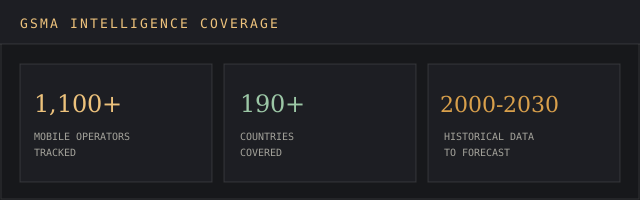
GSMA Intelligence tracks more than 1,100 mobile operators and provides data across 190-plus countries, with historical data reaching back to 2000 and forecasts running to 2030. That kind of coverage supports strategic decisions at a scale a single company's own data never could: connections, devices, smartphones in use, and technology adoption curves, compared consistently across markets.
Market analysis at this scale tends to focus on a handful of recurring questions: how fast smartphones are replacing older devices in a given market, which technology (5G, IoT, satellite connectivity) is gaining users fastest, and which markets are approaching saturation versus which still have real growth ahead.
Market trends here move slower than in most consumer categories, but the scale of the market, billions of devices and users, means even a small shift in market share translates into serious revenue for the companies positioned to capture it.
Mobile Market Research: Capturing Real Behavior
Mobile market research provides immediate feedback from consumers, per Luth Research, and mobile surveys reduce recall bias by capturing that feedback while an experience is still fresh. Mobile platforms allow brands to reach a wider, more diverse demographic than traditional research methods, per Luth Research and Contify, because more people carry a smartphone into more moments of their day than any other research channel can reach.
What separates this kind of research from a traditional survey is that it captures actual behavioral data: where a user goes, what they tap. Traditional surveys capture stated consumer behavior, what someone says they'd do in a hypothetical. That behavioral view matters for marketing efforts and marketing campaigns alike, since consumer preferences reported after the fact often diverge from purchase intent and actual behavior captured in the moment.
Mobility Market Intelligence (MMI) for Loan Officers
Mobility Market Intelligence, the specific platform known as MMI, is used by mortgage lenders and real estate industries professionals to track local market activity, build credibility with referral partners, and identify growth opportunities in the markets they cover before competitors do.
MMI focuses its market analysis narrowly: which loan officers and companies are closing the most business in a given zip code, what mortgage products are trending, and where borrowers are actively shopping right now. The property records behind that mortgage activity, including sales, mortgage and foreclosure data, come from vendors such as ATTOM, covered in our ATTOM Data pricing report.
For a loan officer, this kind of market intelligence supports specific, everyday strategic decisions: which real estate agent's client interactions are worth more business development time, which specific markets are heating up before a competitor's loan officers notice, and how to frame historical data on local mortgage activity into a compelling story during client interactions with prospective borrowers and investors.
Full view reporting like this turns a loan officer's gut feel about "the market feels busy" into actionable strategies backed by actual data.
Advanced Analytics and Data-Driven Decisions
GSMA-style industry data and MMI-style local mortgage tracking both run the underlying advanced analytics the same way: gather data continuously, monitor market trends and emerging trends as they develop, and route the resulting insights to the people making business decisions before a competitor's data driven approach beats them to it.
Behavioral insights, drawn from actual mobile usage patterns, increasingly feed both the telecom side and the mortgage side of this world.
Companies and individual loan officers alike benefit from up to date data more than from a full view delivered too late to act on. Deep insights that arrive after a decision has already been made deliver none of the value they promised, which is why the strongest programs in this space, telecom or mortgage, treat monitoring as a standing habit.
Choosing the Right Resources for Your Business Objectives
A telecom carrier's five-year network plan and a single loan officer's next quarter both start the search for the right resources the same way: identify what decision the data needs to support before comparing tools by feature list.
Raw data and market insights are different things: a platform can offer excellent data quality and still leave a business to do all the analysis itself, while another platform's real power lies in already-processed actionable insights a team can act on the same day.
Comparing tools on the competitors they cover, the research methods behind their data, and how quickly their reports translate into informed decisions is what matters.
Success with any of these resources tends to come down to fit: a telecom strategy team gains little from a mortgage-focused platform's features, and a loan officer gains little from GSMA-style global data built for carriers, so knowing which business objective is being served matters before committing budget.
Data Quality, Research Methods, and Staying Ahead
Data quality separates a resource worth paying for from one that only looks complete on its landing page. Strong research combines quantitative data, downloads, revenue, connections, devices, with qualitative research, interviews and surveys, since numbers alone rarely explain why a trend is happening, only that it is. Businesses that rely on a single data source to spot opportunities tend to miss trends a second, independent source would have caught sooner.
Explore competitors' public data, compare it against your own customers' behavior, and treat every fresh report as an update to existing knowledge.
The businesses and individual lenders who stay ahead of their markets long-term are rarely the ones with access to the most exotic data; they're the ones who improve a solid, boring research habit with fresh data every single cycle, gain a slightly better picture each time, and let that compounding advantage build quietly into a real edge over competitors still checking in once a year.
What to Look for Across Both Kinds of Intelligence Tools
Tools in this space share a few features worth comparing before you commit: research depth behind their insights, how many reports they generate versus how many a business reads, and if their analysis of trends translates into strategies a team can execute.
Revenue tracking, search functionality across historical reports, and the power to compare your own numbers against a competitor's public data all separate a tool worth its price from one that just looks impressive in a demo.
Tools built for telecom carriers emphasize revenue and connections data at massive scale; tools built for mortgage professionals emphasize local trends and customers' shopping behavior instead. Explore both categories before assuming your business objectives fit neatly into one.
The valuable insights that move strategies forward tend to come from research a team revisits often.
Success with any of these tools comes down to a few repeatable habits: reviewing fresh insights on a fixed schedule, comparing revenue and customers trends against last cycle, and treating features as a means to an end.
Providers in both categories keep improving their tools with better insights and new features every year, and businesses that explore what each update changes tend to build stronger strategies for whatever the future of their market holds.
Customers of these tools who compare notes with peers using the same platforms often surface strategies nobody on their own team would have found working from insights alone.
FAQ
What is MMI in mortgage?
MMI stands for Mobility Market Intelligence, a data platform used by mortgage loan officers and real estate professionals to track local market activity, competitor performance, and referral relationships, helping them build credibility and identify growth opportunities in the markets they serve.
The insights it produces improve a lender's own pipeline strategies, and its revenue reporting helps them defend those strategies with real insights.
Pricing insights, competitor insights, and borrower demand insights each tell part of the story, and usually matter more read together than any one taken alone.
What are the best 3 market intelligence tools on the market today?
It depends on the use case. For telecom and device-level industry data, GSMA Intelligence covers more than 1,100 mobile operators across 190-plus countries; for mortgage and real estate market activity, Mobility Market Intelligence (MMI) is a recognized name; and for broader mobile market research capturing consumer behavior, Luth Research is an established option.
How much does market intelligence cost?
It varies enormously by scope. Enterprise telecom industry data from a provider like GSMA Intelligence, covering 190-plus countries and historical data back to 2000, sits in a different pricing tier than a localized mortgage-market tool like MMI, priced around the specific markets a single loan officer or business covers.
What does market intelligence include?
It includes data collection on devices, users, and market trends; competitive analysis of who's winning share in a given market; and consumer behavior research: a mobile survey capturing purchase intent, or a mortgage platform tracking which lenders are closing the most business locally.