Credit market intelligence
 By Jan Suski. I go deep on every review, checking every number against its source and digging up details other coverage misses, a habit from six years of SEO and link building for tech companies. Bylines at Surfer, Brand24, and Senuto. How the scoring works.
· Prefer this source on Google
Credit market intelligence is the collection, analysis, and interpretation of borrower and market data across credit markets. It combines financial analysis, macroeconomic insights, and predictive analytics so lenders and investors can price credit risk and act on it. For banks, funds, and issuers, credit market intelligence turns raw market data into confident decisions about who to lend to, what to buy, and when to sell.
In a credit world where spreads change by the week, that data-led power is what separates lenders that win share from those that absorb the losses.
This guide covers what credit market intelligence is, the components and data behind it, how continuous monitoring works, what the credit markets are signaling, and how different market participants use credit intelligence to compete. The thread running through all of it: better market intelligence lets you move earlier than the rest of the market.
What credit market intelligence is
In short, credit market intelligence assesses credit risk and identifies investment opportunities for lenders and investors. It answers two questions at once: how likely is this borrower to repay, and how is the wider market pricing that same risk today? The first is credit analysis; the second is where market data and credit markets intelligence meet.
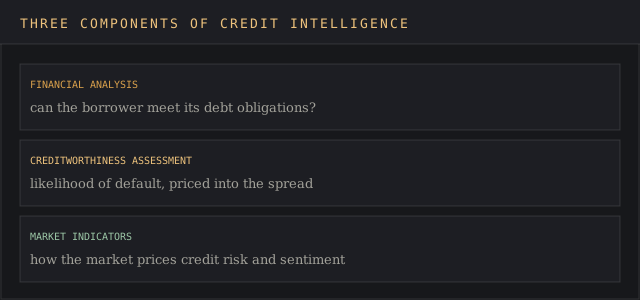
Three components carry the work. Financial analysis evaluates a borrower's ability to meet its debt obligations. Creditworthiness assessment estimates the likelihood of default and supports the pricing of risk. Market indicators reveal how the market prices credit risk and where investor sentiment sits. Put together, these give the actionable insights a credit team needs to lend, price, or sell with more confidence.
Weak on any one and the picture blurs; strong on all three and the credit markets stop being a black box, which is the whole promise of credit markets intelligence.
The three measures of credit risk
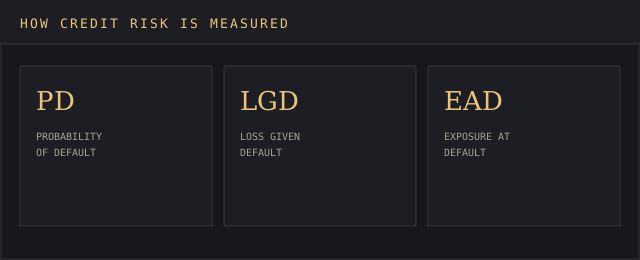
Credit risk breaks into three numbers. Probability of default estimates how likely a borrower is to miss payments. Loss given default measures how much is lost if it does. Exposure at default is how much is at stake at that moment, the figure the other two multiply against to produce expected loss. Multiply and combine them and you have expected loss, the figure that underpins underwriting, provisioning, and pricing across credit markets.
Macroeconomic analysis identifies the economic conditions that change a borrower's repayment capacity, so credit risk is never read in isolation. A single default in a small portfolio is noise; a pattern of defaults across a sector is a signal, and credit market intelligence exists to tell the two apart before the losses land.
The data and analytics behind it
Credit intelligence runs on data. Financial statements and transaction data show what a borrower earns and owes. Market data, spreads, and ratings show what the market thinks. Alternative and qualitative data provide early warning signals that the financials have not caught up to yet. The analytics layer on top turns all of it into scores, benchmarks, and forecasts.
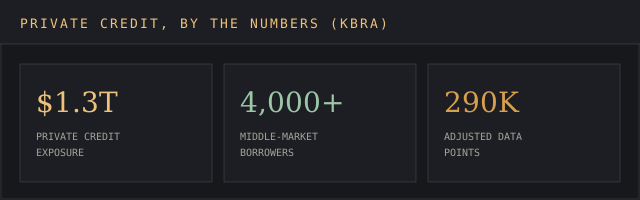
Private credit shows why this matters. Private credit exposure has passed $1.3 trillion, spread across more than 4,000 middle market borrowers, most of them without public ratings. To give investors a consistent read, KBRA provides 290,000 analyst-adjusted financial data points and benchmarks borrowers by leverage and liquidity.
That is the difference between guessing at a private borrower's health and measuring it: access to comparable data, at scale, updated as the numbers change.
Leverage is the number credit analysts watch most closely, because a borrower carrying too much debt has little room when the market changes. Benchmarking leverage across a sector shows which issuers are stretched and which have headroom, and that comparison is only as good as the data and analytics behind it.
Access to that data is the moat. A desk with real-time analytics and clean market data reads sectors and issuers faster than one waiting on filings, and that speed compounds into smarter positioning across the credit markets. The teams with the widest access to comparable data see more of the world's credit markets, sooner.
Continuous monitoring beats origination-only credit
The old model checked a borrower once, at origination, and filed the report. Modern credit market intelligence monitors borrowers continuously instead. Portfolio monitoring detects deterioration early, so a name that looked safe in March can be flagged the moment its numbers or spreads change, months ahead of the next annual review.
Speed is the point. A credit team that can monitor a book in near real time acts faster than one waiting on a quarterly file. Alternative data, property records, news, and transaction data feed the monitor between reporting dates, and the earlier a problem surfaces, the more options a lender has to restructure, hedge, or exit.
The same discipline that catches a weak borrower in March catches an opportunity a week before the rest of the market prices it in.
What the credit markets are signaling
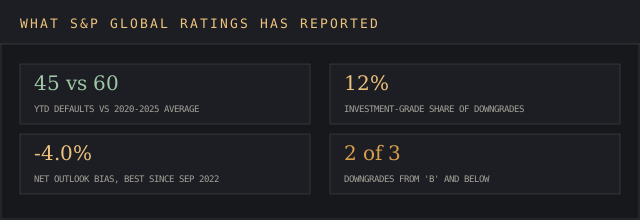
Credit market intelligence is only useful if it reads the cycle. S&P Global Ratings has reported that global corporate defaults reached a one-year high in May 2023, a reminder that defaults cluster when conditions tighten. It has also reported year-to-date corporate defaults of 45, below the 2020-2025 average of 60, so the count sat under trend even as headlines warned of stress.
The mix matters as much as the count. S&P has reported that investment-grade downgrades fell to 12% of total downgrades in May 2023, and that nearly two-thirds of downgrades came from issuers rated 'B' and below. Its net outlook bias, a forward read on where ratings are heading, narrowed to -4.0%, the best level since September 2022.
Read together, those numbers describe credit markets that were cautious but not cracking, exactly the nuance a single default headline misses.
Signals like these differ by sector. Leveraged loans, high-yield bonds, and structured credit such as CMBS each carry their own default and recovery patterns, and credit market intelligence that ignores sector detail will misread the whole. Watching defaults, downgrades, and outlook bias by sector is how investors spot which corner of the credit markets is turning first.
When defaults rise across some sectors while others hold, the credit markets are telling you where the cycle is biting, and tracking those changes week by week is how buyers rotate before the crowd. A borrower priced for calm in March can look different once those changes show up in its spreads.
How market participants use credit intelligence
Different market participants pull different jobs from the same data:
- Lenders and underwriters. Credit intelligence sharpens underwriting, sets limits, and prices loans to risk. Better data lets a bank say yes to sound borrowers faster and no to weak ones earlier.
- Investors and buyers. Investors use credit market intelligence to find mispriced bonds, run sector rotation, and do relative value analysis, buying the credit that pays more than its risk warrants and selling the credit that does not.
- Issuers. Issuers watch how buyers view their debt. Equiniti (EQ) provides customized bondholder identification reports, quarterly or semi-annually, with details on ultimate beneficial owners and 360-degree visibility into bondholder data, which helps an issuer assess options for debt restructuring or a liability exercise.
- Analysts. Analysts stitch the market data, financials, and alternative signals into a single view, so the desk trades on evidence.
Across all four, the payoff is the same: confident decisions made from a clearer picture of the credit markets than the counterparty has. Whatever the seat, the output is insights: insights into a single borrower, insights into a sector, and insights into where the credit markets are heading.
A lending business that acts on those insights approves more good loans; an investing business reads risk better; a business that ignores the signals pays for it in defaults. Turning raw data into insights, and insights into decisions, is the whole business of credit market intelligence, and the smarter the analytics, the wider that edge across the credit markets.
Credit intelligence for small business and consumer lending
Nowhere is better data worth more than in small business lending, where thin files and limited history make credit risk hard to read. Credit intelligence closes that gap by adding transaction data and alternative signals to the traditional score, so a lender can extend small business loans to sound operators that a bureau file alone would reject.
The reported results are concrete. Mastercard Credit Intelligence can increase new account volume by 36%, improves underwriting decisions, and provides near real-time analytics across the credit lifecycle. Equifax reports that its insights can increase market share by up to 15% and reduce credit loss by up to 10%. Those are two sides of smarter lending: more good customers approved, fewer bad ones, and the credit loss line held down while the book grows.
Smarter small business lending is not about lowering the bar; it is about seeing more. With richer data, a lender can approve sound small businesses faster, price each customer to its real risk, and grow the book while credit loss falls. The same smarter analytics help retain existing customers, deepen relationships, and expand into new customer segments the old model overlooked.
For small businesses especially, that access to credit is transformational: a sound operator with a thin file gets approved for small business loans on the strength of its transaction data, and the lender books smarter growth it could not safely underwrite before. Multiply that across thousands of small businesses and the whole small business lending market widens across the credit markets.
Lenders that master this build a durable business: they win more small businesses as customers, grow across sectors, and give customers smarter, faster credit decisions. The analysis that powers those approvals is the same analysis that flags trouble, so smarter growth and risk control move together, and the actionable insights reach the front line in near real time.
The same logic runs through consumer credit. Segmenting customers into customer segments by behavior and risk lets a lender price to each group, target the right consumer offers, and expand access to credit without loosening standards. Done well, smarter consumer analytics widen the market, lift growth, and cut losses at the same time, which is why so many small businesses now treat credit intelligence as a growth engine.
Platforms that provide credit market data
Several providers supply the data and analytics that power credit market intelligence. The right one depends on which corner of the credit markets you work in.
| Provider | Focus | Signal |
|---|---|---|
| S&P Global | Ratings and credit research | Defaults, downgrades, outlook bias, sector research |
| KBRA | Private credit benchmarking | Analyst-adjusted data, leverage and liquidity benchmarks |
| Mastercard | Lending analytics | Near real-time transaction data and underwriting insights |
| Equifax | Consumer and business credit | Bureau data, market share and credit loss analytics |
| Equiniti (EQ) | Bondholder intelligence | Bondholder identification and beneficial ownership data |
Whatever the logo, judge a platform on three capabilities: the breadth of its data, the speed of its updates, and if its insights turn into decisions your team will make. A tool that reports defaults a week late has no place in a credit workflow.
Building a credit intelligence capability
A credit intelligence strategy involves more than buying one platform and more about wiring data into decisions. Start by defining the credit risk questions that matter, connect the market data and transaction data that answer them, and give analysts access to both in one place. Then monitor the book on a cadence fast enough to act, and measure the capability by the decisions it changes.
The strongest credit intelligence strategy is data-led before it is tool-led: pick the capabilities that answer your credit questions, give analysts access to the credit data behind them, and let the analytics power decisions from underwriting to portfolio review. Teams that build these capabilities move faster than rivals and can expand into new sectors with a real strategy.
A durable strategy also plans for access: to more sectors, more issuers, and more of the world's debt markets over time. As a book grows, the questions change, and the capabilities have to change with them, from consumer credit to leveraged loans to structured debt such as CMBS across the credit markets.
Teams that get this right compound an advantage. Each cycle of data, analysis, and outcome sharpens the next, and the power of the approach shows up as steady growth with lower credit loss. The goal is not more dashboards; it is a credit team that reads the credit markets a step ahead and can expand into new sectors with confidence, because it can measure the risk before it takes it on.
That is where durable growth in the credit business comes from.
That is the promise of credit market intelligence: access to enough data, across enough sectors, to see the credit markets change before competitors do. The teams with that access read the world's credit markets with more power and confidence, and turn small businesses, consumer books, and customers into engines of smarter growth. That access to sharper insights is the whole advantage.
FAQ
What are the 4 types of credit market instruments?
The four broad categories are money market instruments (short-term paper such as commercial paper and Treasury bills), bonds and notes, mortgage-backed and asset-backed securities including CMBS, and bank and consumer loans. Each trades in its own corner of the credit markets with its own default and recovery profile, which is why credit market intelligence reads them separately.
What does market intelligence do?
Market intelligence gathers external data about a market, competitors, and conditions and turns it into decisions. In credit, credit market intelligence prices risk, spots mispriced debt, monitors borrowers, and gives lenders and investors a clearer read on the credit markets than the counterparty has, so they can act with more confidence and speed.
What are the 5 C's of credit?
Character, capacity, capital, collateral, and conditions. They summarize what an underwriter weighs: the borrower's track record, its ability to repay from cash flow, the equity behind the deal, the security pledged, and the economic conditions around it. Credit intelligence supplies data for each C, especially capacity and conditions. Property collateral checks draw on records vendors such as ATTOM, priced in our ATTOM Data pricing report.
What is Capital IQ used for?
S&P Capital IQ is a financial data and analysis platform used to research companies, model credit and equity, screen sectors, and pull financial statements and market data into one workflow. Credit teams use it for financial analysis and benchmarking as part of a broader credit market intelligence stack.