App market intelligence
 By Jan Suski. I go deep on every review, checking every number against its source and digging up details other coverage misses, a habit from six years of SEO and link building for tech companies. Bylines at Surfer, Brand24, and Senuto. How the scoring works.
· Prefer this source on Google
App market intelligence is the practice of collecting data on apps, downloads, revenue, and rankings across the App Store and Google Play, then turning that data into informed decisions about which apps to build, promote, or compete against.
Over 257 billion app downloads occurred in 2023, per AppFollow and MobileAction, spread across millions of apps competing for the same limited attention, and only about 15% of those downloads were driven by paid campaigns, which means most apps still win or lose on organic visibility.
The Mobile App Market in Numbers
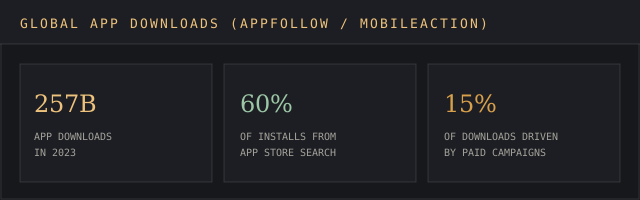
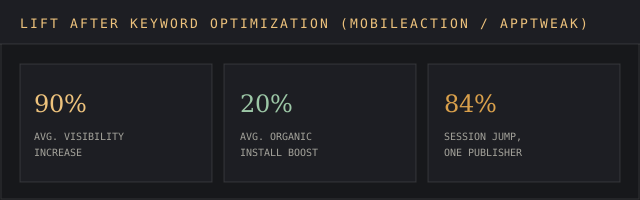
60% of installs across all apps come from app store searches, per AppFollow and ASOMobile, which is why keyword visibility matters as much as any paid channel for most apps chasing growth. A 90% average increase in visibility has been reported for apps after keyword optimization, and a 20% average boost in organic installs typically follows for those same apps, per MobileAction and AppTweak.
Apps that sustain the work can reach the top 30 of their category within 3 months, and one publisher reported an 84% jump in sessions across its apps after using an intelligence platform to guide changes, per MobileAction and AppTweak.
Mobile market trends shift which apps rise and which apps stall: a category full of similar apps today can look completely different in six months once new apps launch and older apps lose ranking. Tracking mobile app market trends across an entire category is how a publisher spots where its own apps still have room to grow.
App Store and Google Play Store Data
Apps behave differently depending on which store they're competing in: app store metrics and performance on Apple's platform and store performance on google play rarely move in lockstep for the same apps, since ranking factors, review volume thresholds, and the pool of competing apps differ between the two.
Publishers running apps on both stores need download estimates and revenue estimates broken out separately, because google play's larger device base and the app store's higher revenue per user change which apps are worth prioritizing.
Search ads and apple ads campaigns on Apple's platform work differently from the auction Google runs for apps inside google play, and tools tracking keyword positions across both stores catch competing apps shifting spend from one store to the other before that shift shows up anywhere else.
Competitor Analysis and Competitor Apps
Competitor analysis reveals estimated downloads and revenue for competitors, per ASOMobile and MobileAction, letting a publisher benchmark its own apps against named competitor apps. Competitor keyword analysis reveals gaps in an app's own keyword strategy, per AppRanking and ASOMobile, surfacing keywords that competitors already rank for that a publisher's own apps have never targeted.
Tracking competing apps historically flags exactly when competitors change a title, icon, or set of screenshots, useful context for reading why those apps moved right after, per AppFollow and AppTweak.
Tools that combine this history with review data and revenue estimates give a fuller read on competitors than download numbers alone ever could, and a publisher managing several apps at once benefits from watching all of them against the same competitive set.
Category Rankings and Market Segments
Category rankings inside each market segment are the most visible signal available for judging which apps are gaining ground; time periods matter here, since a position held for one day among a list of trending apps means far less than the same position held across several time periods.
Tracking apps by category rankings over time separates apps genuinely growing their market segment from ones that spiked briefly on a single promotion before other apps caught up.
New apps entering a category shift the top apps list constantly, so market analysis of apps by category works best as an ongoing habit, checked across countries and devices.
Revenue, Downloads, and Growth Opportunities
Revenue estimates and download estimates modeled from category performance let a publisher size an opportunity across similar apps before committing budget to it.
New growth opportunities usually surface where organic installs for comparable apps are rising, competing apps are thin, and revenue trends across those apps already look strong; spotting that combination in a batch of overlooked apps before other publishers do is most of what separates a growth win from a crowded, late entry among too many similar apps.
Visibility, Reviews, and Reply Rate
Visibility for any app depends on keyword positions, rankings, and reviews together over any one metric alone, and apps with more reviews generally out-rank apps with fewer at a similar rating. Reviews shape how both stores treat competing apps, and a publisher's reply rate to reviews across its apps increasingly factors into how android and iOS users judge if a developer is actively maintaining its apps before committing to a download.
Start Free: Evaluating an App Market Intelligence Platform
Most app market intelligence tools let a publisher start free with limited access to data on its own apps and a handful of competitor apps before committing to a paid tier, which is worth using to compare how each platform's numbers on your apps line up with what you already know to be true.
Access to keyword tracking, publisher analysis, and benchmark data against competitors varies a lot across tools, so testing more than one platform against the same set of apps is worth the time before deciding which to rely on.
Benchmarking Performance Across Stores
Publishers comparing performance across stores need more than a single day's ranking snapshot; useful benchmark data tracks rankings, chart positions, and revenue data across both stores over several weeks. Metrics worth tracking side by side include downloads, revenue estimates, keywords ranked, and review counts, since a publisher's apps can look strong in one market and weak in another market entirely.
Competitive analysis that spans every store turns raw performance charts into a strategic decisions framework a business can use when investing budget into new keywords or a new market.
Top charts and top publishers analysis both help here: comparing an app's own performance against the top publishers already succeeding in the same market segment surfaces valuable insights about which keywords, price points, and update pace those competitors rely on.
Explore how competitors perform across multiple stores and multiple countries, and compare their keywords, benchmark scores, and app store performance side by side, before committing app market intelligence budget to your own strategy.
Keywords, Growth Trends, and What to Track Next
Keywords remain the foundation of organic growth trends across every store in the mobile app market, and mobile app market intelligence increasingly treats keyword tracking as its own discipline: tracking which keywords competitors and top publishers already rank for, and which keywords remain open, helps identify new growth opportunities before competing developers do.
Analyze keyword trends over time across the app store and google play alike, since keywords trending upward in app downloads this month can fade the next once other developers across different countries notice the same market and start investing in the same terms.
To answer the question of what to track next: developers and business teams alike should compare their own apps' keywords, rankings, and revenue data against the same benchmark set every month, treating app market intelligence as a standing habit.
User growth, app store performance, and mobile app market share all move together often enough that tracking one without the others gives an incomplete strategy for any company trying to compare its apps against competitors across stores and countries.
Turning App Market Data Into Strategy
A strategy built on app market data works best when a business analyzes the same set of stores, countries, and categories every cycle.
Analyze app downloads and app category performance side by side across stores in every market the business competes in, and compare that against how competitors and top apps in each category are trending; a strategy that only looks at one store, one market, or one category at a time misses the moves happening everywhere else in the app market.
Charts of insights drawn from category data, app visibility scores, and top charts positions across countries give a business more to act on than any single number could. Market analysis and market trends both matter here: market trends show where an app category is heading across stores and countries, while market analysis of individual competitors explains why.
Explore data on top apps, app category shifts, and competitor analysis together, since a strategy built on data from only one of the three tends to miss what the others would have caught, and a business tracking all three across every store and market it competes in tends to catch a shift in strategy earlier than one relying on downloads alone.
Insights worth watching monthly include which top apps gained or lost app visibility, which top charts saw movement across countries, which competitors' downloads accelerated, and which keywords and trends kept climbing across stores; charts and metrics built from that same set of insights, explored and re-analyzed every cycle, tend to catch trend shifts and anomalies as they happen.
Deep insights on downloads and competitors across stores and countries compound over time: a business that keeps analyzing the same keywords, trends, and charts month after month builds a clearer picture than one that only checks metrics when a launch is imminent. Explore how competitors' stores rankings and downloads move across countries every cycle, well outside release weeks.
Analyze the same top apps and app store insights every month, since publishers who only analyze downloads and trends on launch date miss the slower stores insights that build up between releases.
Competitors watching the same stores and analyzing the same insights on a fixed date each month tend to catch what a one-off check would miss, and the strongest competitors treat that monthly date as fixed as payroll, analyzing every one of their stores the same way, every time, and taking the time to analyze what changed since the last check.
FAQ
Is AppMagic a reliable tool?
AppMagic is one of several established tools used to analyze downloads, revenue, and rankings for apps across the App Store and Google Play; like any single-source tool tracking millions of apps, its estimates are modeled and are best cross-checked against a second data source before a major decision about which apps to prioritize. Sensor Tower bought AppMagic on 12 May 2026 as a dedicated SMB offering, per our Sensor Tower pricing report.
How much does a 10,000 app download make?
It depends entirely on the app's monetization model and category; in-app purchases, subscriptions, and ads produce different revenue across otherwise similar apps, and revenue estimates for comparable apps in the same category are a better benchmark than any flat, universal figure.
What does market intelligence do?
Market intelligence turns raw data on apps, downloads, revenue, and competitors into informed decisions, identifying growth opportunities and market segments worth pursuing across a set of apps before a publisher commits marketing spend to them.
Is App Market a safe app?
Publishers should verify any app named "App Market" against the official App Store or Google Play listing for its developer before installing it; the tools covered in this guide for analyzing apps are business analytics platforms and are unrelated to any consumer app of that name.