Regulatory Intelligence Software: 8 Platforms Ranked (2026)
 By Jan Suski. I go deep on every review, checking every number against its source and digging up details other coverage misses, a habit from six years of SEO and link building for tech companies. Bylines at Surfer, Brand24, and Senuto. How the scoring works.
· Prefer this source on Google
Quick comparison of regulatory intelligence software
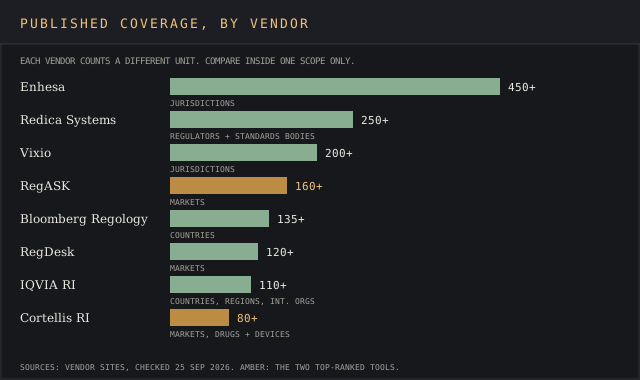
One row per tool, in ranked order. Coverage is each vendor's own published count, so the units differ.
| # | Provider | Published coverage | Entry price | Best fit |
|---|---|---|---|---|
| 1 | RegASK | 160+ markets, 1,800+ experts | Quote only | Pharma, medtech and consumer products in many markets |
| 2 | Cortellis Regulatory Intelligence | 80+ markets, 328,000+ regulatory documents | Quote only | Large pharma regulatory affairs |
| 3 | Redica Systems | 250+ regulators, 170,000+ inspection documents | Quote only | Quality and inspection readiness |
| 4 | IQVIA Regulatory Intelligence | 110+ countries, regions and organizations | Quote only | Drug and device registration requirements |
| 5 | RegDesk | 120 markets | Quote only | Medical devices, small to mid-size RA teams |
| 6 | Enhesa | 450+ jurisdictions, 65+ languages | Tailored quote | EHS, product and chemical compliance |
| 7 | Bloomberg Regology | 135+ countries, 10,000+ sources | $1,700 per user per month | US regulatory change management |
| 8 | Vixio Regulatory Intelligence | 200 jurisdictions, 1,400 authorities | Quote only | Gambling and payments compliance |
Every price in this table is the one the vendor publishes itself. Seven of the eight quote on request, and none of the eight has a Vendr header median of its own.
Where these figures come from
Coverage counts are each vendor's own published figure, read on 25 and 27 September 2026, so the units differ by row. The one public price is Regology's Professional plan. The nearest benchmark for Cortellis is Vendr's Clarivate-wide median, which covers patent and citation tools only. None of the eight publishes a contract length outside Regology's 3-year term, so no row claims one.
Vendor security and compliance risk is ranked separately on the third-party risk management tools ranking, and supplier disruption and sanctions exposure on the supply chain risk management software ranking. This page ranks tools that track what regulators publish.
Regulatory intelligence software reads what regulators publish, sorts it by product and market, and tells a named person which regulatory changes affect their products. The work used to run on bookmarks, inboxes and manual checks of government websites.
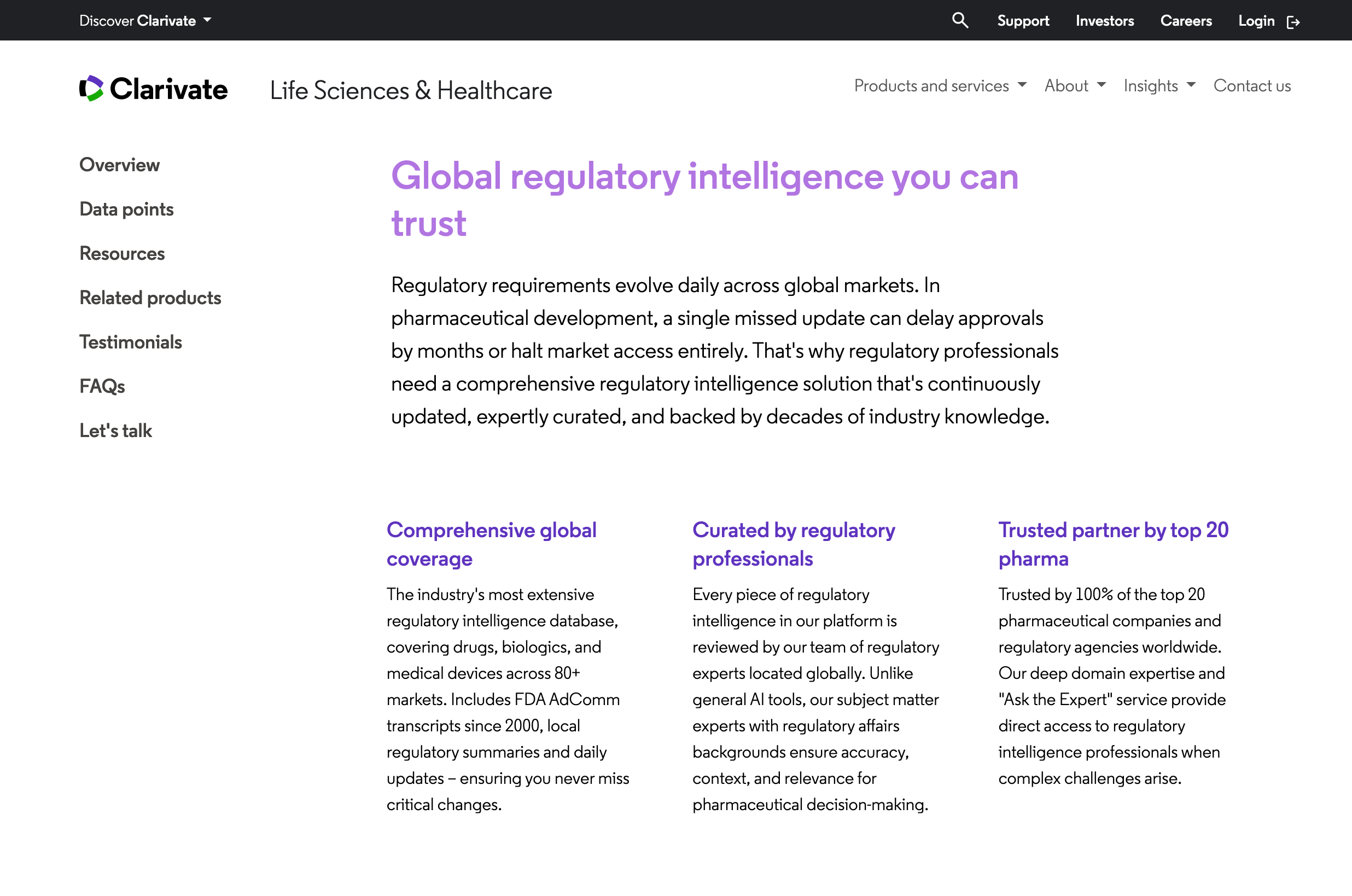
A regulatory team at a drug or device maker now has to keep an eye on guidance documents, consultations, recalls and inspection findings from dozens of regulatory agencies at once. Clarivate's own product page warns that a single missed update can delay approvals by months.
The load keeps climbing. MetricStream, citing the 2025 Cost of Compliance report, says 77% of compliance professionals name keeping up with regulatory changes as their top challenge. Rules in global markets are constantly evolving: RegASK alone logged 16M+ regulatory actions in the last 12 months.
This page ranks eight regulatory intelligence tools on five tests a buyer can run in a demo. It's written for regulatory affairs, quality and compliance teams in pharma market intelligence and medtech first, with three picks for EHS, US law and gambling or payments compliance.
Evaluation criteria for regulatory intelligence tools
Five criteria decide the shortlist of regulatory intelligence tools, and the ranking below applies them in this order. Each one ends in a yes, a no, or a number you can check against the vendor's own site.
Health-authority scope
Does the tool cover regulatory requirements from global health authorities for drugs, biologics or medical devices, and in how many markets? Regulatory intelligence tools that pass rank first. Enhesa, Bloomberg Regology and Vixio fail this gate by design, so they rank after the five that pass.
Source depth
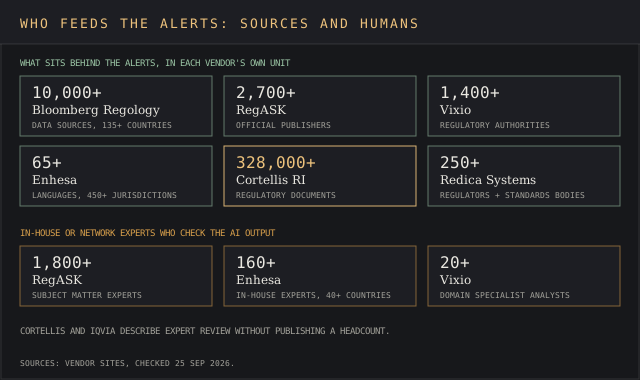
Count the documents, official publishers or regulatory agencies behind the alerts. A published number (328,000 documents, 2,700 publishers) beats a promise of global coverage.
Human review of AI output
Most platforms now summarize guidance with AI. The test is a published count of regulatory experts who check that output, or a named expert-review step you can see in the product. An AI summary nobody reviews is a red flag.
Update latency and audit trail
Ask how many days pass between a regulator publishing new regulations and the alert landing, and if every version of a document is kept. Ensuring compliance at audit means showing when you saw each change. Draft-to-final comparison is the feature to test with your own guidance documents.
Price visibility and fit with existing systems
A public price or Vendr benchmark counts as a yes. So does a documented API or connector into existing systems such as your RIM, QMS or GRC stack. Quote-only pricing is par for the course here: one ranked regulatory intelligence vendor prints a price.
Ranked vendors that print a price on their own site: Bloomberg Regology, at $1,700 per user per month on a 3-year contract. Five of the eight pass the health-authority gate.
The 8 best regulatory intelligence software platforms in 2026
RegASK
Best fit
Regulatory teams selling drugs, devices or consumer products into multiple markets at once.
RegASK is AI-powered regulatory intelligence software backed by a people network. The homepage lists horizon scanning across 160+ markets, impact assessments and prioritized alerts, with direct access to 1,800+ subject matter experts. Its about page puts the source base at 6M+ data points from 2,700+ official publishers, the widest publisher count on this list.
RegASK by its own numbers regask.com, read 27 September 2026
Key features
- Continuous monitoring of regulatory changes across 160+ markets
- Local-language help interpreting regulatory information per jurisdiction
- Conversational Assistant plus Expert Validation
- Impact assessment and risk assessment workflows
- Pharma, medtech, cosmetics, food and supplements coverage
Pricing
Quote only. RegASK publishes no rate card and holds no Vendr listing.
Pros
- Largest published expert bench: 1,800+
- ISO 27001, ISO 42001 and SOC 2 Type II listed
- Covers consumer categories the pharma tools skip
Cons
- No public price
- No archive depth or document count published
- Zero reviews on its G2 listing
Why it's ranked #1. RegASK covers 160+ markets against Cortellis's 80+ and publishes 1,800+ reviewing experts, where Clarivate publishes no headcount. It wins the scope and human-review tests outright, and Cortellis's edge is archive depth.
Cortellis Regulatory Intelligence
Best fit
Large pharma global regulatory affairs teams that need a deep, citable archive.
Clarivate's product page says Cortellis Regulatory Intelligence covers drugs, biologics and medical devices across 80+ markets with daily regulatory updates, and lists 328,000+ regulatory documents, 43 global comparison tables and FDA AdComm transcripts since 2000. Our Cortellis review covers the wider suite.
Cortellis in four numbers Clarivate and Vendr
Key features
- AI-powered Regulatory Assistant, live for all customers since 4 December 2025
- 46,000+ English machine translations from 38 languages
- MCP connector into Claude, announced 10 March 2026
- Ask the Expert access to Clarivate's regulatory experts
Pricing
Quote only. The nearest public benchmark is Vendr's Clarivate-wide median of $175,931 a year, from anonymised buyer data spanning $161,105 to $179,924, and every product on that listing is a patent, trademark or citation tool.
Pros
- Deepest document archive published: 328,000+
- Multilingual regulatory questions answered with citations
- Clarivate says 100% of the top 20 pharma companies use it
Cons
- Half RegASK's market count
- No expert headcount published
- Consumer products and food sit outside scope
Why it's ranked #2. Cortellis holds 328,000+ documents, about double Redica's 170,000 inspection files, and updates daily. It loses #1 because RegASK covers 160+ markets to its 80+ and names its expert count.
Redica Systems
Best fit
Quality and compliance teams preparing for FDA and global inspections.
Redica built its regulatory data from the inspection side, with continuous monitoring of regulatory changes at 250+ regulators. The homepage lists 250+ regulators and standards bodies, 410,000+ site profiles, 170,000+ inspection documents, 8,300+ inspector profiles and a 1 day publish time for core signals.
That inspection record lets quality teams zero in on the sites and inspectors behind a citation, and run inspection and enforcement trend analysis to spot regulatory trends early.
Key features
- Four clouds: Regulatory Intelligence, Inspection, Site and Postmarket
- Draft-to-final tracking with 100% version history
- Explainable AI summaries with source citations
- Redica App, API and integrated solutions
Pricing
Quote only, with no public tiers.
Price of one FDA Form 483 in Redica’s document store, here a single October 2025 inspection of Precision Science. Redica calls itself "the No. 1 FOIA requester of FDA inspections" in its own blog, which is how the archive gets built.
Pros
- Fastest published latency: 1 day
- Maps regulatory updates to SOPs, compliance processes and owners
- Correlates guidance changes with inspection citations
Cons
- No market count for registration requirements
- No public reviews on G2
- No expert headcount published
Why it's ranked #3. Redica publishes 170,000+ inspection documents and a 1 day publish time, two numbers IQVIA doesn't publish at all. It trails Cortellis, whose 328,000+ document archive is nearly double.
IQVIA Regulatory Intelligence
Best fit
Drug and device makers comparing registration requirements country by country.
IQVIA sells this regulatory intelligence database alongside its regulatory services arm. The product page covers human drugs, biologics, medical devices and IVDs for over 110 countries, regions and international organizations, and calls it a validated system to FDA standards. Curated regulatory data runs from clinical trials through approvals, manufacturing and adverse event reporting. Background on the parent sits in our IQVIA review and IQVIA acquisition history.
The regulatory arm behind the database IQVIA’s own pages
Key features
- Cross-Country Tables with alerts on regulatory changes
- Alerts on new regulatory requirements and updated drug approval records
- Expert summaries from IQVIA's local network
- Upload of internal company documents into the database
Pricing
Quote only.
Pros
- 110+ countries, regions and organizations
- English translations of local regulatory information
- Validated to FDA standards
Cons
- No document count or update cadence published
- No named AI assistant on the product page
- Monitoring runs through alerts and personalized newsletters
Why it's ranked #4. IQVIA covers drugs, biologics, devices and IVDs in 110+ markets, where RegDesk covers devices only. It sits below Redica because it publishes no document count against Redica's 170,000+.
RegDesk
Best fit
Medtech regulatory teams that want intelligence and registration tracking in one system.
RegDesk pairs a regulatory intelligence module with RIM workflows for medical devices, covering regulatory processes from market access planning to submission. The homepage lists updates from 120 markets and SOC 2 Type II, ISO 27001 and 21 CFR Part 11 compliance. It holds a 4.9 average from 10 reviews on G2, tied with Vixio for the highest average here.
Key features
- Regulatory Intelligence module, updated daily
- Change Assessment tool linking regulatory changes to product registrations
- AI Forms and Submission Generator
- Standards Management
Pricing
Quote only.
Pros
- Global regulatory tracking feeds registrations in the same tool
- 4.9 from 10 G2 reviews
- Regional impact assessments assignable to external partners
Cons
- Medical devices only
- Registration alerts miss some countries
- Large tracking reports get unwieldy
A regulatory affairs project manager's review on G2, dated 18 March 2026, names the coverage gap:
"One limitation is that device registration alerts don’t yet support all countries. This leaves some gaps in coverage, so we still have to monitor certain regions manually to make sure nothing gets missed."
Carissa B., Regulatory Affairs Project Manager, G2, 18 March 2026
The same reviewer credits it with removing "a lot of the manual effort involved in tracking global requirements."
Why it's ranked #5. RegDesk covers 120 markets and passes the health-authority gate that Enhesa fails. It trails IQVIA, which covers drugs and biologics as well as devices across 110+ markets.
Enhesa
Best fit
EHS, product stewardship and chemical compliance teams at multinationals.
Enhesa tracks rules for facilities, products and substances, and skips drug approvals entirely. Its AI-powered platform homepage claims 450+ jurisdictions in 65+ languages, 160+ in-house experts across 40+ countries, and 22,000 major requirement changes logged in 2025. Enhesa also counts 47% growth in global regulatory changes over the past four years. Our ESG data providers ranking covers its sustainability side.
Key features
- Regulatory Forecaster to anticipate future changes and regulatory trends
- Chemical Assess against 600+ RSLs
- Product regulatory database across 279+ jurisdictions
- Chemical Watch news and analysis
Pricing
The pricing page lists products by department and routes every one to a tailored quote.
Pros
- Widest jurisdiction count published: 450+
- 160+ in-house experts across 40+ countries
- 4.4 average from 14 reviews on G2
Cons
- No drug or device registration coverage
- Cost climbs with jurisdiction count
- G2 reviewers flag reporting and translation limits
A director of global EHS praised "the convenience of having the regulatory requirements automatically updated," then flagged the bill:
"the subscription can be a bit expensive when you have to cover a large number of jurisdictions"
Leanne B., Director Global EHS office and remote workers, G2, 24 April 2026
Why it's ranked #6. Enhesa's 450+ jurisdictions and 160+ experts top Regology's published numbers on human review. It fails the health-authority gate RegDesk passes with 120 device markets.
Bloomberg Regology
Best fit
US compliance teams tracking federal and state law changes across multiple jurisdictions.
Bloomberg Industry Group bought Regology on 3 June 2026. The homepage claims 10,000+ data sources across 135+ countries, organized into a Smart Law Library that filters regulatory changes to the laws each customer follows.
Key features
- Regulatory Change Agent that tracks regulatory changes per jurisdiction
- Compliance Agent for compliance management workflows
- Regulatory Research Agent for comparisons
- Reggi, a free AI-powered assistant
- Search across 16M+ documents
Pricing
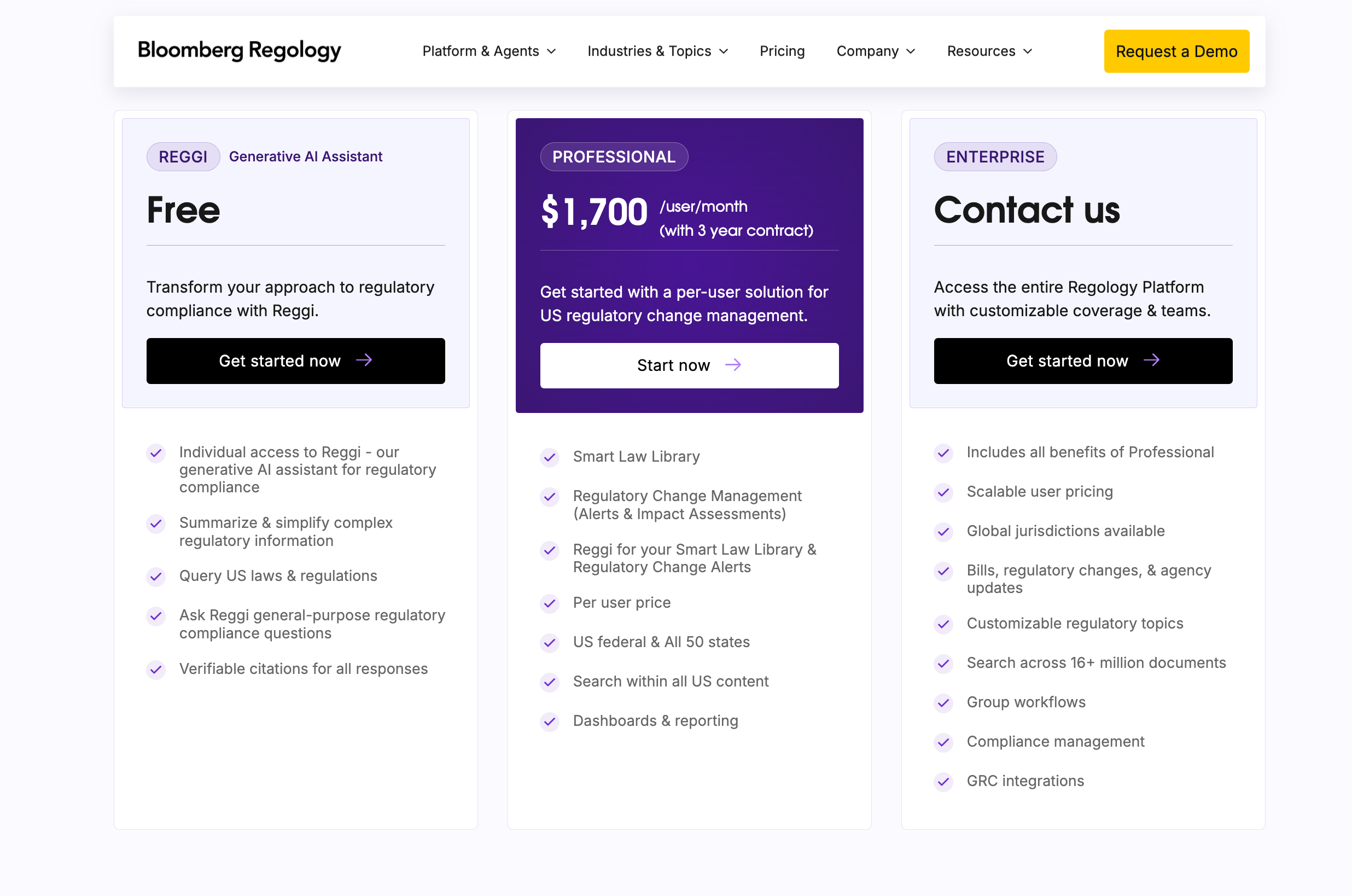
The pricing page lists Reggi free, Professional at $1,700 per user per month on a 3-year contract covering US federal and all 50 states, and Enterprise on request.
Pros
- The only public price among ranked tools
- 10,000+ sources
- Free Reggi tier for a first look
Cons
- Professional is US-only
- 3-year term to get the listed rate
- No drug or device registration data
Why it's ranked #7. Regology's 10,000+ sources dwarf Vixio's 1,400 authorities, and it's the one ranked vendor with a public price. It sits below Enhesa, which publishes 160+ reviewing experts where Regology publishes no expert count.
Vixio Regulatory Intelligence
Best fit
Gambling operators and payments firms entering new jurisdictions.
Vixio covers two industries in depth. The homepage lists 200 jurisdictions, 1,400 regulatory authorities and 20+ domain specialist analysts. It averages 4.9 from 6 reviews on G2.
Key features
- Horizon Scanning for regulatory changes and Jurisdiction Reports
- AI-powered VIQ Assistant, grounded in analyst content
- Obligations Library and Regulatory Mapping
- Vixio Workspace for tasks and project tracking
Pricing
Quote only.
Pros
- 1,400 regulatory authorities tracked
- Country reports that turn rule text into actionable insights for market entry
- All 6 G2 reviews sit in the top star band
Cons
- Gambling and payments only
- Thin customer due diligence guidance, per one reviewer
- Smallest analyst bench here: 20+
"The portal contains all the pertinent info about the gambling jurisdictions and allows us to do market research on new jurisdictions and if it is viable for us to enter those markets."
Tina K., Director of Interactive Compliance, G2, 2 September 2025
A verified IT and services user wrote on 11 August 2025 that "More information on acceptable methods of CDD would be helpful."
Why it's ranked #8. Vixio's 1,400 authorities trail Regology's 10,000+ sources, and its scope stops at two industries. Its 20+ analysts are the smallest published bench on the list.
What is regulatory intelligence?
Regulatory intelligence (RI) is the practice of collecting, analyzing and applying regulatory information so a company can plan around it. MetricStream defines it as a systematic process that keeps organizations compliant with evolving laws while supporting informed business decisions. Regulatory intelligence focuses on what regulatory changes mean for a specific product, market and deadline.
The key components of regulatory intelligence software repeat across vendors:
- Continuous monitoring of regulatory sources, government websites and industry reports
- A regulatory intelligence database of guidance, laws and summaries
- Alerts on new or updated regulations, filtered by product and market
- Impact assessment that assigns relevant changes to an owner
- Trend analysis on regulatory trends and regulatory shifts across multiple regions
- Advanced analytics that flag potential risks before a deadline
- An audit trail of every regulatory update and response
The software turns a complex web of regulatory frameworks into actionable insights for compliance strategies and compliance processes, with centralized access to global regulatory data for everyone on the team. That's the database half. Regulatory intelligence services are the people half, drawn from the regulatory community: RegASK's 1,800+ experts, Enhesa's 160+ experts, Cortellis's Ask the Expert desk.
Regulatory intelligence is one branch of market intelligence. It shares methods with competitive intelligence tools and media monitoring tools, but the source list is statutes, gazettes and agency portals, and a miss carries compliance risks.
Common challenges in regulatory monitoring
Four regulatory challenges drive most purchases of regulatory intelligence solutions, and each maps to a criterion above:
- Volume: monitoring regulatory updates by hand fails at 16M+ regulatory actions a year, the count RegASK reports
- Scope: international regulations and global regulations rarely line up, so one product needs separate tracking in global markets
- Speed: constantly evolving rules and late alerts cause operational disruptions when a shipment or filing stalls on new regulations
- Evidence: ensuring compliance means proving when each change was seen, which shapes compliance risks and compliance requirements
Good regulatory intelligence software supports informed decision making on which markets to enter first and which compliance strategies to fund.
Regulatory intelligence for medical devices and life sciences
Life sciences buyers face the densest source list; healthcare providers face a different one, built on reimbursement and privacy law. A device sold in the EU and the US falls under EU MDR guidance, FDA recalls and national registration rules at the same time. Finding the one change that matters is a needle in a haystack for manual monitoring, and all five top-ranked tools here cover drugs or devices.
Medtech teams have a sixth regulatory intelligence option. Rimsys Intelligence monitors 90+ countries and regulatory jurisdictions for medical devices, IVDs and SaMD, and claims 2 to 4 hours saved per person per day. RegDesk and Rimsys both tie regulatory changes to registrations, so the alert and the filing sit in one record.
Pharma buyers should read our healthcare market intelligence guide alongside this page, and the IQVIA-Veeva lawsuit report before tying regulatory data to a RIM vendor.
Pricing across regulatory intelligence solutions
Seven of the eight ranked vendors quote on request, so budget for a sales cycle. Bloomberg Regology is the exception, at $1,700 per user per month on a 3-year term. Five seats on that plan run $102,000 a year, and the 3-year term puts all your eggs in one basket if the product changes after the acquisition.
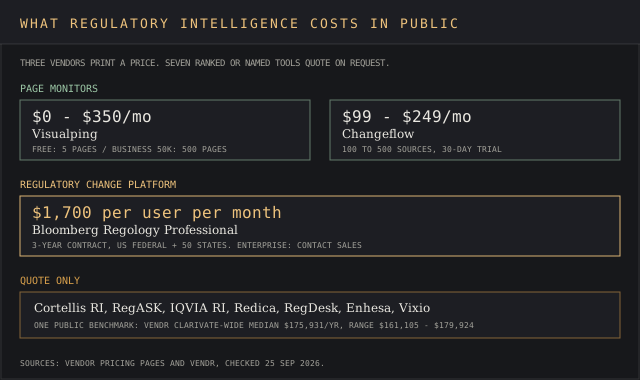
Page monitors cost a fraction of the advanced tools ranked above and handle regulatory monitoring for a short list of government websites. Visualping runs from a free plan with 5 pages to $350 a month for 500. Changeflow charges $99 a month for 100 sources and $249 for 500, with a 30-day trial.
They're a quick and dirty option: neither interprets what changed, so regulatory professionals still read every alert. Teams building their own monitors can start with our web scraping tools ranking.
The market is consolidating. CUBE closed its purchase of Thomson Reuters Regulatory Intelligence and Oden on 31 December 2024, and Bloomberg bought Regology 17 months later.
Customers CUBE counted after closing the Thomson Reuters Regulatory Intelligence and Oden deal, over 200 of them enterprises, per its 2 January 2025 release.
Renewal terms change hands with the vendor, and the devil's in the details: read the assignment clause before signing a multi-year deal. The market intelligence platform pricing report covers why vendors hide quotes, and the vendor evaluation scorecard template keeps a shortlist honest on the five criteria above.
Regulatory intelligence software FAQ
What is IQVIA regulatory intelligence?
It's IQVIA's regulatory intelligence database for human drugs, biologics, medical devices and IVDs, covering 110+ countries, regions and international organizations with alerts and expert summaries.
What is a regulatory intelligence database?
The database is the core of any regulatory intelligence (RI) program: a searchable store of regulatory information, guidance and summaries, tagged by market and product, that supports ensuring compliance at audit. Cortellis holds 328,000+ regulatory documents; Redica holds 170,000+ inspection documents.
Which AI is best for regulatory compliance?
Talk is cheap in AI demos. Pick the assistant that cites its sources, has humans checking it, and fits your regulatory processes. RegASK pairs its regulatory intelligence assistant with 1,800+ experts, and Cortellis's Regulatory AI Assistant answers from its curated archive.
Will regulatory affairs be replaced by AI?
Every ranked vendor keeps people in the loop, from Vixio's 20+ analysts to RegASK's 1,800+. The software cuts manual effort in compliance processes and keeps teams up to speed on monitoring; the filing strategy and the sign-off stay with regulatory teams.
Bottom line
Among regulatory intelligence tools, RegASK is the pick for regulatory teams working across many markets and product types, with the widest published global regulatory coverage and the largest expert bench. Cortellis wins for large pharma teams that need a deep, citable archive and already live in Clarivate data.
Redica fits quality teams preparing for inspections, IQVIA fits registration planning, and RegDesk fits medtech teams that want intelligence and RIM in one login. Match the tool to your compliance strategies and the regulatory changes you face most. Outside life sciences, Enhesa leads for EHS and chemicals, Regology for US law with a public price, and Vixio for gambling and payments, a sector our financial market intelligence guide covers in more depth.