Cortellis review: life sciences and regulatory intelligence platform
 By Jan Suski. I go deep on every review, checking every number against its source and digging up details other coverage misses, a habit from six years of SEO and link building for tech companies. Bylines at Surfer, Brand24, and Senuto. How the scoring works.
· Prefer this source on Google
Best for
Large pharmaceutical and life sciences organizations needing pipeline, trials, regulatory and discovery data under one login, deep pockets included.
Not for
Buyers wanting a single module cheaply, or anyone who can't take on ownership risk while Clarivate's Life Sciences division is up for sale.
What it costs
No published list price. Cortellis sells by module and subscription, so cost tracks how many of the six module lines a team licenses.
- Pipeline entries
- Over 70,000
- Clinical trials
- 325,000
- Regulatory documents
- Over 328,000, with daily updates on regulatory changes
- Regulatory markets
- Filings tracked in over 80 countries
- Generics patents
- 1.2 million in the generics database, for timing entry to patent expiry
- Curation
- Domain experts read scientific literature, patents and regulatory sources before entry
- Regulatory Assistant
- AI assistant launched December 2025 after a beta, open to all Regulatory Intelligence customers
- Assistant languages
- Multilingual queries against sources published in another language
- Enhanced Search
- Generative AI and natural language processing across the whole suite
- Claude integration
- Model Context Protocol link added March 2026, pulling Cortellis data into workflows outside Clarivate's interface
- Assistant rating
- 4.9 out of 5 for ease of use from early adopters, reported by Clarivate
- List price
- Clarivate publishes none; getting a number means a sales conversation
- Buying unit
- Sold by module and by subscription, so cost follows which parts of the suite a team licenses
- Scoping upside
- A regulatory team can license Regulatory Intelligence without paying for discovery data it won't use
- Scoping cost
- Growing into three modules means negotiating three renewals with one vendor
- Benchmarking
- Hard without published rates, since nothing is comparable line by line
- Customer base
- 100% of the top 20 pharmaceutical companies
- Change of control
- Clarivate announced in February 2026 it was exploring a sale of the Life Sciences & Healthcare segment; get the terms in writing
- Competitive Intelligence
- Pipelines, trials, licensing agreements, mergers and acquisitions
- Regulatory Intelligence
- 80-plus markets, live feeds, draft-against-final guidance comparison side by side
- Drug Discovery
- Target discovery plus the early-stage biology and chemistry data behind it
- CMC and Product
- Chemistry, manufacturing and controls requirements, plus product and digital health coverage
- Deals intelligence
- Agreement terms and deal histories
- Predictive analytics
- Drug success probability scores on pipeline assets, traceable to the curated source
Not forA regulatory affairs team fighting filings across markets; that's the job Cortellis is built for.
Not forA team that needs a filing change flagged the day it lands; GlobalData's regulatory monitoring turns around in months.
Pairs well with Cortellis
Where the coverage counts come from, and the two figures Clarivate reports about itself
The coverage counts, over 70,000 pipeline entries, 325,000 clinical trials, 328,000-plus regulatory documents across more than 80 countries and 1.2 million generics patents, are Clarivate's published figures for its own platform. So are the claim that 100% of the top 20 pharmaceutical companies use it and the 4.9 out of 5 ease-of-use rating from AI assistant early adopters; both are the vendor reporting on itself, and neither carries an outside audit.
The February 2026 sale process and the $4.5 billion debt load behind it come from Clarivate's own announcement. No price is listed because Clarivate publishes none. This page was updated 9 August 2026.
This Cortellis review covers what the Clarivate-owned platform does, which modules make up the suite, how the new AI assistant works, who the product is built for, and the ownership question hanging over it in 2026. Cortellis is used by 100% of the top 20 pharmaceutical companies, which shifts the buying question to which database and time window modules a team needs.
↑ FACT SHEETWhat is Cortellis
Cortellis is a suite of Cortellis solutions for the life sciences industry, combining scientific, clinical, regulatory, and commercial data into one platform. Thomson Reuters launched it in February 2012, and Clarivate has owned it since the 2016 spin-off of Thomson Reuters' intellectual property and science division.
The pitch is a single source of truth for competitive intelligence, regulatory intelligence, clinical intelligence, and scientific intelligence. Cortellis integrates data from thousands of sources, clinical trials, patents, and regulatory documents among them, into one search.
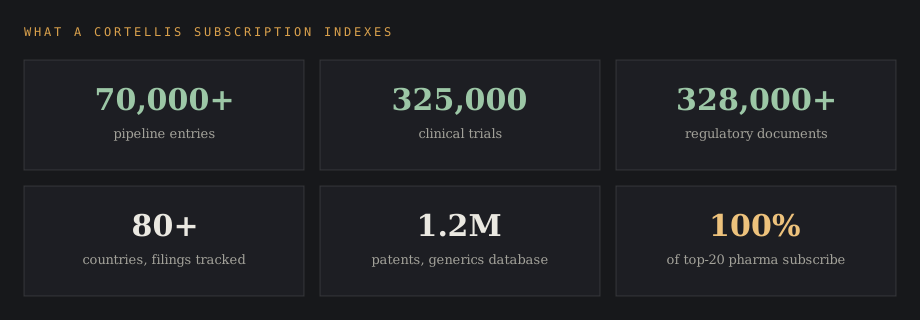
The scale numbers set the frame. Cortellis covers over 70,000 pipeline entries and 325,000 clinical trials, tracks regulatory filings in over 80 countries, and includes over 328,000 regulatory documents with daily updates on regulatory changes.
↑ FACT SHEETWho owns Cortellis, and the 2026 sale process
Clarivate owns Cortellis. The platform started inside Thomson Reuters, moved to Clarivate when the intellectual property and science division was spun off in 2016, and has been built out through acquisitions since.
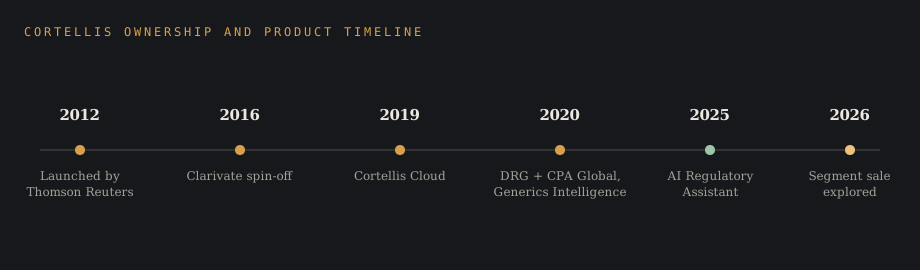
In February 2026 Clarivate announced it was exploring a sale of its entire Life Sciences & Healthcare segment, the division Cortellis sits in, to concentrate on its Academia & Government and Intellectual Property segments and reduce a debt load reported at $4.5 billion.
Any buyer signing a multi-year Cortellis subscription in 2026 is contracting with a business whose owner has publicly said it may not keep it, which belongs on the diligence list alongside module fit and price.
Two 2020 deals shaped the current product. Clarivate acquired Decision Resources Group in 2020, folding its market research into the Cortellis line, and bought CPA Global the same year, adding the intellectual property services arm that now operates under the Clarivate name (formerly CPA Global). Cortellis Cloud had launched in early 2019 as the unified platform, and Cortellis Generics Intelligence followed in July 2020.
The lineage matters for buyers because the databases predate the brand. The curation practices come from the old Thomson Scientific operation, so the historical depth runs deeper than the 2012 launch date suggests.
↑ FACT SHEETCortellis products and modules
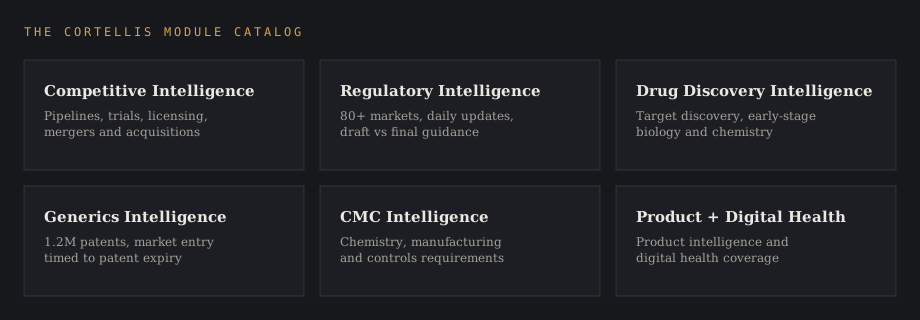
Cortellis sells as modules, and the module list is where a buyer's evaluation should start.
| Module | What it covers |
|---|---|
| Competitive Intelligence | Pipelines, trials, licensing agreements, mergers and acquisitions |
| Regulatory Intelligence | 80+ markets, 328,000+ documents, daily updates, draft-final comparison |
| Drug Discovery Intelligence | Target discovery and early-stage biology and chemistry data |
| Generics Intelligence | 1.2 million patents; market entry timed to patent expiry |
| CMC Intelligence | Chemistry, manufacturing and controls requirements |
| Product Intelligence + Digital Health | Product and digital health coverage |
Cortellis Competitive Intelligence
Cortellis Competitive Intelligence tracks pipeline entries, clinical trials, and the deals around them across the drug development lifecycle. It provides insights into licensing agreements, mergers, and acquisitions, which is the layer business development teams lean on when scouting partners or takeover targets.
Deals intelligence sits here too, covering agreement terms and deal histories.
Cortellis Regulatory Intelligence
Cortellis Regulatory Intelligence is the module regulatory teams buy. It integrates regulatory data from 80+ global markets, includes the 328,000-plus regulatory documents, and delivers daily updates from live regulatory feeds so a filing change in one market doesn't sit unnoticed until an audit.
Comparison tools come with the module as well: teams can compare draft and final guidance side by side, without manually searching through two documents line by line. For regulatory professionals working across multiple markets, that comparison work is where the Cortellis platform saves the most time, and the regulatory guidelines themselves are curated by regulatory experts.
Cortellis Drug Discovery Intelligence
Cortellis Drug Discovery Intelligence covers the early-stage side: target discovery, drug discovery programs, and the biology and chemistry data behind them. The platform is known for strong early-stage R&D coverage, and it's the module research teams in pharmaceutical companies and biotechs use to check what's already been tried against a target before committing budget to it.
Cortellis Generics, CMC Intelligence and Product Intelligence
Cortellis Generics Intelligence carries over 1.2 million patents in its generics database, serving teams that time market entry around patent expiry. Cortellis CMC Intelligence covers chemistry, manufacturing and controls requirements, and Cortellis Product Intelligence and digital health intelligence round out the catalog.
Clarivate's wider science portfolio also includes Ingenuity Pathway Analysis, which sits alongside Cortellis for molecular-level research questions, and teams often run it beside other tools.
How the data is built
Cortellis uses expert-curated data from scientific literature, patents, and regulatory sources. Curation is the differentiator the company sells against raw aggregators: a human with deep domain expertise reads the source before it enters the database, which is why the platform can support successful regulatory approval workflows.
The platform also features predictive analytics and advanced analytics to forecast drug success probabilities, scoring pipeline assets on their odds of reaching market. Teams use those scores as one input for portfolio strategy and wider strategic decision making, and the curated key data underneath is what makes the scores auditable.
↑ FACT SHEETThe AI powered Regulatory Assistant
Cortellis launched an AI powered Regulatory Assistant in December 2025, following a beta earlier that year, and the Cortellis Regulatory AI Assistant is now available to all Cortellis Regulatory Intelligence customers. The AI assistant answers regulatory questions in conversation, so a regulatory affairs specialist can ask about a filing requirement the way they'd ask a colleague, skipping the document searches and result lists.
The AI assistant provides multilingual support for regulatory queries, letting teams work in their preferred language against sources published in another. Alongside it, the Enhanced Search platform uses generative AI and natural language processing for natural language queries across the whole suite, and conversational AI assistants answer complex questions that span modules.
Clarivate reports a 4.9 out of 5 ease-of-use rating from early adopters of the AI assistant.
The advanced technology reached a second stage in March 2026, when Cortellis Regulatory Intelligence gained an integration with Anthropic's Claude through the Model Context Protocol, letting customers pull Cortellis data into AI-assisted workflows they already run.
The practical effect is time. Document searches that ran through manual keyword iterations now run as regulatory questions asked in plain language, and Cortellis integrates AI where the answer needs to trace back to a curated source, which keeps the compliance value of the human curation intact. For regulatory teams weighing the status quo against the AI workflow, the traceability is the part worth testing in a demo.
How to use Cortellis
Access runs through a subscription, scoped to the modules a team licenses, and the working surface is search. The Enhanced Search platform takes natural language, so a first query can be phrased as the actual question, and results come back from the curated database.
Monitoring is the second workflow. Regulatory teams set up coverage for the markets they file in and receive the daily updates as regulatory changes land, which turns the 80-country tracking into a feed. Competitive intelligence users do the same for pipeline movements and deals in their therapeutic areas.
The third is comparison and analysis. Guidance documents can be compared draft against final, pipeline assets can be screened with the predictive analytics scores, and since December 2025 the Regulatory Assistant handles follow-up questions conversationally, in the user's preferred language. Teams that get the most from the platform treat those three loops, search, monitor, compare, as the daily routine and save the deep module work for decision points.
Who uses Cortellis
Cortellis is widely used in pharmaceutical and biotechnology sectors for R&D activities, and the customer list tops out at the top of the market: 100% of the top 20 pharmaceutical companies use it. Regulatory professionals and regulatory teams are the daily users, alongside R&D groups, business development teams scouting deals, and private equity firms running diligence on life sciences assets.
The design goal across all of them is the same: accelerate R&D decision-making and global compliance so treatments reach patients faster. That's the frame Clarivate sells against, connecting the database work to patient lives, and it's also how buyers should test the product: on the critical decisions it has to support, with their own regulatory expertise checking the answers.
↑ FACT SHEETCortellis pricing
Clarivate doesn't publish Cortellis pricing. Access is sold by module and by subscription, so the cost depends on which parts of the suite a team licenses, and getting a number means a sales conversation.
That module structure cuts both ways. A regulatory team can license Cortellis Regulatory Intelligence without paying for discovery data it won't use, but a company that grows into three modules is negotiating three renewals with one vendor, and resources compared across those contracts are hard to benchmark without published rates.
The 2026 sale process is worth raising directly in that conversation: ask what happens to pricing and support commitments if the segment changes hands mid-term.
Strengths and weaknesses
The strengths are scale and curation: 70,000-plus pipeline entries, 325,000 clinical trials, 328,000 regulatory documents across 80 countries, all expert-curated, with AI-powered tools layered on since December 2025 to make regulatory compliance work faster. Coverage of early-stage R&D and regulatory intelligence is where its reputation is strongest.
Most of the weaknesses are structural to enterprise life sciences data, plus one that isn't. Pricing is opaque, the suite's breadth means most buyers pay for a subset of what the brand advertises, and the value of the AI layer depends on how much a team trusts answers it still has to verify against final guidance.
The exception is ownership: an announced sale process introduces uncertainty no competitor in this list currently carries. A buyer should test all four against their own workflows in a trial, with data privacy requirements checked against how the AI features handle queries, before making confident decisions on a multi-year contract.
Cortellis alternatives
The closest alternatives sit in the same pharma intelligence category, ranked side by side in our life science intelligence tools ranking. IQVIA competes from the clinical and commercial data side with roughly 93,000 employees across more than 100 countries; GlobalData competes on analyst coverage, with a community of 2,000 in-house experts spanning industries beyond life sciences; Evaluate competes on pharma forecasting and market sizing.
None of the three matches the regulatory intelligence depth, and that's the honest dividing line. A team whose hardest problem is filings across multiple markets shortlists Cortellis first; a team buying clinical trial operations data or cross-industry forecasts starts with the alternatives and adds Cortellis modules where the regulatory workload justifies them.
Bottom line
Cortellis is the reference platform for life sciences intelligence: the deepest combination of pipeline, trial, patent, and regulatory data sold under one roof, curated by people with the regulatory expertise to keep it defensible, and now searchable through an AI assistant that answers regulatory questions in plain language. The top of the pharmaceutical market has already voted with its subscriptions.
The evaluation for everyone else comes down to module fit, budget and, in 2026, ownership. A biotech that needs discovery coverage or a regulatory team facing an increasingly difficult multi-market filing calendar will find the specialist modules earn their cost; a team that needs one narrow slice should scope the smallest module set that covers it and resist the full suite until the workflows demand it.
Develop treatments on the science, buy the data by the module, and get the change-of-control terms in writing.
FAQ
What is Cortellis?
Cortellis is a suite of life sciences intelligence solutions owned by Clarivate. It combines scientific, clinical, regulatory, and commercial data into one platform, covering over 70,000 pipeline entries, 325,000 clinical trials, and 328,000 regulatory documents across more than 80 countries.
Does Clarivate own Cortellis?
Yes, though not necessarily for long. Clarivate has owned Cortellis since 2016, when the platform came over in the spin-off from Thomson Reuters, and Thomson Reuters had launched it in February 2012. In February 2026 Clarivate announced it was exploring a sale of the Life Sciences & Healthcare segment that contains it.
What is the difference between Clarivate and Cortellis?
Clarivate is the parent company, an analytics provider spanning science, intellectual property, and life sciences; Cortellis is its life sciences intelligence product line. Clarivate also owns other brands, including the IP services business formerly CPA Global and research tools like Ingenuity Pathway Analysis.
What is Cortellis Drug Discovery Intelligence?
Cortellis Drug Discovery Intelligence is the early-stage R&D module, covering target discovery, discovery programs, and the supporting biology and chemistry data. Research teams use it to check prior work against a target before committing to a program.
What is Cortellis Deals Intelligence?
Deals intelligence within Cortellis Competitive Intelligence tracks licensing agreements, mergers, and acquisitions across the life sciences industry, including deal terms and histories. Business development teams use it to benchmark deal structures and scout partners.
How do teams use Cortellis day to day?
Regulatory teams monitor daily updates on regulatory changes and compare draft and final guidance; R&D groups search pipeline and clinical trials data before starting programs; business development tracks deals; and since December 2025, the AI Regulatory Assistant handles regulatory questions in natural language with multilingual support.