Life science intelligence tools: 10 platforms and companies ranked for 2026
 By Jan Suski. I go deep on every review, checking every number against its source and digging up details other coverage misses, a habit from six years of SEO and link building for tech companies. Bylines at Surfer, Brand24, and Senuto. How the scoring works.
· Prefer this source on Google
Quick comparison of life science intelligence tools
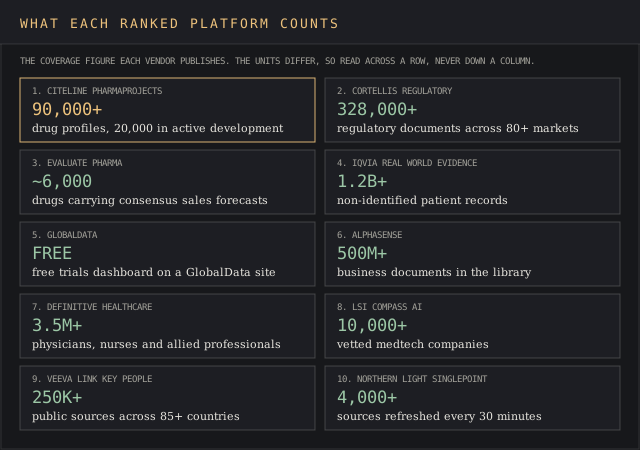
One row per ranked tool, in ranked order. The coverage column carries the single figure each vendor publishes about its own data, so the units differ by row.
| # | Provider | Telling coverage figure | Entry price on record | Best fit |
|---|---|---|---|---|
| 1 | Citeline (Norstella) | 90,000+ drug profiles, 40 years of curated data | Quote only | Pipeline and trial planning teams |
| 2 | Cortellis (Clarivate) | 328,000+ regulatory documents across 80+ markets | Quote only; Clarivate-wide Vendr median $175,931 a year* | Global pharma competitive intelligence |
| 3 | Evaluate (Norstella) | ~6,000 drugs with consensus forecasts, 1.5m+ forecasts since 2003 | Quote only | Sales forecasting and deal valuation |
| 4 | IQVIA | 1.2B+ non-identified patient records | $723,900 a year, averaged across one FDA award | Real-world data and sales data |
| 5 | AlphaSense | 500M+ documents, 300,000+ expert interviews | $18,375 a year, Vendr median of 40 purchases* | CI analysts who live in transcripts |
| 6 | GlobalData | Free clinical trials dashboard plus analyst reports | $68,500 a year, Vendr median* | Strategy teams buying analyst-written reports |
| 7 | Definitive Healthcare | 3.5M+ physicians, nurses and allied professionals | $50,000 a year, Vendr median of 33 purchases* | US medtech and pharma commercial teams |
| 8 | LSI (Life Science Intelligence) | 10,000+ vetted medtech companies, 1,000+ investors | $625 a month, list price | Medtech founders and investors |
| 9 | Veeva Link | 250k+ public sources across 85+ countries | Quote only | Medical affairs KOL mapping |
| 10 | Northern Light SinglePoint | 4,000+ sources refreshed every 30 minutes | Platform license, quote only | CI teams consolidating research |
Medians marked * are anonymised buyer-reported contract values published by Vendr. IQVIA’s figure averages one FDA purchase order over its three-year term, and LSI’s is its own list price.
Where these figures come from
Coverage counts are each vendor’s own published figure, so the units differ by row. Medians marked * come from Vendr’s marketplace listings, IQVIA’s annual figure divides the USAspending record for purchase order 75F40119P10550 by its three years, and LSI’s $625 a month is the Single-User price on its Compass page. Citeline, Evaluate, Veeva and Northern Light publish no price, so their rows read quote only.
Cortellis Regulatory Intelligence ranks #2 and IQVIA Regulatory Intelligence #4 on our regulatory intelligence software ranking, which scores regulatory monitoring. AlphaSense ranks #1 on both the competitive intelligence tools ranking and the investment research platforms ranking. This page scores the drug, trial, patient and medtech data behind each vendor.
Life science intelligence is the paid data behind a pharma, biotech or medtech decision: which drugs sit in which phase, what a launch will sell, which regulator changed a guidance, which surgeon runs 400 procedures a year. Northern Light's March 2026 definition calls it the systematic gathering of insights from scientific, clinical, regulatory and commercial sources.
This page ranks ten life science intelligence tools and the life science intelligence companies behind them against five testable criteria. It covers pipeline & drug data, trial intelligence, competitive intelligence, real-world data, provider data, medtech market sizing and expert calls. Regulatory monitoring has its own page, the regulatory intelligence software ranking, so this one argues every overlap from the commercial and R&D side.
It's written for the people who sign these contracts: business development leads, competitive intelligence managers, medical affairs directors, a corporate development officer pricing a licensing deal, and the managing director of a fund that writes medtech checks. Buyers who want the wider sector first should start with the pharma market intelligence guide or the healthcare market intelligence guide.
The timing matters for a dated reason. Between 6 July and 23 September 2026, three vendors on this list hit a change-of-control or legal event: Clarivate agreed to sell the segment that owns Cortellis, Advent proposed taking Definitive Healthcare private, and Italy's data protection authority fined IQVIA €7 million. Anyone signing a three-year term this quarter is signing into that.
Evaluation criteria for life science intelligence tools
Five criteria decide the shortlist, numbered 1 to 5 in the order below, and every ranked entry names the criterion that puts it above the tool under it. Each one returns a yes, a no or a number that a buyer can check on the vendor's own pages in under an hour.
Published record count
The vendor publishes a count of its core records in a life science unit: drug profiles, trials, regulatory documents, patient records, healthcare professionals or companies. Talk is cheap, and a count is something to test. Pull 20 drugs you already know and see how many the platform carries, at what phase.
History depth in years
How far back the records run. Citeline publishes 40 years, Evaluate's forecasts go back to 2003 and LSI's first medtech report dates to 2006. Depth decides if a team can benchmark a phase 2 readout against a decade of comparable programs.
Price on record
A published list price scores highest, a Vendr median from anonymised buyer data with its purchase count second, a public procurement award third, and quote-only last. A business case for strategic decisions needs a number before the first sales call.
Ownership and legal events in the last 24 months
A yes or no: has the vendor announced a sale, a going-private bid or a regulator fine since October 2024? A multi-year subscription is a bet on who owns the data in year three, and three of these ten fail this test.
Lifecycle span and machine access
Count the named modules across pipeline, trials, regulatory, deals, forecasts, real-world data and people data, then check for a documented API or MCP connector. Clarivate and LSI both shipped MCP connectors by 2026, so this test now separates vendors.
The 10 best life science intelligence platforms in 2026
Citeline
Best fit
Clinical development, business development and portfolio strategy teams that need the deepest analyst-curated drug pipeline and trial record.
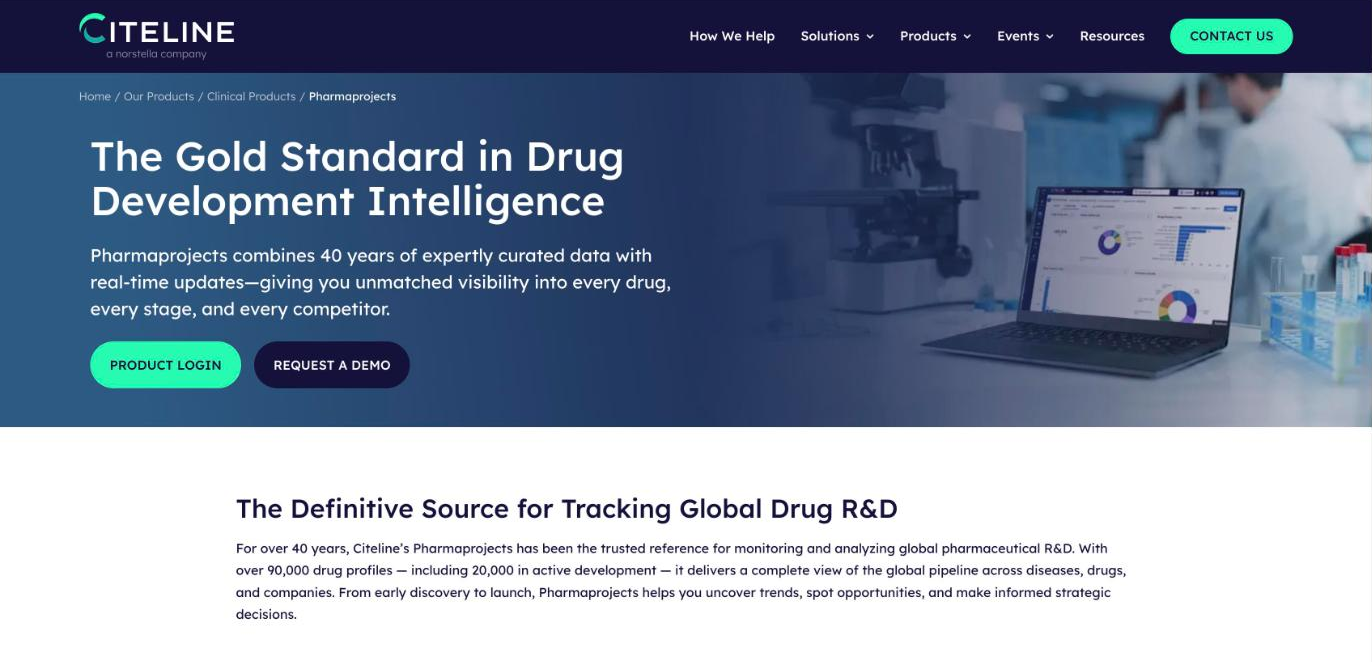
Citeline sells R&D intelligence built by analysts. Its Pharmaprojects page lists 90,000+ drug profiles, including 20,000 in active development, and 40 years of curated data with real-time updates. The Trialtrove page says its trial record draws on 60,000+ sources, curated by therapeutically focused analysts.
Norstella owns Citeline. The merger closed on 1 November 2022 at $5 billion, with 1,600+ employees across five brands: Evaluate, MMIT, Panalgo, The Dedham Group and Citeline. That makes Evaluate, ranked third here, a sister company.
Key features
- Pharmaprojects: 90,000+ drug profiles from early discovery to launch.
- Trialtrove: clinical trial intelligence from 60,000+ sources.
- Trialtrove+: a Trial Health Calculator that benchmarks recruitment performance against comparable trials.
- Ella, an AI chat assistant inside Trialtrove+.
- Trial Activity Landscape views by disease, sponsor, drug and country.
Pricing
Citeline sells on quote, by product and seat count. Budget against the six annual figures in the pricing section below, from $18,375 for an AlphaSense seat to $175,931 for Clarivate's Vendr median.
Pros
- 90,000+ drug profiles, the largest published pipeline count on this page.
- 40 years of history for benchmarking trial timelines.
- Recruitment benchmarking through the Trial Health Calculator.
Cons
- Quote-only pricing, with no Vendr median to anchor it.
- Sales forecasts sit in a separate Norstella brand, Evaluate.
- Biomedtracker, once a Citeline product, now sells under Evaluate, so the pipeline toolkit spans two contracts.
The raw source behind trial databases is the public registry, and its gaps are why curation sells. A Hacker News user wrote in December 2024:
"The main problem with CT.gov right now is that it lacks a bit in data quality standards. There's a lot of variation in completeness of data dependent on country of origin and even between companies."
Hacker News commenter, 22 December 2024, on ClinicalTrials.gov data quality.
A life sciences consultant on Fishbowl named the pipeline shortlist plainly: "Your pipeline/epi databases pick: Citeline/Guidepoint/Cortellis."
Why it’s ranked #1. Citeline publishes 90,000+ drug profiles over 40 years and has had one owner since November 2022. It beats Cortellis on criterion 4, since Cortellis's segment is mid-sale for $600 million. No tool ranks above it.
Cortellis
Best fit
Global pharma competitive intelligence and regulatory affairs teams that want pipeline, trials, deals and regulatory documents in one licensed suite.
Cortellis is Clarivate's life sciences suite, sold as named modules: Competitive Intelligence, Clinical Trials Intelligence, Deals Intelligence and Regulatory Intelligence. Clarivate's regulatory intelligence page lists 328,000+ regulatory documents across 80+ markets, daily updates and FDA Advisory Committee transcripts since 2000. Our Cortellis review covers the full suite.
The owner is changing. On 6 July 2026 Clarivate said it had entered into a definitive agreement to sell its Life Sciences & Healthcare segment to Altaris for $600 million, with closing expected by the end of 2026.
The 2026 revenue Clarivate puts on the segment it’s selling. The same release describes the segment as supporting "critical decision-making across the drug and device lifecycle".
Key features
- Cortellis Competitive Intelligence for drug pipeline and company tracking.
- Cortellis Deals Intelligence for licensing and partnering history.
- Cortellis Regulatory Intelligence: 328,000+ documents, 80+ markets.
- An MCP connector into Anthropic's Claude, announced 10 March 2026.
- A Regulatory AI Assistant, covered in the regulatory ranking.
Pricing
Quote only, by module. The nearest public figure is Vendr's Clarivate-wide median of $175,931 a year from anonymised buyer data, range $161,105 to $179,924, and every product on that listing is a patent, trademark or citation tool. Treat it as a Clarivate-wide ceiling check.
Pros
- Four named modules across pipeline, trials, deals and regulatory, the widest span here.
- 328,000+ regulatory documents with daily updates.
- Documented MCP access for AI workflows since March 2026.
Cons
- A $600 million sale to Altaris pending through year-end 2026.
- Priced by module quote, with only a Clarivate-wide Vendr benchmark.
- New users take time to know the ropes of its module search, per a G2 reviewer.
A pharmaceutical-industry reviewer on G2 wrote in September 2019 that "It covers almost all the Regulatory regions and Health Authorities and is being updated frequently," then added: "Sometimes it's difficult to find the right information."
Why it’s ranked #2. Cortellis sells four named modules and an MCP connector, against Evaluate's two forecast-led products. It loses #1 to Citeline on criterion 4: a $600 million sale to Altaris is pending until late 2026.
Evaluate
Best fit
Business development, licensing and finance teams that value assets on consensus sales forecasts, up to the Sr. Vice President who signs a licensing bid.
Evaluate sells the number that goes into a deal model. The Evaluate Pharma page lists consensus forecasts for almost 6,000 drugs, indication-level sales for 5,000 drugs worldwide and 2,500 at a US level, and 1.5m+ consensus forecasts going back to 2003. Its market forecasts also feed Evaluate's annual World Preview, which sized pharma as a $2 trillion industry in its 2026 edition.
Evaluate also now sells Biomedtracker. The Biomedtracker page carries an Evaluate copyright and covers 35,000+ drugs and 1,800+ listed targets. Our Evaluate review is in progress.
Key features
- Evaluate Pharma consensus forecasts for ~6,000 drugs.
- Historical forecast archive of 1.5m+ data points since 2003.
- Biomedtracker drug events across 35,000+ drugs.
- Europe drug forecasts as a separate dataset.
Pricing
Quote only, with no list price on evaluate.com and no Vendr median. The Fishbowl consultant quoted below pairs it with a pipeline database, so budget for the pair.
Pros
- Forecast history back to 2003 for testing analyst accuracy.
- One Norstella owner since November 2022.
- Biomedtracker adds event and approval tracking.
Cons
- Quote-only pricing.
- Forecasts cover ~6,000 drugs against Citeline's 90,000+ profiles.
- Consensus misses are par for the course, and a deal model built on consensus inherits them.
The same Fishbowl consultant who named Citeline for pipeline gave Evaluate a single job: "EvaluatePharma for sales/forecasting estimates."
Why it’s ranked #3. Evaluate carries 1.5m+ forecasts since 2003 and no legal events, so it beats IQVIA on criterion 4 after IQVIA's €7 million fine. It trails Cortellis, which spans four modules to Evaluate's two.
IQVIA
Best fit
RWE teams, market access groups and commercial analytics leads at large pharma who need patient-level and sales data at global scale.
IQVIA is the data and services giant of the category. Its RWE page lists 1.2B+ non-identified patient records, 1M+ data feeds and 4,400+ health datasets profiled. The about page puts the data solutions business at roughly 93,000 employees in 100+ countries. Our IQVIA review and the IQVIA acquisition history cover how it got that big.
On 23 September 2026 Italy's Garante fined IQVIA €7 million over records from about 1 million patients of 800 general practitioners, ruling that data IQVIA treated as anonymous was pseudonymised, Quotidiano Sanità reported. For a buyer using European real-world data, that's a red flag to raise in diligence.
Key features
- 1.2B+ non-identified patient records for outcomes studies.
- 4,400+ health datasets profiled with 250+ metadata descriptors.
- National and country-level pharmaceutical sales data.
- IQVIA Regulatory Intelligence, ranked on the regulatory page.
Pricing
Engagements are scoped per program. The one public number is a federal award: the FDA committed $2,171,621.71 on purchase order 75F40119P10550 for global pharmaceutical sales data, about $723,900 a year across its three-year term.
Pros
- 1.2B+ patient records, the largest record count on this page.
- A public federal price for its sales data.
- Coverage in 100+ countries.
Cons
- A €7 million Italian privacy fine dated September 2026.
- One dataset can cost an arm and a leg: about $723,900 a year for the FDA's sales data.
- Engagements scoped per program and quoted by sales.
A senior manager in business development & licensing wrote on G2 in October 2022:
"Private market data is accurate, but Government supplies, tender information - volumes and value don't add up."
Sayali K., Senior Manager, Business Development & Licensing, enterprise, G2, 26 October 2022.
A mid-market pharmaceuticals reviewer on the same G2 page put the cost bluntly in April 2021: "The cost of the data is nearly prohibitive."
Why it’s ranked #4. IQVIA's 1.2B+ patient records beat AlphaSense's 500M documents on criterion 1 for proprietary life science data. It loses to Evaluate on criterion 4 after Italy's €7 million fine in September 2026.
AlphaSense
Best fit
Competitive intelligence analysts who read earnings calls, broker research and expert-call transcripts to track rival programs.
AlphaSense is a search layer over documents, with a strong life sciences user base. Its pharma and biotech page claims 92% of the largest pharmaceutical companies as users, 300,000+ Tegus expert interviews and Generative Search across ClinicalTrials.gov, FDA, EMA and PubMed. The 3 June 2026 funding release lists 500 million+ documents, 7,000+ enterprises and a $350 million round at $7.5 billion.
The June round brought fresh capital, and AlphaSense remains independent. The wider competitive intelligence tools ranking covers its cross-industry rivals. Our AlphaSense review and AlphaSense pricing report break down the seat economics.
Key features
- Tegus Expert Insights: 300,000+ expert interviews, including physicians.
- Generative Search across ClinicalTrials.gov, FDA, EMA and PubMed, which turns a needle in a haystack search into one query.
- Generative Grid for side-by-side competitor tables.
- 1,700+ broker research sources.
Pricing
Vendr's anonymised buyer data puts the median at $18,375 a year across 40 purchases, from $9,750 to $51,300, last updated February 2026.
Pros
- $18,375 Vendr median, the lowest tracked median on this page.
- 300,000+ expert interviews for physician and KOL views.
- Fresh capital: $350 million raised in June 2026.
Cons
- Its library is documents: filings, transcripts and broker research.
- A cross-industry library where life science is one vertical.
- Reviewers report a long learning curve.
A pharmaceuticals reviewer at an enterprise rated the library and its search on G2 in January 2026:
"exceptionally large library of premium financial, corporate, and industry content with advanced, context-aware AI search that surfaces highly relevant insights in seconds."
Pharmaceuticals reviewer, enterprise, G2, January 2026.
The same G2 reviewer flagged "limited data and information on CIS (Russian) and Asian companies."
Why it’s ranked #5. AlphaSense publishes 500M+ documents against no GlobalData count, winning criterion 1, and its $18,375 Vendr median is $50,125 lower. It trails IQVIA, whose 1.2B+ patient records are proprietary life science data.
GlobalData
Best fit
Strategy teams and consultancies that buy analyst-written reports and global market forecasts across pharma, medical device and adjacent industries.
GlobalData runs its life sciences work through a Pharma Intelligence Center, which also powers a free clinical trials dashboard on its Pharmaceutical Technology site. That dashboard is the cheapest way to test the trial data before a sales call. Our GlobalData review covers the analyst bench and the GlobalData pricing report covers contracts.
Key features
- Pharma Intelligence Center for drugs, trials and companies.
- A free clinical trials dashboard on Pharmaceutical Technology.
- Analyst-written reports and country-level forecasts.
- Single reports sold separately from subscriptions.
Pricing
Vendr's buyer data puts the median at $68,500 a year, from $43,000 to $73,875.
Pros
- A tracked $68,500 median with a tight $30,875 range.
- Free trial data to test before buying.
- Pharma and medical device coverage from one vendor.
Cons
- Its pharma database coverage is described in prose, with no count to test.
- Reviewers question data triangulation.
- A G2 reviewer reports an inflexible termination policy.
Read between the lines of the G2 complaints and the recurring issue is methodology disclosure. A senior analyst at an enterprise wrote on G2 in July 2021:
"In many cases, the data presented does not triangulate with other known data sources. Hence, data is a little doubtful. Also, the methodology used for calculation of certain metrics is not explained clearly which makes it further unreliable."
Senior Analyst, enterprise, G2, July 2021.
Why it’s ranked #6. GlobalData's $68,500 median sits on a clean ownership record, beating Definitive Healthcare on criterion 4 after Advent's $1.02 bid. It loses to AlphaSense on criterion 1, publishing no record count against 500M+ documents.
Definitive Healthcare
Best fit
US medtech and pharma commercial teams, and the senior vice president of sales who plans their territories, targeting healthcare organizations, health systems and physicians by procedure and claims volume.
Definitive Healthcare sells US provider intelligence. Its homepage lists 9K+ hospital and IDN profiles, 3.5M+ physicians, nurses and allied health professionals, 14K+ ambulatory surgery centers, 17M+ medical and scientific experts, and billions of medical and prescription claims. For a device rep, that's how to zero in on the 50 surgeons who run the most procedures in a territory.
Its ownership is in play. On 1 September 2026 the board's special committee confirmed a non-binding proposal from Advent International to take the company private at $1.02 a share.
Key features
- HospitalView and PhysicianView for health system and provider profiles.
- 17M+ medical and scientific experts across therapy areas.
- Medical and prescription claims for procedure volumes.
- Carevoyance and Populi product lines.
Pricing
Vendr's anonymised buyer data puts the median at $50,000 a year across 33 purchases, from $20,777 to $255,973, updated February 2026.
Pros
- 3.5M+ US clinicians, the deepest people count here.
- Claims-based procedure volumes by facility.
- A tracked Vendr median with 33 purchases behind it.
Cons
- A going-private bid at $1.02 a share, open since September 2026.
- US coverage only.
- G2 reviewers report required three-year terms, one with an automatic renewal.
A CEO at a small business wrote on G2 in August 2025:
"Contracting and their litigious nature. 3-year agreement to evaluate the value of the service and an AUTOMATIC 3-year renewal without warning."
Leslie R., CEO, small business, G2, August 2025, rating 1 of 5.
A customer success advisor on the same G2 page saw the upside in August 2023, calling it "a one stop shop for all the background insights and statistics on an organization."
Why it’s ranked #7. Definitive's 3.5M+ clinician records beat LSI's 10,000+ companies on criterion 1. It falls below GlobalData on criterion 4, with Advent's $1.02-a-share proposal open.
LSI (Life Science Intelligence)
Best fit
Medtech founders, the managing director of a venture capital fund, family offices and corporate development teams at strategics who track private medtech companies and their investors.
LSI, the Huntington Beach company that owns the name, runs medtech research, an AI platform and investor summits. Its about page says LSI exists to "help today's executives build, finance, and scale tomorrow's medical innovations" and that "We published our first medtech report in 2006." Scott Pantel is founder and chief executive officer.
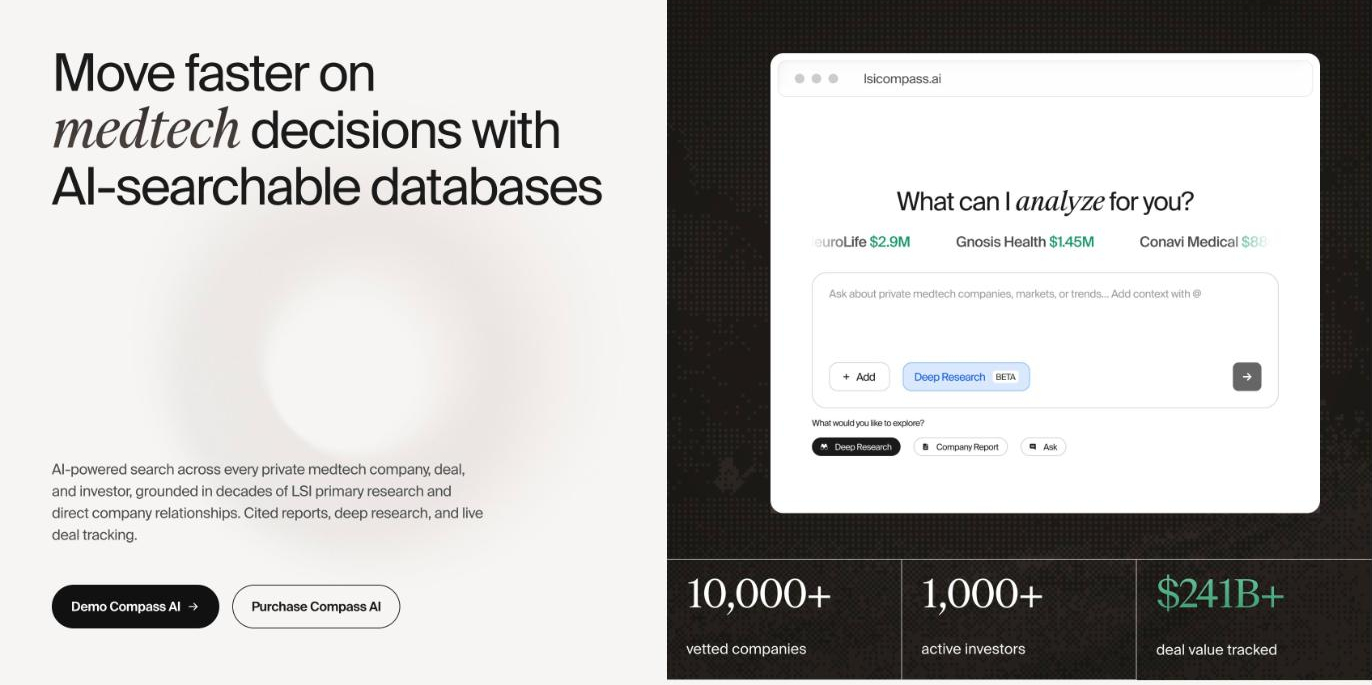
The platform is Compass AI: 10,000+ vetted companies, 1,000+ active investors with check sizes and deal history, and live tracking of the private financings, M&A and partnerships that enable growth, across $241B+ in deal value. What LSI brings to the table beyond the platform is a library of 350+ market studies covering devices from hip replacement implants to renal denervation.
Key features
- Compass AI: 10,000+ medtech companies and 1,000+ investors.
- An MCP connector on every paid plan, and API access on Enterprise.
- 350+ market snapshots plus surgical procedure volumes dashboards.
- LSI USA, LSI Europe and LSI Asia summits.
Pricing
Published on the Compass page: Single-User at $625 a month, Team at $1,250 a month for up to 5 seats, and custom Enterprise with unlimited seats, API access and custom analyst research for deeper market sizing.
Pros
- $625 a month, the only list price on this page.
- MCP connector from the entry plan up.
- Medtech research history back to 2006.
Cons
- Medtech only: 10,000+ device companies and their investors.
- Its catalogue still lists a Global Medtech MAP report with a "Q4 2024" next update.
- 10,000 companies is a small universe against Definitive's 3.5M clinicians.
Patrick Nugent, a partner and CFO at FLG Partners, wrote after LSI USA '25 in March 2025:
"LSI proved Medtech innovations are alive and well, and there is a great spirit for the future of the Medtech ecosystem."
Patrick Nugent, partner and CFO, FLG Partners, March 2025.
LSI's next event is LSI USA '27 in Dana Point, after LSI Europe '26, September 28-October 1, 2026, at the Grand Hyatt Barcelona.
Why it’s ranked #8. LSI publishes a $625 monthly list price, beating Veeva Link's quote-only model on criterion 3. It trails Definitive Healthcare, whose 3.5M+ clinicians dwarf LSI's 10,000+ companies on criterion 1.
Veeva Link
Best fit
Medical affairs and MSL teams that identify and track key opinion leaders across therapeutic areas.
Veeva Link builds expert profiles from public sources. The Link Key People page says profiles draw on 250k+ public sources such as PubMed and conference websites, across 85+ countries, and that 15 of the top 20 biopharmas use it, with a 95% renewal rate. Veeva's long data fight with IQVIA is covered in our IQVIA-Veeva lawsuit report.
Key features
- Link Key People: profiles covering publications, trials, grants, payments and social media.
- Link Key Accounts and Link Medical Insights.
- Link Workflow for field medical teams.
- Link Direct Data API.
Pricing
Quote only. Veeva publishes no Link price, and Vendr's Veeva listing covers the whole company's products, so it can't stand in for a Link quote.
Pros
- Used by 15 of the top 20 biopharmas, per Veeva.
- A 95% renewal rate published by the vendor.
- A documented data API.
Cons
- Quote-only pricing.
- Covers people and accounts: KOLs, institutions and their activity.
- Value for field users is hard to measure.
Marcus Bergler, a sales VP at the KOL-data firm D2L Pharma Research Solutions, wrote in The MSL Journal in July 2024:
"the value aspect of a subscription KOL database is not super compelling for the typical MedAffairs user."
Marcus Bergler, D2L Pharma Research Solutions, The MSL Journal, July 2024.
He sells a rival product, which is worth weighing against the quote.
Why it’s ranked #9. Veeva Link covers 85+ countries of expert data for 15 of the top 20 biopharmas, beating Northern Light's general 4,000-source feed on criterion 1. It loses to LSI, which publishes a $625 price.
Northern Light SinglePoint
Best fit
Enterprise competitive intelligence teams, and the senior vice president of strategy who reads their briefings, that want licensed research, internal reports and news searchable in one portal.
Northern Light is a jack of all trades by design: it aggregates. Its homepage lists 150+ licensed research providers, 4,000+ vetted sources refreshed every 30 minutes, 34,000+ consultancy and think-tank reports, 200,000 active users and a platform pricing model with no per-seat fee. It names Johnson & Johnson, Pfizer and Merck among clients.
Users at one global pharma company that scaled from 100, per Northern Light’s homepage.
Key features
- Search across 150+ licensed research providers with AI use-rights.
- 4,000+ news and industry sources on a 30-minute refresh.
- Weekly briefings that push actionable insights to readers, 10,412 recipients across 12 teams in one homepage example.
- SOC 2 certification.
Pricing
Platform licensing, quoted per enterprise, with a 30 to 45 day pilot-to-live timeline on the vendor's homepage.
Pros
- No per-seat fee, so a 16,000-user rollout doesn't multiply cost per head.
- One search box over licensed and internal research.
- Clients include J&J, Pfizer and Merck.
Cons
- Its content is other vendors' research, so it doesn't replace them.
- Quote-only pricing.
- A thin public review record: 2 ratings on Gartner Peer Insights.
An analyst reviewing SinglePoint on Gartner Peer Insights in February 2022 wrote that "searching for research all in one place has saved us quite some time."
Why it’s ranked #10. Northern Light's 4,000+ sources and 200,000 users put a number on its reach, and it closes the list. It loses to Veeva Link, which owns life science expert data across 85+ countries.
What life science intelligence tools do
Every tool above does three jobs: data acquisition and integration, analytics, and decision support. The vendors differ on which raw sources they ingest and which decision they feed.
- Pipeline and drug intelligence: drug profiles by phase, mechanism and indication. Citeline's 90,000+ profiles and Biomedtracker's 35,000+ drugs.
- Clinical trial intelligence: trial design, enrollment and sites, used to plan trial design and patient recruitment. Trialtrove's Trial Health Calculator benchmarks recruitment performance against comparable trials. Outsourced trial spend is sized in the contract research organization market report.
- Competitive intelligence: rival programs, deals and readouts. Cortellis Deals Intelligence and AlphaSense's expert calls.
- Commercial and market forecasts: consensus sales by drug. Evaluate's ~6,000 forecast drugs.
- Real-world data: claims, EMRs and registries. IQVIA's 1.2B+ records.
- People and account data: physicians, KOLs and health systems. Definitive's 3.5M+ clinicians and Veeva Link's 85+ countries.
- Medtech market sizing: procedure volumes and device markets. LSI's 350+ studies.
The output that matters is a decision with a date on it: license or pass, launch in which country, target which 200 surgeons. Actionable insights are the ones that change one of those strategic decisions inside a quarter. Northern Light's definition stresses early signals for that reason, since a competitor's patent filing or conference abstract can surface before any press release.
Where AI fits in life science intelligence
AI in this category does two things today, and both are new technologies sold as faster actionable insights: it searches across sources in plain language, and it pipes licensed data into an assistant. AlphaSense's Generative Search queries ClinicalTrials.gov, FDA, EMA and PubMed together. Clarivate connected Cortellis Regulatory Intelligence to Claude through MCP on 10 March 2026, and LSI ships an MCP connector on its $625 plan.
Claims beyond that deserve a hard look. Vendors pitch machine learning that speeds target discovery and predictive models that reduce protocol deviations or speed regulatory submissions. For the compliance side, the regulatory intelligence ranking tests those claims vendor by vendor.
The jury's still out on most predictive claims, so ask for the validation study behind any accuracy claim before it goes in a business case.
Real world evidence and life science intelligence
Real-world evidence has a legal definition, set by the FDA:
"clinical evidence about the usage and potential benefits or risks of a medical product derived from analysis of RWD"
U.S. Food and Drug Administration, real-world evidence page.
The agency created its framework for using that evidence in regulatory decisions in 2018, two years after the 21st Century Cures Act.
That's why IQVIA's 1.2B+ patient records rank it fourth on this page. Real-world data measures if a therapy can improve patient outcomes outside a trial, in the patients who'd never qualify for one. It also brings privacy exposure, and Italy's €7 million fine over 1 million GP records is the 2026 reminder.
Before buying any patient-level dataset, ask three questions in writing:
- Which countries, and how many patients per country?
- Is the data anonymised or pseudonymised under GDPR, and who decided?
- Which regulatory submissions has the dataset already supported?
Life science intelligence for medtech: procedure volumes and market sizing
Medtech buyers need a different unit: procedures. A medical device company sizing a global market for a new catheter needs to know how many endovascular procedures happen per year, by country, and how fast the count grows. LSI's report library sells exactly that: a Global Surgical Procedure Volumes Dashboard for 2018 to 2029 and a matching US dataset.
The snapshot titles read like a device catalogue, and each one maps to a patient population:
- Global Markets for Hip Replacement Implants, 2023-2028, an orthopedics staple.
- Peripheral atherectomy catheters, peripheral stents and vascular guidewires, the tools of peripheral artery disease treatment.
- Benign prostatic hyperplasia implants, sold against lower urinary tract symptoms.
- Renal denervation, aimed at blood pressure.
- Tricuspid valve repair and transcatheter mitral valve devices for cardiovascular disease.
- General, Global Surgical Procedure Volumes, 2018-2029, for general surgery baselines across every major region.
Definitive Healthcare answers the same question at facility level in the US, with 14K+ ambulatory surgery centers and claims-based procedure volumes. Use LSI for the global market and Definitive for the territory plan, down to which hospital runs the most general surgery cases.
Procedure counts also expose weak forecasts. A general surgery device pitched at a market of millions needs LSI or Definitive numbers behind it before an investor reads past slide three.
Every pitch deck says its device will transform patient care. Procedure volumes say how many patients a year the device can reach, and that's the number a commercial team gets judged on.
LSI summits: LSI USA, LSI Europe and the next event
LSI also runs investor summits, a global platform across the US, Europe and Asia, and the events carry its brand as far as its research does. Its summits page counts 14 summits, executives from 54 countries and 2,900+ startups served. LSI USA 2026 listed 2,000 executives, 400 presenting startups and 450 active investors.
The summits are younger than the research. In 2020, per the about page, "we launched our first Emerging Medtech Summit." The homepage also links a 2026 Q2 LSI Alumni Funding Report.
Barcelona hosted LSI Europe '26, September 28-October 1, 2026, at the Grand Hyatt Barcelona. The LSI homepage billed it at 1,000+ medtech executives, 200 presenting companies and 200 investors. The next event is LSI USA '27, March 15 to 19, 2027, at the Waldorf Astoria Monarch Beach in Dana Point, California, where LSI expects 2,000 executives, 400 presenting startups from the next generation of device companies, and 400 active investors and strategics.
LSI sells the summits as the room where medtech leaders access capital. The summits page lists emerging companies, venture capital and private equity firms, family offices, investment banks and global strategics as the audience, with Abbott, Boston Scientific, W.L. Gore and Johnson & Johnson among companies represented. LSI says the summit was "purpose-built for world-class executives and hosted in a world-class venue."
What LSI's coverage tracks: four verified examples
LSI's feeds on LinkedIn and X post a steady run of company news from its presenters. Four items from that feed checked out against primary sources:
- Abionic's IVD CAPSULE PSP sepsis test received FDA 510(k) clearance on 2 October 2024, with results within minutes from a drop of blood.
- Acorai reported its 1,600-patient CAPTURE-HF study on 6 October 2025: 86% sensitivity and 90% negative predictive value for elevated wedge pressure across 20 sites.
- Among companies pioneering brain-computer interfaces, CorTec's implanted Brain Interchange let a stroke patient in a University of Washington trial control a computer by thought, announced 29 April 2026. It's one of the implantable devices doing stimulation and recording on the same hardware.
- RevBio received a $2.2 million Phase II NIH grant in October 2025 for minimally invasive TETRANITE use in spine fractures.
The investor side gets the same treatment. Unorthodox Ventures, a medtech-only venture capital firm in Austin, writes checks of $1 million to $5 million. UNC Health renamed Rex Health Ventures, active since 2012, as UNC Health Ventures on 21 August 2026, after nearly 30 early-stage investments. That's the venture investing data Compass AI sells at $625 a month. Investor-side tools beyond medtech sit in the investment research platforms ranking.
Pricing across life science intelligence platforms
Six of the ten vendors have an annual figure on record.
The gap between $7,500 a year for LSI's Single-User plan and about $723,900 a year for one IQVIA data contract with the FDA, for products sold under the same label.
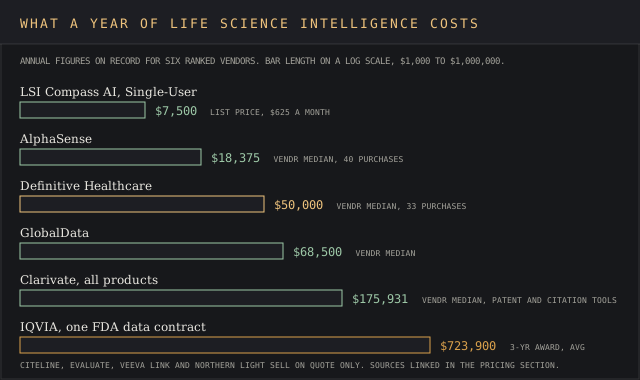
| Vendor | Annual figure | What it is | Source |
|---|---|---|---|
| LSI Compass AI | $7,500 | Single-User list price, $625 a month | LSI |
| AlphaSense | $18,375 | Vendr median, 40 purchases, $9,750 to $51,300 | Vendr |
| Definitive Healthcare | $50,000 | Vendr median, 33 purchases, $20,777 to $255,973 | Vendr |
| GlobalData | $68,500 | Vendr median, $43,000 to $73,875 | Vendr |
| Clarivate (all products) | $175,931 | Vendr median for patent and citation tools | Vendr |
| IQVIA | ~$723,900 | One FDA sales-data award, averaged over 3 years | USAspending |
Citeline, Evaluate, Veeva Link and Northern Light sell on quote only, and getting a list price out of any of them is a long shot. The quote is where the devil's in the details, so get these four terms in writing:
- Term length and renewal. Two G2 reviewers of Definitive Healthcare describe required three-year agreements, and one says the term renewed automatically for three more.
- Termination. A September 2026 GlobalData reviewer on G2 complained of an inflexible termination policy after eight months of non-use.
- Change of control. Cortellis's segment is changing hands and Definitive Healthcare has a going-private bid, so ask what happens to price and scope after closing.
- Add-on content. LSI reserves API access for its Enterprise tier, and AlphaSense sells Tegus expert interviews as a premium service, so price the add-ons with the platform.
For cross-category context, the market intelligence platform pricing report covers tiers across the wider category, the competitive intelligence pricing report covers 18 vendors and the expert network cost report prices the per-call alternative to an AlphaSense seat.
Ownership changes among life science intelligence companies
Consolidation is the market story of 2026, and a buyer signing a long term should map it first. Five dated events in the last four years changed who owns, funds or polices this data. The Cortellis closing date isn't set in stone either: Clarivate says by the end of 2026.
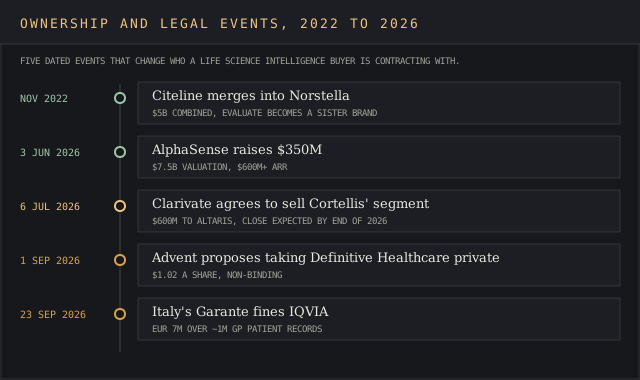
- 1 November 2022: Citeline merges into Norstella, a $5 billion company that also owns Evaluate.
- 3 June 2026: AlphaSense raises $350 million at a $7.5 billion valuation.
- 6 July 2026: Clarivate signs a definitive agreement to sell its Life Sciences & Healthcare segment, Cortellis included, to Altaris for $600 million.
- 1 September 2026: Advent proposes a $1.02-a-share take-private of Definitive Healthcare.
- 23 September 2026: Italy's Garante fines IQVIA €7 million over GP patient records.
Two of the ten ranked tools now sit under one roof at Norstella, and two more face a new owner within months. Funding conditions behind these deals, from biotech venture capital to lab vacancy, are tracked in the life science market report. Putting all your eggs in one basket was always a risk with a single data vendor. In 2026 the basket itself is changing hands.
Common buying mistakes with life science intelligence tools
Most failed purchases trace back to one of five mistakes, and each has a fix that costs an afternoon.
- Buying the brand and skipping the coverage test. Teams that cut corners here pay for it at renewal. Take 20 drugs, devices or physicians you already know and check them in the trial account. A vendor that misses 4 of 20 misses about 20% of the records you care about.
- Treating a generalist as a specialist. AlphaSense and Northern Light search documents. Citeline and Evaluate curate drug records. A team that needs phase-by-phase pipeline counts and buys a search tool is back to square one by the first board meeting.
- Ignoring renewal terms. Required three-year terms, and one automatic three-year renewal, show up in Definitive Healthcare's G2 reviews. Calendar the notice window on day one and keep an eye on it.
- Skipping the ownership check. A $600 million sale and a $1.02-a-share bid are both public. Read the press release before the redline.
- Double-buying inside one parent. Citeline and Evaluate are both Norstella brands, and Biomedtracker moved from one to the other. Ask for one contract.
How to run a life science intelligence trial
A two-week trial is enough if the test set is ready on day one. Teams that hit the ground running get a yes or no out of the vendor before the trial clock runs out.
- Write the questions first. Five real questions from the last quarter, such as "which phase 2 assets target this mechanism" or "how many knee procedures did Spain run in 2024".
- Build a 20-item answer key. Drugs, trials or accounts where your team already knows the truth.
- Score coverage and accuracy separately. Count hits, then count wrong phases, wrong sponsors and stale dates.
- Test the export. Pull 500 rows to Excel or the API and time it.
- Price the full scope. Get the year-two and year-three price in writing, plus add-ons.
Run two vendors at once on the same answer key and keep everyone on the same page about scoring. Comparing one vendor's demo to another's live account is how teams pick the better salesperson.
Citeline versus Cortellis for pipeline intelligence
These two share the pipeline shortlist, and the Fishbowl consultant above named both on one line. The difference is scope and ownership.
| Test | Citeline | Cortellis |
|---|---|---|
| Headline count | 90,000+ drug profiles | 328,000+ regulatory documents |
| History | 40 years | AdComm transcripts since 2000 |
| Owner in 2026 | Norstella, since November 2022 | Clarivate, selling to Altaris for $600M |
| AI access | Ella chat assistant in Trialtrove+ | MCP connector into Claude, March 2026 |
Both vendors sell on quote, so the price comparison happens in negotiation. Ask Cortellis for change-of-control language that survives the Altaris closing, and ask Norstella for a bundled Citeline and Evaluate rate.
Pick Citeline for pipeline and trial depth with a settled owner. Pick Cortellis when one license has to cover regulatory documents and deals as well, and negotiate change-of-control language before signing.
Free and cheap sources of life science intelligence
Public sources cover a lot of the raw material, and a scrappy team can stitch them together. The catch is curation: someone has to clean the data, and that labour is what the paid tools charge for.
- ClinicalTrials.gov: the US registry. The Hacker News comment quoted under Citeline describes its uneven completeness by country and sponsor.
- FDA databases: approvals, 510(k) clearances and Advisory Committee materials.
- GlobalData's free trials dashboard: on Pharmaceutical Technology.
- LSI Compass AI: $625 a month, the cheapest paid entry on this list, and a cheap test for a managing director screening medtech deals.
Free data is a drop in the bucket next to 90,000 curated profiles. It works for a one-off question and breaks the moment a team needs the same answer refreshed every week.
Life science intelligence FAQ
What is life science intelligence?
Life science intelligence is the systematic gathering of insights from scientific, clinical, regulatory and commercial sources to support decisions across the pharma, biotech and medtech lifecycle. It integrates data from clinical trials, patents (the patent search tools ranking covers that layer), regulatory filings and real-world data, then turns it into actionable insights for strategic decisions such as licensing, launch and trial design.
What are the best life science intelligence companies?
For pipeline and trials, Citeline and Cortellis. For forecasts, Evaluate. For real-world data, IQVIA. For medtech and private-company tracking, LSI. The ranking above orders all ten on five testable criteria.
What is LSI USA?
LSI USA is where medtech leaders access capital: the flagship summit of Life Science Intelligence, the company founded by chief executive officer Scott Pantel, held in Dana Point, California. LSI USA 2026 listed 2,000 executives and 450 active investors, and LSI USA '27 runs March 15 to 19, 2027, at the Waldorf Astoria Monarch Beach. That's the next event after LSI Europe '26, September 28-October 1, 2026, in Barcelona.
What does a life science intelligence platform cost?
From $625 a month for LSI's Single-User plan to six figures a year. Vendr medians run $18,375 for AlphaSense, $50,000 for Definitive Healthcare and $68,500 for GlobalData, and one IQVIA FDA contract averaged about $723,900 a year.
How is AI used in life science intelligence?
Mostly for search and delivery: AlphaSense's Generative Search queries ClinicalTrials.gov, FDA, EMA and PubMed together, and Clarivate and LSI both ship MCP connectors that pipe licensed data into AI assistants. Accuracy claims for predictive models still need a validation study behind them.
Who owns Citeline and Evaluate?
Norstella owns both. Citeline merged into Norstella on 1 November 2022, forming a $5 billion company, and Evaluate, ranked third here, now also sells Biomedtracker.
Bottom line
Citeline wins for pipeline and trial work: 90,000+ drug profiles, 40 years of history and one owner since 2022. Cortellis is the pick when one license has to cover regulatory documents and deals, provided the contract survives the Altaris sale. Evaluate is the forecasting desk's tool, and IQVIA owns real-world data at a price only large pharma pays.
AlphaSense is the cheapest serious seat for competitive intelligence analysts at an $18,375 median, and GlobalData suits strategy teams that buy analyst reports. Definitive Healthcare wins US territory planning, LSI wins medtech deal tracking at a published $625 a month, Veeva Link wins KOL mapping, and Northern Light wins when the job is searching everything a team already licenses.
Whatever the pick, test it on 20 answers your team already knows, and read the renewal clause before the signature page.