Pharmaceutical competitive intelligence tools for commercial teams (2026)
 By Jan Suski. I go deep on every review, checking every number against its source and digging up details other coverage misses, a habit from six years of SEO and link building for tech companies. Bylines at Brand24 and Senuto. How the scoring works.
· Prefer this source on Google
Quick comparison of pharma commercial competitive intelligence tools
One row per ranked tool, in ranked order. Every vendor on this list sells through a quote, so the price column reads the same down the whole table.
| # | Tool | Built for | Entry price | Best fit |
|---|---|---|---|---|
| 1 | Within3 | HCP/payer sentiment, launch tracking, advisory boards | Quote-based, demo only | Launch teams tracking prescriber and payer response in real time |
| 2 | Larvol | Pipeline, congress, and KOL tracking | Quote-based | Medical and commercial teams covering a full therapy area |
| 3 | Anervea.ai | AI-aggregated competitive intelligence across 110+ sources | Quote-based | Teams wanting one AI layer over clinical, regulatory, and commercial signals |
| 4 | Klick (Site AiQ) | Competitor website and messaging monitoring | Quote-based, agency-bundled | Brand teams auditing competitor digital messaging |
| 5 | Virtual Science AI | Congress, poster, and publication activity tracking | Quote-based | Launch teams building a scientific-narrative plan |
| 6 | Trinity Life Sciences (InsightsEDGE) | CI consulting plus a dashboard product | Quote-based, project-scoped | Teams that want analysts attached to the software |
| 7 | Pulsar | Pharma-compliant social and HCP narrative listening | Quote-based | Medical affairs and compliance-sensitive social monitoring |
This page ranks commercial and launch CI only. For trial registrations, regulatory filings and deal tracking, see our life science intelligence tools ranking. For generalist battlecard platforms like Crayon and Klue, see our competitive intelligence tools ranking.
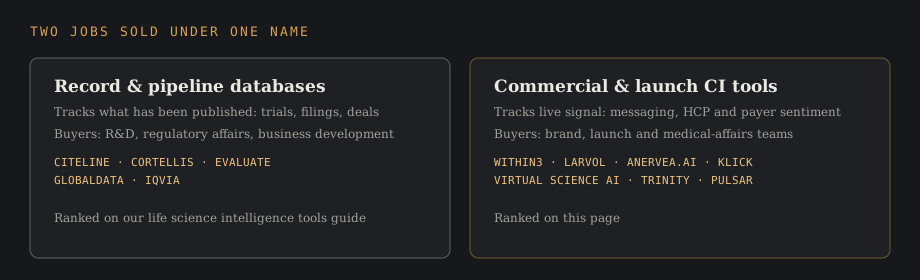
Pharma competitive intelligence splits into two jobs that get sold under the same name. One job tracks published records: clinical trial registrations, regulatory filings, deal terms, ownership changes. The other job sits inside a brand or launch team and answers a narrower question: what is the competitor doing this quarter, what are physicians and payers saying about it, and what does the battlecard need to say before the next sales call.
This page ranks the second category: platforms built for pharma commercial and brand teams tracking competitor pipelines, launches, messaging, and HCP or payer sentiment. It does not re-rank the record-and-database vendors (Citeline, Cortellis, Evaluate, GlobalData, IQVIA) already covered on our life science intelligence tools ranking, which scores those tools on published record counts, history depth, price, and API access.
That ranking serves R&D, regulatory affairs, and business development teams tracking key opinion leaders and trial data across pharmaceutical companies and therapeutic areas. This one serves the commercial side of the same organization.
Seven tools made this list, short of the usual ten, because the commercial-CI-for-pharma category has fewer dedicated vendors than adjacent fields like general B2B competitive intelligence.
Several names a reader might expect, like Crayon or Klue, are generalist battlecard platforms that some pharma teams adopt. Neither builds pharma-specific features such as congress feeds, medical-affairs review cycles, or pharmacovigilance-aware listening. They're covered on our competitive intelligence tools ranking, and we didn't rank them twice.
Competitive intelligence in pharma carries more strategic weight than in most industries, because drug development runs over a decade and costs billions before a single dollar of revenue arrives. Payer negotiations shift under a brand's feet while it waits in late-stage trials: a competitor's regulatory approval, a new licensing agreement, or a shift in reimbursement strategy can change the commercial case for a launch that was priced years earlier.
That's the strategic context the tools on this page operate inside. The pharmaceutical sector's competitive cycle moves faster than the industry's own product cycle, and a brand team that only reviews the market once a quarter is reacting to news a competitor's commercial team already acted on.
Evaluation criteria for pharma commercial competitive intelligence tools
Five criteria decide the shortlist, and the ranking below applies them in this order.
Signal breadth a buyer can name
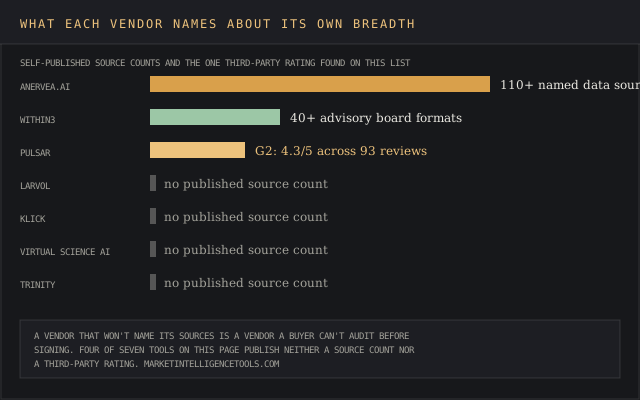
Does the vendor publish what it monitors, with a number or a named list, or only a marketing description? Anervea.ai's AlfaKinetic platform names "110+ global data sources." Within3 names 40+ advisory board formats. A vendor that won't name its sources is a vendor a buyer can't audit before signing.
HCP or payer sentiment, not only brand mentions
Generic social listening counts brand mentions. Pharma commercial CI needs to separate HCP, patient, and payer voices and route anything that looks like an adverse event into the right workflow. Pulsar's compliance matrix names pharmacovigilance-ready AE flagging and HCP segmentation as separate, testable features; a tool without that split fails this criterion regardless of its listening volume.
Built for launch cadence, not quarterly reporting
A launch window moves faster than a standing market-research retainer. Within3 and Virtual Science AI are both built around real-time or near-real-time signal capture tied to a launch calendar; a tool whose output is a scheduled PDF report fails this test even if the underlying data is good.
Named compliance posture
Within3 cites AICPA SOC compliance by name. A vendor handling HCP and patient commentary in a regulated industry should be able to name the standard it's audited against; "enterprise-grade security" with no named framework is not an answer a buyer can verify.
Output a brand team can act on
A battlecard-ready output (a messaging gap, a launch-readiness signal, a payer objection pattern) beats a raw data feed a strategist still has to interpret. Klick Site AiQ's output is a competitive marketing audit, the right shape for a commercial team with no analyst bench.
The ranking
Within3
Best fit
Launch and brand teams who need HCP and payer sentiment tracked continuously against a specific launch calendar.
Within3's Launch Intelligence platform combines field insight, digital listening, and structured engagement (advisory boards, steering committees, congress panels) into one view of how physicians and payers are reacting to a brand and its competitors. The vendor names 40+ virtual advisory board formats and an AI-powered Moderator Assistant, built on more than a decade of work with major pharma accounts.
Key features
- KOL Mapping, which ranks a disease community by influence; job title plays no part in the score.
- Social Listening scoped specifically to congresses and launch milestones.
- Virtual Advisory Boards with 40+ engagement formats and in-platform translation.
- Congress Insights Management, capturing signal before, during, and after a medical meeting.
- Payer-side access-barrier detection, named separately from HCP sentiment tracking.
Pricing
Not published. Within3 sells through a demo and scoped proposal, with no self-serve tier or list price on its site as of this writing.
Pros
- Only vendor on this list naming AICPA SOC compliance directly, which matters for anything touching HCP commentary.
- Combines structured primary research (advisory boards) with passive listening in one platform, where most competitors do one or the other.
- Vendor-reported reporting time drops from months to days against the prior manual process.
Cons
- No public pricing, so budget conversations start from zero information.
- No battlecard-specific module; competitive output is folded into broader insight reports, with no standalone battlecard builder on top.
- No independent review-site presence found on G2, Capterra, or TrustRadius at the time of writing, so there's no third-party customer data to check the vendor's own claims against.
Why it's ranked #1. Within3 is the only tool here naming a compliance standard and pairing passive listening with structured primary research in one platform; it beats #2 on HCP/payer sentiment depth, the criterion Larvol doesn't compete on at all.
Larvol
Best fit
Medical and commercial teams who need one feed covering a therapy area's pipeline, congress activity, and KOL movement together.
Larvol built its name on Larvol Clin, a clinical trial tracker, then extended into commercial and medical-affairs territory with Larvol Omni, a KOL and pharma-tracking tool. It shipped Omni with its own mobile app, so field teams can check competitor activity between meetings with no need to wait on a desk report.
Key features
- Congress and conference tracking folded into the same feed as pipeline updates.
- KOL movement tracking, distinct from the record-database KOL profiles on life-science intelligence platforms.
- A dedicated mobile app for field-level, between-meetings lookups.
- Coverage spanning Larvol's existing Clin and NDA modules for cross-referencing a competitor's trial status against its commercial activity.
Pricing
Quote-based; Larvol does not publish a list price.
Pros
- Connects pipeline status to commercial and KOL activity in one place, which most dedicated commercial-CI tools don't attempt.
- The mobile app is a genuine differentiator for field medical and sales teams, built for daily use on the road.
- Established vendor with a multi-year track record, not a 2025-2026 entrant.
Cons
- No named compliance standard on its public pages.
- No published source count, so breadth claims can't be checked against AlfaKinetic's named 110+.
- No independent review-site presence found under the Larvol or Omni product name at the time of writing.
Why it's ranked #2. Larvol beats #3 on field usability, with a dedicated mobile app Anervea.ai doesn't offer, but loses to #1 on named compliance and HCP-sentiment depth, where Within3 publishes specifics Larvol's pages don't.
Anervea.ai
Best fit
Teams who want one AI layer pulling from clinical, regulatory, and commercial sources at once, with no separate tool needed for each.
Anervea.ai's platform, AlfaKinetic, unifies more than 110 global data sources with what the vendor calls proprietary primary intelligence. A July 2025 partnership with Komodo Health adds claims and real-world-data signals to that mix, aimed at surfacing competitive movement earlier than a manually assembled report would. Komodo itself ranks seventh on our health intelligence platforms ranking, at a $1,000,000 Vendr median.
Key features
- 110+ named data sources feeding a single AI aggregation layer.
- A Komodo Health data partnership folding claims-based real-world evidence into competitive signal.
- Services staff (named roles include VP Enterprise Partnerships and VP US Sales) layered on top of the software.
Pricing
Quote-based; no list price published.
Pros
- The 110+ source count is a figure a buyer can hold the vendor to, unlike most competitors on this list.
- The Komodo Health partnership adds a real-world-data layer most pharma-CI-specific tools don't carry natively.
Cons
- A newer entrant than Larvol or Within3, with less public track record to check claims against.
- No named compliance standard.
- No independent review-site presence found at the time of writing.
Why it's ranked #3. Anervea.ai's 110+ named sources beat #4's single-channel focus on breadth, but it loses to #2 on field-level usability since Larvol ships a dedicated app and Anervea.ai doesn't.
Klick Health (Site AiQ)
Best fit
Brand teams whose main competitive blind spot is what competitor-owned websites and digital messaging are doing right now.
Klick Site AiQ, launched in March 2024 by healthcare marketing agency Klick Health, is an AI tool built specifically to monitor pharmaceutical brand websites and return a real-time competitive marketing audit. It was built pharma-first, with no general-purpose web-monitoring tool repurposed underneath it.
Key features
- Automated competitive marketing audits scoped to pharma brand websites specifically.
- Real-time flagging of messaging and positioning changes on competitor sites.
- Delivered as part of Klick's broader agency relationship; there's no standalone self-serve product.
Pricing
Quote-based, typically bundled into a Klick agency engagement, with no separate line-item price.
Pros
- Narrow, well-defined scope (brand websites) means less noise than a general social or media monitor.
- Backed by an agency with a long healthcare-marketing track record. This isn't a standalone startup betting on one product.
Cons
- Scope is narrower than the other tools on this list; it doesn't touch congress activity, KOL movement, or payer sentiment.
- Typically sold inside an agency contract, which limits it as a tool a brand team can pilot independently.
- No independent review-site presence found for Site AiQ specifically at the time of writing.
Why it's ranked #4. Site AiQ beats #5 on immediacy, since it watches live competitor web pages, not waiting for a congress cycle, but loses to #3 on breadth, covering one channel against Anervea.ai's 110+.
Virtual Science AI (Medical Competitor AI)
Best fit
Launch teams building a scientific-narrative plan around upcoming conferences and publications.
Virtual Science AI shipped Medical Competitor AI in May 2026, an AI product that tracks competitor conference coverage, trade activity, posters, publications, and social engagement around scientific events, aimed at life-science launch teams deciding where to focus activity as budgets tighten.
Key features
- Conference and poster-session tracking tied to named competitor assets.
- Publication monitoring folded into the same feed as congress activity, so it never becomes a separate research task.
- Positioned as part of a wider congress-intelligence suite, including a separate real-time conversational-intelligence product for medical congresses.
Pros
- Parent company already works with most of the top 20 pharma companies on congress intelligence, per its own disclosure, which gives the new product an installed base to build on.
- Scientific-narrative framing fits medical affairs and launch teams specifically, built around pharma's own publication and congress cycle from the start.
Cons
- Launched in May 2026, so it's the newest product on this list with the shortest public track record.
- No source count or coverage figure published for the product itself.
- No independent review-site presence found at the time of writing.
Pricing
Quote-based; no list price published.
Why it's ranked #5. It beats #6 on launch-cadence fit: Trinity's dashboard is paired with project-scoped consulting, a slower delivery model than a continuous feed. It loses to #4 on track record, since Site AiQ has run inside Klick's agency relationships since 2024 against this product's 2026 launch.
Trinity Life Sciences (InsightsEDGE)
Best fit
Teams that want a named analyst relationship attached to the software, with no self-serve license on offer.
Trinity Life Sciences sells competitive intelligence primarily as a consulting program, built around monitoring, rapid response, workshops, and congress coverage, with InsightsEDGE as the named software component inside its wider TrinityEDGE technology suite. The company describes the combination as "strategic advisory thinking" paired with "technology enablement." That's an accurate description of a services-led model: software plus analysts, never software alone.
Key features
- A modular program: ongoing monitoring, rapid-response support, workshops, and congress coverage, selected individually.
- InsightsEDGE software inside the broader TrinityEDGE suite, alongside CustomerEDGE and ForecastEDGE.
- CI work integrated into Trinity's existing commercial-strategy consulting engagements.
Pricing
Project-scoped, quote-based; no self-serve software pricing published separately from the consulting engagement.
Pros
- Pairs software with an analyst team, which suits a brand team with no in-house CI function.
- Modular program structure lets a buyer start with congress coverage alone before committing to the full suite.
Cons
- InsightsEDGE's own feature set isn't described on Trinity's public pages separately from the consulting program, so it's hard to evaluate the software on its own.
- Services-led pricing makes this the hardest tool on this list to budget without a sales conversation.
- No independent review-site presence found for InsightsEDGE specifically at the time of writing.
Why it's ranked #6. Trinity beats #7 on launch-specific depth, since its modular program folds in congress coverage and rapid response that Pulsar doesn't offer, but loses on signal breadth: Pulsar names a specific review-site rating (93 reviews, 4.3/5 on G2) that Trinity has nothing to match.
Pulsar
Best fit
Medical affairs and compliance teams who need HCP and patient social listening built with pharmacovigilance and regulatory review in mind from the start.
Pulsar is a social intelligence platform that, for pharma accounts, separates HCP, patient, and caregiver narratives through a feature it calls Narratives AI, and maps medical sub-specialties with its own TRAC archetypes, a finer cut than a flat "healthcare" filter.
It's built to report into medical-affairs review cycles, a different cadence than a weekly campaign dashboard. G2 lists Pulsar Platform at 4.3 out of 5 across 93 reviews, the only review-site figure found for any tool on this page.
Key features
- Narratives AI, splitting HCP, patient, and caregiver conversation into separate tracked segments.
- TRAC archetypes mapping sub-specialties such as oncology and cardiology, each tracked on its own, never folded into one generic healthcare tag.
- Pharmacovigilance-ready adverse-event flagging, named as a distinct capability in the vendor's own compliance comparison.
- Multilingual, multi-regulator listening across several regional regulatory bodies.
Pricing
Quote-based; no list price published.
Pros
- Only tool on this list with a public, third-party review-site rating to check vendor claims against.
- Named pharmacovigilance and HCP-segmentation features, purpose-built for a regulated industry from the ground up.
Cons
- It's a horizontal social-listening platform with pharma-specific features layered on top, a different build path than a purpose-built pharma CI platform like Within3 or Larvol.
- Doesn't touch pipeline, congress, or deal activity at all; it's a single-channel tool for the sentiment half of the brief.
- Its own comparison page recommends buyers confirm validation documentation and regional coverage directly, a caution against taking the vendor's compliance matrix at face value.
Why it's ranked #7. Pulsar is the narrowest tool on this list by scope, covering sentiment and nothing else, which is why it sits last on a page built around launch and pipeline tracking as much as sentiment. It's the right pick as an add-on to one of the broader platforms above it, never as a replacement for any of them.
What the five pharma competitive intelligence methods cover
Pharma CI isn't one activity; it's several methods pointed at different parts of the competitive landscape, and the tools in this market usually specialize in one or two, not all five:
- Pipeline and clinical trial monitoring: tracking a competitor's trial design, endpoint selection, and patient recruitment through clinical trial registries, the method the record databases on our other ranking specialize in.
- Patent and intellectual property analysis: reading patent filings to infer a competitor's R&D priorities and the mechanism of action it's betting on, before a drug reaches clinical trials at all.
- Deal and licensing tracking: watching licensing agreements, acquisitions, and earnings calls for signs of a competitor's business development strategy and asset strategy.
- Regulatory monitoring: following regulatory filings and approvals through FDA and EMA processes to anticipate a competitor's market entry timing.
- Commercial and launch intelligence: the category this page ranks, covering messaging, HCP and payer sentiment, and launch readiness once a competitor's asset is close to or past approval.
A pharmaceutical company with a mature competitive intelligence function usually runs all five, split across different teams and often different software; the mistake worth naming is assuming one platform, or one person, should run all five at once.
Strategic decision making in a pharma organization works best when each method feeds the team that acts on it: R&D acts on patent and trial signal, business development acts on deal signal, and commercial acts on the launch and sentiment signal this page's tools are built to deliver.
Why this is a different buy than a life science record database
A record database like Citeline or Cortellis answers "what has been published about this asset." A commercial CI tool answers "what should our team do about it this week." The two questions pull different buyers inside the same pharma organization: R&D, business development, and regulatory affairs lean on the database vendors; brand, launch, and medical-affairs teams lean on the tools ranked here.
Buying the wrong category is a common mistake: a brand team that licenses a clinical-trial database expecting battlecard-ready output will find raw trial records instead, with none of the HCP sentiment or messaging analysis this page's vendors are built to produce.
The same split shows up in adjacent functions: intellectual property and clinical development teams track patent filings and trial design, while market access teams negotiate reimbursement using payer data the tools on this page don't collect.
Where the HCP and payer sentiment data comes from
Three collection methods feed this category, and most vendors blend two of them:
- Structured primary research: advisory boards, steering committees, and panels, where a vendor like Within3 recruits and moderates the conversation directly.
- Passive digital listening: social platforms, forums, and public commentary, filtered through a classifier that's supposed to separate HCP voices from patient and general-public ones, which is what Pulsar's TRAC archetypes are built to do.
- Field and congress capture: what a sales or medical liaison hears in person, or what a congress-tracking tool like Larvol Omni or Virtual Science AI picks up from posters, talks, and trade-floor activity.
A tool that relies on only one of the three will miss signal the others catch. That's the practical argument for combining a launch-tracking platform with a narrow sentiment tool like Pulsar: expecting one vendor to cover all three well is asking too much of any single platform on this page.
Why competitive advantage in pharma commercial teams depends on speed as well as coverage
Competitive advantage in a crowded therapy area rarely comes from knowing a competitor exists; every commercial team already knows that. It comes from acting on a market signal before the competitor's own launch team finishes reacting to it.
Strategic priorities for a pharma commercial function usually name three things the tools on this page are built to shorten: the time between a competitor event and the team hearing about it, the time between hearing about it and understanding what it means for market share in a specific therapeutic area, and the time between understanding it and updating the messaging or the battlecard a field team is using that week.
A competitor strategies review that runs once a quarter catches regulatory developments and strategic decisions long after the competitive edge they created has already shaped prescriber and payer behavior.
Healthcare professionals and payers form opinions about a treatment's place in a crowded market early, often around the first medical congresses after launch. A brand team that first hears about a shift in that opinion from its own sales force, with no monitoring tool to catch it sooner, has already lost the time it needed to respond.
Pricing across this category
Every vendor on this list sells through a quote; none publishes a list price or the pricing logic behind that number.
That's consistent with the pattern across commercial software built for the pharma industry generally. Contracts are scoped to a therapy area, a launch window, or a named set of brands, so a per-seat price would undersell a large account and oversell a small one.
The practical effect for a buyer is that budget conversations have to start with a defined scope, such as one brand's launch, one therapy area, or an enterprise-wide rollout, before a vendor will quote a number.
Common buying mistakes in this category
- Buying a record database to do a battlecard's job. Citeline, Cortellis, and similar tools weren't built to output a sales-ready battlecard against live competitive threats; they output records.
- Assuming "social listening" means HCP listening. A generic social suite without a classifier like Pulsar's TRAC archetypes will mix patient chatter, HCP commentary, and general public noise into one undifferentiated feed, leaving a commercial team to extract its own actionable insights by hand.
- Skipping the compliance question. A tool processing HCP or patient commentary in a regulated industry should name its compliance standard; a vendor that can't name one shouldn't be in a shortlist for anything touching adverse-event-adjacent content.
- Treating a 2026 launch as proof of maturity. Several vendors on this page, including Anervea.ai and Virtual Science AI, are recent entrants with real, named capabilities, but a shorter public track record than Larvol or Within3. Weigh that gap against the urgency of the need and how much a longer track record is worth paying for.
Pharmaceutical competitive intelligence tools FAQ
What is pharmaceutical competitive intelligence for commercial teams?
It's the practice of tracking a competitor's pipeline, launch activity, messaging, and the sentiment of physicians and payers toward it, so a brand or launch team can act on the signal, usually through a battlecard, a messaging adjustment, or a launch-timing decision. It's distinct from the clinical and regulatory record-tracking that database vendors sell to R&D and business development teams.
How is this different from a tool like Citeline or Cortellis?
Those platforms track published records: trial registrations, regulatory filings, deal terms, and ownership history, measured on record counts and history depth. The tools ranked here track live commercial signal: what a competitor's brand team is doing this quarter, and what HCPs and payers are saying about it, measured on signal breadth, sentiment depth, and launch-cadence fit instead.
What does a pharma commercial CI platform cost?
None of the seven vendors on this page publish a list price. Contracts are scoped to a brand, a therapy area, or an enterprise rollout, and quoted after that scope is defined. That's standard practice across pharma-specific commercial software; it says nothing about any one vendor being unusually opaque.
Do any of these tools build battlecards directly?
None of the seven ship a dedicated, standalone battlecard builder the way a generalist platform like Klue does. Klick Site AiQ comes closest for messaging-specific output, and Within3's insight reports are built to feed directly into a battlecard. A team wanting a literal battlecard template and workflow will still assemble it from these tools' output; the tool itself won't hand it over ready-made.
Bottom line
Within3 wins this list for most launch and brand teams because it's the only platform combining structured HCP/payer research with passive listening and a named compliance standard in one place.
Teams covering a full therapy area's pipeline alongside commercial activity should look at Larvol first. Teams whose single biggest gap is compliant HCP and patient sentiment tracking, with nothing else needed, should treat Pulsar as an add-on to whichever platform above it they pick; it's built to sit alongside that platform, never to stand in for it.