Health intelligence platforms: 10 tools ranked for 2026
 By Jan Suski. I go deep on every review, checking every number against its source and digging up details other coverage misses, a habit from six years of SEO and link building for tech companies. Bylines at Surfer, Brand24, and Senuto. How the scoring works.
· Prefer this source on Google
Quick comparison of health intelligence platforms
Ten platforms in ranked order, with the data scale each vendor publishes, the price a buyer can check before a demo, and the buyer each one fits.
| # | Platform | Published data scale | Price on record | Best fit |
|---|---|---|---|---|
| 1 | Arcadia | 150M+ patient records, 2,600+ sources | Quote only | Value-based care organizations and payers |
| 2 | Innovaccer | 400+ pre-built connectors, 100+ FHIR resources | Quote only | Health systems replacing several point tools |
| 3 | Health Catalyst | 1,100+ client organizations | $18,469 Vendr median* a year | Hospitals that want analysts and software together |
| 4 | Truveta | 140M+ patients, updated daily | Quote only | Clinical research on fresh EHR data |
| 5 | Health Gorilla | QHIN since 12 Dec 2023, 120+ lab vendors | Quote only | Digital health firms pulling patient charts |
| 6 | Definitive Healthcare | 9K+ hospitals, 3.5M+ clinicians | $50,000 Vendr median*, 33 purchases | Healthcare sales and market planning teams |
| 7 | Komodo Health | 330M+ de-identified patients | $1,000,000 Vendr median* a year | Pharma brand and HEOR teams |
| 8 | DHIS2 | National platform in 75+ countries | $0 license | Ministries of health and NGOs |
| 9 | IQVIA | 1.2B+ non-identified patient records | Quote only | Global pharma needing data and services |
| 10 | Springbuk | 7,500+ employer customers | Quote only | Self-insured employers and benefits advisors |
* Vendr figures are anonymised buyer data read 14 October 2026. Every other figure comes from the vendor's own site unless a sentence names KLAS or G2.
Where these figures come from
Data scale figures are each vendor’s own published count, read on 14 October 2026 and linked from its entry below. Medians marked * are Vendr’s anonymised buyer data for Health Catalyst, Definitive Healthcare and Komodo Health. Arcadia, Innovaccer, Truveta, Health Gorilla, IQVIA and Springbuk publish no price, so their rows read Quote only.
A health intelligence platform pulls clinical, claims and operational data from many systems into one model, then turns it into care gaps, risk scores and reports that care teams and researchers can act on. Arcadia says its platform connects more than 2,600 data sources and manages over 150 million patient records. That's the scale this category sells.
The label covers five different kinds of product. Innovaccer calls Gravity a "Healthcare Intelligence Platform", Springbuk sells "Health Intelligence" to employers, and the open-source DHIS2 runs national health data in more than 75 countries. This page ranks ten of them on six tests a buyer can check.
It's written for population health, analytics and clinical research leads at health systems, payers, life science firms and public health departments. Six of the ten vendors publish no price, so every figure below links to the vendor's own page, to Vendr's anonymised buyer data, or to KLAS and G2 where a sentence says so.
Why now: the category had a rough 2026. Health Catalyst replaced its CEO in February, Epic sued Health Gorilla in January, and Definitive Healthcare booked a $197.2 million goodwill impairment in the first half. Ownership and legal risk belong in the evaluation alongside features.
Two neighbouring pages serve different buyers. Pharma pipeline and trial data sits on our life science intelligence tools ranking, and market sizing for hospitals and payers sits on the healthcare market intelligence guide. This page covers platforms that turn patient data into health intelligence.
Evaluation criteria for health intelligence platforms
Six criteria decide the shortlist. Each one has a method a buyer can define and assess from public pages in an afternoon, with no vendor demo. Each tool gets one point per test passed, and ties go to the tool that passes the earlier test in this list. If two tools pass the same tests, the larger published scale wins. No platform passes all six.
EHR data in a named product
The vendor names an EHR or clinical-record data product on its own site. Claims alone show what was billed. EHR systems show lab values, blood pressure readings and notes, which is what care gap and risk work needs. Claims-only tools still help assess cost trends, but they can't show clinical context. Pass or fail.
Published data scale
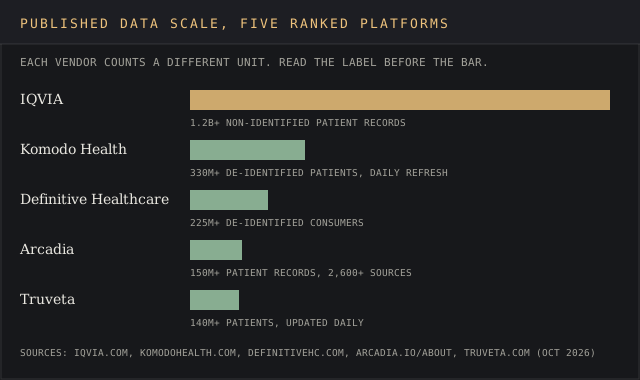
A count of patients, records or sources on the vendor's own domain. Arcadia's 150 million patient records passes. A list of customer logos doesn't. Read the unit: IQVIA counts records, Definitive counts consumers, Truveta counts patients.
A named interoperability standard or connector count
A FHIR resource count, a connector count or a federal designation such as Qualified Health Information Network (QHIN) under TEFCA. "Integrates with your EHR" fails. Innovaccer's 400+ pre-built connectors pass.
Security attestation on the vendor's domain
HITRUST r2, HITRUST CSF or a SOC 2 Type 2 report, announced or badged on the vendor's own site. A SOC 2 Type 1 is a point-in-time check and doesn't pass. These attestations are how a buyer starts the HIPAA and regulatory compliance review.
Price on record
A published price or a Vendr median with its range. Quote-only vendors fail this test, which is par for the course in healthcare data: four of the ten pass.
Independent customer score with a sample
A KLAS score or a G2 rating backed by at least 10 organizations or reviews. Komodo's single G2 review fails. Innovaccer's KLAS page covers 28 organizations for its population health product alone.
The 10 best health intelligence platforms in 2026
Arcadia
Best fit
ACOs, value-based care groups and payers that need clinical and claims data merged to identify patients due for screening.
Arcadia, created in 2002, says it connects more than 2,600 data sources and manages over 150 million patient records, per its company page. It sells three product families: Ascent for providers, CareJourney for value-based care network analysis, and Arcadia LifeScience for real-world data.
The certifications are the part buyers can check. The same page badges HITRUST, SOC 2 and ISO certification, and Arcadia earned NCQA's Validated Data Stream designation in 2023 and Certified Data Partner status in 2024. That NCQA status matters for HEDIS quality reporting, where a payer has to trust the patient data feeding its measures, and for care teams closing care gaps against them.
Key features
- Arcadia Ascent with Platform, Performance, Care, Insight, Finance and Network modules
- Arcadia CareJourney: VBC Navigator, Provider Intelligence and Network Modeler
- NCQA-certified HEDIS measures that follow NCQA guidelines for measurement year 2026
- Arcadia RWD and Arcadia Evidence for life science research
- Aggregate, Transform and Activate steps for multi-source data collection
Pricing
Arcadia publishes no price, and the Vendr marketplace page under that name belongs to a different, energy-data company. Expect a scoped quote.
Pros
- 2,600+ connected sources, the largest source count on this page
- HITRUST, SOC 2 and ISO badges plus two NCQA data designations
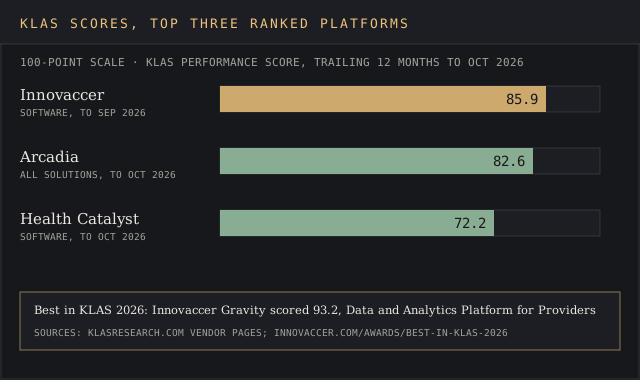
- KLAS overall score of 82.6 across all solutions, October 2025 to October 2026
Cons
- No price on record anywhere
- KLAS respondents flag cost and training
- KLAS lists its 2024 managed-services award under "Arcadia (now Guidehealth)"
Integration is the strength buyers name first. A director told KLAS in September 2026 that "Arcadia is hands down at the top of the game" for data integration. The cost complaint sits on the same page, from a CMO in August 2026:
"Arcadia's system is really expensive. It's a lot of money."
KLAS Research, CMO, August 2026
Why it's ranked #1. Arcadia passes 5 of 6 tests, and publishes a 150 million patient-record count that Innovaccer, at #2 on 4 tests, doesn't publish at all. Nothing ranks above it.
Innovaccer
Best fit
Health systems replacing several point tools (CRM, quality, care management) with one data platform.
Innovaccer launched Gravity, its "Healthcare Intelligence Platform", on 22 May 2025 with 400+ pre-built connectors and 100+ FHIR resources. It raised a $275M Series F in January 2025, so it isn't short of resources.
The KLAS record is the best on this page. Gravity scored 93.2 to win Best in KLAS 2026 for Data and Analytics Platform for Providers, Cured CRM scored 90.1, and the Galaxy payer platform scored 90.5. KLAS lists Innovaccer's overall software score at 85.9.
Key features
- Gravity data platform: 400+ connectors to EHR systems, claims and external sources
- Cured CRM, Best in KLAS for Customer Relationship Management three years running
- Galaxy for payers, scored 90.5 in Best in KLAS 2026
- InNote and Inscribe for ambient documentation and previsit summaries
- AI agents for prior authorization, care coordination, referral intake and chart chase that identify open coding gaps
Pricing
No published price and no Vendr page that loads. The KLAS comments on cost cut both ways, quoted below.
Pros
- Three Best in KLAS 2026 wins, from 90.1 to 93.2
- HITRUST CSF certified, with a 24/7 security operations center
- Published customer outcomes, such as Orlando Health's 47% closure rate for care gaps
Cons
- No patient count for the platform as a whole
- No price on record
- Delivery against promises draws repeat criticism on KLAS
Customers on KLAS split on value. A manager wrote in September 2026 that "The cost is understandable for the value that we're getting from Innovaccer PHM." An executive in another C-suite role disagreed in August 2026:
"Innovaccer has delivered maybe half of what they promised. That is frustrating."
KLAS Research, other C-suite executive, August 2026
Why it's ranked #2. Innovaccer passes 4 of 6 tests and beats Health Catalyst on interoperability with 400+ named connectors. It loses to Arcadia, which also publishes 150 million patient records.
Health Catalyst
Best fit
Hospitals that want an analytics platform and the analysts to run it from one vendor.
Health Catalyst says 1,100+ healthcare organizations use its products and claims $2.8B+ in client-validated outcomes across 390+ documented case studies. Its Ignite data platform runs on a data lakehouse with source starter sets for EMR, claims, financial and operational data.
The company is in hot water financially. Q2 2026 revenue fell 13% to $70.5 million, goodwill impairments reached $122.5 million for the half, and an April 2026 8-K set a workforce cut of about 9%. Ben Albert became CEO on 12 February 2026.
Key features
- Health Catalyst Ignite data and analytics platform with clinical, financial and claims collections, where analysts deliver dashboards created for each department
- Built-in clinical analytics library and self-service tools
- Twistle patient engagement, HITRUST r2 certified in September 2025
- Solution areas for quality performance, costing variation and value-based care
- 24 x 7 technical support through a ticketing system
Pricing
Vendr's anonymised buyer data puts the median at $18,469 a year, with a $3,781 to $28,953 range. That figure covers whatever Vendr's buyers purchased, and an enterprise platform contract runs higher.
Pros
- The only top-three vendor with a price on record
- HITRUST certification across its Data Operating System since February 2021
- 390+ published case studies a buyer can check against its own goals
Cons
- KLAS software score of 72.2, lowest of the top three
- Revenue down 13% year on year, with a ~9% staff cut
- Training gaps named by KLAS respondents
Cost and training are the recurring KLAS themes. A director told KLAS in August 2026: "We have decided to leave Health Catalyst because of the cost." A CEO countered in April 2026 that "Health Catalyst is fair and transparent with ongoing charges." On training, a manager in March 2026:
"Health Catalyst is weak in the training area. We end up taking on most of the training internally."
KLAS Research, manager, March 2026
Why it's ranked #3. Health Catalyst passes 4 of 6 tests, one more than Truveta, thanks to an $18,469 Vendr median and a 72.2 KLAS score. It loses to Innovaccer, which publishes 400+ connectors.
Truveta
Best fit
Clinical research, trial design and pharmacovigilance teams that need EHR data refreshed daily.
Truveta's homepage counts 140M+ patients, updated daily, along with 350+ publications and 100+ regulatory projects. The data comes straight from US health systems: a May 2024 post put it at more than 30 health systems, 800 hospitals and 20,000 clinics.
The sales pitch is freshness. Truveta's daily EHR feed gives a near real time view and lets researchers identify safety signals and changes in a patient's health within days, such as its 2026 influenza study comparing six years of data. Truveta's own data page gives two different notes counts, 7B+ and 8B+, so check the number in the contract.
Key features
- Truveta Data with clinical notes, genomics, images and mother-child linkage
- Truveta Intelligence with Ask and Verify functions
- Truveta Evidence: a secure research environment plus services that deliver finished studies
- Regulatory-grade data, used in 100+ regulatory projects
- Access through Panalgo's Instant Health Data platform since May 2024
Pricing
Quote only. Truveta publishes no rate card, and Vendr shows no page. Its publication guidelines set the rules researchers follow when they publish clinical research on its data.
Pros
- Daily refresh on 140M+ patients
- HITRUST r2 certified since November 2024
- 350+ publications built on its data
Cons
- No public review footprint on KLAS or G2
- No price on record
- US-only data
Why it's ranked #4. Truveta passes 3 tests and beats Health Gorilla on published scale with 140M+ patients. It loses to Health Catalyst, which has an $18,469 Vendr median and a 72.2 KLAS score.
Health Gorilla
Best fit
Digital health companies, payers and provider organizations that need patient charts pulled from QHIN networks through one API.
Health Gorilla became a Qualified Health Information Network on 12 December 2023, after what its CEO called a three-year process. Its homepage calls it the first dual-designated QHIN and QHIO in California, and its API docs say responses are normalized into FHIR resources with provenance metadata.
The red flag is legal. Epic, Reid Health, Trinity Health, UMass Memorial Health and OCHIN sued Health Gorilla and several clients on 12 January 2026, alleging they posed as treating providers to pull nearly 300,000 records, Fierce Healthcare reported. Health Gorilla said it "denies the allegations, has acted in good faith." The case is open.
Key features
- EHR Data, Lab Data, Pharmacy Data, ADT Data and SDOH Data products
- Electronic lab ordering from 120+ vendors
- Clinical Alerts for real time admission and discharge events
- Patient Access, giving patients their own charts
- HL7 C-CDA, IHE and FHIR protocols to deliver charts under TEFCA
Pricing
No published price; the homepage offers an ROI calculator and a sales contact.
Pros
- Federal QHIN designation since December 2023
- HITRUST r2 and SOC badges on its homepage
- One connection reaches every other QHIN under TEFCA
Cons
- Named defendant in Epic's January 2026 lawsuit
- No patient count published
- No price and no public review footprint
Why it's ranked #5. Health Gorilla passes 3 tests and beats Definitive Healthcare on EHR access through a QHIN designated 12 December 2023. It loses to Truveta, which publishes 140M+ patients.
Definitive Healthcare
Best fit
Sales, market access and strategy teams that need to identify buyers inside hospitals, physician groups and payers.
Definitive sells reference data on the healthcare market: 9K+ hospital and IDN profiles, 3.5M+ physicians, nurses and allied professionals, 130K+ physician groups and 225M+ de-identified consumers. Atlas All-Payor Claims adds billions of medical and prescription claims. IQVIA, ranked #9 below, is the main rival for this buyer.
The business is shrinking. Q2 2026 revenue fell 9% to $55.2 million, and the company booked a $197.2 million goodwill impairment for the first half.
Key features
- HospitalView, PhysicianView and PhysicianGroupView profiles
- Monocl ExpertInsight with 17M+ medical and scientific experts
- Atlas All-Payor & Prescription Claims
- ConnectedCareView: 4.5K+ ACO, HIE and payer profiles
- Populi population intelligence and digital audiences
Pricing
Vendr's buyer data shows a $50,000 median across 33 purchases, ranging from $20,777 to $255,973.
Pros
- Price on record from 33 Vendr purchases
- Widest provider reference coverage on this page
- 43 G2 reviews, rating 3.9
Cons
- No EHR product: reference and claims data only
- Reviewers report contact-data errors
- Its own blog documents a SOC 2 Type 1 from June 2023; ask for the Type 2
Data accuracy is the complaint that repeats. Harmonize Health's CEO wrote on TrustRadius in December 2022 that "we experienced errors as high as 30% on some lists." Cancellation is the other sore point:
"Even after verbally and electronically cancelling, they will send you to collections"
G2, Leslie R., chief executive officer, 8 August 2025
A business development manager wrote on the same G2 page in December 2021 that the "information and analytical content of this site are invaluable for someone working in Healthcare sales."
Why it's ranked #6. Definitive passes 3 tests and beats Komodo on independent reviews, 43 on G2 against Komodo's 1. It loses to Health Gorilla, which carries EHR data and a HITRUST r2 badge.
Komodo Health
Best fit
Pharma brand, market access and HEOR teams that need to identify patient pathways and prescribers across the US.
Komodo's Healthcare Map counts 330 million+ de-identified patients and 1 trillion+ linked records from 60+ sources refreshed daily. For outcomes research it offers over 200M patients with an average of 12 months of continuous enrollment. Marmot is the AI layer that sits on top.
Komodo cut 9% of its staff in December 2022, citing customers weighing purchases more carefully.
Key features
- Healthcare Map with daily refresh across 60+ sources, created for patient-level outcome studies
- Marmot apps and agents for analysis
- MapView dashboards with a generative AI assistant
- CMS Qualified Entity certification for Medicare data
- HEOR cohorts with 12 months average continuous enrollment
Pricing
It'll cost an arm and a leg. Vendr's buyer data puts the median at $1,000,000 a year, ranging from $120,000 to $4,958,392.
Pros
- 330M+ patients, second-largest scale figure here
- Daily refresh across 60+ sources
- Price on record through Vendr
Cons
- $1M median, the highest price on this page
- One G2 review, too few to score
- No EHR feed named by source on the Healthcare Map page
Independent reviews barely exist. The single review on Komodo's G2 seller page, from a verified user in May 2023, reads "High-speed tool. Easy to open and login."
Why it's ranked #7. Komodo passes 2 tests and beats DHIS2 on scale, 330M+ patients. It loses to Definitive Healthcare, which has 43 G2 reviews to Komodo's single one.
DHIS2
Best fit
Ministries of health, NGOs and public health organizations that need to identify outbreaks from routine health data.
DHIS2 is open source, supported by the HISP network, and runs as the national platform for routine health data in more than 75 countries. Ethiopia uses it to collect data from 30,000 health facilities serving a population of more than 120 million people.
The page calls countries free to run analytics "without licensing fees, per-user costs, or proprietary analytics engines." That's no strings attached on the license, but servers, training and 23 HISP support groups still cost each country money. It's a certified Digital Public Good and backed the 2025 Ebola response in the DRC.
Key features
- HMIS, disease surveillance and monitoring (IDSR) and campaign data in one model
- Real time dashboards and geospatial analytics
- Predictive modelling and data quality scoring
- Connectors to EMRs, civil registration, supply chain and GIS
- Custom apps, dashboards and AI tools
Pricing
$0 license. Contributing Partners pay a voluntary Shared Services Fee.
Pros
- $0 license and data sovereignty
- Used in 75+ countries
- Local support from 23 HISP groups
Cons
- Built for aggregate facility data from public health programs
- Self-hosted, so security certification falls on the host
- Analytics jobs slow down on large instances
Performance on big instances is the recurring forum complaint. A user on the DHIS2 Community of Practice wrote in August 2021:
"It used to take one 1hour for the Analytics to process queries but now it takes about 8hrs or so."
DHIS2 Community of Practice, Honour Munyai, 12 August 2021
Why it's ranked #8. DHIS2 passes 2 tests and beats IQVIA on price with a $0 license. It loses to Komodo, which publishes 330M+ patients against DHIS2's Ethiopia deployment, which serves 120 million people.
IQVIA
Best fit
Global pharma companies buying healthcare data, analytics and trial services from one vendor.
IQVIA's homepage counts 1.2B+ non-identified patient records, 68+ petabytes of proprietary data and operations in 100+ countries, and says it tracks 90% of global pharma sales. It claims 46% faster clinical trial site identification. Our IQVIA review covers the company and its public contracts.
Key features
- Real World & Healthcare Data and the Real World Evidence Library
- IQVIA OneKey healthcare professional reference data
- IQVIA Healthcare-grade AI and the Med-R1 8B medical reasoning model
- Commercial Analytics and Market Access Insights
- Analytics Research Accelerator for real-world data studies
Pricing
IQVIA prints no rate card and Vendr's IQVIA page shows no figures.
Pros
- The largest data count here, at 1.2B+
- Data and trial services from one company
- 4.3 on G2 across 14 reviews
Cons
- The 1.2B figure doesn't separate EHR from claims and prescriptions
- No price on record
- Reviewers call the data expensive
Cost is the complaint. A verified mid-market pharma user on G2 wrote in April 2021 that "The cost of the data is nearly prohibitive". A business development manager added in October 2022:
"Private market data is accurate, but Government supplies, tender information - volumes and value don't add up."
G2, Sayali K., senior manager, business development & licensing, 26 October 2022
A health and wellness user on the same page in June 2023 found it "extremely easy to build queries on IQVIA."
Why it's ranked #9. IQVIA passes 2 tests and beats Springbuk on scale with its 1.2B+ count. It loses to DHIS2, whose $0 license counts as a price on record.
Springbuk
Best fit
Self-insured employers and benefits advisors that analyze claims to identify gaps in care across their own population.
Springbuk sells health intelligence to employers, and Truven by Merative bought it on 10 September 2025, adding more than 7,500 small and mid-market employers to Truven's base. Truven's MarketScan covers more than 300 million unique patient lives.
Springbuk draws the line between analytics and intelligence plainly: its blog says "health analytics is descriptive, while health intelligence is prescriptive." The platform runs over 180 data quality checks on incoming claims.
Key features
- Health Intelligence with Answers, Insights, Timeline and social determinants
- Health Analytics for claims, gaps in care and cost trends
- Report Builder and Analytics Navigator
- Data Warehouse with 180+ data quality checks
- Springbuk Activate partner marketplace
Pricing
Quote only.
Pros
- SOC 2 Type 2 every year since 2017, plus HITRUST, per its 2024 differentiators sheet
- The only one of the ten built for employer claims
- Now backed by Truven's 300M-life MarketScan
Cons
- No EHR product
- Product roadmap now set by a new owner
- No public review footprint
Why it's ranked #10. Springbuk passes 1 test, its SOC 2 Type 2 record since 2017. It loses to IQVIA, which publishes a 1.2B+ data count and a 4.3 G2 rating from 14 reviews.
What health intelligence software does
The job is to aggregate and analyze multi-source health data, then hand relevant information to the people who act on it. Human API's support centre describes its product as "connecting and converting health data into actionable insights for enterprise businesses", with 30,000+ US data sources.
In practice that work breaks into five tasks:
- Integration. Pull data from EHR systems, claims, labs and external sources, and unify the formats into a single source of truth.
- Risk. Use AI and machine learning to identify high-risk patients, generate risk assessment scores and keep chronic disease under monitoring before an admission.
- Care gaps. Flag missed screenings and visits so care teams can close them.
- Quality. Track the quality metrics value-based contracts pay on.
- Decision support. Turn relevant data into actionable recommendations for clinicians at the point of care.
Care teams meet the output in three places: a worklist ranked by risk, an alert in real time when a patient's health changes, and a quality report for the payer contract. Each depends on clinical context the platform created from several systems, and each breaks when a lab history is missing. Vendors that deliver actionable recommendations without that history generate noise for physicians.
The outcomes vendors publish are their own case studies. Innovaccer reports 65% fewer hospitalizations and 53% less ED use for Intermountain Health's heart failure program, and Health Catalyst claims $32.2M in savings from AI-enabled care management. Treat both as vendor claims and ask for the method.
Real time matters most for urgent clinical decisions. Health Gorilla's Clinical Alerts and ADT Data push admission and discharge events as they happen, so a care manager can quickly respond to a discharge the same day. A claims feed only shows that visit after it's billed.
Patient engagement is the newest piece. Health Gorilla's Patient Access product gives patients access to their own health data and charts, and Innovaccer reports an 86.1% average patient engagement rate at Orlando Health. Documentation is the other: Innovaccer's InNote and Inscribe write previsit summaries and ambient notes to cut physician documentation time.
Types of health intelligence tools and when each fits
Five types sit under the one label, and the buyer's context decides which one counts.
- Provider and payer population health. Arcadia, Innovaccer and Health Catalyst. They support population health management, value-based care contracts and quality reporting for health systems and payers.
- Real-world data for clinical research. Truveta, Komodo Health and IQVIA. Researchers use them to analyze drug effectiveness, design trials, identify eligible patients and measure outcomes.
- Commercial reference data. Definitive Healthcare profiles hospitals, physicians and payers for sales and market planning.
- Interoperability networks. Health Gorilla moves charts between providers under TEFCA.
- Employer and public health. Springbuk serves benefits teams. DHIS2 serves a ministry or national department of health.
Mixing types is where buyers miss the mark. A pharma team buying Arcadia for trial recruitment, or a health system buying Komodo for care gaps, pays for data built for another job.
Public health intelligence: the HI-Atlas model
Public health intelligence works on whole populations and neighbourhoods. The clearest published example is the Health Intelligence Atlas (HI-Atlas), described in Applied Clinical Informatics in 2021 by researchers at the University of Texas at Arlington, Ipsos and Tarrant County Public Health.
HI-Atlas "merged traditional surveillance data with social intelligence" to identify high-risk communities for COVID-19 spread and plan equitable vaccine preparedness and distribution. It fused data streams into "smart hybrid layers" on a GIS map, created with logical operations on variables and cutoff values, so planners could identify where to focus resources. The authors say it supports real-time planning and monitoring of vaccine efforts in counties and states.
Three inputs drove the map:
- CDC's Social Vulnerability Index, which ranks census tracts on 15 social factors from 0 (least vulnerable) to 1 (most vulnerable).
- Health literacy. The authors write that areas with higher health literacy "would be more likely to accept vaccination."
- Pharmacy distance, calculated as actual walking and driving distances to the nearest vaccine pharmacy.
The study county, which the authors say "has a poverty rate at 21% and higher", is the kind of place where those layers decide where a vaccine van parks. DHIS2 runs the same model at national scale, and its health intelligence page cites Rwanda's Marburg outbreak response.
Where the data comes from
Four sources feed this category, each with its own lag and blind spots:
| Source | What it shows | Refresh on this page | Example on this page |
|---|---|---|---|
| EHR data | Labs, readings, notes, diagnoses | Daily at Truveta | Truveta, Arcadia, Health Gorilla |
| Claims | Billed services and prescriptions | Daily at Komodo's Healthcare Map | Komodo, Springbuk, Definitive |
| Network exchange | Charts pulled per patient | On request | Health Gorilla under TEFCA |
| Aggregate facility reports | Counts by district and facility | Routine reporting cycle | DHIS2 |
Patient data rules apply to all four. HIPAA's privacy rule governs identifiable health data in the US, which is why vendors publish HITRUST and SOC 2 reports and sell de-identified datasets to researchers. The devil's in the details: a de-identified dataset can't be linked back to a patient's health record without a separate tokenization service.
The Health Gorilla lawsuit shows what happens when the "treatment" purpose behind a chart request is disputed. Ask each network vendor what method it uses to verify who is requesting, and keep an eye on the case.
Pricing across health intelligence vendors
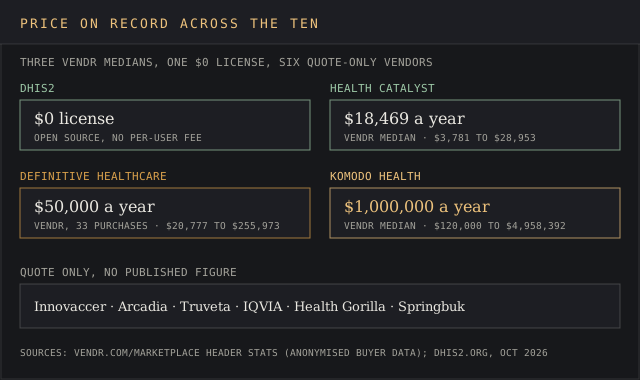
Six of the ten publish nothing, so the price on record comes from three Vendr medians and one $0 license:
- DHIS2: $0 license, with hosting, maintaining servers and training on the buyer.
- Health Catalyst: $18,469 median a year, $3,781 to $28,953.
- Definitive Healthcare: $50,000 median across 33 purchases, $20,777 to $255,973.
- Komodo Health: $1,000,000 median a year, $120,000 to $4,958,392.
The spread runs from zero to seven figures, and the hidden costs sit in implementation. Two numbers are critical in any contract: the services hours and the renewal cap. Establish both, then assess the three-year total. KLAS respondents at Health Catalyst and Arcadia both name training as a cost they absorb. Budget for internal analysts, interface work with your EHR vendor, and the services hours a platform needs to go live.
Ownership, funding and legal events, 2022 to 2026
Six of the ten vendors had a funding, ownership or legal event in four years. A multi-year contract outlives a CEO, so check this list before you sign:
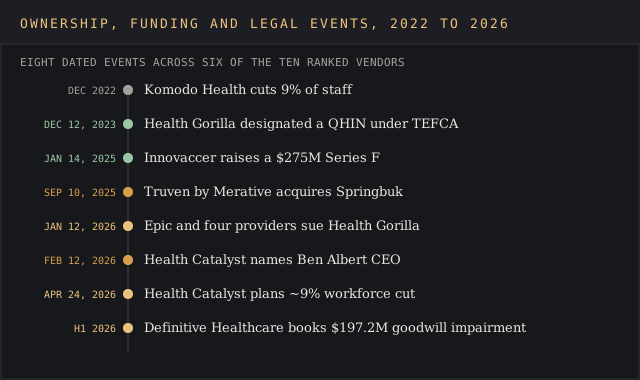
Health Catalyst's board shrinks to five directors before its 2026 annual meeting, and Springbuk now reports to Merative. Both changes can move a product roadmap mid-contract.
How to run an evaluation of health intelligence software
Define the use case first, then test it in the context of your own patient population. Health Catalyst's own guide to self-service analytics names four pillars: a data-centric culture, data literacy training, leadership support through governance, and a defined business goal. Those apply to any platform you evaluate.
Also check that its quality measures follow current NCQA HEDIS guidelines and the clinical guidelines your clinicians already use, and ask how the vendor will implement and develop new measures when CMS guidelines change. Get its data use guidelines in writing too.
- Define the decision. Identify the decision makers and name the specific challenges, such as closing HEDIS care gaps or finding trial patients. Focus the pilot on that one use case.
- Test with known patients. Send 50 patients you already know and count how many the platform matches with complete data. That match rate is the critical test.
- Read the attestation. Ask for the HITRUST r2 or SOC 2 Type 2 report itself, with its date.
- Price the implementation. Get services hours, interface fees and training in writing, with a complete statement of work.
- Call references. Ask two customers of your size what the vendor delivered against the original promise and how long implementation took.
- Establish a baseline. Record today's care gap closure rate, readmissions and documentation time, so the assessment after 12 months has something to compare.
- Assign ownership. Name who is responsible for data quality and for maintaining the EHR interfaces after go-live.
Data democratization helps once the platform is live. Health Catalyst's article argues that leaders who see how data is governed are more likely to support the analytics program, and that data champions build their colleagues' confidence with data. Without that, a platform turns into a needle in a haystack of unused dashboards.
Arcadia vs Innovaccer
These two are the most compared pair here, competing for the same value-based care buyer. Arcadia publishes scale: 2,600+ sources and 150M+ patient records, with NCQA data certifications. Innovaccer publishes interoperability and KLAS wins: 400+ connectors, 100+ FHIR resources and a 93.2 Best in KLAS 2026 score for Gravity.
KLAS customers give Innovaccer the higher overall software score, 85.9 against Arcadia's 82.6, and both draw cost complaints. Pick Arcadia when data aggregation for quality reporting is the focus. Pick Innovaccer when the same contract also has to replace a CRM and a care management tool.
Bottom line
Arcadia wins for value-based care organizations and payers that need clinical and claims data merged and certified for quality reporting. Innovaccer is the pick for health systems that want one vendor for data, CRM and care management, and Health Catalyst fits hospitals that want analysts bundled in, provided its 2026 restructuring doesn't put the account on the back burner.
For clinical research, Truveta's daily EHR feed is the freshest data here, Komodo has the widest claims-linked view, and IQVIA brings data and trial services together at a price reviewers call nearly prohibitive. Definitive Healthcare suits healthcare sales teams, Health Gorilla suits digital health firms willing to watch its lawsuit, Springbuk suits self-insured employers, and DHIS2 suits ministries of health that want a $0 license.