The IQVIA Veeva lawsuit: what it was and how it ended
 By Jan Suski. I go deep on every review, checking every number against its source and digging up details other coverage misses, a habit from six years of SEO and link building for tech companies. Bylines at Surfer, Brand24, and Senuto. How the scoring works.
· Prefer this source on Google
The numbers IQVIA v. Veeva, case 2:17-cv-00177, checked 27 August 2026
The case never reached a verdict; both sides dismissed every claim with prejudice.
Discovery went badly enough for Veeva to draw a rare, five-part sanctions order from the court.
Neither company paid the other damages when the case finally closed.
A trial set for early 2025 never happened. The settlement pre-empted it.
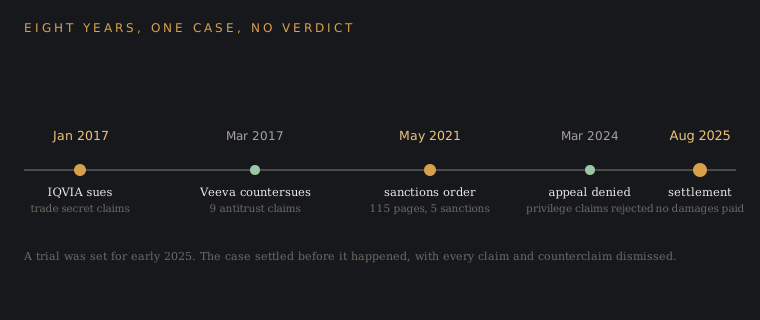
IQVIA and Veeva Systems spent eight years suing each other in federal court before settling every claim in August 2025. The fight started on January 10, 2017, when IQVIA Inc. filed suit against Veeva Systems in the District of New Jersey, accusing Veeva of trying to steal IQVIA trade secrets baked into its physician reference data. Veeva countersued two months later, accusing IQVIA of using its market power to shut Veeva out of the same data.
The case ran through a 115-page sanctions order, an appeal, and years of discovery before both sides walked away with no damages paid to each other. Life sciences companies running Veeva software against IQVIA data have a direct stake in how it ended: the settlement replaced an eight-year standoff with a formal partnership. Here's what the IQVIA Veeva lawsuit alleged, what the court found, and what changed once the case closed.
What each side accused the other of
IQVIA filed its complaint on January 10, 2017, and asserts claims that Veeva intentionally gained unauthorized access to proprietary IQVIA data and other IQVIA proprietary information, then used it to build a competing product. Veeva filed nine counterclaims two months later, alleging IQVIA had abused its monopoly power as the dominant provider of data for life sciences companies to exclude Veeva OpenData and Veeva Network from their respective markets.
| Claim | Brought by | Legal basis |
|---|---|---|
| Trade secret misappropriation (federal) | IQVIA | Defend Trade Secrets Act, 18 U.S.C. § 1836(b) |
| Trade secret misappropriation (state) | IQVIA | New Jersey trade secrets law |
| False advertising | IQVIA | Federal false advertising law |
| Unjust enrichment, tortious interference, unfair trade practices | IQVIA | Common law claims |
| Monopolization and exclusionary conduct | Veeva | Sherman Act antitrust counterclaims, $200 million+ sought |
IQVIA, which sells data, analytics and clinical research services to pharmaceutical companies worldwide, pointed to two data products at the center of the fight: IQVIA's OneKey, a global database of physician contact and prescribing-affiliation records, and Veeva's OpenData, a competing directory.
The court later found this wasn't seriously in dispute. Its 2021 opinion stated there was no dispute that IQVIA reference data had been "programmatically" included in Veeva OpenData.
Veeva's core claim: IQVIA's refusal to sign third-party access (TPA) agreements, Veeva said, blocked it from competing in the CRM, reference-data and master data management markets.
The 2021 sanctions ruling
Discovery went badly for Veeva. On May 7, 2021, the court found Veeva had misappropriated IQVIA data and unlawfully used it to improve Veeva data offerings, engaged in a cover-up by deleting evidence of the theft, and withheld other evidence in furtherance of fraud. The judge imposed five sanctions, including three adverse-inference jury instructions and permission for IQVIA to show the jury evidence of Veeva's destruction efforts.
Veeva appealed; in March 2024 the court denied the appeal on Veeva's privilege claims and held the sanctions question open. A trial had been scheduled for early 2025 before the case settled that August.
How the IQVIA and Veeva lawsuit ended in August 2025
The two companies settled on August 18, 2025, dismissing every claim and counterclaim with prejudice. Neither paid damages to the other. Veeva did agree to a one-time payment of roughly $31 million to certain law firms connected to the case, separate from any payment to IQVIA.
The new IQVIA-Veeva clinical and commercial partnerships
The two companies turned rivalry into partnership: they announced "global clinical and commercial partnerships and the complete resolution of all pending legal disputes." Under the agreement, customers can use "software, data, technology, and service offerings from Veeva and IQVIA together in a simple and efficient way."
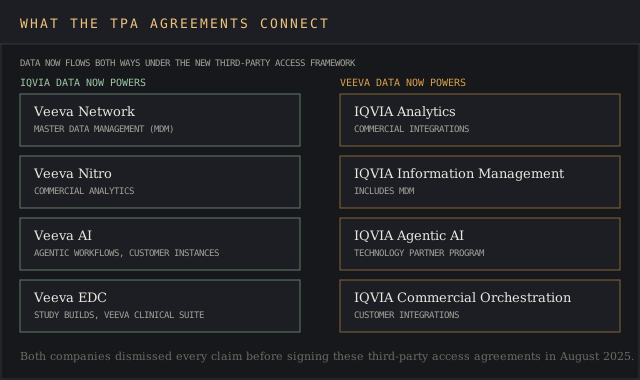
The companies have established master data and software third-party access (TPA) agreements that allow IQVIA or Veeva data to be used with each other's software or services in customer instances, including IQVIA data inside Veeva Network for master data management, Veeva Nitro for analytics, and Veeva AI.
IQVIA also joined the Veeva Technology, AI, and Services Partner Programs, built to support customer integrations between Veeva software and IQVIA Analytics, IQVIA Information Management, IQVIA Agentic AI, and IQVIA Commercial Orchestration offerings.
On the clinical side, IQVIA joined Veeva's CRO Clinical Data Partner program and can now use the Veeva Clinical Suite to execute clinical trials with Veeva software products, including study builds with Veeva electronic data capture (Veeva EDC).
IQVIA's clinical data management and EDC programming expertise are meant to accelerate database builds, study locks, and data delivery, the exact kind of integration Veeva's original antitrust counterclaim said IQVIA had refused to grant.
"We are committed to supporting frictionless product and services integration with IQVIA for the benefit of our joint customers and the industry overall. I am excited about the potential for our clinical and commercial partnerships to create significant value for our shared customers."
— Peter Gassner, founder and CEO, Veeva Systems
"IQVIA and Veeva's partnerships bring together best-in-class capabilities in information, AI, technology, and services for our shared clients. This will enable IQVIA customers on Veeva platforms to accelerate clinical development, bring treatments to market more efficiently, and improve access to innovations for patients."
— Ari Bousbib, chairman and CEO, IQVIA
Both companies are larger than the OneKey-versus-OpenData dispute might suggest. IQVIA employed about 89,000 people in more than 100 countries as of the August 2025 announcement. Veeva, founded in 2007 and built entirely as cloud software, a model life sciences companies have increasingly favored over on-premise systems, serves more than 1,000 customers ranging from the world's largest biopharmaceutical companies to emerging biotechs.
What the settlement means for IQVIA data and Veeva AI users
For shared customers, IQVIA data and Veeva software no longer sit on opposite sides of a legal fight. A pharma company running Veeva Network for MDM, or using IQVIA Information Management directly, can license IQVIA data for use inside Veeva AI under the new TPA framework, something an eight-year dispute between the life sciences industry's two largest data and software vendors had made difficult in practice.
Outside the courtroom, the two companies' certification programs sit at different price points. A comparison published by Assemble Studio puts IQVIA's OCE certification at about $3,000 a year against $10,000 to $15,000 for Veeva's, pricing Assemble Studio says makes IQVIA's platform the more attractive option for small and mid-sized life sciences teams.
Frequently asked questions
Did IQVIA or Veeva pay damages in the settlement?
No. Both companies dismissed all claims and counterclaims with prejudice, and neither paid damages to the other. Veeva's roughly $31 million payment went to law firms tied to the litigation. IQVIA received none of it.
What changes for the life sciences industry now that IQVIA and Veeva have settled?
Shared customers get a cleared path to use IQVIA data inside Veeva's software, and Veeva software inside IQVIA's, through the new third-party access agreements. That path replaces years of working around a legal standoff between their two main data and software vendors.
What does the settlement mean for the life sciences market?
It removes an eight-year source of friction between two of the market's largest data and software providers, and sets data-sharing terms other vendors in the space will likely be measured against.
Can IQVIA data now be used inside Veeva software?
Yes. Under the master data and software TPA agreements signed alongside the settlement, IQVIA data can be used in Veeva Network, Veeva Nitro, Veeva AI and Veeva EDC inside customer instances.
Bottom line
The IQVIA Veeva lawsuit ran for eight years and never reached a jury. IQVIA's trade secret claims held up well enough in discovery to produce a rare five-part sanctions order against Veeva, while Veeva's antitrust counterclaims never got tested at trial.
The settlement sidesteps who was right: it's a commercial deal that hands both companies' shared customers the data access Veeva spent eight years suing over. Anyone weighing IQVIA against Veeva today is evaluating two partners, and our life science intelligence tools ranking scores IQVIA and Veeva Link on the same five tests. Our IQVIA review covers where the company fits in a broader market-intelligence stack.
Sources, and what neither company has put a number on
Case docket and filings: Justia (law.justia.com) and CourtListener (courtlistener.com), case 2:17-cv-00177, D.N.J. Court opinion text: govinfo.gov. Counterclaim damages figure: Bates White Economic Consulting (bateswhite.com). May 2021 sanctions order: IQVIA investor relations (ir.iqvia.com), 10 May 2021. August 2025 settlement announcement: IQVIA newsroom (iqvia.com/newsroom) and Veeva (veeva.com/resources), both 18 August 2025.
Settlement payment reporting: Bloomberg Law (news.bloomberglaw.com) and MobiHealthNews (mobihealthnews.com). Certification pricing: Assemble Studio (assemblestudio.com), a third-party comparison. All checked 27 August 2026. Neither company has published what the new TPA agreements cost either side, or if either company's data pricing changes for shared customers.