IQVIA's acquisition history: the deal the FTC blocked and the ones that closed
 By Jan Suski, six years working in digital. How the scoring works.
The numbers IQVIA acquisitions, checked 27 August 2026
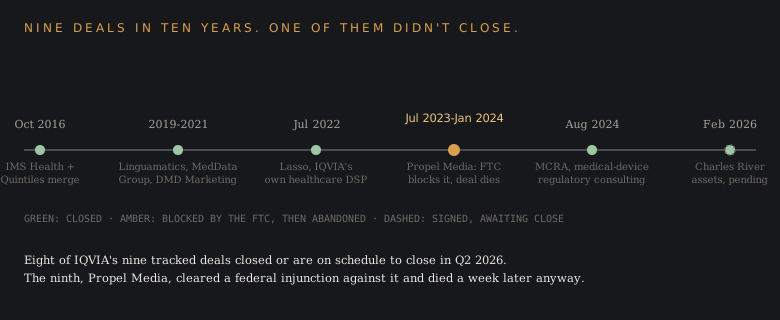
Every acquisition on this list closed except one, and that one drew a federal injunction.
The blocked deal targeted advertising data, not the clinical or drug-discovery business that makes up most of IQVIA's revenue.
Both sides' market-share estimates cleared the 30% legal threshold, so the case never had to settle whose number was right.
IQVIA signed its next acquisition, Charles River's discovery assets, two years after losing the DeepIntent deal.
IQVIA acquisition activity breaks down into nine deals since the company took its current name in 2017: eight closed, and one, the highest-profile of the group, ran into a federal antitrust injunction and died anyway.
This report walks every one of those nine transactions: what each target company did, what it cost where the price is public, and what happened to the deal that didn't survive contact with antitrust law.
It also covers the Federal Trade Commission's case against IQVIA Holdings Inc. and Propel Media Inc. in the depth a buyer needs. Gibson Dunn's own antitrust group called the resulting opinion one "likely to be cited early and often by antitrust plaintiffs in Section 7 cases."
It's written for anyone evaluating IQVIA's data, analytics or clinical-research products, or weighing the risk that a favorite vendor gets folded into a company this size. The FTC's complaint targeted one narrow corner of IQVIA's business. The other eight deals show what the rest of its acquisition pattern looks like.
What IQVIA is, and the businesses it runs
IQVIA became IQVIA on Nov. 6, 2017, more than a year after the merger that created it closed. Quintiles and IMS Health merged on Oct. 3, 2016 in a stock-for-stock deal & traded under the placeholder name QuintilesIMS for thirteen months before the rebrand.
IMS Health shareholders received 0.384 Quintiles shares apiece, ending up with roughly 51.4% of the combined company against Quintiles' 48.6%. The combined entity was valued at $17.6 billion at close.
Three segments make up the company today, per its own filings. Research & Development Solutions, the contract-research-organization business handling clinical trials, clinical research services, regulatory affairs, biostatistics and data management, brought in $8.9 billion in 2025, about 55% of revenue.
Technology & Analytics Solutions, the healthcare-data and analytics arm with access to 1.2 billion de-identified patient records, brought in $6.6 billion, growing 7.6% year over year, and increasingly bundles technology solutions on top of the raw data. A third segment, Contract Sales & Medical Solutions, covers the remaining roughly 5%.
Pharmaceutical companies, medical device makers, and other healthcare industry clients across the life sciences industry make up most of its customer base. Stripped of the segment names, the core business is simple to describe: provide data that identifies which doctor is looking at which webpage, then sell access to reach them.
The company trades as NYSE: IQV, runs out of Durham, North Carolina, and reported $16.31 billion in full-year 2025 revenue with about 93,000 employees across more than 100 countries. That scale is the backdrop for everything below: a company this size buying a $145 million discovery-services unit is a rounding error on the balance sheet and a real addition to whatever business line it lands in.
The acquisitions nobody had to sue over
| Deal | Year | What it does | Outcome |
|---|---|---|---|
| IMS Health + Quintiles merger | 2016 | Combined data, analytics and CRO services | Closed; renamed IQVIA in 2017 |
| Linguamatics | 2019 | Natural-language text mining for scientific literature | Closed, price undisclosed |
| MedData Group | 2019 | Health care professional identity data | Closed, price undisclosed |
| Q2 Solutions (remaining 40%) | 2021 | Full ownership of its clinical-lab joint venture | Closed for $760 million |
| DMD Marketing Solutions | 2021 | Health care professional identity and contact data | Closed, price undisclosed |
| Lasso | 2022 | Healthcare programmatic advertising platform (DSP) | Closed, price undisclosed |
| Propel Media / DeepIntent | 2023 | Rival healthcare DSP | Blocked by injunction, abandoned Jan. 2024 |
| MCRA | 2024 | Medical device regulatory, clinical & reimbursement consulting | Closed, price undisclosed, no press release |
| Charles River drug-discovery assets | 2026 | Five European in-vitro discovery & pharmacology sites | Signed for $145M plus up to $10M; expected to close Q2 2026 |
Three of those quiet deals turned out to matter more than their price tags suggested. IQVIA bought MedData Group in November 2019 and DMD Marketing Solutions in August 2021, folding two health care professional identity-data providers into a company the FTC would later call, in its own complaint, "the world's largest health care data provider." It bought Lasso in July 2022, adding a demand-side-platform operator to what had been, until then, a pure data-supply business.
None of the three drew a second look at the time. Together they gave IQVIA a fourth business: selling the identity data that identifies which doctor sees which ad, then running the DSP that buys the ad slot, then, a year later, agreeing to buy the rival DSP most likely to compete with its own. That last agreement is where the lawsuit starts. Other data vendors grow the same way; our report on MSCI's acquisition of Burgiss covers a similar data-vendor buildout.
Federal Trade Commission v. IQVIA Holdings Inc. and Propel Media Inc.
The FTC filed its administrative complaint on July 17, 2023, voting 3-0 to challenge IQVIA's proposed acquisition of Propel Media and to seek a federal injunction blocking the deal while its own in house administrative proceeding heard the antitrust question. The FTC named IQVIA Holdings Inc. and Propel Media alleging the deal would let a single company set prices in a market it had already helped concentrate.
IQVIA and Propel Media had settled deal terms a year earlier, in July 2022, well before the FTC decided to file suit; the price was never disclosed. Acquiring Propel Media, in the agency's own framing, would hand IQVIA control of two of the three largest healthcare DSPs at once.
The complaint ran two theories at once. Horizontally, the FTC argued the deal would eliminate direct competition between DeepIntent and Lasso in a market it defined narrowly: programmatic advertising sold specifically to health care professionals, not digital advertising generally and not social media.
Vertically, it argued IQVIA's control of "leading provider identity and prescribing behavior data," which the agency called the industry's gold standard, would let the combined firm squeeze rival DSPs' access to it.
The FTC also warned the deal would let IQVIA raise health care prices for the pharmaceutical companies and advertising agencies that pay for HCP-targeted campaigns, on the theory that fewer independent DSPs means less competitive pressure on price.
Internally, IQVIA's own documents named DeepIntent, Lasso and a third firm, PulsePoint, as the "Big 3" health care DSPs, a phrase the FTC quoted straight out of the company's files in its complaint. Two of the Big 3 already served the same healthcare professionals through nearly identical targeting stacks, running advertising campaigns for many of the same pharmaceutical companies.
Buying DeepIntent meant two of the Big 3 would answer to one owner, in a digital advertising space the FTC insisted was narrower than IQVIA claimed.
The preliminary-injunction standard the court didn't have to pick
The FTC sought a temporary restraining order alongside its Section 13(b) motion, then moved for the preliminary injunctive relief that would keep the deal frozen through its own in-house administrative proceeding, originally scheduled to open as an administrative trial on Jan. 18, 2024. Section 13(b) of the FTC Act exists to let the agency freeze a merger in federal court while its in-house judges decide the underlying Section 7 question later.
The two sides couldn't agree on how hard that federal-court showing needed to be. The FTC, citing FTC v. Lancaster Colony Corp., argued it needed only "a fair and tenable chance of ultimate success on the merits." IQVIA argued for a tougher bar:
Evidence "so serious, substantial, difficult and doubtful as to make them fair ground for thorough investigation, study, deliberation and determination," first by the FTC and then by an appeals court.
— IQVIA and Propel Media, quoted in FTC v. IQVIA Holdings Inc. and Propel Media, Inc., 2024 WL 81232 (S.D.N.Y. Jan. 8, 2024)
Judge Edgardo Ramos, of the United States District Court for the Southern District of New York, declined to pick a winner. His opinion held there was "no meaningful difference between the two standards."
Gibson Dunn's antitrust group flagged that resolution as inconsistent with FTC v. Staples, where a different court held the two standards weren't the same and sided with the tougher one, borrowed from the Second Circuit's Fruehauf Corp. v. FTC: a "reasonable probability that the proposed transaction would substantially lessen competition."
Market shares, the HHI, and the Philadelphia National Bank presumption
Before the standard fight, the court had to decide what market IQVIA and DeepIntent competed in. Applying the Brown Shoe factors, Judge Ramos agreed with the FTC's proposed market, pointing to features distinct to programmatic health care advertising, chiefly the granularity of ad-performance data available to a buyer targeting doctors specifically.
IQVIA argued for a broader relevant market, one that included social media, endemic websites like WebMD, and generalist demand-side platforms serving ads across the open web, including alternative channels like streaming services and any internet connected smart television running an ad-supported app.
The opinion conceded the point without following it:
"To be clear, social media companies and endemic websites are competing with DSPs in a broad sense. An agency running an advertising campaign will not have an unlimited budget, so it must make decisions about how to allocate the advertising funds it has."
— Judge Edgardo Ramos, FTC v. IQVIA Holdings Inc. and Propel Media, Inc., 2024 WL 81232 (S.D.N.Y. Jan. 8, 2024)
Those channels, in the court's conclusion, sit outside the relevant market anyway: they aren't reasonable substitutes for what DeepIntent and Lasso sell specifically.
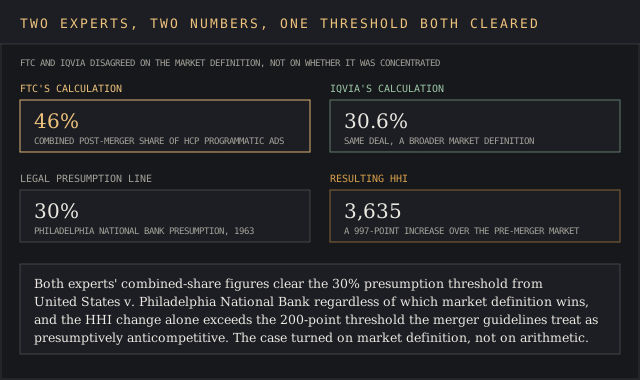
The two sides also disagreed on the arithmetic behind the proposed merger. The FTC's expert calculated IQVIA's combined post-merger market shares at 46% of the narrow market the court had just defined. IQVIA's own expert, using the broader market definition, calculated 30.6%.
Both numbers clear the line that matters: the 30% combined-share threshold the Supreme Court set in 1963's Philadelphia National Bank, above which a merger earns a rebuttable presumption that it will substantially lessen competition.
Add the resulting HHI, which the deal would push to 3,635, a 997-point jump, and the case cleared a second, independent trigger: federal merger guidelines treat any HHI increase past 200 points in an already-concentrated market as presumptively anticompetitive by itself. That's the market concentration problem Section 7 was built to catch.
Judge Ramos didn't have to resolve which market-share number was more accurate, because the Philadelphia National Bank presumption made the dispute close to irrelevant: even at IQVIA's own lower figure, the deal cleared the line.
Gibson Dunn's antitrust practice called that resolution the most consequential part of the ruling. It argued the court applied the 60-year-old presumption without weighing later Supreme Court guidance from United States v. General Dynamics Corp. and United States v. Marine Bancorporation.
Those two 1974 decisions, per the D.C. Circuit's later Baker Hughes opinion, caution against turning a plausible market-share number into "a practically insurmountable burden" for the company being sued.
The opinion itself hedges in a footnote, stating that "market shares alone are not dispositive." Gibson Dunn's read is blunter: once the presumption applied, the court treated IQVIA's remaining defenses, evidence of a "dynamic and fast-moving" market and competitive pressure from other DSPs, as insufficient to rebut it.
IQVIA's chance to present evidence across an eight-day hearing with 27 witnesses didn't change the court's math. "The remainder of the exercise became largely academic," is how the analysis put it.
The hearing, the ruling, and the deal's collapse
The evidentiary hearing ran eight days, opening Nov. 20, 2023, with 27 witnesses called across both sides before closing arguments on Dec. 8, 2023. The evidence presented over those eight days covered ad-buying data most outsiders never see.
Judge Ramos's order granting the FTC's motion for a preliminary injunction came down December 29, 2023; he issued the full written opinion explaining it on January 8, 2024. The FTC secured its injunction without ever having to prove which side's market-share number was correct.
His stated conclusion, direct from the opinion:
"The FTC has shown that there is a reasonable probability that the proposed acquisition will substantially impair competition in the relevant market and that the equities weigh in favor of injunctive relief."
— Judge Edgardo Ramos, FTC v. IQVIA Holdings Inc. and Propel Media, Inc., 2024 WL 81232 (S.D.N.Y. Jan. 8, 2024)
That single sentence ended the deal in practice; the FTC's own in-house administrative trial, the one Section 13(b) exists to hold open, never had to start.
IQVIA and Propel Media mutually abandoned the transaction on Jan. 5, 2024, five days before that in-house trial's Jan. 18 start date and eleven days after the written opinion came down. An IQVIA spokesperson said the acquisition agreement had been terminated "in light of the Court's decision," adding that IQVIA would remain a strategic partner to DeepIntent and that DeepIntent's data would stay on DeepIntent's own platform.
MCRA and Charles River: the acquisitions that didn't need a lawsuit
IQVIA closed its acquisition of MCRA, short for Musculoskeletal Clinical Regulatory Advisers, on Aug. 21, 2024, buying the regulatory, clinical and reimbursement consulting firm from its prior owner, Caltius Structured Capital. MCRA's clients are almost entirely medical device and diagnostics companies, close to 1,000 of them, served out of offices in Washington, Hartford, New York, London, Winterthur, Eschborn and Tokyo.
Neither company issued a press release. The deal surfaced through trade coverage in Orthopedics This Week and deal-tracking sites, and the price has never been disclosed.
Eighteen months later, IQVIA signed a far more visible deal. On Feb. 25, 2026, it agreed to buy five European drug-discovery sites from Charles River Laboratories for approximately $145 million in cash, plus up to $10 million more in potential payments.
Charles River confirmed the transaction the same day, in its own investor release distributed over Business Wire. The assets generated $144 million in 2025 revenue, within a rounding error of the price IQVIA agreed to pay for them.
The five sites split by function. Cambridge, UK handles in-vitro drug discovery work, mainly medicinal chemistry and structural biology. Freiburg (Germany), Kuopio (Finland), Portishead (UK) and Leiden (Netherlands) run pharmacology services across oncology, neuroscience, immunology and advanced cell biology.
IQVIA's own release describes the assets as "underpinned by more than 20 years of curated scientific and operational data" that has already put more than 100 molecules into clinical trials, several of which reached commercial approval.
The same release anchors the deal in two specific capabilities:
"Established laboratory based New Approach Methodologies (NAMs) and a small molecule AI platform, designed to accelerate discovery programs and support growing demand for non animal research methods."
— IQVIA, press release, Feb. 25, 2026
NAMs are the lab and computational techniques built to replace animal testing in early discovery work. David Prime, president of IQVIA Laboratories, framed the deal as filling a gap upstream of IQVIA's existing drug-development business:
"This acquisition will meaningfully strengthen our ability to support clients earlier in the R&D lifecycle and complements our existing translational and clinical development capabilities."
— David Morris, president, IQVIA Laboratories
The deal is expected to close in the second quarter of 2026. Charles River, for its part, is using the sale, alongside a separate divestiture of its CDMO and Cell Solutions businesses to GI Partners, to cut its own 2026 reported revenue-growth guidance by roughly five percentage points.
What this means for buyers of IQVIA's data and analytics
IQVIA already holds a 46% share of the specific data used to target health care professionals with advertising, the figure the FTC's complaint cited to describe it as having "the ability and incentive" to squeeze rivals. That complaint died with the abandoned deal.
The underlying data position, MedData Group's and DMD Marketing Solutions' identity data, still sits inside IQVIA, undisturbed by any litigation.
For healthcare clients evaluating IQVIA's Technology & Analytics Solutions products, the concentration risk runs in one direction so far: the FTC's complaint targeted a specific ad-tech submarket, not the clinical trials, drug discovery and CRO work IQVIA operates day to day, and the deal it targeted didn't close.
The precedent still matters going forward. Gibson Dunn's antitrust group expects the FTC and DOJ to cite the January 8, 2024 opinion often in future Section 7 cases, specifically because it applied the Philadelphia National Bank presumption with so little resistance. The next IQVIA acquisition in a narrowly defined data market clears the same low bar the agency set here.
The practical read for a procurement team: eight of IQVIA's nine tracked deals since 2016 closed quietly, most with undisclosed prices. IQVIA's life sciences and clinical-research businesses have never drawn the scrutiny its advertising-data business did.
This isn't IQVIA's only brush with federal litigation, either. Our report on the IQVIA Veeva lawsuit covers a separate trade-secret fight that ended in a data-sharing partnership, not a blocked deal.
Vendor-continuity risk from a blocked deal is real, but it's concentrated specifically in the healthcare-advertising-data corner of IQVIA's business, not across its broader data and analytics portfolio.
Frequently asked questions
Who owns IQVIA?
No one; IQVIA is a publicly traded company on the NYSE under the ticker IQV. It has no controlling shareholder, and it formed from the 2016 merger of two previously separate public companies, IMS Health and Quintiles.
What companies merged to form IQVIA?
IMS Health and Quintiles merged on Oct. 3, 2016 in a stock-for-stock deal, trading as QuintilesIMS until the company renamed itself IQVIA on Nov. 6, 2017.
What companies has IQVIA acquired?
Since the 2016 merger, IQVIA has closed acquisitions of Linguamatics (2019), MedData Group (2019), the remaining stake in Q2 Solutions (2021), DMD Marketing Solutions (2021), Lasso (2022) and MCRA (2024), and it has a signed, pending deal for European drug-discovery assets from Charles River Laboratories (2026). Its 2023 agreement to acquire Propel Media, DeepIntent's parent, was blocked by a federal injunction and abandoned in January 2024.
What companies are under IQVIA?
IQVIA organizes its acquisitions under three reporting segments: Research and Development Solutions (its CRO business, which includes Q2 Solutions), Technology and Analytics Solutions (its data and analytics business), and Contract Sales and Medical Solutions. MCRA now operates as part of what IQVIA brands IQVIA MedTech.
Is MCRA part of IQVIA?
Yes, since Aug. 21, 2024, when IQVIA closed its acquisition of the firm from prior owner Caltius Structured Capital.
Who owns DeepIntent?
Propel Media, Inc. IQVIA's 2023 agreement to acquire Propel Media collapsed in January 2024 after the FTC's injunction, so DeepIntent remained under Propel Media instead of becoming part of IQVIA.
Who is IQVIA's biggest competitor?
It depends on which business line. In contract research, IQVIA competes most directly with CROs like ICON plc and Parexel. In healthcare data and analytics, Norstella and its Citeline and MMIT brands are commonly cited as its closest rival.
Why is IQVIA stock falling?
IQVIA's 2026 earnings guidance of $12.55 to $12.85 in adjusted EPS came in below Wall Street's roughly $12.95 estimate, driven partly by about $80 million in additional interest expense tied to 2025 financing activity. The stock has traded well below its 52-week high since the guidance came out, despite quarterly revenue and profit both beating estimates.
How much does the CEO of IQVIA make?
Chairman and CEO Ari Bousbib's total compensation for fiscal 2025 was $28.1 million, per the company's Feb. 27, 2026 DEF 14A proxy filing: $1.8 million in salary, roughly $5 million in bonus, $15.75 million in stock awards, $4.53 million in option awards and about $394,000 in other compensation.
Is IQVIA in debt?
IQVIA carries substantial long-term debt taken on to finance the 2016 merger and its subsequent acquisitions. Its 2026 earnings guidance already reflects that load directly: roughly $80 million of the guidance shortfall traces to added interest expense from financing raised in 2025.
Bottom line
IQVIA's acquisition pattern since 2016 looks nothing like a company constantly fighting regulators. Eight deals closed, most without a disclosed price and none with a lawsuit attached. The one exception ran headfirst into a market IQVIA had already concentrated through two of its own smaller, quieter acquisitions, and a federal court used a 60-year-old presumption to end the fight before either side's economic model got a real test.
That single result now sits as the precedent every future IQVIA deal, and plenty of deals having nothing to do with IQVIA, will get measured against. A buyer evaluating IQVIA's core data and clinical-research products is exposed to little of that risk directly.
Anyone tracking the company's next move into an adjacent, narrowly defined data market should read the January 8, 2024 opinion first, because the FTC already knows how it plans to win the next one.
Sources, and what neither company disclosed
The FTC's complaint, market-share and HHI figures are from the FTC's July 2023 and January 2024 press releases (ftc.gov), the American Bar Association's Antitrust Law Section newsletter (americanbar.org), and Gibson Dunn's January 2024 client alert (gibsondunn.com).
Those figures were cross-checked against the district court opinion itself (caselaw.findlaw.com), FTC v. IQVIA Holdings Inc. and Propel Media, Inc., 2024 WL 81232 (S.D.N.Y. Jan. 8, 2024). The abandonment date is Axios's January 2024 reporting.
IQVIA's revenue, headcount and segment figures come from its own investor relations site (ir.iqvia.com) and February 2026 newsroom release. The Charles River deal's price, target revenue and site list are Charles River's own investor release (ir.criver.com), dated 25 February 2026, cross-checked against IQVIA's matching release.
The MCRA acquisition date and deal description are Orthopedics This Week's August 2024 report (orthotw.com); neither IQVIA nor MCRA issued a press release, and the price has never been disclosed anywhere.
Ari Bousbib's compensation is IQVIA's own Feb. 27, 2026 DEF 14A proxy filing (sec.gov). The stock-guidance figures are IQVIA's own 2026 guidance, as reported by TipRanks and Barchart. All figures checked 27 August 2026. Neither IQVIA nor MCRA has disclosed what that acquisition cost.