Best market database platforms in 2026
 By Jan Suski. I go deep on every review, checking every number against its source and digging up details other coverage misses, a habit from six years of SEO and link building for tech companies. Bylines at Surfer, Brand24, and Senuto. How the scoring works.
· Prefer this source on Google
Quick comparison of market database platforms
Ten providers with the coverage claim each one makes, the entry price where one exists, and the buyer each fits. Rows marked "Quote only" publish no number anywhere on the vendor's own site.
| # | Provider | Coverage figure | Entry price | Best fit |
|---|---|---|---|---|
| 1 | Statista | 170 industries, 150+ countries | $199/mo (free Basic tier) | Analysts needing broad, citable stats fast |
| 2 | Euromonitor Passport | 210 countries, 1,000+ researchers | Quote only | Enterprise CPG teams needing global benchmarks |
| 3 | IBISWorld | 700 NAICS industries, 97% of US GDP | $2,850/report | Teams needing standardized US industry forecasts |
| 4 | GlobalData | 350 datasets, 2,000 analysts | Quote only, reports from $1,950 | Enterprises tracking deals across many sectors |
| 5 | S&P Global Market Intelligence | 60M+ private, 109K+ public companies | Quote only | Finance teams needing company-level financials |
| 6 | MarketResearch.com | 1.61M reports, 410 publishers | $175-$4,750/report | Buyers needing one report, from any publisher |
| 7 | EMARKETER | 10,000+ metrics, 400+ benchmarks | Quote only | Ad & marketing teams building forecast decks |
| 8 | Mintel | 86 countries, 40,000 launches tracked monthly | $4,995/report | Consumer brands needing attitudinal FMCG research |
| 9 | Global Market Database | 20 countries, 12 industries | $5,000/module (~$20/report) | Budget-limited teams needing directional forecasts |
| 10 | Bloomberg Intelligence | 59K listed companies, 1,200+ research providers | Bundled in Bloomberg Terminal | Finance teams already running a Terminal seat |
Coverage figures, headcounts and prices are each vendor's own published number. "Quote only" means the vendor publishes no self-serve price anywhere on its own site.
Where these figures come from
Coverage counts, headcounts and feature claims are each vendor's own published figure, read 8 September 2026. Medians marked * are Vendr's anonymized buyer-reported contract values, separate from any vendor list price. Five vendors here (Euromonitor Passport, GlobalData's platform tier, S&P Global Market Intelligence, EMARKETER, Bloomberg Intelligence) publish no subscription price of their own, so no row states one for them beyond the Vendr median.
S&P Global Market Intelligence also shows up on our financial data providers ranking, where it holds the third spot on published coverage and pricing. That page scores it as financial-data infrastructure; this one scores it as a market database. The two rankings measure different things and land in different places. Statista also ranks sixth on our market research tools ranking, next to survey and traffic tools.
A market database is a centralized platform selling access to market-sizing figures, industry statistics & forecast data built by an outside research team. It works as a citation source: a team cites an existing figure without commissioning a fresh survey.
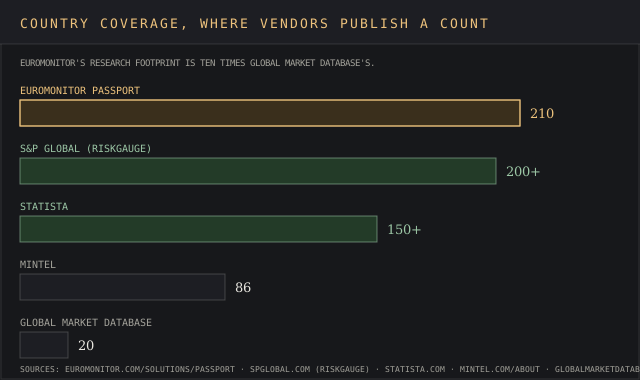
Statista alone tracks 170 industries across more than 150 countries from one login, while Euromonitor's Passport platform runs research operations in 210 countries. Both sell the same basic thing: a number a buyer can cite without running the study.
Market research reports and market analysis sit at the center of every listing on this page. What separates one vendor from the next is how much a buyer pays to see the number, and how fast it shows up.
This page ranks ten of them: Statista, Euromonitor Passport, IBISWorld, GlobalData, S&P Global Market Intelligence, MarketResearch.com, EMARKETER, Mintel, Global Market Database & Bloomberg Intelligence. Every entry names a published price where one exists, links the figure behind it & carries at least one quote from someone who paid for it.
The list fits analysts, corporate strategy teams & marketers who need a citable number for a board deck. A blank survey template is a different tool for a different job. A two-person consultancy and a Fortune 500 strategy group need different things from this category, and the entries below say which is which.
Pricing spans Global Market Database's $20 report to enterprise contracts running into six figures. Five of the ten vendors here never publish a number at all. They route every visitor to a demo request instead, a pattern this page tracks criterion by criterion. To cut to the chase: three vendors publish a real price, and the ranking below explains why that beats a research team's headcount on its own.
Evaluation criteria for market database platforms
Five criteria decide the shortlist, and the ranking below applies them in this order. Every criterion applies the same way to every vendor, a level playing field a reader can rerun against a fresh shortlist of their own.
Country and market coverage
Every vendor here publishes a country or market count somewhere on its own site. A buyer can pull that number up in under a minute and compare it against a shortlist, no sales call required.
Published entry price
Can a buyer see an actual number before talking to a salesperson? Three of the ten vendors here answer yes, with a checkout price on their own site. The other seven route every visitor to a form. A buyer who sees a real number first stays in the driver's seat once that sales call starts.
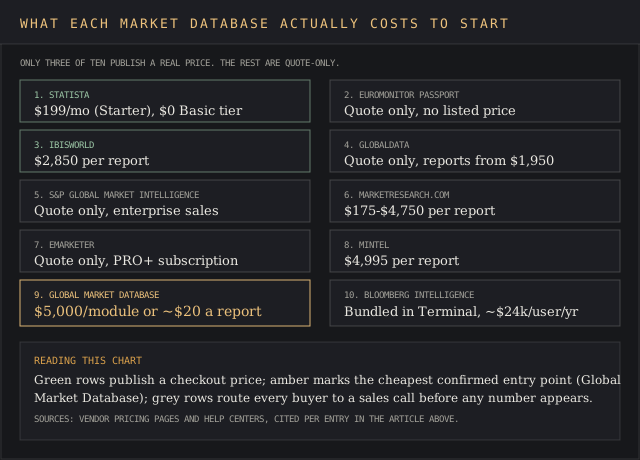
Vendors here that show a real checkout price before a sales call: Statista, IBISWorld and Global Market Database. The other seven route every visitor to a demo request first.
Industry and report-library breadth
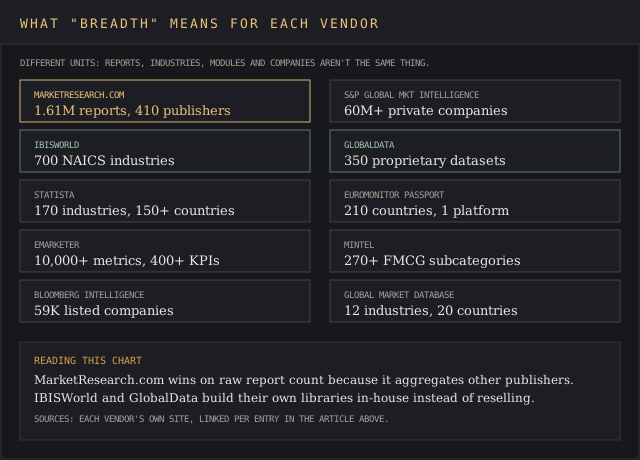
A vendor's own site should state how many industries, NAICS codes, or individual reports sit inside the platform. MarketResearch.com's 1.61 million reports and IBISWorld's 700 NAICS industries are both testable this way, a filtered search confirms or disproves each count.
In-house research headcount
Self-reported analyst counts run from GlobalData's 2,000 down to Bloomberg Intelligence's 650, both published on the vendor's own about or research page. Headcount is not proof of accuracy, but it is the one production-capacity number every research shop is willing to state.
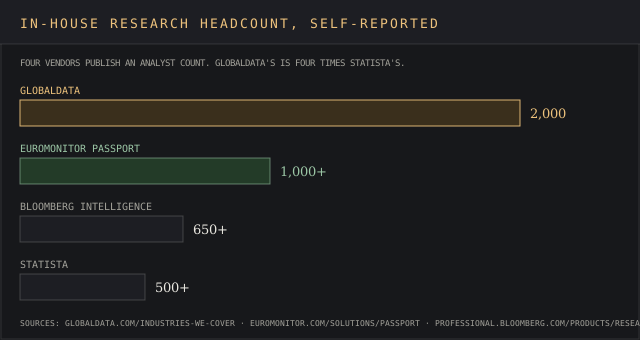
GlobalData's self-reported analyst headcount, the largest in this list. Bloomberg Intelligence runs the smallest at 650-plus, though it draws on 1,200-plus outside research providers on top of that.
Independent review record
G2, Capterra & TrustRadius each let a buyer filter by company size, role & rating before reading a single review. A platform with 68 G2 reviews and a platform with zero are not carrying the same amount of proof, whatever their sales deck claims. A dense review history tends to hit the nail on the head faster than a glossy case study page ever will. Existing users are the fastest way to sanity-check a claim, faster than the vendor's own marketing.
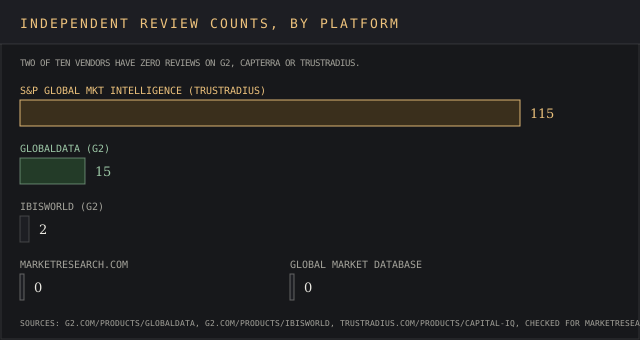
Independent reviews on G2, Capterra or TrustRadius for MarketResearch.com and Global Market Database. Every other vendor on this page carries at least one.
Top market database platforms, ranked
Statista
Best fit
Analysts & marketers who need broad, citable statistics fast, without a procurement cycle.
Statista tracks 170 industries across more than 150 countries, and its own accounts page states the platform is used by more than 23,000 companies. Over 500 in-house researchers gather & double-check every statistic before it publishes, according to the same site.
Key features
- Research AI: unlimited natural-language queries on paid tiers, across 100 supported languages.
- Consumer Insights module: 3 million-plus interviews across 56 countries, 500+ industries & 15,000 brands.
- Statista Connect API: search over 1 million insights inside a company's own knowledge systems.
- eCommerce Insights: data on 39,000+ online stores and marketplaces, with 70+ KPIs per store.
- Market Insights tool: comparable market data across 190+ countries, territories & regions, with custom regions.
Pricing
Statista is the rare vendor in this category with a real, public price list. The Starter tier runs $199 a month billed annually (about $2,388 a year), the Personal tier runs $649 a month (about $7,788 a year), and a free Basic tier exists with no card required. Professional and enterprise seats above that go to a sales quote.
Vendr's anonymized buyer data puts the median negotiated contract at $26,000 a year across 32 deals, a range of $8,272 to $51,400, which reflects the custom-quoted Professional tier, separate from the self-serve prices above.
Pros
- Publishes a real price, the only vendor here with one below $10,000 a year in writing.
- 170-industry, 150-country breadth from a single subscription.
- Free Basic tier lets a buyer test the interface before paying anything, no strings attached.
Cons
- Premium reports and Statista+ custom work sit behind a separate, unlisted price.
- Annual contracts auto-renew at list price, per the account terms.
- Depth on any single industry trails a specialist like IBISWorld or Mintel.
"Statista is an absolute gem for business development, strategy, and content marketing... One thing I wish they'd work on is making premium reports more affordable. As a startup founder many times over, I've seldom been in a position to pay for premium services with Statista."
David B., Founder & CEO, small business, G2, reviewed February 27, 2025
"They don't offer great quality reports for the price you pay. This company uses a non-transparent auto-renewal with protracted cancellation process... most data is hidden in very expensive reports."
Jef W., Digital Account Manager, mid-market, G2, reviewed July 21, 2023
Why it's ranked #1. Statista is the only platform in this list where a buyer sees a real checkout price, $199 a month, before ever booking a call. Euromonitor Passport covers 60 more countries, but that number stays behind a demo request, which is exactly where Statista pulls ahead. It raises the bar every other vendor in this list has to clear on price transparency alone.
Euromonitor Passport
Best fit
Enterprise consumer-goods & retail teams that need standardized, cross-country category benchmarks.
Euromonitor's Passport platform runs research across 210 countries, covering what the company calls 99.9% of the world's consumers, built by a team it states runs over 1,000 researchers, data scientists & technology specialists. More than 5,700 organizations use it, per the same page, including consumer goods manufacturers, government trade departments & financial institutions.
Key features
- Passport AI: natural-language queries returning sourced answers across the full research library.
- Passport Data Integration Services: an API that pipes Passport insights into a company's own workflow tools.
- Dedicated E-Commerce, Innovation & Sustainability modules, sold as add-ons to the core platform.
- Category market sizes, shares, company & brand data, and a full retail-universe dataset.
- Forecast models for scenario testing plus data-manipulation tools for building custom datasets.
Pricing
Euromonitor publishes no price anywhere on its own site. Every path from the Passport product page ends at a demo request, and Vendr carries no header pricing stats for Euromonitor at all, only two anonymized notes about contract structure (a break clause, semi-annual payment terms).
A G2 reviewer sums up the opacity directly: subscription cost scales with the size of the buying institution, and Euromonitor doesn't publish the formula. A buyer has to read between the lines of reviewer testimony to estimate cost at all.
Pros
- Widest published country count in this list, 60 more than Statista's.
- 1,000-plus in-house researchers, the largest self-reported headcount after GlobalData.
- Forecast horizon runs out to 2030 for most metrics, per reviewer testimony.
Cons
- Zero public pricing, on the vendor's own site or on Vendr.
- Smaller institutions report paying more per seat than larger ones, unevenly.
- Data manipulation tools require training before a new user gets full value.
"The best use of Euromonitor is in industry level or macro-level analysis. It has massive coverage of macroeconomic data. It gives you the same data as Oxford at half the price... it also provides with the forecast up to 2030 for most of the metrics."
Abhigyan A., Senior Analyst, enterprise, G2, reviewed September 7, 2021
"Passport is a highly useful resource for industry scholars, but not every institution can afford a subscription. EI does not publicize its pricing structure. Subscription costs are based on enrollment numbers, so larger institutions will pay more than smaller ones."
Verified User, Marketing and Advertising, small business, G2, reviewed January 7, 2019
Why it's ranked #2. Passport's 210-country reach & 1,000-plus researchers outscale Statista on raw coverage, and IBISWorld doesn't come close on either count. It falls to #2 because none of that scale converts into a number a buyer can check before a sales call, which is the gap that keeps Statista on top.
IBISWorld
Best fit
Teams that need a standardized, citable US industry forecast on a recurring basis.
IBISWorld covers 700 NAICS industries, which the company states represents 97% of the US economy, drawn from what it describes as more than 10 million data points. The firm has run since 1971, out of six offices, serving what its own about page puts at 10,000-plus clients globally.
Key features
- Industry Research Reports: five-year forecasts of expected growth across all 700 NAICS codes, 30 to 40 pages each.
- Industry Risk Rating Reports: a forward-looking numerical risk score for each of the 700-plus industries.
- Business Environment Profiles: 200-plus reports on macro factors like commodity prices & financial markets.
- iExpert Summary: a condensed question-and-answer format for every covered industry.
- Industry Wizard & an API, plus a Call Prep Insights integration built for Salesforce.
Pricing
A single Industry Research Report costs $2,850 in the US, and the shorter Industry Spotlight Report runs $800, both listed on IBISWorld's own help center, a number that comes straight from the vendor, no reseller markup involved. Membership pricing above single-report purchases isn't public. Vendr's tracked buyer data puts the median membership at $10,931 a year, ranging from $8,606 to $24,991.
Pros
- A real, orderable price sits on the vendor's own help center, confirmed on Vendr too.
- 700 NAICS industries covers 97% of US GDP, the deepest single-country breadth here.
- iExpert Summary format makes a 30-page report skimmable inside minutes.
Cons
- Regional reports outside the US, Canada, UK, Australia & Germany cost extra, priced separately per region.
- Only two G2 reviews exist for the product, both flagged as gift-card-incentivized.
- Growth forecasts read conservative against actual market movement, per one of those reviewers.
"The coverage especially for United States and Canada is great. Name any sub verticals and IBISworld can help over there."
Sadashiva S., Competitive Intelligence Consultant, enterprise, G2, reviewed December 14, 2021
"The only thing I dislike is you have to pay separately for different region reports."
Vinayaka A., Associate CI Consultant, enterprise, G2, reviewed December 17, 2021
Why it's ranked #3. IBISWorld beats GlobalData on price transparency: a single report runs $2,850, listed and orderable today, where GlobalData's platform price never appears without a call. It loses to Euromonitor Passport on reach, since IBISWorld's core library holds to five markets against Passport's 210 countries.
GlobalData
Best fit
Large enterprises tracking deals, competitive moves & market sizing across many sectors at once.
GlobalData states that 4,000 of the world's largest companies use its platform, built on what it calls 350 proprietary datasets & 50 years of data collection. The company backs that with 2,000 in-house analysts, holding the lion's share of self-reported research headcount of any vendor on this page.
Key features
- Ava: an AI research analyst querying across 250-plus proprietary databases and 100,000-plus analyst reports, keeping GlobalData ahead of the curve on AI-assisted research tooling among the vendors ranked here.
- Deals Intelligence: tracks M&A, private equity & venture capital deals, plus licensing and partnership activity.
- Sales Intelligence platform: built on more than 100 million data points and the 2,000-analyst bench.
- Intelligence Centers: 350 datasets spanning healthcare, technology, energy, consumer & financial-services verticals.
- Digital Workers: named AI-agent tooling layered on top of the core research platform.
Pricing
GlobalData sells individual reports at public prices on its research store, from $1,950 for a thematic report up to $3,950 for a full market report. The platform subscription itself carries no public number. Vendr's tracked buyer data shows a median annual contract of $68,500, ranging from $43,000 to $73,875, the highest median of any vendor in this list.
Pros
- 2,000 in-house analysts, the deepest self-reported research bench in this category.
- Deals Intelligence adds M&A and funding tracking most market databases don't carry.
- G2's 4.5-out-of-5 rating across 15 reviews is the strongest aggregate score in this list.
Cons
- No published subscription price, only individual report prices and Vendr's aggregate.
- Highest median contract value tracked here, at $68,500 a year.
- Bulk data exports cap out and require a support ticket for anything past 1,000 rows.
"In terms of the coverage of data, Global data is on top. Not even S&P or Fitch has as exhaustive coverage as Global data... if someone is looking to do a macro-level analysis that is not affected by minor inaccuracies in individual data points, Global data is highly recommended."
Abhigyan A., Senior Analyst, enterprise, G2, reviewed July 8, 2021
"The data export has a limit and to download more than 1k, I every time have to reach out to support, which takes them 48 hours to share the simple download."
Abhinav S., Associate, Research, enterprise, G2, reviewed June 13, 2023
Why it's ranked #4. GlobalData's 2,000 analysts double Euromonitor Passport's self-reported bench, and its 4.5-star G2 average beats every other vendor here. It ranks below IBISWorld because a $2,850 IBISWorld report is orderable today, where GlobalData's $68,500 median contract only shows up after a sales call.
S&P Global Market Intelligence
Best fit
Investment banks, M&A teams & corporate development groups needing company-level financials.
S&P Global Market Intelligence covers 58 million-plus private companies worldwide, and its flagship Capital IQ Pro terminal indexes 60 million private and 109,000-plus public companies. A separate March 2025 release put RiskGauge's credit-risk coverage at 400 million-plus companies across 200-plus countries.
Key features
- S&P Capital IQ Pro: fundamental & sector-specific data with AI-assisted insight generation.
- Private Company Data: financials on 58 million-plus private companies worldwide.
- Panjiva Supply Chain Intelligence: global trade & counterparty-risk data via a dedicated feed.
- RiskGauge: credit-risk scoring across 400 million-plus companies, paired with an early-warning framework.
- Sector-specific verticals covering energy, real estate, technology, insurance & private equity.
Pricing
No public price list exists on spglobal.com; access is quote-based. Vendr's anonymized buyer data for the broader S&P Global vendor profile, spanning Capital IQ and Market Intelligence together, shows a median contract of $51,672 a year across 56 tracked purchases, ranging from $13,500 to $215,000.
Pros
- Deepest company-level dataset here: 58 million private companies, with public-market data layered on top.
- TrustRadius carries 115 reviews at 7.5 out of 10, the largest independent review base in this list.
- Excel integration draws consistent praise across multiple reviewers.
Cons
- No published price on the vendor's own site at any tier.
- Reviewers describe it as slower than Bloomberg for live market data lookups.
- Market research reports sit behind an added fee on top of the base subscription, per reviewer testimony.
"Best in class tool to source financial data from public companies. Great integration with Excel. Must-have tool for anyone performing financial analysis on a regular basis."
Verified User, Director, professional services, TrustRadius, reviewed December 27, 2024
"Well suited for gathering market data in excel. Not well suited for looking for data given how slow S&P CIQ Pro is relative to Bloomberg."
Verified User, Finance and Accounting, enterprise, TrustRadius, reviewed January 1, 2025
Why it's ranked #5. S&P's 115 TrustRadius reviews outnumber every other vendor's independent review count in this list by a wide margin. It sits below GlobalData because its 58-million-company dataset skews toward company financials, where GlobalData's 350 datasets are built around market-level sizing, the category this page ranks.
MarketResearch.com
Best fit
Buyers who need one report, from any publisher, without committing to a subscription.
MarketResearch.com, now under AlphaSense since its 2024 acquisition, lists 1.61 million-plus reports from 410 publishers across 1,390 industries. The company states its base of report buyers tops 10,000 customers a year, with over 89% of the Fortune 1000 among past purchasers.
Key features
- Search Inside This Report: full-text keyword search inside a report before buying it.
- Boolean & proximity search syntax, including NEAR() and ONEAR() operators for precise queries.
- Profound platform: buy a single chapter, table or chart without buying the full report.
- MarketResearch.com Academic: a university-library subscription tier across food, tech, healthcare, pharmaceuticals & consumer goods, from household essentials to cosmetics.
- Single-user, multi-user & global site licenses, priced per report by the originating publisher.
Pricing
There's no flat subscription price; each publisher sets its own report price, plus a $10 handling fee per order, per the site's own FAQ. Sample prices pulled from the homepage span $175 for a 19-page Euromonitor report on Spain's furniture market to $4,750 for a 220-page Mordor Intelligence industry report.
Pros
- 1.61 million reports across 410 publishers, the largest single library in this category.
- Buy one chapter or table through the Profound platform, skipping the full report.
- No subscription commitment, a buyer pays once per report needed.
Cons
- No listing on G2, Capterra or TrustRadius, so there's no independent review record to check.
- Report quality varies by originating publisher, since MarketResearch.com doesn't author most of what it sells. A buyer who knows the ropes checks the search-inside preview before paying.
- A $10 handling fee applies to every order, on top of the publisher's price.
Why it's ranked #6. MarketResearch.com's 1.61 million reports outsize EMARKETER's single-publisher library by a wide margin, and its per-chapter Profound purchasing beats EMARKETER on flexibility. It loses ground for carrying zero reviews on G2, Capterra or TrustRadius, where every vendor ranked above it has at least one.
EMARKETER
Best fit
Advertising, media & commerce teams building forecast-backed planning decks.
EMARKETER, a subsidiary of Axel Springer since its rebrand from Insider Intelligence, builds forecasts from more than 10,000 proprietary metrics, which the company states run to under 5% variation against actuals. Over 100,000 business professionals use the platform, and its research draws 65,000-plus citations a year, per its own pricing page. Updated data on online marketing trends and digital-advertising spend is what most subscribers cite.
Key features
- PRO+ subscription: reports, forecasts, performance benchmarks, industry KPIs & briefings in one login.
- AI Search: context-driven industry insights pulled from EMARKETER's own research corpus.
- Five-year interactive forecasts with a built-in Compare Tool for cross-market benchmarking.
- Over 400 standardized industry KPI benchmarks, drawn from 3,000-plus third-party sources.
- EM Advisory: an analyst-led add-on covering report reviews & hosted events.
- Regional splits across Asia-Pacific, Central & Eastern Europe, Latin America, the Middle East & Africa, North America and Western Europe.
Pricing
EMARKETER's own pricing page routes every visitor to a quote request, with no tier or number shown. Vendr's tracked buyer data puts the median annual contract at $41,383, ranging from $15,600 to $243,708 across confirmed purchases.
Pros
- 400-plus standardized benchmarks make cross-market comparison faster than building one from scratch.
- Under 5% forecast variance against actuals, a specific accuracy claim most competitors don't publish.
- Flexible chart exports and data cuts draw consistent praise from reviewers.
Cons
- No public price, only Vendr's median of $41,383 a year.
- Coverage concentrates in advertising, media & commerce, narrower than a Statista or GlobalData.
- Value drops fast once a subscription lapses, since the vendor sells ongoing access and raw data ownership never changes hands.
"What I like most is the variety of data cuts and ability to manipulate data in charts/download different formats."
Matthew T., Associate Director, Connections Planning, small business, G2, reviewed April 15, 2021
"If my agency wasn't paying for a subscription I don't think I would be able to use it, which would be a downside."
Verified User, Marketing and Advertising, mid-market, G2, reviewed February 1, 2023
Why it's ranked #7. EMARKETER's 400-plus standing benchmarks give continuous access across a full year, where Mintel's $4,995 entry price buys a single report on one category. It ranks below MarketResearch.com because its 10,000-metric library is a fraction of MarketResearch.com's 1.61 million reports.
Mintel
Best fit
Consumer brands & agencies needing attitudinal FMCG research, beyond plain market-sizing numbers.
Mintel tracks 40,000 product launches a month across 86 countries, speaking with more than 1 million consumers across four continents to build its consumer-behavior data. The company runs 1,100-plus employees out of 14 global offices, and states more than 5,000 businesses use its research.
Key features
- GNPD (Global New Products Database): tracks new product launches across 270-plus FMCG subcategories.
- Spark & Leap: AI tools for early-stage concept generation and closed-loop research Q&A.
- Market Dynamics, Macro Trends & Landscapes databases, bundled under the On-Demand subscription tier.
- Mintel Consulting: bespoke research for innovation strategy & market-expansion projects.
- Interactive charting tools with centralized, single-portal access across every database.
Pricing
Individual reports carry public prices on the Mintel Store, such as a US wellness consumer report at $4,995. The On-Demand subscription tier, which bundles GNPD & the other databases, has no listed price and requires a sales conversation. No Vendr listing exists for Mintel.
Pros
- 86-country reach with monthly product-launch tracking most syndicated vendors don't match.
- Attitudinal "why" data on consumer behavior, beyond plain market-sizing figures.
- Bundle discounts up to 20% when buying multiple reports together, per the vendor's own pricing page.
Cons
- Single-report entry price of $4,995 is the highest per-report figure in this list.
- Subscription tier pricing is fully hidden, with no Vendr data to cross-check it.
- Panel size caps some accounts at 80,000 respondents, short of Mintel's full consumer base.
"I love how deep the Mintel insights go. Their reports are very in-depth, with dozens of graphs... The sample sizes are large enough to seem representative (usually 2,000+ respondents in each survey they report on)."
Tegan J., Senior Data Analyst, small business, G2, reviewed December 23, 2021
"We only have access to 80K panelists vs. several million, so we do not have access to all data available. But, our account manager is always willing to help us search the whole database."
Lindsey S., Business Development Manager, small business, G2, reviewed August 17, 2016
Why it's ranked #8. Mintel's 86-country reach & G2-verified reviews beat Global Market Database's zero independent reviews outright. It trails EMARKETER because its $4,995 price buys one report on one category, where an EMARKETER subscription runs 400-plus benchmarks all year.
Global Market Database
Best fit
Budget-limited teams needing directional 10-year forecasts, lighter than a deep company-level analysis.
Global Market Database covers more than 600 markets across 20 countries and 12 industries, from automotive & semiconductors to food & beverage, letting a narrow team zero in on one industry without paying for eleven others. Its own site states the underlying data refreshes at least four times a year through what it calls Dynamic Market Data technology.
Key features
- 12 named modules: automotive, semiconductors, ICT, pharma, healthcare, logistics, agriculture, energy & power, advanced materials, chemicals, packaging & food & beverages.
- 10-year market forecasts spanning 2020 through 2029, refreshed quarterly.
- Scenario analysis across three named growth scenarios, plus opportunity & company-benchmarking tools.
- Custom Market Dataset requests included in a subscription at no added cost.
- Free tier: five global markets available to any registered user at no charge.
Pricing
A single-module annual subscription runs about $5,000, covering 25-plus markets inside that industry, an effective cost of roughly $20 to $30 per market report. That's the most transparent, and the cheapest, published price in this entire category.
Pros
- Cheapest confirmed entry point in this list, at roughly $20 to $30 per report.
- Data refreshes four times a year, a published cadence most competitors don't state.
- Free tier covers five markets before any payment is required.
Cons
- 20 countries is the narrowest geographic footprint of any vendor ranked here.
- No listing found on G2, Capterra, TrustRadius, Reddit or Hacker News, so no independent review exists to check, a platform that operates under the radar even inside its own category.
- 12 industry modules cover mostly industrial & B2B categories, with no consumer-behavior data.
Why it's ranked #9. Global Market Database's $20-a-report price beats every quote-only vendor above it, and its four-times-a-year refresh cadence is a published number Mintel's subscription tier doesn't offer, the best of both worlds for a team that can live with 20-country coverage. It ranks below Mintel on reach, 20 countries against Mintel's 86, and on review evidence, since no independent review of it exists on any tracked platform.
Bloomberg Intelligence
Best fit
Finance teams that already run a Bloomberg Terminal seat and want research bundled in.
Bloomberg Intelligence sits inside the Bloomberg Terminal's research hub, which states coverage of 59,000-plus listed companies, representing 99% of global market cap, drawn from more than 1,200 permissioned research providers. The Terminal's research desk runs on 650-plus expert analysts, connected to a stated 350,000-plus financial professionals on the platform.
Key features
- BQuant Desktop: programmatic access to Bloomberg's underlying Terminal data.
- Bloomberg AI: AI-assisted research workflow tools built directly into the Terminal.
- Research Management Solutions: tools for organizing & integrating research across a team.
- Regulatory Intelligence: tracks regulation & policy developments shaping financial markets.
- Sibling verticals under the same Terminal umbrella: BloombergNEF and Bloomberg Economics.
Pricing
Bloomberg publishes no price for Intelligence or for a Terminal seat anywhere on its own site; every path leads to a demo request. It isn't sold standalone, a buyer needs a full Terminal subscription to reach it, and no Vendr marketplace listing exists to cross-check a figure.
Pros
- 1,200-plus permissioned research providers feed into one Terminal research hub.
- 59,000-plus listed companies covered, representing 99% of global market cap.
- Integrated directly with live trading & market data, part of one terminal, no separate research silo to log into.
Cons
- Zero public pricing, the only vendor here with no number anywhere, vendor or third party.
- Not purchasable on its own, a buyer must take a full Terminal seat to get it.
- Reviewers describe it as built for finance professionals first, a narrower target than industry researchers running market sizing.
"Bloomberg is not a cheap tool that everyone can afford."
Marco Antonio R., Portfolio Manager, small business, G2, reviewed September 20, 2024
"I did prefer the Reuters 3000 Xtra system but that became obsolete a few years ago and Bloomberg Terminal is seen as the default go to system anyway... You're fortunate if your company have implemented this expensive but useful tool at your disposal."
Verified User, Financial Services, enterprise, G2, reviewed January 23, 2019
Why it's ranked #10. Bloomberg Intelligence's 59,000-company coverage and 1,200 research providers are real numbers, but it's the only vendor here with zero price anywhere, missing from its own site and missing from Vendr alike. Global Market Database beats it on both price transparency and standalone purchasability, which is why it closes out this list.
What a market database does
A market database is a centralized collection of data tied to a specific market, built once by a research team and resold to many buyers. No one commissions a fresh study for each purchase. That's the definition behind every vendor on this page, from a $20 Global Market Database report to a six-figure GlobalData contract.
Most platforms blend two data types: externally sourced market intelligence (competitor pricing, category size, industry forecasts) and, where a company connects its own systems, internal sales history layered on top. Historical sales metrics feed directly into demand forecasting, which is why IBISWorld & EMARKETER both lead their pricing pages with forecast-accuracy claims over raw historical counts.
Competitor intelligence inside these platforms usually means market-share figures & pricing-strategy data, tracked well enough to support competitive benchmarking that updates in real time, beyond a one-time snapshot. GlobalData's Deals Intelligence module, tracking M&A and funding activity as it happens, is the clearest example in this list.
Buyers commonly run a total addressable market calculation against these platforms before a product launch or market entry, checking a category's published size against a company's own revenue targets. Demographic data, target-audience age & income breakdowns among the most requested, sits inside most consumer-focused modules, Mintel's GNPD and Statista's Consumer Insights included.
Sector breakdowns follow a familiar pattern across the category: oil & gas, pharmaceuticals, consumer electronics, industrial automation, automotive (electric vehicles included) & healthcare each get a dedicated slice inside Statista, GlobalData & IBISWorld's industry libraries.
Company profiles, available data tables & various segments across a market make up the core of what a paid account unlocks over the free preview. Software and manufacturing companies show up most often as buyers in vendor case studies, alongside investors and procurement teams vetting suppliers before a contract renewal. Government resources round out the free end of the category, covered in the section below.
Every report format here leads with an outlook section: forward-looking industry performance and technology trends for the next one to three years, the language business leaders quote directly in a board deck. Security controls like SSO and audit logs sit behind enterprise tiers only, self-serve tiers skip them, and shared-team networking features remain rare across the category even after decades of platform iteration.
Market database subtypes and when each fits
Statista & Euromonitor Passport are syndicated stats portals: one login, broad industry coverage, numbers built for a slide deck, lighter than a raw dataset built for modeling. IBISWorld and MarketResearch.com sell individual reports, IBISWorld from its own research team, MarketResearch.com from 410 outside publishers, a jack-of-all-trades built through aggregation.
GlobalData and S&P Global Market Intelligence sit closer to company-level data than pure market sizing, GlobalData through Deals Intelligence, S&P through 58 million private-company financials. EMARKETER and Mintel run narrower verticals: advertising & commerce forecasts for one, FMCG & attitudinal consumer research for the other.
Bloomberg Intelligence is the outlier. It's bundled research inside a trading terminal, a different shape than a standalone market database, useful only to a buyer who already has a Terminal seat for other reasons.
Quote-only pricing hides a wide range. Vendr's tracked medians for the seven quote-only vendors here span EMARKETER's $41,383 a year up to GlobalData's $68,500 a year, a gap worth pricing into any first negotiation.
Pricing across the category and its hidden costs
Ten vendors, three public prices: Statista at $199 a month, IBISWorld at $2,850 a report, and Global Market Database at roughly $20 to $30 a report. Everything else routes through a sales quote, and Vendr's tracked medians for those seven span from EMARKETER's $41,383 up to GlobalData's $68,500 a year. Quote-only pricing is par for the course above the self-serve tier in this category.
The devil's in the details here: the real cost in this category sits outside the base contract, in caps, add-ons & per-region fees a sales call rarely volunteers. IBISWorld charges separately per region beyond its US baseline. GlobalData caps bulk exports and routes anything over 1,000 rows through a support ticket that takes 48 hours, per a G2 reviewer, and Mintel's On-Demand tier panel access caps some accounts at 80,000 respondents, short of Mintel's full base.
Ask where the renewal clause lives before signing anything, before the first invoice ever lands. Two vendors here put a price increase on autopilot once year one ends, and neither states the mechanism on its own pricing page.
Auto-renewal is the other trap. Statista's own account terms state a subscription renews at list price after one year unless canceled, and Euromonitor reviewers describe a similar structure, with a break clause buried in the contract & never on the price sheet.
Free and cheap market data options
Statista's Basic tier is free with no card required, keeping casual users engaged before they hit a paywall, though it strips out the Consumer Insights and eCommerce modules that make the paid tiers worth citing. Global Market Database gives any registered user five markets at no charge before a $5,000 module purchase becomes necessary, the same free-first pattern that keeps new users around long enough to see the paid tiers.
Roughly what a single report costs through Global Market Database's $5,000-a-year module subscription, the cheapest confirmed entry point in this category. Statista's Basic tier is free with no card required, though it excludes the Consumer Insights and eCommerce modules.
Government and academic sources fill the rest of the gap. The US Department of Commerce Library and the OECD Library both publish country-level economic data at no cost, though neither packages it with the forecasting or benchmarking tools a paid platform builds around the raw numbers.
Common buying mistakes
The most expensive mistake is buying platform-wide access for a single report's worth of need. A buyer who needs one industry number should start with MarketResearch.com's per-report or per-chapter pricing before committing to a full Statista or GlobalData subscription.
The second is skipping the trial run on export limits. GlobalData's 1,000-row export cap and Mintel's 80,000-panelist ceiling only surface once a team hits them mid-project, long after the sales call ends. A ten-minute test export gets a new team up to speed on where the real ceiling sits before a contract signs.
Ask the sales rep directly what happens past the cap. A GlobalData export over 1,000 rows routes through a support ticket that a G2 reviewer clocked at 48 hours to clear, and that turnaround time isn't in any spec sheet.
The third is assuming quote-only pricing scales down for a small team. Euromonitor reviewers report the opposite, smaller institutions paying more per seat than larger ones, which makes a demo call worth having before assuming a platform is out of budget. A small team that bites the bullet and books the call often finds room to negotiate anyway.
Market database platforms FAQ
What is a market database?
A market database is a centralized platform selling pre-built market-sizing figures, industry statistics & forecast data, researched by the vendor and delivered ready to cite.
How much does a market database cost?
Published prices in this category run from about $20 a report (Global Market Database) to $199 a month (Statista) at the low end, up to Vendr-tracked medians of $41,383 to $68,500 a year for platforms covering global markets on a quote-only enterprise basis.
Is Statista free?
Statista's Basic tier is free with no card required. It excludes the Consumer Insights & eCommerce modules, which sit behind the $199-a-month Starter tier and above.
Which market database is best for a small business?
Statista's free Basic tier or $199-a-month Starter tier fits a small team's budget better than any quote-only enterprise platform in this list. Global Market Database's roughly $20-a-report pricing is the cheapest paid option for a narrow, industrial-focused need. A buyer on the fence between Statista's two paid tiers should start with Starter and upgrade only once the free tier's limits start to bite.
How does a market database differ from a B2B data provider?
A market database sells industry & market-sizing statistics; a B2B data provider sells contact & firmographic records on individual companies for sales prospecting. GlobalData and S&P Global Market Intelligence overlap both categories through their company-level datasets.
How often is market database data updated?
Cadence is rarely published. Global Market Database is the exception, stating its data refreshes at least four times a year; most other vendors describe updates as continuous without a stated frequency.
Bottom line
Treat this ranking as guidance for a first shortlist, a starting point before any vendor demo. Statista wins for most buyers: a real, public price, 170-industry breadth & a free tier to test before paying. Euromonitor Passport is the upgrade once a team needs 210-country reach into global markets and can absorb quote-only enterprise pricing, and GlobalData is the pick for a team that specifically needs deals & M&A tracking alongside market sizing.
IBISWorld stays the standard for a single, citable US industry number, still orderable at a fixed $2,850 with no sales call required. Global Market Database is the budget answer for narrow, industrial-focused forecasting, and Bloomberg Intelligence only makes sense bundled into a Terminal a finance team already pays for.